|
(11) | EP 0 252 372 B1 |

| (12) | EUROPEAN PATENT SPECIFICATION |
|
|
| (54) |
Curable isobutylene polymer, a curable composition containing it, and a cured product thereof Härtbare Isobutenpolymere, eine härtbare Zusammensetzung, die diese enthält, und ein gehärtetes Produkt daraus Polymères de l'isobutène réticulables, combinaison réticulable contenant ces polymères, et produit réticulé préparé de cette combinaison |
|
|
|||||||||||||||||||||||||||||||
|
||||||||||||||||||||||||||||||||
| Note: Within nine months from the publication of the mention of the grant of the European patent, any person may give notice to the European Patent Office of opposition to the European patent granted. Notice of opposition shall be filed in a written reasoned statement. It shall not be deemed to have been filed until the opposition fee has been paid. (Art. 99(1) European Patent Convention). |
[0001] The present invention relates to an isobutylene polymer having at least one silicon-containing group cross-linkable by the formation of a siloxane bond (hereinafter referred to as "cross-linkable silicon group") at the molecular ends, a curable composition containing the same, and a cured product thereof.
[0002] An organic rubber polymer having a cross-linkable silicon group is an organic polymer having a silicon-containing group cross-linkable by forming a siloxane bond, and has such an interesting property as it is cured even at ordinary temperature to form a rubber-like elastomer, as shown in the following formula.
wherein X' is a hydrolyzable group
[0003] The above polymer has a similar curing property to that of a room temperature-vulcanizable polysiloxane. Moreover, it can have properties that the polysiloxane does not have since its main chain is not a polysiloxane but an organic polymer. As the organic polymer having a cross-linkable silicon group, a polyether having cross-linkable silicon group is disclosed in US-A-3 981 751. However, its properties such as weatherability, water-resistance and heat-resistance are not sufficient and, therefore, the polyether is sometimes restricted in its use.
[0004] GB-A-2 110 706 and US-A-3 644 315 describe isobutylene copolymers and isobutylene polymers, respectively, containing at least one silicon-containing group cross-linkable by the formation of a siloxane bond. However, the tensile strength and the elongation at break of these polymers are rather low.
[0005] Therefore, the object of the present invention is to provide polymers having a cross-linkable silicon group with excellent weatherability, water-resistance and heat-resistance, and excellent tensile strength and elongation at break, a composition containing the same, and the cured product thereof.
[0006] According to the present invention, this object is achieved by providing an isobutylene polymer having at least one silicon-containing group cross-linkable by the formation of a siloxane bond at the molecular ends.
[0007] The isobutylene polymer is a polymer curable at ordinary temperature and having not only excellent weatherability, water-resistance and heat-resistance but also excellent electric isolation and gas impermeability as well as excellent tensile strength and elongation at break.
[0008] Furthermore, the present invention relates to a composition containing the above isobutylene polymer and silanol condensation catalysts.
[0009] According to a further aspect the present invention relates to a cured product of the isobutylene polymer as defined above.
[0010] The isobutylene polymer having at least one cross-linkable silicon group of the present invention has a main chain mainly composed of isobutylene monomer units. Though a polymer having a main chain which is substantially composed of only isobutylene monomer units is usually employed, an isobutylene copolymer can be also employed. In case of employing the copolymer, a copolymer having at least 50 % by weight of isobutylene monomer units is preferred, and more preferably at least 70 % by weight.
[0011] Such a polymer can be prepared by cationic polymerisation of monomers including isobutylene monomers as a main component. As the monomer to be copolymerized, there are examplified, for instance, a cationic polymerizable olefin having 4 to 12 carbon atoms, a conjugated diene, a vinyl ether, an aromatic vinyl compound, a vinylsilane, and an allylsilane. Examples of the copolymerizable monomers are, for instance, 1-butene, 2-butene, 2-methyl-1-butene, 3-methyl-1-butene, pentene, 4-methyl-1-pentene, hexene, vinylcyclohexane, butadiene, isoprene, methyl vinyl ether, ethyl vinyl ether, isobutyl vinyl ether, styrene, α-methylstyrene, dimethylstyrene, monochlorostyrene, dichlorostyrene, β-pinene, indene, vinyltrichlorosilane, vinylmethyldichlorosilane, vinyldimethylchlorosilane, vinyldimethylmethoxysilane, vinyltrimethylsilane, divinyldichlorosilane, divinyldimethoxysilane, divinyldimethylsilane, 1,3-divinyl-1,1,3,3-tetramethyldisiloxane, trivinylmethylsilane, tetravinylsilane, allyltrichlorosilane, allylmethyldichlorosilane, allyldimethylchlorosilane, allyldimethylmethoxysilane, allyltrimethylsilane, diallyldichlorosilane, diallyldimethoxysilane, diallyldimethylsilane, τ-methacryloyloxypropyltrimethoxysilane, and τ-methacryloyloxypropylmethyldimethoxysilane,. In the cationic polymerization, an acid such as H₂SO₄ or CCℓ₃CO₂H, or a Friedel-Crafts catalyst such as SnCℓ₄ or TiCℓ₄ can be employed as a polymerization initiator. Also, it is preferable to carry out the polymerization by means of Inifer method by which a polymer having functional groups at the molecular ends can be prepared. The Inifer method disclosed in US-A- 4,276,394 is a method for cationic polymerisation in which, as a polymerization initiator, an organic halogen compound capable of producing a stable carbonium cation is employed in combination with a Friedel-Crafts catalyst such as BCℓ₃, SnCℓ₄, TiCℓ₄, SbCℓ₆, FeCℓ₃ or AℓCℓ₃. The above-mentioned organic halogen compound has such a structure as
(wherein Y is a halogen atom),
(wherein Y is as defined above),
(wherein R⁵, R⁶, R⁷ and R⁸ are the same or different, and each is hydrogen atom, a lower alkyl group having 1 to 20 carbon aboms or phenyl group, R⁹ is a bivalent hydrocarbon group having 1 to 20 carbon atoms and Y is as defined above) or
(wherein R¹⁰, R¹¹, R¹² and R¹³ are the same or different, and each is a monovalent hydrocarbon having 1 to 20 carbon atoms, R¹⁴ and R¹⁵ are the same or different, and each is a hydrogen atom, a hydrocarbon group having 1 to 20 carbon atoms or a halogen atom, provided that when either one of R¹⁴ and R¹⁵ is a halogen atom, the other is not a halogen atom or hydrogen atom; Y is as defined above, and n is 0 or an integer from 1 to 20). Examples of such compounds are, for instance,
[0012]
In the Inifer method, the polymerization of the above-mentioned cation-polymerizable monomers is carried out at a temperature from -130° to +10°C in a saturated hydrocarbon solvent such as ethane, propane, butane, pentane or hexane; a halogenated hydrocarbon solvent such as methyl chloride, methylene chloride or 1,1-dichloroethane; or a mixture thereof to give a polymer having, at the polymer ends, a halogen atom derived from the above-mentioned organic halogen compound.
[0013] For example, a polymer having the groups of the formula:
at both molecular ends can be prepared by polymerizing isobutylene monomers at -70°C in methylene chloride, using
with BCℓ₃ as the polymerization initiator. Further, the obtained polymer can be converted into an isobutylene polymer having the group of the formula:
at both molecular ends by selectively eliminating HCℓ with a strong base such as potassium t-botoxide (t-BuOK). The obtained isobutylene polymer can be suitably employed in a hydrosilylation as described later.
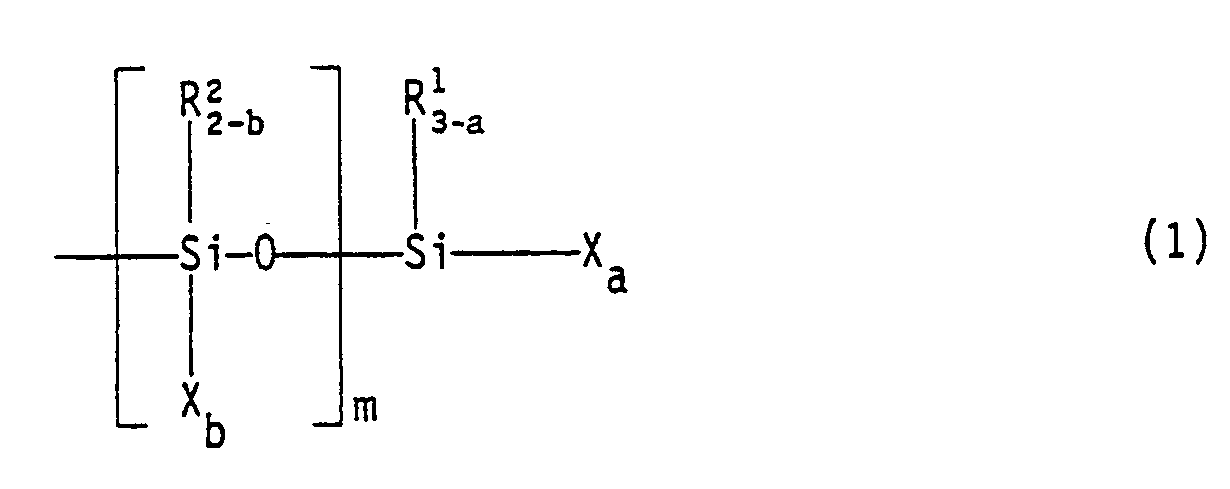
[0014] In the invention, as the cross-linkable silicon group, there is exemplified a cross-linkable silicon-containing group, having a hydroxyl group or a hydrolyzable group bonded to a silicon atom. A typical example of the cross-linkable silicon group is the group represented by the formula (1):
wherein R¹ and R² are the same or different and each is a member selected from the group consisting of an alkyl group having 1 to 20 carbon atoms, an aryl group having 6 to 20 carbon aboms, an aralkyl group having 7 to 20 carbon atoms and a triorganosiloxy group having the formula (7):
(R')₃SiO- (7)
in which each R' is independently a monovalent hydrocarbon group having 1 to 20 carbon atoms; X is a hydroxyl group or a hydrolyzable group, and when more than one x is present, the X groups are the same or different; a is 0, 1, 2 or 3, b is 0, 1 or 2, provided that the sum of a and b is 1 or more; m is 0 or an integer of 1 to 18. Among the groups represented by the formula (1), a group having the formula:
wherein R¹, X and a are as defined above is preferable.
[0015] Examples of the group X are hydrolyzable groups used in general such as a hydrogen atom, an alkoxyl group, an acyloxyl group, a ketoxymate group, an amino group, an amido group, an aminoxy group, a mercapto group, and an alkenyloxy group. Among the hydrolyzable groups, the alkoxyl group is especially preferred in that the hydrolyzability is adequate and handling is easy. One to three groups X can bond to one silicon atom and when more than one X is present, the groups X are the same or different.
[0016] The number of silicon atoms in the cross-linkable silicon group may be one or more. In case of silicon atoms bonded by siloxane bond, cross-linkable silicon groups with at most 20 silicon atoms are preferable.
[0017] The isobutylene polymer must have at least one at the molecular ends, and has preferably 1.2 to 4 cross-linkable silicon groups in its molecule. When the number of the cross-linkable silicon groups included in the molecule is less than 1, the curability tends to be insufficient.
[0018] When the cross-linkable silicon group exists at the molecular ends, a rubber-like cured product having a excellent strength and a high elongation can be obtained easily because of maximizing the chain length between cross-linking sites in the cured product.
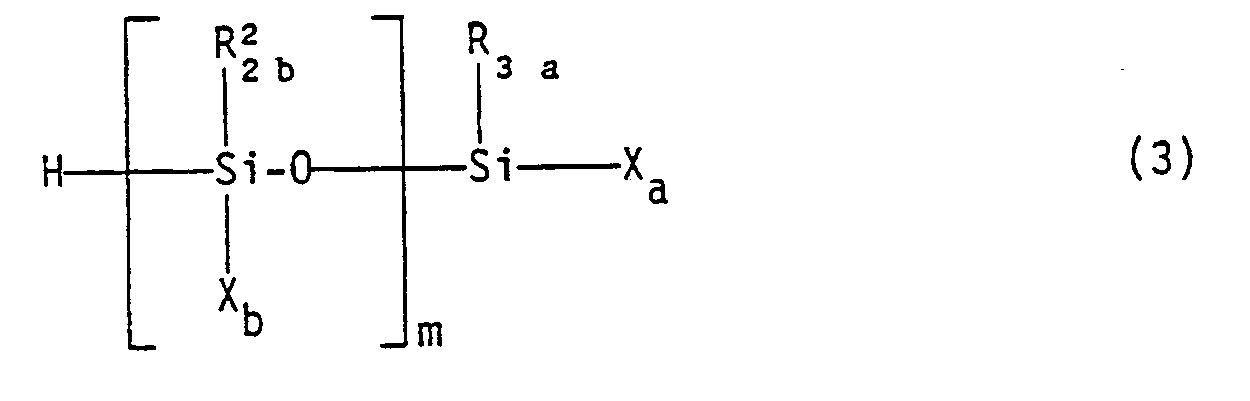
[0019] Methods for introducing the cross-linkable silicon group into the isobutylene polymer are not limited, and the following methods are effectively employed. That is, a silicon hydride compound having the formula (3):
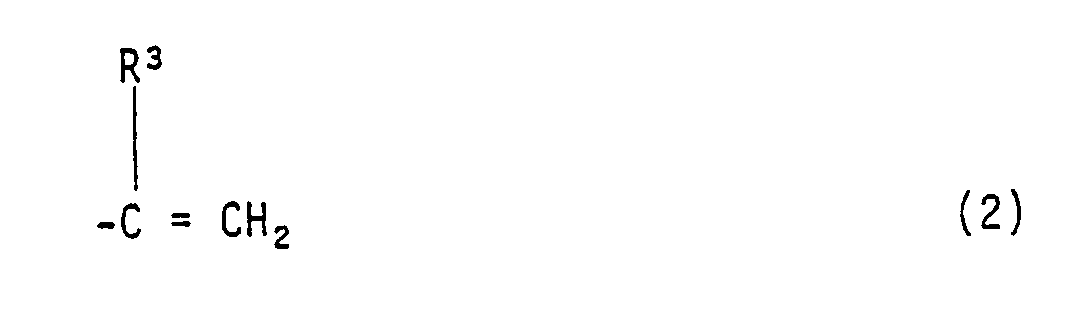
wherein R¹ , R², X, a, b and m are as defined above, is introduced into an isobutylene polymer having at least one unsaturated group represented by the formula (2):
wherein R³ is hydrogen atom, an alkyl group having 1 to 8 carbon atoms, an aryl group having 6 to 20 carbon atoms or an aralkyl group having 7 to 20 carbon atoms, by so-called hydrosilylation in the presence of a catalyst. Examples of the catalyst mentioned above are, for instance, H₂PtCℓ₆·6H₂O, a compound of
platinum metals, RhCℓ(PPh₃)₃, RhCℓ₃, Rh/Aℓ₂O₃, RuCℓ₃, IrCℓ₃, FeCℓ₃, AℓCℓ₃, PdCℓ₂·2H₂O, NiCℓ₂, and TiCℓ₄.
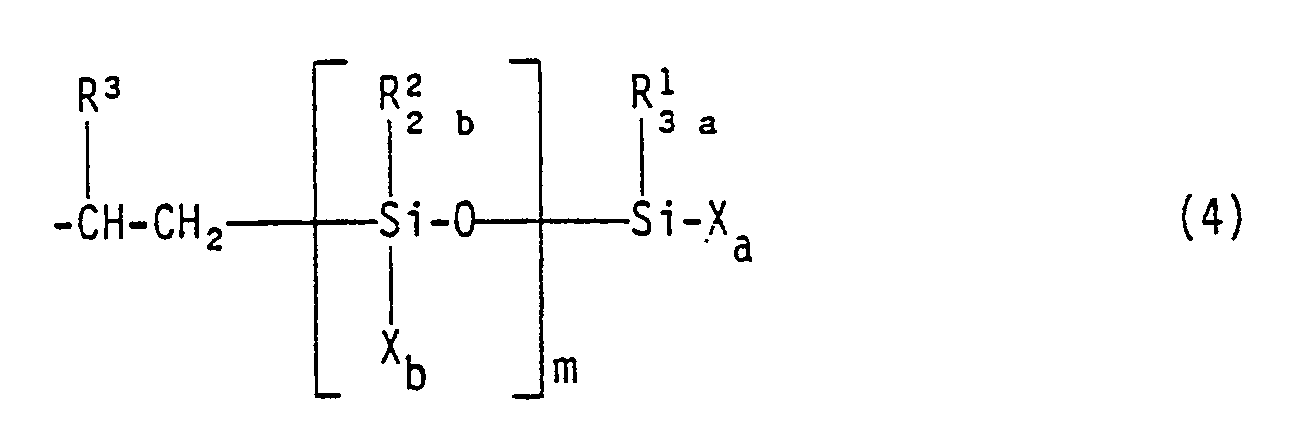
[0020] According to the above hydrosilylation, the polymer having a cross-linkable silicon group represented by the formula (4):
wherein R¹, R², R³, X, a, b and m are as defined above, is obtained.
[0021] The hydrosilylation is generally carried out at a temperature of 0° to 150°C. As occasion demands, a solvent such as n-pentane, n-hexane, n-heptane, benzene, toluene or xylene may be used for controlling the reaction temperature or the viscosity of the reaction system.
[0022] Another method for introducing the cross-linkable silicon group into the molecule of the isobutylene polymer is as follows:
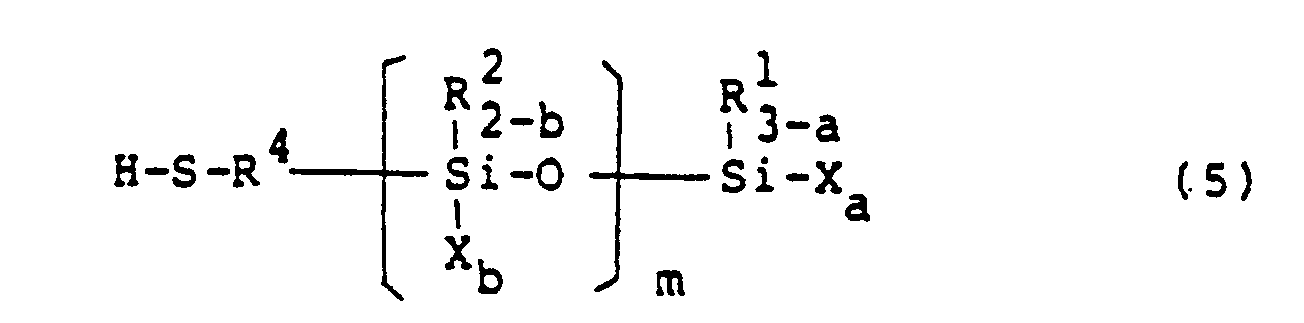
A mercaptan compound having a cross-linkable silicon group represented by the formula (5):
wherein R¹ R² a, b and m are as defined above and R⁴ is a bivalent hydrocarbon group having 1 to 10 carbon atoms, is introduced by a radical addition reaction into the unsaturated bond in an isobutylene polymer having at least one unsaturated group (2) in the presence of a radical initiator and/or a source for generating radicals.
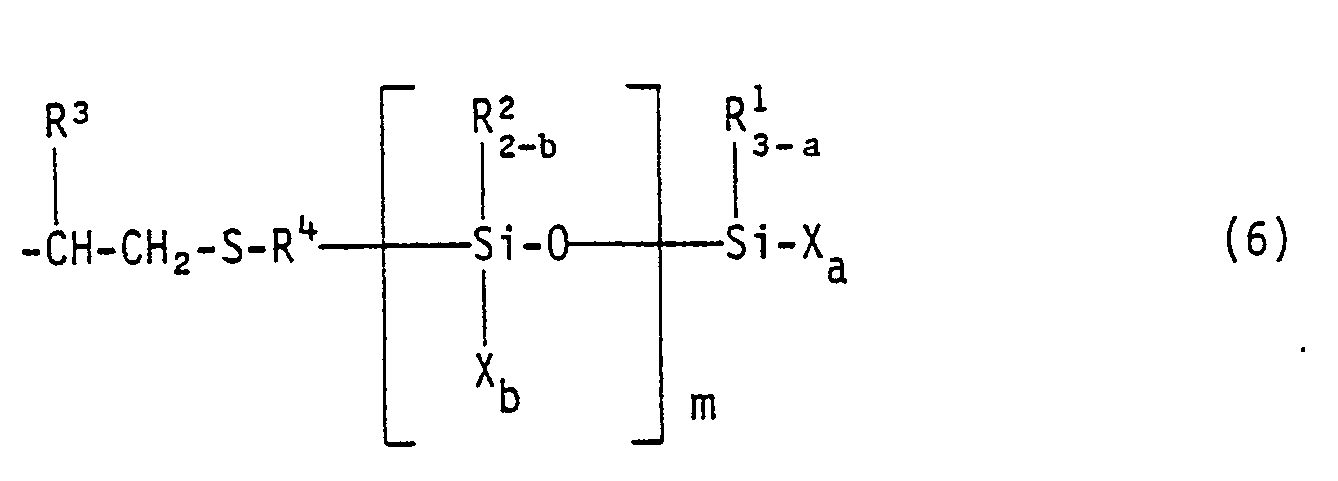
[0023] According to the above radical addition reaction, a polymer having the cross-linkable silicon group represented by the formula (6):
wherein R¹ R² R³ R⁴ a, b and m are as defined above, is obtained.
[0024] Examples of the radical initiator used in the present invention are, for instance, azo compounds such as azobisisobutyronitrile or phenylazotriphenylmethane, organic peroxides such as tert-butyl peroxide, and benzoyl peroxide.
[0025] Examples of the source for generating radicals are, for instance, sun light, ultraviolet ray, X-ray, β-ray, and γ-ray. In case of using the source for generating radicals, a light-sensitizer such as benzophenone or acetophenone may be used together with the above initiators or sources, as occasion demands.
[0026] It is preferable that the reaction is carried out at a temperature of 20° to 200°C when using the radical initiator, and it is preferable that the reaction is carried out at a temperature of -20° to 200°C when using the source for generating radicals. Also, the radical initiator can be used with the source for generating radicals.
[0027] For controlling the reaction temperature and the viscosity of the reaction system, a solvent such as n-pentane, n-hexane, n-heptane, benzene, toluene or xylene may be used as occasion demands.
[0028] As the polymer having at least one unsaturated group (2) in its molecule, the isobutylene polymer obtained according to Inifer method is preferred because of the presence of the group:
at the molecular ends. There is preferable an isobutylene polymer having the group:
at as many of the molecular ends as possible, since many cross-linkable silicon groups can be introduced at the molecular ends and the molecular ends which do not participate in the curing become fewer upon the hydrosilylation, and more preferably, an isobutylene polymer having the group:
at more than 70 % of the molecular ends.
[0029] The average number of the groups:
in one molecule is preferably 1.4 to 4.5. When the number is less than 1.4, since it is difficult to introduce the cross-linkable silicon groups into all unsaturated double bonds, it may not be possible to introduce at least one cross-linkable silicon group into the molecular ends, thus resulting in unsatisfactory curing of the polymer of the present invention.
[0030] Examples of the silicon hydride compound are, for instance, halogenated silanes such as trichlorosilane, methyldichlorosilane, dimethylchlorosilane, and trimethylsiloxydichlorosilane; alkoxy silanes such as trimethoxysilane, triethoxysilane, methyldimethoxysilane, phenyldimethoxysilane, and 1,3,3,5,5,7,7-heptamethyl-1,1-dimethoxytetrasiloxane; acyloxysilanes such as methyldiacetoxysilane, and trimethylsiloxymethyl-acetoxysilane; ketoxymate silanes such as bis(dimethylketoxymate)methylsilane, bis(cyclohexylketoxymate)methyl silane, and bis(diethylketoxymate)trimethylsiloxysilane; hydrosilanes having at least two Si-H bonds in a molecule such as dimethylsilane, trimethylsiloxymethyl silane, 1,1,3,3-tetramethyldisiloxane, and 1,3,5-trimethylcyclotrisiloxane; alkenyloxy silanes such as methyldi-(isopropenyloxy)silane. Among these compounds, chlorosilanes such as trichlorosilane, methyldichlorosilane and dimethylchlorosilane are especially preferable because of high activity in the hydrosilylation. However, when the isobutylene polymer having chlorosilyl groups is obtained by the hydrosilylation using the chlorosilanes, since the obtained isobutylene polymer generates hydrogen chloride gas or hydrochloric acid while curing by condensing, there are some troubles in practical use of the polymer. Further, the generated chlorine ion functions as a catalyst in the condensation reaction of the cross-linkable silicon group, which exert a harmful effect on the storage stability of the polymer. For that reason, it is preferable that the chlorine atom of the chlorosilyl group is converted into an alkoxyl group, an acyloxyl group, an aminoxy group, an alkenyloxy group, or a hydroxyl group. Among them, the alkoxyl group is especially preferred in that the hydrolyzability is adequate and handling is easy.
[0031] Examples of the mercaptan compound represented by the formula (5) are, for instance,
The cross-linkable silicon group in the mercaptan compound may be suitably converted depending on the intended use after being introduced into the isobutylene polymer.
[0032] It is preferable that the molecular weight of the isobutylene polymer having the cross-linkable silicon groups is 500 to 30,000. Particularly, the liquid isobutylene polymer having a molecular weight of 1,000 to 15,000 is more preferred in that handling is easy.
[0033] The cross-linked product of the isobutylene polymer having the cross-linkable silicon groups is excellent in weatherability, water-resistance, heat-resistance, electric isolation and gas impermeability. Particularly, when the polymer does not have an unsaturated bond other than aromatic rings in its molecule, the polymer is remarkably excellent in weatherability in comparison with the oxypropylene polymer or other organic polymers having unsaturated bonds. Also, the polymer has excellent water-resistance because of being a hydrocarbon polymers. Further, by using the isobutylene polymer of the present invention, it is possible to produce a mastic cured product in which the surface is cured and the inside is uncured. The mastic cured product has excellent adhesion to various materials. And, curable compositions having the abovementioned properties can be obtained by employing the isobutylene polymer of the present invention.
[0034] The curable composition of the present invention may contain various silicon compounds as a modifier for widely adjusting physical properties of the cured product, e.g. strength and elongation.
[0035] Typical examples of the silicon compounds are, for instance, a silicon compound having at least one hydrolyzable group or silanol group, e.g.,
(CH₃)₃ SiOH, (CH₃CH₂)₃SiOH,
(CH₃CH₂CH₂)₃SiOH,
(wherein R is a hydrogen atom or a hydrocarbon group having 1 to 20 carbon atoms) ,
(wherein x' + y' = 1 - 19, and R is as defined above) ,
(wherein R is as defined above),
(wherein p + q = 2 - 20 and R is as defined above),
[0038] The first method is a method in which the modifier is added to the isobutylene polymer. The modifier is uniformly dispersed or dissolved in the isobutylene polymer, if necessary, with heating and stirring depending on the properties of the used silicon compound. It is not necessary to make the mixture of the modifier and polymer entirely uniform and transparent, and the object of the invention can be satisfactorily attained when it is dispersed in the polymers even if the mixture is not transparent. Further, an agent for improving the dispersiblity such as a surface active agent can be used together with the modifier as occasion demands.
[0039] The second method is a method in which the modifier is added and mixed in a predetermined amount when curing the composition. For example, when using the curable composition as a sealing material of a two-package composition, the modifier is admixed with the isobutylene polymer and a curing agent as a third component.
[0040] The third method is a method in which the modifier is previously reacted with the isobutylene polymer, if necessary, by using a tin catalyst, a titanic acid ester catalyst, an acidic or a basic catalyst. In case the modifier is a compound capable of producing a compound containing a silanol group by moisture, the reaction is carried out, adding water in a required amount under reduced pressure with heating and degasification.
[0041] Examples of the above catalyst are, for instance, a titanate such as tetrabutyl titanate or tetrapropyl titanate; a tin carbonate such as dibutyl tin dilaurate, dibutyl tin maleate, dibutyl tin diacetate, tin octylate or tin naphthenate; lead octylate; an amine compound such as butylamine, octylamine, dibutylamine, monoethanolamine, diethanolamine, triethanolamine, diethylenetriamine, triethylenetetramine, oleylamine, cyclohexylamine, benzylamine, diethylaminopropylamine, xylylenediamine, triethylenediamine, guanidine, diphenylguanidine, 2,4,6-tris(dimethylaminomethyl)phenol, morpholine, N-methylmorpholine or 1,3-diazabicyclo-(5,4,6)undecene-7(DBU), and a salt thereof with a carboxylic acid; a low molecular polyamide obtained by the reaction of an excess polyamine with a polybasic acid; a reaction product of an excess polyamine with an epoxy compound; and a silane coupling agent having an amino group, e.g. a silanol condensation catalyst such as ℓ-aminopropyltrimethoxysilane or N-(β-aminoethyl)aminopropylmethyldimethoxysilane. The catalysts may be employed alone or in admixture thereof.
[0042] Further, the curable composition of the present invention may also contain various additives, as occasion demands, e.g. fillers, plasticizers, silanol condensation catalysts which are generally used for curing the isobutylene polymers having cross-linkable silicon-containing groups; water; antioxidants, ultraviolet adsorbents, lubricants, pigments, foaming agents, and tackifiers.
[0043] Examples of the filler are, for instance, wood flour, pulp, cotton, asbestos, glass fiber, carbon fiber, mica, walnut shell flour, rice hull flour, graphite, diatomaceous earth, terra alba, fumed silica, finely divided anhydrous silica, silicic dioxide, carbon black, calcium carbonate, clay, talc, titanium dioxide, magnesium carbonate, quartz, aluminum powder, flint powder, and zinc powder. The fillers may be employed alone or as an admixture thereof.
[0044] Examples of the plasticizer are, for instance, a hydrocarbon compound such as a polybutene, a hydrogenated polybutene, an α-methylstyrene oligomer, biphenyl, triphenyl, a triaryldimethane, an alkylene triphenyl, a liquid polybutadiene, a liquid hydrogenated polybutadiene, an alkyl diphenyl or a partially hydrogenated terphenyl; a chlorinated paraffin; a phthalic acid ester such as dibutyl phthalate, diheptyl phthalate, di(2-ethylhexyl)phthalate, butylbenzyl phthalate or butylphthalylbutyl glycolate; a non-aromatic dibasic acid ester such as dioctyl adipate or dioctyl sebacate; a polyalkylene glycol ester such as diethylene glycol dibenzoate or triethylene glycol dibenzoate; a phosphoric acid ester such as tricresyl phosphate or tributyl phosphate. The plasticizer may be employed alone or as an admixture thereof. Also, the plasticizer may be used instead of the solvent when introducing silicon-containing groups into the isobutylene polymer, for adjusting the reaction temperature or viscosity of the reaction system.
[0045] The silane condensation catalyst may be employed for curing the isobutylene polymer, which is the main component of the curable composition, and has cross-linkable silicon groups, as occasion demands.
[0046] Examples of the condensation catalyst are, for instance, a titanate such as tetrabutyl titanate or tetrapropyl titanate; a tin carbonate such as dibutyl tin dilaurate, dibutyl tin maleate, dibutyl tin diacetate, tin octylate or tin naphthenate; a reaction product of dibutyl tin oxide with a phthalic acid ester; dibutyl tin diacetylacetonato; an organo aluminum compound such as aluminum triacetylacetonatoaluminum, tris(ethylacetoacetate)aluminum or diisopropoxyaluminum ethyl acetoacetate; a chelate compound such as zirconium tetraacetylacetonato or titanium tetraacetylacetonato; lead octylate; an amine compound such as butylamine, monoethanolamine, triethylenetetramine guanidine, 2-ethyl-4-methyl imidazole or 1,3-diazabicyclo(5,4,6)-undecene-7(DBU), and a salt thereof with a carboxylic acid; and another known acidic or basic silanol condensation catalyst.
[0047] The adhesive property of the curable composition to various kinds of materials can be further improved by incorporation of one or more kinds of adhesion accelerators such as epoxy resins, phenol resins, various silane coupling agents, e.g. aminosilane compounds and epoxysilane compounds, alkyltitanates and aromatic polyisocyanates.
[0048] The polymers or the curable compositions of the invention can be suitably employed as an adhesive, a pressure sensitive adhesive tape, a paint, a sealant, a water proofing material, a spraying material, a molding material, or a casting rubber material.
[0049] The present invention is more specifically described and explained by means of the following Examples and Comparative Examples in which all percentages and parts are by weight unless otherwise noted.
Example 1
[0050] A 500 mℓ four neck flask was charged with 20 g of an isobutylene polymer having a molecular weight of about 5,000 and having isopropenyl groups at both molecular chain ends at about 92 % of the total polymer ends and 1 g of toluene and degasified under reduced pressure at 90°C for 2 hours. To the flask, there were added 120 mℓ of dried heptane, 1.15 g of methyldichlorosilane and 0.1 mℓ of a solution of chloroplatinic acid catalyst prepared by dissolving 1 g of H₂PtCℓ₆ ·6H₂O in 9 g of 1,2-dimethoxy-ethane and 1 g of ethanol under nitrogen gas atmosphere at room temperature, and the reaction was carried out at 90°C for 12 hours.
[0051] As a result of determination of the residual isopropenyl groups of the isobutylene polymer in the reaction mixture according to infrared spectrophotometry, it was found that the isopropenyl groups hardly remained.
[0052] Then, 21.2 g of methyl orthoformate and 6.4 g of methanol were added and the mixture was reacted at 70°C for 3 hours. The reaction system was neutral at a pH of about 7. After a volatile component was distilled away under reduced pressure, 50 mℓ of hexane was added to the residue and mixed well, and then, the insoluble component was filtered off from the reaction mixture. Hexane was distilled away from the filtrate to give an isobutylene polymer having groups of the formula:
at both molecular chain ends.
[0053] According to nuclear magnetic resonance (hereinafter referred to as "NMR"), it was found that the groups:
were introduced at about 80 % of the molecular chain ends.
Example 2
[0054] A 200 mℓ four neck flask was charged with 20 g of an isobutylene polymer having a molecular weight of about 5,000 and having isopropenyl groups at both molecular chain ends at about 92 % of the total polymer ends and 1 g of toluene and degasified under reduced pressure at 90°C for 2 hours. To the flask, there were added 5.8 mℓ of dried heptane and 1.88 g of γ-mercaptopropylmethyldimethoxysilane under nitrogen gas atmosphere at room temperature and the mixture was heated to 90°C. To the reaction mixture, 0.2 mℓ of a solution of azobisisobutyronitrile (hereinafter referred to as "AIBN") in acetone prepared by dissolving 1 g of AIBN in 5 g of acetone was added 10 times at two hour intervals. As a result of determination of the residual isopropenyl groups of the isobutylene polymer in the reaction mixture according to infrared spectrophotometry, a residual isopropenyl group proportion was about 15 % of that of the starting isobutylene polymer.
[0055] Then, the solvent and unreacted silane compound in the reaction system were removed under reduced pressure at 90°C for 2 hours to give an isobutylene polymer having groups of the formula:
at the molecular chain ends. According to NMR, it was found that the groups:
were introduced at about 75 % of the molecular chain ends.
Example 3
[0056] A 200 mℓ four neck flask was charged with 20 g of the isobutylene polymer used in Example 2 and degasified under reduced pressure at 90°C for 2 hours. To the flask, there were added 20 mℓ of dried heptane, 1.44 g of γ-mercaptopropylmethyldimethoxysilane and 10 mg of benzophenone under nitrogen gas atmosphere. The mixture was reacted at room temperature for 40 hours by irradiating with UV lamps (commercially available under the trade name of "MIS53" made by Mitsubishi Electric Corp., 15W x 2) from outside of the flask. As a result of determination of the residual isopropenyl groups of the isobutylene polymer in the reaction mixture according to infrared spectrophotometry, a residual isopropenyl group proportion was 20 % of that of the starting isobutylene polymer.
[0057] Then, the solvent and unreacted silane compound in the reaction system were removed under reduced pressure to give an isobutylene polymer having the group of the formula:
at the molecular chain ends. According to NMR, it was found that the groups:
were introduced at about 70 % of the molecular ends.
Comparative Example 1
[0058] A pressure reactor equipped with a stirrer was charged with 800 g of a polypropylene oxide having an average molecular weight of 8,000 and having allyl ether groups at 97 % of the whole polymer ends. To the reactor was added 19 g of methyldimethoxysilane and then 0.34 mℓ of a solution of chloroplatinic acid catalyst prepared by dissolving 8.9 g of in 18 mℓ of isopropyl alcohol and 160 mℓ of tetrahydrofuran was added, and the reaction was carried out at 80°C for 6 hours.
[0059] As a result of determination of the residual silicon hydride (Si-H) groups by infrared spectrophotometry, it was found that the silicon hydride groups hardly remained. According to NMR, the groups of the formula:
were introduced at about 85 % of the molecular chain ends.
Example 4
[0060] There were mixed 100 parts of the isobutylene polymer having the groups of the formula:
at the molecular ends obtained in Example 1, 50 parts of hydrogenated polybutene (commercially available under the trade name "Polybutene OH" made by Idemitsu Sekiyu Kagaku Kabushiki Kaisha) used as a plasticizer, 100 parts of a calcium carbonate treated with a fatty acid (commercially available under the trade name "CCR" made by Shiraishi Kogyo Kabushiki Kaisha) used as a filler, 2.2 parts of diphenylsilanediol used as a modifier, 0.5 part of water and 1 part of a hindered phenol antioxidant (commercially available under the trade name "Nocrac NS-6" made by Ouchi Shinko Kagaku Kabushiki Kaisha). After the mixture was kneaded sufficiently by passing through a three roller paint mill 3 times, a silanol condensation catalyst composed of 3 parts of tin octylate and 0.75 parts of laurylamine were added, which was prepared separately, and kneaded thoroughly. The composition was poured into a mold having a depth of about 3 mm while minimizing the formation of bubbles in the composition, cured at a room temperature for 4 days and aged at 50°C for 4 days to give a cured sheet.
[0061] The obtained cured sheet was punched to give No. 3 dumbbell shaped specimens provided in Japanese Industrial Standard (JIS) K 6301, and the specimens were subjected to a tensile test (rate of tension: 500 mm/min). The tensile strength at break was 7.4 kg/cm² and the elongation at break was 400 %.
Example 5
[0062] There were mixed 100 parts of the isobutylene polymer having the groups of the formula:
at the molecular chain ends obtained in Example 1, 0.5 part of water and 50 parts of toluene and the mixture was stirred sufficiently to provide a uniform mixture. The toluene solution was poured into a mold having a depth of about 3 mm and cured at room temperature for 1 day, and aged at 50°C for 4 days. Then, toluene was completely remove by evaporating at 50°C under a reduced pressure of 267-400 Pa (2 to 3 mmHg) for 2 hours.
[0063] The weatherability of the obtained cured sheets was measured by using a sunshine weather meter for 300 hours (cycle: 120 minutes, spray: 18 minutes). The surface of the sheet was not deteriorated and the cured sheets were not resinificated and softened.
Example 6
[0064] The heat resistance of the cured sheets obtained in Example 5 was estimated by placing the sheets in a hot air dryer of 150°C and the sheet was observed for elapsed changes. The surface of the sheet did not change at all after 30 minutes, and further, surface tackiness was not increased, and the cured sheet was not resinificated and softened after 5 hours though a little coloring occurred on the sheet.
Example 7
[0065] There were thoroughly mixed 100 parts of the isobutylene polymer having the groups of the formula:
at the molecular ends obtained in Example 1, 50 parts of Polybutene OH, 1 part of Nocrac NS-6 and 2 parts of dibutyl tin dilaurate. The mixture was poured into a frame having a depth of about 3 mm and cured at room temperature for 4 days, and aged at 70°C for 10 days to give a cured sheet.
[0066] Cutting off the sheet, it was found that the obtained cured sheet is a mastic cured sheet in which a surface layer of about 1 mm was cured and the inside was not cured.
Example 8
[0067] There were mixed 100 parts of the isobutylene polymer obtained in Example 2 having the groups of the formula:
50 parts of Polybutene OH, 100 parts of CCR, 2.0 parts of diphenyl silane diol, 0.5 part of water, and 1 part of Nocrac NS-6. After the mixture was kneaded thoroughly by passing through a three roller paint mill 3 times, a silanol condensation catalyst composed of 3 parts of tin octylate and 0.75 part of laurylamine, which was prepared separately, was added, and the mixture was kneaded sufficiently. The composition was poured into a frame having a depth of about 3 mm while minimizing the formation of bubbles in the composition and cured at room temperature for 4 days, and aged at 50°C for 4 days to give a cured sheet.
[0068] The obtained cured sheets were punched to give No. 3 dumbbell specimens provided in JIS K 6301, and the specimens were subjected to a tensile test (rate of tension: 500 mm/min). The tensile strength at break was 6.0 kg/cm² and the elongation at break was 450 %.
Example 9
[0069] The procedure of Example 8 was repeated except that the polymer obtained in Example 3 was used instead of the polymer obtained in Example 2 to give a cured sheet. The cured sheet was subjected to a tensile test (rate of tension: 500 mm/min). The tensile strength at break was 5.5 kg/cm² and the elongation at break was 420 %.
Example 10
[0070] There were mixed 100 parts of the isobutylene polymer having the groups of the formula:
at the molecular ends obtained in Example 2, 0.5 part of water and 50 parts of toluene and the mixture was stirred sufficiently to provide a uniform mixture. The toluene solution was poured into a frame having a depth of about 3 mm and cured at room temperature for 1 day, and aged at 50°C for 4 days. After, toluene was completely removed by evaporating at 50°C under a reduced pressure of 267-400 Pa (2 to 3 mmHg) for 2 hours.
[0071] The weatherability of the obtained cured sheets was measured by using the sunshine weather meter for 300 hours (cycle: 120 minutes, spray: 18 minutes). The surfaces of the sheets were not deteriorated and the cured sheets were not resinificated and softened.
Example 11
[0072] The procedure of Example 10 was repeated except that the polymer obtained in Example 3 was used instead of the polymer obtained in Example 2 to give a cured sheet. The weatherability of the cured sheets was estimated. The surfaces of the sheets were not deteriorated and the cured sheets were not resinificated and softened at all.
Example 12
[0073] The heat resistance of the cured sheet obtained in Example 10 was measured by using a hot air dryer of 150°C and the elapsed changes thereof were observed. No change was observed after 30 minutes, and further, surface tackiness was not increased, and the cured sheets were not resinificated and softened at all after 5 hours though a little coloring occurred on the sheet.
Example 13
[0074] The heat resistance of the cured sheets obtained in Example 11 was measured in the same manner as in Example 12. No change was observed after 30 minutes, and further, surface tackiness was not increased, and the cured sheets were not resinificated and softened at all after 5 hours though a little coloring occurred on the sheets.
Example 14
[0075] There were thoroughly mixed 100 parts of the isobutylene polymer having the groups of the formula:
at the molecular ends obtained in Example 2, 50 parts of Polybutene OH, 1 part of Nocrac NS-6 and 2 parts of dibutyl tin dilaurate. The mixture was poured into a frame having a depth of about 3 mm, cured at room temperature for 4 days, and aged at 70°C for 10 days to give a cured sheet.
[0076] Cutting off the sheet, it was found that the obtained cured sheet is a mastic cured sheet in which a surface layer of about 1 mm was cured and the inside was not cured.
Comparative Example 2
[0077] The weatherability was measured in the same manner as in Example 5 except that the polymer obtained in Comparative Example 1 was used instead of the polymer obtained in Example 1. The cured sheet was softened and melted down in part after 60 hours exposure.
Comparative Example 3
1. An isobutylene polymer having at least one silicon-containing group cross-linkable
by the formation of a siloxane bond at the molecular ends.
2. The polymer of Claim 1, wherein said silicon-containing group is represented by the
formula (1):
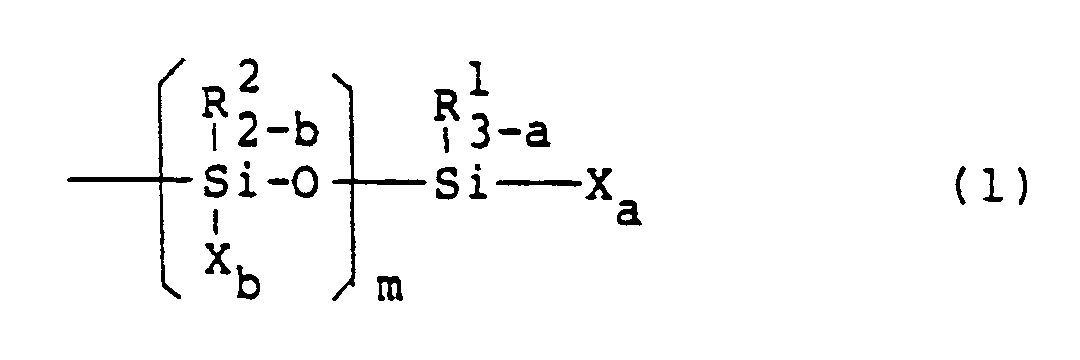
wherein R¹ and R² are the same or different and each is a member selected from the group consisting of an alkyl group having 1 to 20 carbon atoms, an aryl group having 6 to 20 carbon aboms, an aralkyl group having 7 to 20 carbon atoms and a triorganosiloxy group having the formula (7):
(R')₃SiO- (7)
in which each R' is independently a monovalent hydrocarbon group having 1 to 20 carbon atoms;
X is a hydroxyl group or a hydrolyzable group and when more than one X is present, X groups are the same or different;
a is 0, 1, 2 or 3, and b is 0, 1 or 2, provided that the sum of a and b is 1 or more; and
m is 0 or an integer of 1 to 18.
wherein R¹ and R² are the same or different and each is a member selected from the group consisting of an alkyl group having 1 to 20 carbon atoms, an aryl group having 6 to 20 carbon aboms, an aralkyl group having 7 to 20 carbon atoms and a triorganosiloxy group having the formula (7):
(R')₃SiO- (7)
in which each R' is independently a monovalent hydrocarbon group having 1 to 20 carbon atoms;
X is a hydroxyl group or a hydrolyzable group and when more than one X is present, X groups are the same or different;
a is 0, 1, 2 or 3, and b is 0, 1 or 2, provided that the sum of a and b is 1 or more; and
m is 0 or an integer of 1 to 18.
3. The polymer of Claim 2, wherein X is a member selected from the group consisting of
a hydrogen atom, a hydroxyl group, an alkoxyl group, an acyloxyl group, a ketoxymate
group, an amino group, an amido group, an aminoxy group, a mercapto group and an alkenyloxy
group.
4. The polymer of Claim 2, wherein said X is an alkoxyl group.
5. The polymer of Claim 1, wherein said silicon-containing group is represented by the
formula (4):
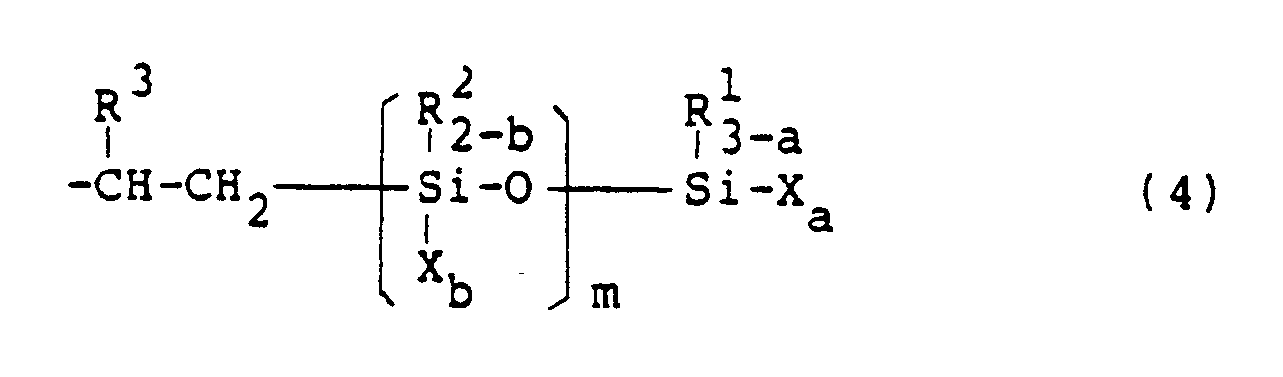
wherein R¹ and R² are the same or different and each is a member selected from the group consisting of an alkyl group having 1 to 20 carbon atoms, an aryl group having 6 to 20 carbon atoms, an aralkyl group having 7 to 20 carbon atoms, and a triorganosiloxy group having the formula (7):
(R')₃SiO- (7)
in which each R' is independently a monovalent hydrocarbon group having 1 to 20 carbon atoms;
R³ is a member selected from the group consisting of a hydrogen atom, an alkyl group having 1 to 8 carbon atoms, an aryl group having 6 to 20 carbon atoms, and an aralkyl group having 7 to 20 carbon atoms;
X is a hydroxyl group or a hydrolyzable group and when more than one X is present, the X groups are the same or different;
a is 0, 1, 2 or 3, and b is 0, 1 or 2, provided that the sum of a and b is 1 or more; and
m is 0 or a integer of 1 to 18.
wherein R¹ and R² are the same or different and each is a member selected from the group consisting of an alkyl group having 1 to 20 carbon atoms, an aryl group having 6 to 20 carbon atoms, an aralkyl group having 7 to 20 carbon atoms, and a triorganosiloxy group having the formula (7):
(R')₃SiO- (7)
in which each R' is independently a monovalent hydrocarbon group having 1 to 20 carbon atoms;
R³ is a member selected from the group consisting of a hydrogen atom, an alkyl group having 1 to 8 carbon atoms, an aryl group having 6 to 20 carbon atoms, and an aralkyl group having 7 to 20 carbon atoms;
X is a hydroxyl group or a hydrolyzable group and when more than one X is present, the X groups are the same or different;
a is 0, 1, 2 or 3, and b is 0, 1 or 2, provided that the sum of a and b is 1 or more; and
m is 0 or a integer of 1 to 18.
6. The polymer of Claim 5, wherein said R³ is a methyl group.
7. The polymer of Claim 1, wherein said silicon-containing group is represented by the
formula (6):
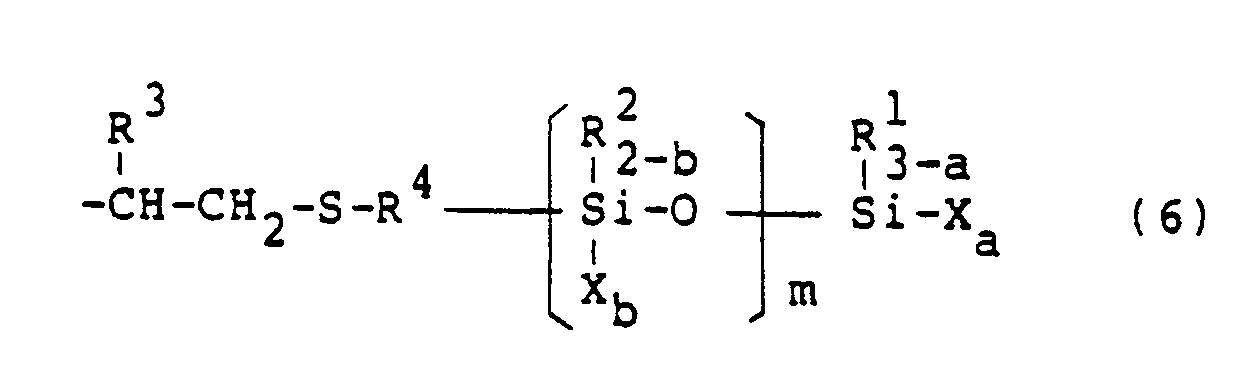
wherein R¹ and R² are the same or different and each is a member selected from the group consisting of an alkyl group having 1 to 20 carbon atoms, an aryl group having 6 to 20 carbon atoms, an aralkyl group having 7 to 20 carbon atoms, and a triorganosiloxy group having the formula (7):
(R')₃SiO- (7)
in which each R' is independently a monovalent hydrocarbon group having 1 to 20 carbon atoms;
R³ is a member selected from the group consisting of a hydrogen atom, an alkyl group having 1 to 8 carbon atoms, an aryl group having 6 to 20 carbon atoms, and an aralkyl group having 7 to 20 carbon atoms;
R⁴ is a bivalent hydrocarbon group having 1 to 10 carbon atoms;
X is a hydroxyl group or a hydrolyzable group and when more than one X is present, the X groups are the same or different;
a is 0, 1, 2 or 3, and b is 0, 1 or 2, provided that the sum of a and b is 1 or more; and
m is 0 or an integer of 1 to 18.
wherein R¹ and R² are the same or different and each is a member selected from the group consisting of an alkyl group having 1 to 20 carbon atoms, an aryl group having 6 to 20 carbon atoms, an aralkyl group having 7 to 20 carbon atoms, and a triorganosiloxy group having the formula (7):
(R')₃SiO- (7)
in which each R' is independently a monovalent hydrocarbon group having 1 to 20 carbon atoms;
R³ is a member selected from the group consisting of a hydrogen atom, an alkyl group having 1 to 8 carbon atoms, an aryl group having 6 to 20 carbon atoms, and an aralkyl group having 7 to 20 carbon atoms;
R⁴ is a bivalent hydrocarbon group having 1 to 10 carbon atoms;
X is a hydroxyl group or a hydrolyzable group and when more than one X is present, the X groups are the same or different;
a is 0, 1, 2 or 3, and b is 0, 1 or 2, provided that the sum of a and b is 1 or more; and
m is 0 or an integer of 1 to 18.
8. The polymer of Claim 7, wherein R³ is methyl group.
9. The polymer of Claim 1, which is obtained by a hydrosilylation of an isobutylene polymer
having, at the molecular ends, at least one unsaturated group represented by the formula
(2):
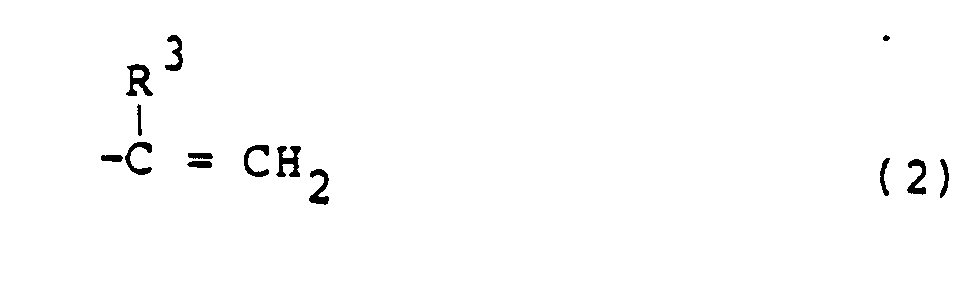
wherein R³ is a member selected from the group consisting of a hydrogen atom, an alkyl group having 1 to 8 carbon atoms, an aryl group having 6 to 20 carbon atoms, and an aralkyl group having 7 to 20 carbon atoms and a hydrosilane represented by the formula (3):
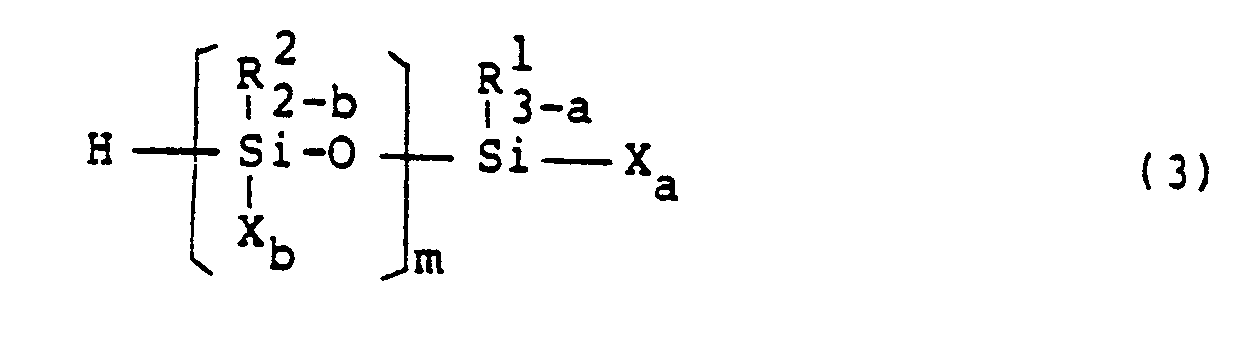
wherein R¹ and R² are the same or different and each is a member selected from the group consisting of an alkyl group having 1 to 20 carbon atoms, an aryl group having 6 to 20 carbon atoms, an aralkyl group having 7 to 20 carbon atoms, and a triorganosiloxy group having the formula (7):
(R')₃SiO- (7)
in which each R' is independently a monovalent hydrocarbon group having 1 to 20 carbon atoms;
X is a hydroxyl group or a hydrolyzable group and when more than one X is present, the X groups are the same or different;
a is 0, 1, 2 or 3, b is 0, 1 or 2, provided that the sum of a and b is 1 or more; and
m is 0 or a integer of 1 to 18.
wherein R³ is a member selected from the group consisting of a hydrogen atom, an alkyl group having 1 to 8 carbon atoms, an aryl group having 6 to 20 carbon atoms, and an aralkyl group having 7 to 20 carbon atoms and a hydrosilane represented by the formula (3):
wherein R¹ and R² are the same or different and each is a member selected from the group consisting of an alkyl group having 1 to 20 carbon atoms, an aryl group having 6 to 20 carbon atoms, an aralkyl group having 7 to 20 carbon atoms, and a triorganosiloxy group having the formula (7):
(R')₃SiO- (7)
in which each R' is independently a monovalent hydrocarbon group having 1 to 20 carbon atoms;
X is a hydroxyl group or a hydrolyzable group and when more than one X is present, the X groups are the same or different;
a is 0, 1, 2 or 3, b is 0, 1 or 2, provided that the sum of a and b is 1 or more; and
m is 0 or a integer of 1 to 18.
10. The polymer of Claim 1, which is obtained by a radical addition reaction, in the presence
of a source for generating a radical, of an isobutylene polymer having, at the molecular
ends, at least one unsaturated group represented by the formula (2):
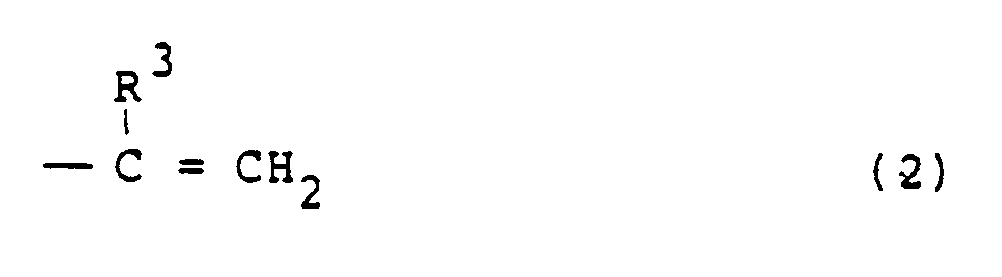
wherein R³ is a member selected from the group consisting of hydrogen atom, an alkyl group having 1 to 8 carbon atoms, an aryl group having 6 to 20 carbon atoms, and an aralkyl group having 7 to 20 carbon atoms and a mercaptan compound represented by the formula (5):
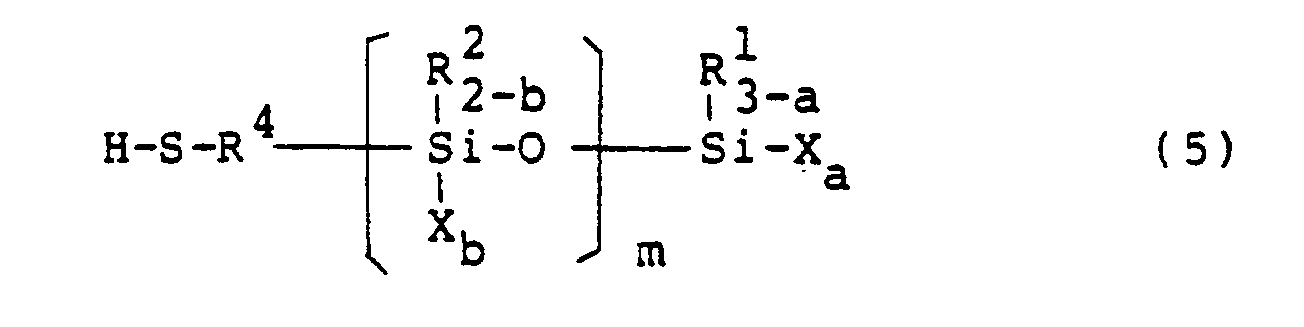
wherein R¹ and R² are the same or different and each is a member selected from the group consisting of an alkyl group having 1 to 20 carbon atoms, an aryl group having 6 to 20 carbon atoms, an aralkyl group having 7 to 20 carbon atoms, and a triorganosiloxy group having the formula (7):
(R')₃SiO- (7)
in which each R' is independently a monovalent hydrocarbon group having 1 to 20 carbon atoms;
R⁴ is a hydrocarbon group having 1 to 10 carbon atoms; X is a hydroxyl group or a hydrolyzable group and when more than one X is present, the X groups are the same or different;
a is 0, 1, 2 or 3, and b is 0, 1 or 2, provided that the sum of a and b is 1 or more; and
m is 0 or an integer of 1 to 18.
wherein R³ is a member selected from the group consisting of hydrogen atom, an alkyl group having 1 to 8 carbon atoms, an aryl group having 6 to 20 carbon atoms, and an aralkyl group having 7 to 20 carbon atoms and a mercaptan compound represented by the formula (5):
wherein R¹ and R² are the same or different and each is a member selected from the group consisting of an alkyl group having 1 to 20 carbon atoms, an aryl group having 6 to 20 carbon atoms, an aralkyl group having 7 to 20 carbon atoms, and a triorganosiloxy group having the formula (7):
(R')₃SiO- (7)
in which each R' is independently a monovalent hydrocarbon group having 1 to 20 carbon atoms;
R⁴ is a hydrocarbon group having 1 to 10 carbon atoms; X is a hydroxyl group or a hydrolyzable group and when more than one X is present, the X groups are the same or different;
a is 0, 1, 2 or 3, and b is 0, 1 or 2, provided that the sum of a and b is 1 or more; and
m is 0 or an integer of 1 to 18.
11. A composition containing the isobutylene polymer having at least one silicon-containing
group cross-linkable by the formation of a siloxane bond according to claim 1 and
silanol condensation catalysts.
12. A cured product of the isobutylene polymer having at least one silicon-containing
group cross-linkable by the formation of a siloxane bond according to claim 1.
1. Polymère d'isobutylène ayant au moins un groupe réticulable contenant du silicium
par la formation d'une liaison siloxane aux extrémités de la molécule.
2. Polymère selon la revendication 1, dans lequel ledit groupe contenant du silicium
est représenté par la formule (1) :
où R¹ et R² sont identiques ou différents, et chacun est un membre choisi dans le groupe constitué par un groupe alkyle ayant de 1 à 20 atomes de carbone, un groupe aryle ayant de 6 à 20 atomes de carbone, un groupe aralkyle ayant de 7 à 20 atomes de carbone et un groupe triorganosiloxy ayant la formule (7) :
(R')₃SiO- (7)
dans laquelle chaque R' est, de façon indépendante, un groupe hydrocarboné monovalent ayant de 1 à 20 atomes de carbone ; X est un groupe hydroxyle ou un groupe hydrolysable, et, lorsque plus d'un X est présent, les groupes X sont identiques ou différents :
a est égal à 0, 1, 2 ou 3, et b est égal à 0, 1 ou 2, à la condition que la somme de a et b soit égale à 1 ou plus ; ou
m est égal à 0, ou il est un nombre entier de 1 à 18.
où R¹ et R² sont identiques ou différents, et chacun est un membre choisi dans le groupe constitué par un groupe alkyle ayant de 1 à 20 atomes de carbone, un groupe aryle ayant de 6 à 20 atomes de carbone, un groupe aralkyle ayant de 7 à 20 atomes de carbone et un groupe triorganosiloxy ayant la formule (7) :
(R')₃SiO- (7)
dans laquelle chaque R' est, de façon indépendante, un groupe hydrocarboné monovalent ayant de 1 à 20 atomes de carbone ; X est un groupe hydroxyle ou un groupe hydrolysable, et, lorsque plus d'un X est présent, les groupes X sont identiques ou différents :
a est égal à 0, 1, 2 ou 3, et b est égal à 0, 1 ou 2, à la condition que la somme de a et b soit égale à 1 ou plus ; ou
m est égal à 0, ou il est un nombre entier de 1 à 18.
3. Polymère selon la revendication 2, dans lequel X est un membre choisi dans le groupe
constitué par un atome d'hydrogène, un groupe hydroxyle, un groupe alcoxyle, un groupe
acyloxyle, un groupe cétoxymate, un groupe amino, un groupe amido, un groupe aminoxy,
un groupe mercapto et un groupe alcényloxy.
4. Polymère selon la revendication 2, dans lequel ledit X est un groupe alcoxyle.
5. Polymère selon la revendication 1, dans lequel ledit groupe contenant du silicium
est représenté par la formule (4) :
dans laquelle R¹ et R² sont identiques ou différents, et chacun est un membre choisi dans le groupe constitué par un groupe alkyle ayant de 1 à 20 atomes de carbone, un groupe aryle ayant de 6 à 20 atomes de carbone, un groupe aralkyle ayant de 7 à 20 atomes de carbone, et un groupe triorganosiloxy ayant la formule (7) :
(R')₃SiO- (7)
dans laquelle chaque R' est, de façon indépendante, un groupe hydrocarboné monovalent ayant de 1 à 20 atomes de carbone ; R³ est un membre choisi dans le groupe constitué par un atome d'hydrogène, un groupe alkyle ayant de 1 à 8 atomes de carbone, un groupe aryle ayant de 6 à 20 atomes de carbone, et un groupe aralkyle ayant de 7 à 20 atomes de carbone ;
X est un groupe hydroxyle ou un groupe hydrolysable, et lorsque plus d'un X est présent, les groupes X sont identiques ou différents ; a est égal à 0, 1, 2 ou 3, et b est égal à 0, 1 ou 2, à la condition que la somme de a et b soit égale à 1 ou plus ; et
m est égal à 0 ou il est un nombre entier de 1 à 18.
dans laquelle R¹ et R² sont identiques ou différents, et chacun est un membre choisi dans le groupe constitué par un groupe alkyle ayant de 1 à 20 atomes de carbone, un groupe aryle ayant de 6 à 20 atomes de carbone, un groupe aralkyle ayant de 7 à 20 atomes de carbone, et un groupe triorganosiloxy ayant la formule (7) :
(R')₃SiO- (7)
dans laquelle chaque R' est, de façon indépendante, un groupe hydrocarboné monovalent ayant de 1 à 20 atomes de carbone ; R³ est un membre choisi dans le groupe constitué par un atome d'hydrogène, un groupe alkyle ayant de 1 à 8 atomes de carbone, un groupe aryle ayant de 6 à 20 atomes de carbone, et un groupe aralkyle ayant de 7 à 20 atomes de carbone ;
X est un groupe hydroxyle ou un groupe hydrolysable, et lorsque plus d'un X est présent, les groupes X sont identiques ou différents ; a est égal à 0, 1, 2 ou 3, et b est égal à 0, 1 ou 2, à la condition que la somme de a et b soit égale à 1 ou plus ; et
m est égal à 0 ou il est un nombre entier de 1 à 18.
6. Polymère selon la revendication 5, dans lequel ledit R³ est un groupe méthyle.
7. Polymère selon la revendication 1, dans lequel ledit groupe contenant du silicium
est représenté par la formule (6) :
dans laquelle R¹ et R² sont identiques ou différents et chacun est un membre choisi dans le groupe constitué par un groupe alkyle ayant de 1 à 20 atomes de carbone, un groupe aryle ayant de 6 à 20 atomes de carbone, un groupe aralkyle ayant de 7 à 20 atomes de carbone, et un groupe triorganosiloxy ayant la formule (7) :
(R')₃SiO- (7)
dans laquelle chaque R' est, de façon indépendante, un groupe hydrocarboné monovalent ayant de 1 à 20 atomes de carbone ;
R³ est un membre choisi parmi le groupe constitué par un atome d'hydrogène, un groupe alkyle ayant de 1 à 8 atomes de carbone, un groupe aryle ayant de 6 à 20 atomes de carbone, et un groupe aralkyle ayant de 7 à 20 atomes de carbone ;
R⁴ est un groupe hydrocarboné bivalent ayant de 1 à 10 atomes de carbone ;
X est un groupe hydroxyle ou un groupe hydrolysable, et, lorsque plus d'un X est présent, les groupes X sont les mêmes ou différents ;
a est égal à 0, 1, 2 ou 3, et b est égal à 0, 1 ou 2, avec la condition que la somme de a et b soit égale à 1 ou plus ; et
m est égal à 0 ou il est un nombre entier de 1 à 18.
dans laquelle R¹ et R² sont identiques ou différents et chacun est un membre choisi dans le groupe constitué par un groupe alkyle ayant de 1 à 20 atomes de carbone, un groupe aryle ayant de 6 à 20 atomes de carbone, un groupe aralkyle ayant de 7 à 20 atomes de carbone, et un groupe triorganosiloxy ayant la formule (7) :
(R')₃SiO- (7)
dans laquelle chaque R' est, de façon indépendante, un groupe hydrocarboné monovalent ayant de 1 à 20 atomes de carbone ;
R³ est un membre choisi parmi le groupe constitué par un atome d'hydrogène, un groupe alkyle ayant de 1 à 8 atomes de carbone, un groupe aryle ayant de 6 à 20 atomes de carbone, et un groupe aralkyle ayant de 7 à 20 atomes de carbone ;
R⁴ est un groupe hydrocarboné bivalent ayant de 1 à 10 atomes de carbone ;
X est un groupe hydroxyle ou un groupe hydrolysable, et, lorsque plus d'un X est présent, les groupes X sont les mêmes ou différents ;
a est égal à 0, 1, 2 ou 3, et b est égal à 0, 1 ou 2, avec la condition que la somme de a et b soit égale à 1 ou plus ; et
m est égal à 0 ou il est un nombre entier de 1 à 18.
8. Polymère selon la revendication 7, dans lequel R³ est un groupe méthyle.
9. Polymère selon la revendication 1, qui est obtenu par une hydrosilylation d'un polymère
de l'isobutylène ayant, aux extrémités de la molécule, au moins un groupe insaturé
représenté par la formule (2) :
dans laquelle R³ est un membre choisi dans le groupe constitué par un atome d'hydrogène, un groupe alkyle ayant de 1 à 8 atomes de carbone, un groupe aryle ayant de 6 à 20 atomes de carbone, et un groupe aralkyle ayant de 7 à 20 atomes de carbone et un hydrosilane représenté par la formule (3) :
dans laquelle R¹ et R² sont identiques ou différents, et chacun est un membre choisi dans le groupe constitué par un groupe alkyle ayant de 1 à 20 atomes de carbone, un groupe aryle ayant de 6 à 20 atomes de carbone, un groupe aralkyle ayant de 7 à 20 atomes de carbone, et un groupe triorganosiloxy ayant la formule (7) :
(R')₃SiO- (7)
dans laquelle chaque R' est, de façon indépendante, un groupe hydrocarboné monovalent ayant de 1 à 20 atomes de carbone ;
X est un groupe hydroxyle ou un groupe hydrolysable, et, lorsque plus d'un X est présent, les groupes X sont identiques ou différents ;
a est égal à 0, 1, 2 ou 3, b est égal à 0, 1 ou 2, à la condition que la somme de a et b soit égale à 1 ou plus ; et
m est égal à 0 ou il est un nombre entier de 1 à 18.
dans laquelle R³ est un membre choisi dans le groupe constitué par un atome d'hydrogène, un groupe alkyle ayant de 1 à 8 atomes de carbone, un groupe aryle ayant de 6 à 20 atomes de carbone, et un groupe aralkyle ayant de 7 à 20 atomes de carbone et un hydrosilane représenté par la formule (3) :
dans laquelle R¹ et R² sont identiques ou différents, et chacun est un membre choisi dans le groupe constitué par un groupe alkyle ayant de 1 à 20 atomes de carbone, un groupe aryle ayant de 6 à 20 atomes de carbone, un groupe aralkyle ayant de 7 à 20 atomes de carbone, et un groupe triorganosiloxy ayant la formule (7) :
(R')₃SiO- (7)
dans laquelle chaque R' est, de façon indépendante, un groupe hydrocarboné monovalent ayant de 1 à 20 atomes de carbone ;
X est un groupe hydroxyle ou un groupe hydrolysable, et, lorsque plus d'un X est présent, les groupes X sont identiques ou différents ;
a est égal à 0, 1, 2 ou 3, b est égal à 0, 1 ou 2, à la condition que la somme de a et b soit égale à 1 ou plus ; et
m est égal à 0 ou il est un nombre entier de 1 à 18.
10. Polymère selon la revendication 1, qui est obtenu par une réaction d'addition radicalaire,
en présence d'une source pour générer un radical, d'un polymère d'isobutylène ayant,
aux extrémités de la molécule, au moins un groupe insaturé, représenté par la formule
(2) :
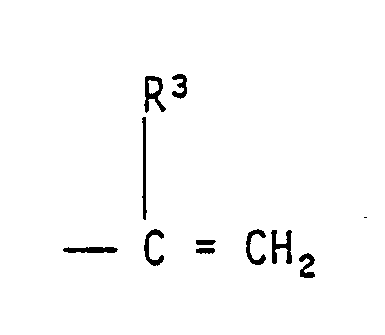
dans laquelle R³ est un membre choisi dans le groupe constitué par un atome d'hydrogène, un groupe alkyle ayant de 1 à 8 atomes de carbone, un groupe aryle ayant de 6 à 20 atomes de carbone, et un groupe aralkyle ayant de 7 à 20 atomes de carbone, et un composé mercaptan représenté par la formule (5) :
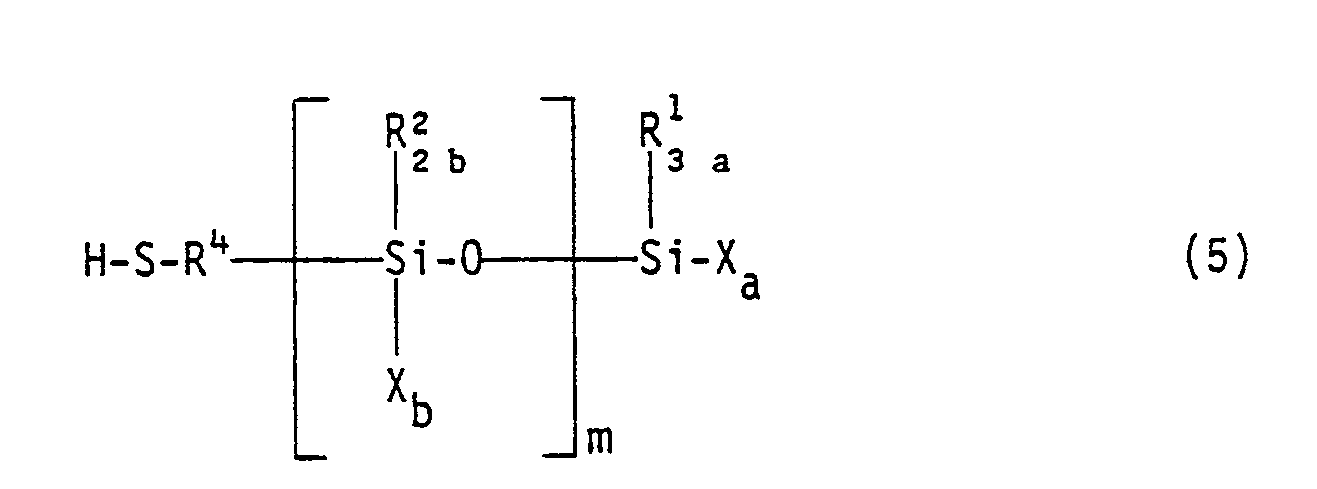
dans laquelle R¹ et R² sont identiques ou différents et chacun est un membre choisi dans le groupe constitué par un groupe alkyle ayant de 1 à 20 atomes de carbone, un groupe aryle ayant de 6 à 20 atomes de carbone, un groupe aralkyle ayant de 7 à 20 atomes de carbone, et un groupe triorganosiloxy ayant la formule (7) :
(R')₃SiO- (7)
dans laquelle chaque R' est, de façon indépendante un groupe hydrocarboné monovalent ayant de 1 à 20 atomes de carbone ;
R⁴ est un groupe hydrocarboné ayant de 1 à 10 atomes de carbone ;
X est un groupe hydroxyle ou un groupe hydrolysable, et, lorsque plus d'un X est présent, les groupes X sont identiques ou différents ;
a est égal à 0, 1, 2 ou 3, et b est égal à 0, 1 ou 2, à la condition que la somme de a et b soit égale à 1 ou plus ; et
m est égal à 0, ou il est un nombre entier de 1 à 18.
dans laquelle R³ est un membre choisi dans le groupe constitué par un atome d'hydrogène, un groupe alkyle ayant de 1 à 8 atomes de carbone, un groupe aryle ayant de 6 à 20 atomes de carbone, et un groupe aralkyle ayant de 7 à 20 atomes de carbone, et un composé mercaptan représenté par la formule (5) :
dans laquelle R¹ et R² sont identiques ou différents et chacun est un membre choisi dans le groupe constitué par un groupe alkyle ayant de 1 à 20 atomes de carbone, un groupe aryle ayant de 6 à 20 atomes de carbone, un groupe aralkyle ayant de 7 à 20 atomes de carbone, et un groupe triorganosiloxy ayant la formule (7) :
(R')₃SiO- (7)
dans laquelle chaque R' est, de façon indépendante un groupe hydrocarboné monovalent ayant de 1 à 20 atomes de carbone ;
R⁴ est un groupe hydrocarboné ayant de 1 à 10 atomes de carbone ;
X est un groupe hydroxyle ou un groupe hydrolysable, et, lorsque plus d'un X est présent, les groupes X sont identiques ou différents ;
a est égal à 0, 1, 2 ou 3, et b est égal à 0, 1 ou 2, à la condition que la somme de a et b soit égale à 1 ou plus ; et
m est égal à 0, ou il est un nombre entier de 1 à 18.
11. Composition contenant le polymère d'isobutylène ayant au moins un groupe réticulable
contenant du silicium par la formation d'une liaison siloxane, selon la revendication
1, et des catalyseurs de condensation de silanol.
12. Produit durci du polymère d'isobutylène ayant au moins un groupe réticulable contenant
du silicium par la formation d'une liaison siloxane, selon la revendication 1.
1. Ein Isobutylenpolymer mit wenigstens einer Silicium enthaltenden Gruppe, die durch
die Bildung einer Siloxanbindung an den molekularen Enden vernetzbar ist.
2. Polymer nach Anspruch 1, worin genannte Silicium enthaltende Gruppe durch die Formel
(1) dargestellt ist:
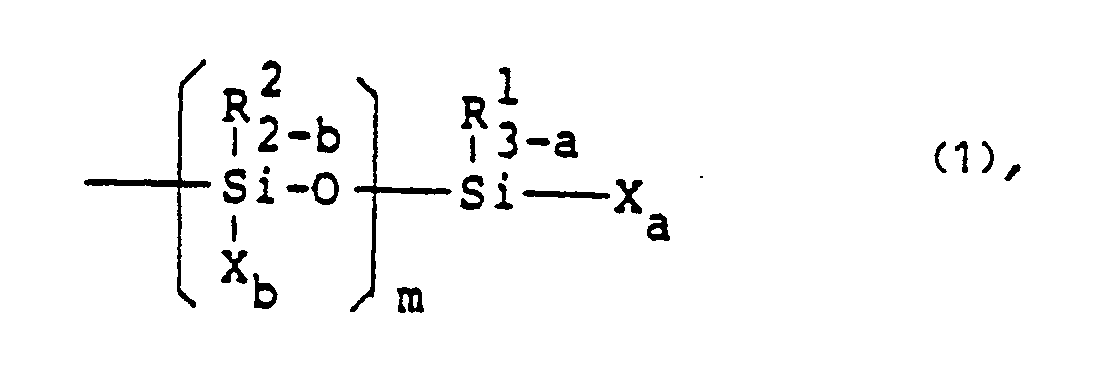
worin R¹ und R² die gleichen oder verschiedene sind und jede Mitglied aus der Gruppe ist, die aus einer Alkylgruppe mit 1 bis 20 Kohlenstoffatomen, einer Arylgruppe mit 6 bis 20 Kohlenstoffatomen, einer Aralkylgruppe mit 7 bis 20 Kohlenstoffatomen und einer Triorganosiloxygruppe mit der Formel (7) besteht:
(R')₃SiO- (7)
in welcher jedes R' unabhängig eine monovalente Kohlenwasserstoffgruppe mit 1 bis 20 Kohlenstoffatomen ist;
X ist eine Hydroxylgruppe oder eine hydrolysierbare Gruppe ist,und wenn mehr als ein X vorhanden ist, die X-Gruppen die gleichen oder verschiedene sind;
a 0, 1, 2 oder 3 ist, und b 0, 1 oder 2 ist, vorausgesetzt, daß die Summe von a und b 1 oder mehr ist; und m 0 oder eine ganze Zahl von 1 bis 18 ist.
worin R¹ und R² die gleichen oder verschiedene sind und jede Mitglied aus der Gruppe ist, die aus einer Alkylgruppe mit 1 bis 20 Kohlenstoffatomen, einer Arylgruppe mit 6 bis 20 Kohlenstoffatomen, einer Aralkylgruppe mit 7 bis 20 Kohlenstoffatomen und einer Triorganosiloxygruppe mit der Formel (7) besteht:
(R')₃SiO- (7)
in welcher jedes R' unabhängig eine monovalente Kohlenwasserstoffgruppe mit 1 bis 20 Kohlenstoffatomen ist;
X ist eine Hydroxylgruppe oder eine hydrolysierbare Gruppe ist,und wenn mehr als ein X vorhanden ist, die X-Gruppen die gleichen oder verschiedene sind;
a 0, 1, 2 oder 3 ist, und b 0, 1 oder 2 ist, vorausgesetzt, daß die Summe von a und b 1 oder mehr ist; und m 0 oder eine ganze Zahl von 1 bis 18 ist.
3. Polymer von Anspruch 2, worin X ein Mitglied ist, ausgewählt aus der Gruppe, die aus
einem Wasserstoffatom, einer Hydroxylgruppe, einer Alkoxygruppe, einer Acyloxylgruppe,
einer Ketoxymatgruppe, einer Aminogruppe, einer Amidogruppe, einer Aminoxygruppe,
einer Mercaptogruppe und einer Alkenyloxygruppe besteht.
4. Polymer von Anspruch 2, worin genanntes X eine Alkoxygruppe ist.
5. Polymer von Anspruch 1, worin genannte Silicium enthaltende Gruppe durch die Formel
(4) dargestellt wird:
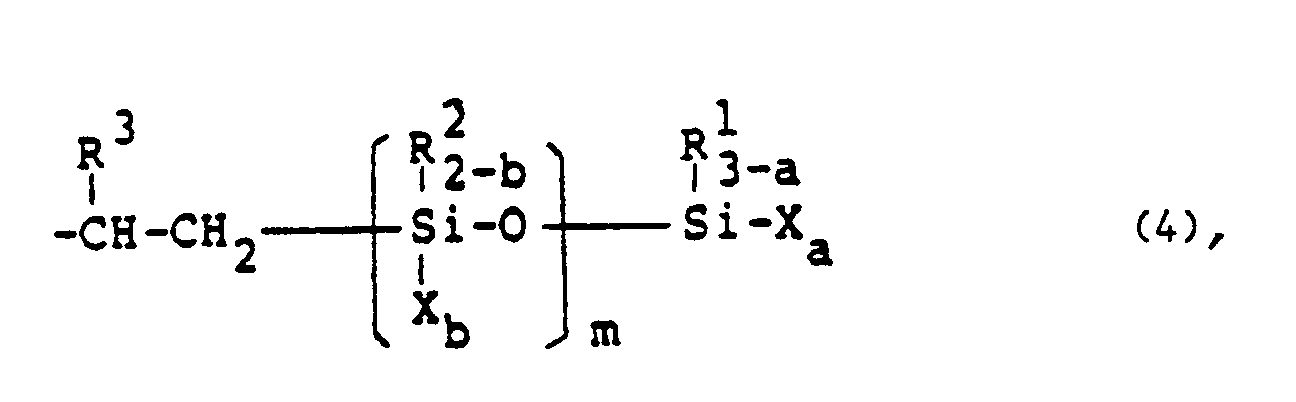
worin R¹ und R² die gleichen oder verschiedene sind und jede ein Mitglied ist, ausgewählt aus der Gruppe, die aus einer Alkylgruppe mit 1 bis 20 Kohlenstoffatomen, einer Arylgruppe mit 6 bis 20 Kohlenstoffatomen, einer Aralkylgruppe mit 7 bis 20 Kohlenstoffatomen, und einer Triorganosiloxygruppe mit der Formel (7) besteht:
(R')₃SiO- (7)
in welcher jedes R' unabhängig eine monovalente Kohlenwasserstoffgruppe mit 1 bis 20 Kohlenstoffatomen ist;
R³ ein Mitglied ist ausgewählt aus der Gruppe, die aus einem Wasserstoffatom, einer Alkylgruppe mit 1 bis 8 Kohlenstoffatomen, einer Arylgruppe mit 6 bis 20 Kohlenstoffatomen, und einer Aralkylgruppe mit 7 bis 20 Kohlenstoffatomen besteht;
X eine Hydroxylgruppe ist oder eine hydrolisierbare Gruppe, und wenn mehr als ein X vorhanden ist, die X-Gruppen die gleichen oder verschiedene sind;
a 0, 1, 2 oder 3 ist, und b 0, 1 oder 2 ist, vorausgesetzt, daß die Summe von a und b 1 oder mehr ist; und
m 0 oder eine ganze Zahl von 1 bis 18 ist.
worin R¹ und R² die gleichen oder verschiedene sind und jede ein Mitglied ist, ausgewählt aus der Gruppe, die aus einer Alkylgruppe mit 1 bis 20 Kohlenstoffatomen, einer Arylgruppe mit 6 bis 20 Kohlenstoffatomen, einer Aralkylgruppe mit 7 bis 20 Kohlenstoffatomen, und einer Triorganosiloxygruppe mit der Formel (7) besteht:
(R')₃SiO- (7)
in welcher jedes R' unabhängig eine monovalente Kohlenwasserstoffgruppe mit 1 bis 20 Kohlenstoffatomen ist;
R³ ein Mitglied ist ausgewählt aus der Gruppe, die aus einem Wasserstoffatom, einer Alkylgruppe mit 1 bis 8 Kohlenstoffatomen, einer Arylgruppe mit 6 bis 20 Kohlenstoffatomen, und einer Aralkylgruppe mit 7 bis 20 Kohlenstoffatomen besteht;
X eine Hydroxylgruppe ist oder eine hydrolisierbare Gruppe, und wenn mehr als ein X vorhanden ist, die X-Gruppen die gleichen oder verschiedene sind;
a 0, 1, 2 oder 3 ist, und b 0, 1 oder 2 ist, vorausgesetzt, daß die Summe von a und b 1 oder mehr ist; und
m 0 oder eine ganze Zahl von 1 bis 18 ist.
6. Polymer von Anspruch 5, worin genanntes R³ eine Methylgruppe ist.
7. Polymer von Anspruch 1, worin genannte Silicium enthaltende Gruppe durch die Formel
(6) dargestellt wird:
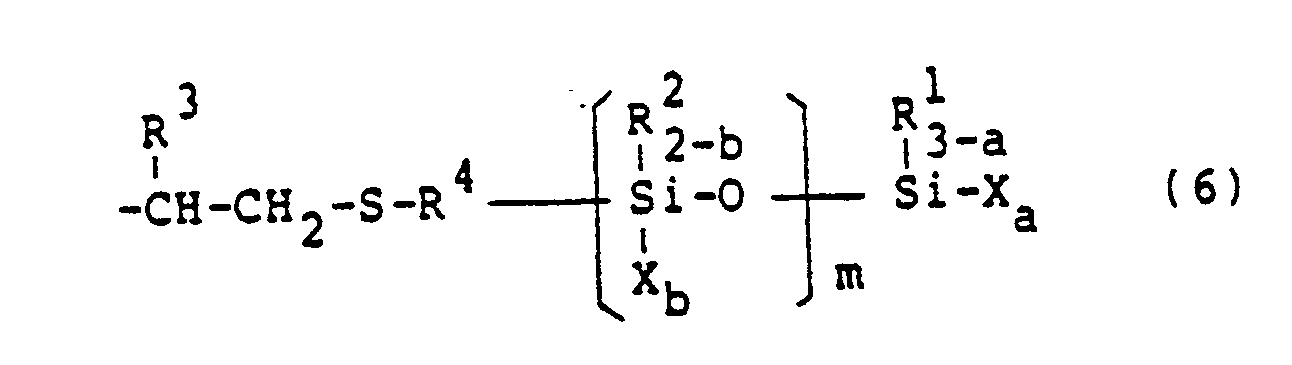
worin R¹ und R² die gleichen oder verschiedene sind, und jedes Mitglied ist, ausgewählt aus der Gruppe, die aus einer Alkylgruppe mit 1 bis 20 Kohlenstoffatomen, einer Arylgruppe mit 6 bis 20 Kohlenstoffatomen, einer Aralkylgruppe mit 7 bis 20 Kohlenstoffatomen und einer Triorganosiloxygruppe mit der Formel (7) besteht:
(R')₃SiO- (7)
in welcher jedes R' unabhängig eine monovalente Kohlenwasserstoffgruppe mit 1 bis 20 Kohlenstoffatomen ist;
R³ ein Mitglied ist, ausgewählt aus der Gruppe, die aus einem Wasserstoffatom, einer Alkylgruppe mit 1 bis 8 Kohlenstoffatomen, einer Arylgruppe mit 6 bis 20 Kohlenstoffatomen, und einer Aralkylgruppe mit 7 bis 20 Kohlenstoffatomen besteht;
R⁴ eine bivalente Kohlenwasserstoffgruppe mit 1 bis 10 Kohlenstoffatomen ist;
X eine Hydroxylgruppe oder eine hydrolysierbare Gruppe ist, und wenn mehr als ein X vorhanden ist, die X-Gruppen die gleichen oder verschiedene sind; a 0, 1, 2 oder 3 ist, und b 0, 1 oder 2 ist, vorausgesetzt, daß die Summe von a und b 1 oder mehr ist; und
m 0 oder eine ganze Zahl von 1 bis 18 ist.
worin R¹ und R² die gleichen oder verschiedene sind, und jedes Mitglied ist, ausgewählt aus der Gruppe, die aus einer Alkylgruppe mit 1 bis 20 Kohlenstoffatomen, einer Arylgruppe mit 6 bis 20 Kohlenstoffatomen, einer Aralkylgruppe mit 7 bis 20 Kohlenstoffatomen und einer Triorganosiloxygruppe mit der Formel (7) besteht:
(R')₃SiO- (7)
in welcher jedes R' unabhängig eine monovalente Kohlenwasserstoffgruppe mit 1 bis 20 Kohlenstoffatomen ist;
R³ ein Mitglied ist, ausgewählt aus der Gruppe, die aus einem Wasserstoffatom, einer Alkylgruppe mit 1 bis 8 Kohlenstoffatomen, einer Arylgruppe mit 6 bis 20 Kohlenstoffatomen, und einer Aralkylgruppe mit 7 bis 20 Kohlenstoffatomen besteht;
R⁴ eine bivalente Kohlenwasserstoffgruppe mit 1 bis 10 Kohlenstoffatomen ist;
X eine Hydroxylgruppe oder eine hydrolysierbare Gruppe ist, und wenn mehr als ein X vorhanden ist, die X-Gruppen die gleichen oder verschiedene sind; a 0, 1, 2 oder 3 ist, und b 0, 1 oder 2 ist, vorausgesetzt, daß die Summe von a und b 1 oder mehr ist; und
m 0 oder eine ganze Zahl von 1 bis 18 ist.
8. Polymer von Anspruch 7, wobei R³ Methylgruppe ist.
9. Polymer von Anspruch 1, erhalten durch die Hydrosilylierung eines Isobutylenpolymers,
das an den molekularen Enden wenigstens eine ungesättigte Gruppe, dargestellt durch
die Formel (2), hat:
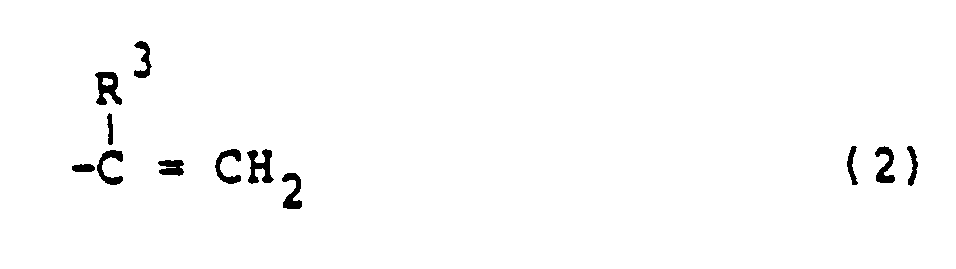
worin R³ ein Mitglied ist, ausgewählt aus der Gruppe, die aus einem Wasserstoffatom, einer Alkylgruppe mit 1 bis 8 Kohlenstoffatomen, einer Arylgruppe mit 6 bis 20 Kohlenstoffatomen und einer Aralkylgruppe mit 7 bis 20 Kohlenstoffatomen besteht und eines Hydrosilans, dargestellt durch die Formel (3),
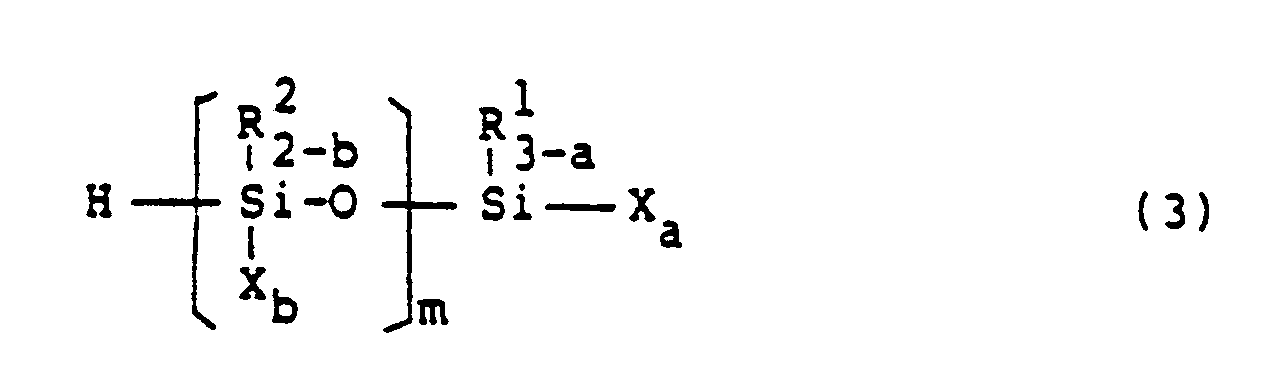
worin R¹ und R² die gleichen oder verschiedene sind und jede ein Mitglied ist, ausgewählt aus der Gruppe, die aus einer Alkylgruppe mit 1 bis 20 Kohlenstoffatomen, einer Arylgruppe mit 6 bis 20 Kohlenstoffatomen, einer Aralkylgruppe mit 7 bis 20 Kohlenstoffatomen, und einer Triorganosiloxygruppe mit der Formel (7) besteht:
(R')₃SiO- (7)
in welcher jedes R' unabhängig eine monovalente Kohlenwasserstoffgruppe mit 1 bis 20 Kohlenstoffatomen ist;
X eine Hydroxygruppe ist oder eine hydrolisierbare Gruppe, und wenn mehr als ein X vorhanden ist, die X-Gruppen die gleichen oder verschiedene sind;
a 0, 1, 2 oder 3 ist, b 0, 1 oder 2 ist, vorausgesetzt, daß die Summe von a und b 1 oder mehr ist; und
m 0 oder eine ganze Zahl von 1 bis 18 ist.
worin R³ ein Mitglied ist, ausgewählt aus der Gruppe, die aus einem Wasserstoffatom, einer Alkylgruppe mit 1 bis 8 Kohlenstoffatomen, einer Arylgruppe mit 6 bis 20 Kohlenstoffatomen und einer Aralkylgruppe mit 7 bis 20 Kohlenstoffatomen besteht und eines Hydrosilans, dargestellt durch die Formel (3),
worin R¹ und R² die gleichen oder verschiedene sind und jede ein Mitglied ist, ausgewählt aus der Gruppe, die aus einer Alkylgruppe mit 1 bis 20 Kohlenstoffatomen, einer Arylgruppe mit 6 bis 20 Kohlenstoffatomen, einer Aralkylgruppe mit 7 bis 20 Kohlenstoffatomen, und einer Triorganosiloxygruppe mit der Formel (7) besteht:
(R')₃SiO- (7)
in welcher jedes R' unabhängig eine monovalente Kohlenwasserstoffgruppe mit 1 bis 20 Kohlenstoffatomen ist;
X eine Hydroxygruppe ist oder eine hydrolisierbare Gruppe, und wenn mehr als ein X vorhanden ist, die X-Gruppen die gleichen oder verschiedene sind;
a 0, 1, 2 oder 3 ist, b 0, 1 oder 2 ist, vorausgesetzt, daß die Summe von a und b 1 oder mehr ist; und
m 0 oder eine ganze Zahl von 1 bis 18 ist.
10. Polymer von Anspruch 1, das erhalten wird in Gegenwart einer Quelle zur Erzeugung
eines Radikals durch eine Radikaladditionsreaktion eines Isobutylenpolymers, das an
den molekularen Enden wenigstens eine ungesättigte Gruppe hat, die durch die Formel
(2) dargestellt wird:
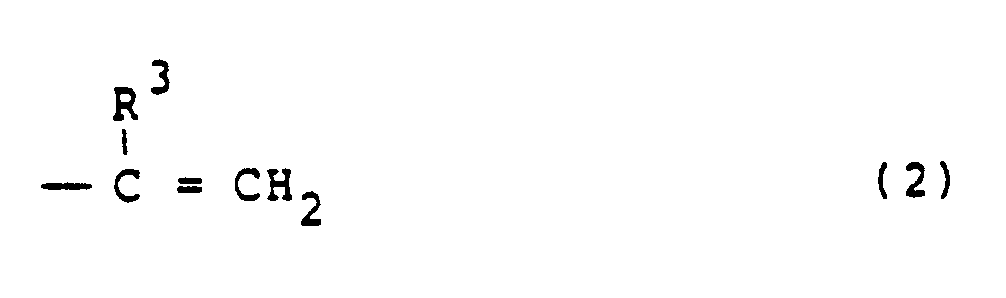
wobei R³ ein Mitglied ist, ausgewählt aus der Gruppe, die aus Wasserstoffatom, einer Alkylgruppe mit 1 bis 8 Kohlenstoffatomen, einer Arylgruppe mit 6 bis 20 Kohlenstoffatomen und einer Aralkylgruppe mit 7 bis 20 Kohlenstoffatomen besteht und einer Mercaptanverbindung dargestellt durch die Formel (5)
worin R¹ und R² die gleichen oder verschiedene sind und jede ein Mitglied ist ausgewählt aus der Gruppe, die aus einer Alkylgruppe mit 1 bis 20 Kohlenstoffatomen, einer Arylgruppe mit 6 bis 20 Kohlenstoffatomen, einer Aralkylgruppe mit 7 bis 20 Kohlenstoffatomen, und einer Triorganosiloxygruppe der Formel (7) besteht:
(R')₃SiO- (7)
in welcher jedes R' unabhängig eine monovalente Wasserstoffgruppe mit 1 bis 20 Kohlenstoffatomen ist;
R⁴ eine Kohlenwasserstoffgruppe mit 1 bis 10 Kohlenstoffatomen ist;
X eine Hydroxylgruppe oder eine hydrolisierbare Gruppe ist, und wenn mehr als ein X vorhanden ist, die X-Gruppen die gleichen oder verschiedene sind;
a 0, 1, 2 oder 3 ist, und b 0, 1 oder 2 ist, vorausgesetzt, daß die Summe von a und b 1 oder mehr ist; und
m ist 0 oder eine ganze Zahl von 1 bis 18 ist.
wobei R³ ein Mitglied ist, ausgewählt aus der Gruppe, die aus Wasserstoffatom, einer Alkylgruppe mit 1 bis 8 Kohlenstoffatomen, einer Arylgruppe mit 6 bis 20 Kohlenstoffatomen und einer Aralkylgruppe mit 7 bis 20 Kohlenstoffatomen besteht und einer Mercaptanverbindung dargestellt durch die Formel (5)
worin R¹ und R² die gleichen oder verschiedene sind und jede ein Mitglied ist ausgewählt aus der Gruppe, die aus einer Alkylgruppe mit 1 bis 20 Kohlenstoffatomen, einer Arylgruppe mit 6 bis 20 Kohlenstoffatomen, einer Aralkylgruppe mit 7 bis 20 Kohlenstoffatomen, und einer Triorganosiloxygruppe der Formel (7) besteht:
(R')₃SiO- (7)
in welcher jedes R' unabhängig eine monovalente Wasserstoffgruppe mit 1 bis 20 Kohlenstoffatomen ist;
R⁴ eine Kohlenwasserstoffgruppe mit 1 bis 10 Kohlenstoffatomen ist;
X eine Hydroxylgruppe oder eine hydrolisierbare Gruppe ist, und wenn mehr als ein X vorhanden ist, die X-Gruppen die gleichen oder verschiedene sind;
a 0, 1, 2 oder 3 ist, und b 0, 1 oder 2 ist, vorausgesetzt, daß die Summe von a und b 1 oder mehr ist; und
m ist 0 oder eine ganze Zahl von 1 bis 18 ist.
11. Zusammensetzung, die das Isobutylenpolymer, das wenigstens eine Silicium enthaltende,
durch die Bildung einer Siloxanbindung vernetzbare Gruppe gemäß Anspruch 1 hat, und
Silanolkondensationskatalysatoren enthält.
12. Ein gehärtetes Produkt des Isobutylenpolymers, das wenigstens eine Silicium enthaltende
durch die Bildung einer Siloxanbindung vernetzbaren Gruppe entsprechend Anspruch 1
enthält.