|
(11) | EP 0 254 053 A1 |

| (12) | EUROPEAN PATENT APPLICATION |
|
|
|
|
|||||||||||||||||||||||||||
| (54) | Polychloropyridine production from polychloro-2,3-lutidines |
| (57) Polychloropyridines containing chlorine substituents in the 2, 3, and 6 positions
and, optionally, in the 4 and 5 positions, are prepared from polychloro-2,3-lutidines
containing at least one chlorine substituent in each methyl group and, optionally,
a chlorine substituent in the 6 position by liquid phase chlorination. Lewis acid
metal halide catalysts are, optionally, employed. 2,3,5,6-Tetrachloropyridine is,
accordingly, prepared by chlorination at 200 to 260°C in the presence of ferric chloride
catalyst of a mixture of polychloro-2,3-lutidines obtained by the vapor phase chlorination
of 2,3-lutidine. |
[0001] Polychloropyridines are valuable intermediates in the production of a wide variety of agricultural insecticides, herbicides, fungicides, and many other useful materials. Several polychloropyridines have been produced commercially and a number of processes for their production have been described. These known processes generally involve the chlorination of pyridine or a compound containing a pyridine nucleus. Methods for the chlorination of pyridine to polychloropyridines are known. The chlorination of alkyl pyridines in the vapor phase to obtain pentachloropyridine and the chlorination in the liquid phase of alpha-picoline, beta-picoline, and 3,5-lutidine to obtain certain poychloropyridines is also known. Certain metal halide catalysts are sometimes employed in these known processes. 2,6-Dichloropyridine is converted to 2,3,5,6-tetrachloropyridine and pentachloropyridine by liquid phase chlorination in the presence of selected metal halide catalysts as taught in the art. Also known is the liquid phase chlorination of various chlorinated (trichloromethyl) pyridines to obtain certain polychloropyridines. The use of uv light and of specific metal halide catalysts is optionally employed in some of these processes.
[0002] The present invention relates to the preparation of a select class of polychloropyridines by the chlorination of certain polychloro-2,3-lutidines.
[0003] It has now been found that the liquid phase chlorination of partially chlorinated 2,3-lutidines in which both methyl groups and, optionally, the 6 position of the ring contain chlorine substituents, is a convenient and economical process for the production of polychloropyridines in which the 2, 3, and 6 positions and, optionally, the 4 and 5 positions are substituted by chlorine.
[0004] Thus, polychloropyridines of Formula I
wherein X and Y each, independently represents H or Cl are prepared in a process which comprises chlorinating a polychloro-2,3-lutidine of Formula II
wherein
A and D each, independently represents mono-, di-, or trichloromethyl; and
E represents H or Cl
with chlorine in the liquid phase.
[0005] The preparation of 2,3,5,6-tetrachloropyridine and pentachloropyridine by the process is facilitated by Lewis acid metal halide catalysts whereas the preparation of 2,3,6-trichloropyridine is best conducted in the absence of such catalysts.
[0006] The polychloropyridines prepared in the present invention are defined by Formula I. These polychloropyridines are characterized by having chlorine substition in the 2, 3, and 6 positions and, optionally, in the 4 and 5 positions. The compounds included in this definition are 2,3,6-trichloropyridine, 2,3,5,6-tetrachloropyridine, 2,3,4,6-tetrachloropyridine, and pentachloropyridine.
[0007] The polychloro-2,3-lutidines that are employed as starting materials in the present invention are defined by Formula II. They are characterized as 2,3-lutidines substituted by at least one chlorine atom on each methyl group and optionally by chlorine in the 6 position of the ring. These compounds can be employed in the process individually or as mixtures containing two or more of them.
[0008] The polychloro-2,3-lutidines of Formula II can be obtained by the vapor phase chlorination of 2,3-lutidine. A mixture of polychloro-2,3-lutidines obtained by the vapor phase chlorination of 2,3-lutidines can be used in the present process without further purification either before or after the removal of any chlorocarbon diluent. Alternatively, such mixtures can be separated into individual compounds of Formula II and any or all of the individual compounds thus obtained can be utilized separately. The compounds of Formula II typically obtained in this manner include 2-(chloromethyl)-3-(dichloromethyl)-pyridine, 3-(chloromethyl)-2-(dichloromethyl)-pyridine, 2,3-bis(dichloromethyl)pyridine, 6-chloro-2,3-bis(dichloromethyl)pyridine, 3-(dichloromethyl)-2-(trichloromethyl)pyridine, 6-chloro-3-(dichloromethyl)-2-(trichloromethyl)pyridine, and 6-chloro-2-(dichloromethyl)-3-(trichloromethyl)pyridine.
[0009] The chlorination reactions that take place on chlorinating polychloro-2,3-lutidines of Formula II with chlorine in the liquid phase are the replacement of ring and mono- or dichloromethyl substituent hydrogen atoms by chlorine and the replacement of trichloromethyl groups by chlorine. In order to obtain the products of the present invention, both of the chlorinated methyl groups and up to three of the ring hydrogen atoms of the polychloro-2,3-lutidines of Formula II must be replaced by chlorine.
[0010] The process of the present invention can be carried out in any equipment suitable for liquid phase chlorination. Such equipment is well known to those skilled in the art. It can be carried out batch-wise using one or more chlorination reactors or in a continuous manner.
[0011] In carrying out the invention, the polychloro-2,3-lutidine of Formula II, chlorine, and, optionally, a catalyst are placed in a reaction vessel and the mixture is heated. The reactants can be added in any order and the heat can be applied before or after the addition of any of the reactants. It is generally preferred to place the polychloro-2,3-lutidine and any catalyst in the reaction vessel, heat as required to obtain a molten mass, add chlorine, and finally heat to the desired reaction temperature.
[0012] Chlorine is employed in the present process in an amount at least sufficient to convert all of the chlorinated methyl moieties to carbon tetrachloride and to place the desired number of chlorine atom substituents on the polychloropyridine product. Typically an excess is employed as this tends to facilitate the process.
[0013] Lewis acid metal halide catalysts can be employed in the process to accelerate the reactions involved, especially the reactions involving replacement of the 5-position hydrogen atom of the polychloro-2,3-lutidine starting materials by chlorine. Useful catalysts include, for example, the halides of iron, zinc, aluminum, tantalum, antimony, tungsten, molybdenum, titanium, nickel and cobalt. The chlorides are generally the preferred halides and iron is the preferred metal of the salt. Ferric chloride is especially preferred. The metal halide catalyst can be added in the form of a metal in those cases, such as iron, zinc, and aluminum, where the metal is converted to the corresponding metal chloride under the reaction conditions or can be added in the form of a metal oxide or oxyhalide in those cases where the metal oxide or oxyhalide is converted to the coresponding metal chloride under the reaction conditions. The addition of iron in lieu of ferric chloride is a preferred procedure.
[0014] Lewis acid metal halide catalysts, when employed, are employed in an amount sufficient to accelerate the chlorination. Generally, amounts up to six percent by weight of the polychloro-2,3-lutidine starting material are appropriate. Amounts of 1 to 5 percent are preferred. Such catalysts are generally employed when the desired polychloropyridine product is primarily 2,3,5,6-tetrachloropyridine or pentachloropyridine and are generally not employed when the desired product is primarily 2,3,6-trichloropyridine or 2,3,4,6-tetrachloropyridine.
[0015] Hydrogen chloride is formed as a by-product in the process and is, therefore, present during the process. It is, however, often helpful to the process to add additional hydrogen chloride to the reaction mixture either before the introduction of chlorine or concurrently with the introduction of chlorine.
[0016] The polychloropyridines of Formula I are generally formed when polychloro-2,3-lutidines of Formula II are contacted with chlorine at temperatures above 160°C. Increasing the temperature increases the reaction rate and generally increases the degree of chlorination. That is to say the reaction produces more tetra- and pentachloropyridines and less 2,3,6-trichloropyridine at higher temperatures. Reaction temperatures of 180°C to 300°C are preferred and temperatures of 200°C to 260°C are especially preferred. In the case of continuous processes or batch processes using multiple reactors, it is often advantageous to employ different temperatures downstream or in the latter reactors than the temperatures used for the original contact of chlorine and compounds of Formula II.
[0017] The process of the present invention can be carried out at atmospheric or super-atmospheric pressure. Super atmospheric pressures are often preferred because such pressures facilitate the contact of the polychloro-2,3-lutidines with chlorine, allow the reactor to contain more chlorine, and thereby accelerate the reactions. It also allows the use of reaction temperatures above the boiling point of any reaction mixture component. Pressures up to 2860 kPa (400 psig) are normally employed and it is often preferred to employ pressures of 204.74 to 2169.13 kPa (15 to 300 psig). Pressures of about 1480 kPa (200 psig) are especially preferred.
[0018] The reaction mixtures are optionally agitated throughout the chlorination or during some part of it.
[0019] The chlorination reaction is continued until a substantial amount of the desired polychloropyridine of Formula I has formed or until a substantial portion of the polychloro-2,3-lutidine of Formula II has been converted to polychloropyridines. This generally requires several hours to several days depending on the amount of chlorine employed, the presence, amount and identity of any catalyst, the temperature, the pressure, and the other parameters employed. The reaction can be monitored using standard analytical techniques such as gas chromatography, liquid chromatography, and the like to determine the course of the reaction and its status at any time. The desired reaction conclusion time can thus be determined. The reaction is terminated by ceasing to heat and releasing any pressure in the reactor.
[0020] The present process can be optimized readily by one skilled in the art for the production of any polychloropyridine of Formula I using any polychloro-2,3-lutidine of Formula II as the starting material by adjusting the parameters discussed herein and following the progress of the reaction by standard analytical techniques.
[0021] The polychloropyridines of Formula I are generally obtained in the process of the present invention as mixtures containing at least one such compound. The individual compounds of Formula I can be recovered from the reaction mixture by standard methods such as distillation, crystallization, and extraction. It is generally preferred to isolate the products by distillation. Multiple distillations carried out in series are often employed.
Example 1 - Non-Catalytic Chlorination of a Mixture of Polychloro-2,3-lutidines
[0023] A 30 g sample of mixed polychloro-2,3-lutidines containing the following approximate percentage composition: 2,3-bis(dichloromethyl)pyridine, 2.2; 6-chloro-2,3-bis(dichloromethyl)pyridine and 3-(dichloromethyl)-2-(trichloromethyl)pyridine, 13.6; 6-chloro-2-(dichloromethyl)-3-(trichloromethyl)pyridine and 6-chloro-3-(dichloromethyl)-2-(trichloromethyl)pyridine, 45.3; unknown C₇H₂Cl₇N (2 components), 1.8; 3,6-dichloro-2-(trichloromethyl)pyridine, 6.8; 2,6-dichloro-3-(trichloromethyl)pyridine, 10.6; 2,3,6-trichloropyridine, 6.3; 2,3,4,6-tetrachloropyridine, 0.8; 2,3,5,6-tetrachloropyridine, 0.5; and pentachlorovinylpyridines (2 components), 11.9 was placed in a 50 ml round bottom flask fitted with a condenser, scrubber, and dip tube for introducing chlorine. The flask was heated to about 165°C and chlorine was introduced at the rate of about 35 mmoles per hour. Heating and chlorine addition were continued at about 165°C for about 3 hours. The chlorine addition was continued and the temperature was increased to about 200°C for about 12 hours and then to about 245°C for an additional approximately 15 hours. Analysis of the reaction mixture by capillary gas chromatography using standards showed that it contained the following approximate percentage composition: 2,3,6-trichloropyridine, 53.6; 2,3,4,6-tetrachloropyridine, 3.4; 2,3,5,6-tetrachloropyridine, 8.8; pentachloropyridine, 0.7; 3,6-dichloro-2-(trichloromethyl)pyridine, 4.8; 2,6-dichloro-3-(trichloromethyl)pyridine, 16.2; 3,5,6 -trichloro-2-(trichloromethyl)pyridine, 0.4; 2,5,6-trichloro-3-(trichloromethyl)pyridine, 1.5; and hexachloro-2,3-lutidines, 1.9. A total of 8.1 g of carbon tetrachloride was collected in the scrubber.
Example 2 - Catalytic Chlorination of a Mixture of Polychloro-2,3-lutidines
[0024] A 30 g sample of the mixture of polychloro-2,3-lutidines employed in Example 1 was placed in a 50 ml round bottom flask fitted with a condenser, scrubber and dip tube for introducing chlorine. Ferric chloride (0.45 g, 1.5 weight percent) was added and the resulting mixture was heated to about 200°C. Chlorine was introduced at the rate of about 35 mmoles per hour and continued for about 2 hours at about 200°C and 25 hours at about 245°C. Analysis of the reaction mixture by capillary gas chromatography using standards showed that it contained the following percentage composition: 2,3,6-trichloropyridine, 5,9; 2,3,4,6-tetrachloropyridine, 1.8; 2,3,5,6-tetrachloropyridine, 62.0; pentachloropyridine, 11.9; 2,6-dichloro-3-(trichloromethyl)pyridine, 1.2; 2,5,6-trichloro-3-(trichloromethyl)pyridine, 6.3; and hexachlorolutidines, 2.2. A total of over 7.1 g of carbon tetrachloride was collected in the scrubber.
1. A process for preparing a polychloropyridine of the formula
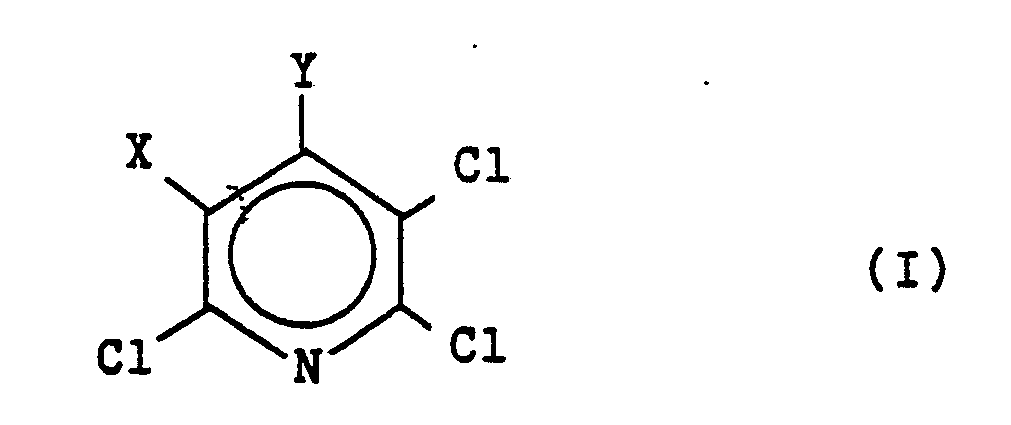
wherein X and Y each, independently represents H or Cl which comprises chlorinating a polychloro-2-3-lutidine of the formula
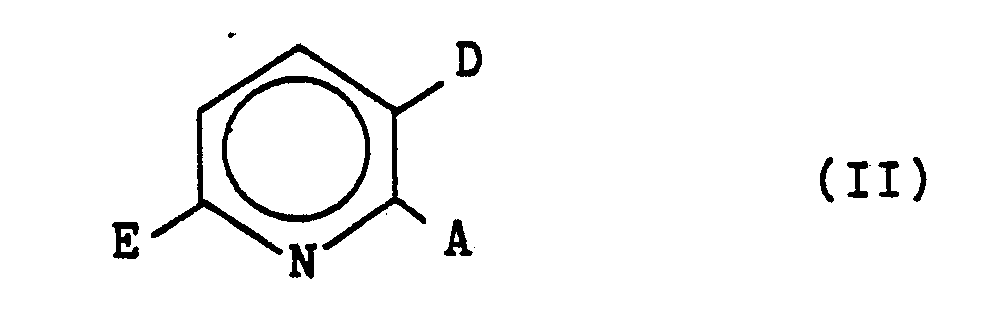
wherein
A and D each, independently represents mono-, di-, or trichloromethyl; and
E represents H or Cl
with chlorine in the liquid phase.
wherein X and Y each, independently represents H or Cl which comprises chlorinating a polychloro-2-3-lutidine of the formula
wherein
A and D each, independently represents mono-, di-, or trichloromethyl; and
E represents H or Cl
with chlorine in the liquid phase.
2. Process of Claim 1 wherein the chlorinating is carried out in the presence of
a Lewis acid metal halide catalyst.
3. Process of Claim 2 wherein the catalyst is ferric chloride.
4. Process of Claim 1 wherein the polychloro-2,3-lutidine is employed as a mixture
comprising at least two polychloro-2,3-lutidines.
5. Process of Claim 1 wherein the polychloro-2,3-lutidine is 2-(chloromethyl)-3-(dichloromethyl)pyridine,
3-(chloromethyl)-2-(dichloromethyl)pyridine, 2,3-bis(dichloromethyl)pyridine, 6-chloro-2,3-bis(dichloromethyl)pyridine,
3-(dichloromethyl)-2-(trichloromethyl)pyridine, 6-chloro-3-(dichloromethyl)-2-(trichloromethyl)pyridine,
or 6-chloro-2-(dichloromethyl)-3-(trichloromethyl)pyridine.
6. Process of Claim 1 wherein the chlorinating is carried out at a pressure of up
to about 2860 kPa.
7. Process of Claim 1 wherein the chlorination is carried out at a temperature above
about 160°C.
8. Process of any one of Claims 1 to 7 wherein 2,3,5,6-tetrachloropyridine is prepared
and is separated and recovered from the reaction mixture.
9. Process of any one of Claims 1 to 7 wherein 2,3,6-trichloropyridine is prepared
and is separated from the reaction mixture.
10. Process of Claim 8 or Claim 9 wherein the product is recovered by distillation.