| (19) |
 |
|
(11) |
EP 0 254 530 B1 |
| (12) |
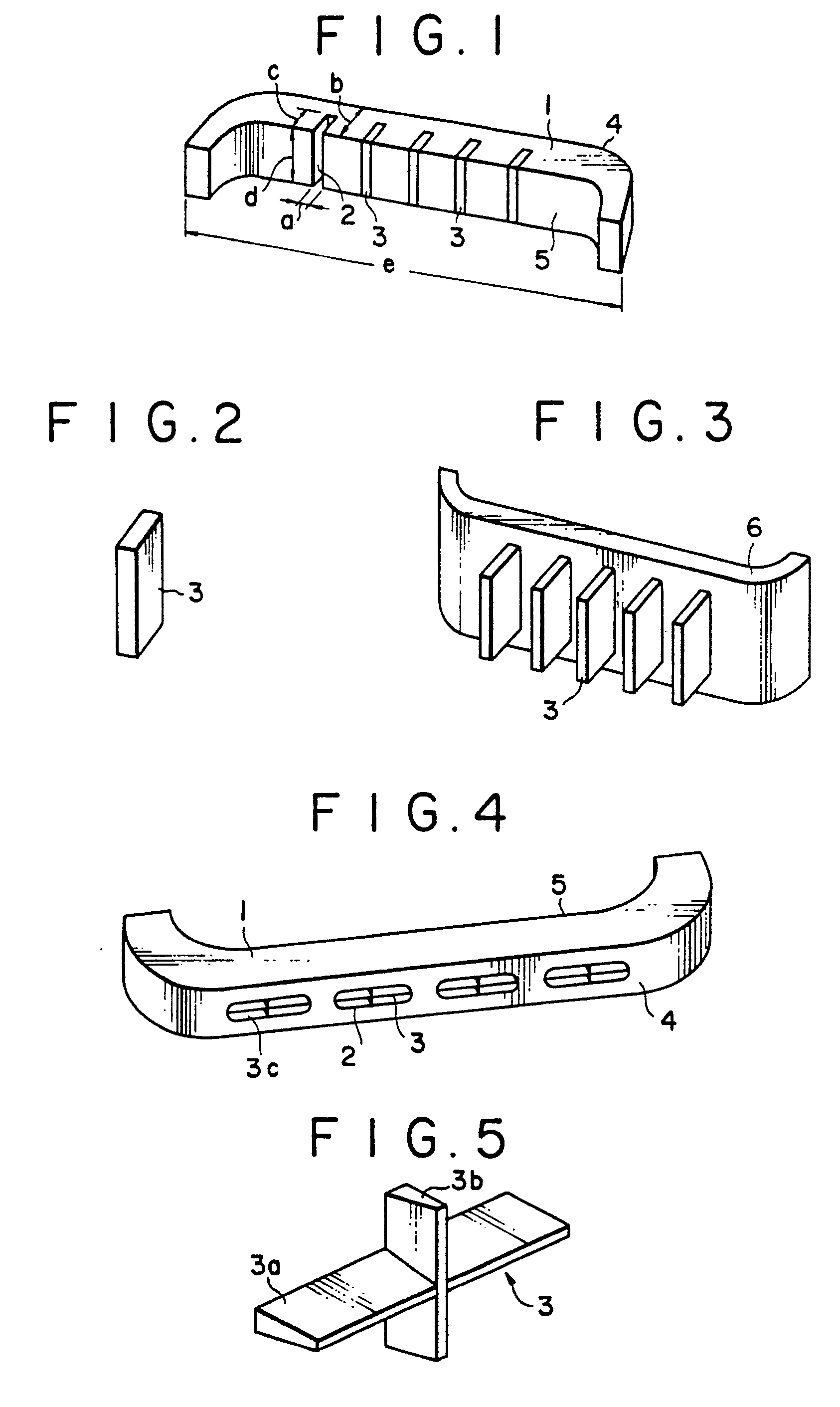
EUROPEAN PATENT SPECIFICATION |
| (45) |
Mention of the grant of the patent: |
|
10.10.1990 Bulletin 1990/41 |
| (22) |
Date of filing: 21.07.1987 |
|
| (51) |
International Patent Classification (IPC)5: B60R 19/18 |
|
| (54) |
Core material for automobile bumpers
Kernmaterial für Kraftfahrzeugstossstangen
Matériau pour pare-chocs de véhicules
|
| (84) |
Designated Contracting States: |
|
DE FR GB |
| (30) |
Priority: |
22.07.1986 JP 113174/86 U
21.01.1987 JP 7280/87 U
|
| (43) |
Date of publication of application: |
|
27.01.1988 Bulletin 1988/04 |
| (73) |
Proprietor: Japan Styrene Paper Corporation |
|
Chiyoda-ku
Tokyo (JP) |
|
| (72) |
Inventors: |
|
- Kuramochi, Hiroyuki
Hiratsuka-shi
Kanagawa-ken (JP)
- Kuranari, Hiroki
Ichikawa-shi
Chiba-ken (JP)
- Yamaguchi, Toru
Utsunomiya-shi
Tochigi-ken (JP)
- Tetsuka, Hisao
Shimotsuka-gun
Tochigi-ken (JP)
- Nakatsuka, Hideto
Isehara-shi
Kanagawa-ken (JP)
- Takahashi, Shingo
Utsunomiya-shi
Tochigi-ken (JP)
|
| (74) |
Representative: Allam, Peter Clerk et al |
|
LLOYD WISE, TREGEAR & CO.,
Commonwealth House,
1-19 New Oxford Street
London WC1A 1LW
London WC1A 1LW (GB) |
| (56) |
References cited: :
US-A- 3 721 433
US-A- 4 101 704
|
US-A- 4 078 837
US-A- 4 186 915
|
|
| |
|
|
|
|
| |
|
| Note: Within nine months from the publication of the mention of the grant of the European
patent, any person may give notice to the European Patent Office of opposition to
the European patent
granted. Notice of opposition shall be filed in a written reasoned statement. It shall
not be deemed to
have been filed until the opposition fee has been paid. (Art. 99(1) European Patent
Convention).
|
[0001] This invention relates generally to an energy absorbing bumper to be utilized on
automobiles and, more specifically, to an energy absorber bumper provided with a core
material formed of a polyolefin foam.
[0002] There are known a variety of energy absorbing bumpers in which a foamed polymeric
material is utilized as an energy-absorbing core material. Generally, the bumper includes
a front cover serving as a front impact surface, a back seam serving as a rear mounting
surface, and a foamed core disposed between the front cover and the back beam. Examples
of such automobile bumpers are those disclosed in United States patents Nos. 4 504
534 and 4, 600,636 owned by Japan Styrene Paper Corporation.
[0003] Conventional bumper cores are generally designed to withstand an impact of 1,55-3,11
Km/ h (2,5-5 mile/h). In order to improve the energy absorbing power, it is unavoidable
to use a core material of a higher density.
[0004] The present invention contemplates the provision of a bumper core material which
is light in weight but which has excellent energy absorbing property.
[0005] In accordance with the present invention there is provided an energy absorbing bumper
of the kind referred to and in which the core material comprises:
an elongated body formed of a foamed polyolefin resin and having front and rear surfaces,
said body being provided with a plurality of depressed portions in the front and/or
rear surfaces thereof; and
structural members formed of a synthetic resin and having a bulk density of 0,2-3,5
g/cm3, said structural members being disposed in at least part of said depressed portions.
[0006] The present invention will now be described in detail below with reference to the
accompanying drawings, in which:
Fig. 1 is a perspective view diagrammatically showing one embodiment of an automobile
bumper core material used according to the present invention;
Fig. 2 is an enlarged perspective view of the structural member;
Fig. 3 is a perspective view showing another embodiment of structural member;
Fig. 4 is a perspective view showing another embodiment of automobile bumper core
material used according to the present invention; and
Fig. 5 is an enlarged perspective view of the structural member of Fig. 4.
[0007] Referring now to Fig. 1, automobile bumper core material used according to the present
invention includes an elongated body 1 formed of a foamed polyolefin resin and having
front and rear surfaces 4 and 5. In the front surface 4 and/or rear surface 5 (in
the rear surface 5 in the illustrated specific embodiment) are provided a plurality
(five in the illustrated case) of depressed portions 2. The nu m ber of the depressed
portions 2 varies with the size of the elongated body 1 and the size of the depressed
portions 2, but generally it is 1-100, preferably 2-50. The depressed portions are
preferably arranged or distributed symmetrically in the axial direction.
[0008] The size or area of the opening of each depressed portion 2 ((axd) in the illustrated
case) is generally 0.5-200 cm
2, preferably 1-100 cm
2. The total area of the openings of the depressed portions (5(axd) in the illustrated
case) in the front surface 4 and/or rear surface 5 is desirably 1.5-100% of the projected
area ((dxe) in the illustrated case) of the elongated body 1, the projection being
in the direction from the front surface 4 to the rear surface 5 of the elongated body
1. When the depressed portions 2 are provided in either the front surface 4 or rear
surface 5, the total area of the openings of the depressed portions 2 is desirably
not greater than 70% of the projected area of the elongated body 1. The projected
area of the elongated body 1 is generally in the range of 400-5000 cm
2. The depth (c in the illustrated case) of each of the depressed portions 2 is preferably
15-95% of the thickness (b in the illustrated case) of the elongated body 1.
[0009] The polyolefin resin to be used as the elongated body 1 may include, for example,
polypropylene polymers such as polypropylene homopolymers, ethylene-propylene random
copolymers and ethylene-propylene block copolymers, high density polyethylenes and
high density polyethylenes modified with vinyl aromatic monomers. Above all, the use
of the polypropylene copolymers is most preferred. The density (apparent density)
of the elongated body 1 is generally 0.15-0.01 g/ cm
3, preferably 0.1-0.015 g/cm
3.
[0010] Disposed within at least a part of the depressed portions 2 are structural members
3 formed of a synthetic resin and having a density of 0.2-3.5 g/ cm
3. Both foamed or unfoamed resin may be used. Illustrative of suitable synthetic resin
to be used as the structural members are polyolefin resins such as polypropylenes
and polyethylenes, hard polyurethanes, polystyrenes, nylons, polycarbonates, polyethylene
terephthalates and hard vinyl chloride resins. These resins may be used singly or
as a mixture or as a composite of two or more.
[0011] If desired, a filler may be incorporated into the resin of which the structural members
3 are formed. Illustrative of suitable fillers are silica, mica, talc, clay, bentonite,
graphite, carbon black, calcium carbonate, titanium oxide, alumina, iron powder, molybdenum
disulfide, vanadium sulfide, polyacrylurea, cuprophthalocyanine, asbestos, glass fibers
and glass fiber fabric. The amount of the filler is generally 10-80 parts by weight,
preferably 20-70 parts by weight per 100 parts by weight of the resin.
[0012] The shape of the structural member 3 is not specifically limited as long as it permits
the insertion of the member 3 into the depressed portion 2. In the embodiment shown
in Figs. 1 and 2, the structural member 3 is a plate-like form which can plug the
depressed portion 2.
[0013] In another embodiment shown in Fig. 3, a plurality of the structural members 3 are
mounted integrally in a comb-like fashion on a back beam 6 which serves as a rear
mounting surface of the bumper assembly.
[0014] Figs. 4 and 5 depict a further embodiment, in which the structural member 3 is constructed
from two, intersected, laterally and vertically extending walls 3a and 3b. The depressed
portions 2 in this embodiment are provided in the front surface 4 of the elongated
body 1 and are each in the form of a cavity within which the structural member 3 is
disposed to define cells 3c therebetween. The structural member 3 may be in any other
form such as a honeycomb structure, rod or plate.
[0015] The structural members 3 are generally used in a number so that the ratio of the
total weight of the structural members 3 to the elongated foamed body 1 is in the
range of 1/50 to 5/1, preferably 1/30 to 3/1, more preferably 1/20 to 2.5/ 1 for reasons
of desirable energy absorbing property and lightness in weight of the bumper core
assembly.
[0016] The bumper core assembly used according to the present invention, in which the structural
members 3 are disposed within a plurality of bores 2 of the elongated foamed body
1, has an improved energy absorbing efficiency in comparison with a bumper core formed
of a single material with a higher density than the foamed body 1 and having the same
weight as that of the bumper core assembly of this invention.
[0017] The following examples and comparative examples will further illustrate the present
invention.
Example 1
[0018] A foamed body, formed of an ethylene-propylene random copolymer (ethylene content:
2.5 weight %) and having a size of 10 cmx50 cmx7 cm and a bulk density of 0.06 g/cm
3 was prepared in a manner as disclosed in United States patent No. 4,600,636. The
foamed body was formed to provide seven (7) depressions, similar to those shown in
Fig. 1, each having a size of 10 cmxO.3 cmx3.5 cm in the front surface (with an area
of 10x50 cm
2) thereof. Thus, the foamed body has a projected area in the direction from the front
surface to the rear surface of 500 cm
2, a total area of the openings of the depressions of 21 (=
7×10×0.3) cm
2 and a weight of 206 g.
[0019] Into each depression was inserted a plate-like structural member formed of a polypropylene
and having a bulk density of 0.9 g/cm
3 to obtain a core material. The structural members each had a shape identical to the
shape of the depression of the foamed body. The total weight of the structural members
is thus 66 (=
7x0.9x10x0.3x3.5) g. The core material has a total weight of 272 g and a weight ratio
of the structural members to the foamed body of 0.32/1. The core material was then
tested for its energy absorbing property. Thus, the core material was horizontally
placed on a table with the front surface thereof being directed upward. A plate-like
weight (1500 kg) was dropped on the core material at a speed of E mile/hr and the
load received by the rear side oi the core material was measured. The load causec
was 8.2 tons.
Comparative example 1
[0020] An ethylene-propylene random copolymer (ethylene content: 2.5 weight %) foamed body
having the same size as that in Example 1 and a density of 0.078 g/cm
3 was prepared. The foamed body had no depressions. The weight of the foamed body is
thus 273 g. The energy absorbing property of the foamed body was measured in the same
manner as in Example 1 to reveal that the load caused was 10.0 tons.
Example 2
[0021] Example 1 was repeated in the same manner as that of Example 1 except that the foamed
body having a density of 0.078 g/cm
3 and the structural member having a density of 1.07 g/cm
3 were used. The structural member used contained 25% by weight of glass fiber fillers
dispersed in the polypropylene matrix. Thus, the core material has a total weight
of 346 g and a weight ratio of the structural members to the foamed body of 0.29/1.
[0022] The core material was then tested for its energy absorbing property in the same manner
as Example 1. The exerted load was 8.3 g/cm
3.
Comparative example 2
[0023] Comparative Example 1 was repeated in the same manner as described, except that the
foamed body had a bulk density of 0.099 g/cm
3 was used. The weight of the foamed body is thus 347 g. The load caused was found
to be 12 tons.
[0024] From the results shown above, it will be appreciated that the bumper core material
used according to the present invention exhibits superior energy absorbing property
without causing an undesirable high increase in weight.
1. An energy absorbing bumper comprising a front cover providing an impact surface,
a back beam (6) serving as a rear mounting surface, and a core disposed between the
front cover and the back beam (6) and shaped as an elongated body (1) formed of a
foamed polyolefin resin and having front and rear surfaces (4, 5), characterized in
that said body (1) is provided with a plurality of depressed portions (2) in the front
and/or rear surfaces (4, 5) thereof; and in that structural members (3) formed of
a synthetic resin and having a bulk density of 0.2 to 3.5 g/cm3 are disposed within at least part of said depressed portions (2).
2. An energy absorbing bumper according to Claim 1, wherein the area of the opening
of each depressed portion (2) is in the range of 0.5 to 200 cm2.
3. An energy absorbing bumper according to Claim 1 or Claim 2, wherein the total area
of the openings of said depressed portions (2) is in the range of 15 to 100% of the
area of projections of said body (1) in the direction from the front to rear surfaces
(4, 5) thereof.
4. An energy absorbing bumper according to Claim 3, wherein said area of projection
is in the range of 1.5 to 100 cm2.
5. An energy absorbing bumper according to any preceding Claim, wherein each depressed
portion (2) has a depth (C) of 15 to 95% of the distance (b) between the front and
the rear surfaces (4, 5).
6. An energy absorbing bumper according to any preceding Claim, wherein each of said
structural members (3) substantially completely fills the corresponding depressed
portion (2).
7. An energy absorbing bumper according to any preceding Claim, wherein each of said
structural members (3) contains a filler dispersed in the matrix of said synthetic
resin.
8. An energy absorbing bumper according to any preceding Claim, wherein each of said
structural members (3) has a denisty of 0.2 to 1.5 g/cm3.
9. An energy absorbing bumper according to any preceding Claim, wherein the ratio
of the total weight of the structural members (3) to the weight of the elongated body
(1) is in the range of 1/30 to 3/1.
10. An energy absorbing bumper according to any preceding Claim, wherein each of said
structural members (3) includes intersected, laterally and vertically extending walls
(3a, 3b) formed of the synthetic resin, so that there are defined cells (3c) between
the inside wall of the depressed portions (2) and said laterally and vertically extending
walls.
11. An energy absorbing bumper according to any one of Claims 1-9, wherein said structural
members (3) are integrally mounted on a support (6).
12. An energy absorbing bumper according to any one of Claims 1-9 or Claim 11, wherein
each of said depressed portions (2) extends from said front surface (4) toward said
rear surface (5) or from said rear surface (5) toward said front surface (4) and wherein
each of said structural members (3) has a shape extending along its axis and is disposed
within said depressed portion (2) so that the axis thereof is in parallel with the
direction along which said depressed portion (2) extends.
1. Kernmaterial für Kraftfahrzeugstoßstangen bestehend aus einer vorderen Abdeckung,
die eine dem Stoß ausgesetzte Fläche bildet, einem rückwärtigen Träger (6), der als
hintere Aufbaufläche dient, und aus einem Kern, der zwischen der vorderen Abdeckung
und dem rückwärtigen Träger (6) angeordnet und als länglicher Körper (1) ausgestaltet
ist, der aus einem geschäumten Polyolefinharz gebildet sowie mit einer vorderen und
hinteren Oberfläche (4 bzw. 5) versehen ist, dadurch gekennzeichnet, daß der Körper
(1) mit einer Anzahl von tiefliegenden Abschnitten (2) auf der vorderen bzw. hinteren
Oberfläche (4, 5) versehen ist und daß aus einem Kunstharz gebildete Bauteile mit
einer Fülldichte von 0,2 bis 3,5 g/cm3 zumindest teilweise innerhalb der tiefliegenden Abschnitte (2) angeordnet sind.
2. Vorrichtung nach Anspruch 1, dadurch gekennzeichnet, daß die Fläche der Öffnung
jedes tiefliegenden Abschnitts (2) im Bereich von 0,5 bis 200 cm2 liegt.
3. Vorricvtung nach einem der vorhergehenden Ansprüche 1 oder 2, dadurch gekennzeichnet,
daß die Gesamtfläche der Öffnungen der tiefliegenden Abschnitte (2) im Bereich von
15 bis 100% der Fläche der Vorsprünge des Körpers (1) in der Richtung von der vorderen
zur hinteren Fläche (4 bzw. 5) liegt.
4. Vorrichtung nach Anspruch 3, dadurch gekennzeichnet, daß die Vorsprungsfläche im
Bereich von 1,5 bis 100 cm2 liegt.
5. Vorrichtung nach einem der vorhergehenden Ansprüche 1 bis 4, dadurch gekennzeichnet,
daß jeder tiefliegende Abschnitt (2) eine Tiefe (C) von 15 bis 95% des Abstandes (b)
zwischen der vorderen und hinteren Fläche (4 bzw. 5) hat.
6. Vorrichtung nach einem der vorhergehenden Ansprüche 1 bis 5, dadurch gekennzeichnet,
daß jedes der Bauteile (3) die entsprechenden tiefligenden Abschnitte (2) im wesentlichen
vollständig ausfüllt.
7. Vorrichtung nach einem der vorhergehenden Ansprüche 1 bis 6, dadurch gekennzeichnet,
daß jedes der Bauteile (3) einen Füllstoff enthält, der in der Matrix des Kunstharzes
feinst verteilt ist.
8. Vorrichtung nach einem der vorhergehenden Ansprüche 1 bis 7, dadurch gekennzeichnet,
daß jedes der Bauteile (3) eine Dichte von 0,2 bis 1,5 g/cm3 besitzt.
9. Vorrichtung nach einem der vorhergehenden Ansprüche 1 bis 8, dadurch gekennzeichnet,
daß das Verhältnis von Gesamtgewicht der Bauteile (3) zum Gewicht des länglichen Körpers
(1) im Bereich von 1/30 bis 3/1 liegt.
10. Vorrichtung nach einem der vorhergehenden Ansprüche 1 bis 9, dadurch gekennzeichnet,
daß jedes der Bauteile (3) sich kreuzende, seitlich und senkrecht verlaufende Wände
(3a, 3b) aus Kunstharz aufweist, so daß es Zellen (3c) gibt, die zwischen der Innenwand
der tiefliegenden Abschnitte (2) und der sich seitlich sowie senkrecht erstreckenden
Wand festgelegt sind.
11. Vorrichtung nach einem der vorhergehenden Ansprüche 1 bis 9, dadurch gekennzeichnet,
daß die Bauteile (3) auf dem Träger (6) mit diesem ein Stück bildend eingesetzt sind.
12. Vorrichtung nach einem der vorhergehenden Ansprüche 1 bis 9 oder Anspruch 11,
dadurch gekennzeichnet, daß die tiefliegenden Abschnitte (2) sich von der vorderen
Fläche (4) zur hinteren Fläche (5) oder von der hinteren Fläche (5) zur vorderen Fläche
(4) erstrecken, wobei jedes der Bauteile (3) eine Form hat, die sich längs ihrer Achse
erstreckt und innerhalb des tiefliegenden Abschnitts (2) derart angeordnet ist, daß
ihre Achse mit der Richtung parallel liegt, längs der sich der tiefliegende Abschnitt
(2) erstreckt.
1. Pare-chocs absorbeur d'énergie, comprenant une couverture avant fournissant une
surface d'impact, une poutre arrière (6) servant de surface de montage arrière et
un noyau disposé entre la couverture avant et la poutre arrière (6) et ayant la forme
d'un corps (1) allongé formé d'une mousse de résine de polyoléfine, ce corps ayant
des surfaces avant et arrière (4, 5), pare-chocs caractérisé en ce que ledit corps
(1) comporte plusieurs parties en creux (2) dans ses surfaces avant et/ou arrière
(4, 5) et en ce que des éléments structurels (3), formés d'une résine synthétique
et ayant une masse volumique apparente de 0,2 à 3,5 g/cm3, sont disposés au sein d'au moins une partie desdites portions ou parties (2) en
creux.
2. Pare-chocs absorbeur d'énergie selon la revendication 1, dans lequel l'aire de
surface de l'ouverture de chaque partie (2) en creux se situe entre 0,5 et 200 cm3.
3. Pare-chocs absorbeur d'énergie selon la revendication 1 ou la revendication 2,
dans lequel l'aire de surface totale des ouvertures desdites parties (2) en creux
représente de 15 à 100% de l'aire des projections dudit corps (1) dans la direction
allant de la surfuce avant à la surface arrière (4, 5) de ce corps.
4. Pare-chocs absorbeur d'énergie selon la revendication 3, dans lequel ladite aire
de projection a une surface comprise entre 1,5 et 100 cm2.
5. Pare-chocs absorbeur d'énergie selon l'une quelconque des revendications précédentes,
dans lequel chaque partie (2) en creux a une profondeur (c) représentant 15 à 95%
de la distance (b) séparant la surface avant de la surface arrière (4, 5).
6. Pare-chocs absorbeur d'énergie selon l'une quelconque des revendications précédentes,
dans lequel chacun des éléments structurels (3) emplit quasi-totalement la partie
(2) en creux correspondante.
7. Pare-chocs absorbeur d'énergie selon l'une quelconque des revendications précédentes,
dans lequel chacun desdits éléments structurels (3) contient une charge, dispersée
dans la matrice constituée par ladite résine synthétique.
8. Pare-chocs absorbeur d'énergie selon l'une quelconque des revendications précédentes,
dans lequel chacun desdits éléments structurels (3) a une masse volumique de 0,2 à
1,5 g/cm3.
9. Pare-chocs absorbeur d'énergie selon l'une quelconque des revendications précédentes,
dans lequel le rapport entre le poids total des éléments structurels (3) et le poids
du corps (1) allongé se situe entre 1/30 et 3/1.
10. Pare-chocs absorbeur d'énergie selon l'une quelconque des revendications précédentes,
dans lequel chacun desdits éléments de structure (3) comprend des parois (3a, 3b)
s'étendant latéralement et verticalement et formant une intersection, ces parois étant
formées en la résine synthétique, de sorte que des cellules (3c) sont définies entre
la paroi intérieure des parties (2) en creux et lesdites parois s'étendant latéralement
et verticalement.
11. Pare-chocs absorbeur d'énergie selon l'une quelconque des revendications 1 à 9,
dans lequel lesdits éléments structurels (3) sont montés sur un support (6) dont ils
font partie intégrante (support monobloc).
12. Pare-chocs absorbeur d'énergie selon l'une quelconque des revendications 1 à 9
ou selon la revendication 11, dans lequel chacune desdites parties (2) en creux s'étend
depuis ladite surface avant (4) vers ladite surface arrière (5) ou de ladite surface
arrière (5) vers ladite surface avant (4) et dans lequel chacun desdits éléments structurels
(3) a une forme s'étendant le long de son axe et est disposé au sein de ladite partie
(2) en creux de manière que son axe soit parallèle à la direction le long de laquelle
s'étend ladite partie (2) en creux.