| (19) |
 |
|
(11) |
EP 0 255 969 B1 |
| (12) |
EUROPEAN PATENT SPECIFICATION |
| (45) |
Mention of the grant of the patent: |
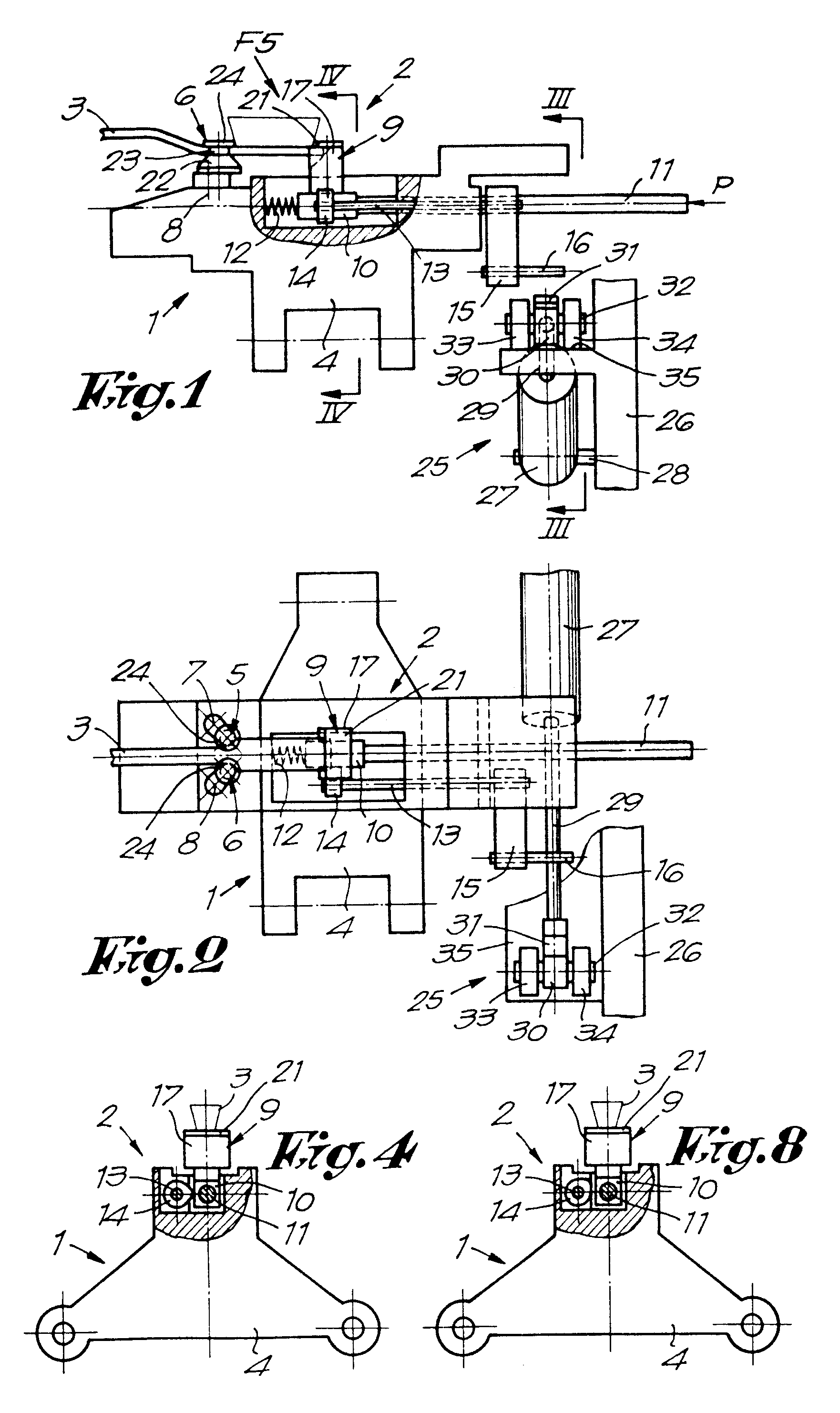
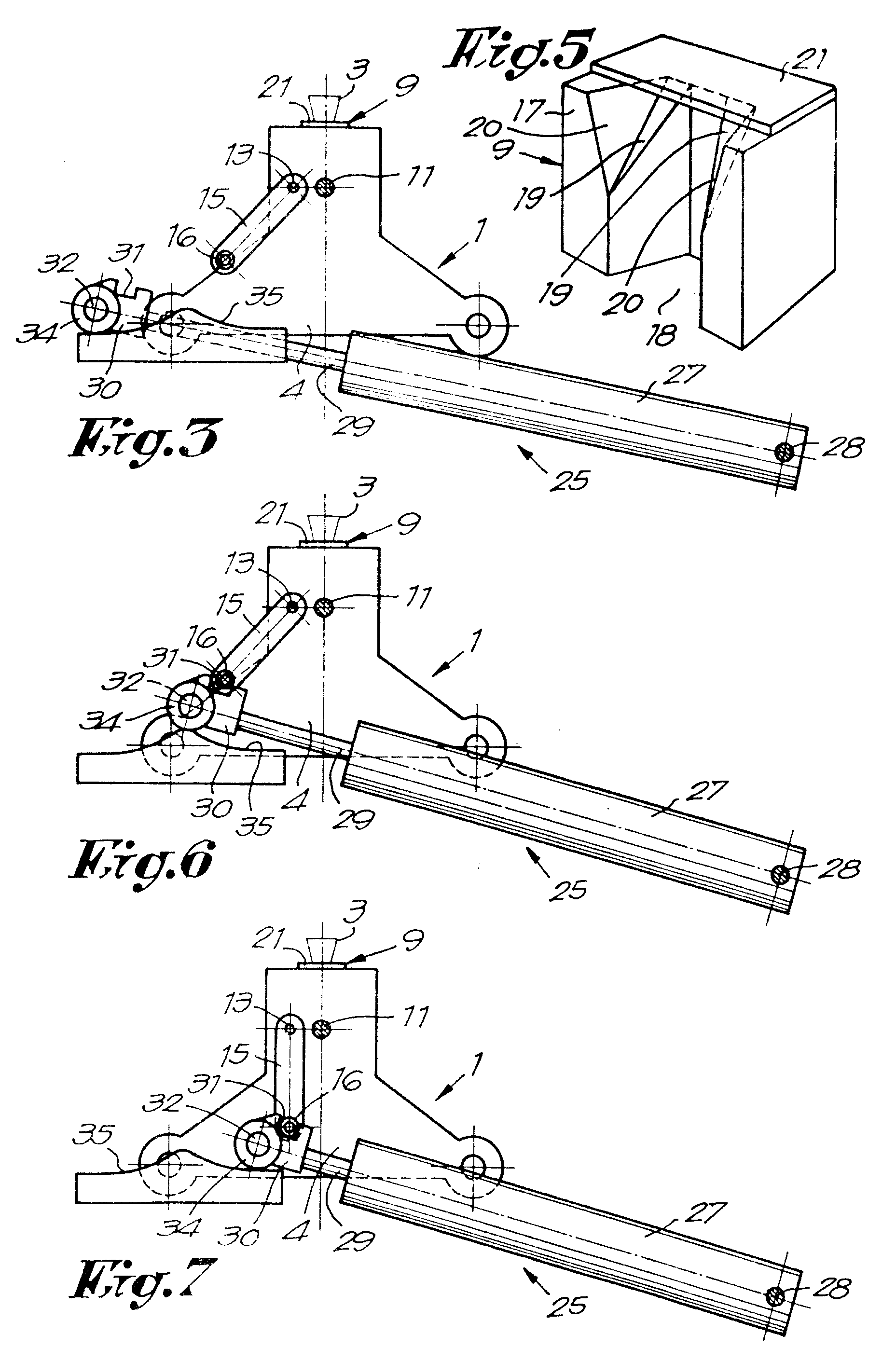
|
09.06.1993 Bulletin 1993/23 |
| (22) |
Date of filing: 20.07.1987 |
|
| (51) |
International Patent Classification (IPC)5: A46D 3/08 |
|
| (54) |
Universal brush clamp
Universalklemme für Bürstenmaschine
Etau universel pour la fabrication des brosses
|
| (84) |
Designated Contracting States: |
|
DE GB IT |
| (30) |
Priority: |
05.08.1986 BE 2061027
|
| (43) |
Date of publication of application: |
|
17.02.1988 Bulletin 1988/07 |
| (73) |
Proprietor: G.B. BOUCHERIE, N.V. |
|
B-8700 Izegem (BE) |
|
| (72) |
Inventor: |
|
- Boucherie, Leonel
B-8810 Roeselare-Rumbeke (BE)
|
| (74) |
Representative: Donné, Eddy |
|
M.F.J.Bockstael
Arenbergstraat 13
2000 Anvers
2000 Anvers (BE) |
| (56) |
References cited: :
DE-A- 1 903 771
US-A- 3 279 858
US-A- 3 614 165
|
US-A- 2 851 308
US-A- 3 306 670
|
|
| |
|
|
|
|
| |
|
| Note: Within nine months from the publication of the mention of the grant of the European
patent, any person may give notice to the European Patent Office of opposition to
the European patent
granted. Notice of opposition shall be filed in a written reasoned statement. It shall
not be deemed to
have been filed until the opposition fee has been paid. (Art. 99(1) European Patent
Convention).
|
[0001] This invention concerns a universal brush clamp, i.e. a device by which it is possible
with one universal clamp to fix different sorts of brush bodies in a brush-making
machine or in the peripheral appliances of this brush-making machine.
[0002] It is known that so far each sort of brush body requires a separate brush clamping
device that is applicable to it, for example by means of underlays applied to the
back of the brush body and by suitable clamping devices. The consequence of this is
that when a machine for making or processing brush bodies and/or brushes is switched
from one type of brush to another type, each of the brush clamps or brush clamping
devices named above has to be changed.
[0003] In view of the number of brush clamping devices in a brush-making machine or in the
apparatus for processing the brush bodies and/or brushes, there being in general a
relatively large number of such devices, and these devices being not only relatively
complicated but also consisting of a large number of parts which have to be fitted
together accurately, it is clear that changing these brush clamps is not only a time-consuming
activity but also a very expensive affair.
[0004] One sample which brings out this problem very clearly indeed is in the manufacture
of toothbrushes in view of the number of brush clamping devices not only on these
machines but in particular in the peripherals collaborating with these machines in
the further processing of the brushes, such as trimming and the like, this number
being very considerable.
[0005] A clamping apparatus for tooth brushes is known from US-A-3.279.858. This apparatus
however is not apt for automatically operating on brush bodies of different dimensions.
[0006] It is the purpose of this invention to avoid the above-named and other disadvantages
and to offer a brush clamp or brush clamping device that is universal, i.e. that is
so designed that nearly all the different types of a brush bodies can be fixed with
it.
[0007] To this end the invention relates to a universal brush clamp, comprising a fixed
stop and a clamp between which a brush body is clamped, the distance between said
fixed stop and said clamp being adjustable, characterized in that said fixed stop
consists of a U-shaped recess above which an abutment plate is fixed, each side of
said U-shaped recess comprising two pairs of chamfered edges diverging from the bottom
of the recess towards the open side of the recess, a portion of said brush body being
located in said recess between said abutment plate and said chamfered edges; and in
that said clamp comprises a conical part above which an abutment part is provided,
allowing that during clamping said brush body is automatically displaced along said
conical part of said clamp and along said chamfered edges of said fixed stop and is
urged into contact with said abutment parts, thereby allowing the clamping of brush
bodies having different shapes and/or dimensions.
[0008] More particularly, the above-named elements are constituted by one fixed stop and
one or more clamps which press the brush body against the fixed stop and cooperate
with the latter to position the brush body accurately, the distance between the above-named
stop and the clamp being adjustable.
[0009] To gain a better insight into the characteristics of the invention, we give below
an example, which is not limitative, of one possible version of a universal brush
clamp of this type, with reference to the attached drawings in which:
figure 1 gives a schematic and partially sectioned side view of a universal brush
clamp according to the invention;
figure 2 gives a view from above of figure 2; figures 3 and 4 respectively are sections
along the lines III-III and IV-IV in figure 1;
figure 5 reproduces on a larger scale and in perspective the part indicated by F5
in figure 1;
figures 6 and 7 are views similar to that of figure 3 but for positions assumed by
the invention during the unlatching of the brush clamp;
figure 8 gives a view that is similar to that of figure 4 but for a second position
of the brush clamp.
[0010] A support 1 for a brush clamp 2 for fixing a brush 3 is reproduced schematically
in the figures, and in this specific case, the support 1 is constituted by one link
4 of a chain of which each link carries such a brush clamp 2.
[0011] Although in this example support 1 is shown as a link of a chain for handling the
brushes 3, it is clear that this support can also form part of a so-called drum of
a brush-making machine in which brush bodies 3 are clamped fast during the actual
process of making a brush.
[0012] The universal brush clamp 2 according to the invention consists in this version principally
of two clamping cams 5, 6 which can be suitably rotated round axes 7, 8, and a stop
9 feed on a slide 10, which is guided in an appropriate manner, not shown on the drawing,
in respect of support 1.
[0013] At one extremity of the slide 10 there is an extension 11, consisting of a rod or
the like, whose purpose is to prolong the slide 10 outside the support 1, while between
these support 1 and the other extremity of the slide 10, a spring 12 is provided.
[0014] In the support 1, apart from the slide 10, there is also a shaft 13 which can rotate
freely and which, at the place of the slide 10, is provided with a cam 14 which, outside
the support 1, is connected with a lever 15 of which the free extremity has a projection
15, in the form of a spindle for sample.
[0015] The above-named fixed stop 9 consists principally of a lower part 17 provided with
a U-shaped recess 18, the corners of which have triangular chamfered edges respectively
19-20, and above the part 17 a plate 21 is provided which projects over the chamfered
edges 19 and 20.
[0016] The clamping cams 5 and 6 have a shape which is mainly as reproduced in figure 1,
i.e. a conical part 22 that is connected, via a cylindrical part 23, with an extremity
24, the diameter of which is significantly larger that the smallest diameter of the
above-named conical part 22.
[0017] Finally, the figures also show an additional device 25 which, for example, is fixed
to the fixed frame 26 of the machine, this device 25 consisting mainly of a pressure
cylinder 27 which is connected with the frame 26 in such a way that it can be hinged
by means of a shaft 28, and of which the piston rod 29 is fitted at its free extremity
with a thickened part 30 in which there is a groove 31.
[0018] In the part 30, a shaft 32 is fixed, to which are applied one or two freely rotating
runners, respectively 33 and 34.
[0019] These runners 33 and 34 cooperate with a cam 35 which is also connected to the machine
frame 26.
[0020] Clamping a brush body 3 in a universal clamp according to the invention is carried
out simply by adjusting the fixed stop 9 to a certain position and subsequently placing
the brush body in the clamp, more particularly on the chamfered edges 19-20 of the
fixed stop 9 and the conical part 22 of the cams 5-6. By subsequently pressing the
brush body against the triangular chamfered edges 19 and 20 of the fixed stop 9 by
means of the clamping cams 5 and 6 which are brought to bear on the brush body for
this purpose, as shown in figures 1 and 2, the following occurs:
The brush body, by the cooperation of, one the one hand, the triangular chamfered
edges 19-20 of the fixed stop 9 and, on the other hand, of the conical part 22 of
the clamping cams 5 and 6, during the action of these clamping cams, simultaneously
pressing it against the stop 9, is displaced upwards until the brush body 3 lies cleanly
against, on the one hand, the plate 21 of the feed stop 9 and, on the other hand,
the part 24 of each clamping cam 5 and 6.
[0021] In this way, because of the shape of the stop 9 and of the clamping cams 5 and 6,
the positioning and fixing of a brush body becomes a simple matter.
[0022] With the object of making such a brush clamp independent of the shape and/or length
of the brush body 3, apart from the above-mentioned measures, we have also aimed at
an adjustment of the fixed stop 9, so as to make universal adaptation both in length
and height possible.
[0023] This second adjustment is obtained by the displacement of the slide 10.
[0024] The latter is always held fast against the action of the spring 12 by, for example,
the cam 14 which clamps against the slide 10. At that moment, the device is in the
position as shown in figures 1 to 4; in other words the slide 10 together with the
extension 11, is immovable. For this purpose the cam 14 acts on the slide 10 and the
spring 12 has no effect.
[0025] When at a given moment in the manufacture or treatment of a determined type of brush
body, a change is made to the production or treatment of brushes with another form
of brush body, then the pressure cylinder 27 is involved. For this purpose the slot
31 is displaced in the bulge 30 towards the lever 15 - see figure 6 - and all this
happens in such a way that, through the presence of the cam 35, the above-named slot
31 comes into contact with the spindle 16 on the lever 15, and thus when this movement
is continued further, as shown in figure 7, this lever is displaced in such a way
that the cam 14 is turned as shown in figure 8. At that moment, the slide is freed,
and the spring 12 can act on it to push it back.
[0026] It suffices at this moment, by exercising an appropriate pressure, in the direction
of the arrow P, on the rod 11, to bring the slide 10 and thus the stop 9 into a suitable
position in respect of the support 1 so as subsequently again to activate the pressure
cylinder 27 in order to move from the position as shown in figure 7 into the position
as shown in figure 3 and thereby to fix the slide 10 in the determined position in
respect of support 1 by the clamping of cam 14.
[0027] It is clear that the above-named process must be carried out for each brush clamp
present in the machine, i.e. when this brush clamp is placed against the device 25,
the adjustment will vary until all the clamps are adjusted and work can subsequently
be continued with the new brush type.
[0028] The pressure exercised in the direction of the arrow P can be exercised either manually
or automatically, and this pressure can be obtained either by letting the various
prolongations 11 of each slide 10 cooperate with a suitably profiled guide, or by
exercising a pressure P at the appropriate place on these prolongations 11 which can
be controlled in any manner desired.
[0029] Obviously this invention is in no way limited to the variant described as an example
and shown in the accompanying drawings and a universal brush clamp of this type or
the elements cooperating with it according to the invention can be realized in all
sorts of forms and dimensions.
[0030] It is in any case clear that the universal brush clamp according to the invention
applies to all possible clamps for fixing brush bodies in a brush-making machine or
a machine for the processing of brush bodies and/or brushes, independently of whether
the elements named above, respectively the fixed stop and the clamp or clamps, are
placed against each other following the length, or the breadth, or according to a
diagonal or similar element of the brush body.
1. Universal brush clamp, comprising a fixed stop (9) and a clamp (5-6) between which
a brush body is clamped, the distance between said fixed stop (9) and said clamp (5-6)
being adjustable, characterized in that said fixed stop (9) consists of a U-shaped
recess (18) above which an abutment plate (21) is fixed, each side of said U-shaped
recess (18) comprising two pairs of chamfered edges (19-20) diverging from the bottom
of the recess towards the open side of the recess, a portion of said brush body being
located in said recess between said abutment plate (21) and said chamfered edges (19-20);
and in that said champ (5-6) comprises a conical part (22) above which an abutment
part (24) is provided, allowing that during clamping said brush body is automatically
displaced along said conical part (22) of said clamp (5-6) and along said chamfered
edges (19-20) of said fixed stop (9) and is urged into contact with said abutment
parts (21,24), thereby allowing the clamping of brush bodies having different shapes
and/or dimensions.
2. Universal brush clamp according to claim 1, characterized by the fact that the above-named
clamp (5-6) is formed by two clamping cams.
3. Universal brush clamp according to claim 1 or 2, characterized by the fact that the
fixed stop (9) can have its distance adjusted and set in relation to the clamp (5-6).
4. Universal brush clamp according to claim 3, characterized by the fact that the fixed
stop (9) is fixed on a slide (10) which can be displaced to and fro in the direction
of the clamping cam (5-6) and can be brought to and fixed in any desired position.
5. Universal brush clamp according to claim 4, characterized by the fact that between
the slide (10) and the support (1) in respect of which it can be displaced, a spring
(12) is provided which always attempts to displace the slide in one direction, and
by the fact that the opposite extremity of the slide (10) has a prolongation (11)
which projects as far as the above-named support, where it can be acted on so as to
adjust the position of the slide (10).
6. Universal brush clamp according to claims 4 or 5, characterized by the fact that the
slide (10) is held fast in respect of the support (1) by a clamping action.
7. Universal brush clamp according to claim 6, characterized by the fact that a cam (14)
acts on the slide (10).
8. Universal brush clamp according to claim 7, characterized by the fact that the cam
(14) is fixed on a shaft (13) which extends outside the support (1) and is there provided
with means of turning it.
9. Universal brush clamp according to claim 8, characterized by the fact that the above-named
means are formed by a lever (15) with which a control device (25) can cooperate.
10. Universal brush clamp according to claim 9, characterized by the fact that the above-named
control device is formed by a projection (16) on the above-named lever, and a slot
(31) which is applied to the free extremity of the piston rod (29) of a pressure cylinder
(27), this free extremity being displaced along a cam (35) so as to bring the slot
(31) in contact with or respectively to free it from the projection (16).
11. Universal brush clamp according to claim 10, characterized by the fact that the slot
(31) is applied to a bulge (30) on the extremity of the piston rod (29), wherein said
bulge (30) is provided with runners (33-34) contacting the cam (35).
12. Universal brush clamp according any one of the foregoing claims, characterized by
the fact that the chamfered edges are located in a common part (17) on which the plate
(21) is fixed.
13. Universal brush clamp according to one of the foregoing claims, characterized by the
fact that between the conical part (22) and the abutment part (24) a cylindrical part
(23) is provided.
14. Universal brush clamp according to one or more of the above claims, characterized
by the fact that the adjustment of the distance between the above-named fixed stop
(9) and clamp (5-6) is adjusted by displacing these elements in a setting station.
15. Universal brush clamp according to one or more of the claims 1 to 13, characterized
by the fact that the adjustment of the distance between the above-named fixed stop
(9) and clamp 5-6 is made by simultaneously displacing these elements for all the
brush clamps occuring on a given machine.
16. Universal brush clamp according to claim 14 or 15, characterized in that the adjustment
is made manually.
17. Universal brush clamp according to claim 14 or 15, characterized in that the adjustment
is made automatically.
18. Universal brush clamp according to claim 17, characterized in that the adjustment
is made via a pressure cylinder.
19. Universal brush clamp according to claim 17, characterized in that the adjustment
is made via a servomotor, for example a stepping motor, DC or AC servomotor, hydroservos,
etc.
1. Universelle Bürstenklemme, die einen festen Anschlag (9) und eine Klemme (5-6) umfaßt,
zwischen denen ein Bürstenkörper festgeklemmt wird, wobei der Abstand zwischen besagtem
festen Anschlag (9) und besagter Klemme (5-6) reguliert werden kann, dadurch gekennzeichnet,
daß besagter fester Anschlag (9) aus einer U-förmigen Aussparung (18) besteht, über
welcher eine Anschlagplatte (21) angebracht ist, wobei jede Seite von besagter U-förmiger
Aussparung (18) zwei Paar abgeschrägte Kanten (19-20) aufweist, die vom Boden der
Aussparung nach der offenen Seite der Aussparung hin divergieren, wobei ein Teil des
besagten Bürstenkörpers in besagter Aussparung zwischen besagter Anschlagplatte (21)
und besagten abgeschrägten Kanten (19-20) plaziert wird; und dadurch, daß besagte
Klemme (5-6) einen konischen Teil (22) aufweist, über welchem ein Anschlagteil (24)
vorgesehen ist, welches es erlaubt, daß während des Klemmens der besagte Bürstenkörper
automatisch entlang dem besagtem konischen Teil (22) besagter Klemme (5-6) und entlang
den besagten abgeschrägten Kanten (19-20) von besagtem festen Anschlag (9) verschoben
und zwangsläufig mit besagten Anschlagteilen (21,24) in Kontakt gebracht wird und
dabei das Klemmen von Bürstenkörpern verschiedener Formen und/oder Abmessungen ermöglicht.
2. Universelle Bürstenklemme gemäß Anspruch 1, dadurch gekennzeichnet, daß die obengenannte
Klemme (5-6) durch zwei Klemmnocken gebildet wird.
3. Universelle Bürstenklemme gemäß Anspruch 1 oder 2, dadurch gekennzeichnet, daß der
Abstand des festen Anschlags (9) in Bezug auf die Klemme (5-6) reguliert und eingestellt
werden kann.
4. Universelle Bürstenklemme gemäß Anspruch 3, dadurch gekennzeichnet, daß der feste
Anschlag (9) auf einem Schlitten (10) befestigt ist, der in Richtung des Klemmnockens
(5-6) hin- und herbewegt sowie in jede gewünschte Position gebracht und in dieser
fixiert werden kann.
5. Universelle Bürstenklemme gemäß Anspruch 4, dadurch gekennzeichnet, daß zwischen dem
Schlitten (10) und dem Träger (1), in Bezug auf welchen er verschoben werden kann,
eine Feder (12) vorgesehen ist, die stets danach strebt, den Schlitten in eine Richtung
zu verschieben, und dadurch, daß das gegenüberliegende Ende des Schlittens (10) eine
Verlängerung (11) aufweist, die so weit wie der obengenannte Träger reicht, wo auf
sie eingewirkt werden kann, um die Position des Schlittens (10) einzustellen.
6. Universelle Bürstenklemme gemäß den Ansprüchen 4 oder 5, dadurch gekennzeichnet, daß
der Schlitten (10) in Bezug auf den Träger (1) durch einen Klemmvorgang festgehalten
wird.
7. Universelle Bürstenklemme gemäß Anspruch 6, dadurch gekennzeichnet, daß ein Nocken
(14) auf den Schlitten (10) einwirkt.
8. Universelle Bürstenklemme gemäß Anspruch 7, dadurch gekennzeichnet, daß der Nocken
(14) auf einer Welle (13) befestigt ist, die sich außerhalb des Trägers (1) erstreckt
und dort mit Mitteln versehen ist, um sie zu drehen.
9. Universelle Bürstenklemme gemäß Anspruch 8, dadurch gekennzeichnet, daß die obengenannten
Mittel durch einen Hebel (15) gebildet werden, auf den eine Steuervorrichtung (25)
einwirken kann.
10. Universelle Bürstenklemme gemäß Anspruch 9, dadurch gekennzeichnet, daß die obengenannte
Steuervorrichtung durch eine Verlängerung (16) auf dem obengenannten Hebel gebildet
wird, sowie durch eine Nut (31), die an dem freien Ende der Kolbenstange (29) eines
Druckzylinders (27) angebracht ist, wobei dieses freie Ende entlang einem Nocken (35)
verschoben werden kann, um die Nut (31) in Kontakt mit der Verlängerung (16) zu bringen
oder sie entsprechend daraus zu lösen.
11. Universelle Bürstenklemme gemäß Anspruch 10, dadurch gekennzeichnet, daß die Nut (31)
an einer Verdickung (30) auf dem Ende der Kolbenstange (29) angebracht ist, wobei
besagte Verdickung (30) mit Rollen (33-34) versehen ist, die Kontakt mit dem Nocken
(35) haben.
12. Universelle Bürstenklemme gemäß einem der vorgenannten Ansprüche, dadurch gekennzeichnet,
daß die abgeschrägten Kanten auf einem gemeinsamen Teil (17) angebracht sind, auf
welchem die Platte (21) befestigt ist.
13. Universelle Bürstenklemme gemäß einem der vorgenannten Ansprüche, dadurch gekennzeichnet,
daß zwischen dem konischen Teil (22) und dem Anschlagteil (24) ein zylindrisches Teil
(23) vorgesehen ist.
14. Universelle Bürstenklemme gemäß einem oder mehreren der vorgenannten Ansprüche, dadurch
gekennzeichnet, daß die Regulierung des Abstands zwischen dem vorgenannten festen
Anschlag (9) und der Klemme (5-6) durch Verschieben dieser Elemente in einer Justierstation
vorgenommen wird.
15. Universelle Bürstenklemme gemäß einem oder mehreren der Ansprüche 1 bis 13, dadurch
gekennzeichnet, daß die Regulierung des Abstands zwischen dem obengenannten festen
Anschlag (9) und der Klemme (5-6) durch gleichzeitiges Verschieben dieser Elemente
für alle Bürstenklemmen, die eine bestimmte Maschine beinhaltet, vorgenommen wird.
16. Universelle Bürstenklemme gemäß Anspruch 14 oder 15, dadurch gekennzeichnet, daß die
Regulierung manuell vorgenommen wird.
17. Universelle Bürstenklemme gemäß Anspruch 14 oder 15, dadurch gekennzeichnet, daß die
Regulierung automatisch vorgenommen wird.
18. Universelle Bürstenklemme gemäß Anspruch 17, dadurch gekennzeichnet, daß die Regulierung
mit Hilfe eines Druckzylinders vorgenommen wird.
19. Universelle Bürstenklemme gemäß Anspruch 17, dadurch gekennzeichnet, daß die Regulierung
mit Hilfe eines Servomotors, zum Beispiel eines Schrittmotors, Gleichstrom- oder Wechselstrommotors,
Hydroservos etc. vorgenommen wird.
1. Pince universelle pour brosse, comprenant un arrêt fixe (9) et une pince (5-6) entre
laquelle est pincé un corps de brosse, la distance entre ledit arrêt fixe (9) et ladite
pince (5-6) étant réglable, caractérisée en ce que ledit arrêt fixe (9) consiste en
un évidement (18) en forme de U au-dessus duquel est fixée une plaque de butée (21),
chaque côté dudit évidement (18) en forme de U comprenant deux paires de bords chanfreinés
(19-20) divergeant à partir du fond de l'évidement en direction du côté ouvert de
l'évidement, une portion dudit corps de brosse étant disposée dans ledit évidement
entre ladite plaque de butée (21) et lesdits bords chanfreinés (19-20); et en ce que
ladite pince (5-6) comprend un élément conique (22) au-dessus duquel est disposé un
élément (24) faisant office de butée, permettant qu'au cours du pinçage, ledit corps
de brosse se déplace automatiquement le long dudit élément conique (22) de ladite
pince (5-6) et le long desdits bords chanfreinés (19-20) dudit arrêt fixe (9) et est
pressé en contact avec lesdits éléments de butée (21, 24), permettant ainsi le pinçage
des corps de brosse ayant différentes formes et/ou dimensions.
2. Pince universelle pour brosse selon la revendication 1, caractérisée par le fait que
la pince susmentionnée (5-6) est formée par deux cames de serrage.
3. Pince universelle pour brosse selon la revendication 1 ou 2, caractérisée par le fait
que l'on peut régler et établir la distance de l'arrêt fixe (9) par rapport à la pince
(5-6).
4. Pince universelle pour brosse selon la revendication 3, caractérisée par le fait que
l'arrêt fixe (9) est fixé sur un coulisseau (10) qui peut être déplacé d'avant en
arrière en direction de la came de serrage (5-6) et peut être fixé dans n'importe
quelle position désirée.
5. Pince universelle pour brosse selon la revendication 4, caractérisée par le fait qu'entre
le coulisseau (10) et le support (1) par rapport auquel il peut être déplacé, un ressort
(12) est prévu, qui tente toujours de déplacer le coulisseau dans une direction, et
par le fait que l'extrémité opposée du coulisseau (10) possède un prolongement (11)
qui fait saillie aussi loin que le support susmentionné sur lequel il peut agir de
façon à régler la position du coulisseau (10).
6. Pince universelle pour brosse selon la revendication 4 ou 5, caractérisée par le fait
que le coulisseau (10) est maintenu fixe par rapport au support (1) à l'intervention
d'une action de serrage.
7. Pince universelle pour brosse selon la revendication 6, caractérisée par le fait qu'une
came (14) agit sur le coulisseau (10).
8. Pince universelle pour brosse selon la revendication 7, caractérisée par le fait que
la came (14) est fixée sur un arbre (13) qui s'étend à l'extérieur du support (1)
et est munie, à cet endroit, d'un moyen pour la faire tourner.
9. Pince universelle pour brosse selon la revendication 8, caractérisée par le fait que
le moyen susmentionné est formé par un levier (15) avec lequel peut coopérer un dispositif
de commande (25).
10. Pince universelle pour brosse selon la revendication 9, caractérisée par le fait que
le dispositif de commande susmentionné est formé par une saillie (16) sur le levier
susmentionné et par une fente (31) qui est appliquée à l'extrémité libre de la tige
de piston (29) d'un cylindre de pression (27), cette extrémité libre étant déplacée
le long d'une came (35) de façon à amener la fente (31) en contact avec la saillie
(16) ou respectivement de l'en libérer.
11. Pince universelle pour brosse selon la revendication 10, caractérisée par le fait
que la fente (31) est appliquée à une saillie (30) sur l'extrémité de la tige de piston
(29), ladite saillie (30) étant munie de galets (33-34) venant se mettre en contact
avec la came (35).
12. Pince universelle pour brosse selon l'une quelconque des revendications précédentes,
caractérisée par le fait que les bords chanfreinés sont disposés dans un élément commun
(17) sur lequel la plaque (21) est fixée.
13. Pince universelle pour brosse selon l'une quelconque des revendications précédentes,
caractérisée par le fait qu'entre l'élément conique (22) et l'élément de butée (24),
on prévoit un élément cylindrique (23).
14. Pince universelle pour brosse selon l'une ou plusieurs des revendications ci-dessus,
caractérisée par le fait que le réglage de la distance entre l'arrêt fixe susmentionné
(9) et la pince (5-6) est réalisé en déplaçant ces éléments dans un poste de mise
au point.
15. Pince universelle pour brosse selon l'une ou plusieurs des revendications 1 à 13,
caractérisée par le fait que le réglage de la distance entre l'arrêt fixe susmentionné
(9) et la pince (5-6) est réalisé en déplaçant simultanément ces éléments pour toutes
les pinces de brosses que l'on rencontre sur une machine donnée.
16. Pince universelle pour brosse selon la revendication 14 ou 15, caractérisée en ce
que le réglage est réalisé à la main.
17. Pince universelle pour brosse selon la revendication 14 ou 15, caractérisée en ce
que le réglage est réalisé de manière automatique.
18. Pince universelle pour brosse selon la revendication 17, caractérisée en ce que le
réglage est réalisé à l'aide d'un cylindre sous pression.
19. Pince universelle pour brosse selon la revendication 17, caractérisée en ce que le
réglage est réalisé à l'intervention d'un servomoteur, par exemple un moteur pas à
pas, un servomoteur à courant continu ou à courant alternatif, un hydro-servomécanisme,
etc.