| (19) |
 |
|
(11) |
EP 0 256 688 B1 |
| (12) |
EUROPEAN PATENT SPECIFICATION |
| (45) |
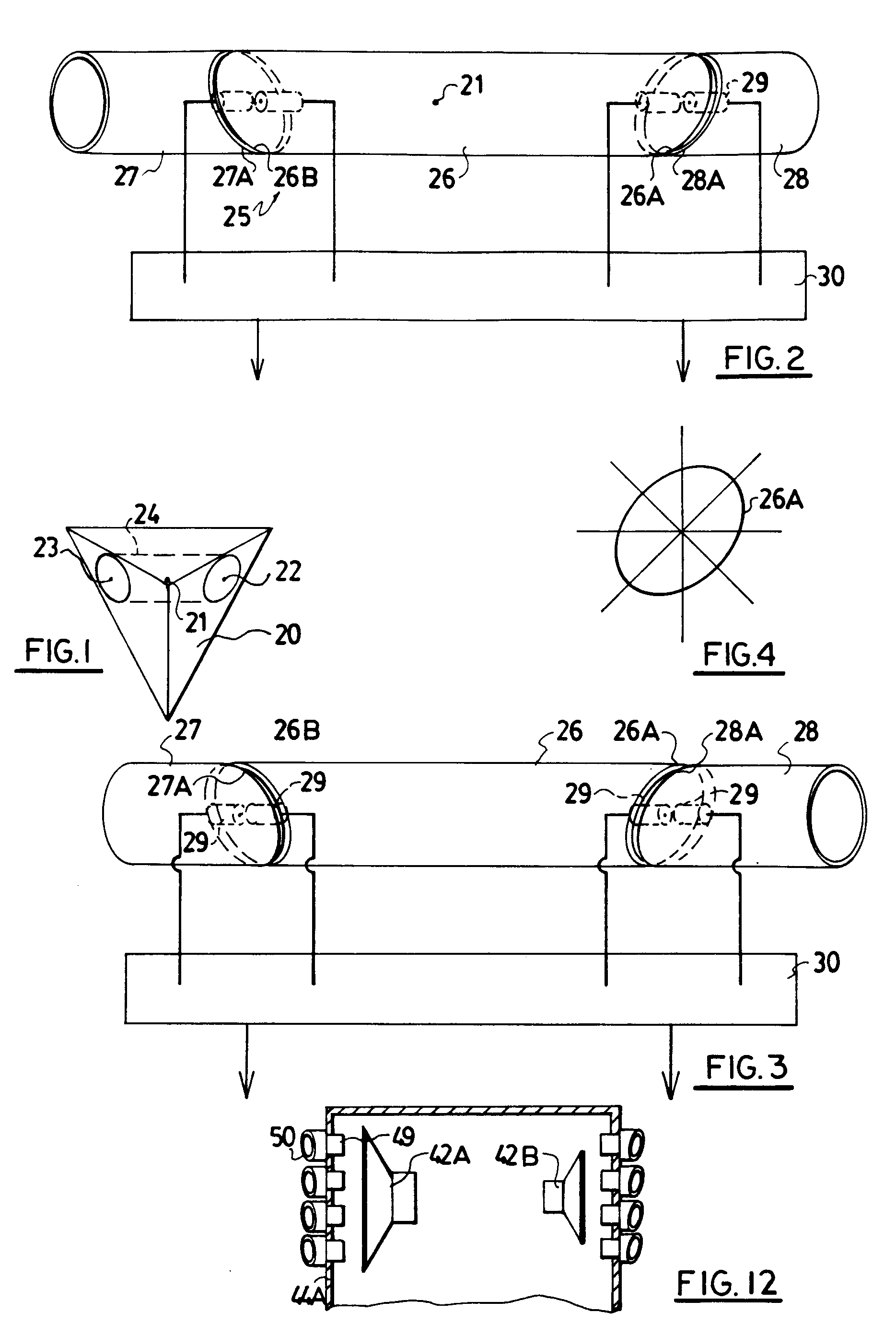
Mention of the grant of the patent: |
|
22.12.1993 Bulletin 1993/51 |
| (22) |
Date of filing: 23.07.1987 |
|
|
| (54) |
Omniphonic microphone and loudspeaker system
Omniphones Mikrophon und Lautsprechersystem
Système omniphonique avec microphones et haut-parleurs
|
| (84) |
Designated Contracting States: |
|
DE FR GB IT |
| (30) |
Priority: |
23.07.1986 GB 8617953
|
| (43) |
Date of publication of application: |
|
24.02.1988 Bulletin 1988/08 |
| (73) |
Proprietor: Wehner, Raymond |
|
Selkirk
Manitoba R1A 1L7 (CA) |
|
| (72) |
Inventor: |
|
- Wehner, Raymond
Selkirk
Manitoba R1A 1L7 (CA)
|
| (74) |
Representative: Frost, Dennis Thomas et al |
|
Withers & Rogers
4 Dyers Buildings
Holborn
GB-London EC1N 2JT
GB-London EC1N 2JT (GB) |
| (56) |
References cited: :
DE-A- 2 440 844
|
FR-A- 2 345 046
|
|
| |
|
|
|
|
| |
|
| Note: Within nine months from the publication of the mention of the grant of the European
patent, any person may give notice to the European Patent Office of opposition to
the European patent
granted. Notice of opposition shall be filed in a written reasoned statement. It shall
not be deemed to
have been filed until the opposition fee has been paid. (Art. 99(1) European Patent
Convention).
|
[0001] This invention relates to new and useful improvements to omniphonic microphone and
loud speaker systems illustrated and described in my U.S. Patent 4122910 (& FR-A-2345046).
[0002] In this U.S. Patent, a regular tetrahedron construction is used for both the microphone
and loud speaker components. However, that particular construction contains some directional
ambiguity, which ambiguity is significantly reduced by the improvements described
hereafter.
[0003] According to one aspect of the present invention there is provided a microphone system
comprising a substantially cylindrical module with a longitudinal axis and comprising
a centre section with two elliptical outer end faces truncated at one half of the
dihedral angle of a regular tetrahedron and two end sections at opposite ends of the
centre section in longitudinal alignment therewith, each end section having an elliptical
inner end face confronting a respective one of the outer end face of the centre section,
each said inner end face and the outer end face confronted thereby lying in substantially
parallel, spaced planes, and each elliptical end face of the centre section and the
end sections having a long axis oriented at approximately 45° to a horizontal plane,
and a microphone transducer situated centrally in each of said outer end faces of
said centre section and said inner end faces of each of said end sections.
[0004] According to another aspect of the present invention there is provided a loudspeaker
system comprising a substantially cylindrical module comprising a centre section with
two elliptical outer end faces truncated at one-half the dihedral angle of a regular
tetrahedron and two end sections of opposite ends of the centre section in longitudinal
alignment therewith, each end section having an elliptical inner end face confronting
a respective one of the outer end faces of the centre section, each said inner end
face and the outer end face confronted thereby lying in substantially parallel, spaced
planes, and each elliptical end face of the centre section and the end sections having
a long axis oriented at approximately 45° to a horizontal plane, and a speaker transducer
situated within and spaced in from each outer end of said centre section and facing
outwardly therefrom and a further transducer situated within and spaced outwardly
from the inner ends of each said end sections.
[0005] According to another aspect of the present invention there is provided an optimal
shadow omniphonic microphone and loudspeaker system comprising in combination an omniphonic
microphone component, a speaker component and electronic means coupling the microphone
and speaker components for processing signals from the microphone component and transmitting
signals to the speaker component, each of said microphone and loudspeaker components
including a substantially cylindrical module with a longitudinal axis and comprising
a centre section with two elliptical outer end faces truncated at approximately one
half the dihedral angle of a regular tetrahedron and two end sections at opposite
ends of the centre section in longitudinal alignment therewith, each end section having
an elliptical inner end face confronting a respective one of the outer end faces of
the centre section, each said inner end face and the outer end face confronted thereby
lying in a substantially parallel, spaced planes, and each elliptical end face of
the centre section and the end sections having a long axis oriented at approximately
45° to a horizontal plane, a microphone transducer situated centrally in each of said
outer end faces of said centre section of said microphone component and said inner
end faces of each of said end sections of said microphone component, and a speaker
transducer situated in and spaced in from each of said outer end faces of said centre
section of said speaker component and a further speaker transducer situated In and
spaced outwardly from the inner end faces of each of said end sections.
[0006] According to a further aspect of the present invention there is provided an operculum
acting as a baffle means for use with a loudspeaker component and comprising a truncated
cylinder secured adjacent a loudspeaker transducer with an inner end being operatively
situated to said transducer, and an outer end being truncated at approximately one
half the dihedral angle of a regular tetrahedron, the long axes of the ellipses formed
by said truncation being oriented at approximately 45° to the horizontal.
[0007] The improvements include the following technical features:
(1) All of the transducers are shielded by operculae which are cylindrical structures
truncated at 1/2 dihedral angle of the regular tetrahedron, namely, 35° 16' and where
planes are set at 45° to the horizontal.
(2) The planes of the elliptical openings of the operculae correspond or are isomorphic
to the tympanic membrane of the human hearing structure.
(3) The operculae of the optimal shadow omniphonic microphone component and of the
isomorphic module/operculated baffles are isomorphic to the truncated cylinders described
in the microphone and loud speaker components of U.S. Patent 4122910 and indicated
in that patent by reference character 23.
(4) The planes of the truncated openings of the optimal shadow omniphonic microphone
components correspond to the dihedral planes of the omniphonic microphone of the above
U.S. Patent and illustrated in Figure 8 thereof.
(5) The planes of the truncated openings of the isomorphic module of the loud speaker
component correspond to the dihedral planes of the omniphonic loud speaker illustrated
in Figure 9 of the above U.S. Patent.
(6) The planes of all of the baffle operculae are set at 45° and incline downwardly
and away from the listener.
DESCRIPTION OF THE DRAWINGS
[0008] Figure 1 is similar to Figure 8 of U.S. Patent #4122910 and shows schematically the
location of the optimal shadow omniphonic microphone component of the present invention.
[0009] Figure 2 is an enlarged rear elevational view of this microphone component with electronic
connections being shown schematically.
[0010] Figure 3 is a front elevation of Figure 2.
[0011] Figure 4 is a schematic end elevation of one of the inner ends of the truncated cylinder
carrying the microphones.
[0012] Figure 5 is a view similar to Figure 2 showing the tetrahedron loud speaker structure
of U.S. Patent 4122910 and illustrating, schematically, the core of the tetrahedron
utilized in the loud speaker module of the present invention.
[0013] Figure 6 is a schematic view of the relationship of the isomorphic module and the
outer speaker components.
[0014] Figure 7 is a frontal elevation of Figure 6 with the electronic connections shown
schematically.
[0015] Figure 8 is an enlarged frontal elevational view of the isomorphic module of Figure
7.
[0016] Figure 9 is an enlarged isometric view of one of the operculae.
[0017] Figure 10 is a partially schematic front elevation of the left and right baffles
of the lefthand speaker component.
[0018] Figure 11 is a view similar to Figure 10 but showing the left and right baffles of
the righthand speaker component.
[0019] Figure 12 is a fragmentary cross-sectional schematic view of part of one of the outer
speaker cabinets showing the relationship between the operculae and the transducers.
[0020] In the drawings like characters of reference indicate corresponding parts in the
different figures.
DETAILED DESCRIPTION
[0021] Proceeding to describe the invention in detail, reference should first be made to
Figures 1 through 4 which which illustrate the Optimal Shadow Omniphonic Microphone
portion of the invention.
[0022] Figure 1 shows partially schematically, the tetrahedron 20 forming the microphone
module illustrated and described in U.S. Patent 4122910 and specifically Figure 8
thereof.
[0023] Reference character 21 illustrates the centre of this tetrahedral structure and points
22 and 23 show the theoretical locations of the centre of the microphones illustrated
in Figure 8 of this U.S. patent.
[0024] The cylindrical outline 24 shown in phantom in Figure 1, illustrates a core from
this tetrahedron, the portions of which form the microphone component collectively
designated 25 illustrated in Figures 2, 3 and 4 of the enclosed drawings.
[0025] This component 25 consists of a central portion 26, a righthand portion 27 and a
lefthand portion 28, it being understood that Figure 2 is a rear view of the component
whereas Figure 3 is front elevational view.
[0026] The aforementioned theoretical centre of the tetrahedron of Figure 1 is also illustrated
by reference character 21 of Figure 2 so that this component retains the regular tetrahedral
form of the omniphonic microphone of the U.S. patent, as an abstraction. The cylindrical
construction is formed from a solid material and the ends 26A and 26B of the central
section are truncated at an angle of 35° 16' which equals half the dihedral angle
of the regular tetrahedron shown in Figure 1.
[0027] The corresponding inner ends 27A and 28A of the end portions 27 and 28 are also truncated
at a similar angle of 35° 16' and the longitudinal axes of the ellipsis formed by
the truncation is rotated through 45°. This is illustrated by comparison of Figures
2 and 3 and shown schematically in Figure 4.
[0028] Conventional microphone elements 29 open onto these truncated faces of all four ends
and are connected electronically to a conventional microphone mixer 30 and thence
to left and right amplifiers all of which is conventional.
[0029] The truncated ends 26B/27A and 26A/28A are spaced apart from one another thus forming
an adjustable gap therebetween which may be in the order of between 1 - 4 mm as an
example and this gap is selected for optimum sound reception with minimal ambiguity.
[0030] Figures 5 through 12 show the isomorphic module/operculated baffle assemblies constituting
the loudspeaker component of the system and reference should first be made to Figure
5 which shows a regular tetrahedron 31 similar to the loudspeaker tetrahedron shown
in Figure 9 of U.S. Patent 4122910.
[0031] In this U.S. patent, the transducers 32 are situated on adjacent faces 33 of the
tetrahedron and the cylinder 34 shown in phantom in Figure 5 of the present application
constitutes theoretically, the isomorphic module collectively designated 35 with reference
character 36 indicating the theoretical centre of the tetrahedron and of the cylinder
35.
[0032] The construction shown in detail in Figure 8, is similar to the module of the microphone
component shown in Figure 3 in that it contains a central section 37 and end sections
38 and 39. These are formed from hollow cylindrical material filled with acoustical
insulation material (not illustrated). The outer ends 37A and 37B of the centre section
37 are also truncated at an angle of 35° 16' (half the dihedral angle of the regular
tetrahedron) as are the inner ends 38A and 39A. Once again the longitudinal axis of
the ellipse formed by this truncation of all of these ends is rotated through 45°
as clearly shown by a consideration of Figure 8 and comparing same with the structure
shown in Figures 2 and 3.
[0033] Mid-range transducers 40 are mounted spaced inwardly from the ends 37A/38A and inwardly
from the ends 37B and 39A and are connected electronically to the amplifier 41 as
shown.
[0034] Once again the truncated ends of the sections 37, 38 and 39 are spaced apart and
the gap therebetween may be adjusted similar to that described for the microphone
components.
[0035] Figure 6 shows, schematically, the alignment of all of the transducers not only of
the isomorphic module but also of outer or side speaker components collectively designated
42 and 43 with the left and right channel connections controlled by amplitude controls
44 and connected to the amplifier as shown.
[0036] From this schematic view, it will be seen that the outer speakers 42A and 43A are
low-range speakers connected to opposite channels and that the inner speakers 42B
and 43B are high-range speakers connected to the opposite channels with the crossover
being approximately 700 Hz. The four central speakers 40 are mid-range tweeter type
speakers and are also connected to the respective channels as illustrated. The cross-over
frequency need not be rigidly fixed but may be in a range between 700 - 1500 Hz.
[0037] The speaker components 42 and 43 may be enclosed in an acoustic suspension or acoustic
reflex speaker cabinet 44A of conventional construction with the exception of the
speaker baffle panels shown in Figures 10 and 11. Figure 10 shows the left outer baffle
panel 45 of the component 42 and the left inner baffle panel 46 also of component
42.
[0038] Figure 11 shows the right outer baffle panel 47 and the right inner baffle panel
48 both of the speaker component 43.
[0039] All of the baffle panels include, adjacent the upper end thereof, a plurality of
operculated baffles collectively designated 49 adjacent the front of the cones of
the speakers 42A and 42B and 43A and 43B respectively. These operculated baffles take
the form of small cylindrical components having truncated outer ends 50 formed at
half the dihedral angle of a regular tetrahedron, namely, 35° 16'. They are preferably
provided with a felt outer cover 51 and a felt inner liner 52 and they are mounted
in the baffle panels in a symmetrical array as illustrated. Of importance is the fact
that the operculated baffles of the outer panels 45 and 47 are positioned so that
the elliptical openings on the outer face of the panels open downwardly and outwardly
from the panel whereas the elliptical openings of the inner baffles 46 and 48 open
downwardly and inwardly from the baffles as illustrated in Figures 10, 11 and 12.
[0040] All of the surfaces of the optimal shadow microphone/and the isomorphic module are
preferably provided with a felt covering.
1. A microphone system comprising a substantially cylindrical module (25) with a longitudinal
axis and comprising a centre section (26) with two elliptical outer end faces (26A,26B)
truncated at one half the dihedral angle of a regular tetrahedron and two end sections
(27,28) at opposite ends of the centre section (26), in longitudinal alignment therewith,
each end section having an elliptical inner end face confronting a respective one
of the outer end face of the centre section, each said inner end face (27A; 28A) and
the outer end face (26A;26B) confronted thereby lying in substantially parallel, spaced
planes, and each elliptical end face (26A, 26B, 27A, 28A) of the centre section and
the end sections having a long axis oriented at approximately 45° to a horizontal
plane, and a microphone transducer (29) situated centrally in each of said outer end
faces of said centre section and said inner end faces (27A, 28A) of each of said end
sections (27,28).
2. A microphone system according to Claim 1 in which the gap between said inner end faces
(27A, 28A) of said outer sections (27,28) and said outer end faces (26A, 26B) of said
centre section (26) is adjustable between 1 mm and 4 mm.
3. A loudspeaker system comprising a substantially cylindrical module (35) comprising
a centre section (37) with two elliptical outer end faces (37A,37B) truncated at one
half the dihedral angle of a regular tetrahedron and two end sections (38,39) at opposite
ends of the centre section in longitudinal alignment therewith, each end section (38,39)
having an elliptical inner end face (38D;39D) confronting a respective one of the
outer end faces (37A;37B) of the centre section (37), each said inner end face (38A;39A)
and the outer end face (37A; 37B) confronted thereby lying in substantially parallel,
spaced planes, and each elliptical end face (37A;37B;38A;39A) of the centre section
(37) and the end sections (38,39) having a long axis oriented at approximately 45°
to a horizontal plane, and a speaker transducer (40) situated within and spaced in
from each outer end (37A;37B) of said centre section (37) and facing outwardly therefrom
and a further transducer (40) situated within and spaced outwardly from the inner
ends (38A, 39A) of each said end sections (38,39).
4. A system according to Claim 1, 2 or 3 in which the portions of said centre section
(26,37) outboard of said transducers (29;40) and the portions of said outer sections
(27,28;38,39) inboard of said transducers (29;40) act as operculate to the respective
transducers.
5. A system according to Claim 4 in which said sections are filled with acoustical insulation
material.
6. A system according to Claim 3 which includes outer or side speaker components (42,43)
on respective sides of said first mentioned speaker component (35) and being operatively
connected thereto, each said outer or side speaker component (42;43) including a pair
of outwardly facing transducers (42A,42B;43A,43B) and an enclosure (44A) for said
transducers, the transducers of each pair of transducers (42A,42B;43A,43B) being situated
back to back and spaced inwardly from opposing end walls (45,46;47,48) of said enclosure,
a plurality of apertures (50A) formed through said walls opposite to said transducers
and baffle means (49) operculating said apertures.
7. A system according to Claim 6 wherein the baffle means (49) comprise a truncated cylinder
secured around each of said apertures with the inner end being operatively adjacent
said transducer (42A, 42B;43A,43B), the outer end (5) being truncated at an angle
of approximately 35° 16', the axis of the ellipses formed by said truncation being
rotated through 45° to the horizontal.
8. An optimal shadow omniphonic microphone and loudspeaker system comprising in combination
an omniphonic microphone component (25), a speaker component (35) and electronic means
(30,,41) coupling the microphone and speaker components for processing signals from
the microphone component and transmitting signals to the speaker component, each of
said microphone and loudspeaker components including a substantially cylindrical module
(25;35) with a longitudinal axis and comprising a centre section (26;37) with two
elliptical outer end faces (26A,26B;37A,37B) truncated at approximately one half the
dihedral angle of a regular tetrahedron and two end sections (27,28;38,39) at opposite
ends of the centre section in longitudinal alignment therewith, each end section having
an elliptical inner end face (27A,28A;38A39A) confronting a respective one of the
outer end faces (26A,26B; 37A,37B) of the centre section (26;37), each said inner
end face (27A,28A;38A,39A) and the outer end face (26A,26B;37A,37B) confronted thereby
lying in a substantially parallel, spaced planes, and each elliptical and face (26A,26B,27A,28A;37A,37B,38A,39A)
of the centre section and the end sections having a long axis oriented at approximately
45° to a horizontal plane, a microphone transducer (29)situated centrally in each
of said outer end faces (26A,26B) of said centre section (26) of said microphone component
and said inner end faces (27A,28A) of each of said end sections (27,28) of said microphone
component, and a speaker transducer (40) situated in and spaced in from each of said
outer end faces (37A,37B) of said centre section (37) of said speaker component and
a further speaker transducer (40) situated in and spaced outwardly from the inner
end faces (38A, 39A) of each of said end sections (38,39).
9. An operculum acting as a baffle means for use with a loudspeaker component and comprising
a truncated cylinder (49) secured adjacent a loudspeaker transducer (42A,42B) with
an inner end being operatively situated to said transducer, and an outer end (50)
being truncated at approximately one half the dihedral angle of a regular tetrahedron,
the long axes of the ellipses formed by said truncation being oriented at approximately
45° to the horizontal.
1. Mikrophonsystem, das einen im wesentlichen zylindrischen Modul (25) mit einer Längsachse
aufweist und der einen mittleren Abschnitt (26) mit zwei elliptischen äußeren Stirnflächen
(26A, 26B), die unter dem halben Flächenwinkel eines regelmäßigen Tetraeders abgeschnitten
sind, und zwei Endabschnitte (27, 28) an den entgegengesetzten Enden des mittleren
Abschnitts (26) in Längsrichtung damit fluchtend aufweist, wobei jeder Endabschnitt
eine elliptische innere Stirnfläche hat, die einer jeweiligen äußeren Stirnfläche
des mittleren Abschnitts gegenübersteht, wobei jede innere Stirnfläche (27A; 28A)
und die ihr gegenüberstehende äußere Stirnfläche (26A; 26B) in im wesentlichen parallelen,
voneinander beabstandeten Ebenen liegen und jede elliptische Stirnfläche (26A, 26B,
27A, 28A) des mittleren Abschnitts und der Endabschnitte eine lange Achse hat, die
auf etwa 45° zu einer horizontalen Ebene ausgerichtet ist, und mit einem Mikrophonwandler
(29), der zentral in jeder äußeren Stirnfläche des mittleren Abschnitts und jeder
inneren Stirnfläche (27, 28A) eines jeden Endabschnitts (27, 28) angeordnet ist.
2. Mikrophonsystem nach Anspruch 1, bei welchem der Spalt zwischen den inneren Stirnflächen
(27A, 28A) der äußeren Abschnitte (27, 28) und den äußeren Stirnflächen (26A, 26B)
des mittleren Abschnitts (26) auf eine Größe zwischen 1 mm und 4 mm einstellbar ist.
3. Lautsprechersystem mit einem im wesentlichen zylindrischen Modul (35), der einen mittleren
Abschnitt (37) mit zwei elliptischen äußeren Stirnflächen (37A, 37B), die unter dem
halben Flächenwinkel eines regelmäßigen Tetraeders abgeschnitten sind, und zwei Endabschnitte
(38, 39) an den entgegengesetzten Enden des mittleren Abschnitts in Längsrichtung
damit fluchtend aufweist, wobei jeder Endabschnitt (38, 39) eine elliptische innere
Stirnfläche (38D; 39D) hat, die einer jeweiligen äußeren Stirnfläche (37A; 37B) des
mittleren Abschnitts (37) gegenübersteht, wobei jede innere Stirnfläche (38A; 39A)
und die ihr gegenüberstehende äußere Stirnfläche (37A; 37B) in im wesentlichen parallelen,
voneinander beabstandeten Ebenen liegen, und jede elliptische Stirnfläche (37A; 37B;
38A; 39A) des mittleren Abschnitts (37) und der Endabschnitte (38, 39) eine lange
Achse hat, die auf etwa 45° zu einer horizontalen Ebene ausgerichtet ist, und mit
einem Lautsprecherwandler (40), der innerhalb und mit Abstand nach innen von jedem
äußeren Ende (37A; 37B) des mittleren Abschnitts (37) angeordnet ist und von dort
auswärts weist, und einem weiteren Wandler (40), der innerhalb und mit Abstand nach
außen von den inneren Enden (38A, 39A) eines jeden Endabschnitts (38, 39) angeordnet
ist.
4. System nach Anspruch 1, 2 oder 3, bei welchem die außerhalb der Wandler (29; 40) liegenden
Teile des mittleren Abschnitts (37) und die innerhalb der Wandler (29; 40) liegenden
Teile der äußeren Abschnitte (27, 28; 38, 39) als Abdeckung für die jeweiligen Wandler
wirken.
5. System nach Anspruch 4, bei welchem die Abschnitte mit einem schallisolierenden Material
gefüllt sind.
6. System nach Anspruch 3, mit Außen- oder Seitenlautsprecherteilen (42, 43) auf den
jeweiligen Seiten des zuerst genannten Lautsprecherteils (35) und die wirkmäßig damit
verbunden sind, wobei jedes Außen- oder Seitenlautsprecherteil (42; 43) ein Paar auswärtsweisender
Wandler (42A, 42B; 43A, 43B) und ein Gehäuse (44A) für die Wandler aufweist, wobei
die Wandler eines jeden Paares von Wandlern (42A, 42B; 43A, 43B) Rücken an Rücken
angeordnet sind und einen Abstand einwärts von den sich gegenüberliegenden Stirnwänden
(45, 46; 47, 48) des Gehäuses haben, wobei eine Vielzahl von Öffnungen (50A) in den
zu den Wandlern entgegengesetzten Wänden gebildet sind und eine Schallschirmeinrichtung
(49) diese Öffnungen abdeckt.
7. System nach Anspruch 6, bei welchem die Schallschirmeinrichtung (49) einen schräg
abgeschnittenen Zylinder aufweist, der um jede Öffnung herum befestigt ist, wobei
das innere Ende wirkmäßig an den Wandler (42A, 42B; 43A, 43B) angrenzt, wobei das
äußere Ende (5) unter einem Winkel von ungefähr 35° 16' schräg abgeschnitten ist,
wobei die Achse der durch den schrägen Schnitt gebildeten Ellipsen um 45° gegenüber
der Horizontalen gedreht ist.
8. Optimalschatten-Allrichtungsmikrophon- und Lautsprechersystem, das ein Allrichtungsmikrophonteil
(25), ein Lautsprecherteil (35) und eine elektronische Einrichtung (30, 41), die den
Mikrophonteil und Lautsprecherteil zum Verarbeiten von Signalen von dem Mikrophonteil
und Weiterleiten der Signale zum Lautsprecherteil verbindet, in der Kombination aufweist,
wobei sowohl das Mikrophon- als auch das Lautsprecherteil einen im wesentlichen zylindrischen
Modul (25; 35) aufweist, der eine Längsachse und einen mittleren Abschnitt (26; 37)
mit zwei elliptischen äußeren Stirnflächen (26A, 26B; 37A, 37B), die etwa unter dem
halben Flächenwinkel eines regelmäßigen Tetraeders schräg abgeschnitten sind, und
zwei Endabschnitte (27, 28; 38, 39) an den entgegengesetzten Enden des mittleren Abschnitts
in Längsrichtung damit fluchtend aufweist, wobei jeder Endabschnitt eine elliptische
innere Stirnfläche (27A, 28A; 38A, 39A) hat, die einer jeweiligen äußeren Stirnfläche
(28A, 28B; 37A, 37B) des mittleren Abschnitts (26; 37) gegenübersteht, wobei jede
innere Stirnfläche (27A, 28A; 38A, 39A) und jede äußere Stirnfläche (26A, 26B; 37A,
37B), die ihr gegenübersteht, in im wesentlichen parallelen, voneinander beabstandeten
Ebenen liegen, und wobei jede elliptische Stirnfläche (26A, 26B, 27A, 28A; 37A, 37B,
38A, 39A) des mittleren Abschnitts und der Endabschnitte eine lange Achse hat, die
auf ungefähr 45° zu einer Horizontalebene ausgerichtet ist, mit einem Mikrophonwandler
(29), der zentral in einer jeden äußeren Stirnfläche (26A, 26B) des mittleren Abschnitts
(26) des Mikrophonteils unter der inneren Stirnfläche (27A, 28A) eines jeden Endabschnitts
(27, 28) des Mikrophonteils angeordnet ist, und einem Lautsprecherwandler (40), der
in und im Abstand nach innen von jeder der äußeren Stirnflächen (37A, 37B) des mittleren
Abschnitts (37) des Lautsprecherteils angeordnet ist, und mit einem weiteren Lautsprecherwandler
(40), der in und mit Abstand auswärts von den inneren Stirnflächen (38A, 39A) eines
jeden Endabschnitts (38, 39) angeordnet ist.
9. Abdeckung, die als Schallschirmeinrichtung für ein Lautsprecherteil wirkt und einen
schräg abgeschnittenen Zylinder (49) aufweist, der neben einem Lautsprecherwandler
(42A, 42B) befestigt ist, wobei ein inneres Ende wirksam an dem Wandler angeordnet
ist und ein äußeres Ende (50) unter ungefähr dem halben Flächenwinkel eines regelmäßigen
Tetraeders abgeschnitten ist, wobei die langen Achsen der durch das schräge Abschneiden
gebildeten Ellipsen auf ungefähr 45° zu der Horizontalen ausgerichtet sind.
1. Dispositif microphone comprenant un module à peu près cylindrique (25) à axe longitudinal,
comprenant une section centrale (26) à deux faces d'extrémité extérieures (26A, 26B)
elliptiques tronquées selon la moitié de l'angle dièdre d'un tétraèdre régulier et
deux sections d'extrémité (27, 28) disposées aux extrémités opposées de la section
centrale (26) et en alignement longitudinal avec elle, chaque section d'extrémité
ayant une face d'extrémité intérieure elliptique faisant face respectivement à une
des faces d'extrémité extérieures de la section centrale , chaque dite face d'extrémité
intérieure (27A ; 28A) et la face correspondante d'extrémité extérieure (26A ; 26B)
se développant selon des plans espacés a peu près parallèles, et chaque face d'extrémité
elliptique (26A, 26B, 27A, 28A) de la section centrale et des sections d'extrémité
ayant un grand axe oriente selon approximativement 45° par rapport à un plan horizontal,
et un transducteur microphone (29) positionné au centre de chacune desdites faces
d'extrémité extérieures de ladite section centrale et desdites faces d'extrémité intérieures
(27A, 28A) de chacune desdites sections d'extrémité (27, 28).
2. Dispotif microphone selon la revendication 1 dans lequel l'intervalle entre lesdites
faces d'extrémité intérieures (27A, 28A) desdites sections extérieures (27, 28) et
lesdites faces d'extrémité extérieures (28A, 28B) de ladite section centrale (26)
est réglable entre 1 mm et 4 mm.
3. Dispotif haut-parleur comprenant un module à peu près cylindrique (35) , comprenant
une section centrale (37) à deux faces d'extrémité extérieures (37A, 37B) elliptiques
tronquées selon la moitié de l'angle dièdre d'un tétraèdre régulier et deux sections
d'extrémité (38, 39) disposées aux extrémités opposées de la section centrale et en
alignement longitudinal avec elle, chaque section d'extrémité (38, 39) ayant une face
d'extrémité intérieure (38D, 39D) elliptique faisant face respectivement à une des
faces d'extrémité extérieures (37A, 37B) de la section centrale (37), chaque dite
face d'extrémité intérieure (38A ; 39A) et la face correspondante d'extrémité extérieure
(37A ; 37B) se développant selon des plans espacés à peu près parallèles, et chaque
face d'extrémité elliptique (37A, 37B, 38A, 39A) de la section centrale (37) et des
sections d'extrémité (38, 39) ayant un grand axe orienté selon approximativement 45°
par rapport à un plan horizontal, et un transducteur haut-parleur (40) placé à l'intérieur
et espacé intérieurement de chaque extrémité extérieure (37A, 37B) de ladite section
centrale (37) et orienté vers l'extérieur de celle-ci et un autre transducteur (40)
placé à l'intérieur et espacé extérieurement des extrémités intérieures (38A, 39A)
de chacune desdites sections d'extrémité (38, 39).
4. Dispositif selon la revendication 1, 2 ou 3 dans lequel les parties de ladite section
centrale (26, 37) dépassant vers l'extérieur desdits transducteurs (29, 40) et les
parties desdites sections extérieures (27, 28, 38, 39) dépassant vers l'intérieur
desdits transducteurs (29, 40) servent d'opercules aux transducteurs respectifs.
5. Dispositif selon la revendication 4 dans lequel lesdites sections sont remplies de
matériau isolant acoutisque.
6. Dispositif selon la revendication 3 qui inclut des composants haut-parleur (42, 43)
extérieurs ou latéraux sur les côtés respectifs dudit premier composant haut-parleur
mentionné (36) et lui étant activement connecté, chaque composant haut-parleur (42,
43) extérieur ou latéral incluant une paire de transducteurs (42A, 42B ; 43A, 43B)
se faisant face et orientés vers l'extérieur, et une enciente (44A) desdits transducteurs
, les tranducteurs de chaque paire de transducteurs (42A, 42B ; 43A, 43B) étant placés
dos à dos et espacés intérieurement des parois opposées (45, 46 ; 47, 48) de ladite
enceinte, un certain nombre d'ouvertures (50A) étant pratiquées au travers desdites
parois à l'opposé desdits transducteurs et des moyens déflecteurs (49) formant opercules
sur lesdites ouvertures.
7. Dispositif selon la revendication 6 dans lequel les moyens déflecteurs comprennent
un cylindre tronqué fixé autour de chacune desdites ouvertures dont l'extrémité intérieure
est fonctionnellement adjacente audit transducteur (42A, 42B ; 43A, 43B) et dont l'extrémité
extérieure (5) est tronquée selon un angle d'approximativement 35° 16', l'axe des
ellipses formées par ladite tronquature étant tourné de 45° par rapport à l'horizontale.
8. Un dispositif à microphone omniphonique à ombre optimale et haut-parleur comprenant
en combinaison un composant microphone omniphonique (25), un composant haut-parleur
(35) et des moyens électroniques (30, 41) couplant les composants microphone et haut-parleur
pour le traitement des signaux provenant du composant microphone et la transmission
des signaux au composant haut-parleur, chacun desdits composants microphone et haut-parleur
incluant un module à peu prés cylindrique (25 ; 35) à axe longitudinal, comprenant
une section centrale (26 ; 37) à deux faces d'extrémité extérieures (26A, 26B ; 37A,
37B) elliptiques tronquées selon approximativement la moitié de l'angle dièdre d'un
tétraèdre régulier et deux sections d'extrémité (27, 28 ; 38, 39) disposées aux extrémités
opposées de la section centrale (26) et en alignement longitudinal avec elle, chaque
section d'extrémité ayant une face d'extrémité intérieure (27A, 28A ; 38A, 39A) elliptique
faisant face respectivement à une des faces d'extrémité extérieures (26A, 26B ; 37A,
37B) de la section centrale (26 ; 37) , chaque dite face d'extrémité intérieure (27A,
28A ; 38A, 39A) et la face correspondante d'extrémité extérieure (26A, 26B ; 37A,
37B) se développant selon des plans espacés à peu près parallèles, et chaque face
d'extrémité elliptique (26A, 26B, 27A, 28A ; 37A, 37B, 38A, 39A) de la section centrale
et des sections d'extrémité ayant un grand axe orienté selon approximativement 45°
par rapport a un plan horizontal, un transducteur microphone (29) positionné au centre
de chacune desdites faces d'extrémité extérieures (26A, 26B) de ladite section centrale
(26) dudit composant microphone et desdites faces d'extrémité intérieures (27A, 28A)
de chacune desdites sections d'extrémité (27, 28) dudit composant microphone, et un
transducteur haut-parleur (40) place à l'intérieur et espacé intérieurement de chacune
des extrémités extérieures (37A, 37B) de ladite section centrale (37) dudit composant
haut-parleur et un autre transducteur haut-parleur (40) placé à l'intérieur et espace
extérieurement des extrémités intérieures (38A, 39A) de chacune desdites sections
d'extrémité (38, 39).
9. Un opercule servant de moyens déflecteurs destinés à un composant haut-parleur et
comprenant un cylindre tronqué (49) fixé à proximité d'un transducteur haut-parleur
(42A, 42B) dont l'extrémité intérieure est placée fonctionnellement vers ledit transducteur,
et dont l'autre extrémité (50) est tronquée selon approximativement la moitié de l'angle
dièdre d'un tétraèdre régulier, les grand axes des ellipses formées par ladite tronquature
étant orienté d'approximativement 45° par rapport a l'horizontale.