| (19) |
 |
|
(11) |
EP 0 257 145 A1 |
| (12) |
EUROPEAN PATENT APPLICATION |
| (43) |
Date of publication: |
|
02.03.1988 Bulletin 1988/09 |
| (22) |
Date of filing: 11.08.1986 |
|
| (51) |
International Patent Classification (IPC)4: B60T 15/04 |
|
| (84) |
Designated Contracting States: |
|
BE DE FR IT NL SE |
| (71) |
Applicant: BENDIX LIMITED |
|
Kingswood, Bristol BS15 2NL (GB) |
|
| (72) |
Inventor: |
|
- Turner, Alan Reginald
Bath BA1 5TL (GB)
|
| (74) |
Representative: Turner, Alan Reginald |
|
c/o Bendix Limited
Douglas Road
Kingswood, Bristol BS15 2NL
Kingswood, Bristol BS15 2NL (GB) |
|
| |
|
| (54) |
Manually operable control valves |
(57) In a compressed air vehicle brake valve a hand lever (9) is lockable in a predetermined
position by a slideable locking element (10) wich is normally spring biassed into
the locking position but a further spring (23) is located on the lever between the
locking element (10) and a slideable release member (14) this spring being compressible
by the action of the release member to apply a force to the locking element which
will cause it to release when the position or other retaining means is overcome.
|
|
[0001] This invention relates to manually operable control valves and relates especially
but not exclusively to control valves for vehicle compressed air braking systems.
[0002] In compressed air braking systems for heavy vehicles, it is customary, in addition
to a foot operable control valve for operation of service brakes,also to provide a
manually operable control valve device for operating secondary and/or parking brakes.
Such a control valve device may be a single valve, or alternatively, may comprise
one valve for controlling spring brakes and one valve for providing graduable secondary
control. The valve assembly may include a control member moveable from a first brakes
released position through a control range to a full secondary brake position and beyond
that to a special parking brake position. For security purposes it is normal to provide
a spring-biassed manually releaseable locking element which is engageable in the housing
in the parked position. Despite the provision of the mentioned locking element a shortcoming
of such a control valve assembly may exist to the extent that vibration or inadvertent
knocking of the control member may cause undesired release of the locking element
and result in unsafe-release of the parking brake when a driver is not in a position
to properly control the vehicle.
[0003] The object of the invention is to provide a manually operable control valve mechanism
wherein the possibility of such an inadvertent operation is even further reduced.
[0004] According to the present invention there is provided a manually operable control
valve mechanism having a valve assembly in a housing operable by a control member,
said control member being provided with a locking element lockingly engageable withLthe
housing in a pre-determined position of the control member and a release member normally
spring biassing the locking element into such engagement actuation of said release
member to overcome said bias being effective to apply a reverse spring bias permitting
the locking element to disengage only when the control member is moved to relieve
friction or other retention means.
[0005] In order that the invention may be more clearly understood and readily carried into
effect the same will be further described by way of example with reference to the
accompanying drawing which illustrates an embodiment of the invention.
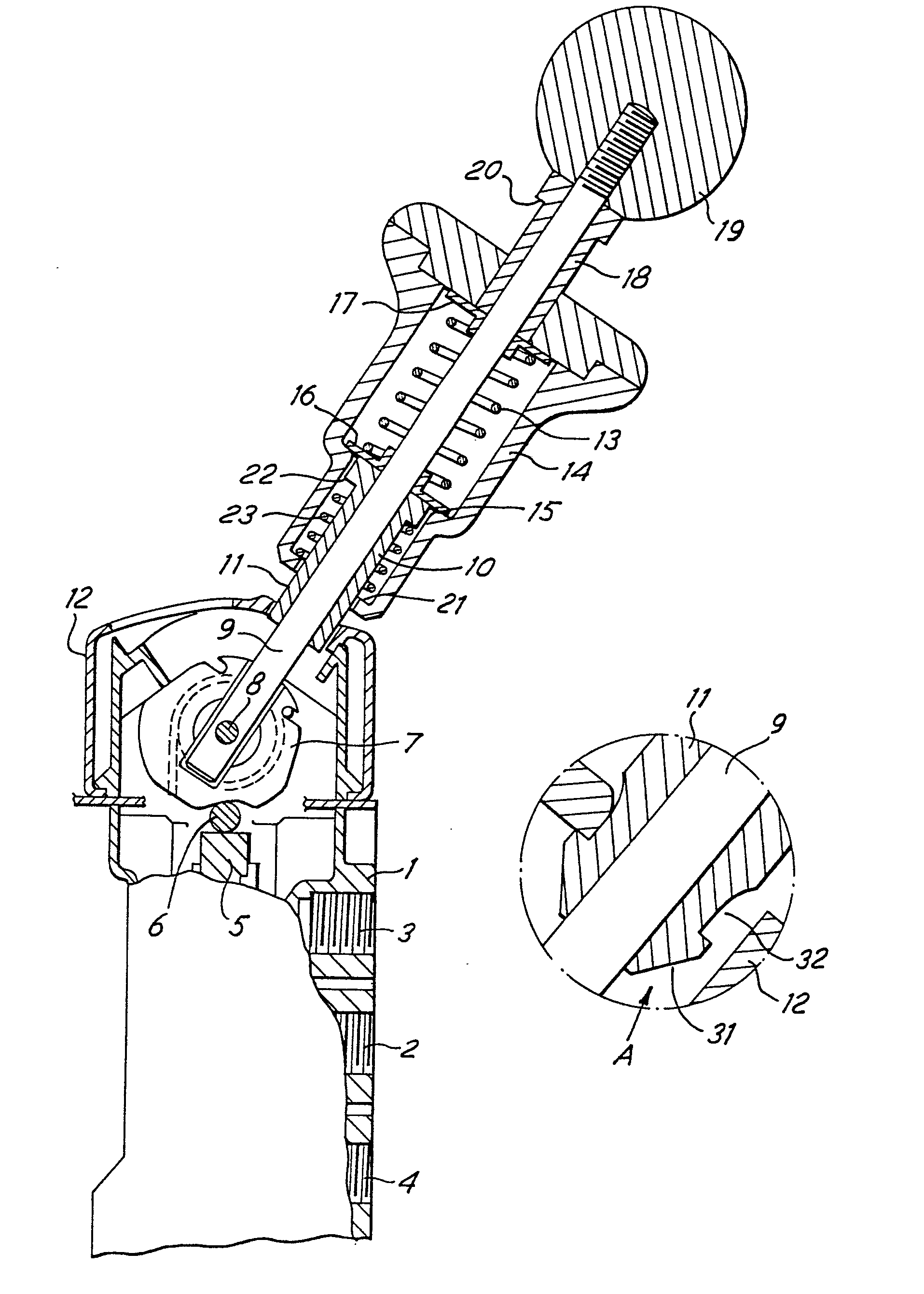
[0006] Referring to the drawing the manually operable control valve mechanism shown therein
is intended to be used in controlling secondary and/or parking brakes of a heavy vehicle
fitted with a multi-circuit compressed air braking system. The mechanism has a housing
1 provided with an input port 2 for connecting to a compressed air supply reservoir,
an output port 3 for connecting to a control line for secondary or parking brake actuators
of the vehicle and a vent port 4. A self-lapping valve assembly (not shown) is operable
by a cylindrical plunger 5 axially guided in the housing and actuable via a roller
6 by a cam 7 pivotted at 8 transversly with the plunger axis. The roller 6 is guided
for movement in line with said axis by means such as is described for example in the
Specification of copending British Application No. 8214144. The mentioned self-lapping
valve is operable to connect the output port 3 alternatively to the input port 2 or
to the vent port to produce graduable air pressure at port 3 dependent upon the position
of the plunger 5 as set by the cam 7.
[0007] The cam 7 which is biassed clockwise by a return spring(which is not shown) is rotatable
about axis 8 by a control member in the form of a lever 9 which engages with the cam
and is guided in a gate assembly 12 on the top of the housing. The lever 9 is provided
with a locking element 10 which is slideable along the lever 9, the lower end 11 thereof
being moveable into and out of engagement with the gate assembly..12. In the position
shown the locking element 10 is shown as engaged with the gate assembly in a predetermined
position which will normally be the parking position of the gate lever. The locking
element 10 is urged into such locking engagement by means of a captive spring 13 retained
in a release member 14 in the form of a moulded plastics assembly which is also slideable
oh the lever 9. The spring 13 is located between a lower washer 16 which rests against
a shoulder 15 within the member 14 and a washer 17 which rests against a tubular collar
and stop element 18 retained on the lever 9 by a screwed-on control knob 19. The collar
18 has a flange at 20 to act as a stop for the member 14 when moved upwards. The member
14 has a further lower shoulder indicated by reference 21 between which and a upper
shoulder 22 of the locking member 11 there is a lighter spring 23 which in the position
shown is designed to be uncompressed.
[0008] In operation of the valve assembly, the position shown is intended to be the parked
position wherein if the valve is controlling spring brakes, the output at port 3 will
be vented. In order to move the lever out of this parked position it is necessary
for the vehicle driver first to pull upwards the release member 14 against the stop
20. By so doing the downward bias on the locking element 11 is removed and replaced
by an upward bias introduced by some compression of the spring 23 which now acts on
the upper flange 22 of element 11. However, by virtue of the return spring action
tending to move lever 9 away from the position shown, there is sufficient friction
acting against the gate assembly and the element 11 to prevent 11 moving out of locking
engagement therewith until the lever 9 is moved against the rotational spring bias.
By such movement the frictional forces are removed and the spring 23 is effective
to lift the element 11 out of the locking engagement. By releasing the member 14 the
spring 13 again becomes effective to urge the element 11 in a locking direction such
that it will engage with the gate assembly when the lever 9 is placed in the predetermined
position.
[0009] As an alternative to placing reliance on friction between the lower end of element
11 and the gate assembly these may be designed to provide a positive latching function.
One possibility for this is shown enlarged at inset A, wherein the lower end of 11
is shamfered at 31 and provided with an annular groove 32 whereby it locks into engagement
with the gate assembly under the.action of spring 13 and is only releaseable following
slight clockwise rotation of the lever 9 and upward movement of the release member.
1. A manually operable control valve mechanism having a valve assembly in a housing
(11) operable by a control member (9), said control member being provided with a locking
element (10) lockingly engageable with part (12) of the housing in a predetermined
position of the control member (9) and a release member (14) normally forward biassing
the locking element into such engagement and characterised by actuation of said release
member to overcome said bias being effective to apply a reverse spring bias to the
locking element (10) in a sense to effect disengagement thereof when the control member
(9) is moved to release frictional or other retention means.
2. A manually operable control valve mechanism as claimed in claim 1, said control
element comprising a lever (9) on which the locking element (11) is slideable into
and out of engagement with the housing part (12) characterised-by the release member
being slideable along said lever and relative to the locking element a substantially
normally unloaded spring (23) being retained between the locking element (10) and
the release member (14).
3. A manually operable control valve mechanism as claimed in claim 1 or 2 characterised
by said release member (14) normally being biassed towards a locking position by virtue
of a spring (13) captive between the release member (14) and means (16) slideable
on the lever and cooperable with the locking element.
4. A manually operable control valve mechanism as claimed in claim 3, characterised
by said means (16) being engageable with a stop (15) inside the release member (14).
5. A manually operable control valve mechanism as claimed in claim 1, 2, 3 or 4 characterised
by catch means (31,32) between the locking element (10) and the housing part(12)whereby
the lever (9) is required to be moved through a predetermined angle in relation to
the housing part (12) to permit release.