|
(11) | EP 0 259 818 A2 |

| (12) | EUROPEAN PATENT APPLICATION |
|
|
|
|
|||||||||||||||||||||||||||
| (54) | Process for the preparation of perhalohydrocarbon hypochlorites |
| (57) Process for the preparation of chloro-oxy-halo-compounds by means of the direct reaction
between FCl and organic compounds having a molecular structure wherein an oxygen atom
is directly linked to a carbon atom in the carbonyl form, in the presence of a catalyst
constituted by an alkali metal or alkali-earth metal fluoride, preferably selected
from K, Rb, Cs, Ba, Sr, the reaction being carried out continuously in the gas phase.
|
[0001] The present invention relates to a process for the preparation of chloro-oxy-halo-compounds. More particularly, the present invention relates to a continuous process for the preparation of chloro-oxy-halo-compounds having the general formula:
(R) nC(F) m - OCl (1)
wherein R is an alkyl, cycloalkyl, aromatic, heterocyclic or polyether radical, containing from 1 to 12 carbon atoms, preferably from 1 to 6 carbon atoms, fully halogenated with fluorine, chlorine and/or bromine; n is 0, 1 or 2; m is 3- n. If n = 2, R can represent radicals equal to or different from each other.
[0002] The preparation of chloro-oxy-derivatives of perfluoroalkanes is known from the technical and patent literature: however, the described processes are mostly unsatisfactory, as is better explained hereunder.
[0003] Schack and Naya in J.A.C.S. (1969) 2902-91,11 describe the preparation, by a batch process, at temperatures ranging from -78°C to room temperature for the first member of the series, CF₃OCl, whilst, for the higher members, it operates at -78°C. The operation is carried out with the reactants being in the liquid phase, possibly under their autogenous pressure. It is stated that for the higher members, the low temperature adopted in the reaction is due to their high instability at room temperature. As relates to the first member, it would result that even at room temperature, the formation rate is not very high (only 60% after 1 hour).
[0004] U.S. Pat. 3,842,156 claims gaseous catalysts of the type of SbF₅, HCl, BF₃, which would be preferable to the metal fluorides of the prior art, and would be furthermore suitable for the gas-phase reaction. Actually, the preparation described are carried out at -20°C on reactants in the liquid state, with very long reaction times (24 hours).
[0005] U.S. Pat. 3,769,312: in this case too, the process is of batch type, carried out at a low temperature of from -78° to 0°C, preferably -20°C, with reaction times of the order of 10 hours.
[0006] Finally, the French patent 1,589,946 relates exclusively to the synthesis of CF₃ OCl, carried out in the gas phase, at room temperature, batchwise; reaction times of some hours are mentioned. This patent uses catalysts prepared in a special way from MgF₂ and fluorinated Al₂O₃.
[0007] We can conclude hence that from the prior art examined, it results in general that the reaction is carried out in the liquid phase, with very long reaction times. The preferred temperatures are lower than, or at maximum equal to 0°C, preferably -78°C or -20°C. According to Schack, at room temperature, for the first term, the yield is of 60% only after 1 hour, and for reaching a 99% yield, approximately 12 hours are necessary.
[0008] The only process in the gas phase is the one disclosed by in French Pat. 1,589,946, limitedly to the synthesis of CF₃OCl, always by a batch process. In this case too, the times mentioned are very long.
[0009] A purpose of the present invention is to provide an improved process for preparing the chloro-oxy-compounds, which does not show the limitations and the drawbacks of the processes of the prior art.
[0010] More particularly, a purpose of the present invention is to provide a continuous industrial process for the preparation of the chloro-oxy-compounds.
[0011] A further purpose of the present invention is to provide an industrial process which makes it possible to produce, in a selective way, and with high yields, the desired chloro-oxy-compound.
[0012] Still a further purpose of the present invention is to provide an industrial process which makes it possible to produce chloro-oxy-compounds with a high productivity and at a hig h purity level, without the need for a subsequent isolation and/or processing, so as to prevent the risks and the limitations connected with their high instability.
[0013] The Applicant has now surprisingly found, and it is the object of the present invention, that these and other purposes are achieved by carrying out the direct reaction, in continuous mode, in the gas phase, between FCl and organic compounds, having a molecular structure wherein an oxygen atom is directly bonded to a carbon atom in carbonyl form, in the presence of a solid catalyst constituted by a fluoride of alkali metal or alkali-earth metal,preferably selected from K, Rb, Cs and Ba, Sr, in particular CsF, preferably supported on or mixed with a metal in particular copper. Such catalyst, in the process of the invention, shows a rather high life of the catalytic activity, of the order of some hours.
[0014] The reaction temperature is maintained at values comprised within the range of from 0° to +100°C, preferably of from 25 to 50°C. The reaction times are always shorter than 10 minutes, and, in particular, shorter than 1 minute.
[0015] In as much as it was found that by operating under the above shown operating conditions, with particularly active catalysts, the reaction takes place with quantitative yields within very short times, of the order of seconds, it is suitable, for accomplising a reliable control, to dilute the reactants with an inert gas. This latter can be, e.g., nitrogen, a chlorofluorocarbon inert under the reaction conditions, in particular C₂F₄Cl₂, or He.
[0017] The above-indicated catalyst is used at a granulometry of from 50 to 1000, preferably comprised within the range of from 250 to 500 microns, and it can be obtained by grinding. The catalyst is preferably mixed with metal particles of dimensions of the order of some mm. The metal can be, e.g., Cu, Ni or Al. In particular the catalyst is supported by the metal particles.
[0018] The reactants used must be free from H₂O and HF, and H₂ and hydrogenated compounds, e.g., alcohols, aldehydes, hydrocarbons, must not be present.
[0019] As already said, the chloro-oxy-halo-compounds which are the object of the present invention can be directly used, it being not necessary that they are isolated and purified for the subsequent uses, and, in particular, for the reaction with olefins for obtaining then, by dehalogenation, fluoroalkyl-vinyl-ethers, not easily available compounds which are used for preparing modified fluorinated polymers, plastomers and fluoroelastomers.
[0020] It is well known that, to date, the possibility of preparing these latter compound on an industrial scale by this route was limited by the excessive cost of preparation of the fluoroalkyl-chloro-oxy-compounds.
[0021] According to the prior art, in fact, such compounds have always been prepared heretofore by batch processes, with very small amounts of reactants, of the order of millimoles.
[0022] The starting compounds used in the present invention contain a carbonyl group, and have the general formula:
wherein:
Rʹ can be F or perfluoroalkyl;
R = F or a fluorinated hydrocarbon radical which can contain also other halogens of the type as defined in formula (I).
[0023] In particular, the starting products are those wherein Rʹ is F and R is F or a C₁-C₆ perfluoroalkyl, such as: COF₂,CF₃COF, C₂F₅COF, C₃F₆COF, CF₂BrCOF.
[0024] In particular, for obtaining CF₃OCl, the starting product COF₂ can be advantageously obtained according to the continuous process disclosed as the 1st step in Italian patent application No. 21,172 A/86 , to the same Applicant, by reaction between CO and F₂, by directly using the gaseous reaction mixture from the 1st step in the subsequent reaction with FCl.
[0025] The reactants are supplied continuously in the gas phase, preferably under a slight pressure and in equimolar amounts, with flow rates of each reactant higher than 5.10⁻⁶ mol/h per catalyst gram. Flow rates of each reactant comprised within the range of from 10⁻⁴ to 10⁻¹ mol/h per catalyst gram are preferred.
[0026] In general, the reactor is of stainless steel or of copper and its alloys, or of other materials inert towards the reactants.
[0027] A particular advantage offered by the present invention consists in that the chloro-oxy-compound obtained by means of the process of the invention can be used as such as a gaseous mixture with the possible diluent, in the reaction with halogenated olefins for obtaining the corresponding ethers.
[0028] For a better understanding of the possibilities of practical embodiment of the present invention the following illustrative, non-limitative examples are given.
[0029] In all the Examples, as the reactant FCl was used, which was obtained in the following way: to a nickel reactor of 1 liter of capacity, 3 l/h of chlorine and 3.1 l/h of fluorine are delivered, with the reactor being maintained at the temperature of 400°C. At the reactor outlet, a cold trap, kept cooled at -80°C, secures the removal of ClF₃ and the obtained gas is FCl, at a good purity level; it is used as such as the reactant in the hereunder reported Examples.
Example 1
[0030] A cylindrical steel reactor of 50 cm³ of capacity is packed with copper wire fragments, on which cesium fluoride was deposited by evaporation from a methanol solution. The amount of CsF in the so-prepared reactor is 15 g. The reactor is maintained at 30°C by means of a temperature-controlled bath. To the reactor, a gas mixture of 6 l/h of chlorine fluoride (FCl), prepared according to the above-reported process and 5 l/h of trifluoroace tyl fluoride is fed. This latter reactant is in a slightly lower amount relatively to the stoichiometric, for the purpose of securing the complete conversion thereof. As the diluent, helium is used in an amount of 30 l/hour. The reaction mixture is analysed by I.R. spectrophotometry and gas-chromatography. Detected is: the presence of FCl, used in a slight excess, the sesappearance of
and the presence of one single product detectable by chromatography, and corresponding to the derivative CF₃CF₂-OCl. The I.R. spectrum of the gas corresponds to that reported on J.A.C.S. 91 2902 (1969).
[0031] By flowing the so obtained gas for a 2-hour time directly through a glass reactor kept cooled at -80°C, containing CF₂Cl-CF₂Cl, acting as the reaction solvent, and at the same time feeding CFCl=CFCl in an equimolar amount with the trifluoroacetyl fluoride supplied to the hypochlorite synthesis reactor, at the end of the reaction a solution is obtained wherein the main product, obtained with a yield of about 70% by mol relatively to the olefin fed, is
CFCl₂-CFCl-O-CF₂-CF₃,
identified by N.M.R. analysis, and which can be isolated by distillation. Other reaction byproducts are lower boiling and are distil led off as overhead products.
Example 2
[0032] Through the same reactor of Example 1 a mixture is flown of FCl (6 l/h) and 6 l/h of COF₂ diluted in 30 l/h of helium, obtained by mixing inside an externally water-cooled tube, CO, F₂, helium, respectively in the amounts of respectively 3 + 3 + 30 l/h.
[0033] In this case, the reactor is maintained at 50°C. In the outlet reaction product the conversion is nearly total, and the I.R. spectrum of the gas shows two bands at 730 and 790 cm⁻¹ which in the technical literature are attributed to the presence of the OCl group of CF₃OCl.
Example 3
[0034] Through the same reactor of Example 1, a mixture is flown of FCl (6 l/h) and CF₂Br-COF (4 l/h) diluted with 30 1/h of helium. reactor is maintained at 20°C.
[0035] On the stream leaving the reactor it is observed that CF₂Br-COF has reacted by more than 90%, as it is demonstrated by the nearly disappeared I.R. adsorption of C=O group and by the presence of the two new absorption bands 775 and 1290 cm⁻¹ attributed, by analogy with the previous cases, to the compound
CF₂Br-CF₂OCl.
1. Process for the preparation of chloro-halo-compounds having the formula:
(R) nC(F) m - OCL (1)
wherein R is an alkyl, cycloalkyl, aromatic, heterocyclic or polyether radical, containing from 1 to 12 carbon atoms, fully halogenated with fluorine, chlorine and/or bromine: n is an integer comprised within the range of from 0 to 2; m is an integer equal to 3-n, and wherein, if n = 2, R represents radicals equal to or different from each other, by means of the direct reaction in the presence of a solid catalyst constituted by a fluoride of an alkali metal or of an alkali-earth metal, betwen FCl and organic compounds, having a molecular structure wherein an oxygen atom is directly bonded to a carbon atom in carbonyl form, characterized in that the reaction is carried out in the gas phase at a temperature comprised within the range of from 0 to 100°C, under conditions of continuous feeding of the reactants and of removal of the reaction product, so that the residence time of the reactants inside the reaction medium is shorter than 10 minutes, and under conditions of removal of the reaction heat for maintaining the temperature at a not higher value than pre-determined.
(R) nC(F) m - OCL (1)
wherein R is an alkyl, cycloalkyl, aromatic, heterocyclic or polyether radical, containing from 1 to 12 carbon atoms, fully halogenated with fluorine, chlorine and/or bromine: n is an integer comprised within the range of from 0 to 2; m is an integer equal to 3-n, and wherein, if n = 2, R represents radicals equal to or different from each other, by means of the direct reaction in the presence of a solid catalyst constituted by a fluoride of an alkali metal or of an alkali-earth metal, betwen FCl and organic compounds, having a molecular structure wherein an oxygen atom is directly bonded to a carbon atom in carbonyl form, characterized in that the reaction is carried out in the gas phase at a temperature comprised within the range of from 0 to 100°C, under conditions of continuous feeding of the reactants and of removal of the reaction product, so that the residence time of the reactants inside the reaction medium is shorter than 10 minutes, and under conditions of removal of the reaction heat for maintaining the temperature at a not higher value than pre-determined.
2. Process according to claim 1, characterized in that the organic compounds, having
a molecular structure wherein an oxygen atom is directly bonded to a carbon atom in
the carbonyl form, have the formula:
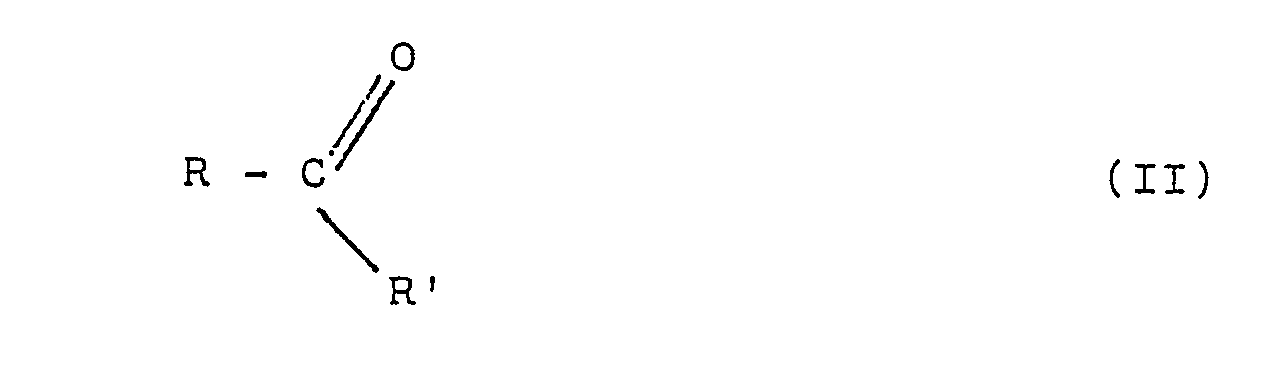
wherein: Rʹ = F or perfluoroalkyl, R = F or a fluorinated hydrocarbon radical which can contain also chlorine and/or bromine.
wherein: Rʹ = F or perfluoroalkyl, R = F or a fluorinated hydrocarbon radical which can contain also chlorine and/or bromine.
3. Process according to claim 2, characterized in that R represents a perfluoroalkyl
radical containing from 1 to 6 carbon atoms.
4. Process according to any of preceding claims, characterized in that the reaction
between FCl and organic compounds having a molecular structure in which an oxygen
atom is directly bonded to a carbon atom in the carbonyl form, is carried out by means
of the continuous flowing of the reactants in the gas phase through a fixed bed containing
the catalyst, and capable of securing the desired heat exchange.
5. Process according to any of preceding claims, characterized in that it is carried
out in the presence of a metal material essentially inert towards fluorine, used as
a support for the catalyst.
6. Process according to claim 4 and 5, characterized in that the catalyst is admixed
with the metal material as shavings, Rasch ing rings and similar packing bodies.
7. Process according to claim 5 or 6, characterized in that the metal material is
copper or its alloys, such as brass and Monel.
8. Process according to any of preceding claims, characterized in that the reactants
are fed in diluted form with an inert gas, at concentrations comprised within the
range of from 5 to 70% by volume.