| (19) |
 |
|
(11) |
EP 0 261 234 B1 |
| (12) |
EUROPEAN PATENT SPECIFICATION |
| (45) |
Mention of the grant of the patent: |
|
15.05.1991 Bulletin 1991/20 |
| (22) |
Date of filing: 31.03.1987 |
|
| (86) |
International application number: |
|
PCT/US8700/734 |
| (87) |
International publication number: |
|
WO 8705/806 (08.10.1987 Gazette 1987/22) |
|
| (54) |
DUAL PHASE SOLVENT CARRIER SYSTEM
ZWEIPHASENLÖSUNGSMITTEL-TRÄGERSYSTEM
SYSTEME DE VEHICULE A SOLVANT BIPHASE
|
| (84) |
Designated Contracting States: |
|
AT BE CH DE FR GB IT LI LU NL SE |
| (30) |
Priority: |
31.03.1986 US 846171
|
| (43) |
Date of publication of application: |
|
30.03.1988 Bulletin 1988/13 |
| (73) |
Proprietor: UNIVERSITY OF SOUTHERN CALIFORNIA |
|
Los Angeles,
California 90007 (US) |
|
| (72) |
Inventor: |
|
- NIMNI, Marcel, Efraim
Santa Monica, CA 90405 (US)
|
| (74) |
Representative: Newstead, Michael John et al |
|
Page Hargrave
Temple Gate House
Temple Gate
Bristol BS1 6PL
Bristol BS1 6PL (GB) |
| (56) |
References cited: :
EP-A- 0 131 228
US-A- 3 899 578
US-A- 4 352 808
|
FR-A- 2 566 661
US-A- 4 039 664
US-A- 4 375 474
|
|
| |
|
|
- Canadian Veterinary Journal, vol. 20, February 1979, K. Post et al.;pages 45 and 47
- Arch Dermatol, vol. 113, November 1977, S.M. Wallace et al.; pages 1539-1542
- Journal of International Medical Research, vol. 5, 1977, H.A. AL et al.; pages 382-386
- British Journal of Dermatology, Vol. 91, 1974, A. Knight, pages 49-55
- Acta Dermato-Venerologica, Vol. 39, 1959, L. Goldman et al.; pages 454-468
- Popovich "Handbook of Non-prescription Drugs", 6th Edition, 1979, American Pharm.
Assn., page 449
- Arch Dermatol, vol. 111, October 1975, W.L. Epstein et al.; pages 1293-1296
- Journal of Investigative Dermatology, Vol. 64, no. 4, 1975, D.P. Zarowny et al.; pages
268-271
|
|
| |
|
| Note: Within nine months from the publication of the mention of the grant of the European
patent, any person may give notice to the European Patent Office of opposition to
the European patent
granted. Notice of opposition shall be filed in a written reasoned statement. It shall
not be deemed to
have been filed until the opposition fee has been paid. (Art. 99(1) European Patent
Convention).
|
[0001] The present invention is directed to a dual phase carrier system for pharmaceutically
active compounds and also to compositions useful for the treatment of dermatomycoses
fungal infections. In a specific embodiment, the invention is directed to a composition
containing griseofulvin which is topically applied to dermatophytic infections.
[0002] In many applications, it is desirable to topically apply pharmaceutically active
compounds. One particular application is the treatment of dermatophytic infections.
A dermatophytic infection is caused by the invasion of fungi into the keratinized
layers of the epidermis, hair and nails of human beings and other animals. There are
numerous fungi, such as T. rub- rum, Microsporum Canis, T. interdigitale, and other
known fungi that can cause these types of infections. The treatment of these infections
typically involves administering one or more known types of antifungal agents, e.g.
griseofulvin, clotrimazole, miconazole nitrate and thiabendazole, either orally or
topically depending on either orally or topically depending on the particular anti-fungal
agent used, While certain antifungal agents may be applied topically or orally, certain
antifungal agents, e.g. griseofulvin, have generally only been administered orally.
Typically, griseofulvin may be administered when the dermatophytic infection has not
been successfully treated with the topical application of other antifungal agents.
[0003] Despite the effectiveness of orally administered griseofulvin there is concern that
the oral use of griseofulvin includes a risk of toxicity and car- cinogenesis. It
is generally believed that these risks may be reduced if griseofulvin could be successfully
topically administered. The topical administration of griseofulvin has been hindered
by the lack of a suitable carrier, since griseofulvin can not be topically applied
and absorbed through the dermis in its natural solid or powder state. Furthermore,
griseofulvin is insoluble in water and only slightly soluble in common solvents, such
as dimethylsulfoxide, dimethylformamide and acetone which are typically used as pharmaceutical
carriers. The following articles generally discuss the topical application of griseofulvin
using various carrier systems.
"Topical griseofulvin therapy of that which is called tinea pedis", by Goldman et
al, ASMC Der- matoVenereologica, line 39, page 454-460 (1959) ;
"The activity of various topical griseofulvin preparations and the appearance of oral
griseofulvin in the stratum comeum", by Knight, British Journal of Dermatology, Vol.
91, pages 49-55 (1974) ;
"Topically applied griseofulvin in the treatment of superficial dermatomycoses in
Egypt", by H, Abgel-Aal et al, Journal International Medical Research, Vol. 5, pages
382-286 (1977) ;
"Topically applied griseofulvin in prevention and treatment of Trichophyton mentagrophytes"
by Eps- tein et al, Archives of Dermatology, Vol. 111, pages 1293-1296 (October 1975)
;
"Evaluation of the effectiveness of griseofulvin, tolnaftate, and placebo in the topical
therapy of superficial dermatophytoses" by Zarowny et al, The Journal of Investigative
Dermatology, Vol. 64 pages 268-272 (1975) ;
"Topical treatment of experimental ringworm in guinea pigs with griseofulvin in dimethylsulfoxide"
by Post and Saunders, Canadian Veterinary Journal, Vol. 20, pages 45-48 (February
1979) ;
"Topically applied antifungal agents" by Wallace et al, Archives of Dermatology, Vol.
113, pages 1539-1542 (November 1977).
[0004] The carrier systems discussed by these articles may be generally classified as consisting
of highly volatile solvents, oily solvents or ointments. Some of these carrier systems
were found to be ineffective, or if at least partially effective, exhibited other
drawbacks. Generally, the highly volatile solvents, e.g. alcohol, dissipated before
sufficient time had elapsed forthe griseofulvin to be absorbed through the dermis,
leaving a residue of griseofulvin powder on the dermis surface. The oily solvents
or ointment carriers, even when demonstrated as potentially effective as a carrier,
typically were applied in relatively excessive amounts leaving an oily residue on
the dermis even after the elapse of an extended period of time. Furthermore, some
of the carrier solvents found effective, i.e. trichloroethanol and dimethylsulfoxide,
caused irritation to the dermis when used over extended periods of time.
[0005] Topical compositions of nicardipine hydrochloride or nifedipine are disclosed in
EP-0131228. The solvent carrier systems disclosed include a mixed solvent of benzyl
alcohol (boiling point 205°C) and propylene glycol (boiling point 188°C). However,
the relatively low volatility of this solvent carrier system can cause undesirable
oily residues on the dermis.
[0006] Topical griseofulvin compositions are also disclosed in U.S. Patent No. 3,899,578,
issued to Bird et al, August 12, 1975. The disclosed compositions are comprised of
griseofulvin dissolved in various high boiling solvents, e.g. propylene carbonate,
dimethyl phthalate, 3-phenoxypropanol, 4-chlorophenoxyetha- nol, phenoxyethanol, phenylethanol,
eugenol and benzyl alcohol. Benzyl alcohol, alone or in combination with dimethyl
phthalate, propylene carbonate or eugenol are disclosed as preferred solvent carriers.
The useful composition may be diluted with ethanol, n-propanol, isopropanol, propylene
glycol or glycerol. However, the disclosed compositions would be generally classified
as a gel, ointment or paste due to the large amount of the low volatility solvent
used in their preparation. Thus, these compositions will leave an oily residue for
a considerable amount of time after application. This potentially delays or hinders
the absorption of griseofulvin since it is believed that griseofulvin preferably remains
solubilized in the oily layer of the composition.
[0007] There thus remains a need for topically applied solvent carrier system which does
not cause irritation or leave a substantially large oily residue which potentially
delays or hinders absorption of the pharmaceutically active compound being applied,
and particulariy a carrier system for the topical application of griseofulvin.
[0008] The present invention is based on the surprising finding that by maintaining the
proportions of a benzyl alcohol delivery solvent within the range 5 to 15 weight percent
and at the same time employing a relatively large proportion of a volatile fugitive
solvent a dual phase solvent carrier system is obtained which goes at least some way
towards meeting this need.
[0009] According to the present invention, there is provided a dual phase solvent carrier
system comprising a pharmaceutically effective amount of a pharmaceutically active
compound, from 5 to 15 weight percent of benzyl alcohol, and a major amount of a pharmaceutically
acceptable fugitive solvent having a boiling point of less than 110°C.
[0010] The invention is directed to a unique solvent carrier system for the topical application
of pharmaceutically active compounds, e.g. antifungal agents. This solvent carder
system comprises a first (benzyl alcohol) solvent phase of a relatively high boiling
solvent and a second (fugitive) solvent phase of a relatively low boiling solvent
and a pharmaceutically effective amount of pharmaceutically active compound. Both
solvents are compatible and co-soluble in each other and of the type into which the
particular pharmaceutically active compound can be dissolved. When topically applied,
the low boiling solvent will quickly dissipate due to the patient's body temperature,
leaving a concentrated solution of the pharmaceutically active compound in the remaining
high boiling solvent Due to the low concentration of the high solvent in the initial
composition, the remaining layer is sufficiently thin enough to promote the absorption
of the pharmaceutically active compound through the patient's dermis without the above
discussed disadvantages.
[0011] In a specific embodiment, the invention is directed to a composition which is comprised
of at least 0.05 weight percent griseofulvin, from 5 to 15 weight percent benzyl alcohol,
and a major amount of a pharmaceutically acceptable fugitive solvent having a boiling
point of less than 110°C. This composition can be topically applied to dermatophytic
infection for treating the same.
[0012] The invention is further directed to methods of making and using the composition.
[0013] The present invention may be better understood and its numerous advantages and objectives
will become apparent to those of ordinary still in the art by reference to the accompanying
drawings, wherein like reference numerals refer to like elements in the several figures,
in which :
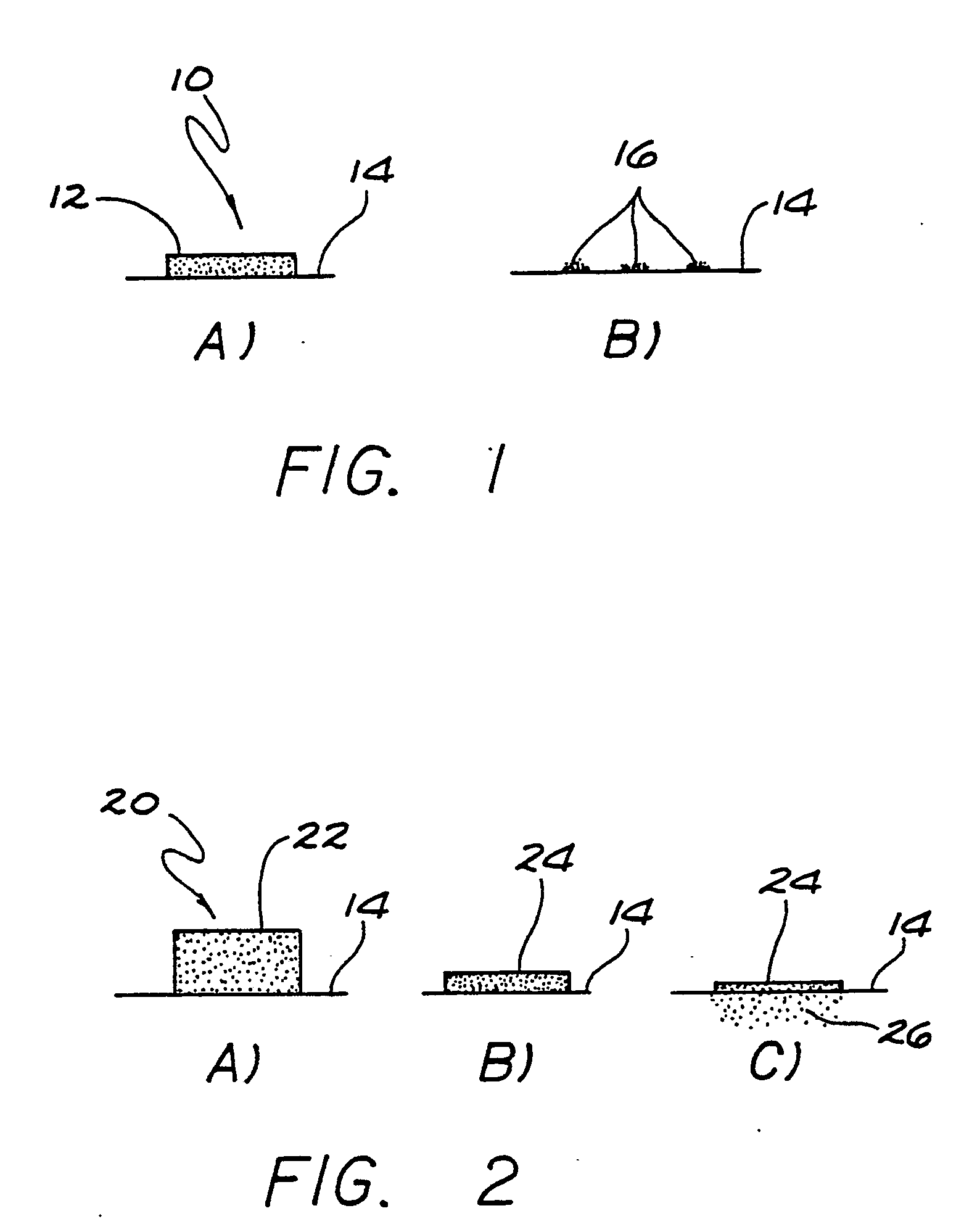
Figure 1A and 1B are schematic illustrations of one type of prior art solvent carrier
system ; and
Figures 2A, B and C are schematic illustrations of a dual-phase carrier system in
accordance with an embodiment of the invention.
[0014] In accordance with one embodiment the invention is directed to a dual phase solvent
carrier system for topically applying pharmaceutically active compounds. Specifically,
the invention is directed to a solvent carrier system comprised of a pharmaceutically
effective amount of pharmaceutically active compound dissolved in a solution of benzyl
alcohol as a delivery solvent (which possesses a relatively high boiling point) and
a pharmaceutically acceptable fugitive solvent which possesses a relatively low boiling
point of less than 110°C, preferably less than 85°C.
[0015] An advantage of using the dual phase solvent carrier system of the invention is that
a pharmaceutically effective amount of a pharmaceutically active compound can be delivered
to the site of infection which is to be treated without an excessive amount of an
oily residue remaining after a period of time. "Pharmaceutically effective amount"
shall mean the amount of the compound dissolved into the dual phase solvent carrier
system that is effective for achieving the desired results, i.e. treatment, cure or
control of a specific infection or disease. This amount will vary depending upon the
particular active compound and the disease or infection being treated.
[0016] The dual phase solvent carrier system of the invention is comprised of from 5 to
15 weight percent ofthe delivery solvent and of a major amount, typically more than
fifty percent, of the fugitive solvent. Preferably, the fugitive solvent will comprise
from about 95 to about 75 weight percent of the carrier system.
[0017] The carrier system of the invention may be used to topically apply any suitable pharmaceutically
active compound, primarily hydrophobic compounds. Preferably the active compound is
an antifungal agent, e.g. miconazole nitrate, thiapendazole, toinaftate, clotrimazole
or griseofulvin, and most preferably griseofulvin. The active compound will be present
in the carrier system at a pharmaceutically effective amount for the particular compound
and the disease being treated. Preferably, the active compound will comprise about
0.05 to about 3 weight percent of the carrier system.
[0018] An advantage of using the dual phase carrier system of the invention is that following
topical application, a very thin layer of the delivery solvent will remain upon the
affected area as the fugitive solvent quickly dissipates. The delivery solvent, which
remains on the affected area, possesses a greater concentration of the pharmaceutically
active compound than the starting carrier system. A concentration of the active compound
on the patienfs dermis of 5-20 or more fold can be achieved by using this system.
Furthermore, as stated, the amount of the system, remaining on the affected area after
application is significantly reduced. Even at the higher concentrations of the delivery
solvent the amount of the carrier system remaining will be less than about 15 percent
of the initial amount of carrier system. This not only concentrates the active compound,
but it is believed facilitates the transport of the active compound through the patient's
dermis. It is believed that the remaining thin layer of the delivery solvent provides
a sufficiently greater surface area to volume ratio which promotes the dissipation
of the delivery solvent slowly. It is further believed that this slow dissipation
induces the transport of the active compound through the dermis. When large amounts
of a low volatile solvent remain on the dermis it has been found that the active compound
will preferentially remain in the solvent and be absorbed slowly if at all through,
the dermis. This is the situation with previously used ointment or gel type carrier
systems. Thus not only does the carrier system of the invention provide a means for
applying a concentrated amount of an active compound but also promotes transport of
the compound through the dermis. It should be noted that the above discussion concerning
the mechanism of absorption is merely a theory and should not be taken in any manner
to limit the scope of the invention.
[0019] The carrier system may be prepared by admixing the solvents and active compound in
a suitable manner which assures the solubilization of the compound in the solvents.
Furthermore, the carrier system may be applied to the affected area by any suitable
means.
[0020] Referring to Figures 1A and B, a schematic illustration of a prior art solvent delivery
system of the type which comprises a relatively low boiling organic solvent, e.g.
an alcohol, is seen generally at 10. As shown in Figure 1A, a solution 12 of a pharmaceutically
active compound (illustrated as a powder) in the low boiling solvent is applied to
a patent's dermis 14. The solvent, which is volatile, quickly dissipates due to the
temperature of the patient's dermis, typically about 32°C, leaving as a residue the
solid or powder form of the active compound, as seen generally at 16. The active compound
power residue 16 will not be absorbed through the dermis 14. Furthermore, little,
if any, of the active compound will be absorbed through the patienfs dermis 14 prior
to dissipation or evaporation of the solvent. Thus this type of prior art carrier
system is generally ineffective as a delivery system for most pharmaceutically active
compounds.
[0021] Referring now to Figure 2A, B and C, a schematic illustration of the dual phase solvent
carrier system of the invention applied to the patient's dermis 14 is seen generally
at 20. As stated above, the system 20 is comprised of a solution 22 of from about
5 to about 15 weight percent of the benzyl alcohol delivery solvent (high boiling
point solvent) and a major of the fugitive solvent (low boiling point solvent) into
which a pharmaceutically active compound is dissolved. Upon topical administration
of the solution 22 to the patient's dermis 14, the fugitive solvent will be substantially
dissipated or evaporated due to the dermis 14 temperature (about 32°C). As seen in
Figure 2B, this leaves a residue solution 24 of the pharmaceutically active compound
concentrated in the delivery solvent. A comparison of Figures 2B and 2C schematically
illustrates that as the delivery solvent or residue solution 24 slowly dissipates
over a sufficient enough period of time the active compound is absorbed through the
dermis 14, represented generally at 26 as a powder. This allows the active compound
to be delivered to and act upon the specific disease or infection.
[0022] It should be noted that the solvents utilized should be compatible and of the types
into which the active compound may be dissolved. The benzyl alcohol delivery solvent
has high enough boiling point to ensure a residue time for the solution 24 upon the
dermis 14 sufficient enough to promote the absorption of the active compound. Suitable
fugitive solvents include, but are not limited to, ethanol, n-propanol, isopropanol,
butyl alcohol and acetone.
[0023] In accordance with another embodiment the invention is directed to a particularly
useful carrier system for treating dermatophytic infections. This carrier system is
a composition comprised of benzyl alcohol, as the delivery solvent, a fugitive solvent
(as defined above) and a pharmaceutically effective amount of griseofulvin. This embodiment
of the invention has been found unexpectedly superior for topically delivering pharmaceutically
effective amounts of the griseofulvin to treat dermatophytic infections.
[0024] There are various types of dermatophytic infections which this composition of the
invention may be used to treat. Generally, this composition may be used to treat the
various dermatophytic infections, e.g. tinea pedis, tinea capitis and tinea corporis.
These types of infections may be caused by numerous fungi, e.g. those classified under
the general trichophyton, microsporum on epidermophyton.
[0025] The antifungal agent griseofulvin used to treat these fungal infections in accordance
with this embodiment of the invention is represented by the following general formula
:
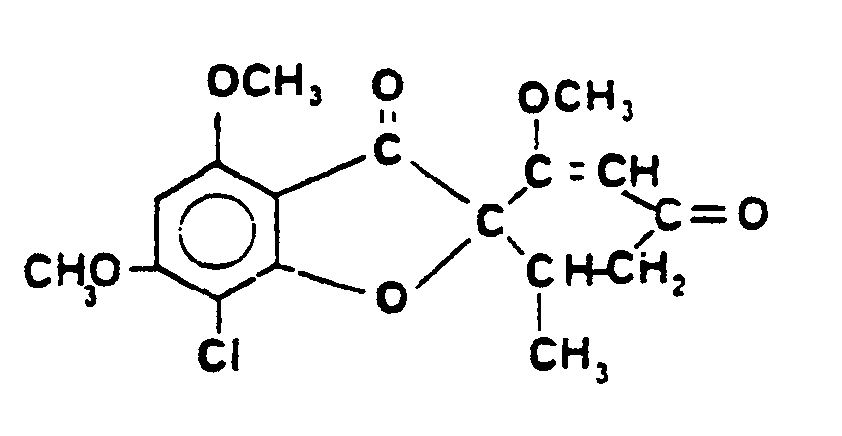
[0026] The composition is comprised of at least about 0.05 weight percent griseofulvin,
preferably from 0.5 to 3 weight percent and more preferably 1 weight percent.
[0027] The delivery solvent used in this composition is as stated advantageously benzyl
alcohol. It has been found that benzyl alcohol is particularly well suited to act
as the delivery solvent for the griseofulvin. Generally, the composition will be comprised
of from 5 weight percent to 15 weight percent benzyl alcohol, more preferably 10 weight
percent. It has been unexpectedly found that griseofulvin is soluble in benzyl alcohol
at high concentrations, i.e. 8 to 20 weight percent concentration, at room temperature
and even more importantly at elevated temperatures, such as about 32°C which is the
temperature of the patienfs skin to which the composition will be applied. This assures
that the griseofulvin will be soluble in the layer of benzyl alcohol remaining after
the dissipation of the fugitive solvent. Furthermore, it has unexpectedly been found
that the griseofulvin remains solubilized in benzyl alcohol as the fugitive solvent
dissipates, and that the benzyl alcohol solution remains on the dermis, even as a
thin layer, for a sufficient enough period of time allowing the griseofulvin to be
absorbed into the dermis.
[0028] The fugitive solvent will comprise a major amount of the composition, preferably
from 95 to 75 weight percent, more preferably 90 weight percent of the composition.
More, than one fugitive solvent may be utilized in preparing the composition with
the proviso that the boiling point of the fugitive solvents not be effected to make
them less volatile. Suitable fugitive solvents include, but are not limited to, isopropyl
alcohol, acetone, n-propanol, ethanol and butyl alcohol. It should be noted that the
fugitive solvents which are useful for the practice of the invention are those compatible
with the benzyl alcohol and those in which the griseofulvin is soluble.
[0029] Other compounds or additives may be present in the composition, e.g. other antifungal
agents, solubilizing agents, keratolitic agents, aliphatic compounds with antifungal
activity and solvent capacity (i.e. unde- cylenic acid). Preferably, the composition
contains a pharmaceutically effective amount of a second anti- fungal agent, e.g.
miconazole nitrate, thiabendazole, tolnaflate, or clotrimazole, preferably from 0.05
to 3 weight percent of a second antifungal agent, and more preferably dotrimazole
as the second antifungal agent.
[0030] The composition of the invention may be prepared by any suitable technique, e.g.
preparing or admixing the solvents and subsequently dissolving therein the griseofulvin
and other additives. Preferably, the griseofulvin is first dissolved in the benzyl
alcohol at an amount to provide the desired concentration of the griseofulvin in the
final composition. The amount of benzyl alcohol into which the griseofulvin is dissolved
shall also be sufficient to provide the desired concentration of benzyl alcohol in
the final composition. This solution of griseofulvin in benzyl alcohol is then admixed
with the desired fugitive solvent or solvents such as isopropyl alcohol, to provide
the desired composition. Preferably, any other additives are dissolved along with
the griseofulvin into the benzyl alcohol.
[0031] While the dissolving of the griseofulvin in benzyl alcohol may be carried out at
room temperature, it is preferable that the benzyl alcohol be heated to a temperature
of from 40°C to 50°C prior to dissolving the griseofulvin or other additives. This
accelerates the solubilizing of the griseofulvin into the benzyl alcohol. The griseofulvin
is preferably used in its microcrystalline form. The dissolving of the benzyl alcoholgriseofulvin
solution into the fugitive solvent or solvents is typically carried out at room temperature.
[0032] The resulting composition is topically applied directly to the infected site. After
application the fugitive solvent or solvents will quickly dissipate by evaporation,
due to the body temperature of the patient, leaving as a residue a thin film of the
benzyl alcoholgriseofulvin solution on the effected area. It has unexpectedly been
found that even when the griseofulvin becomes highly concentrated in the benzyl alcohol,
as the fugitive solvent dissipates, it remains in solution and does not precipitate
out of the benzyl alcohol. This is critical since any griseofulvin which precipitates
out of the benzyl alcohol would not be in a form to be absorbed into the dermis. Furthermore,
the benzyl alcohol is stable enough at the given temperature of the patient's dermis
to remain for a sufficient enough time to allow absorption into the dermis.
[0033] The composition may be applied to the infected area by any satisfactory means, such
as by a cotton swab, an eye dropper or aerosol spray. The effective amount of the
composition applied to the infected area is such to provide a thin layer of the benzyl
alcohol-griseofulvin solution after dissipation or absorption of the fugitive solvent
The precise amount of the composition applied is not critical, however excessive application
will not be beneficial.
[0034] The utilization of this composition ensures that the griseofulvin remains dissolved
in a thin layer of solvent for a sufficient enough time on the patient's dermis to
allow for absorption of the griseofulvin. Furthermore, the topical application of
griseofulvin using this composition allows a reduction in the amount of griseofulvin
given the patient in comparison with oral administration. This reduces the potential
risks associated with the oral administration of griseofulvin as discussed above and
the potential of skin irritation caused by the solvent.
EXAMPLE
[0035] A griseofulvin composition of the invention was prepared comprised of 1 weight percent
griseofulvin, 10
weight percent benzyl alcohol, 40 weight percent acetone and 50 weight percent isopropyl
alcohol. This composition was prepared by dissolving the griseofulvin into benzyl
alcohol that was heated to about 40°C. This resulting composition was dissolved into
the acetone and subsequently into the isopropyl alcohol. The final composition showed
no indication of griseofulvin precipitation.
[0036] This composition was applied to a tinea pedis infection, using a cotton swab, every
7 to 10 days. The outbreak of the infection was successfully controlled by this application
with no observed secondary skin irritations caused by the composition. Previously,
a composition containing 1 weight percent griseofulvin, 1 weight percent chloroform
with the remainder being isopropyl alcohol was topically applied to the same tinea
pedis infection. This composition was only effective in controlling the infection
by daily applications. Thus the administration of the griseofulvin composition of
the invention was unexpectedly superior in controlling the outbreak of the tinea pedis
infection than the previously used composition. This demonstrates that the griseofulvin
composition of the invention provides a better solvent carrier system for the griseofulvin.
[0037] The composition described in the above example may also be used to control other
dermatophytic infections, e.g. tinea capitis and tinea corporis.
Claims for the following Contracting State(s) : s : BE, CH, DE, FR, GB, IT, L!, LU,
NL, SE
1. A dual phase solvent carrier system comprising :
a pharmaceutically effective amount of a pharmaceutically active compound ;
from 5 to 15 weight percent of benzyl alcohol ; and
a major amount of a pharmaceutically acceptable fugitive solvent having a boiling
point of less than 110°C.
2. The system of claim 1 wherein said fugitive solvent is present at from 95 to 75
weight percent of said system.
3. The system of claim 1 or claim 2 wherein said fugitive solvent has a boiling point
of less than 85°C.
4. The system of any one of claims 1 to 3 wherein said pharmaceutically active compound
is present at from 0.05 to 3 weight percent of the system.
5. The system of claim 4 wherein said pharmaceutically active compound is miconazole
nitrate, thiabendazole, toinaftate, clotrimazole orgriseofulvin,
6. The system of claim 4 wherein said pharmaceutically active compound is griseofulvin.
7. A composition comprising :
at least 0.05 weight percent griseofulvin ;
from 5 to 15 weight percent benzyl alcohol ; and
a major amount of a pharmaceutically acceptable fugitive solvent having a boiling
point of less than 110°C.
8. The composition of claim 7 wherein said fugitive solvent comprises from 75 to 95
weight percent of said composition.
9. The composition of claim 7 or claim 8 wherein said griseofulvin is present at from
0.5 to 3 weight percent of said composition.
10. The composition of claim 7 or claim 8 wherein said griseofulvin is present in
said composition at 1 weight percent.
11. The composition of any one of claims 7 to 10 wherein said benzyl alcohol is present
in said composition at 10 weight percent
12. The composition of any one of claims 7 to 11 further including a pharmaceutically
effective amount of miconazole nitrate, thiabendazole, toinaftate or clotrimazole.
13. The composition of claim 12 wherein said miconazole nitrate, thiabendazole, tolnaftate
or clotrimazole is present at from 0.05 to 3 weight percent of said composition.
14. The composition of any one of claims 7 to 13 wherein said fugitive solvent has
a boiling point of less than 85°C.
15. The composition of any one of claims 7 to 14 wherein said fugitive solvent is
selected from the group consisting of n-propanol, isopropyl alcohol, acetone, ethyl
alcohol and butyl alcohol.
16. The composition of any one of claims 7 to 15 wherein said fugitive solvent comprises
90 weight percent of said composition.
17. The system or composition of any one of the preceding claims for use as a topical
antifungal agent.
18. A process for preparing a system or composition according to any one of the preceding
claims, said process comprising admixing the pharmaceutically active compound, the
benzyl alcohol and the fugitive solvent in suitable amounts and in such a way as to
solubilize the pharmaceutically active compound in the benzyl alcohol and the fugitive
solvent to obtain the desired system or composition.
19. Use, in the manufacture of a pharmaceutical composition, of a dual phase solvent
carrier comprising benzyl alcohol and a pharmaceutically acceptable fugitive solvent
having a boiling point of less than 110°C, the benzyl alcohol being present in the
carrier in such an amount as to comprise 5 to 15 weight percent of the composition
and the fugitive solvent being present in the carrier in such an amount as to comprise
a major amount of the composition.
20. Use of a dual phase solvent carrier according to claim 19 in the manufacture of
a topical antifungal agent.
21. Use of a dual phase solvent carrier according to claim 19 or claim 20 in the manufacture
of a topical composition for treating dermatophytic infection.
22. Use of a dual phase solvent carrier according to any one of claims 19 to 21 in
the manufacture of a composition including griseofulvin as active agent.
23. Use, for the solubilization of a pharmaceutically active compound in a pharmaceutical
composition, of benzyl alcohol in such an amount as to comprise 5 to 15 weight percent
of the composition and a pharmaceutically acceptable fugitive solvent having a boiling
point of less than 110°C in such an amount as to comprise a major amount of the composition.
Claims for the following Contracting State(s) : AT
1. A process for preparing a dual phase solvent carrier system comprising a pharmaceutically
effective amount of a pharmaceutically active compound, from 5 to 15 weight percent
of benzyl alcohol, and a major amount of a pharmaceutically acceptable fugitive solvent
having a boiling point of less than 110°C, said process comprising admixing the pharmaceutically
active compound, the benzyl alcohol and the fugitive solvent in suitable amounts and
in such a way as to solubilize the pharmaceutically active compound in the benzyl
alcohol and the fugitive solvent to obtain the desired system.
2. The process of claim 1 wherein said fugitive solvent is admixed in such an amount
as to be present at from 95 to 75 weight percent of said system.
3. The process of claim 1 or claim 2 wherein said fugitive solvent has a boiling point
of less than 85°C.
4. The process of any one of claims 1 to 3 wherein said pharmaceutically active compound
is admixed in such an amount as to be present at from 0.05 to 3 weight percent of
the system.
5. The process of claim 4 wherein said pharmaceutically active compound is miconazole
nitrate, thiabendazole, tolnaftate, clotrimazole or griseofulvin.
6. The process of claim 4 wherein said pharmaceutically active compound is griseofulvin.
7. A process for preparing a composition comprising at least 0.05 weight percent griseofulvin,
from 5 to 15 weight percent benzyl alcohol, and a major amount of a pharmaceutically
acceptable fugitive solvent having a boiling point of less than 110°C, said process
comprising admixing the griseofulvin, the benzyl alcohol and the fugitive solvent
in suitable amounts and in such a way as to solubilize the griseofulvin in the benzyl
alcohol and the fugitive solvent to obtain the desired composition.
8. The process of claim 7 wherein said fugitive solvent is admixed in such an amount
as to comprise from 75 to 95 weight percent of said composition.
9. The process of claim 7 or claim 8 wherein said griseofulvin is admixed in such
an amount as to be present at from 0.5 to 3 weight percent of said composition.
10. The process of claim 7 or claim 8 wherein said griseofulvin is admixed in such
an amount as to be present in said composition at 1 weight percent.
11. The process of any one of claims 7 to 10 wherein said benzyl alcohol is admixed
in such an amount as to be present in said composition at 10 weight percent.
12. The process of any one of claims 7 to 11 further including admixing a pharmaceutically
effective amount of miconazole nitrate, thiabendazole, tolnaftate or clotrimazole.
13. The process of claim 12 wherein said miconazole nitrate, thiabendazole, tolnaftate
or clotrimazole is admixed in such an amount as to be present at from 0.05 to 3 weight
percent of said composition.
14. The process of any one of claims 7 to 13 wherein said fugitive solvent has a boiling
point of less than 85°C.
15. The process of any one of claims 7 to 14 wherein said fugitive solvent is selected
from the group consisting of n-propanol, isopropyl alcohol, acetone, ethyl alcohol
and butyl alcohol.
16. The process of any one of claims 7 to 15 wherein said fugitive solvent is admixed
in such an amount as to comprise 90 weight percent of said composition.
17. Use, in the manufacture of a pharmaceutical composition, of a dual phase solvent
carrier comprising benzyl alcohol and a pharmaceutically acceptable fugitive solvent
having a boiling point of less than 110°C, the benzyl alcohol being present in the
carrier in such an amount as to comprise 5 to 15 weight percent of the composition
and the fugitive solvent being present in the carrier in such an amount as to comprise
a major amount of the composition.
18. Use of a dual phase solvent carrier according to claim 17 in the manufacture of
a topical antifungal agent.
19. Use of a dual phase solvent carrier according to claim 17 or claim 18 in the manufacture
of a topical composition for treating dermatophytic infection.
20. Use of a dual phase solvent carrier according to any one of claims 17 to 18 in
the manufacture of a composition including griseofulvin as active agent.
21. Use, for the solubilization of a pharmaceutically active compound in a pharmaceutical
composition, of benzyl alcohol in such an amount as to comprise 5 to 15 weight percent
of the composition and a pharmaceutically acceptable fugitive solvent having a boiling
point of less than 110°C in such an amount as to comprise a major amount of the composition.
Patentansprüche für folgende(n) Vertragsstaat(en) : BE, CH, DE, FR, GB, IT, LI, LU,
NL, SE
1. Ein Zweiphasen-Lösungsmittel-Transfersystem enthaltend :
eine pharmazeutisch wirksame Menge einer pharmazeutisch aktiven Verbindung ;
5 bis 15 Gewichtsprozent Benzylalkohol, und
eine größere Menge eines pharmazeutisch akzeptablen flüchtigen Lösungsmittels mit
einem Siedepunkt von weniger als 110°C.
2. Das System nach Anspruch 1, worin das besagte flüchtige Lösungsmittel mit 95 bis
75 Gewichtsprozent vom besagten System anwesend ist.
3. Das System nach Anspruch 1 oder 2, worin das besagte flüchtige Lösungsmittel einen
Siedepunkt von weniger als 85°C hat.
4. Das System nach einem der Ansprüche 1 bis 3, worin die besagte pharmazeutisch aktive
Verbindung mit 0,05 bis 3 Gewichtsprozent vom System anwesend ist.
5. Das System nach Anspruch 4,worin die besagte aktive pharmazeutisch aktive Verbindung
Miconazolnitrat, Thiabendazol, Tolnaphtat, Clotrimazol oder Griseofulvin ist.
6. Das System nach Anspruch 4, worin die besagte pharmazeutisch aktive Verbindung
Griseofulvin ist.
7. Eine Zusammensetzung enthaltend :
mindestens 0,05 Gewichtsprozent Griseofulvin, 5 bis 15 Gewichtsprozent Benzylalkohol
und
eine größere Menge eines pharmazeutisch akzeptablen flüchtigen Lösungsmittels mit
einem Siedepunkt von weniger als 110°C.
8. Die Zusammensetzung nach Anspruch 7 worin das besagte flüchtige Lösungsmittel 75
bis 95 Gewichtsprozent der besagten Zusammensetzung umfasst.
9. Die Zusammensetzung nach Anspruch 7 oder Anspruch 8, worin das besagte Griseofulvin
mit 0,5 bis 3 Gewichtsprozent von der besagten Zusammensetzung anwesend ist.
10. Die Zusammensetzung nach Anspruch 7 oder Anspruch 8, worin das besagte Griseofulvin
mit einem Gewichtsprozent in der besagten Zusammensetzung anwesend ist.
11. Die Zusammensetzung nach einem der Ansprüche 7 bis 10, worin der besagte Benzylalkohol
mit 10 Gewichtsprozent in der besagten Zusammensetzung anwesend ist.
12. Die Zusammensetzung nach einem der Ansprüche 7 bis 11, weiter enthaltend eine
pharmazeutisch wirksame Menge von Mikonazolnitrat, Thiabendazol, Tolnaphtat oder Clotrimazol.
13. Die Zusammensetzung nach Anspruch 12, worin das besagte Miconazolnitrat, Thiabendazol,
Tolnaphtat oder Clotrimazol mit 0,05 bis 3 Gewichtsprozent von der besagten Zusammensetzung
anwesend ist.
14. Die Zusammensetzung nach einem der Ansprüche 7 bis 13, worin das besagte flüchtige
Lösungsmittel einen Siedepunkt von weniger als 85°C hat.
15. Die Zusammensetzung nach einem der Ansprüche 7 bis 14, worin das besagte flüchtige
Lösungsmittel aus der aus n-Propanol, lsopropylalkohol, Aceton, Ethylalkohol und Butylalkohol
bestehenden Gruppe ausgewählt ist.
16. Die Zusammensetzung nach einem der Ansprüche 7 bis 15, worin das besagte flüchtige
Lösungsmittel 90 Gewichtsprozent der besagten Zusammensetzung umfaßt.
17. Das System oder die Zusammensetzung nach einem der vorhergehenden Ansprüche zur
Verwendung als örtliches Antifungalmittel.
18. Ein Verfahren zur Herstellung eines Systems oder einer Zusammensetzung nach einem
der vorhergehenden Ansprüche, umfassend das Vermischen der pharmazeutisch aktiven
Verbindung, des Benzylalkohols und des flüchtigen Lösungsmittels in entsprechenden
Mengen dergestalt, daß die pharmazeutisch aktive Verbindung in dem Benzylalkohol und
dem flüchtigen Lösungsmittel aufgeschlossen wird,um das gewünschte System oder die
gewünschte Zusammensetzung zu erhalten.
19. Verwendung eines Zweiphasen-Lösungsmittelträgers, enthaltend Benzylalkohol und
ein pharmazeutisch akzeptables flüchtiges Lösungsmittel mit einem Siedepunkt von weniger
als 110°C, wobei der Benzylalkohol mit 5 bis 15 Gewichtsprozent von der Zusammensetzung
anwesend ist, und wobei das flüchtige Lösungsmittel im Träger in einer solchen Menge
anwesend ist, daß es die größere Menge der Zusammensetzung umfasst, bei der Herstellung
einer pharmazeutischen Zusammensetzung.
20. Verwendung eines Zweiphasen-Lösungsmittelträgers nach Anspruch 19 bei der Herstellung
eines örtlich antifungalen Mittels.
21. Verwendung eines Zweiphasen-Lösungsmittelträgers nach Anspruch 19 oder Anspruch
20 bei der Herstellung einer örtlich antifungalen Zusammensetzung zur Behandlung dermatophytischer
Infektionen.
22. Verwendung eines Zweiphasen-Lösungsmittelträgers nach einem derAnsprüche 19 bis
21 bei der Herstellung einer Zusammensetzung, die Griseofulvin als aktives Agens einschließt.
23. Verwendung, zum Zwecke des Aufschließens einer pharmazeutisch aktiven Verbindung
in einer pharmazeutischen Zusammensetzung, von Benzylalkohol in solcher Menge, daß
er 5 bis 15 Gewichtsprozent der Zusammensetzung umfaßt und eines pharmazeutisch akzeptablen
flüchtigen Lösungsmittels mit einem Siedepunkt von weniger als 110°C in einer solchen
Menge, daß es die größere Menge der Zusammensetzung umfaßt.
Patentansprüche für folgende(n) Vertragsstaat(en) : AT
1. Ein Verfahren zur Herstellung eines Zweiphasen-Lösungsmittel-Transfersystems, das
eine pharmazeutisch wirksame Menge einer pharmazeutisch aktiven Verbindung, 5 bis
15 Gewichtsprozent Benzylalkohol, und eine größere Menge eines pharmazeutisch akzeptablen
flüchtigen Lösungsmittels mit einem Siedepunkt von weniger als 110°C enthält, wobei
das besagte Verfahren das Vermischen der pharmazeutisch aktiven Substanz, des Benzylalkohols
und des flüchtigen Lösungsmittels in entsprechenden Mengen dergestalt umfaßt, daß
die pharmazeutisch aktive Verbindung in dem Benzylalkohol und dem flüchtigen Lösungsmittel
aufgeschlossen wird, um das gewünschte System zu erhalten.
2. Das Verfahren nach Anspruch 1, worin das besagte flüchtige Lösungsmittel in solch
einer Menge zugemischt wird, daß es zu 95 bis 75 Gewichtsprozent von dem besagten
System anwesend ist.
3. Das Verfahren nach Anspruch 1 oder Anspruch 2, worin das besagte flüchtige Lösungsmittel
einen Siedepunkt von weniger als 85°C hat.
4. Das Verfahren nach einem derAnsprüche 1 bis 3, worin die besagte pharmazeutisch
aktive Verbindung in solch einer Menge zugemischt wird, daß sie mit 0,05 bis 3 Gewichtsprozent
vom System anwesend ist.
5. Das Verfahren nach Anspruch 4, worin die besagte pharmazeutisch aktive Verbindung
Miconazolnitrat, Thiabendazol, Tolnaphtat, Clortrimazol oder Griseofulvin ist.
6. Das Verfahren nach Anspruch 4, worin die besagte pharmazeutisch aktive Verbindung
Griseofulvin ist.
7. Ein Verfahren zur Herstellung einer Zusammensetzung, die mindestens 0,05 Gewichtsprozent
Griseofulvin, 5 bis 15 Gewichtsprozent Benzylalkohol und eine größere Menge eines
pharmazeutisch akzeptablen flüchtigen Lösungsmittels mit einem Siedepunkt von weniger
als 110°C enthält, wobei das besagte Verfahren das Vermischen des Griseofulvins, des
Benzylalkohols und des flüchtigen Lösungsmittels in entsprechenden Mengen dergestalt
umfaßt, daß das Griseofulvin in dem Benzylalkohol und dem flüchtigen Lösungsmittel
aufgeschlossen wird, um die gewünschte Zusammensetzung zu erhalten.
8. Das Verfahren nach Anspruch 7, worin das besagte flüchtige Lösungsmittel in solch
einer Menge zugemischt ist, daß es 75 bis 95 Gewichtsprozent der besagten Zusammensetzung
umfaßt.
9. Das Verfahren nach Anspruch 7 oder Anspruch 8, worin das besagte Griseofulvin in
solch einer Menge zugemischt ist, daß es mit 0,5 bis 3 Gewichtsprozent von der besagten
Zusammensetzung anwesend ist.
10. Das Verfahren nach Anspruch 7 oder 8, worin das besagte Griseofulvin in solch
einer Menge zugemischt ist, daß es mit einem Gewichtsprozent in der besagten Zusammensetzung
anwesend ist.
11. Das Verfahren nach einem der Ansprüche 7 bis 10, worin der besagte Benzylalkohol
in solch einer Menge zugemischt ist, daß er mit 10 Gewichtsprozent in der besagten
Zusammensetzung anwesend ist.
12. Das Verfahren nach einem der Ansprüche 7 bis 11 weiter einschließend das Zumischen
einer pharmazeutisch wirksamen Menge von Miconazolnitrat, Thiabendazol, Tolnaphtat
oder Clortrimazol
13. Das Verfahren nach Anspruch 12, worin das besagte Miconazolnitrat, das Thiabendazol,
das Tolnaphtat oder das Clortrimazol in solch einer Menge zugemischt ist, daß es mit
0,05 bis 3 Gewichtsprozent von der besagten Zusammensetzung anwesend ist.
14. Das Verfahren nach einem der Ansprüche 7 bis 13, worin das besagte flüchtige Lösungsmittel
einen Siedepunkt von weniger als 85°C hat.
15. Das Verfahren nach einem der Ansprüche 7 bis 14, worin das besagte flüchtige Lösungsmittel
aus der aus n-Propanol, Isopropylalkohol, Aceton, Ethylalkohol und Butylalkohol bestehenden
Gruppe ausgewählt ist.
16. Das Verfahren nach einem der Ansprüche 7 bis 15, worin das besagte flüchtige Lösungsmittel
in solch einer Menge zugemischt ist, daß es 90 Gewichtsprozent der besagten Zusammensetzung
umfaßt.
17. Verwendung eines Zweiphasen-Lösungsmittelträgers, enthaltend Benzylalkohol und
ein pharmazeutisch akzeptables flüchtiges Lösungsmittel mit einem Siedepunkt von weniger
als 110°C, wobei der Benzylalkohol in solch einer Menge in dem Träger anwesend ist,
daß er 5 bis 15 Gewichtsprozent der Zusammensetzung umfaßt, und wobei das flüchtige
Lösungsmittel in solch einer Menge in dem Träger anwesend ist, daß es die größere
Menge der Zusammensetzung umfaßt, bei der Herstellung einer pharmazeutischen Verbindung.
18. Verwendung eines Zweiphasen-Lösungsmittelträgers nach Anspruch 17 bei der Herstellung
eines örtlich antifugalen Mittels.
19. Verwendung eines Zweiphasen-Lösungsmittelträgers nach Anspruch 17 oderAnspruch
18 bei der Herstellung einer örtlich wirkenden Zusammenmischung zur Behandlung dermatophysischer
Infektionen.
20. Verwendung eines Zweiphasen-Lösungsmittelträgers nach einem derAnsprüche 17 bis
18 bei der Herstellung einer Zusammensetzung die Griseofulvin als aktives Agens einschließt.
21. Verwendung, zum Zwecke des Aufschließens einer pharmazeutisch aktiven Verbindung
in einer pharmazeutischen Zusammensetzung, von Benzylalkohol in solch einer Menge,
daß er 5 bis 15 Gewichtsprozent der Zusammensetzung umfaßt und eines pharmazeutisch
akzeptablen flüchtigen Lösungsmittels mit einem Siedepunkt von weniger als 110°C in
solch einer Menge, daß es die größere Menge der Zusammensetzung umfaßt.
Revendications pour l'(les) Etat(s) contractant(s) suivant(s) : BE, CH, DE, FR, GB,
IT, LI, LU, NL, Se
1. Système de véhicule solvant à deux phases comprenant :
une quantité efficace pharmaceutiquement d'un composé actif pharmaceutiquement ;
de 5 à 15% en poids d'alcool benzylique ; et
une quantité prépondérante d'un solvant volatil, acceptable pharmaceutiquement et
ayant un point d'ébullition inférieur à 110°.
2. Le système de la revendication 1, dans lequel le solvant volatil représente de
95 à 75% du poids du système.
3. Le système de la revendication 1 ou de la revendication 2, dans lequel le solvant
volatil a un point d'ébullition inférieur à 85°.
4. Le système de l'une quelconque des revendications 1 à 3, dans lequel le composé
actif pharmaceutiquement représente de 0,05 à 3% du poids du système.
5. Le système de la revendication 4, dans lequel le composé actif pharmaceutiquement
est le nitrate de miconazole, le thiabendazole, le tolnaftate, le clotrimazole ou
la griséofulvine.
6. Le système de la revendication 4, dans lequel le composé actif phamaceutiquement
est la griséofulvine.
7. Composition comprenant :
au moins 0,05% en poids de griséofulvine ;
de 5 à 15% en poids d'alcool benzylique ; et
une quantité prépondérante d'un solvant volatil, acceptable phamaceutiquement et ayant
un point d'ébullition inférieur à 110°.
8. La composition de la revendication 7, dans laquelle le solvant volatil représente
de 75 à 95% du poids de la composition.
9. La composition de la revendication 7 ou de la revendication 8, dans laquelle la
griséofulvine représente de 0,5 à 3 % du poids de la composition.
10. La composition de la revendication 7 ou de la revendication 8, dans laquelle la
griséofulvine représente 1 % du poids de la composition.
11. La composition de l'une quelconque des revendications 7 à 10, dans laquelle l'alcool
benzylique représente 10% du poids de la composition.
12. La composition de l'une quelconque des revendications 7 à 11, comprenant en outre
une quantité efficace pharmaceutiquement de nitrate de miconazole, de thiabendazole,
de tolnaftate ou de clotrimazole.
13. La composition de la revendication 12, dans laquelle le nitrate de miconazole,
le thiabendazole, le tolnaftate ou le clotrimazole représentent de 0,05 à 3% du poids
de la composition.
14. La composition de l'une quelconque des revendications 7 à 13, dans laquelle le
solvant volatil a un point d'ébullition inférieur à 85°.
15. La composition de l'une quelconque des revendications 7 à 14, dans laquelle le
solvant volatil est choisi parmi le propanol normal, l'alcool isopropy- lique, l'acétone,
l'alcool éthylique et l'alcool butylique.
16. La composition de l'une quelconque des revendications 7 à 15, dans laquelle le
solvant volatil représente 90% du poids de la composition.
17. Le système ou la composition suivant l'une quelconque des revendications précédentes,
destiné à être utilisé comme agent antifongique à administrer par voie topique.
18. Procédé de préparation d'un système ou d'une composition suivant l'une quelconque
des revendications précédentes, qui consiste à mélanger le composé actif pharmaceutiquement,
l'alcool benzylique et le solvant volatil en des quantités convenables et de manière
à solubiliser le composé actif pharmaceutiquement dans l'alcool benzylique et dans
le solvant volatil pour obtenir le système ou la composition souhaité.
19. Utilisation, pour la fabrication d'une composition pharmaceutique, d'un véhicule
solvant à deux phases comprenant de l'alcool benzylique et un solvant volatil, acceptable
pharmaceutiquement et ayant un point d'ébullition inférieur à 110°, l'alcool benzylique
étant présent dans le véhicule en une quantité telle qu'il représente de 5 à 15% du
poids de la composition et le solvant volatil étant présent dans le véhicule en une
quantité telle qu'il représente une quantité prépondérante de la composition.
20. Utilisation d'un véhicule solvant à deux phases, suivant la revendication 19,
pour la fabrication d'un agent antifongique à administrer par voie topique.
21. Utilisation d'un véhicule solvant à deux phases, suivant la revendication 19 ou
la revendication 20, pour la fabrication d'une composition administrée par voie topique
et destinée à traiter les affections de la peau.
22. Utilisation d'un véhicule solvant à deux phases, suivant l'une quelconque des
revendications 19 à 21, pour la fabrication d'une composition comprenant de la griséofulvine
comme principe actif.
23. Utilisation pour la solubilisation d'un composé actif pharmaceutiquement dans
une composition pharmaceutique d'alcool benzylique en une quantité telle qu'il représente
de 5 à 15% du poids de la composition et d'un solvant volatil acceptable phamaceutiquement
et ayant un point d'ébullition inférieur à 110° en une quantité telle qu'il représente
une quantité prépondérante de la composition.
Revendications pour l'(les) Etat(s) contractant(s) suivant(s) : AT
1. Procédé de préparation d'un système de véhicule solvant à deux phases, comprenant
une quantité efficace pharmaceutiquement d'un composé actif pharmaceutiquement, de
5 à 15% en poids d'alcool benzylique et une quantité prépondérante d'un solvant volatil,
acceptable pharmaceutiquement et ayant un point d'ébullition inférieur à 110°, ce
procédé consistant à mélanger le composé actif pharmaceutiquement, l'alcool benzylique
et le solvant volatil en des quantités convenables et de façon à solubiliser le composé
actif pharmaceutiquement dans l'alcool benzylique et dans le solvant volatil, pour
obtenir le système souhaité.
2. Le procédé de la revendication 1, qui consiste à mélanger le solvant volatil en
une quantité telle qu'il représente de 95 à 75% du poids du système.
3. Le procédé de la revendication 1 ou de la revendication 2, dans lequel le solvant
volatil a un point d'ébullition inférieur à 85°.
4. Le procédé suivant l'une des revendications 1 à 3, qui consiste à mélanger le composé
actif pharmaceutiquement en une quantité telle qu'il représente de 0,05 à 3% du poids
du système.
5. Le procédé de la revendication 4, dans lequel le composé actif pharmaceutiquement
est le nitrate de miconazole, le thiabendazole, le tolnaftate, le clotrimazole ou
la griséofulvine.
6. Le procédé de la revendication 4, dans lequel le composé actif pharmaceutiquement
est la griséofulvine.
7. Procédé de préparation d'une composition comprenant au moins 0,05% en poids de
griséofulvine ; de 5 à 15% en poids d'alcool benzylique ; et une quantité prépondérante
d'un solvant volatil acceptable pharmaceutiquement ayant un point d'ébullition inférieur
à 110°, ce procédé consistant à mélanger la griséofulvine, l'alcool benzylique et
le solvant volatil en des quantités convenables et de façon à solubiliser la griséofulvine
dans l'alcool benzylique et dans le solvant volatil, pour obtenir la composition souhaitée.
8. Le procédé de la revendication 7, qui consiste à mélanger le solvant volatil en
une quantité telle qu'il représente de 75 à 95% du poids de la composition.
9. Le procédé de la revendication 7 ou de la revendication 8, qui consiste à mélanger
la griséofui- vine en une quantité telle qu'elle représente de 0,5 à 3% du poids de
la composition.
10. Le procédé de la revendication 7 ou de la revendication 8, qui consiste à mélanger
la griséofulvine en une quantité telle qu'elle représente 1% du poids de la composition.
11. Procédé suivant l'une quelconque des revendications 7 à 10, qui consiste à mélanger
l'alcool benzylique en une quantité telle qu'il représente 10% en poids de la composition.
12. Procédé suivant l'une quelconque des revendications 7 à 11, qui consiste à mélanger
en outre une quantité efficace pharmaceutiquement de nitrate de miconazole, de thiabendazole,
de tolnaftate ou de clotrimazole.
13. Le procédé de la revendication 12, qui consiste à mélanger le nitrate de miconazole,
le thiabendazole le tolnaftate ou le clotrimazole en une quantité telle qu'il représente
de 0,05 à 3% du poids de la composition.
14. Procédé suivant l'une quelconque des revendications 7 à 13, dans lequel le solvant
volatil a un point d'ébullition inférieur à 85°.
15. Procédé suivant l'une quelconque des revendications 7 à 14, dans lequel le solvant
volatil est choisi parmi le propanol normal, l'alcool isopropyli- que, l'acétone,
l'alcool éthylique et l'alcool butylique.
16. Procédé suivant l'une quelconque des revendications 7 à 15, qui consiste à mélanger
le solvant volatil en une quantité telle qu'il représente 90% du poids de la composition.
17. Utilisation, pour la fabrication d'une composition phamaceutique, d'un véhicule
solvant à deux phases comprenant de l'alcool benzylique et un solvant volatil, acceptable
pharmaceutiquement et ayant un point d'ébullition inférieur à 11011, l'alcool benzylique
étant présent dans le véhicule en une quantité telle qu'il représente de 5 à 15% du
poids de la composition et le solvant volatil étant présent dans le véhicule en une
quantité telle qu'il représente une quantité prépondérante de la composition.
18. Utilisation d'un véhicule solvant à deux phases, suivant la revendication 17,
pour la fabrication d'un agent antifongique à administrer par voie topique.
19. Utilisation d'un véhicule solvant à deux phases, suivant la revendication 17 ou
la revendication 18, pour la fabrication d'une composition à administrer par voie
topique et destinée à traiter les infections de la peau.
20. Utilisation d'un véhicule solvant à deux phases, suivant l'une quelconque des
revendications 17 à 18, pour la fabrication d'une composition comprenant de la griséofulvine
comme principe actif.
21. Utilisation, pour la solubilisation d'un composé actif pharmaceutiquement dans
une composition pharmaceutique d'alcool benzylique en une quantité telle qu'il représente
de 5 à 15% du poids de la composition et d'un solvant volatil, acceptable pharmaceutiquement
et ayant un point d'ébullition inférieur à 110° en une quantité telle qu'il représente
une quantité prépondérante de la composition.