|
(11) | EP 0 261 705 A1 |

| (12) | EUROPEAN PATENT APPLICATION |
|
|
|
|
|||||||||||||||||||||||||||
| (54) | Herbicidal imidazolinyl benzoic acids and derivatives |
| (57) Compounds of the Formulae I, II, III or IV
wherein X is hydrogen, C₁-C₃ alkyl, C₁-C₃ alkoxy, halogen or nitro; Y is hydrogen or C₁-C₇ acyl; Z is hydrogen, halogen, nitro, CN, C₁-C₃ alkyl, or C₁-C₃ haloalkyl; or X and Z when taken together are -CH=CH-CH=CH-; R₁ is C₁-C₄ alkyl; R₂ is C₁-C₆ alkyl, C₃-C₆ cycloalkyl, C₂-C₄ alkenyl, phenyl, halophenyl or benzyl; or R₁ and R₂ together with the carbon to which they are attached represent optionally substituted C₃-C₆ cycloalkyl; and R₃ is hydrogen, optionally substituted C₁-C₁₂ alkyl, optionally substituted C₃-C₅ alkenyl or alkynyl, benzyl, cyclohexenylmethyl, ethynylcyclohexyl, ethynylalkyl, pentadienyl, or optionally substituted C₃-C₆ cycloalkyl, are useful as herbicides and plant growth regulators. |
[0001] The present invention relates to 3-fluoro-2-(4-oxo-5,5-disubstituted-imidazolin-2-yl)benzoic acids and derivatives thereof, their use as herbicides for controlling undesirable plant growth and to compositions containing such compounds.
[0002] U.S. Patent Nos. 4,017,510, 4,067,718 and 4,188,487 describe certain imidazolinyl benzoic acids, esters and salts and derivatives thereof and their use as herbicides. Some of these compounds contain a chlorine atom on the benzoic acid ring. While such compounds do have some herbicidal activity, it is desirable to obtain materials which have a higher level and greater spectrum of activity in both pre-emergence and post-emergence applications.
[0003] The present invention is directed to compounds of the Formula I, II, III or IV
wherein X is hydrogen, C₁-C₃ alkyl, C₁-C₃ alkoxy, halogen or nitro; Y is hydrogen or C₁-C₇ acyl; Z is hydrogen, halogen, nitro, CN, C₁-C₃ alkyl, or C₁-C₃ haloalkyl; or X and Z when taken together are -CH=CH-CH=CH-; R₁ is C₁-C₄ alkyl; R₂ is C₁-C₆ alkyl, C₃-C₆ cycloalkyl, C₂-C₄ alkenyl, phenyl, halophenyl or benzyl; or when R₁ and R₂ are taken together with the carbon to which they are attached they may represent C₃-C₆ cycloalkyl optionally substituted with methyl; except that, for a compound of formula I or II where X is hydrogen, R¹ is methyl and R² is isopropyl, Z is not a 4-methyl substituent; and R₃ is hydrogen, C₁-C₁₂ alkyl optionally substituted with one C₁-C₃ alkoxy group or one alkoxycarbonyl group or one C₃-C₆ cycloalkyl group or one phenyl group or one furanyl group or with one to three halogen substituent(s) (preferably chlorine), C₃-C₅ alkenyl or alkynyl optionally substituted with one or two C₁-C₃ alkyl group(s) or one phenyl group or with one to two halogen substituent(s) (preferably chlorine), benzyl, cyclohexenylmethyl, ethynylcyclohexyl, ethynylalkyl, pentadienyl or C₃-C₆ cycloalkyl optionally substituted with one or two C₁-C₃ alkyl group(s); or a salt forming cation of an alkali metal, ammonia, or an aliphatic amine; and, when R₁ and R₂ are not the same, the optical isomers and the isomeric mixtures thereof; and, except when R₃ is a salt-forming cation, the acid addition salts thereof.
[0004] The compounds are useful for controlling undesirable plant species growth at a locus and the invention therefore includes a method of combating plant growth at a locus comprising treating the locus, for example by applying to the foliage of the undesirable plant species or to soil containing seeds, seedlings, or propagating organs of the undesirable plant species, a herbicidally effective amount of an imidazolinyl benzoic acid derivative depicted by Formula I, II, III or IV as defined above. The compounds are also intermediates to each other depending on which of the synthesis routes described below is selected.
[0005] Preferred compounds for use as herbicidal agents are those represented by Formula I, II, III or IV above, wherein X is hydrogen, C₁-C₃ alkyl, C₁-C₃ alkoxy or halogen; Y is hydrogen or C 1-2 acyl; Z is hydrogen, halogen or C 1-3 alkyl; R₁ is C₁-C₃ alkyl; R₂ is C₁-C₃ alkyl or cyclohexyl; or when R₁ and R₂ are taken together with the carbon to which they are attached they represent cyclohexyl or methylcyclohexyl; R₃ is hydrogen, C₁-C₁₂ alkyl optionally substituted with one C₁-C₃ alkoxy group or one alkoxycarbonyl group or one C₃-C₆ cycloalkyl group or one phenyl group or one furanyl group or with one to three halogen substituent(s) (preferably chlorine), C₃-C₅ alkenyl optio nally substituted with one or two C₁-C₃ alkyl group(s) or one phenyl group or with one or two halogen substituent(s) (preferably chlorine), C₃-C₅ alkynyl optionally substituted with one or two C₁-C₃ alkyl group(s) or one phenyl group or with one to two halogen substituent(s) (preferably chlorine), benzyl, cyclohexenylmethyl, ethynylcyclohexyl, ethynylalkyl, pentadienyl or C₃-C₆ cycloalkyl optionally substituted with one or two C₁-C₃ alkyl group(s); or a salt forming cation of an alkali metal or ammonia; and, when R₁ and R₂ are not the same, the optical isomers and the isomeric mixtures thereof; and, except when R₃ is a salt-forming cation, the acid addition salts thereof.
[0006] In one preferred form of the invention, the compounds are those represented by Formula I, II, III or IV wherein X is hydrogen, methyl, chlorine or fluorine; Y is hydrogen or C₁C₂-acyl; Z is hydrogen, fluorine, methyl or ethyl; R₁ is C₁C₃-alkyl; R₂ is C₁-C₃ alkyl or cyclohexyl; or, when R₁ and R₂ are taken together with the carbon to which they are attached, they represent cyclohexyl or methylcyclohexyl; R₃ is hydrogen, C₁-C₁₂ alkyl, C₃-C₅ alkenyl optionally substituted with one or two C₁-C₃ alkyl substituents, C₃-C₅ alkynyl optionally substituted with one or two C₁-C₃ alkyl substituents, benzyl, cyclohexenylmethyl or pentadienyl; and, when R₁ and R₂ are not the same, the optical isomers and the isomeric mixtures thereof; and the addition salts thereof.
[0007] Still more preferred are compounds represented by Formula I, II, III or IV wherein R₁ is methyl; R₂ is isopropyl; Y is hydrogen; Z is hydrogen, fluorine, methyl or ethyl; and (1) X is hydrogen, methyl, fluorine or chlorine; and R₃ is hydrogen, or the alkali metal and ammonium salts thereof; or (2) X is hydrogen, methyl, fluorine or chlorine; R₃ is C₁-C₁₂ alkyl optionally substituted with one C₁-C₃ alkoxy group or one C₃-C₆ cycloalkyl group or one phenyl group or one furanyl group or with one to three halogen substituent(s) preferably chlorine. Particularly useful compounds have the Formula I or II wherein X, Y, Z and R₃ are hydrogen, and R₁ is methyl and R₂ is isopropyl.
[0008] A further preferred group of compounds in accordance with the invention are those of formulae I, II, III and IV as defined above where Z is hydrogen.
[0009] Non-limiting illustrative examples of compounds within the scope of the invention include:
3-fluoro-5-methyl-2-(5-isopropyl-5-methyl-4-oxo-2-imidazol n-2-yl)benzoic acid, methyl ester,
3-fluoro-5-ethyl-2-(5-isopropyl-5-methyl-4-oxo-2-imidazolin- -yl)benzoic acid, methyl ester,
3-fluoro-5-methyl-2-(5-isopropyl-5-methyl-4-oxo-2-imidazo-lin-2-yl)benzoic acid,
3-fluoro-5-ethyl-2-(5-isopropyl-5-methyl-4-oxo-2-imidazol n-2-yl)benzoic acid,
3,4,5-trifluoro-2-(5-isopropyl-5-methyl-4-oxo-2-imidazoli -2-yl)benzoic acid,
3-fluoro-5-isopropoxy-2-(5-isopropyl-5-methyl-4-oxo-2-imi azolin-2-yl)benzoic acid,
3,5-difluoro-2-(5-isopropyl-5-methyl-4-oxo-2-imidazolin-2 yl)benzoic acid, n-propyl ester,
3-fluoro-4-chloro-2-(5-isopropyl-5-methyl-4-oxo-2-imidaz lin-2-yl)benzoic acid, 1,1-dimethylallyl ester,
3-fluoro-2-(5-isopropyl-5-methyl-4-oxo-2-imidazolin-2-yl benzoic acid, octyl ester
(+)-3-fluoro-2-(5-isopropyl-5-methyl-4-oxo-2-imidazolin-2 yl)benzoic acid, ethyl ester,
(+)-3-fluoro-2-(5-isopropyl-5-methyl-4-oxo-2-imidazolin- -yl)benzoic acid, 2-chloroallyl ester,
3-fluoro-5-nitro-2-(5-ethyl-5-methyl-4-oxo-2-imidazolin- -yl)benzoic acid,
(-)-3-fluoro-2-(5-isopropyl-5-methyl-4-oxo-2-imidazolin-2 yl)benzoic acid, 2-propynyl ester,
(-)-3-fluoro-2-(5-isopropyl-5-methyl-4-oxo-2-imidazolin- -yl)benzoic acid, compound with isopropylamine salt,
3-fluoro-5-ethyl-2-(5-isopropyl-5-methyl-4-oxo-2-imidazolin-2 yl) benzoic acid, sodium salt,
3-fluoro-2-(5-isopropyl-5-methyl-4-oxo-2-imidazolin-2-yl)benzoic acid, 1-methyl-2-butenyl ester;
and the corresponding derivatives of Formula II, III or IV.
[0010] The invention also includes a process for the preparation of a compound of Formula I, II, III or IV as defined above comprising carbonating a compound of Formula V, or its tautomer,
wherein R¹, R², X, Y and Z are as defined in claim 1, by treatment with an organo metallic compound and carbon dioxide to yield a compound of Formula I or II where R³ is H; optionally converting the free acid of Formula I or II where R³ is H to the desired ester, salt or acid addition salt of Formula I or II where R³ is other than H; or optionally heating the free acid of Formula I or II where R³ is H in the presence of a condensing agent to give a compound of Formula III or IV.
[0011] Alternatively compounds of Formula I, II, III or IV may be prepared by cyclising a compound of Formula VI
wherein R¹, R², X, Y and Z are as defined in claim 1, to give a compound of Formula III or IV; optionally hydrolysing the compound of Formula III or IV to a compound of Formula I or II; and, where R³ is hydrogen, optionally converting the free acid of Formula I or II to the desired ester, salt or acid addition salt of Formula I or II where R³ is other than H.
[0012] The compounds of Formula I or II where R³ is H may be prepared by (1) treating a compound of the Formula V with n-butyl lithium and N,N,Nʹ,N′-tetramethylethylenediamine in ether at -78° to -25°C, (2) adding carbon dioxide at -78°C, and (3) treating with aqueous hydrochloric acid.
[0013] The compounds of Formulae III and IV may be prepared by heating the acids of Formula I with acetic anhydride. The compounds of Formula I or II where R³ is other than H or a salt may be prepared by treating the compounds of Formulae III and IV with an alcohol in the presence of a 0.1 to 0.5 equivalent of the appropriate alkali metal alkoxide, followed by acetic acid.
[0014] The compounds of Formula V or their tautomers may be prepared by treating the appropriate 2-fluorobenzoic acid chloride with an appropriate alpha-amino-alpha,alpha-disubstituted acetamide in the presence of triethylamine in an inert solvent at 0°C to ambient temperature, followed by cyclization of the resultant intermediate bisamide with sodium hydride, DBU (1,8-diazabicyclo[5.4.0]undec-7-ene) or any suitable basic catalyst in a refluxing solvent that forms an azeotrope with water. Suitable solvents include toluene, xylene, and 0-dichlorobenzene.
[0015] The compounds of Formula I or II where R³ is H may also be prepared by treating a compound of Formula III or IV with an excess of hydrochloric acid in the presence of a water-miscible solvent and treating the resulting spirolactone with base. Alternatively, one compound of Formula I may be prepared by treating a compound of Formula III or IV with a catalytic to stoichiometric amount of an alkali metal hydroxide in the presence of an aqueous alcoholic solvent and treating the resultant solution with a mineral acid. The acids can be conventionally converted to the corresponding salts.
[0016] The compounds of Formulae II and IV may also be prepared by cyclizing the corresponding fluoro-phthalimidocarboxamide precursors of Formula VI above by pyrolysis, or more conveniently by treatment with sodium hydride, DBU (1,8-diazabicyclo[5.4.0]undec-7-ene), or any suitable basic catalyst in a refluxing solvent that forms an azeotrope with water. Suitable solvents include toluene, xylene, and o-dichlorobenzene.
[0017] The compounds of the Formula I may also be prepared by cyclization of the corresponding N-(carbamoylalkyl)phthalamate with an alkali metal hydride or by refluxing with excess aqueous sodium hydroxide optionally followed by treatment with hydrochloric acid.
[0018] The above processes are broadly disclosed in U.S. patents 4,017,510, 4,067,718 and 4,188,487.
[0019] The compounds of Formula I, II, III or IV have been found to be useful for controlling and combatting undesirable plant growth at a locus by applying an effective amount of the compound to the locus of the plant. The compounds are also selective with respect to some crop species such as corn, rice, wheat, grain sorghum and the like, particularly in post-emergence application.
[0020] For application, a compound of Formula I, II, III or IV ordinarily is applied most effectively by formulating it with a suitable inert carrier or surface-active agent, or both. The invention, therefore, also includes compositions comprising an inert carrier or surface-active agent, or both, and as active ingredient at least one compound of Formula I, II, III or IV.
[0021] The term "carrier" as used herein means an inert solid or liquid material, which may be inorganic or organic and of synthetic or natural origin, with which the active compound is mixed or formulated to facilitate its application to the plant, seed, soil or other object to be treated, or its storage, transport and/or handling. Any of the materials customarily employed in formulating pesticides, herbicides, or fungicides - i.e., horticulturally acceptable carriers -- are suitable.
[0022] Suitable solid carriers include natural and synthetic clays and silicates, for example natural silicas such as diatomaceous earths; magnesium silicates, for example talcs; magnesium aluminium silicates, for example attapulgites and vermiculites; aluminium silicates, for example kaolinites, montmorillonites and micas; calcium carbonate; calcium sulphate; synthetic hydrated silicon oxides and synthetic calcium or aluminium silicates; elements such as, for example, carbon and sulphur; natural and synthetic resins such as, for example, coumarone resins, polyvinyl chloride, and styrene polymers and copolymers; bitumen; waxes such as, for example, beeswax, paraffin wax, and chlorinated mineral waxes; solid fertilizers, for example, superphosphates; and ground, naturally-occurring, fibrous materials, such as ground corncobs.
[0023] Example of suitable liquid carriers are water, alcohols such as isopropyl alcohol and glycols; ketones such as acetone, methyl ethyl ketone, methyl isobutyl ketone and cyclohexanone; ethers such as cellosolves; aromatic hydrocarbons such as benzene, toluene and xylene; petroleum fractions such as kerosene and light mineral oils; chlorinated hydrocarbons such as carbon tetrachloride, perchloroethylene and trichloromethane. Also suitable are liquefied, normally vaporous and gaseous compounds. Mixtures of different liquids are often suitable.
[0024] The surface-active agent may be an emulsifying agent or a dispersing agent or a wetting agent; it may be nonionic or ionic. Any of the surface-active agents usually applied in formulating herbicides or insecticides may be used. Examples of suitable surface-active agents are the sodium and calcium salts of polyacrylic acids and lignin sulfonic acids; the condensation products of fatty acids or aliphatic amines or amides containing at least 12 carbon atoms in the molecule with ethylene oxide and/or propylene oxide; fatty acid esters of glycerol, sorbitan, sucrose or pentaerythritol; condensates of these with ethylene oxide and/or propylene oxide; condensation products of fatty alcohols or alkyl phenols, for example, p-octylphenol or p-octylcresol, with ethylene oxide and/or propylene oxide; sulfates or sulfonates of these condensation products, alkali or alkaline earth metal salts, preferably sodium salts, of sulfuric or sulfonic acid esters containing at least 10 carbon atoms in the molecule, for example, sodium lauryl sulfate, sodium secondary alkyl sulfates, sodium salts of sulfonated castor oil, and sodium alkylaryl sulfonates such as sodium dodecylbenzene sulfonate; and polymers of ethylene oxide and copolymers of ethylene oxide and propylene oxides.
[0025] The compositions of the invention may be prepa red as wettable powders, dusts, granules, solutions, emulsifiable concentrates, emulsions, suspension concentrates and aerosols. Wettable powders are usually compounded to contain 25 to 75% by weight of active compound and usually contain, in addition to the solid carrier, 3-10% by weight of a dispersing agent, 2-15% of a surface-active agent and, where necessary, 0-10% by weight of stabilizer(s) and/or other additives such as penetrants or stickers. Dusts are usually formulated as a dust concentrate having a similar composition to that of a wettable powder but without a dispersant or surface-active agent, and are diluted in the field with further solid carrier to give a composition usually containing 0.5-10% by weight of the active compound. Granules are usually prepared to have a size between 10 and 100 BS mesh (1.676-0.152 mm), and may be manufactured by agglomeration or impregnation techniques. Generally, granules will contain 0.5-25% by weight of the active compound, 0-1% by weight of additives such as stabilizers, slow release modifiers and binding agents. Emulsifiable concentrates usually contain, in addition to the solvent and, when necessary, cosolvent, 10-50% weight per volume of the active compound, 2-20% weight per volume emulsifiers and 0-20% weight per volume of appropriate additives such as stabilizers, penetrants and corrosion inhibitors. Suspension concentrates are compounded so as to obtain a stable, non-sedimenting, flowable product and usually contain 10-75% weight of the active compound, 0.5-5% weight of dispersing agents, 1-5% of surface-active agent, 0.1-10% weight of suspending agents, such as defoamers, corrosion inhibitors, stabilizers, penetrants and stickers, and as carrier, water or an organic liquid in which the active compound is substantially insoluble; certain organic solids or inorganic salts may be dissolved in the carrier to assist in preventing sedimentation or as antifreeze agents for water.
[0026] Of particular interest in current practice are water-dispersible granular formulations. There are in the form of dry, hard granules that are essentially dust-free, and are resistant to attrition on handling, thus minimizing the formation of dust. On contact with water, the granules readily disintegrate to form stable suspensions of the particles of active material. Such formulations contain 90% or (up to 95%) more by weight of finely divided active material, 3-7% by weight of a blend of surfactants, which act as wetting, dispersing, suspending and binding agents, and may contain up to 3% by weight of a finely divided carrier, which acts as a resuspending agent.
[0027] Aqueous dispersions and emulsions, for example, compositions obtained by diluting a wettable powder or a concentrate according to the invention with water, also lie within the scope of the present invention. The said emulsions may be of the water-in-oil or of the oil-in-water type, and may have thick, mayonnaise-like consistency.
[0028] It is evident from the foregoing that this invention contemplates compositions containing as little as about 0.5% by weight to as much as about 95% by weight of a compound of Formula I, II, II or IV as the active ingredient.
[0029] The compositions of the invention may also contain other ingredients, for example, other compounds possessing pesticidal, especially insecticidal, acaricidal, herbicidal or fungicidal properties, as are appropriate to the intended purpose.
[0030] Protection of a locus or area from undesirable plants is effected by applying a compound of Formula I, II, III or IV, ordinarily in a composition of one of the aforementioned types, to soil in which the seeds of the unwanted plants are present, or to the foliage of the unwanted plants. The active compound, of course, is applied in an amount sufficient to exert the desired action.
[0031] The amount of the compound of the invention to be used in combatting undesired plants will naturally depend on the condition of the plants, the degree of activity desired, the formulation used, the mode of application, the climate, the season of the year, and other variables. Recommendations as to precise amounts are, therefore, not possible. In general, however, application to the locus to be protected of from 0.1 to 10.0 kg per hectare of the compound of Formula I, II, III or IV will be satisfactory.
[0032] The invention is illustrated by the following examples which are presented for the purpose of illustration, and should not be regarded as limiting the invention in any way. The identity of the products was confirmed by elemental, infrared and nuclear magnetic resonance spectral (NMR) analysis as necessary.
Example 1 - 3-Fluoro-2-(5-isopropyl-5-methyl-4-oxo-2-imidazolin-2-yl)benzoic acid
[0033] To a cooled (-78°C) solution of 2.34 g of 2-(2-fluorophenyl)-5-methyl-5-isopropyl-1,3-imidazolin-4-one and 3.02 g N,N,Nʹ,Nʹ-tetramethylethylenediamine in 150 ml of dry ether was added 8.2 ml of 2.7 M n-butyllithium in hexane over 10 minutes. After 30 minutes at -78°C, the haze orange solution was warmed to -20 to -30°C for 2.5 hours and recooled to -78°C with the addition of excess carbon dioxide. After 10 minutes, the solution was warmed to room temperature followed by addition of 75 ml of water and 6N hydrochloric acid to give a pH of 7. The ether was decanted, and the aqueous phase was brought to pH 10 with 10% sodium hydroxide. The resulting aqueous solution was extracted thrice with 75 ml of ethyl acetate, concentrated, cooled to 0°C, acidified with 6N hydrochloric acid to pH 3, extracted thrice with methylene chloride, adjusted to pH 6, extracted thrice with ethyl acetate, and dried (MgSO₄). The yellow crystals from the methylene chloride and ethyl acetate extracts totalled 0.37 g; m.p.: 211-213°C. Concentration of the aqueous solution and ethanol extraction of the residue gave 2.19 g of colorless solid. Trituration of the above with ethyl acetate gave a total of 1.26 g of the desired product, m.p.: 220-222°C.
Example 2 - Cyclized derivatives of 3-fluoro-2-(5-isopropyl-5-methyl-4-oxo-2-imidazolin-2-yl)benzoic acid
[0034] A stirred solution of 0.40 g of the acid of Example 1 above in 20 ml of acetic anhydride was refluxed for 1 hour. After removal of acetic anhydride in vacuo, 0.37 g of a mixture of the desired products was obtained as an oil that solidified to a light brown solid; m.p. 86-92°C.
Example 3 - Methyl 3-fluoro-2-(5-methyl-4-oxo-2-imidazolin-2-yl)benzoate
[0035] To a solution of 190 mg of the material of Example 2 above in 15 ml of dry methanol was added 19.7 mg of sodium methoxide. The mixture was stirred at room temperature for 1 hour, then acidified to pH 5-6 with acetic acid, concentrated, dissolved in ethyl acetate, and chromatographed with ethyl acetate as eluent, and concentrated to give 212.0 mg of the desired product as an oily solid. The product was recrystallized from diethyl ether-hexane to give the desired product as a colorless solid; m.p. 156-158°C.
Example 4 - 3-Fluoro-5-methyl-2-(5-isopropyl-5-methyl-4-oxo-2-imidazolin-2-yl)benzoic acid
[0036] To a cooled -78°C solution of 0.993 g of 2-(2-fluoro-4-methylphenyl)-5-methyl-5-isopropyl-1,3-imidazolin-4-one and 1.21 g of N,N,NʹN′-tetramethylethylenediamine in 60 ml dry ether was added 3.39 ml of 2.6 M n-butyllithium in hexane over 5 minutes while maintaining the temperature at -78 to -70°C. The resulting orange solution was stirred at -78°C for 30 minutes, warmed to -20°C and held at -30 to -20°C for 2 hours 45 minutes. The dark red-brown solution was recooled to -78°C and treated with excess carbon dioxide. Ater stirring for 10 minutes at -78°C, the reaction mixture was warmed to room temperature, the ether was removed, 30 ml of water and sufficient 10% sodium hydroxide were added to give a pH of 10-11. The solution was extracted thrice with ethyl acetate, and the aqueous phase was reduced in volume to 20 ml, cooled in an ice bath and acidified with 6N hydrochloric acid to pH 3. The resulting mixture was stirred at 0°C for 45 minutes and filtered. The solid was washed with cold water and dried to give the desired product as a colorless solid; m.p. 264-266°C.
Examples 5-8
[0037] Following procedures similar to those described in Examples 1-4 above, the following 3-fluoro-2-(5-isopropyl-5-methyl-4-oxo-2-imidazolin-2-yl)benzoic acid derivatives were prepared as set forth in Table I.
Example 9 Activity with Respect to Plants
Test Procedures
[0039] The preemergence (soil) herbicidal activity of compounds of Formulae I, II, III or IV was evaluated by planting seeds of downy brome, johnsongrass, yellow foxtail, barnyardgrass, yellow millet, blackgrass, hemp sesbania, velvetleaf, morningglory, prickly sida, sicklepod and garden cress in test tubes, nominally measuring 25 × 200 millimeters, filled about three-quarters full of untreated soil, in each case covered on top with about 2.5 cubic centimeters of soil treated with 0.1 milligram of the test compound, to give a dosage of 2.0 pounds of test compound per acre. The seeds were planted on top of the treated soil and covered with about 1.5 cubic centimeters of untreated soil. The planted soil was held under a controlled regimen of temperature, moisture, and light. At 10 days, the amounts of germination and growth in each tube were evaluated on a 0 to 9 scale, the numeric ratings having the following meanings:
[0040] The postemergence (foliar) herbicidal activity of compounds of Formulae I, II, III or IV was evaluated by spraying 9-day-old large crabgrass plants, 9-day-old pigweed plants, 6-day-old johnsongrass plants, 9-day-old velvetleaf plants, 8-day-old yellow foxtail plants, 9-day-old sicklepod plants, 5-day-old morningglory plants, 5-day-old barnyardgrass plants, 6-day-old yellow millet plants, 9-day-old nightshade plants, 9-day-old prickly sida plants and 7-day-old field bindweed plants to runoff with 2.4 milliliters of a liquid formulation containing 0.5 milligram of the test compound (1.12 kg per hectare; one pound of the test compound per acre). The sprayed plants were held under a controlled regimen of temperature, moisture and light for 7 to 8 days, when the effect of the test compound was evaluated visually, the results being rated on the 0 to 9 scale described above.
1. A compound of the Formula I, II, III or IV
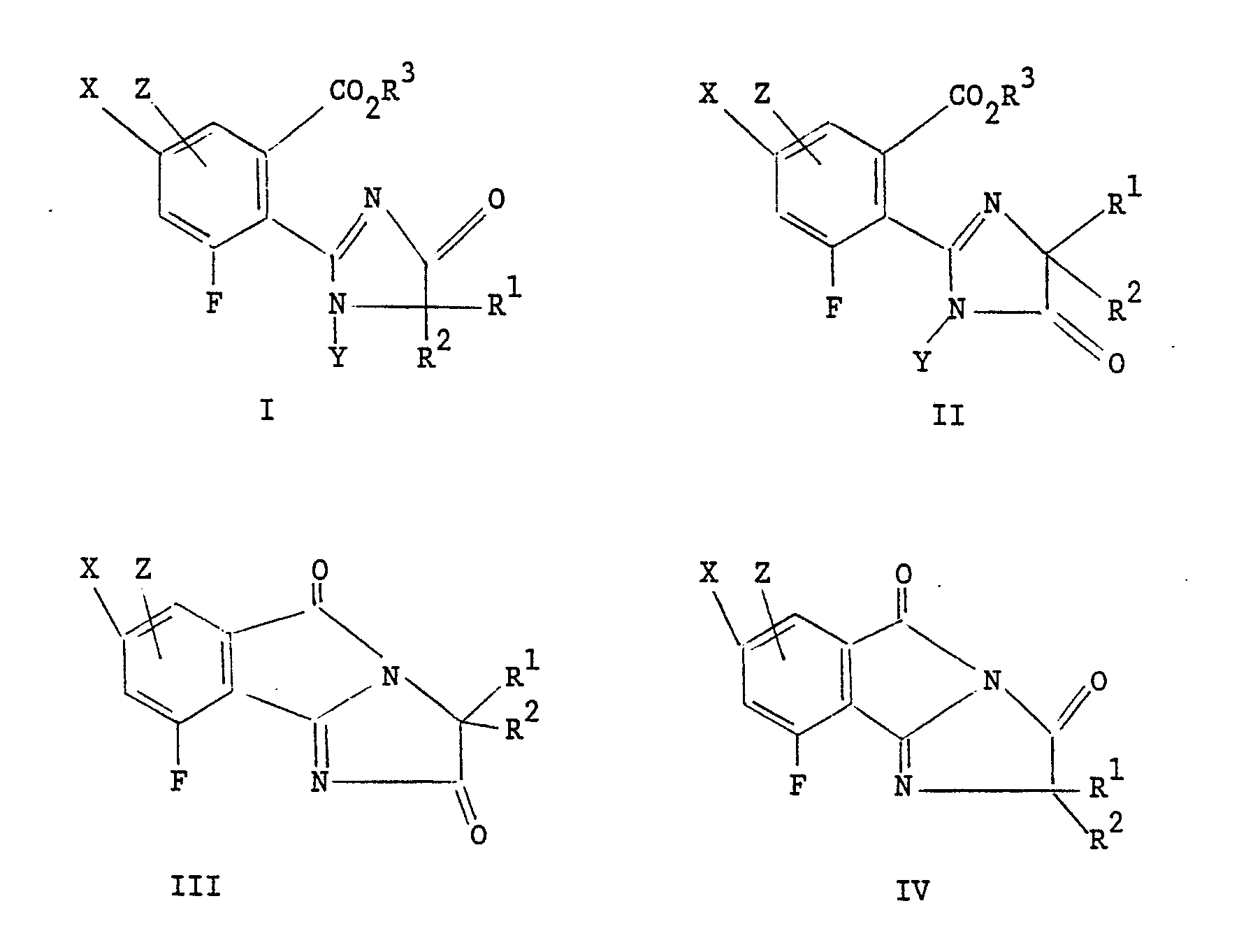
wherein X is hydrogen, C₁-C₃ alkyl, C₁-C₃ alkoxy, halogen or nitro; Y is hydrogen or C₁-C₇ acyl; Z is hydrogen, halogen, nitro, CN, C₁-C₃ alkyl C₁-C₃, or C₁-C₃ haloalkyl; or X and Z when taken together are -CH=CH-CH=CH-; R₁ is C₁-C₄ alkyl; R₂ is C₁-C₆ alkyl, C₃-C₆ cycloalkyl, C₂-C₄ alkenyl, phenyl, halophenyl or benzyl; or when R₁ and R₂ are taken together with the carbon to which they are attached they may represent C₃-C₆ cycloalkyl optionally substituted with methyl; except that, for a compound of formula I or II where X is hydrogen, R¹ is methyl and R² is isopropyl, Z is not a 4-methyl substituent; and R₃ is hydrogen, C₁-C₁₂ alkyl optionally substituted with one C₁-C₃ alkoxy group or one alkoxycarbonyl group or on C₃-C₆ cycloalkyl group or one phenyl group or one furanyl group or with one to three halogen substituent(s), C₃-C₅ alkenyl or C₃-C₅ alkynyl optionally substituted with one or two C₁-C₃ alkyl group(s) or one phenyl group or with one or two halogen substituent(s), benzyl, cyclohexenylmethyl, ethynylcyclohexyl, ethynylalkyl, pentadienyl or C₃-C₆ cycloalkyl optionally substituted with one or two C₁-C₃ alkyl group(s); or a salt forming cation of an alkali metal, ammonia, or an aliphatic amine; and, when R₁ and R₂ are not the same, the optical isomers and the isomeric mixtures thereof; and, except when R₃ is a salt-forming cation, the acid addition salts thereof.
wherein X is hydrogen, C₁-C₃ alkyl, C₁-C₃ alkoxy, halogen or nitro; Y is hydrogen or C₁-C₇ acyl; Z is hydrogen, halogen, nitro, CN, C₁-C₃ alkyl C₁-C₃, or C₁-C₃ haloalkyl; or X and Z when taken together are -CH=CH-CH=CH-; R₁ is C₁-C₄ alkyl; R₂ is C₁-C₆ alkyl, C₃-C₆ cycloalkyl, C₂-C₄ alkenyl, phenyl, halophenyl or benzyl; or when R₁ and R₂ are taken together with the carbon to which they are attached they may represent C₃-C₆ cycloalkyl optionally substituted with methyl; except that, for a compound of formula I or II where X is hydrogen, R¹ is methyl and R² is isopropyl, Z is not a 4-methyl substituent; and R₃ is hydrogen, C₁-C₁₂ alkyl optionally substituted with one C₁-C₃ alkoxy group or one alkoxycarbonyl group or on C₃-C₆ cycloalkyl group or one phenyl group or one furanyl group or with one to three halogen substituent(s), C₃-C₅ alkenyl or C₃-C₅ alkynyl optionally substituted with one or two C₁-C₃ alkyl group(s) or one phenyl group or with one or two halogen substituent(s), benzyl, cyclohexenylmethyl, ethynylcyclohexyl, ethynylalkyl, pentadienyl or C₃-C₆ cycloalkyl optionally substituted with one or two C₁-C₃ alkyl group(s); or a salt forming cation of an alkali metal, ammonia, or an aliphatic amine; and, when R₁ and R₂ are not the same, the optical isomers and the isomeric mixtures thereof; and, except when R₃ is a salt-forming cation, the acid addition salts thereof.
2. A compound according to claim 1 wherein X is hydrogen, C₁-C₃ alkyl, C 1-3 alkoxy or halogen; Y is hydrogen or C 1-2acyl; Z is hydrogen, halogen or C 1-3 alkyl; R₁ is C₁-C₃ alkyl; R₂ is C₁-C₃ alkyl or cyclohexyl; or when R₁ and R₂ are
taken together with the carbon to which they are attached they represent cyclohexyl
or methylcyclohexyl; R₃ is hydrogen, C₁-C₁₂ alkyl optionally substituted with one
C₁-C₃ alkoxy group or one alkoxycarbonyl group or one C₃-C₆ cycloalkyl group or one
phenyl group or one furanyl group or with one or three halogen substituent(s), C₃-C₅
alkenyl optionally substituted with one or two C 1-3 alkyl group(s) or one phenyl group or with one or two halogen substituent(s), C₃-C₅
alkynyl optionally substituted with one or two C₁-C₃ alkyl group(s) or one phenyl
group or with one or two halogen substituent(s), benzyl, cyclohexenylmethyl, ethynylcyclohexyl,
ethynylalkyl, pentadienyl or C₃-C₆ cycloalkyl optionally substituted with one or two
C₁-C₃ alkyl group(s); or a salt forming cation of an alkali metal or ammonia; and,
when R₁ and R₂ are not the same, the optical isomers and the isomeric mixtures thereof;
and, except when R₃ is a salt-forming cation, the acid addition salts thereof.
3. A compound according to claim 1 or 2, wherein X is hydrogen, methyl, chlorine or
fluorine; Y is hydrogen or C₁-C₂ acyl; Z is hydrogen, fluorine, methyl or ethyl; R₁
is C₁-C₃ alkyl; R₂ is C₁-C₃ alkyl or cyclohexyl; or, when R₁ and R₂ are taken together
with the carbon to which they are attached, they represent cyclohexyl or methylcyclohexyl;
R₃ is hydrogen, C₁-C₁₂ alkyl, C₃-C₅ alkenyl optionally substituted with one or two
C₁-C₃ alkyl substituents, C₃-C₅ alkynyl optionally substituted with one or two C₁-C₃
alkyl substituents, benzyl, cyclohexenylmethyl or pentadienyl; and, when R₁ and R₂
are not the same, the optical isomers thereof, and the isomeric mixtures thereof;
and the addition salts thereof.
4. A compound according to claim 1, 2 or 3 wherein R₁ is methyl; R₂ is isopropyl;
Y is hydrogen; Z is hydrogen, fluorine, methyl or ethyl; and (1) X is hydrogen, methyl,
fluorine or chlorine; and R₃ is hydrogen or the alkali metal and ammonium salts thereof;
or (2) X is hydrogen, methyl, fluorine or chlorine; and R₃ is C₁-C₁₂ alkyl optionally
substituted with one C₁-C₃ alkoxy group or one C₃-C₆ cycloalkyl group or one phenyl
group or one furanyl group or with one to three halogen substituent(s).
5. A compound according to any one of claims 1 to 4 wherein X, Y and Z are hydrogen.
6. A compound according to any one of the preceding claims wherein Z is hydrogen.
7. A process for the preparation of a compound of Formula I, II, III or IV as defined
in claim 1 comprising carbonating a compound of Formula V, or its tautomer,
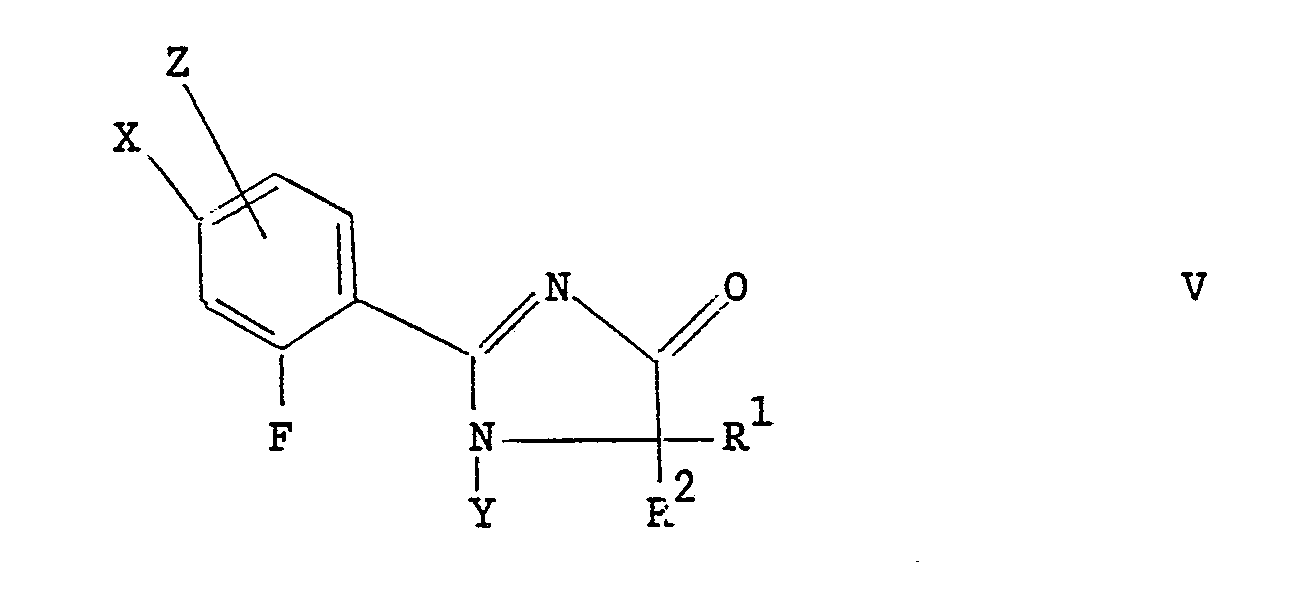
wherein R¹, R², X, Y and Z are as defined in claim 1, by treatment with an organo metallic compound and carbon dioxide to yield a compound of Formula I or II where R³ is H; optionally converting the free acid of Formula I or II where R³ is H to the desired ester, salt or acid addi tion salt of Formula I or II where R³ is other than H; or optionally heating the free acid of Formula I or II where R³ is H in the presence of a condensing agent to give a compound of Formula III or IV.
wherein R¹, R², X, Y and Z are as defined in claim 1, by treatment with an organo metallic compound and carbon dioxide to yield a compound of Formula I or II where R³ is H; optionally converting the free acid of Formula I or II where R³ is H to the desired ester, salt or acid addi tion salt of Formula I or II where R³ is other than H; or optionally heating the free acid of Formula I or II where R³ is H in the presence of a condensing agent to give a compound of Formula III or IV.
8. A process for the preparation of Formula I, II, III or IV as defined in claim 1
comprising cyclising a compound of Formula VI
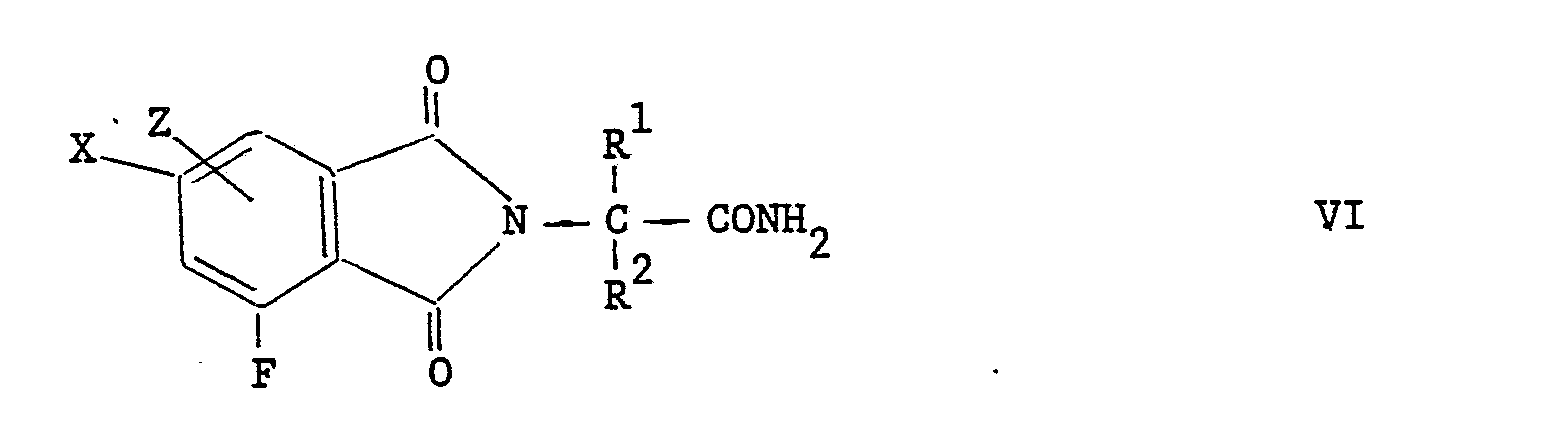
wherein R¹, R², X, Y and Z are as defined in claim 1, to yield a compound of Formula III or IV; optionally hydrolysing the compound of Formula III or IV to a compound of Formula I or II; and, where R³ is hydrogen, optionally converting the free acid of Formula I or II to the desired ester, salt or acid addition salt of Formula I or II where R³ is other than H.
wherein R¹, R², X, Y and Z are as defined in claim 1, to yield a compound of Formula III or IV; optionally hydrolysing the compound of Formula III or IV to a compound of Formula I or II; and, where R³ is hydrogen, optionally converting the free acid of Formula I or II to the desired ester, salt or acid addition salt of Formula I or II where R³ is other than H.
9. A compound of Formula I, II, III or IV when prepared by the process of claim 7
or 8.
10. A herbicidal composition which comprises a compound according to any one of claims
1 to 6 or 9 and at least one surface-active agent and/or carrier.
11. A method of controlling undesirable plant growth at a locus which comprises treating
the locus with a compound according to any one of claims 1 to 6 or 9 or a composition
according to claim 10.