|
(11) | EP 0 261 795 A1 |

| (12) | EUROPEAN PATENT APPLICATION |
|
|
|
|
|||||||||||||||||||||||||||
| (54) | Methods for deactivating metallic species in hydrocarbon fluids |
| (57) A method of deactivating a metallic species disposed in a hydrocarbon medium wherein,
in the absence of the deactivating method the metal would initiate decomposition of
the hydrocarbon medium, which comprises adding to the hydrocarbon medium an effective
amount to deactivate the metallic species, of an effective Mannich reaction product
formed by reaction of reactants (A), (B), and (C), wherein (A) comprises an alkyl
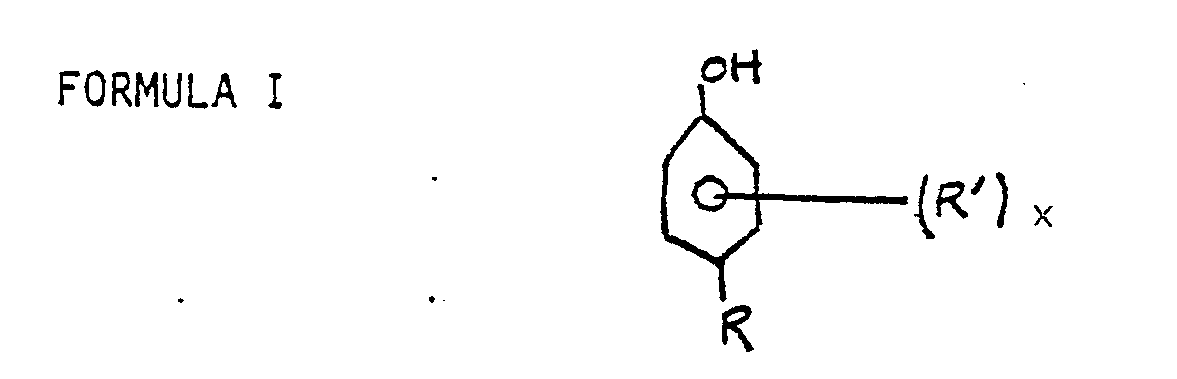
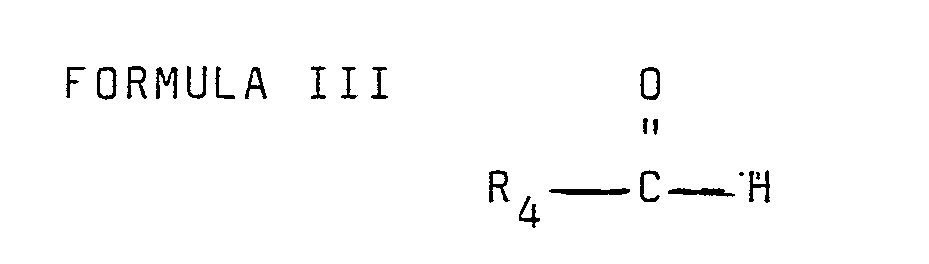
substituted phenol of the structure
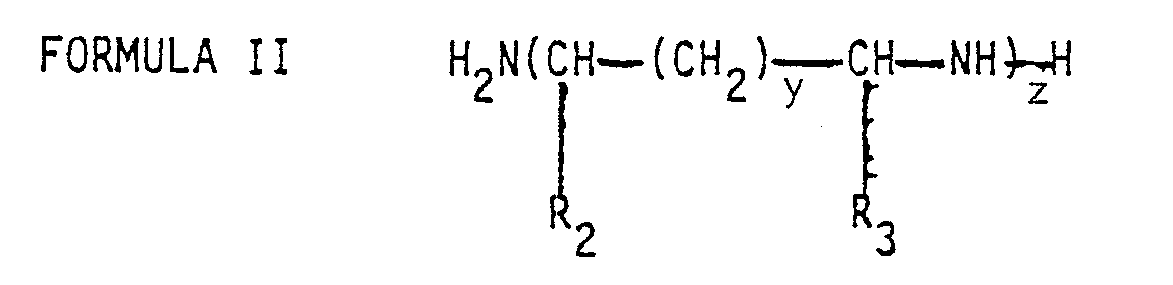
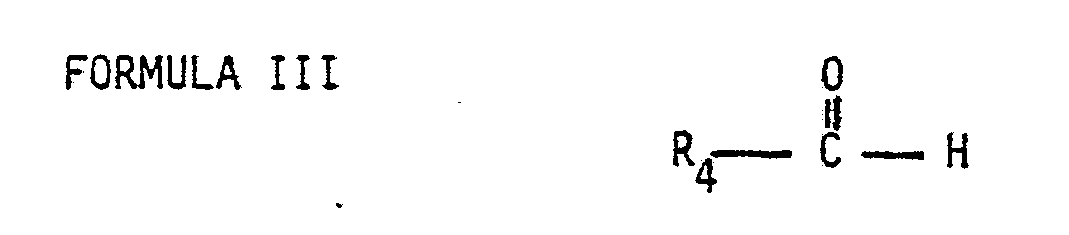
wherein R and R¹ are the same or different and are independently selected from the alkyl, aryl, alkaryl, or arylalkyl of from about 1 to 20 carbon atoms and x is 0 or 1; (B) comprises a polyamine of the structure wherein z is a positive integer, R₂ and R ₃ are the same or different and are independently selected from H, alkyl, aryl, aralkyl, or alkaryl, having from 1 to 20 carbon atoms, y being 0 or 1; and (C) comprising an aldehyde of the structure wherein R₄ is selected from hydrogen and alkyl having from 1 to 6 carbon atoms. |
[0001] This invention relates to the use of chelating molecules to deactivate metallic species in a hydrocarbon medium. More particularly it relates to deactivating copper species, especially both copper and iron species to prevent fouling in hydrocarbon fluids.
[0002] In a hydrocarbon stream, saturated and unsaturated organic molecules, oxygen, peroxides, and metal compounds are found, albeit the latter three in trace quantities. Of these materials, peroxides can be the most unstable, decomposing at temperatures from below room temperature and above depending on the molecular structure of the peroxide (G. Scott, "Atmospheric Oxidation and Anitoxidants", published by Elsevier Publishing Co., NY, 1965).
[0003] Decomposition of peroxides will lead to free radicals, which then can start a chain reaction resulting in polymerization of unsaturated organic molecules. Antioxidants can terminate free radicals that are already formed.
[0004] Metal compounds and, in particualr, transition metal compounds such as, for example, copper can intiate formation in three ways. First they can lower the energy of activation required to decompose peroxides, thus leading to a more favourable path for free radical formation. Second, metal species can complex oxygen and catalyze the formation of peroxides. Last, metal compounds can react directly with organic molecules to yield free radicals.
[0005] The first row transition metal species manganese, iron, cobalt, nickel, and copper are found in trace quantities (0.01 to 100 ppm) in crude oils, in hydrocarbon streams that are being refined, and in refined products. C. J. Pedersen (Inc. Eng. Chem., 41, 924-928, 1949) showed that these transition metal species reduce the induction time for gasoline, an indication of free radical initiation. Copper compounds are more likely to initiate free radicals than the other first row transition elements under these conditions.
[0006] To counteract the free radical initiating tendencies of the transition metal species and, in particular, copper, so called metal deactivators are added to fluids. These materials are organic chelators that tie up the orbitals on the metal rendering the metal inactive. When metal species are deactivated, fewer free redicals are initiated and smaller amounts of antioxidants would be needed to inhibit polymerization.
[0007] Not all chelators will function as metal deactivators. In fact, some chelators will act as metal activators. Pedersen showed that while copper is desctivated by many chelators, other transition metals are only deactivated by selected chelators.
[0008] Schiff Bases such as N,Nʹ - salicylidene-1,2-diaminopropane are the most commonly used metal deactivators. In US- A- 3 034 876 and US- A- 3 068 083, the use of this Schiff Base with esters was claimed as synergistic blends for the thermal stabilization of jet fuels.
[0009] In US- A- 3 437 583 and US- A- 3 442 791 there is described and claimed the use of N,Nʹ - disalicylidene -1,2-diaminopropane in combination with the product from the reaction of a phenol, an amine, and an aldehyde as a synergistic antifoulant. Alone the product of reaction of the phenoil, amine, and aldehyde has little, if any, antifoulant activity.
[0010] Products from the reaction of a phenol, an amine, and an aldehyde (known as Mannich-type products) have been prepared in many ways with differing results due to the method of preparation and due to the exact ratio of reactants and the structure of the reactants.
[0011] The preparation of metal chelators by a Mannich reaction is described in US- A- 3 355 270. Such chelators were reacted with copper to form a metal chelate complex which was used as a catalyst for furnace oil combustion. The activity of the copper was not decreased or deactivated by the Mannich reaction chel ator.
[0012] The use of Mannich-type products as dispersants is described in US- A- 3 235 484 US- Re- 26,330 US- A-4 032 304 and US- A- 4 200 545. A Mannich-type product in combination with a polyalkylene amine to provide stability in preventing thermal degradation of fuels is described in US- A- 4 166 726.
[0013] Copper, but not iron, is effectively deactivated by metal chelators such an N,Nʹ - disalicylidene-1,2-diaminopropane. Mannich-type products, while acting as chelators for the preparation of catalysts or as dispersants, have not been shown to be copper iron deactivators.
[0014] According to the present invention there is provided a method of deactivating a metal species disposed in a hydrocarbon medium, wherein in the absence of the deactivating method, the metal would initiate decomposition of the hydrocarbon medium, which comprises adding to the hydrocarbon medium an effective amount to deactivate the metallic species, of an effective Mannich reaction product formed by reaction of reactants (A), (B), and (C); wherein (A) comprises an alkyl substituted phenol of the structure
wherein R and R¹ are the same or different and are independently selected from alkyl, aryl, alkaryl, of arylalkyl of from about 1 to 20 carbon atoms, x is 0 or 1; wherein (B) comprises a polyamine of the structure
wherein z is a positive integer, R₂ and R₃ are the same or different and are independently selected from H, alkyl, aryl, aralkyl, or alkaryl having from 1 to 20 carbon atoms, y being 0 or 1; wherein (c) comprises an aldehyde of the structure
wherein R₄ is selected from hydrogen and alkyl having from 1 to 6 carbon atoms.
[0015] The metallic species is preferably at least one member of the group of first row transition metals, particularly copper, or copper and iron.
[0016] The present invention particularly is an effective copper deactivator for use in hydrocarbon medium so as to inhibit free radical formation during the high temperature processing of the hydrocarbon fluid, and is capable of performing efficiently even when used at low dosages.
[0018] As to exemplary compounds falling within the scope of Formula I above, p-cresol, 4-ethylphenol, 4-t-butyl-phenol, 4-t-amylphenol, 4-t-octyphenol, 4-dodecylphenol, 2,4-di-t-butylphenol, 2,4-di-t-amylphenol, and 4-nonylphenol may be mentioned. At present, it is preferred to use 4-nonylphenol as the Formula I component.
[0019] Exemplary polyamines which can be used in accordance with Formula II include ethylenediamine, propylene diamine, diethylene triamine, triethylene tetramine, tetraethylene pentamine and the like, with ethylenediamine being preferred.
[0020] The aldehyde component can comprise, for example, formaldehyde, acetaldehyde, propanaldehyde, butrylaldehyde, hexaldehyde, heptaldehyde, etc. with the most preferred being formaldehyde which may be used in its monomeric form, or, more conveniently, in its polymeric form (i.e., paraformaldehyde).
[0021] As is conventional in the art, the condensation reaction may proceed at temperatures from about 50 to 200°C with a preferred temperature range being about 75-175°C. As is stated in US- A- 4 166 726, the time required for completion of the reaction usually varies from about 1-8 hours, varying of course with the specific reactants chosen and the reaction temperature.
[0022] As to the molar range of components (A):(B):(C) which may be used, this may fall within 0.5-5:1:0.5-5.
[0023] The deactivators used in the present invention may be dispersed within the hydrocarbon medium within the range of .05 to 50,000 ppm based upon one million parts of the hydrocarbon medium. Preferably, the deactivator is added in an amount from about 1 to 10,000 ppm.
[0024] The hydrocarbon medium may be heated to about 38°C-538°C (a bout 100°F-1000°F), preferably about 316°C-538°C (about 600°F-1000°F).
[0025] In an even more specific aspect of the invention and one that is of particular commerical appeal, specific Mannich products are used to effectively deactivate both copper and iron. This aspoect is especially attractive since iron is often encountered in hydrocarbons as a metal species capable of promoting polymerization of organic impurities. The capacity to deactivate both copper and iron is unique and quite unpredictable. For instance, the commonly used metal deactivator, N,Nʹ-disalicylidene-1,2-diamino-propane deactivates copper but actually activates iron under the ASTM D-525 test.
[0026] In this narrower embodiment of the invention, it is critical that ethylenediamine be used as the polyamine (B) Mannich component. Also, with respect to concurrent copper and iron deactivation, the molar ratio of components (A):(B)-ethylenediamine:(C) should be within the range of 1-2:1:1-2 with the (A):(B):(C) molar range of 2:1:2 being especially preferred.
Examples
[0027] The invention will now be further described with reference to a number of specific examples which are to be regarded solely as illustrative and not as restricting the scope of the invention. Comparative examples are designated with letters while examples that exemplify this invention are given numbers.
Testing Methods
[0028] Four test methods were employed to determine the deactivating ability of chelators. These were: 1) hot wire test, 2) peroxide test, 3) oxygen absorption test, and 4) ASTM D-525-80.
Hot Wire Test
[0029]
I. Objective: To screen preparations according to the amount of fouling protection they exhibit.
II. Method Outline: Samples treated with candidate materials are placed in hot wire apparatus and electrically heated. Fouling deposits from an untreated sample are compared with those of the treatments.
Peroxide Test
[0030] The peroxide test involves the reaction of a metal compound, hydrogen peroxide, a base, and a metal chelator. In the presence of a base, the metal species will react with the hydrogen peroxide yielding oxygen. When a metal chelator is added, the metal can be tied up resulting in the inhibition of the peroxide decomposition or the metal can be activated resulting in the acceleration of the rate of decomposition. The less oxygen generated in a given amount of time, the better the metal deactivator.
[0031] A typical test is carried out as follows: In a 250-mL two-necked, round-bottomed flask equipped with an equilibrating dropping funnel, a gas outlet tube. and a magnetic stirrer, was placed 10 mL of 3% (0.001 mol) hydrogen peroxide in water 10 mL of a 0.01 M (0.0001 mol) metal naphthenate in xylene solution, and metal deactivator. To the gas outlet tube was attached a water-filled trap. The stirrer was started and stirring kept at a constant rate to give good mixing of the water and organic phases. Ammonium hydroxide (25 mL of a 6% aqueous solution) was placed in the dropping funnel, the system was closed, and the ammonium hydroxide added to the flask. As oxygen was evolved, water was displaced, with the amount being recorded as a factor of time. A maximum oxygen solution was 105 mL. With metal species absent, oxygen was not evolved over 10 minutes.
Oxygen Absorption Test
[0032] In the oxygen absorption test, a metal compound, N,N-diethylhydroxylamine (DEHA), a basic amine, and a metal chelator are placed in an autoclave and 344.75 to 689.5 kPa (50 to 1000 psig) of oxygen over-pressure is charged to the autoclave. The change in pressure versus time is recorded. With only the metal compound, DEHA, and a basic amine present, absorption of oxygen occurs. A metal deactivator in the reaction will chelate the metal in such a way to inhibit the oxygen absorption. The less the pressure drop, th e better the metal deactivator.
[0033] A typical test used 1.25 g of a 6% metal naphthenate solution, 5.6 g of DEHA, 5.6 g of N-(2 aminoethyl)piperazine, 12.5 g of heavy aromatic naphtha as solvent, and about 2 g of metal chelator. Pressure drops of from 0 to 330.96 kPa (0 to 48 psig) were found over a 60 minute time period. With metal species absent, oxygen was not absorbed.
ASTM D-525-80
[0034] In the ASTM test, a sample of a feedstock known to polymerize is placed in an autoclave with a metal compound, an antioxidant, and a metal chelator. An over-pressure of 689.5 kPa (100 psig) of oxygen is added and the apparatus is heated on a hot water bath to 100°C until a drop in pressure is noted signifying the loss of antioxidant activity. The longer the time until a drop in pressure occurs, the more effective the antioxidant and/or metal deactivator.
Examples
[0035] Hot wire tests using 80 ppm of copper naphthenate as the corrosive species were undertaken with respect to several Mannich products of the invention and a commercially known metal deactivator. Results appear in Table I.
[0037] Additional oxygen tests were also undertaken with various Mannich products of the invention and comparative materials with varying metal species as indicated. Results appear in Table III as follows:
[0038] Table III indicates that the para-cresol TETA PF compounds deactivated copper but not iron. In contrast, the P-cresol EDA-PF compounds deactivated both copper and iron. The MD activates iron naphthenate and acetate and appears to slightly deactivate some other forms of iron. The MD appears to slightly deactivate Co and Ni as well as V and Cr. Overall, the NP-EDA-PF Mannich product is more efficacious than MD.
Example A
[0039] The reactivity of copper and iron were determined by the peroxide, oxygen absorption test, and ASTM test described above. Results are shown in Table IV.
[0040] Each of these tests show the same results, namely, copper is the more active catalyst and iron is much less active, although iron is still an active catalyst for promoting oxidation reactions. Manganese is between copper and iron in reactivity as evidenced in the peroxide test.
Example B
[0041] The Table IV tests above were repeated, but this time with N,Nʹ-disalicylidene-1,2-diaminocyclohexane (DM) present (Table V).
[0042] Comparing Example A and Example B shows that catalytic activity of the copper was reduced (deactivated) by the N,N-disalicylidene-1,2-diaminocyclohexane, but that of iron and manganese were increased (activated).
Example 1
[0043] A series of products were prepared by reacting p-nonylphenol, ethylenediamine, and paraformaldehyde in xylene. For the 2-1-2 product, 110 g (0.5 mol) of nonylphenol, 15 g (0.25 mol) of ethylene-diamine, 16.5 g (0.5 mol) of paraformaldehyde, and 142 g of xylene were charged to a 3-necked flask fitted with a condenser, a thermome ter, and a stirrer. The mixture was slowly heated to 110°C and held there for two hours. It was then cooled to 95°C and a Dean Stark trap inserted between the condenser and the flask. The mixture was heated to 145°C, during which time water of formation was azeotroped off -- 9 mL was collected -- approximately the theoretical amount. The mixture was cooled to room temperature and used as is.
Example 2
[0044] The 4-1-4, 1-1-2, and 2-1-2 products from Example 1 were evaluated in the pe roxide test (Table VI) and in the Oxygen Absorption test (Table VII).
[0045] In this example, it can be seen that at very high levels of any ratio all products work. But as treatment is decreased to more cost effective levels, the 2-1-2 product is more effective for copper and all ratios are effective for iron.
[0046] These products are effective iron deactivators in contrast to N,N-disalicylidene-1,2-diaminocyclohexane, an iron activator.
Example 3
[0047] A series of products prepared by reaction of p-dodecylphenol, EDA, and formaldehyde as in Example 1 were tested in the peroxide test (Table VIII).
[0048] As above, at high treatment levels all products show efficacy. However, at lower treatment levels, the 2-1-2 molar ratio product is superior for copper and all are similar for iron.
Example 4
[0050] The 1-1-2 and 2-1-2 products from the reaction of p-t-octylphenol, EDA, and formaldehyde were prepared as in Example 1 and tested in the peroxide test (Table IX).
Example 5
[0051] The p-t-butylphenol-EDA-formaldehyde products were prepared as in Example 1 and tested in the peroxide test (Table X).
Example 6
[0052] Deactivation of manganese is achieved by the compounds of the invention. Again, the 1-1-2 compounds also deactivate manganese but not as well as the 2-1-2 compounds (Table XI).
Example 7
[0053] The p-alkylphenol-TETA-formaldehyde products were prepared as in Example 1 and tested in the peroxide test (Table XII).
[0054] This example shows that TETA in place of EDA provides a good copper deactivator, but an iron activator.
Example 8
[0055] Mixtures of polyamines can be used in the preparation of the Mannich products, prepared as in Example 1 and tested in the peroxide test (Table XIII).
[0056] This example shows that mixtures of polyamines give good copper deactivators and iron activators.
Example 9
1. A method of deactivating a metallic species disposed in a hydrocarbon medium wherein,
in the absence of the deactivating method, the metal would initiate decomposition
of the hydrocarbon medium, which comprises adding to the hydrocarbon medium an effective
amount to deactivate the metallic species, of an effective Mannich reaction product
formed by reaction of reactants (A) (B) and (C), wherein (A) comprises an alkyl substituted
phenol of the structure
wherein R and R¹ are the same or different and are independently selected from the alkyl, aryl, alkaryl, or arylalkyl of from about 1 to 20 carbon atoms and x is 0 or 1; (B) comprises a polyamine of the structure
wherein z is a positive integer, R₂ and R₃ are the same or different and are independently selected from H, alkyl, aryl, aralkyl, or alkaryl having from 1 to 20 carbon atoms, y being 0 or 1; and (C) comprises an aldehyde of the structure
wherein R₄ is selected from hydrogen and alkyl having from 1 to 6 carbon atoms.
wherein R and R¹ are the same or different and are independently selected from the alkyl, aryl, alkaryl, or arylalkyl of from about 1 to 20 carbon atoms and x is 0 or 1; (B) comprises a polyamine of the structure
wherein z is a positive integer, R₂ and R₃ are the same or different and are independently selected from H, alkyl, aryl, aralkyl, or alkaryl having from 1 to 20 carbon atoms, y being 0 or 1; and (C) comprises an aldehyde of the structure
wherein R₄ is selected from hydrogen and alkyl having from 1 to 6 carbon atoms.
2. A method according to claim 1, wherein the metallic species is at least one member
of the group of first row transition metals.
3. A method according to claim 2, wherein the metallic species comprises copper.
4. A method according to claim 1, wherein the species comprises copper and iron.
5. A method according to any of claims 1 to 4, wherein the molar ratio of reactants
(A):(B):(C) is 0.5-5:1:10.5-5.
6. A method according to any of claims 1 to 5, wherein the polyamine (B) is selected
from ethylenediamine and triethylenetetramine.
7. A method of simultaneously deactivating copper and iron species contained within
a hydrocarbon liquid wherein, in the absence of the deactivating method, the copper
and iron species would initiate the decomposition of the hydrocarbon liquid, which
comprises adding to the hydrocarbon liquid an effective amount to inhibit the copper
and iron species from forming the free radicals, of an effective Mannich reaction
product formed by reaction of reactants (A), (B), and (C) wherein (A) comprises an
alkyl substituted phenol of the structure
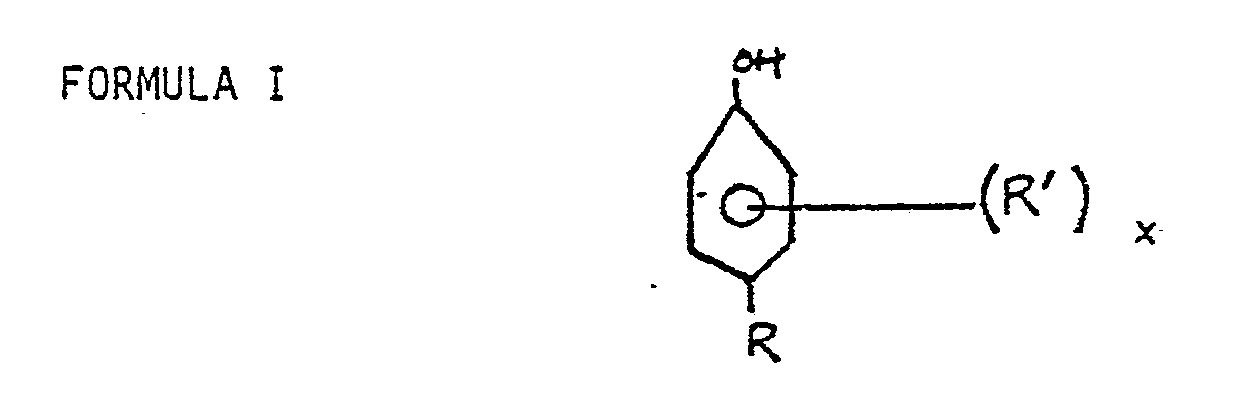
wherein R and R¹ are the same or different and are independently selected from the alkyl, aryl, alkaryl, or arylalkyl of from about 1 to 20 carbon atoms and x is 0 or 1; (B) is ethylenediamine, and (C) comprises an aldehyde of the structure
wherein R4 is selected from hydrogen and alkyl having from 1 to 6 carbon atoms.
wherein R and R¹ are the same or different and are independently selected from the alkyl, aryl, alkaryl, or arylalkyl of from about 1 to 20 carbon atoms and x is 0 or 1; (B) is ethylenediamine, and (C) comprises an aldehyde of the structure
wherein R4 is selected from hydrogen and alkyl having from 1 to 6 carbon atoms.
8. A method according to claim 7, wherein the molar ratio of reactants (A):(B):(C)
is within the range of 1-2:1:1-2.
9. A method according to claim 8, wherein the molar ratio of reactants (A):(B):(C)
is about 2:1:2.
10. A method according to any of claims 1 to 9, wherein the reaction product is admitted
to the hydrocarbon medium or liquid in an amount of from 0.5-50,000 ppm based upon
one million parts of the hydrocarbon medium or liquid.
11. A method according to claim 10, wherein the Mannich reaction product is admitted
to the hydrocarbon medium or liquid in an amount of 1 to 10,000 ppm based upon one
million parts of the hydrocarbon medium or liquid.
12. A method according to any of claims 1 to 11, wherein the hydrocarbon medium or
liquid is heated at a temperature of from about 38°C-538°C (about 100°F-1000°F).
13. A method according to claim 12 wherein the hydrocarbon medium is heated at a temperature
of about 316°C-538°C (about 600°F-1000°F).
14. A method according to any of claims 1 to 13, wherein (A) comprises a member or
members selected from p-cresol, 4-ethylphenol, 4-t-butylphenol, 4-t-amylphenol, 4-t-octylphenol,
4-dodecylphenol, 2,4-di-t-butylphenol, 2,4-di-t-amylphenol, and 4-nonylphenol.
15. A method according to claim 14, wherein (A) comprises nonylphenol.
16. A method according to any of claims 1 to 15, wherein (C) is selected from formaldehyde
and paraformaldehyde.