|
(11) | EP 0 262 373 B1 |

| (12) | EUROPEAN PATENT SPECIFICATION |
|
|
| (54) |
Benzothiazepine derivates Benzothiazepin-Derivate Dérivés de benzothiazépine |
|
|
|||||||||||||||||||||||||||||||
|
||||||||||||||||||||||||||||||||
| Note: Within nine months from the publication of the mention of the grant of the European patent, any person may give notice to the European Patent Office of opposition to the European patent granted. Notice of opposition shall be filed in a written reasoned statement. It shall not be deemed to have been filed until the opposition fee has been paid. (Art. 99(1) European Patent Convention). |
[0001] It has now been found that cis isomers having the formula
and the pharmaceutically acceptable salts thereof, have calcium channel blocking activity. These compounds are cis benzothiazepines having in the 3-position of the benzothiazepine nucleus a substituent linked to the nucleus via a carbon atom. In formula I, and throughout the specification, the symbols are as defined below.
[0002] R₁ is alkyl, alkenyl or alkynyl;
R₂ and R₅ are each independently hydrogen, alkyl (of 1 to 4 carbon atoms), alkoxy (of 1 to 4 carbon atoms), halogen or trifluoromethyl; and
R₃ and R₄ are each independently alkyl or cycloalkyl or R₃ and R₄ together with the nitrogen atom to which they are attached are pyrrolidinyl, piperidinyl or morpholinyl.
[0003] Listed below are definitions of various terms used to describe the benzothiazepines of this invention. These definitions apply to the terms as they are used throughout the specification (unless they are otherwise limited in specific instances) either individually or as part of a larger group.
[0004] The terms "alkenyl" and "alkynyl" refer to both straight and branched chain groups having 2 to 10 carbon atoms.
[0005] The terms "alkyl" and "alkoxy" refer to both straight and branched chain groups having 1 to 10 carbon atoms.
[0009] The compounds of formula I form acid-addition salts with inorganic and organic acids. These acid-addition salts frequently provide useful means for isolating the products from reaction mixtures by forming the salt in a medium in which it is insoluble. The free base may then be obtained by neutralization, e.g., with a base such as sodium hydroxide. Any other salt may then be formed from the free base and the appropriate inorganic or organic acid. Illustrative are the hydrohalides, especially the hydrochloride and hydrobromide, sulfate, nitrate, phosphate, borate, acetate, tartrate, maleate, fumarate, citrate, succinate, benzoate, ascorbate, salicylate, methanesulfonate, benzenesulfonate, toluenesulfonate or lactate.
[0010] The carbon atoms in the 3 and 4-positions of the benzothiazepine nucleus of the compounds of formula I are asymmetric carbons. The compounds of formula I, therefore, exist as enantiomeric mixtures. This invention is directed to those compounds of formula I wherein the relative stereo-chemistry at the chiral centers in the 3 and 4-positions of the benzothiazepine nucleus is cis.
[0011] GB-A-2 139 620 discloses a new stereo-specific synthesis of the calcium antagonist diltiazem hydrochloride, a benzothiazepine derivative of the formula shown below.
[0012] It is the object underlying the present invention to provide new benzothiazepine derivatives having an improved activity. Said object has been solved by the presently claimed compounds showing a surprisingly higher activity.
[0013] The compounds of formula I, and the pharmaceutically acceptable salts thereof, are useful as cardiovascular agents. These compounds act as vasodilators and are useful as anti-hypertensive agents. By the administration of a composition containing one (or a combination) of the compounds of this invention, the blood pressure of a hypertensive mammalian (e.g., human) host is reduced. Daily doses of about 0.1 to 100 mg per kilogram of body weight per day, preferably about 1 to about 50 mg per kilogram per day, are appropriate to reduce blood pressure, and can be administered in single or divided doses. The substance is preferably administered orally, but parenteral routes such as the subcutaneous, intramuscular, or intravenous routes can also be employed.
[0014] As a result of the vasodilating activity of the compounds of formula I, it is believed that such compounds in addition to being anti-hypertensive may also be useful as antiarrhythmic agents, as anti-anginal agents, as antifibrillatory agents, as anti-asthmatic agents, and in limiting myocardial infarction.
[0015] The compounds of this invention can also be formulated in combination with a diuretic, or a beta-adrenergic agent, or angiotensin converting enzyme inhibitor. Suitable diuretics include the thiazide diuretics such as hydrochlorothiazide and bendroflumethiazide, suitable beta-adrenergic agents include nadolol, and suitable angiotensin converting enzyme inhibitors include captopril.
[0016] The cis benzothiazepines of formula I can be prepared by epimerization of the corresponding trans benzothiazepine. This can be accomplished by treating the appropriate trans benzothiazepine with a strong base, such as lithium diisopropylamide, at a reduced temperature (less than about -20°C, preferably about -78°C or less). The reaction can be quenched with an organic acid, e.g., acetic acid.
[0017] The starting trans benzothiazepines are known, and can be prepared using the methodology described in United States patent 3,075,967 issued January 29, 1963. This comprises reacting a 2-aminothiophenol having the formula
with a cinnamic acid derivative having the formula
Example 1 (cis)-5-[2-(Dimethylamino)ethyl]-2,3-dihydro-3-methyl-4-phenyl-1,5-benzothiazepin-4(5H)-one, monohydrochloride
[0019] A solution of diisopropylamine (1.2 g; 12 mmole) in 12 ml of dry tetrahydrofuran was cooled in an ice bath and treated with a 1.6M solution of n-butyl lithium in hexane (7.35 ml; 11.8 mmole) under argon. The reaction mixture was allowed to stir for ∼30 minutes and was cooled to -78°C. A solution of (trans)-5-[2-(dimethylamino)ethyl]-2,3-dihydro-3-methyl-4-phenyl-1,5-benzothiazepin-4(5H)-one (1.8 g; 6 mmole) in 2 ml of tetrahydrofuran was added slowly to a solution of lithium diisopropylamide in tetrahydrofuran at -78°C under argon and allowed to stir at -78°C for 5 hours. An aliquot (∼100 mg) was syringed out after 4 hours of reaction time and quenched with acetic acid/tetrahydrofuran (0.5/0.5 ml), diluted with ether, washed with saturated potassium bicarbonate, dried over anhydrous magnesium sulfate, and concentrated in vacuo. The NMR of the product indicated a 16/4 cis/trans ratio.
[0020] When the whole reaction mixture was quenched with acetic acid/tetrahydrofuran (2/2 ml) and worked up as above, NMR showed a 33/67 cis/trans ratio. 1.3 g of the product mixture was purified by flash chromatography eluting with 5% methanol in acetone to yield
0.3 g of pure cis compound
0.46 g of mixture of cis and trans (more cis)
0.54 g of pure trans compound.
[0021] To a solution of the cis amine (0.3 g; 1 mmole) in 1 ml of dichloromethane was added 10 ml of etheral hydrochloric acid. The reaction mixture was stirred at room temperature for ∼30 minutes, then concentrated in vacuo and diluted with ether, stirred overnight, filtered and dried to yield 0.25 g of the title compound, melting point 203-204°C.
Analysis Calc'd for C₂₀H₂₄N₂OS·HCl·0.95H₂O:
C, 60.94; H, 6.53; N, 7.10; Cl, 8.99; S, 8.13
Found: C, 60.94; H, 6.52; N, 6.91; Cl, 9.09; S, 7.83
Example 2 (cis)-5-[2-(Dimethylamino)ethyl]-2,3-dihydro-2-(4-methoxyphenyl)-3-methyl-1,5-benzothiazepin-4(5H)-one, monohydrochloride
[0022] A solution of freshly distilled diisopropylamine (0.66 g; .0066 mole) in 10 ml of dry tetrahydrofuran was cooled in an ice bath and treated with a 1.0 M solution of n-butyl lithium in hexane (6.3 ml; .0063 mole) under argon. The reaction mixture was allowed to stir for ∼30 minutes at 0°C and then cooled to -78°C. A solution of (trans)-5-[2-(dimethylamino)ethyl]-2,3-dihydro-2-(4-methoxyphenyl)-3-methyl-1,5-benzothiazepin-4(5H)-one (1.06 g; .0029 mole) in 2 ml of tetrahydrofuran was then added to this mixture and allowed to stir at -78°C for 4 hours. The reaction mixture was then cooled to -100°C with methanol and liquid nitrogen and quenched slowly with a cold solution of acetic acid/tetrahydrofuran (0.5/0.5 ml). It was then stirred for ∼10 minutes and allowed to warm to room temperature, diluted with water and extracted with dichloromethane, dried over anhydrous magnesium sulfate and concentrated in vacuo to yield 0.6 g of crude product, which was purified by flash chromatography, eluting with 9/1 (dichloromethane/methanol). The purified product was dissolved in dichloromethane (1 ml) and treated with ether/hydrochloric acid (30 ml), stirred for ∼15 minutes, concentrated in vacuo and purified on a preparative plate (7/3 ethyl acetate/methanol). The resulting solid was crystallized from acetonitrile to give 0.087 g of the title product, melting point 167-168°C.
Analysis Calc'd for C₂₁H₂₆N₂O₂S·HCl·0.16H₂O:
C, 61.55; H, 6.71; N, 6.85; Cl, 8.66; S, 7.80
Found: C, 61.55; H, 6.65; N, 7.11; Cl, 8.66; S, 7.75
Claims for the following Contracting State(s): BE, CH, DE, FR, GB, IT, LI, LU, NL,
SE
1. A compound having the formula
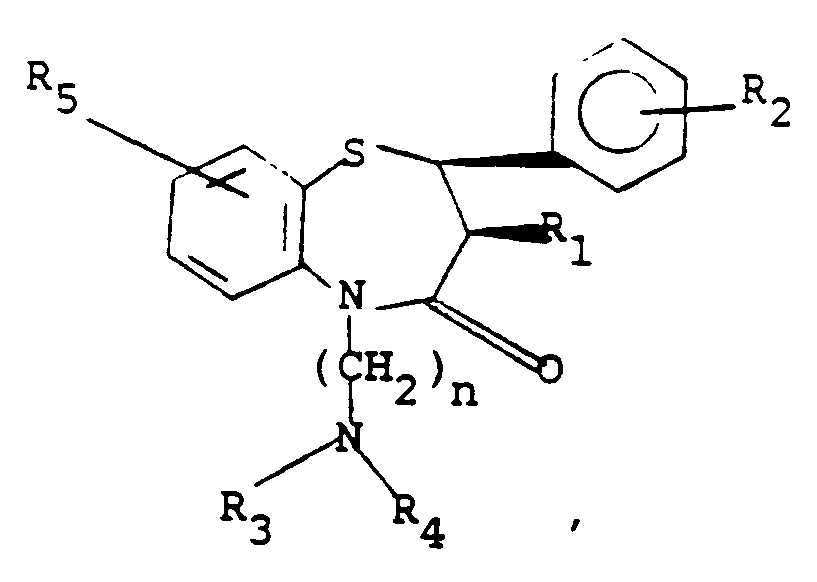
or a pharmaceutically accpetable salt thereof, wherein the stereochemistry at the chiral centers in the 3 and 4-positions of the benzothiazepine nucleus is cis, and wherein
R₁ is C₁₋₁₀ alkyl, C₂₋₁₀ alkenyl or C₂₋₁₀ alkynyl;
R₂ and R₅ are each independently hydrogen, C₁₋₄ alkyl, C₁₋₄ alkoxy, halogen or trifluoromethyl; and
R₃ and R₄ are each independently C₁₋₁₀ alkyl or C₃₋₇ cycloalkyl or R₃ and R₄ together with the nitrogen atom to which they are attached are pyrrolidinyl, piperidinyl or morpholinyl.
or a pharmaceutically accpetable salt thereof, wherein the stereochemistry at the chiral centers in the 3 and 4-positions of the benzothiazepine nucleus is cis, and wherein
R₁ is C₁₋₁₀ alkyl, C₂₋₁₀ alkenyl or C₂₋₁₀ alkynyl;
R₂ and R₅ are each independently hydrogen, C₁₋₄ alkyl, C₁₋₄ alkoxy, halogen or trifluoromethyl; and
R₃ and R₄ are each independently C₁₋₁₀ alkyl or C₃₋₇ cycloalkyl or R₃ and R₄ together with the nitrogen atom to which they are attached are pyrrolidinyl, piperidinyl or morpholinyl.
2. A compound in accordance with claim 1 wherein R₁ is C₁₋₁₀ alkyl.
3. A compound in accordance with claim 1 wherein R₁ is C₂₋₁₀ alkenyl.
4. A compound in accordance with claim 1 wherein R₁ is C₂₋₁₀ alkynyl.
5. A compound in accordance with claim 1 wherein R₁ is methyl.
6. A compound in accordance with claim 1 wherein R₂ is hydrogen.
7. A compound in accordance with claim 1 wherein R₅ is hydrogen.
8. A compound in accordance with claim 1 wherein R₂ and R₅ are hydrogen.
9. A compound in accordance with claim 1 wherein R₃ and R₄ are each C₁₋₁₀ alkyl.
10. A compound in accordance with claim 1 wherein R₃ and R₄ are each methyl.
11. The compound in accordance with claim 1, (cis)-5-[2-(dimethylamino)ethyl]-2,3-dihydro-3-methyl-4-phenyl-1,5-benzothiazepin-4-(5H)-one,
or a pharmaceutically acceptable salt thereof.
12. The compound in accordance with claim 1, (cis)-5-[2-(dimethylamino)ethyl]-2,3-dihydro-2-(4-methoxyphenyl)-3-methyl-1,5-benzothiazepin-4-(5H)-one,
or a pharmaceutically acceptable salt thereof.
13. Pharmaceutical compositions comprising a pharmaceutical effective amount of a compound
in accordance with any of claims 1 to 12.
14. Cardiovascular agents comprising a pharmaceutical effective amount of a compound in
accordance with any of claims 1 to 12.
15. Use of the compounds according to any of claims 1 to 12 for the preparation of pharmaceutical
compositions.
16. Use according to claim 15 wherein the pharmaceutical compositions have anti-hypertensive
activity.
Claims for the following Contracting State(s): AT, ES
1. A process for preparing a compound having the formula
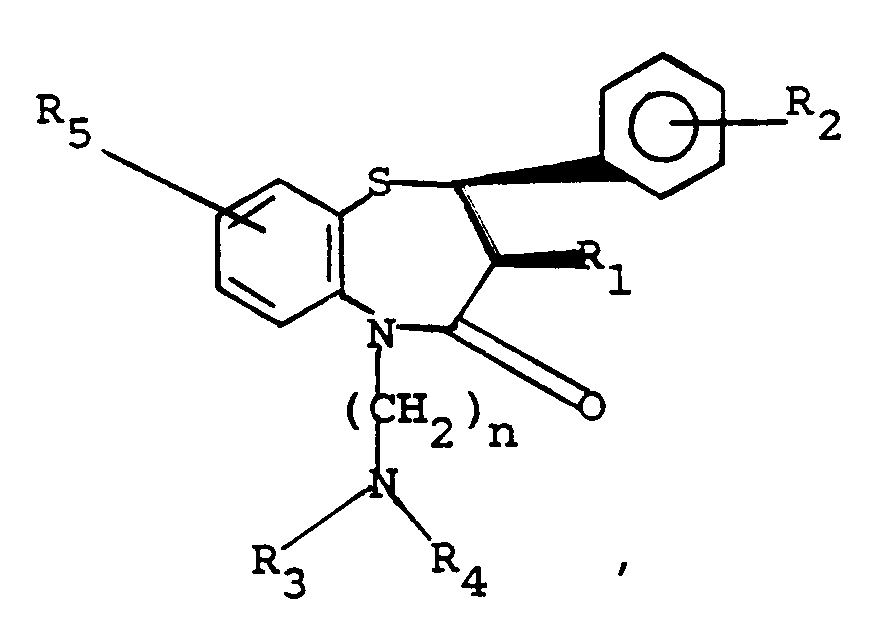
or a pharmaceutically acceptable salt thereof, wherein the stereochemistry at the chiral centers in the 3 and 4-positions of the benzothiazepine nucleus is cis, and wherein
R₁ is C₁₋₁₀ alkyl, C₂₋₁₀ alkenyl or C₂₋₁₀ alkynyl;
R₂ and R₅ are each independently hydrogen, C₁₋₄ alkyl, C₁₋₄ alkoxy, halogen or trifluoromethyl; and
R₃ and R₄ are each independently C₁₋₁₀ alkyl or C₃₋₇ cycloalkyl or R₃ and R₄ together with the nitrogen atom to which they are attached are pyrrolidinyl, piperidinyl or morpholinyl which comprises epimerizing the corresponding trans compound.
or a pharmaceutically acceptable salt thereof, wherein the stereochemistry at the chiral centers in the 3 and 4-positions of the benzothiazepine nucleus is cis, and wherein
R₁ is C₁₋₁₀ alkyl, C₂₋₁₀ alkenyl or C₂₋₁₀ alkynyl;
R₂ and R₅ are each independently hydrogen, C₁₋₄ alkyl, C₁₋₄ alkoxy, halogen or trifluoromethyl; and
R₃ and R₄ are each independently C₁₋₁₀ alkyl or C₃₋₇ cycloalkyl or R₃ and R₄ together with the nitrogen atom to which they are attached are pyrrolidinyl, piperidinyl or morpholinyl which comprises epimerizing the corresponding trans compound.
2. A process in accordance with claim 1 wherein R₁ is C₁₋₁₀ alkyl.
3. A process in accordance with claim 1 wherein R₁ is C₂₋₁₀ alkenyl.
4. A process in accordance with claim 1 wherein R₁ is C₂₋₁₀ alkynyl.
5. A process in accordance with claim 1 wherein R₁ is methyl.
6. A process in accordance with claim 1 wherein R₂ is hydrogen.
7. A process in accordance with claim 1 wherein R₅ is hydrogen.
8. A process in accordance with claim 1 wherein R₂ and R₅ are hydrogen.
9. A process in accordance with claim 1 wherein R₃ and R₄ are each C₁₋₁₀ alkyl.
10. A process in accordance with claim 1 wherein R₃ and R₄ are each methyl.
11. A process in accordance with claim 1 wherein the product is (cis)-5-[2-(dimethylamino)
ethyl]-2,3-dihydro-3-methyl-4-phenyl-1,5-benzothiazepin-4(5H)-one, or a pharmaceutically
acceptable salt thereof.
12. A process in accordance with claim 1 wherein the product is (cis)-5-[2-(dimethylamino)ethyl]-2,3-dihydro-2-(4-methoxyphenyl)-3-methyl-1,5-benzothiazepin-4(5H)-one,
or a pharmaceutically acceptable salt thereof.
13. The process in accordance with claim 1 wherein the epimerization is accomplished by
treating the trans compound with a strong base.
Claims for the following Contracting State(s): GR
1. A compound having the formula
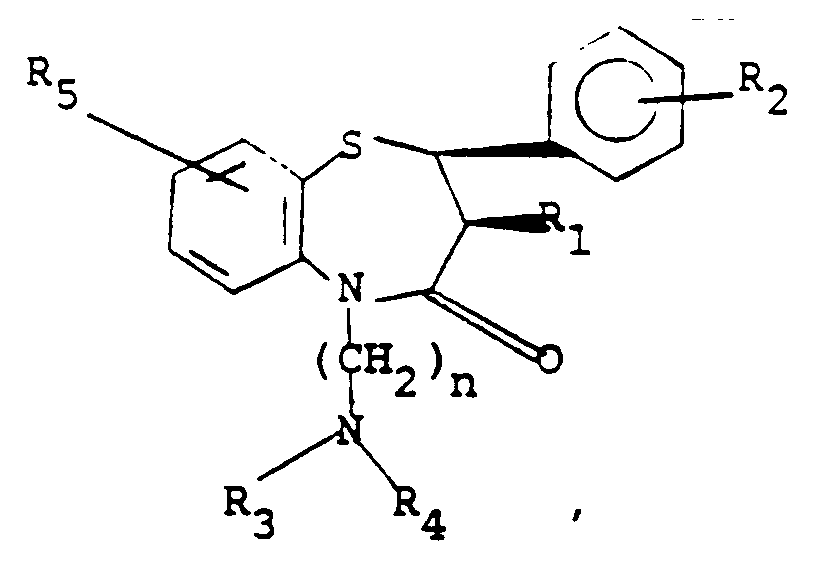
or a pharmaceutically accpetable salt thereof, wherein the stereochemistry at the chiral centers in the 3 and 4-positions of the benzothiazepine nucleus is cis, and wherein
R₁ is C₁₋₁₀ alkyl, C₂₋₁₀ alkenyl or C₂₋₁₀ alkynyl;
R₂ and R₅ are each independently hydrogen, C₁₋₄ alkyl, C₁₋₄ alkoxy, halogen or trifluoromethyl; and
R₃ and R₄ are each independently C₁₋₁₀ alkyl or C₃₋₇ cycloalkyl or R₃ and R₄ together with the nitrogen atom to which they are attached are pyrrolidinyl, piperidinyl or morpholinyl.
or a pharmaceutically accpetable salt thereof, wherein the stereochemistry at the chiral centers in the 3 and 4-positions of the benzothiazepine nucleus is cis, and wherein
R₁ is C₁₋₁₀ alkyl, C₂₋₁₀ alkenyl or C₂₋₁₀ alkynyl;
R₂ and R₅ are each independently hydrogen, C₁₋₄ alkyl, C₁₋₄ alkoxy, halogen or trifluoromethyl; and
R₃ and R₄ are each independently C₁₋₁₀ alkyl or C₃₋₇ cycloalkyl or R₃ and R₄ together with the nitrogen atom to which they are attached are pyrrolidinyl, piperidinyl or morpholinyl.
2. A compound in accordance with claim 1 wherein R₁ is C₁₋₁₀ alkyl.
3. A compound in accordance with claim 1 wherein R₁ is C₂₋₁₀ alkenyl.
4. A compound in accordance with claim l wherein R₁ is C₂₋₁₀ alkynyl.
5. A compound in accordance with claim 1 wherein R₁ is methyl.
6. A compound in accordance with claim 1 wherein R₂ is hydrogen.
7. A compound in accordance with claim 1 wherein R₅ is hydrogen.
8. A compound in accordance with claim 1 wherein R₂ and R₅ are hydrogen.
9. A compound in accordance with claim 1 wherein R₃ and R₄ are each C₁₋₁₀ alkyl.
10. A compound in accordance with claim 1 wherein R₃ and R₄ are each methyl.
11. The compound in accordance with claim 1, (cis)-5-[2-(dimethylamino)ethyl]-2,3-dihydro-3-methyl-4-phenyl-1,5-benzothiazepin-4-(5H)-one,
or a pharmaceutically acceptable salt thereof.
12. The compound in accordance with claim 1, (cis)-5-[2-(dimethylamino)ethyl]-2,3-dihydro-2-(4-methoxyphenyl)-3-methyl-1,5-benzothiazepin-4(5H)-one,
or a pharmaceutically acceptable salt thereof.
13. Use of the compounds according to any of claims 1 to 12 for the preparation of pharmaceutical
compositions.
14. Use according to claim 13 wherein the pharmaceutical compositions have anti-hypertensive
activity.
Revendications pour l'(les) Etat(s) contractant(s) suivant(s): BE, CH, DE, FR, GB,
IT, LI, LU, NL, SE
1. Composé de formule
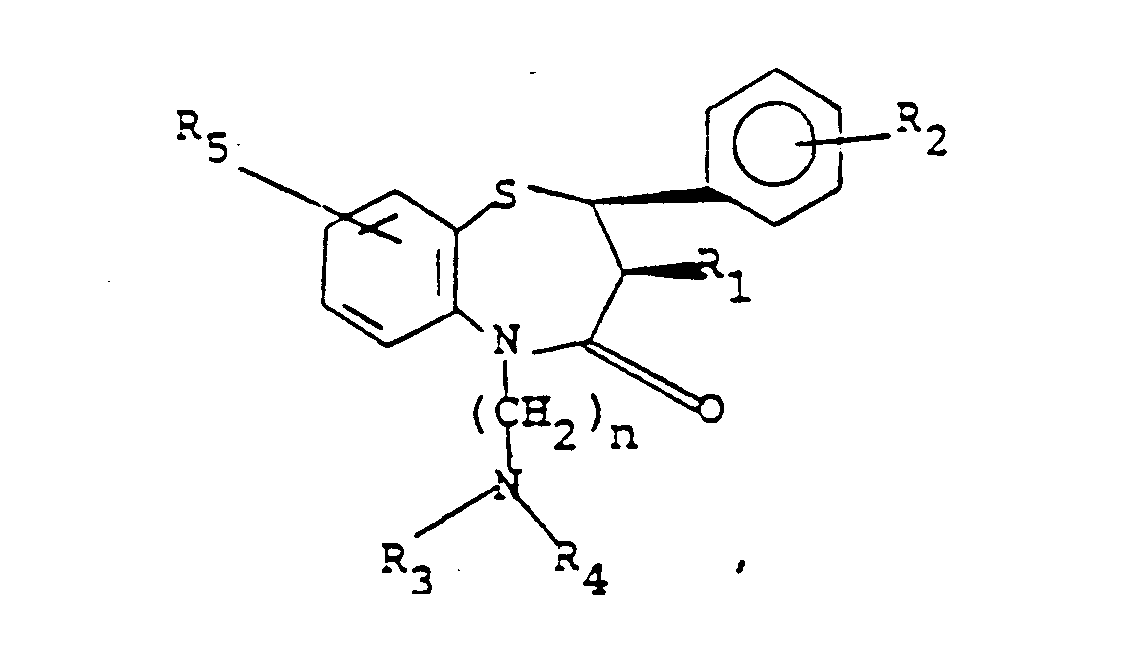
ou sel pharmaceutiquement acceptable de celui-ci, dans lequel la stéréochimie aux centres chiraux en positions 3 et 4 du noyau benzothiazépine est cis, et dans lequel
R₁ est un radical alkyle en C₁-C₁₀, alcényle en C₂-C₁₀ ou alcynyle en C₂-C₁₀ ;
R₂ et R₅ sont chacun, indépendamment, l'hydrogène, un radical alkyle en C₁-C₄ ou alcoxy en C₁-C₄, un atome d'halogène ou le radical trifluorométhyle ; et
R₃ et R₄ sont chacun, indépendamment, un radical alkyle en C₁-C₁₀ ou cycloalkyle en C₃-C₇, ou bien R₃ et R₄ forment, avec l'atome d'azote auquel ils sont fixés, un radical pyrrolidinyle, pipéridinyle ou morpholinyle.
ou sel pharmaceutiquement acceptable de celui-ci, dans lequel la stéréochimie aux centres chiraux en positions 3 et 4 du noyau benzothiazépine est cis, et dans lequel
R₁ est un radical alkyle en C₁-C₁₀, alcényle en C₂-C₁₀ ou alcynyle en C₂-C₁₀ ;
R₂ et R₅ sont chacun, indépendamment, l'hydrogène, un radical alkyle en C₁-C₄ ou alcoxy en C₁-C₄, un atome d'halogène ou le radical trifluorométhyle ; et
R₃ et R₄ sont chacun, indépendamment, un radical alkyle en C₁-C₁₀ ou cycloalkyle en C₃-C₇, ou bien R₃ et R₄ forment, avec l'atome d'azote auquel ils sont fixés, un radical pyrrolidinyle, pipéridinyle ou morpholinyle.
2. Composé selon la revendication 1, dans lequel R₁ est un radical alkyle en C₁-C₁₀.
3. Composé selon la revendication 1, dans lequel R₁ est un radical alcényle en C₂-C₁₀.
4. Composé selon la revendication 1, dans lequel R₁ est un radical alcynyle en C₂-C₁₀.
5. Composé selon la revendication 1, dans lequel R₁ est le radical méthyle.
6. Composé selon la revendication 1, dans lequel R₂ est l'hydrogène.
7. Composé selon la revendication 1, dans lequel R₅ est l'hydrogène.
8. Composé selon la revendication 1, dans lequel R₂ et R₅ sont l'hydrogène.
9. Composé selon la revendication 1, dans lequel R₃ et R₄ sont tous deux un radical alkyle
en C₁-C₁₀.
10. Composé selon la revendication 1, dans lequel R₃ et R₄ sont tous deux le radical méthyle.
11. Composé selon la revendication 1, qui est la (cis)-5-[2-(diméthylamino)éthyl]-2,3-dihydro-3-méthyl-4-phényl-1,5-benzothiazépin-4(5H)-one,
ou un sel pharmaceutiquement acceptable de celle-ci.
12. Composé selon la revendication 1, qui est la (cis)-5-[2-(diméthylamino)éthyl]-2,3-dihydro-2-(4-méthoxyphényl)-3-méthyl-1,5-benzothiazépin-4(5H)-one,
ou un sel pharmaceutiquement acceptable de celle-ci.
13. Compositions pharmaceutiques comprenant une quantité pharmaceutiquement efficace d'un
composé selon l'une quelconque des revendications 1 à 12.
14. Agents cardiovasculaires comprenant une quantité pharmaceutiquement efficace d'un
composé selon l'une quelconque des revendications 1 à 12.
15. Utilisation des composés selon l'une quelconque des revendications 1 à 12 pour la
préparation de compositions pharmaceutiques.
16. Utilisation selon la revendication 15, dans laquelle les compositions pharmaceutiques
ont une action antihypertensive.
Revendications pour l'(les) Etat(s) contractant(s) suivant(s): AT, ES
1. Procédé de préparation d'un composé de formule
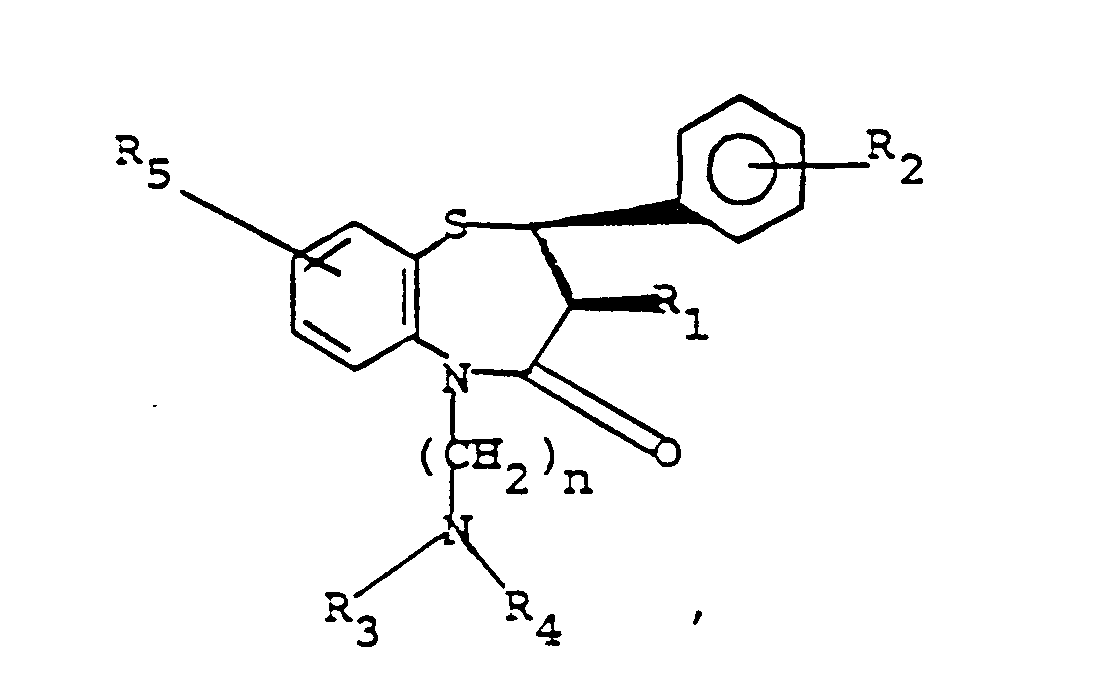
ou d'un sel pharmaceutiquement acceptable de celui-ci, dans lequel la stéréochimie aux centres chiraux en positions 3 et 4 du noyau benzothiazépine est cis, et dans lequel
R₁ est un radical alkyle en C₁-C₁₀, alcényle en C₂-C₁₀ ou alcynyle en C₂-C₁₀ ;
R₂ et R₅ sont chacun, indépendamment, l'hydrogène, un radical alkyle en C₁-C₄ ou alcoxy en C₁-C₄, un atome d'halogène ou le radical trifluorométhyle ; et
R₃ et R₄ sont chacun, indépendamment, un radical alkyle en C₁-C₁₀ ou cycloalkyle en C₃-C₇, ou bien R₃ et R₄ forment, avec l'atome d'azote auquel ils sont fixés, un radical pyrrolidinyle, pipéridinyle ou morpholinyle,
qui consiste à épimériser le composant trans correspondant.
ou d'un sel pharmaceutiquement acceptable de celui-ci, dans lequel la stéréochimie aux centres chiraux en positions 3 et 4 du noyau benzothiazépine est cis, et dans lequel
R₁ est un radical alkyle en C₁-C₁₀, alcényle en C₂-C₁₀ ou alcynyle en C₂-C₁₀ ;
R₂ et R₅ sont chacun, indépendamment, l'hydrogène, un radical alkyle en C₁-C₄ ou alcoxy en C₁-C₄, un atome d'halogène ou le radical trifluorométhyle ; et
R₃ et R₄ sont chacun, indépendamment, un radical alkyle en C₁-C₁₀ ou cycloalkyle en C₃-C₇, ou bien R₃ et R₄ forment, avec l'atome d'azote auquel ils sont fixés, un radical pyrrolidinyle, pipéridinyle ou morpholinyle,
qui consiste à épimériser le composant trans correspondant.
2. Procédé selon la revendication 1, dans lequel R₁ est un radical alkyle en C₁-C₁₀.
3. Procédé selon la revendication 1, dans lequel R₁ est un radical alcényle en C₂-C₁₀.
4. Procédé selon la revendication 1, dans lequel R₁ est un radical alcynyle en C₂-C₁₀.
5. Procédé selon la revendication 1, dans lequel R₁ est le radical méthyle.
6. Procédé selon la revendication 1, dans lequel R₂ est l'hydrogène.
7. Procédé selon la revendication 1, dans lequel R₅ est l'hydrogène.
8. Procédé selon la revendication 1, dans lequel R₂ et R₅ sont l'hydrogène.
9. Procédé selon la revendication 1, dans lequel R₃ et R₄ sont tous deux un radical alkyle
en C₁-C₁₀.
10. Procédé selon la revendication 1, dans lequel R₃ et R₄ sont tous deux le radical méthyle.
11. Procédé selon la revendication 1, dans lequel le produit est la (cis)-5-[2-(diméthylamino)éthyl]-2,3-dihydro-3-méthyl-4-phényl-1,5-benzothiazépin-4-(5H)-one,
ou un sel pharmaceutiquement acceptable de celle-ci.
12. Procédé selon la revendication 1, dans lequel le produit est la (cis)-5-[2-(diméthylamino)éthyl]-2,3-dihydro-2-(4-méthoxyphényl)-3-méthyl-1,5-benzothiazépin-4(5H)-one,
ou un sel pharmaceutiquement acceptable de celle-ci.
13. Procédé selon la revendication 1, dans laquel on réalise l'épimérisation en traitant
le composé trans par une base forte.
Revendications pour l'(les) Etat(s) contractant(s) suivant(s): GR
1. Composé de formule

ou sel pharmaceutiquement acceptable de celui-ci, dans lequel la stéréochimie aux centres chiraux en positions 3 et 4 du noyau benzothiazépine est cis, et dans lequel
R₁ est un radical alkyle en C₁-C₁₀, alcényle en C₂-C₁₀ ou alcynyle en C₂-C₁₀ ;
R₂ et R₅ sont chacun, indépendamment, l'hydrogène, un radical alkyle en C₁-C₄ ou alcoxy en C₁-C₄, un atome d'halogène ou le radical trifluorométhyle ; et
R₃ et R₄ sont chacun, indépendamment, un radical alkyle en C₁-C₁₀ ou cycloalkyle en C₃-C₇, ou bien R₃ et R₄ forment, avec l'atome d'azote auquel ils sont fixés, un radical pyrrolidinyle, pipéridinyle ou morpholinyle.
ou sel pharmaceutiquement acceptable de celui-ci, dans lequel la stéréochimie aux centres chiraux en positions 3 et 4 du noyau benzothiazépine est cis, et dans lequel
R₁ est un radical alkyle en C₁-C₁₀, alcényle en C₂-C₁₀ ou alcynyle en C₂-C₁₀ ;
R₂ et R₅ sont chacun, indépendamment, l'hydrogène, un radical alkyle en C₁-C₄ ou alcoxy en C₁-C₄, un atome d'halogène ou le radical trifluorométhyle ; et
R₃ et R₄ sont chacun, indépendamment, un radical alkyle en C₁-C₁₀ ou cycloalkyle en C₃-C₇, ou bien R₃ et R₄ forment, avec l'atome d'azote auquel ils sont fixés, un radical pyrrolidinyle, pipéridinyle ou morpholinyle.
2. Composé selon la revendication 1, dans lequel R₁ est un radical alkyle en C₁-C₁₀.
3. Composé selon la revendication 1, dans lequel R₁ est un radical alcényle en C₂-C₁₀.
4. Composé selon la revendication 1, dans lequel R₁ est un radical alcynyle en C₂-C₁₀.
5. Composé selon la revendication 1, dans lequel R₁ est le radical méthyle.
6. Composé selon la revendication 1, dans lequel R₂ est l'hydrogène.
7. Composé selon la revendication 1, dans lequel R₅ est l'hydrogène.
8. Composé selon la revendication 1, dans lequel R₂ et R₅ sont l'hydrogène.
9. Composé selon la revendication 1, dans lequel R₃ et R₄ sont tous deux un radical alkyle
en C₁-C₁₀.
10. Composé selon la revendication 1, dans lequel R₃ et R₄ sont tous deux le radical méthyle.
11. Composé selon la revendication 1, qui est la (cis)-5-[2-(diméthylamino)éthyl]-2,3-dihydro-3-méthyl-4-phényl-1,5-benzothiazépin-4(5H)-one,
ou un sel pharmaceutiquement acceptable de celle-ci.
12. Composé selon la revendication 1, qui est la (cis)-5-[2-(diméthylamino)éthyl]-2,3-dihydro-2-(4-méthoxyphényl)-3-méthyl-1,5-benzothiazépin-4-(5H)-one,
ou un sel pharmaceutiquement acceptable de celle-ci.
13. Utilisation des composés selon l'une quelconque des revendications 1 à 12 pour la
préparation de compositions pharmaceutiques.
14. Utilisation selon la revendication 13, dans laquelle les compositions pharmaceutiques
ont une action antihypertensive.
Patentansprüche für folgende(n) Vertragsstaat(en): BE, CH, DE, FR, GB, IT, LI, LU,
NL, SE
1. Verbindung der Formel
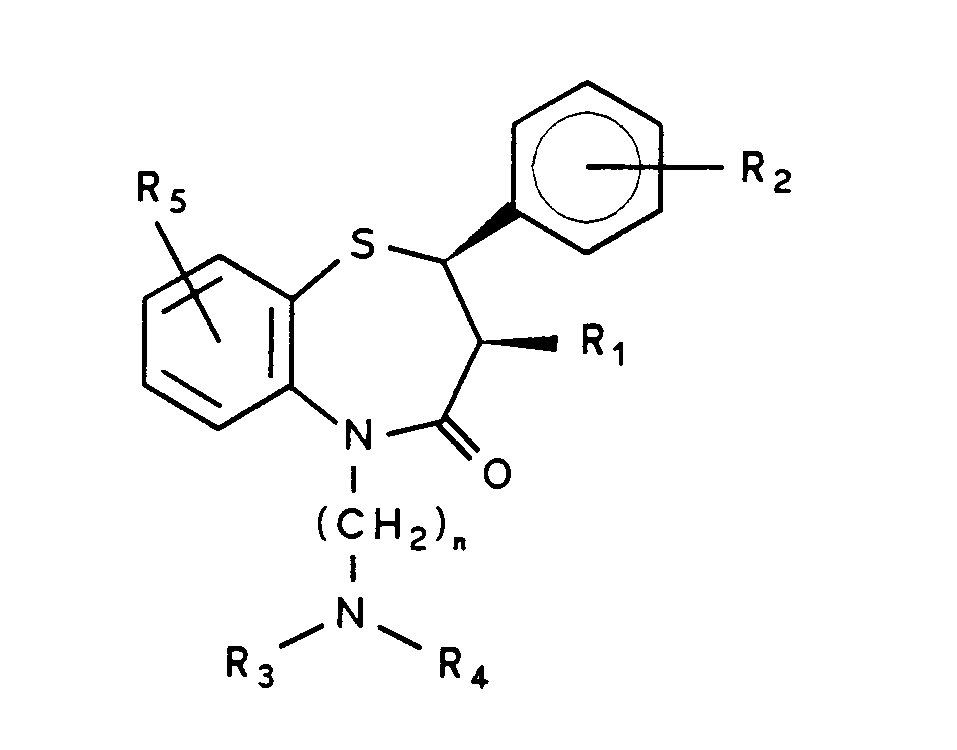
oder ein pharmazeutisch verträgliches Salz davon, in der die Stereochemie an den chiralen Zentren in den 3- und 4-Stellungen des Benzothiazepinkerns cis ist, und in der
R₁ einen C₁₋₁₀-Alkyl-, C₂₋₁₀-Alkenyl- oder einen C₂₋₁₀-Alkinylrest bedeutet;
R₂ und R₅ jeweils unabhängig voneinander ein Wasserstoffatom, einen C₁₋₄-Alkyl-, C₁₋₄-Alkoxyrest, ein Halogenatom oder eine Trifluormethylgruppe bedeuten, und
R₃ und R₄ jeweils unabhängig voneinander einen C₁₋₁₀-Alkyl- oder einen C₃₋₇-Cycloalkylrest bedeuten oder R₃ und R₄ zusammen mit dem Stickstoffatom, an das sie gebunden sind, einen Pyrrolidinyl-, Piperidinyl- oder einen Morpholinylrest bedeuten.
oder ein pharmazeutisch verträgliches Salz davon, in der die Stereochemie an den chiralen Zentren in den 3- und 4-Stellungen des Benzothiazepinkerns cis ist, und in der
R₁ einen C₁₋₁₀-Alkyl-, C₂₋₁₀-Alkenyl- oder einen C₂₋₁₀-Alkinylrest bedeutet;
R₂ und R₅ jeweils unabhängig voneinander ein Wasserstoffatom, einen C₁₋₄-Alkyl-, C₁₋₄-Alkoxyrest, ein Halogenatom oder eine Trifluormethylgruppe bedeuten, und
R₃ und R₄ jeweils unabhängig voneinander einen C₁₋₁₀-Alkyl- oder einen C₃₋₇-Cycloalkylrest bedeuten oder R₃ und R₄ zusammen mit dem Stickstoffatom, an das sie gebunden sind, einen Pyrrolidinyl-, Piperidinyl- oder einen Morpholinylrest bedeuten.
2. Verbindung gemäß Anspruch 1, in der R₁ einen C₁₋₁₀-Alkylrest bedeutet.
3. Verbindung gemäß Anspruch 1, in der R₁ einen C₂₋₁₀-Alkenylrest bedeutet.
4. Verbindung gemäß Anspruch 1, in der R₁ einen C₂₋₁₀-Alkinylrest bedeutet.
5. Verbindung gemäß Anspruch 1, in der R₁ einen Methylrest bedeutet.
6. Verbindung gemäß Anspruch 1, in der R₂ ein Wasserstoffatom bedeutet.
7. Verbindung gemäß Anspruch 1, in der R₅ ein Wasserstoffatom bedeutet.
8. Verbindung gemäß Anspruch 1, in der R₂ und R₅ ein Wasserstoffatom bedeuten.
9. Verbindung gemäß Anspruch 1, in der R₃ und R₄ jeweils einen C₁₋₁₀-Alkylrest bedeuten.
10. Verbindung gemäß Anspruch 1, in der R₃ und R₄ jeweils einen Methylrest bedeuten.
11. Die Verbindung gemäß Anspruch 1, (cis)-5-[2-(Dimethylamino)ethyl]-2,3-dihydro-3-methyl-4-phenyl-1,5-benzothiazepin-4(5H)-on
oder ein pharmazeutisch verträgliches Salz davon.
12. Die Verbindung gemäß Anspruch 1, (cis)-5-[2-(Dimethylamino)ethyl]-2,3-dihydro-2-(4-methoxyphenyl)-3-methyl-1,5-benzothiazepin-4(5H)-on
oder ein pharmazeutisch verträgliches Salz davon.
13. Arzneimittel, umfassend eine pharmazeutisch wirksame Menge einer Verbindung gemäß
einem der Ansprüche 1 bis 12.
14. Kardiovaskuläre Wirkstoffe, umfassend eine pharmazeutisch wirksame Menge einer Verbindung
gemäß einem der Ansprüche 1 bis 12.
15. Verwendung der Verbindungen gemäß einem der Ansprüche 1 bis 12 zur Herstellung von
Arzneimitteln.
16. Verwendung gemäß Anspruch 15, wobei die Arzneimittel antihypertonische Wirkung haben.
Patentansprüche für folgende(n) Vertragsstaat(en): AT, ES
1. Verfahren zur Herstellung einer Verbindung der Formel
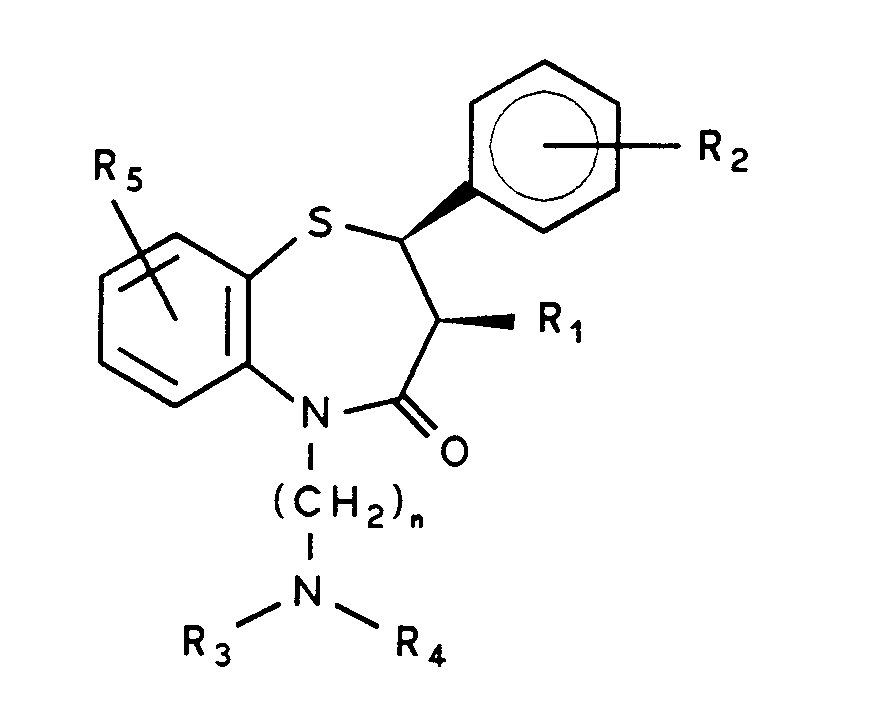
oder eines pharmazeutisch verträglichen Salzes davon, in der die Stereochemie an den chiralen Zentren in den 3- und 4-Stellungen des Benzothiazepinkerns cis ist, und in der
R₁ einen C₁₋₁₀-Alkyl-, C₂₋₁₀-Alkenyl- oder einen C₂₋₁₀-Alkinylrest bedeutet;
R₂ und R₅ jeweils unabhängig voneinander ein Wasserstoffatom, einen C₁₋₄-Alkyl-, C₁₋₄-Alkoxyrest, ein Halogenatom oder eine Trifluormethylgruppe bedeuten, und
R₃ und R₄ jeweils unabhängig voneinander einen C₁₋₁₀-Alkyl- oder einen C₃₋₇-Cycloalkylrest bedeuten oder R₃ und R₄ zusammen mit dem Stickstoffatom, an das sie gebunden sind, einen Pyrrolidinyl-, Piperidinyl- oder einen Morpholinylrest bedeuten,
umfassend die Epimerisierung der entsprechenden trans-Verbindung.
oder eines pharmazeutisch verträglichen Salzes davon, in der die Stereochemie an den chiralen Zentren in den 3- und 4-Stellungen des Benzothiazepinkerns cis ist, und in der
R₁ einen C₁₋₁₀-Alkyl-, C₂₋₁₀-Alkenyl- oder einen C₂₋₁₀-Alkinylrest bedeutet;
R₂ und R₅ jeweils unabhängig voneinander ein Wasserstoffatom, einen C₁₋₄-Alkyl-, C₁₋₄-Alkoxyrest, ein Halogenatom oder eine Trifluormethylgruppe bedeuten, und
R₃ und R₄ jeweils unabhängig voneinander einen C₁₋₁₀-Alkyl- oder einen C₃₋₇-Cycloalkylrest bedeuten oder R₃ und R₄ zusammen mit dem Stickstoffatom, an das sie gebunden sind, einen Pyrrolidinyl-, Piperidinyl- oder einen Morpholinylrest bedeuten,
umfassend die Epimerisierung der entsprechenden trans-Verbindung.
2. Verfahren gemäß Anspruch 1, in dem R₁ einen C₁₋₁₀-Alkylrest bedeutet.
3. Verfahren gemäß Anspruch 1, in dem R₁ einen C₂₋₁₀-Alkenylrest bedeutet.
4. Verfahren gemäß Anspruch 1, in dem R₁ einen C₂₋₁₀-Alkinylrest bedeutet.
5. Verfahren gemäß Anspruch 1, in dem R₁ einen Methylrest bedeutet.
6. Verfahren gemäß Anspruch 1, in dem R₂ ein Wasserstoffatom bedeutet.
7. Verfahren gemäß Anspruch 1, in dem R₅ ein Wasserstoffatom bedeutet.
8. Verfahren gemäß Anspruch 1, in dem R₂ und R₅ ein Wasserstoffatom bedeuten.
9. Verfahren gemäß Anspruch 1, in dem R₃ und R₄ jeweils einen C₁₋₁₀-Alkylrest bedeuten.
10. Verfahren gemäß Anspruch 1, in dem R₃ und R₄ jeweils einen Methylrest bedeuten.
11. Verfahren gemäß Anspruch 1, in dem das Produkt (cis)-5-[2-(Dimethylamino)ethyl]-2,3-dihydro-3-methyl-4-phenyl-1,5-benzothiazepin-4(5H)-on
oder ein pharmazeutisch verträgliches Salz davon ist.
12. Verfahren gemäß Anspruch 1, in dem das Produkt (cis)-5-[2-(Dimethylamino)ethyl]-2,3-dihydro-2-(4-methoxyphenyl)-3-methyl-1,5-benzothiazepin-4(5H)-on
oder ein pharmazeutisch verträgliches Salz davon ist.
13. Verfahren gemäß Anspruch 1, in dem die Epimerisierung durch Behandlung der trans-Verbindung
mit einer starken Base erreicht wird.
Patentansprüche für folgende(n) Vertragsstaat(en): GR
1. Verbindung der Formel
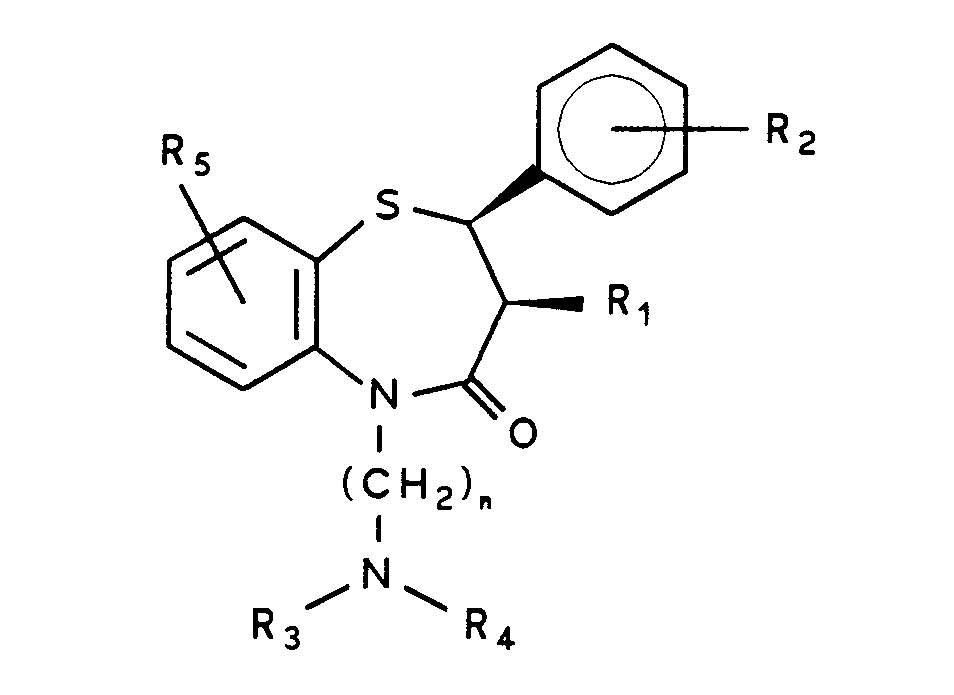
oder ein pharmazeutisch verträgliches Salz davon, in der die Stereochemie an den chiralen Zentren in den 3- und 4-Stellungen des Benzothiazepinkerns cis ist, und in der
R₁ einen C₁₋₁₀-Alkyl-, C₂₋₁₀-Alkenyl- oder einen C₂₋₁₀-Alkinylrest bedeutet;
R₂ und R₅ jeweils unabhängig voneinander ein Wasserstoffatom, einen C₁₋₄-Alkyl-, C₁₋₄-Alkoxyrest, ein Halogenatom oder eine Trifluormethylgruppe bedeuten, und
R₃ und R₄ jeweils unabhängig voneinander einen C₁₋₁₀-Alkyl- oder einen C₃₋₇-Cycloalkylrest bedeuten oder R₃ und R₄ zusammen mit dem Stickstoffatom, an das sie gebunden sind, einen Pyrrolidinyl-, Piperidinyl- oder einen Morpholinylrest bedeuten.
oder ein pharmazeutisch verträgliches Salz davon, in der die Stereochemie an den chiralen Zentren in den 3- und 4-Stellungen des Benzothiazepinkerns cis ist, und in der
R₁ einen C₁₋₁₀-Alkyl-, C₂₋₁₀-Alkenyl- oder einen C₂₋₁₀-Alkinylrest bedeutet;
R₂ und R₅ jeweils unabhängig voneinander ein Wasserstoffatom, einen C₁₋₄-Alkyl-, C₁₋₄-Alkoxyrest, ein Halogenatom oder eine Trifluormethylgruppe bedeuten, und
R₃ und R₄ jeweils unabhängig voneinander einen C₁₋₁₀-Alkyl- oder einen C₃₋₇-Cycloalkylrest bedeuten oder R₃ und R₄ zusammen mit dem Stickstoffatom, an das sie gebunden sind, einen Pyrrolidinyl-, Piperidinyl- oder einen Morpholinylrest bedeuten.
2. Verbindung gemäß Anspruch 1, in der R₁ einen C₁₋₁₀-Alkylrest bedeutet.
3. Verbindung gemäß Anspruch 1, in der R₁ einen C₂₋₁₀-Alkenylrest bedeutet.
4. Verbindung gemäß Anspruch 1, in der R₁ einen C₂₋₁₀-Alkinylrest bedeutet.
5. Verbindung gemäß Anspruch 1, in der R₁ einen Methylrest bedeutet.
6. Verbindung gemäß Anspruch 1, in der R₂ ein Wasserstoffatom bedeutet.
7. Verbindung gemäß Anspruch 1, in der R₅ ein Wasserstoffatom bedeutet.
8. Verbindung gemäß Anspruch 1, in der R₂ und R₅ ein Wasserstoffatom bedeuten.
9. Verbindung gemäß Anspruch 1, in der R₃ und R₄ jeweils einen C₁₋₁₀-Alkylrest bedeuten.
10. Verbindung gemäß Anspruch 1, in der R₃ und R₄ jeweils einen Methylrest bedeuten.
11. Die Verbindung gemäß Anspruch 1, (cis)-5-[2-(Dimethylamino)ethyl]-2,3-dihydro-3-methyl-4-phenyl-1,5-benzothiazepin-4(5H)-on
oder ein pharmazeutisch verträgliches Salz davon.
12. Die Verbindung gemäß Anspruch 1, (cis)-5-[2-(Dimethylamino)ethyl]-2,3-dihydro-2-(4-methoxyphenyl)-3-methyl-1,5-benzothiazepin-4(5H)-on
oder ein pharmazeutisch verträgliches Salz davon.
13. Verwendung der Verbindungen gemäß einem der Ansprüche 1 bis 12 zur Herstellung von
Arzneimitteln.
14. Verwendung gemäß Anspruch 13, wobei die Arzneimittel antihypertonische Wirkung haben.