|
(11) | EP 0 267 187 B1 |

| (12) | EUROPEAN PATENT SPECIFICATION |
|
|
| (54) |
CYCLONE SEPARATOR ZYKLONABSCHEIDEVORRICHTUNG SEPARATEUR A CYCLONE |
|
|
|||||||||||||||||||||||||||||||
| Note: Within nine months from the publication of the mention of the grant of the European patent, any person may give notice to the European Patent Office of opposition to the European patent granted. Notice of opposition shall be filed in a written reasoned statement. It shall not be deemed to have been filed until the opposition fee has been paid. (Art. 99(1) European Patent Convention). |
[0001] This invention is about a cyclone separator. This separator may find application in removing a lighter phase from a large volume of denser phase such as oil from water, with minimum contamination of the more voluminous phase. Most conventional cyclone separators are designed for the opposite purpose, that is removing a denser phase from a large volume of lighter phase, with a minimum contamination of the less voluminous phase. In our case, a typical starting liquid-liquid dispersion would contain under 1% by volume of the lighter (less dense) phase, but it could be more.
[0002] WO-A-86/01130 which was published on 27th February 1986 and which falls under Article 54(3)EPC discloses a cyclone separator for the separation of a mixture including multiphase liquids, the separator comprising a primary portion having generally the form of a volume of revolution and having a first end and a second end, the diameter d₂ at said second end being less than the diameter d₁ at said first end, a generally axially symmetrical second portion substantially coaxial with said primary portion at said second end of saif primary portion, a single inlet with at least a tangential component at said first end of said primary portion for introducing the multiphase mixture to be separated into the cyclone separator, and at least an overflow outlet and an underflow outlet. The cyclone separator is further defined by certain mathematical relationships.
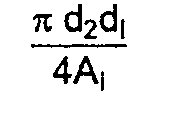
[0003] According to the present invention there is provided a cyclone separator comprising at least a primary portion having generally the form of a volume of revolution and having a first end and a second end, the diameter at said second end being less that at said first end, a plurality of n inlets, where n > 1, at or adjacent said first end for introduced feed to be separated into the cyclone separator said inlets being axially staggered and inwardly spiralling and the separator further including an overflow outlet and an underflow outlet in which cyclone separator the following relationship applies: -
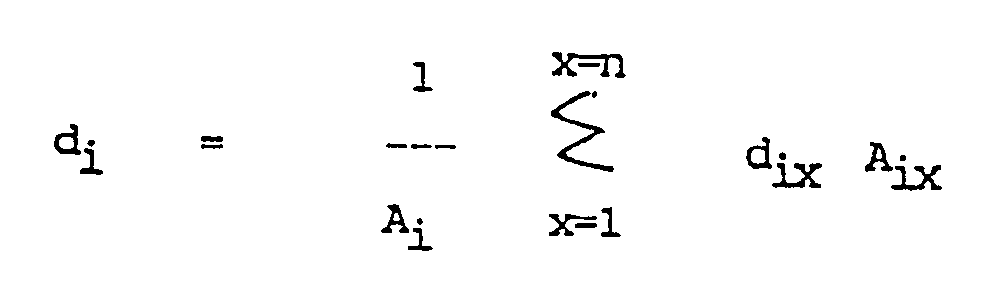
where d₁ is the diameter of the said primary portion where flow enters (but neglecting the feed channel), dix is twice the radius at which flow enters the cyclone through the xth inlet (i.e. twice the minimum distance of the tangential component of the inlet centre line from the axes ) and
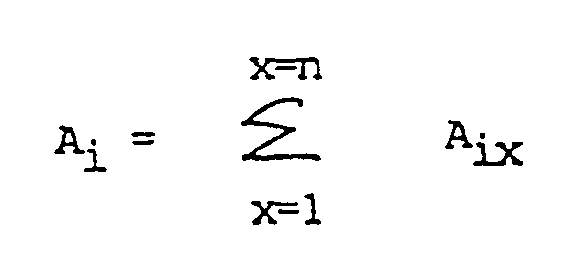
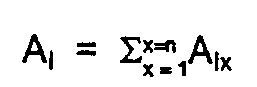
where Aix is the minimum cross sectional area of the xth inlet at entry to the cyclone separator in a plane parallel to the axis of the cyclone separator, and where
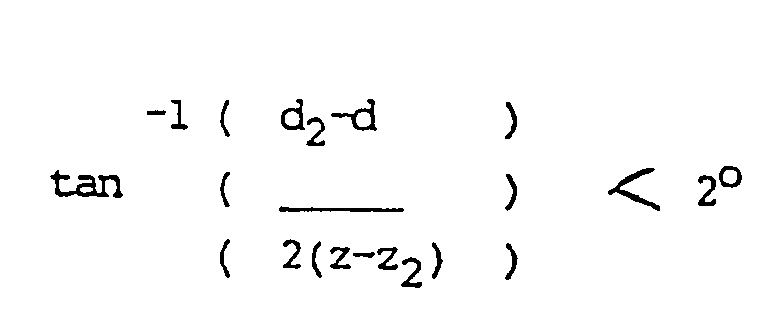
and where d₂ is the diameter of the primary portion measured at a point z₂ where the condition first applies that
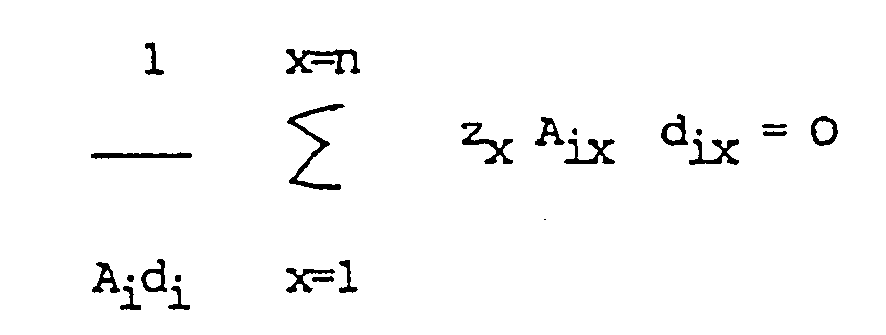
for all z > z₂ where z is the distance along the cyclone separator axis downstream of the plane containing the inlet and d is the diameter of the cyclone at z, and further z=O being the axial position of the weighted areas of the inlets such that the injection of angular momentum into the cyclone separator is equally distributed axially about said axial position where z=O and being defined by
where zx is the axial position of the xth inlet, and further
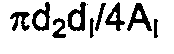
is from 3 to 12.
[0004] In one form the cyclone separator may have an inlet portion having generally the form of a volume of revolution and, adjacent to the inlet portion and substantially coaxial therewith, a generally axially symmetrical separation portion converging (preferably uninterruptedly) into a downstream portion. The inlet portion has an axial overflow outlet opposite the separation portion (i.e.in its end surface).
[0005] Preferably, where d₃ is the cyclone diameter where the separation portion joins the downstream section and is defined as the diameter at z₃ where d/d₃ > 0.98 for all the z > z₃, and dO is the minimum internal diameter of the axial overflow outlet, then the following relationships apply:
where α is the half angle of the convergance of the separation portion i.e.
Each feed channel may be fed from a duct directed substantially tangentially into the inlet portion, the (outer) surface of the channel converging to the principal diameter of the inlet portion d₁, for example by substantially equal radial decrements per unit angle around the axis, preferably attaining the diameter D₁ after more than 360°/n around the axis.
[0006] The expression
which we call the "swirl coefficient" S, is a reasonable predictor of the ratio of velocities tangentially: axially of flow which has entered the cyclone and which has reached the plane of d₂ and, (with dispersed lighter phase, as is of interest to us) in order to be able to create an internal flow structure favourable for separation at a low split ratio. i.e. split ratio=
of the order of 1%, then the half-angle of convergence averaged over the whole separation portion is 20′ to 2°, preferably less than 1°, more preferably less than 52′, preferably at least 30′. S is from 3 to 12, preferably from 4 to 10, more preferably from 6 to 8. The convergence averaged from the diameter d₁ measured in the inlet plane to the diameter d₂ may be the fastest (largest one half-angle) in the cyclone, and may be from 5° to 45° (The inlet plane is that plane normal to the cyclone axis including the point z=O.) The inlet portion should be such that the angular momentum of material entering from the inlets is substantially conserved into the separation portion.
[0007] Preferably, d₃/d₂ is less than 0.75 (more preferably less than 0.7) and preferably exceeds 0.25 (more preferably exceeding 0.3). Preferably where the internal length of the downstream outlet portion is 1₃, 1₃/d₃ is at least 1, more preferably at least 5; is typically about 10 and may be as large as desired, such as at least 40. For space reasons it may be desired to curve the dense-phase-outlet portion gently, and a radius of curvature of the order of 50 d₃ is possible, and gentle curvature of the cyclone axis is feasible, d₁/d₂ may be from 1¼ to 3. Preferably do/d₂ is at most 0.15 and preferably at least 0.008, possibly from 0.01 to 0.1, such as 0.02 to 0.06. Pressure drop in the axial overflow outlet should not be excessive, and therefore the length of the "do" portion of the axial overflow outlet should be kept low. The axial overflow outlet may reach its "do" diameter instantaneously or by any form of abrupt or smooth transition, and may widen thereafter by a taper or step. The axial distance from the inlet plane to the "do" point is preferably less than 4d₂. The actual magnitude of d₂ is a matter of choice for operating and engineering convenience and may for example be 10 to 100mm.
[0008] In another form, according to the invention, at least part of the generator of the inlet portion or of the separation portion or of both is curved.
[0009] The generator may be, for example, (i) a monotonic curve (having no points of inflexion) steepest at the inlet-portion end and tending to a cone-angle of zero at its open end, or (ii) a curve with one or more points of inflexion but overall converging towards the downstream outlet portion.
[0010] The invention extends to a method of removing a lighter phase from a larger volume of denser phase, comprising applying the phases to the feed of a cyclone separator as set forth above, the phases being at a higher pressure than in the axial overflow outlet and in the downstream end of the downstream outlet portion; in practice, it will generally be found that the pressure out of the downstream outlet portion will exceed that out of the axial overflow outlet.
[0011] This method is particularly envisaged for removing up to 1 part by volume of oil (light phase) from over 19 parts of water (denser phase), such as over 99 parts, such as oil-field production water or sea water which may have become contaminated with oil, as a result of a spillage, shipwreck, oil-rig blow out or routing operations such as bilge-rinsing or oil-rig drilling. The ratio of flow rates upstream outlet/downstream outlet (and hence the split ratio) has a minimum value for successful separation of the oil, which value is determined by the geometry of the cyclone (especially by the value of do/d₂) but preferably the cyclone is operated above this minimum value, e.g. by back pressure for example provided by valving or flow restriction outside the defines cyclone. Thus preferably the method comprises arranging the split ratio to exceed 1 1/2 (do/d₂)², preferably to exceed 2 (do/d₂)².
[0012] The method preferably further comprises, as a preliminary step, eliminating free gas from the phases such that in the inlet material the volume of gas is not more than 10%, such as not more than 1/2%.
[0013] As liquids normally become less viscous when warm, water for example being approximately half as viscous at 50° as at 20°C. the method is advantageously performed at as high a temperature as convenient. The invention extends to the products of the method (such as concentrated oil, or cleaned water).
[0014] The invention will now be described by way of example with reference to the accompanying drawings, in which:-
Figure 1 shows, schematically, a cross-section taken on the axis of a cyclone separator according to the invention, and
Figure 2 Is a view down the axis of the cyclone separator. The drawings are not to scale.
[0015] An inlet portion 1 having generally the shape of a volume of revolution has two axially spaced spiral feed channels 8 each fed from a duct 9 directed tangentially into the widest part of the inlet portion 1, the two being symmetrically disposed about the cyclone axis. The width (radially) of the duct 9 is rv (max), and the channel 8 converges smoothly to the principal diameter d₁ of the inlet portion; thus rv diminishes linearly to zero at about 360° after the point of entry of the duct 9 into the cyclone separator. This is best seen in Figure 2, which is a view down the axis of the cyclone separator, whose end surface 11 has been removed. Coaxial with the inlet portion 1, and adjacent to it, is a separation cylindrical downstream outlet portion 3. The portion 3 opens into collection ducting 4. The channel 8 alternatively may be slightly angled towards the separation portion 2 to impart an axial component of velocity, and in that case may be helical, reducing to the principal diameter d₁ after say 2 full revolutions.
[0021] This cyclone should accordingly be operated at a
of more than 1 1/2 (0.04)²
i.e. more than 0.24%.
[0022] To the principal diameter d₁ of the inlet portion, there must be added a radial amount rv decreasing smoothly from 4.4mm (maximum) to zero, for the volute inlets, n being 2:
noting that
[0023] nlirv (max) = Ai, as defined previously and (d₁ + rv (max)) = di as defined previously, the foregoing expression thus being the swirl coefficient S of this cyclone. The taper which average out as T₁ actually curves over a radiussing R₁ (radius = 5 mm) into a frustoconical part of the inlet portion 1.
[0024] d₂ = 38 mm. This is regarded as the 'cyclone diameter' and for many purposes can be anywhere within the range 10-100 mm, for example 15-60 mm; with excessively large d₂, the energy consumption becomes large to maintain effective separation while with too small d₂ unfavourable Reynolds Number effects and excessive shear stresses arise.
[0026] The surface 11 is smooth as, in general irregularities upset the desired flow pattersn, within the cyclone. For the best performance, all other internal surfaces of the cyclone should also be smooth. However, surface 11 need not be plane; it could be dished (conves or concave) or may have a small upstanding circular ridge concentric with the outlet 10 to assist the flow moving radially inward near the surface, and the outer 'fringe' of the vortex, to recirculate in a generally downstream direction for resorting. The outlet 10 is a cylindrical bore as shown, but its minimum diameter do could instead be approached by a smooth curve of the surface 11, and the outlet 10 could thereafter diverge. Where the minimum diameter is provided by an orifice plate lying flush on the surface 11 and containing a central hole of diameter do leading directly to a relatively large bore, the different flow characteristics appear to have a slightly detrimental though not serious, effect on performance. The outlet 10 may advantageously be divergent in the direction of overflow, with the outlet widening thereafter at a cone half-angle of up to 10°. In this way, a smaller pressure drop is experienced along the outlet, which must be balanced against the tendency of the illustrated cylindrical bore (cone half angle of zero) to encourage coalescence of droplets of the ligher phase, according to the requirements of the user.
1. A cyclone separator comprising at least a primary portion having generally the
form of a volume of revolution and having a first end and a second end, the diameter
at said second end being less that at said first end, a plurality of n inlets, where
n > 1, at or adjacent said first end for introduced feed to be separated into the
cyclone separator said inlets being axially staggered and inwardly spiralling and
the separator further including an overflow outlet and an underflow outlet in which
cyclone separator the following relationship applies:-
where d₁ is the diameter of the said primary portion where flow enters (but neglecting the feed channel), dix is twice the radius at which flow enters the cyclone through the xth inlet (i.e. twice the minimum distance of the tangential component of the inlet centre line from the axes) and
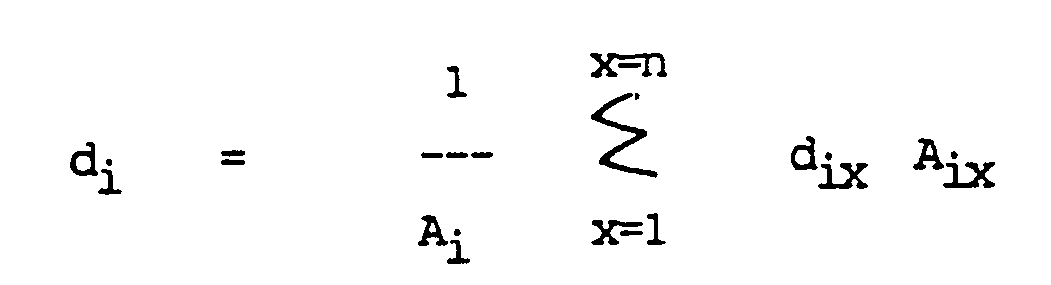
where Aix is the minimum cross sectional area of the xth inlet at entry to the cyclone separator in a plane parallel to the axis of the cyclone separator, and where
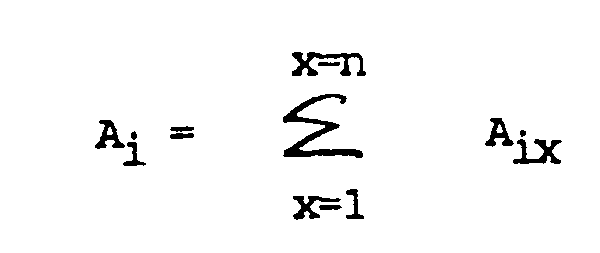
and where d₂ is the diameter of the primary portion measured at a point z₂ where the condition first applies that
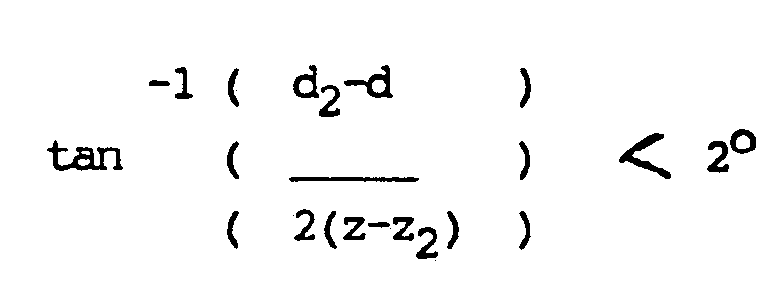
for all z > z₂ where z is the distance along the cyclone separator axis downstream of the place containing the inlet and d is the diameter of the cyclone at z, and further z=O being the axial position of the weighted areas of the inlets such that the injection of angular momentum into the cyclone separator is equally distributed axially about said axial position where z=O and being defined by
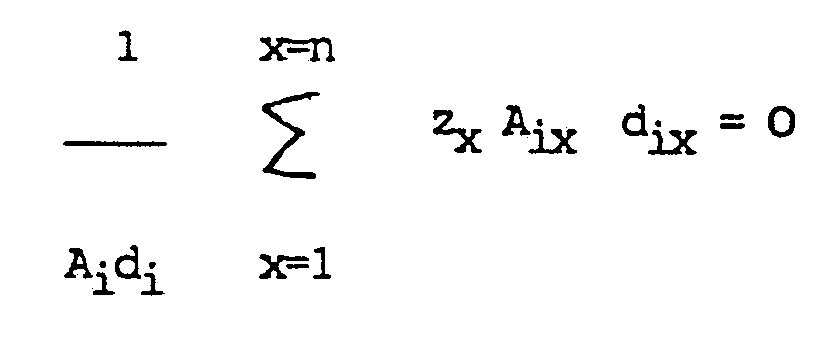
where zx is the axial position of the xth inlet, and further
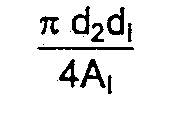
is from 3 to 12.
where d₁ is the diameter of the said primary portion where flow enters (but neglecting the feed channel), dix is twice the radius at which flow enters the cyclone through the xth inlet (i.e. twice the minimum distance of the tangential component of the inlet centre line from the axes) and
where Aix is the minimum cross sectional area of the xth inlet at entry to the cyclone separator in a plane parallel to the axis of the cyclone separator, and where
and where d₂ is the diameter of the primary portion measured at a point z₂ where the condition first applies that
for all z > z₂ where z is the distance along the cyclone separator axis downstream of the place containing the inlet and d is the diameter of the cyclone at z, and further z=O being the axial position of the weighted areas of the inlets such that the injection of angular momentum into the cyclone separator is equally distributed axially about said axial position where z=O and being defined by
where zx is the axial position of the xth inlet, and further
is from 3 to 12.
2. A cyclone separator according to claim 1 wherein
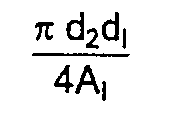
is from 4 to 10
is from 4 to 10
3. A cyclone separator according to claim 1 wherein
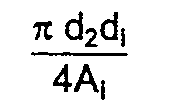
is from 6 to 8
is from 6 to 8
4. A cyclone separator according to claim 1, further including a generally axially
symmetrical secondary portion at said second end and substantially coaxial with said
primary portion and wherein d/d₃ > 0.98 for all z > z₃, where d₃ is the diameter of
the end of the secondary portion remote from said primary portion.
5. A cyclone separator according to claim 4 further including a tertiary portion substantially
coaxial with said secondary portion and at the end of said secondary portion remote
from said primary portion.
6. A cyclone separator according to claim 4 or claim 5 wherein 20′ < α <2° where α
is the half angle of convergence of the secondary portion; i.e.
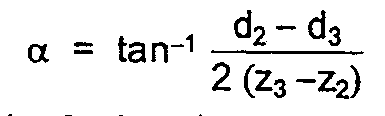
7. A cyclone separator according to claim 6 wherein α is form 30′ to 52′.
8. A cyclone separator according to any one of claims 1 to 7 wherein d₂ < 0.9di.
9. A cyclone separator according to any one of claims 4 to 8 wherein d₃ < 0.9d₂.
10. A cyclone separator according to claim 9 wherein d₃/d₂ is from 0. 25 to 0. 75.
11. A cyclone separator according to any one of claims 1 to 10 wherein the inlets
give into an inwardly sprialling feed channel.
12. A cyclone separator according to any one of claims 1 to 11 wherein the inlets
enter the cyclone with a component in the axial downstream direction.
13. A cyclone separator according to any one of claims 1 to 12 wherein one of said
outlets is an overflow outlet at said first said primary portion.
14. A cyclone separator according to any one of claims 1 to 13 wherein do/d₂<0.2 where do is the diameter of said overflow outlets.
15. A cyclone separator according to claim 14 wherein do/d₂ is from 0.008 to 0.1.
1. Zyklonabscheidevorrichtung mit wenigstens einem ersten Teil, der im allgemeinen
die Form eines Umdrehungsvolumens hat, und ein erstes Ende und ein zweites Ende hat,
wobei der Durchmesser bei dem zweiten Ende kleiner ist als bei dem ersten Ende, einer
Vielzahl von n Einlässen, wobei n > 1, und zwar bei oder benachbart dem ersten Ende,
um eine zu trennende Beschickung in die Zyklonabscheidevorrichtung einzuführen, wobei
die Einlässe axial gegeneinander versetzt und nach innen spiralförmig sind und die
Abscheidevorrichtung ferner einen Überfluß-Auslaß und einen Unterfluß-Auslaß aufweist,
wobei die Zyklonabscheidevorrichtung die folgende Beziehung erfüllt:
wobei d₁ der Durchmesser des ersten Teils ist, wo der Fluß eintritt (unter Vernachlässigung des Beschickungskanals), dix der doppelte Radius ist, bei dem der Fluß den Zyklon durch den x-ten Einlaß erreicht (d.h. der doppelte minimale Abstand der tangentialen Komponente der Einlaß-Mittellinie von den Achsen) und
wobei Aix die minimale Querschnittsfläche des x-ten Einlaß am Eingang zu der Zyklonabscheidevorrichtung in einer Ebene ist, die parallel zur Achse der Zyklonabscheidevorrichtung ist, und wobei
und wobei d₂ der Durchmesser des ersten Teils ist, gemessen an dem Punkt z₂, wo die erste Bedingung erfüllt ist, daß
für alle z > z₂, wobei z der Abstand längs der Zyklonabscheidevorrichtungs-Achse abwärts von der Ebene ist, die den Einlaß enthält, und d der Durchmesser des Zyklons bei z ist, und ferner z = 0 die axiale Position der gewichteten Flächen der Einlässe dergestalt ist, daß die Injektion des Drehimpulses in die Zykonabscheidevorrichtung gleichmäßig axial um die axiale Position verteilt wird, bei der z = 0 ist und die definiert ist durch
wobei zx die axiale Position bei dem x-ten Einlaß ist, und ferner
von 3 bis 12 vorliegt.
wobei d₁ der Durchmesser des ersten Teils ist, wo der Fluß eintritt (unter Vernachlässigung des Beschickungskanals), dix der doppelte Radius ist, bei dem der Fluß den Zyklon durch den x-ten Einlaß erreicht (d.h. der doppelte minimale Abstand der tangentialen Komponente der Einlaß-Mittellinie von den Achsen) und
wobei Aix die minimale Querschnittsfläche des x-ten Einlaß am Eingang zu der Zyklonabscheidevorrichtung in einer Ebene ist, die parallel zur Achse der Zyklonabscheidevorrichtung ist, und wobei
und wobei d₂ der Durchmesser des ersten Teils ist, gemessen an dem Punkt z₂, wo die erste Bedingung erfüllt ist, daß
für alle z > z₂, wobei z der Abstand längs der Zyklonabscheidevorrichtungs-Achse abwärts von der Ebene ist, die den Einlaß enthält, und d der Durchmesser des Zyklons bei z ist, und ferner z = 0 die axiale Position der gewichteten Flächen der Einlässe dergestalt ist, daß die Injektion des Drehimpulses in die Zykonabscheidevorrichtung gleichmäßig axial um die axiale Position verteilt wird, bei der z = 0 ist und die definiert ist durch
wobei zx die axiale Position bei dem x-ten Einlaß ist, und ferner
von 3 bis 12 vorliegt.
2. Zyklonabscheidevorrichtung nach Anspruch 1, wobei
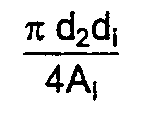
von 4 bis 10 vorliegt.
von 4 bis 10 vorliegt.
3. Zyklonabscheidevorrichtung nach Anspruch 1, wobei
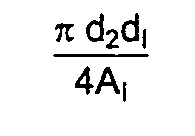
von 6 bis 8 vorliegt.
von 6 bis 8 vorliegt.
4. Zyklonabscheidvorrichtung nach Anspruch 1, die ferner einen allgemeinen axialsymmetrischen
zweiten Teil aufweist, und zwar bei dem zweiten Ende, der im wesentlichen koaxial
zu dem ersten Teil ist, und wobei d/d₃ > 0.98 für alle z > z₃, wobei d₃ der Durchmesser
des Endes des zweiten Teils ist, der von dem ersten Teil entfernt ist.
5. Zyklonabscheidevorrichtung nach Anspruch 4, die ferner einen dritten Teil aufweist,
der im wesentlichen koaxial mit dem zweiten Teil ist und an dem Ende des zweiten Teils
vorliegt, der entfernt ist von dem ersten Teil.
6. Zyklonabscheidevorrichtung nach Anspruch 4 oder 5, wobei 20′ < α < 2°, wobei α
der halbe Winkel der Konvergenz des zweiten Teils ist; d.h.
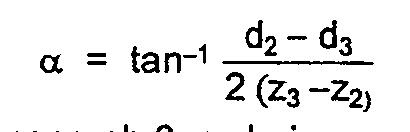
7. Zyklonabscheidevorrichtung nach Anspruch 6, wobei α von 30′ bis 52′ ist.
8. Zyklonabscheidevorrichtung nach einem der Ansprüche 1 bis 7, wobei d₂ < 0.9 di.
9. Zyklonabscheidevorrichtung nach einem der Ansprüche 4 bis 8, wobei d₃ < 0.9 d₂.
10. Zyklonabscheidevorrichtung nach Anspruch 9, wobei d₃/d₂ von 0,25 bis 0,75 ist.
11. Zyklonabscheidevorrichtung nach einem der Ansprüche 1 bis 10, wobei die Einlässe
sich in einen nach innen spiralförmigen Beschickungskanal öffnen.
12. Zyklonabscheidevorrichtung nach einem der Ansprüche 1 bis 11, wobei die Einlässe
das Zyklon mit einer Komponente in der axialen Abwärtsrichtung erreichen.
13. Zyklonabscheidvorrichtung nach einem der Ansprüche 1 bis 12, wobei einer der Auslässe
ein Überfluß-Auslaß an dem ersten Erstteil ist.
14. Zyklonabscheidevorrichtung nach einem der Ansprüche 1 bis 13, wobei d₀/d₂ < 0.2
wobei d₀ der Durchmesser der Überfluß-Auslässe ist.
15. Zyklonabscheidevorrichtung nach Anspruch 14, wobei d₀/d₂ von 0,008 bis 0,1 ist.
1. Séparateur à cyclone comprenant au moins une partie primaire ayant de façon générale
la forme d'un volume de révolution et ayant une première extrémité et une seconde
extrémité, le diamètre à la seconde extrémité étant inférieur à celui de la première
extrémité, un nombre n d'entrées, tel que n>1, placées à la première extrémité ou
près de celle-ci pour l'introduction de la matière qui doit être séparée dans le séparateur
à cyclone, les entrées étant décalées axialement et formant une spirale vers l'intérieur,
et le séparateur comprenant en outre une sortie d'écoulement par-dessus et une sortie
d'écoulement par-dessous, le séparateur à cyclone étant tel que les relations suivantes
s'appliquent :
si d₁ est le diamètre de la partie primaire par laquelle pénètre le courant (le canal d'alimentation étant négligé), dix le double du rayon auquel pénètre le courant dans le cyclone par la xième entrée (c'est-à-dire deux fois la distance minimale de la composante tangentielle de l'axe central d'entrée par rapport aux axes)

Aix étant la section minimale de la xième entrée à l'entrée du séparateur à cyclone dans un plan parallèle à l'axe du séparateur à cyclone, et si
et si d₂ est le diamètre de la partie primaire mesuré à un point z₂ auquel la condition suivante s'applique d'abord

pour tout z>z₂, z étant la distance le long de l'axe du séparateur à cyclone en aval du plan contenant l'entrée et d étant le diamètre du cyclone pour z, et en outre z=0 étant la position axiale des sections pondérées des entrées si bien que l'injection d'un moment angulaire dans le séparateur à cyclone est régulièrement distribuée axialement autour de la position axiale pour laquelle z=0 et étant définie par la relation :

zx étant la position axiale de la xième entrée, et en outre :
est compris entre 3 et 12.
si d₁ est le diamètre de la partie primaire par laquelle pénètre le courant (le canal d'alimentation étant négligé), dix le double du rayon auquel pénètre le courant dans le cyclone par la xième entrée (c'est-à-dire deux fois la distance minimale de la composante tangentielle de l'axe central d'entrée par rapport aux axes)
Aix étant la section minimale de la xième entrée à l'entrée du séparateur à cyclone dans un plan parallèle à l'axe du séparateur à cyclone, et si
et si d₂ est le diamètre de la partie primaire mesuré à un point z₂ auquel la condition suivante s'applique d'abord
pour tout z>z₂, z étant la distance le long de l'axe du séparateur à cyclone en aval du plan contenant l'entrée et d étant le diamètre du cyclone pour z, et en outre z=0 étant la position axiale des sections pondérées des entrées si bien que l'injection d'un moment angulaire dans le séparateur à cyclone est régulièrement distribuée axialement autour de la position axiale pour laquelle z=0 et étant définie par la relation :
zx étant la position axiale de la xième entrée, et en outre :
est compris entre 3 et 12.
2. Séparateur à cyclone selon la revendication 1, dans lequel
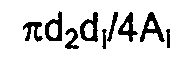
est compris entre 4 et 10.
est compris entre 4 et 10.
3. Séparateur à cyclone selon la revendication 1, dans lequel
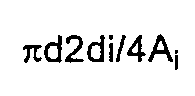
est compris entre 6 et 8.
est compris entre 6 et 8.
4. Séparateur à cyclone selon la revendication 1, comprenant en outre une partie secondaire
à symétrie axiale de façon générale, à la seconde extrémité, cette partie étant sensiblement
coaxiale à la partie primaire, et en outre d/d₃>0,98 pour toute valeur z>z₃, d₃ étant
le diamètre de l'extrémité de la partie secondaire distante de la partie primaire.
5. Séparateur à cyclone selon la revendication 4, comprenant en outre une partie tertiaire
sensiblement coaxiale à la partie secondaire et placée à l'extrémité de la partie
secondaire qui est distante de la partie primaire.
6. Séparateur à cyclone selon la revendication 4 ou 5, dans laquelle 20′<α<2°, α étant
le demi-angle de convergence de la partie secondaire, c'est-à-dire :

7. Séparateur à cyclone selon la revendication 6, caractérisé en ce que α est compris
entre 30′ et 52′.
8. Séparateur à cyclone selon l'une quelconque des revendications 1 à 7, dans lequel
d₂ < 0,9di.
9. Séparateur à cyclone selon l'une quelconque des revendications 4 à 8, dans lequel
d₃ < 0,9d₂.
10. Séparateur à cyclone selon la revendication 9, dans lequel d₃/d₂ est compris entre
0,25 et 0,75.
11. Séparateur à cyclone selon l'une quelconque des revendications 1 à 10, dans lequel
les entrées débouchent dans un canal d'alimentation formant une spirale dirigée vers
l'intérieur.
12. Séparateur à cyclone selon l'une quelconque des revendications 1 à 11, dans lequel
les entrées pénètrent dans le cyclone avec une composante dans la direction axiale
vers l'aval.
13. Séparateur à cyclone selon l'une quelconque des revendications 1 à 12, dans lequel
l'une des sorties est une sortie d'écoulement par-dessus dans la partie primaire.
14. Séparateur à cyclone selon l'une quelconque des revendications 1 à 13, dans lequel
do/d₂ < 0,2, d₂ étant le diamètre des sorties d'écoulement par-dessus.
15. Séparateur à cyclone selon la revendication 14, dans lequel do/d₂ est compris entre 0,008 et 0,1.