|
(11) | EP 0 268 220 B1 |

| (12) | EUROPEAN PATENT SPECIFICATION |
|
|
| (54) |
Penetration enhancers for transdermal delivery of systemic agents Penetrationsverbesserer für die transdermale Verabreichung von systemisch wirksamen Arzneimitteln Agents améliorant la pénétration pour la délivrance transdermale de médicaments systémiques |
|
|
|||||||||||||||||||||||||||||||
| Note: Within nine months from the publication of the mention of the grant of the European patent, any person may give notice to the European Patent Office of opposition to the European patent granted. Notice of opposition shall be filed in a written reasoned statement. It shall not be deemed to have been filed until the opposition fee has been paid. (Art. 99(1) European Patent Convention). |
[0001] The invention generally relates to an improved method of drug delivery. More particularly, the invention relates to a composition for enhancing the membrane penetration of at least one topically administered systemically active drug in humans and animals.
[0002] For some years, pharmaceutical researchers have sought an effective means of introducing drugs into the bloodstream by applying them to unbroken skin. Among other advantages, such administration can provide a comfortable, convenient, and safe way of giving many drugs now taken orally or infused into veins or injected intramuscularly.
[0003] Using skin as the portal for drug entry offers unique potential, because transdermal delivery permits close control over drug absorption. For example, it avoids factors that can cause unpredictable absorption from the gastrointestinal tract, including: changes in acidity, motility, and food content. It also avoids initial metabolism of the drug by the liver. Thus, controlled drug entry through skin can achieve a high degree of control over blood concentrations of drug.
[0004] Close control over drug concentrations in blood can translate readily into safer and more comfortable treatment. When a drug's adverse effects occur at higher concentrations than its beneficial ones, rate control can maintain the concentrations that evoke only, or principally, the drug's desired actions. This ability to lessen undesired drug actions can greatly reduce the toxicity hazards that now restrict or prevent the use of many valuable agents.
[0005] Transdermal delivery particularly benefits patients with chronic disease. Many such patients have difficulty following regimens requiring several doses daily of medications that repeatedly cause unpleasant symptoms. They find the same drugs much more acceptable when administered in transdermal systems that require application infrequently- in some cases, only once or twice weekly- and that reduce adverse effects.
[0006] Transdermal delivery is feasible for drugs effective in amounts that can pass through the skin area and that are substantially free of localized irritating or allergic effects. While these limitations may exclude some agents, many others remain eligible for transdermal delivery. Moreover, their numbers will expand as pharmaceutical agents of greater potency are developed. Particularly suitable for transdermal delivery are potent drugs with only a narrow spread between their toxic and safe blood concentrations, those having gastrointestinal absorption problems, or those requiring frequent dosing in oral or injectable form.
[0007] Transdermal therapy permits much wider use of natural substances such as hormones. Often the survival times of these substances in the body are so short that they would have to be taken many times daily in ordinary dosage forms. Continuous transdermal delivery provides a practical way of giving them, and one that can mimic the body's own patterns of secretion.
[0008] At present, controlled transdermal therapy appears feasible for many drugs used for a wide variety of ailments including, but not limited to, circulatory problems, hormone deficiency, respiratory ailments, and pain relief.
[0009] Percutaneous administration can have the advantage of permitting continuous administration of drug to the circulation over a prolonged period of time to obtain a uniform delivery rate and blood level of drug. Commencement and termination of drug therapy are initiated by the application and removal of the dosing devices from the skin. Uncertainties of administration through the gastrointestinal tract and the inconvenience of administration by injection are eliminated. Since a high concentration of drug never enters the body, problems of pulse entry are overcome and metabolic half-life is not a factor of controlling importance.
[0010] U.S. Patent Nos. 3,989,815; 3,989,816; 3,991,203; 4,122,170; 4,316,893; 4,415,563; 4,423,040; 4,424,210; and 4,444,762 generally decribe a method for enhancing the topical (as contrasted to the systemic) administration of physiologically active agents by combining such an agent with an effective amount of a penetration enhancer and applying the combination topically to humans or animals, in the form of creams, lotions, gels, etc.
[0011] Penetration enhancers for enhancing systemic administration of therapeutic agents transdermally are cited in U.S. Patent Nos. 4,405,616; 4,562,075; 4,031,894; 3,996,934; and 3,921,636.
[0012] GB-A-2,142,237 discloses pharmaceutical compositions for percutaneous administration comprising a pharmaceutical agent and a percutaneous carrier liquid comprising in certain weight ratios a 10-26 aliphatic monoalcohol and a thioglycerol, lactic acid or ester, cyclic urea, alkyl or acyl urea, alkyl amide and/or pyrrolidone or N-alkyl pyrrolidone.
EP-A-164,998 discloses compositions and methods useful for enhancing the transdermal and transmembrane drug delivery of topical and systemic agents, wherein the compositions and methods comprises the active agent together with an effective amount of certain amides of heterocyclic amines which are penetration enhancers.
[0013] It has been discovered that the penetration enhancers having the structural formula shown below are useful to enhance the transdermal delivery of systemically active agents through the skin or other body membranes of humans and animals directly into the bloodstream.
[0014] The invention therefore provides a composition for enhancing the membrane penetration of at least one topically administered systemically active agent through the skin or mucosal membranes of humans and animals, in a transdermal device or formulation, said composition comprising an effective amount of a membrane penetration enhancer having the structural formula
wherein R¹ and R² are independently selected from the group consisting of alkyl radicals and cycloalkyl radicals, comprising from 1 to 20 carbon atoms, preferably from 2 to 14 carbon atoms and R is selected from the group consisting of alkyl radicals and cycloalkyl radicals comprising from 1 to 30 carbon atoms, preferably from 1 to 20 carbon atoms; provided, however, that the total number of carbon atoms in said compound is 15 or more and the total number of carbon atoms in R¹ and R² is 5 or more.
In a more preferred embodiment of the present invention, R¹ and R² are normal alkyl radicals or cycloalkyl radicals having from 3 to 12 carbon atoms, e.g. n-propyl, n-dodecyl or cyclohexyl radicals, and R is represented by the general formula
wherein n is an integer of from 0 to 19, more preferably from 0 to 12, e.g. n is 0 or 10.
[0015] The compounds useful as membrane penetration-enhancers in the formulations or devices of the instant invention may be made by techniques known in the state of the art. Topical examples of compounds represented by the above structural formula include:
N,N-dipropyloctanamide
N-butyl,-N-dodecylacetamide
N,N-didodecylacetamide
N-cyclohexyl,-N-dodecylacetamide
N,N-di-propyldodecanamide
N,N-dibutyloctadecanamide
N,N-dihexylheptanamide
N,N-dipropyleicosanamide
N,N-dipcopylheneicosanamide
N,N-dipropylpentadecanamide
N,N-dipropylheptadecanamide
N,N-dipropyloctadecanamide
N,N-dipropylnonadecanamide
N,N-dihexyloctanamide
N,N-dipropyltetradecanamide
N,N-dipropyltridecnamide
N,N-dipropylundecanamide
N,N-dipropylnonanamide
N,N-dibutyltetradecanamide
N,N-dipentylheptanamide
N,N-dipentyloctanamide
N,N-dipropylhexadecanamide
N,N-dibutylnonanamide
N,N-dibutyldecanamide
N,N-dibutylundecanamide
N,N-dibutyltridecanamide
N,N-dibutylheptanamide
N,N-dibutyloctanamide
N,N-dihexyloctadecanamide
N,N-dipropyldecanamide
N,N-dibutylhexadecanamide
N,N-dibutyloctadecanamide
Typical systemically active agents which may be delivered transdermally are therapeutic agents which are sufficiently potent such that they can be delivered through the skin or other membrane to the bloodstream in sufficient quantities to produce the desired therapeutic effect. In general, this includes therapeutic agents in all of the major therapeutic areas including, but not limited to, anti-infectives, such as antibiotics and antiviral agents, analgesics and analgesic combinations, anorexics, anthelmintics, antiarthritics, antiasthma agents, anticonvulsants, antidepressants, antidiabetic agents, antidiarrheals, antihistamines, anti-inflammatory agents, antimigraine preparations, antimotion sickness, antinauseants, antineoplastics, antiparkinsonism drugs, antipruritics, antipsychotics, antipyretics, antispasmodics, including gastrointestinal and urinary; anticholinergics, sympathomimetics, xanthine derivatives, cardiovascular preparations including calcium channel blockers, beta-blockers, antiarrhythmics, antihypertensives, diuretics, vasodilators including general, coronary, peripheral and cerebral; central nervous system stimulants, cough and cold preparations, decongestants, diagnostics, hormones, hypnotics, immunosuppressives, muscle relaxants, parasympatholytics, parasympathomimetics, psychostimulants, sedatives and tranquilizers.
[0016] Dosage forms for application to the skin or other membranes of humans and animals include creams, lotions, gels, ointments, suppositories, sprays, aerosols, buccal and sub-lingual tablets and any one of a variety of transdermal devices for use in the continuous administration of systemically active drugs by absorption through the skin, oral mucosa or other membranes. See, for example, one or more of U.S. Patents Nos. 3,598,122; 3,598,123; 3,731,683; 3,742,951; 3,814,097; 3,921,636; 3,972,995; 3,993,072; 3,993,073, 3,996,934; 4,031,894; 4,060,084; 4,069,307; 4,201,211; 4,230,105; 4,292,299 and 4,292,303. U.S. Patent No. 4,077,407 and the foregoing patents also disclose a variety of specific systemically active agents which may also be useful in transdermal delivery.
[0017] Typical inert carriers which may be included in the foregoing dosage forms include conventional formulating materials, such as, for example, water, isopropyl alcohol, gaseous fluorocarbons, ethyl alcohol, polyvinyl pyrrolidone, propylene glycol, fragrances, gel-producing materials such as Carbopol(R), stearyl alcohol, stearic acid, spermaceti, sorbitan monooleate, "Polysorbates", Tweens(R), sorbital, methylcellulose, etc.
[0018] Systemically active agents are used in amounts calculated to achieve and maintain therapeutic blood levels in a human or animal over the period of time desired. These amounts vary with the potency of each systemically active substance; the amount required for the desired therapeutic or other effect; the rate of elimination or breakdown of the substance by the body once it has entered the bloodstream; and the amount of penetration-enhancer in the formulation. In accordance with conventional prudent formulating practices, a dosage near the lower end of the useful range of a particular agent is usually employed initially and the dosage increased or decreased as indicated from the observed response, as in the routine procedure of the physician.
[0019] The amount of penetration enhancer which may be used in the invention varies from 1 to 100 percent although adequate enhancement of penetration is generally found to occur in the range of 1 to 10 percent by weight of the formulation to be delivered.
[0020] The invention is further illustrated by the following examples which are illustrative of a specific mode of practicing the invention and is not intended as limiting the scope of the appended claims.
EXAMPLE 1
[0021] A composition, in the form of a gel, suitable for transdermal delivery of haloperidol, an antidyskinetic or antipsychotic drug, is prepared by mixing the following components in the given concentrations.
| Component | Weight % |
| Haloperidol | 1-5 |
| N,N-di-n-dodecylacetamide | 1-10 |
| Carbopol(R) 934 P (Available from B.F. Goodrich) | 0.5-2 |
| Neutralizing Agent (NaOH) | q.s. |
| Tween-20(R) (Available from Atlas Chemical, a Div. of I.C.I.) | 1-10 |
| Preservative (Sorbic Acid) | q.s. |
| Antioxidant (Ascorbic Acid) | q.s. |
| Chelating Agent (Disodium salt of ethylenediaminetetraacetic acid) | q.s. |
| Deionized Water | q.s. to 100 |
This composition is topically applied to the skin of a human subject and after the passage of a suitable period of time haloperidol is found in the bloodstream of said subject.
Example 2
[0022] When an amine, e.g. triethylamine or triethanolamine, is substituted for NaOH the results are substantially similar, i.e. a topical composition suitable for transdermally delivering haloperidol to the bloodstream is obtained.
Example 3
[0023] When potassium sorbate, or a lower alkyl paraben, e.g. methyl, ethyl, propyl or butyl paraben are substituted for the preservative of the composition of Example 1, the results are substantially similar, i.e. a topical composition suitable for the transdermal delivery of haloperidol to the bloodstream is obtained.
Example 4
[0024] When ascorbyl palmitate, Vitamin E, thioglycerol, thioglycolic acid, sodium formaldehyde sulphoxylate, BHA (1), BHT (2), propyl gallate or sodium metabisulphite are substituted for the antioxidant of the composition formulated in Example 1, the results are substantially similar in that a topical composition suitable for transdermally delivering haloperidol to the bloodstream is obtained.
(1)tert.-butyl-4-methoxyphenol
(2)tert.-butyl-4-methylphenol
Example 5
[0025] The composition of Example 1 is prepared in the form of a sodium alginate gel by mixing the following components in the following given concentrations:
| Component | Weight % |
| Haloperidol | 1-5 |
| N,N-di-n-dodecylacetamide | 1-10 |
| Sodium Alginate | 0.5-5 |
| Calcium Salts | q.s. |
| Tween-20(R) | 1-10 |
| Preservative* | q.s. |
| Antioxidant** | q.s. |
| Chelating Agent*** | q.s. |
| Deionized Water | to 100 |
| *Suitable preservatives are those used in Example 3 as well as sorbic acid. | |
| **Suitable antioxidants are those used in Example 4 including ascorbic acid. | |
| ***The chelating agent is the disodium salt of ethylenediaminetetraacetic acid. |
[0026] This composition when applied topically is found to transdermally deliver haloperidol to the bloodstream of a subject.
Example 6
[0027] The composition of Example 1 is prepared in the form of a hydrophilic cream by mixing the following components.
The oil phase and the water phase is made up separately and then agitated to form an emulsion. (When, as in Example 8, the active ingredient, is other than haloperidol, depending on its lipophilicity, it will be distributed in the oil or water phase.) This hydrophilic cream, when applied topically to the skin of a human, is found to transdermally delivery haloperidol into the bloodstream.
Example 7
[0028] The composition of the instant invention may also be delivered by use of a polymeric matrix. For example, a solid polymer such as cellulose triacetate, polyvinyl acetate, terpolymers and copolymers of vinyl chloride and vinyl acetate, copolymers of polyvinyl alcohol and polyvinyl acetate, and silicon elastomers is imbibed with a liquid having the following components in the given concentrations.
| Component | Weight % |
| Polymer | 5-40 |
| Haloperidol | q.s. |
| N,N-di-n-dodecylacetamide | 0.5-80 |
| Solvent* | 5-90 |
| Surfactant** | 1-10 |
| Preservative*** | q.s. |
| Antioxidant**** | q.s. |
| *Solvents may be the solvents used in Example 6 above. | |
| **The Surfactant may be Tween-20(R), glycerol monostearate or sodium laurylsulphate. | |
| ***The preservative may be any of the preservatives used in Example 3 above. | |
| ****The antioxidants may be any of those used in Example 4 above. |
When a solid matrix containing the active ingredients formulated above is contacted with the skin of a human subject, after a period of time the active agent is found in the bloodstream of said subject.
Example 8
[0029] Examples 1 to 7 are repeated except that the following active ingredients in the given concentrations are substituted for haloperidol:
| Active Ingredient | Weight % |
| Isosorbide Dinitrate | 5-15 |
| Nitroglycerin | 1-5 |
| Estradiol | 1-5 |
| Clonidine | 0.5-3 |
| Propranolol | 1-5 |
| Indomethacine | 5-15 |
| Nifedipine | 1-5 |
| Nicardipine | 1-5 |
| Diclorofenac | 5-15 |
| Metaproterenol | 1-5 |
Similar results are obtained in that the active ingredient is transdermally delivered to the bloodstream of an animal.
Example 9
Claims for the following Contracting State(s): BE, CH, DE, FR, GB, IT, LI, LU, NL,
SE
1. A composition for enhancing the membrane penetration of at least one topically administered
systemically active agent, especially of a therapeutic agent, through the skin or
mucosal membranes of humans and animals in a transdermal device or formulation, said
composition comprising an effective amount of a membrane penetration enhancer having
the structural formula
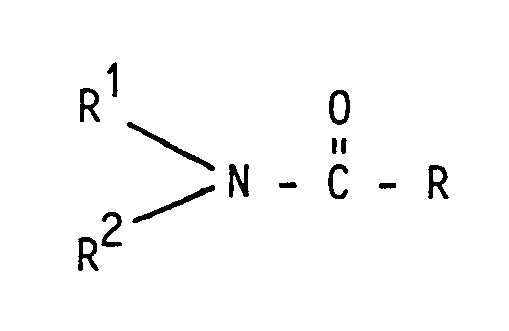
wherein R¹ and R² are independently selected from alkyl and cycloalkyl radicals comprising from 1 to 20 carbon atoms and R is selected from alkyl and cycloalkyl radicals comprising from 1 to 30 carbon atoms; provided, however, that the total number of carbon atoms in said compound is 15 or more and the total number of carbon atoms in R¹ and R² is 5 or more.
wherein R¹ and R² are independently selected from alkyl and cycloalkyl radicals comprising from 1 to 20 carbon atoms and R is selected from alkyl and cycloalkyl radicals comprising from 1 to 30 carbon atoms; provided, however, that the total number of carbon atoms in said compound is 15 or more and the total number of carbon atoms in R¹ and R² is 5 or more.
2. The composition of claim 1 wherein R¹ and R² are normal alkyl radicals or cycloalkyl
radicals having from 3 to 12 carbon atoms.
3. The composition of claim 2 wherein R is represented by the general formula -(-CH₂)nCH₃ wherein n is an integer of from 0 to 19.
4. The composition of claim 3 wherein n is 0 or 10.
5. The composition of claim 1 wherein the membrane penetration enhancer is selected from
N-n-butyl, N-n-dodecylacetamide, N,N-di-n-dodecylacetamide, N-cycloheptyl, -N-n-dodecylacetamide
and N,N-n-di-n-propyldodecanamide.
6. The composition of any of the preceding claims wherein the systemically active agent
is selected from haloperidol, isosorbide dinitrate, nitroglycerine, estradiol, clonidine,
propranolol, indomethacin, nifedipine, nicardipine, diclorofenac and metaproterenol.
Claims for the following Contracting State(s): ES, GR
1. A process for preparing a composition for enhancing the membrane penetration of at
least one topically administered systemically active agent, especially of a therapeutic
agent, through the skin or mucosal membranes of humans and animals in a transdermal
device or formulation comprising mixing an effective amount of a membrane penetration
enhancer having the structural formula
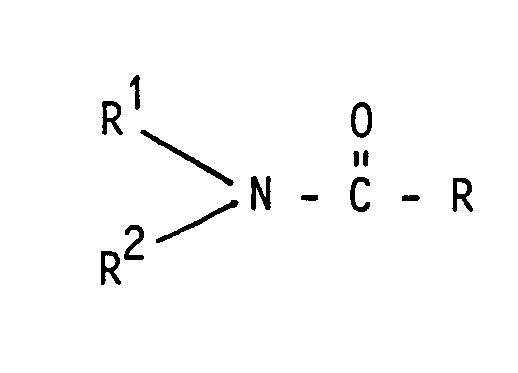
wherein R¹ and R² are independently selected from alkyl and cycloalkyl radicals comprising from 1 to 20 carbon atoms and R is selected from alkyl and cycloalkyl radicals comprising from 1 to 30 carbon atoms; provided, however, that the total number of carbon atoms in said compound is 15 or more and the total number of carbon atoms in R¹ and R² is 5 or more with at least one systemically active agent.
wherein R¹ and R² are independently selected from alkyl and cycloalkyl radicals comprising from 1 to 20 carbon atoms and R is selected from alkyl and cycloalkyl radicals comprising from 1 to 30 carbon atoms; provided, however, that the total number of carbon atoms in said compound is 15 or more and the total number of carbon atoms in R¹ and R² is 5 or more with at least one systemically active agent.
2. A process according to claim 1 wherein in the penetration enhancer R¹ and R² are normal
alkyl radicals or cycloalkyl radicals having from 3 to 12 carbon atoms.
3. A process according to claim 2 wherein in the penetration enhancer R is represented
by the general formula -(-CH₂)nCH₃ wherein n is an integer of from 0 to 19.
4. A process according to claim 3 wherein in the general formula n is 0 or 10.
5. A process according to claim 1 wherein the membrane penetration enhancer is selected
from N-n-butyl, N-n-dodecylacetamide, N,N-di-n-dodecylacetamide, N-cycloheptyl, -N-n-dodecylacetamide
and N,N-n-di-n-propyldodecanamide.
6. A process according to any of the preceding claims wherein the systemically active
agent is selected from haloperidol, isosorbide dinitrate, nitroglycerine, estradiol,
clonidine, propranolol, indomethacin, nifedipine, nicardipine, diclorofenac and metaproterenol.
Claims for the following Contracting State(s): AT
1. A composition for enhancing the membrane penetration of at least one topically administered
systemically active agent, especially of a therapeutic agent, through the skin or
mucosal membranes of humans and animals in a transdermal device or formulation, said
composition comprising an effective amount of a membrane penetration enhancer having
the structural formula
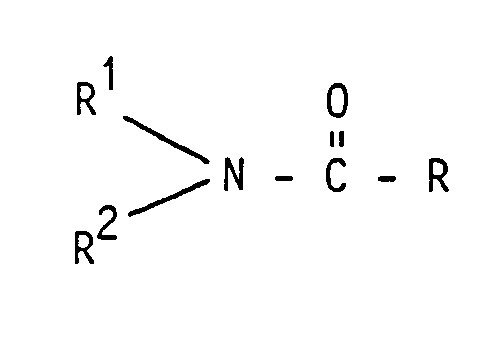
wherein R¹ and R² are independently selected from alkyl and cycloalkyl radicals comprising from 1 to 20 carbon atoms and R is selected from alkyl and cycloalkyl radicals comprising from 1 to 30 carbon atoms; provided, however, that the total number of carbon atoms in said compound is 15 or more and the total number of carbon atoms in R¹ and R² is 5 or more.
wherein R¹ and R² are independently selected from alkyl and cycloalkyl radicals comprising from 1 to 20 carbon atoms and R is selected from alkyl and cycloalkyl radicals comprising from 1 to 30 carbon atoms; provided, however, that the total number of carbon atoms in said compound is 15 or more and the total number of carbon atoms in R¹ and R² is 5 or more.
2. The composition of claim 1 wherein R¹ and R² are normal alkyl radicals or cycloalkyl
radicals having from 3 to 12 carbon atoms.
3. The composition of claim 2 wherein R is represented by the general formula -(-CH₂)nCH₃ wherein n is an integer of from 0 to 19.
4. The composition of claim 3 wherein n is 0 or 10.
5. The composition of claim 1 wherein the membrane penetration enhancer is selected from
N-n-butyl, N-n-dodecylacetamide, N,N-di-n-dodecylacetamide, N-cycloheptyl, -N-n-dodecylacetamide
and N,N-n-di-n-propyldodecanamide.
6. The composition of any of the preceding claims wherein the systemically active agent
is selected from haloperidol, isosorbide dinitrate, nitroglycerine, estradiol, clonidine,
propranolol, indomethacin, nifedipine, nicardipine, diclorofenac and metaproterenol.
7. A process for preparing a composition for enhancing the membrane penetration of at
least one topically administered systemically active agent, especially of a therapeutic
agent, through the skin or mucosal membranes of humans and animals in a transdermal
device or formulation comprising mixing an effective amount of a membrane penetration
enhancer having the structural formula
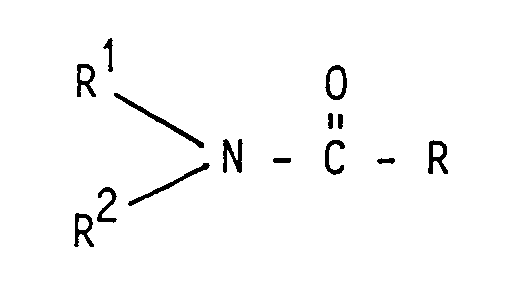
wherein R¹ and R² are independently selected from alkyl and cycloalkyl radicals comprising from 1 to 20 carbon atoms and R is selected from alkyl and cycloalkyl radicals comprising from 1 to 30 carbon atoms; provided; however, that the total number of carbon atoms in said compound is 15 or more and the total number of carbon atoms in R¹ and R² is 5 or more with at least one systemically active agent.
wherein R¹ and R² are independently selected from alkyl and cycloalkyl radicals comprising from 1 to 20 carbon atoms and R is selected from alkyl and cycloalkyl radicals comprising from 1 to 30 carbon atoms; provided; however, that the total number of carbon atoms in said compound is 15 or more and the total number of carbon atoms in R¹ and R² is 5 or more with at least one systemically active agent.
8. A process according to claim 7 wherein in the penetration enhancer R¹ and R² are normal
alkyl radicals or cycloalkyl radicals having from 3 to 12 carbon atoms.
9. A process according to claim 8 wherein in the penetration enhancer R is represented
by the general formula -(-CH₂)nCH₃ wherein n is an integer of from 0 to 19.
10. A process according to claim 9 wherein in the general formula n is 0 or 10.
11. A process according to claim 7 wherein the membrane penetration enhancer is selected
from of N-n-butyl, N-n-dodecylacetamide, N,N-di-n-dodecylacetamide, N-cycloheptyl,
-N-n-dodecylacetamide and N,N-n-di-n-propyldodecanamide.
12. A process according to any of the claims 7 - 11 wherein the systemically active agent
is selected from haloperidol, isosorbide dinitrate, nitroglycerine, estradiol, clonidine,
propranolol, indomethacin, nifedipine, nicardipine, diclorofenac and metaproterenol.
Revendications pour l'(les) Etat(s) contractant(s) suivant(s): BE, CH, DE, FR, GB,
IT, LI, LU, NL, SE
1. Composition pour améliorer la pénétration membraneuse d'au moins un agent à action
systémique administré topiquement, en particulier d'un agent thérapeutique, à travers
la peau ou les muqueuses de l'être humain et des animaux dans un dispositif ou une
formulation transdermique, cette composition comprenant une quantité efficace d'un
agent améliorant la pénétration membraneuse répondant à la formule structurale :
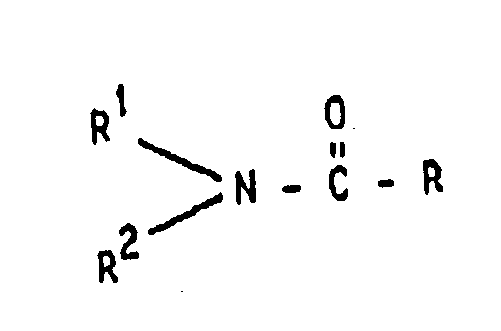
dans laquelle R¹ et R² sont choisis indépendamment parmi les radicaux alkyle et cycloalkyle comprenant de 1 à 20 atomes de carbone et R est choisi parmi les radicaux alkyle et cycloalkyle comprenant de 1 à 30 atomes de carbone, pour autant, toutefois, que le nombre total d'atomes de carbone dans le composé précité soit de 15 ou plus et le nombre total d'atomes de carbone dans R¹ et R² soit de 5 ou plus.
dans laquelle R¹ et R² sont choisis indépendamment parmi les radicaux alkyle et cycloalkyle comprenant de 1 à 20 atomes de carbone et R est choisi parmi les radicaux alkyle et cycloalkyle comprenant de 1 à 30 atomes de carbone, pour autant, toutefois, que le nombre total d'atomes de carbone dans le composé précité soit de 15 ou plus et le nombre total d'atomes de carbone dans R¹ et R² soit de 5 ou plus.
2. Composition suivant la revendication 1, caractérisée en ce que R¹ et R² sont des radicaux
alkyle normaux ou des radicaux cycloalkyle comportant de 3 à 12 atomes de carbone.
3. Composition suivant la revendication 2, caractérisée en ce que R est représenté par
la formule générale -(-CH₂)nCH₃, dans laquelle n est un nombre entier de 0 à 19.
4. Composition suivant la revendication 3, caractérisée en ce que n est égal à 0 ou 10.
5. Composition suivant la revendication 1, caractérisée en ce que l'agent améliorant
la pénétration membraneuse est choisi parmi les N-n-butyl,-N-n-dodécylacétamide, N,N-di-n-dodécylacétamide,
N-cycloheptyl,-N-n-dodécylacétamide et N,N-n-di-n-propyldodécanamide.
6. Composition suivant l'une quelconque des revendications précédentes, caractérisée
en ce que l'agent à action systémique est choisi parmi l'halopéridol, le dinitrate
d'isosorbide, la nitroglycérine, l'oestradiol, la clonidine, le propranolol, l'indométhacine,
la nifédipine, la nicardipine, le diclorofénac et le métaprotérénol.
Revendications pour l'(les) Etat(s) contractant(s) suivant(s): ES, GR
1. Procédé de préparation d'une composition pour améliorer la pénétration membraneuse
d'au moins un agent à action systémique administré topiquement, en particulier d'un
agent thérapeutique, à travers la peau ou les membranes muqueuses de l'être humain
et des animaux dans un dispositif ou une formulation transdermique, comprenant le
mélange d'une quantité efficace d'un agent améliorant la pénétration membraneuse répondant
à la formule structurale :
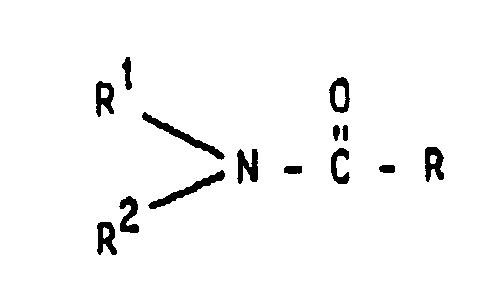
dans laquelle R¹ et R² sont choisis indépendamment parmi les radicaux alkyle et cycloalkyle comprenant de 1 à 20 atomes de carbone et R est choisi parmi les radicaux alkyle et cycloalkyle comprenant de 1 à 30 atomes de carbone, pour autant, toutefois, que le nombre total d'atomes de carbone dans le composé précité soit de 15 ou plus et le nombre total d'atomes de carbone dans R¹ et R² soit de 5 ou plus, avec au moins un agent à action systémique.
dans laquelle R¹ et R² sont choisis indépendamment parmi les radicaux alkyle et cycloalkyle comprenant de 1 à 20 atomes de carbone et R est choisi parmi les radicaux alkyle et cycloalkyle comprenant de 1 à 30 atomes de carbone, pour autant, toutefois, que le nombre total d'atomes de carbone dans le composé précité soit de 15 ou plus et le nombre total d'atomes de carbone dans R¹ et R² soit de 5 ou plus, avec au moins un agent à action systémique.
2. Procédé suivant la revendication 1, caractérisé en ce que dans l'agent améliorant
la pénétration R¹ et R² sont des radicaux alkyle normaux ou des radicaux cycloalkyle
comportant de 3 à 12 atomes de carbone.
3. Procédé suivant la revendication 2, caractérisé en ce que dans l'agent améliorant
la pénétration R est représenté par la formule générale -(-CH₂)nCH₃, dans laquelle n est un nombre entier de 0 à 19.
4. Procédé suivant la revendication 3, caractérisé en ce que dans la formule générale
n est égal à 0 ou 10.
5. Procédé suivant la revendication 1, caractérisé en ce que l'agent améliorant la pénétration
membraneuse est choisi parmi les N-n-butyl, -N-n-dodécylacétamide, N,N-di-n-dodécylacétamide,
N-cycloheptyl, -N-n-dodécylacétamide et N,N-n-di-n-propyldodécanamide.
6. Procédé suivant l'une quelconque des revendications précédentes, caractérisé en ce
que l'agent à action systémique est choisi parmi l'halopéridol, le dinitrate d'isosorbide,
la nitroglycérine, l'oestradiol, la clonidine, le propranolol, l'indométhacine, la
nifédipine, la nicardipine, le diclorofénac et le métaprotérénol.
Revendications pour l'(les) Etat(s) contractant(s) suivant(s): AT
1. Composition pour améliorer la pénétration membraneuse d'au moins un agent à action
systémique administré topiquement, en particulier d'un agent thérapeutique, à travers
la peau ou les muqueuses de l'être humain et des animaux dans un dispositif ou une
formulation transdermique, cette composition comprenant une quantité efficace d'un
agent améliorant la pénétration membraneuse répondant à la formule structurale :

dans laquelle R¹ et R² sont choisis indépendamment parmi les radicaux alkyle et cycloalkyle comprenant de 1 à 20 atomes de carbone et R est choisi parmi les radicaux alkyle et cycloalkyle comprenant de 1 à 30 atomes de carbone, pour autant, toutefois, que le nombre total d'atomes de carbone dans le composé précité soit de 15 ou plus et le nombre total d'atomes de carbone dans R¹ et R² soit de 5 ou plus.
dans laquelle R¹ et R² sont choisis indépendamment parmi les radicaux alkyle et cycloalkyle comprenant de 1 à 20 atomes de carbone et R est choisi parmi les radicaux alkyle et cycloalkyle comprenant de 1 à 30 atomes de carbone, pour autant, toutefois, que le nombre total d'atomes de carbone dans le composé précité soit de 15 ou plus et le nombre total d'atomes de carbone dans R¹ et R² soit de 5 ou plus.
2. Composition suivant la revendication 1, caractérisée en ce que R¹ et R² sont des radicaux
alkyle normaux ou des radicaux cycloalkyle comportant de 3 à 12 atomes de carbone.
3. Composition suivant la revendication 2, caractérisée en ce que R est représenté par
la formule générale -(-CH₂)nCH₃, dans laquelle n est un nombre entier de 0 à 19.
4. Composition suivant la revendication 3, caractérisée en ce que n est égal à 0 ou 10.
5. Composition suivant la revendication 1, caractérisée en ce que l'agent améliorant
la pénétration membraneuse est choisi parmi les N-n-butyl,-N-n-dodécylacétamide, N,N-di-n-dodécylacétamide,
N-cycloheptyl,-N-n-dodécylacétamide et N,N-n-di-n-propyldodécanamide.
6. Composition suivant l'une quelconque des revendications précédentes, caractérisée
en ce que l'agent à action systémique est choisi parmi l'halopéridol, le dinitrate
d'isosorbide, la nitroglycérine, l'oestradiol, la clonidine, le propranolol, l'indométhacine,
la nifédipine, la nicardipine, le diclorofénac et le métaprotérénol.
7. Procédé de préparation d'une composition pour améliorer la pénétration membraneuse
d'au moins un agent à action systémique administré topiquement, en particulier d'un
agent thérapeutique, à travers la peau ou les membranes muqueuses de l'être humain
et des animaux dans un dispositif ou une formulation transdermique, comprenant le
mélange d'une quantité efficace d'un agent améliorant la pénétration membraneuse repondant
à la formule structurale :
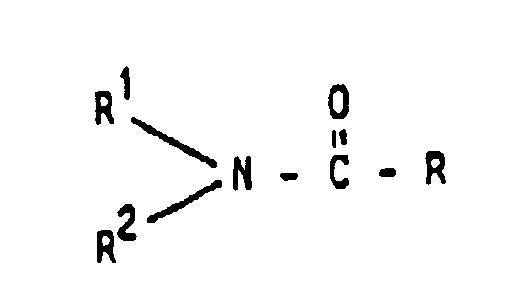
dans laquelle R¹ et R² sont choisis indépendamment parmi les radicaux alkyle et cycloalkyle comprenant de 1 à 20 atomes de carbone et R est choisi parmi les radicaux alkyle et cycloalkyle comprenant de 1 à 30 atomes de carbone, pour autant, toutefois, que le nombre total d'atomes de carbone dans le composé précité soit de 15 ou plus et le nombre total d'atomes de carbone dans R¹ et R² soit de 5 ou plus, avec au moins un agent à action systémique.
dans laquelle R¹ et R² sont choisis indépendamment parmi les radicaux alkyle et cycloalkyle comprenant de 1 à 20 atomes de carbone et R est choisi parmi les radicaux alkyle et cycloalkyle comprenant de 1 à 30 atomes de carbone, pour autant, toutefois, que le nombre total d'atomes de carbone dans le composé précité soit de 15 ou plus et le nombre total d'atomes de carbone dans R¹ et R² soit de 5 ou plus, avec au moins un agent à action systémique.
8. Procédé suivant la revendication 7, caractérisé en ce que dans l'agent améliorant
la pénétration R¹ et R² sont des radicaux alkyle normaux ou des radicaux cycloalkyle
comportant de 3 à 12 atomes de carbone.
9. Procédé suivant la revendication 8, caractérisé en ce que dans l'agent améliorant
la pénétration R est représenté par la formule générale -(-CH₂)nCH₃, dans laquelle n est un nombre entier de 0 à 19.
10. Procédé suivant la revendication 9, caractérisé en ce que dans la formule générale
n est égal à 0 ou 10.
11. Procédé suivant la revendication 7, caractérisé en ce que l'agent améliorant la pénétration
membraneuse est choisi parmi les N-n-butyl, -N-n-dodécylacétamide, N,N-di-n-dodécylacétamide,
N-cycloheptyl, -N-n-dodécylacétamide et N,N-n-di-n-propyldodécanamide.
12. Procédé suivant l'une quelconque des revendications 7 à 11, caractérisé en ce que
l'agent à action systémique est choisi parmi l'halopéridol, le dinitrate d'isosorbide,
la nitroglycérine, l'oestradiol, la clonidine, le propranolol, l'indométhacine, la
nifédipine, la nicardipine, le diclorofénac et le métaprotérénol.
Patentansprüche für folgende(n) Vertragsstaat(en): BE, CH, DE, FR, GB, IT, LI, LU,
NL, SE
1. Zusammensetzung zur Erhöhung der Membranpenetration von wenigstens einem topisch verabreichten,
systemisch wirksamen Mittel, insbesondere von einem therapeutischen Wirkstoff, durch
die Haut oder Schleimhautmembranen von Menschen und Tieren in einer transdermalen
Vorrichtung oder Formulierung, wobei die Zusammensetzung eine wirksame Menge eines
Membranpenetrations-Verstärkers umfaßt, der die Strukturformel
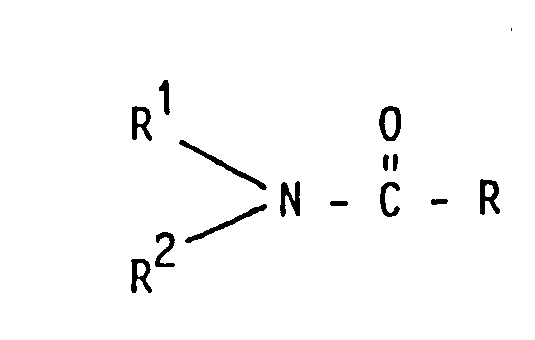
aufweist, worin R¹ und R² unabhängig voneinander aus Alkyl- und Cycloalkylresten mit 1 bis 20 Kohlenstoffatomen ausgewählt sind und R aus Alkyl- und Cycloalkylresten mit 1 bis 30 Kohlenstoffatomen ausgewählt ist, mit der Maßgabe jedoch, daß die Gesamtzahl der Kohlenstoffatome in der Verbindung 15 oder mehr ist und daß die Gesamtzahl der Kohlenstoffatome in R¹ und R² 5 oder mehr ist.
aufweist, worin R¹ und R² unabhängig voneinander aus Alkyl- und Cycloalkylresten mit 1 bis 20 Kohlenstoffatomen ausgewählt sind und R aus Alkyl- und Cycloalkylresten mit 1 bis 30 Kohlenstoffatomen ausgewählt ist, mit der Maßgabe jedoch, daß die Gesamtzahl der Kohlenstoffatome in der Verbindung 15 oder mehr ist und daß die Gesamtzahl der Kohlenstoffatome in R¹ und R² 5 oder mehr ist.
2. Zusammensetzung nach Anspruch 1, worin R¹ und R² Normal-Alkylreste oder Cycloalkylreste
mit 3 bis 12 Kohlenstoffatomen sind.
3. Zusammensetzung nach Anspruch 2, worin R durch die allgemeine Formel -(-CH₂)nCH₃ wiedergegeben wird, worin n eine ganze Zahl von 0 bis 19 ist.
4. Zusammensetzung nach Anspruch 3, worin n 0 oder 10 ist.
5. Zusammensetzung nach Anspruch 1, worin der Membranpenetrations-Verstärker aus N-n-Butyl,
N-n-Dodecylacetamid, N,N-di-n-Dodecylacetamid, N-Cycloheptyl, -N-n-Dodecylacetamid
und N,N-n-di-n-Propyldodecanamid ausgewählt ist.
6. Zusammensetzung nach irgendeinem der vorhergehenden Ansprüche, worin das systemisch
wirksame Mittel aus Haloperidol, Isosorbiddinitrat, Nitroglyzerin, Östradiol, Clonidin,
Propranolol, Indometacin, Nifedipin, Nicardipin, Dichlorfenac und Metaproterenol ausgewählt
ist.
Patentansprüche für folgende(n) Vertragsstaat(en): ES, GR
1. Verfahren zur Herstellung einer Zusammensetzung zur Erhöhung der Membranpenetration
von wenigstens einem topisch verabreichten, systemisch wirksamen Mittel, insbesondere
von einem therapeutischen Wirkstoff, durch die Haut oder Schleimhautmembranen von
Menschen und Tieren in einer transdermalen Vorrichtung oder Formulierung, bei dem
man eine wirksame Menge eines Membranpenetrations-Verstärkers mit der Strukturformel
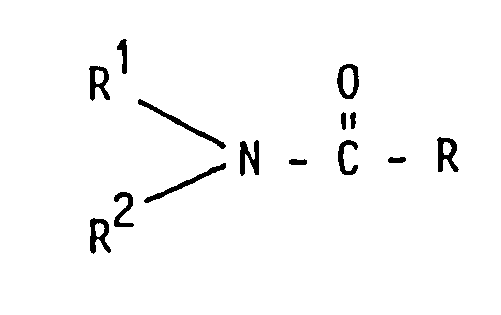
worin R¹ und R² unabhängig voneinander aus Alkyl- und Cycloalkylresten mit 1 bis 20 Kohlenstoffatomen ausgewählt werden und R aus Alkyl- und Cycloalkylresten mit 1 bis 30 Kohlenstoffatomen ausgewählt wird, mit der Maßgabe jedoch, daß die Gesamtzahl der Kohlenstoffatome in der Verbindung 15 oder mehr ist und daß die Gesamtzahl der Kohlenstoffatome in R¹ und R² 5 oder mehr ist, mit mindestens einem systemisch wirksamen Mittel mischt.
worin R¹ und R² unabhängig voneinander aus Alkyl- und Cycloalkylresten mit 1 bis 20 Kohlenstoffatomen ausgewählt werden und R aus Alkyl- und Cycloalkylresten mit 1 bis 30 Kohlenstoffatomen ausgewählt wird, mit der Maßgabe jedoch, daß die Gesamtzahl der Kohlenstoffatome in der Verbindung 15 oder mehr ist und daß die Gesamtzahl der Kohlenstoffatome in R¹ und R² 5 oder mehr ist, mit mindestens einem systemisch wirksamen Mittel mischt.
2. Verfahren nach Anspruch 1, bei dem in dem Penetrations-Verstärker R¹ und R² Normal-Alkylreste
oder Cycloalkylreste mit 3 bis 12 Kohlenstoffatomen sind.
3. Verfahren nach Anspruch 2, bei dem in dem Penetrations-Verstärker R durch die allgemeine
Formel -(-CH₂)nCH₃ wiedergegeben wird, worin n eine ganze Zahl von 0 bis 19 ist.
4. Verfahren nach Anspruch 3, bei dem in der allgemeinen Formel n 0 oder 10 ist.
5. Verfahren nach Anspruch 1, bei dem der Membranpenetrations-Verstärker aus N-n-Butyl,
N-n-Dodecylacetamid, N,N-di-n-Dodecylacetamid, N-Cycloheptyl, -N-n-Dodecylacetamid
und N,N-n-di-n-Propyldodecanamid ausgewählt wird.
6. Verfahren nach irgendeinem der vorhergehenden Ansprüche, worin das systemisch wirksame
Mittel aus Haloperidol, Isosorbiddinitrat, Nitroglyzerin, Östradiol, Clonidin, Propranolol,
Indometacin, Nifedipin, Nicardipin, Dichlorfenac und Metaproterenol ausgewählt wird.
Patentansprüche für folgende(n) Vertragsstaat(en): AT
1. Zusammensetzung zur Erhöhung der Membranpenetration von wenigstens einem topisch verabreichten,
systemisch wirksamen Mittel, insbesondere von einem therapeutischen Wirkstoff, durch
die Haut oder Schleimhautmembranen von Menschen und Tieren in einer transdermalen
Vorrichtung oder Formulierung, wobei die Zusammensetzung eine wirksame Menge eines
Membranpenetrations-Verstärkers umfaßt, der die Strukturformel
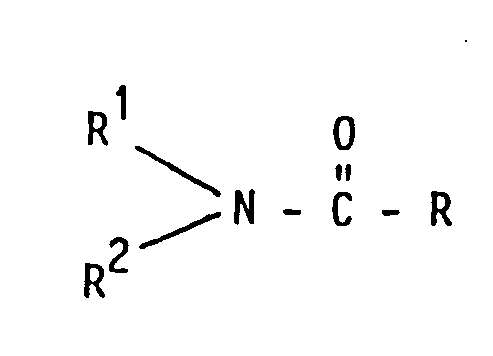
aufweist, worin R¹ und R² unabhängig voneinander aus Alkyl- und Cycloalkylresten mit 1 bis 20 Kohlenstoffatomen ausgewählt sind und R aus Alkyl- und Cycloalkylresten mit 1 bis 30 Kohlenstoffatomen ausgewählt ist, mit der Maßgabe jedoch, daß die Gesamtzahl der Kohlenstoffatome in der Verbindung 15 oder mehr ist und daß die Gesamtzahl der Kohlenstoffatome in R¹ und R² 5 oder mehr ist.
aufweist, worin R¹ und R² unabhängig voneinander aus Alkyl- und Cycloalkylresten mit 1 bis 20 Kohlenstoffatomen ausgewählt sind und R aus Alkyl- und Cycloalkylresten mit 1 bis 30 Kohlenstoffatomen ausgewählt ist, mit der Maßgabe jedoch, daß die Gesamtzahl der Kohlenstoffatome in der Verbindung 15 oder mehr ist und daß die Gesamtzahl der Kohlenstoffatome in R¹ und R² 5 oder mehr ist.
2. Zusammensetzung nach Anspruch 1, worin R¹ und R² Normal-Alkylreste oder Cycloalkylreste
mit 3 bis 12 Kohlenstoffatomen sind.
3. Zusammensetzung nach Anspruch 2, worin R durch die allgemeine Formel -(-CH₂)nCH₃ wiedergegeben wird, worin n eine ganze Zahl von 0 bis 19 ist.
4. Zusammensetzung nach Anspruch 3, worin n 0 oder 10 ist.
5. Zusammensetzung nach Anspruch 1, worin der Membranpenetrations-Verstärker aus N-n-Butyl,
N-n-Dodecylacetamid, N,N-di-n-Dodecylacetamid, N-Cycloheptyl, -N-n-Dodecylacetamid
und N,N-n-di-n-propyldodecanamid ausgewählt ist.
6. Zusammensetzung nach irgendeinem der vorhergehenden Ansprüche, worin das systemisch
wirksame Mittel aus Haloperidol, Isosorbiddinitrat, Nitroglyzerin, Östradiol, Clonidin,
Propranolol, Indometacin, Nifedipin, Nicardipin, Dichlorfenac und Metaproterenol ausgewählt
ist.
7. Verfahren zur Herstellung einer Zusammensetzung zur Erhöhung der Membranpenetration
von wenigstens einem topisch verabreichten, systemisch wirksamen Mittel, insbesondere
von einem therapeutischen Wirkstoff, durch die Haut oder Schleimhautmembranen von
Menschen und Tieren in einer transdermalen Vorrichtung oder Formulierung, bei dem
man eine wirksame Menge eines Membranpenetrations-Verstärkers mit der Strukturformel
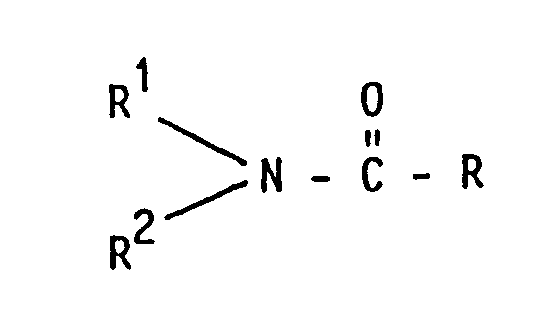
worin R¹ und R² unabhängig voneinander aus Alkyl- und Cycloalkylresten mit 1 bis 20 Kohlenstoffatomen ausgewählt werden und R aus Alkyl- und Cycloalkylresten mit 1 bis 30 Kohlenstoffatomen ausgewählt wird, mit der Maßgabe jedoch, daß die Gesamtzahl der Kohlenstoffatome in der Verbindung 15 oder mehr ist und daß die Gesamtzahl der Kohlenstoffatome in R¹ und R² 5 oder mehr ist, mit mindestens einem systemisch wirksamen Mittel mischt.
worin R¹ und R² unabhängig voneinander aus Alkyl- und Cycloalkylresten mit 1 bis 20 Kohlenstoffatomen ausgewählt werden und R aus Alkyl- und Cycloalkylresten mit 1 bis 30 Kohlenstoffatomen ausgewählt wird, mit der Maßgabe jedoch, daß die Gesamtzahl der Kohlenstoffatome in der Verbindung 15 oder mehr ist und daß die Gesamtzahl der Kohlenstoffatome in R¹ und R² 5 oder mehr ist, mit mindestens einem systemisch wirksamen Mittel mischt.
8. Verfahren nach Anspruch 7, bei dem in dem Penetrations-Verstärker R¹ und R² Normal-Alkylreste
oder Cycloalkylreste mit 3 bis 12 Kohlenstoffatomen sind.
9. Verfahren nach Anspruch 8, bei dem in dem Penetrations-Verstärker R durch die allgemeine
Formel -(-CH₂)nCH₃ wiedergegeben wird, worin n eine ganze Zahl von 0 bis 19 ist.
10. Verfahren nach Anspruch 9, bei dem in der allgemeinen Formel worin n 0 oder 10 ist.
11. Verfahren nach Anspruch 7, bei dem der Membranpenetrations-Verstärker aus N-n-Butyl,
N-n-Dodecylacetamid, N,N-di-n-Dodecylacetamid, N-Cycloheptyl, -N-n-Dodecylacetamid
und N,N-n-di-n-Propyldodecanamid ausgewählt wird.
12. Verfahren nach irgendeinem der Ansprüche 7 bis 11, worin das systemisch wirksame Mittel
aus Haloperidol, Isosorbiddinitrat, Nitroglyzerin, Östradiol, Clonidin, Propranolol,
Indometacin, Nifedipin, Nicardipin, Dichlorfenac und Metaproterenol ausgewählt wird.