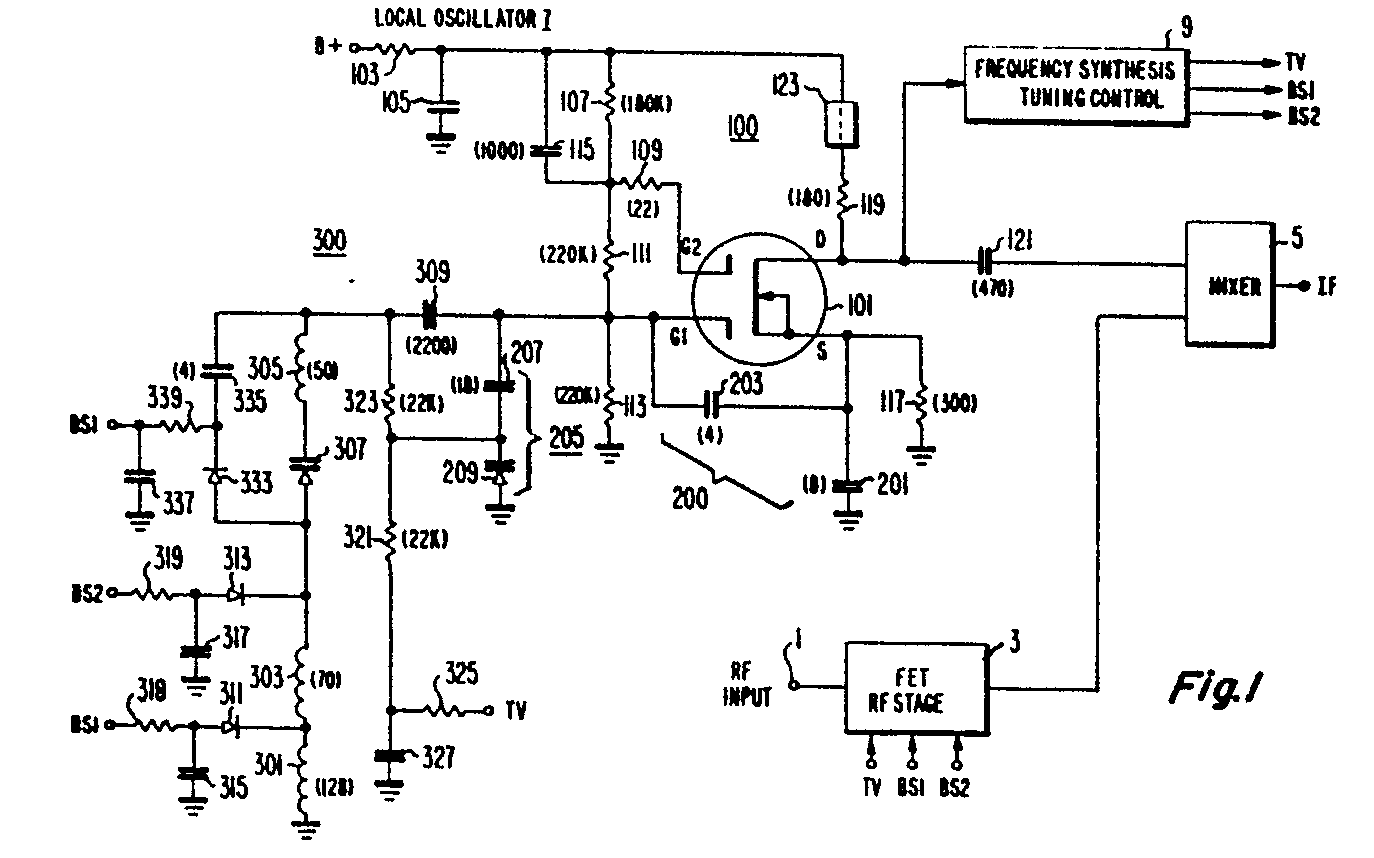
(57) A local oscillator (7), arranged e.g. in a Colpitts type configuration, includes
an amplifying device (101) such as a bipolar transistor or field effect transistor
having a control electrode (G1) (base or gate electrode) which is coupled to a first
electrode (S) (emitter or source electrode), defining one end of a conduction channel,
through an oscillation conditioning network (200) for conditioning the device to oscillate
in a given range, and also to a frequency determining network (300) including a first
varactor diode (307) responsive to the tuning voltage (TV) and an inductance element
(305) coupled in series between the control electrode (G1) and signal ground. The
output is taken at a second electrode (D) (collector or drain) defining the other
end of the conduction channel. A range extending circuit (205) including a second
varactor diode (209) responsive to the tuning voltage is coupled between the control
electrode and signal ground for ensuring that the oscillator operates reliably at
both ends of the tuning range. In an alternative arrangement the frequency determining
network comprises a parallel combination of inductance and first varactor diode, and
the second varactor diode is connected in series between it and the control electrode.
|
|
