|
(11) | EP 0 273 343 B1 |

| (12) | EUROPEAN PATENT SPECIFICATION |
|
|
| (54) |
Monoazo compounds, process for their preparation and their use for dyeing or printing Monoazo-Verbindungen, Verfahren zu ihrer Herstellung und ihre Verwendung zum Färben oder Bedrucken Composés monoazoiques, leur procédé de préparation et leur utilisation à la teinture ou à l'impression |
|
|
|||||||||||||||||||||||||||||||
|
||||||||||||||||||||||||||||||||
| Note: Within nine months from the publication of the mention of the grant of the European patent, any person may give notice to the European Patent Office of opposition to the European patent granted. Notice of opposition shall be filed in a written reasoned statement. It shall not be deemed to have been filed until the opposition fee has been paid. (Art. 99(1) European Patent Convention). |
[0001] The present invention relates to water soluble monoazo compounds, a process for their production and a process for dyeing or printing fiber materials using the compounds. More specifically, the present invention relates to monoazo compounds having two vinylsulfone type fiber reactive groups, which are particularly useful for dyeing or printing hydroxy group- and/or carbonamide group-containing materials, particularly those comprising cellulose fibers, natural or synthetic polyamides or polyurethane fibers, leather or the like, or mixed fibers thereof.
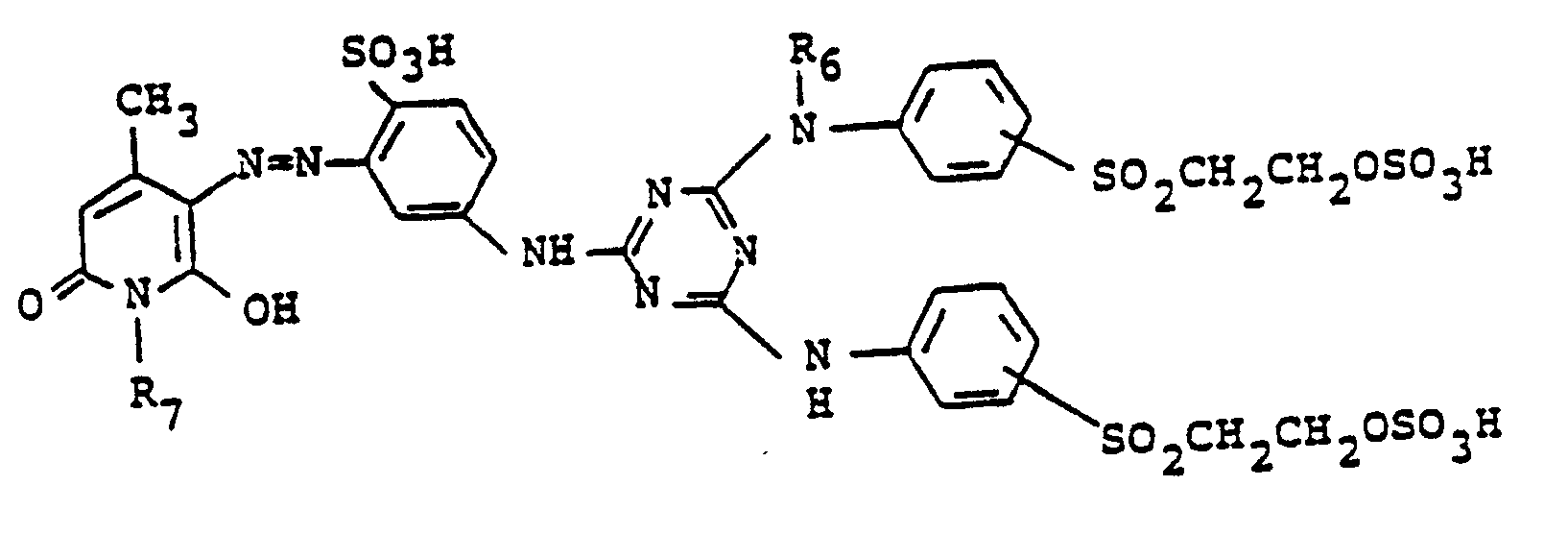
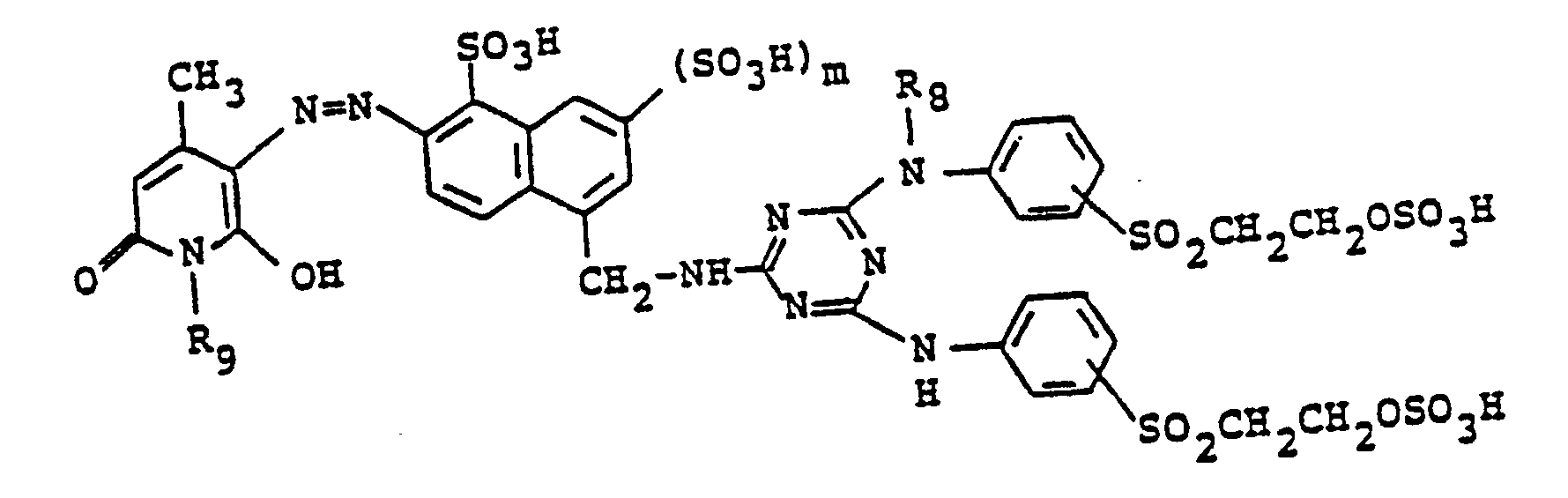
[0002] Reactive dyes, particularly those having a so-called vinylsulfone type fiber reactive group, have been extensively used for dyeing or printing cellulose fibers or polyamide fibers, because of being applicable to various kinds of dyeing and printing methods and giving dyed and printed products of a brilliant color superior in wet fastness properties.
[0003] For example, in United States Patent Nos. 4618671 and 4644058 and European Patent Publication No. 182366, reactive dyes having the vinylsulfone type fiber reactive group are disclosed.
[0004] In recent years, needs for the build-up property of dyes become severe from viewpoint of dyeing costs and waste water treatment in dye houses. Thus, the dyes of this kind also await improvements in particular as regards build-up properties.
Chem. Abstr. 71 (1969) 14158K discloses fiber-reactive dyes containing two kinds of reactive groups which are superior to dyes containing only one reactive group in the degree of fixation on cotton fabric by the pad baking method.
EP-A-0 076 782 discloses reactive dyes represented by the formula
wherein D is the residue of a sulfo group-containing organic dye of the series mono or polyazo, metal-complex-azo , anthraquinone, phthalocyanine, formazane, azomethine, dioxazine, phenazine, stilbene, triphenylmethane, xanthene, thioxanthone, nitroaryl, naphthoquinone, pyrenquinone or perylene tetracarbimide, R is hydrogen or optionally substituted C₁-C₄-alkyl; A is an optionally substituted aliphatic or aromatic bridging unit; Y is -CH=CH2 or -CH2CH2X in which X is a group splittable by an alkali; Z is hydrogen or an optionally substituted hydrocarbon; and R1 and R2 are each independently of one another hydrogen or an optionally substituted hydrocarbon.
[0005] The technical problem underlying the present invention is to provide dyes of this kind superior in various dye performance such as fastness properties, level-dyeing property, water solubility or the like as well as build-up property, and as a result have found specific compounds meeting the needs described above.
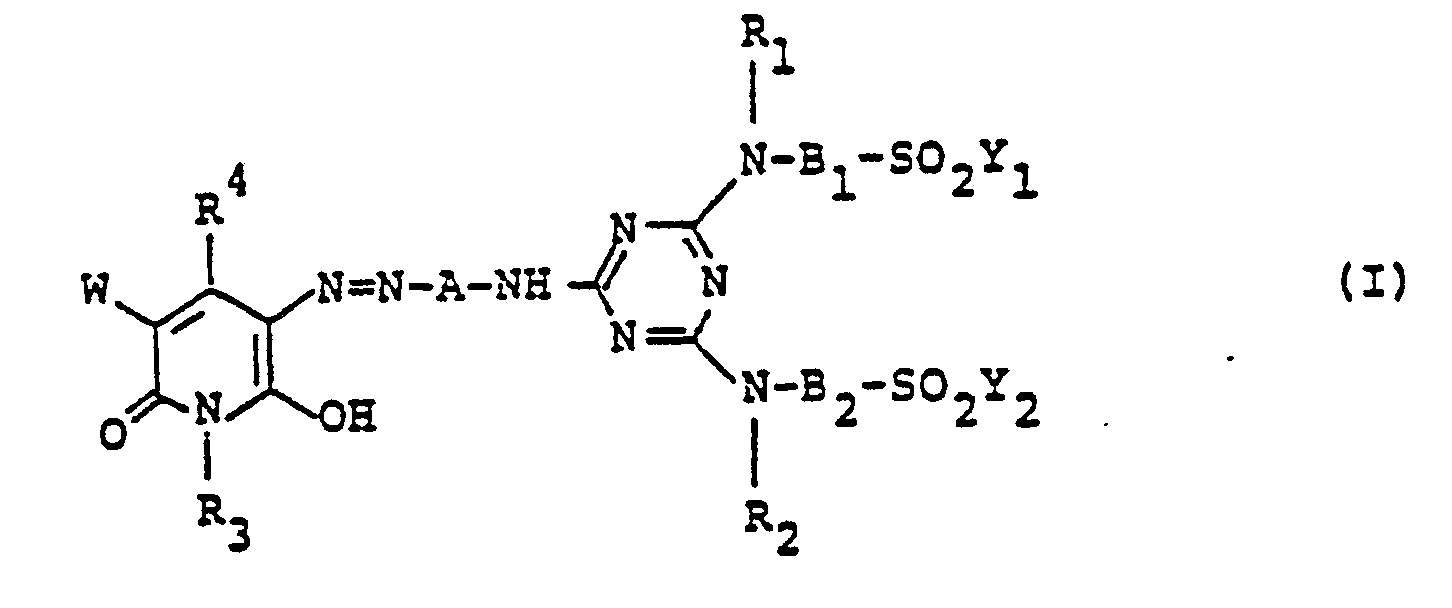
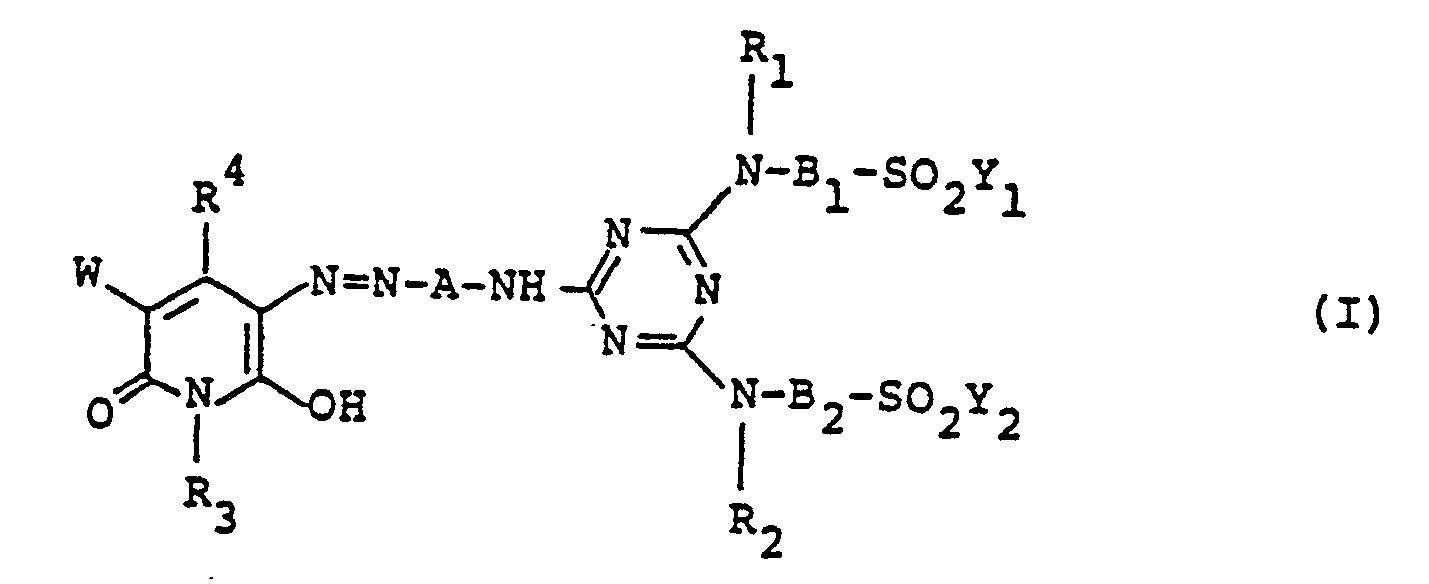
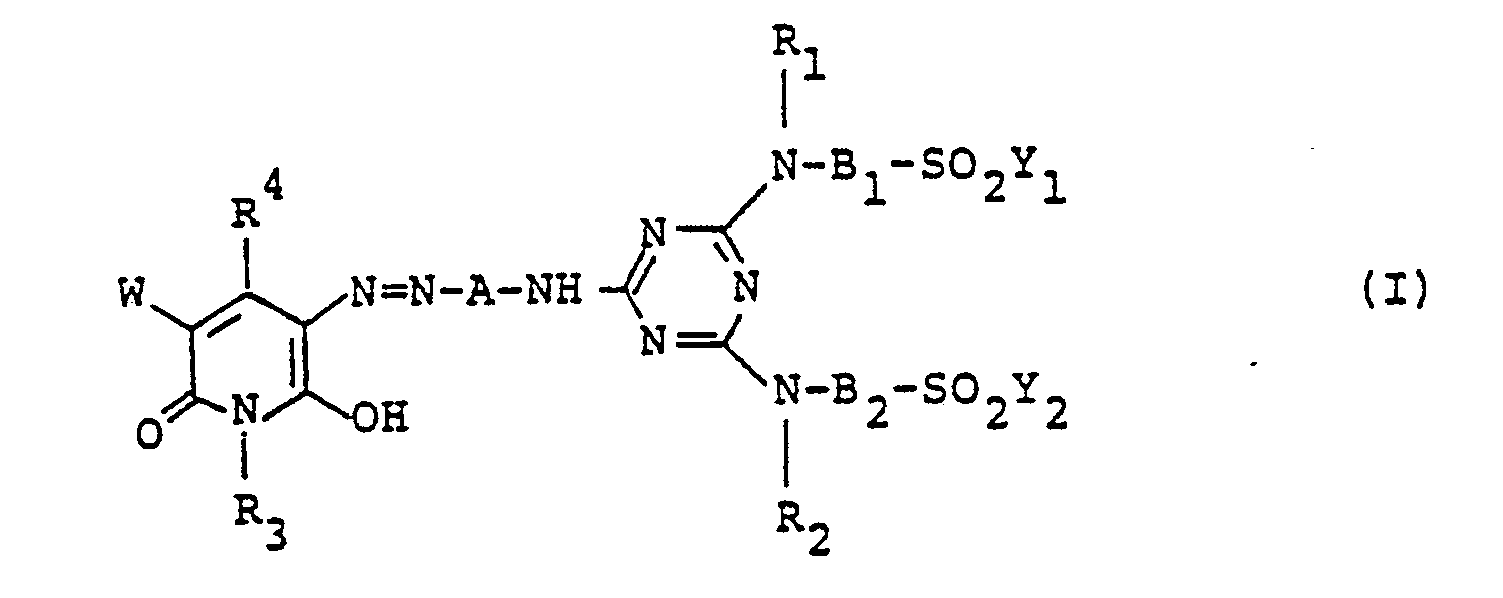
[0006] Thus, the present invention relates to monoazo compounds represented by the general formula (I),
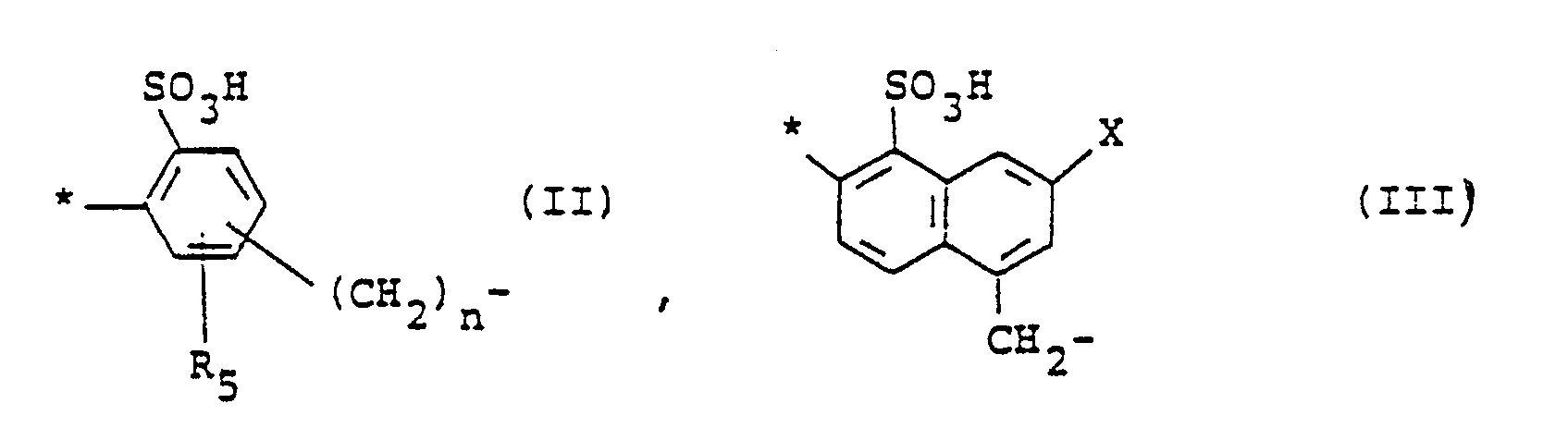
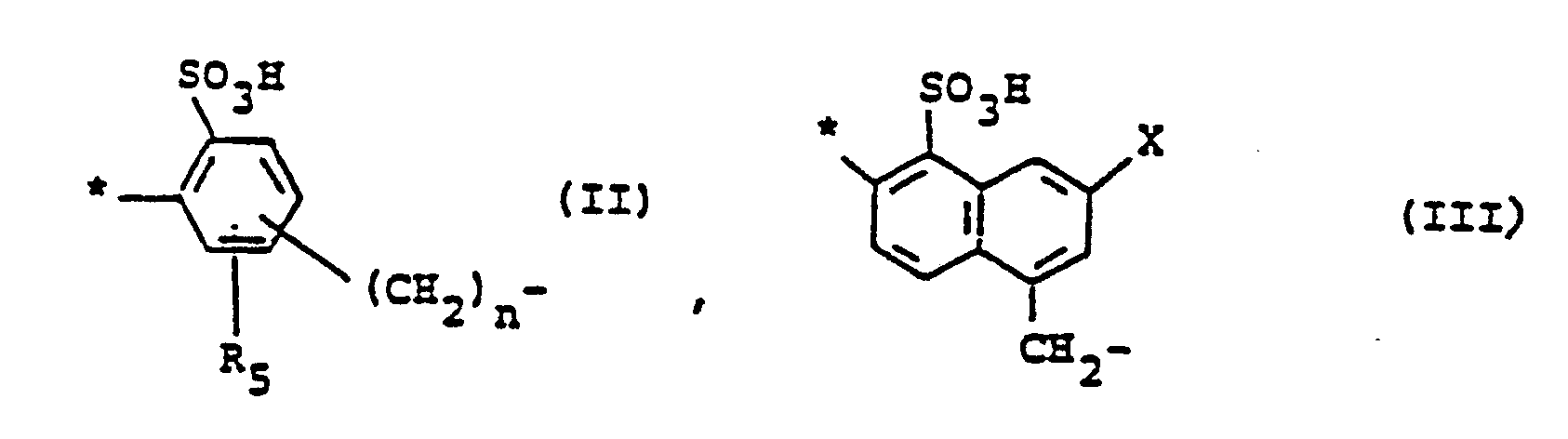
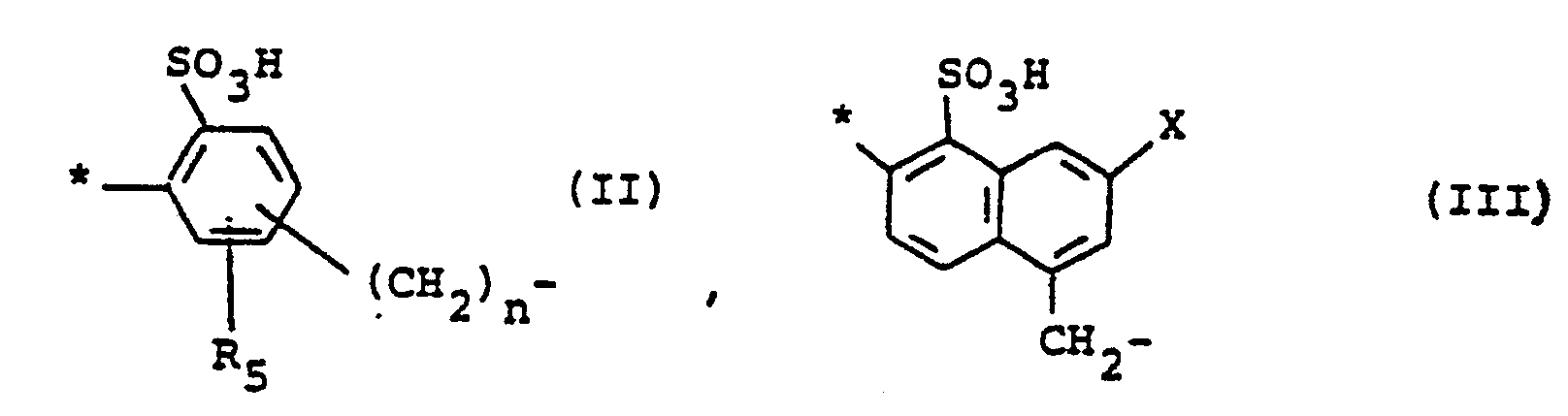
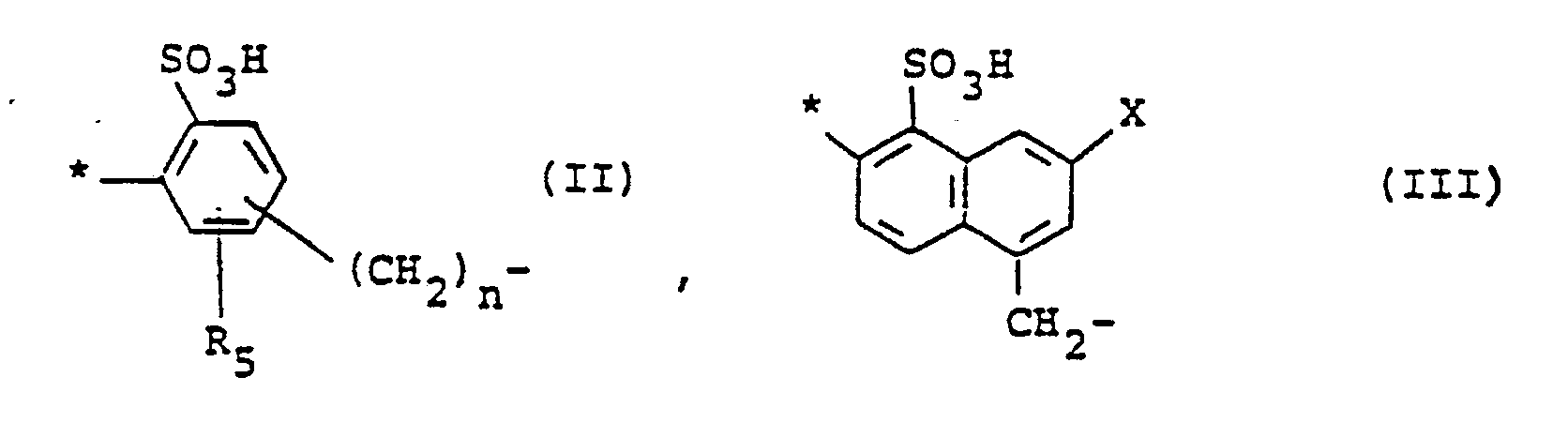
wherein R₁ and R₂ independently of one another are each hydrogen or unsubstituted or substituted alkyl, R3 is hydrogen or alkyl, R₄ is alkyl or carboxy, A is a divalent group represented by the following formula (II) or (III) in each free acid form,
in which R₅ is hydrogen, methyl, methoxy, ethoxy, sulfo or carboxy, X is hydrogen or sulfo, n is 0 or 1, and the asterisked linkage bonds to the azo group, B₁ and B₂ independently of one another are each phenylene unsubstituted or substituted once or twice by methyl, methoxy, ethyl, ethoxy, chloro, bromo, sulfo or carboxy, or naphthylene unsubstituted or substituted by sulfo, W is hydrogen, carbamoyl, sulfoalkyl, cyano, sulfo, chloro or bromo, and Y₁ and Y₂ independently of one another, are each -CH=CH₂ or -CH₂CH₂Z in which Z is a group splittable by the action of an alkali, and a process for producing the monoazo compound of the formula (I), which comprises reacting a cyanuric halide, a diamine compound represented by the general formula (IV),
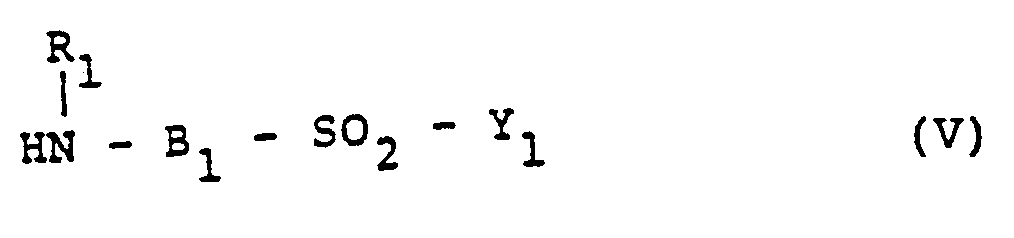
wherein A is as defined above, an amine compound represented by the general formula (V),
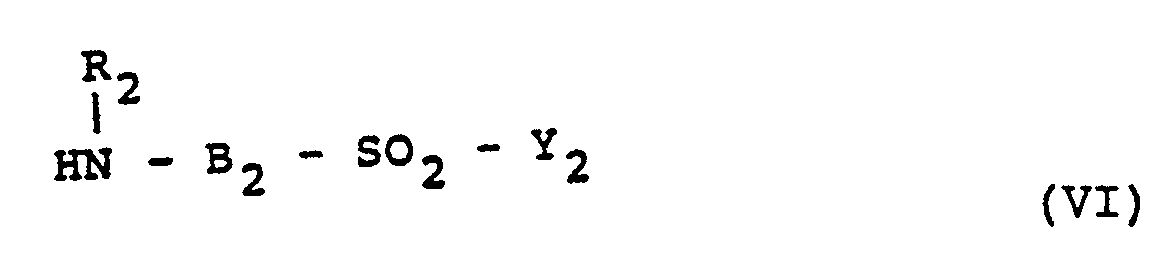
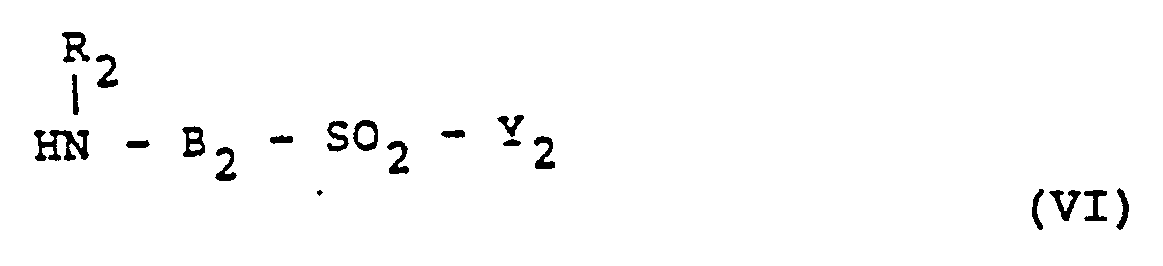
wherein R₁, B₁ and Y₁ are as defined above, another amine compound represented by the general formula (VI),
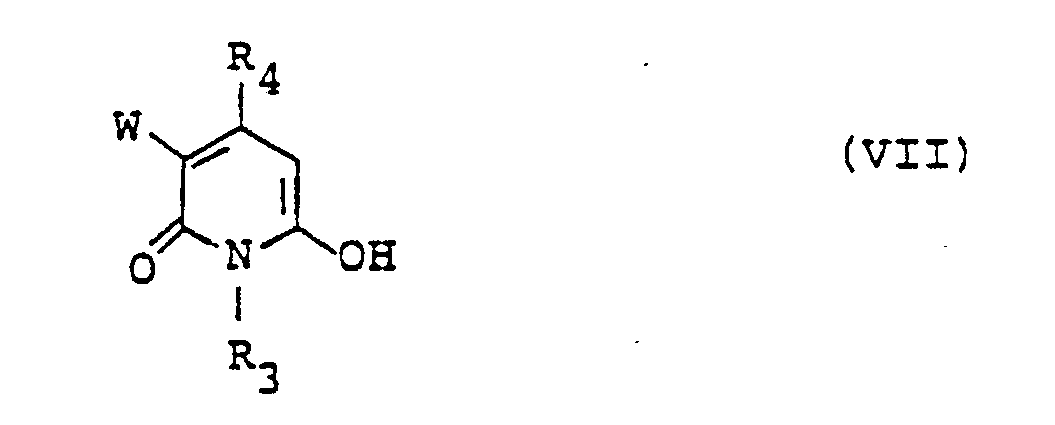
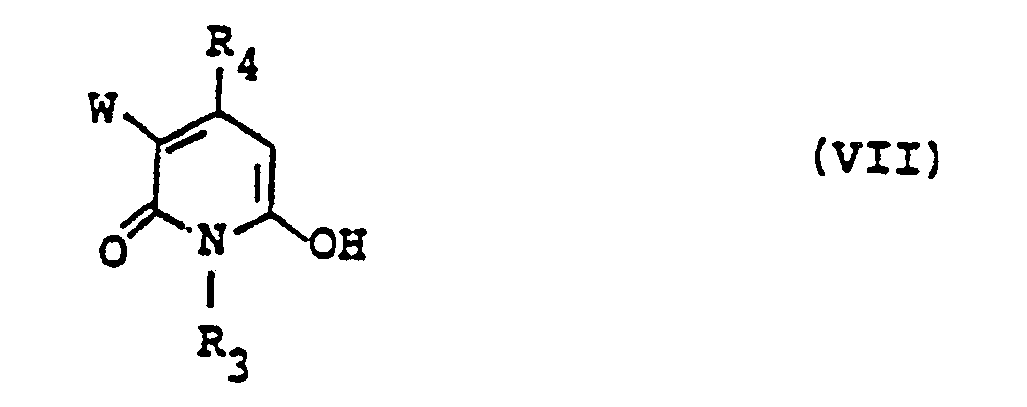
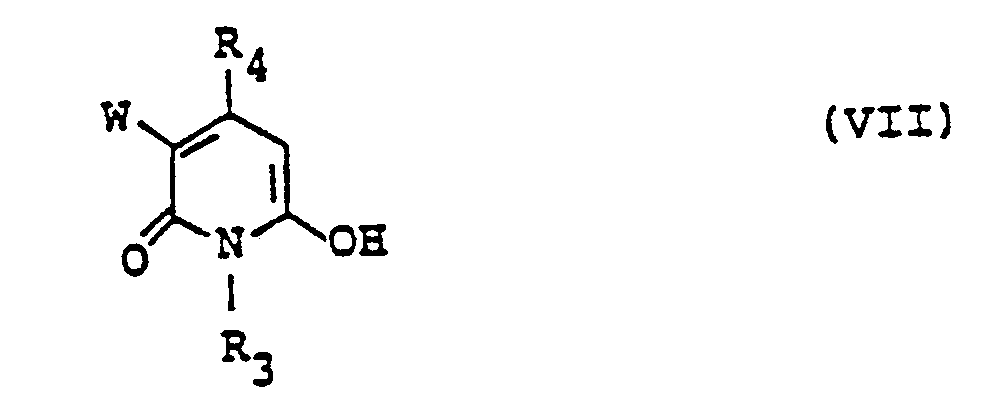
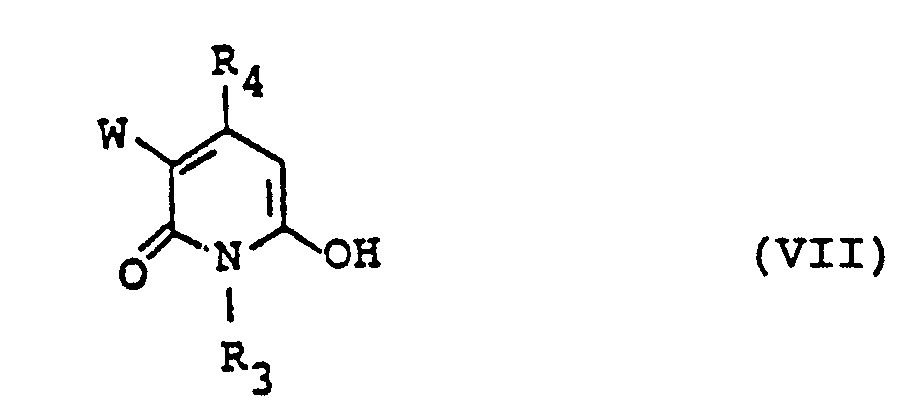
wherein R₂, B₂ and Y₂ are as defined above, and a pyridone compound represented by the general formula (VII),
wherein R₃, R₄ and W are as defined above, in an aqueous medium.
[0007] The present invention also provides a process for dyeing or printing hydroxy group- or carbonamide group- containing materials, which comprises using the monoazo compounds of the general formula (I).
[0008] In the above formula (I), the alkyl represented by R₁ and R₂ is preferably a group having 1 to 4 carbon atoms, which is unsubstituted or substituted by hydroxy, cyano, C1-4 alkoxy, halogeno, carboxy, carbamoyl, C1-4 alkoxycarbonyl, C1-4 alkylcarbonyloxy, sulfo or sulfamoyl. Examples thereof are the same as disclosed in Published Unexamined Japanese Patent Application No. 122549/1984. Of these alkyl groups, preferred are methyl and ethyl. In the present invention, any one of R₁ and R₂ is preferably hydrogen.
[0009] The alkyl represented by R₃ and R₄ is preferably a group having 1 to 4 carbon atoms, and includes, for example, methyl, ethyl, n-propyl, iso-butyl, sec-butyl and the like. Of these, preferred are methyl, ethyl and n-propyl. In the present invention, particularly preferred is a case where R₃ is methyl or ethyl and R₄ is methyl or carboxy.
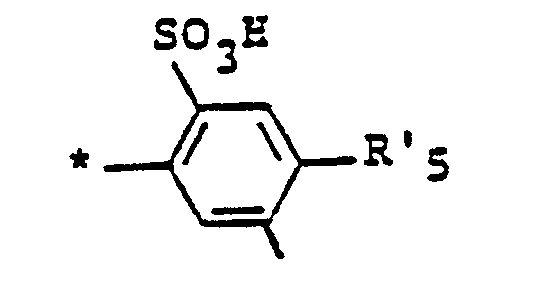
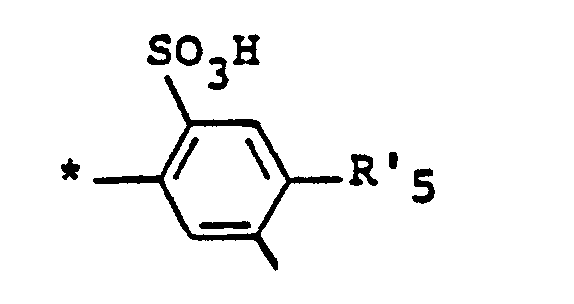
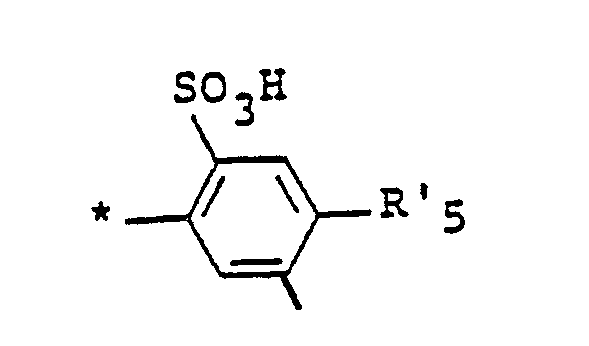
[0010] Among the divalent groups A represented by the formula (II), preferred is the one represented by the following formula,
wherein the asterisked linkage is as defined above, and Rʹ₅ is hydrogen, methyl, methoxy, sulfo or carboxy, preferably hydrogen or sulfo.
[0011] Examples of the phenylene and naphthylene unsubstituted or substituted, which are represented by B₁ and B₂ are as shown in the specification of Published unexamined Japanese Patent Application No. 122549/1984. Of these, particularly preferred is phenylene unsubstituted or substituted once or twice by methyl and methoxy.
[0012] The symbol Z in -CH₂CH₂Z which is represented by Y₁ and Y₂ denotes a group capable of being split by the action of an alkali, and includes various groups known per se, such as sulfato, thiosulfato, phosphato, acetoxy, chloro and the like. Of these groups represented by Y₁ and Y₂, preferred is β-sulfatoethyl. In the present invention, the most preferred is a case where both Y₁ and Y₂ are β-sulfatoethyl, which may be partially replaced by vinyl.
[0013] With respect to the symbol W, preferred are hydrogen, sulfo-C1-2-alkyl such as sulfomethyl or sulfoethyl; sulfo, chloro and bromo. Of these, particularly preferred is hydrogen.
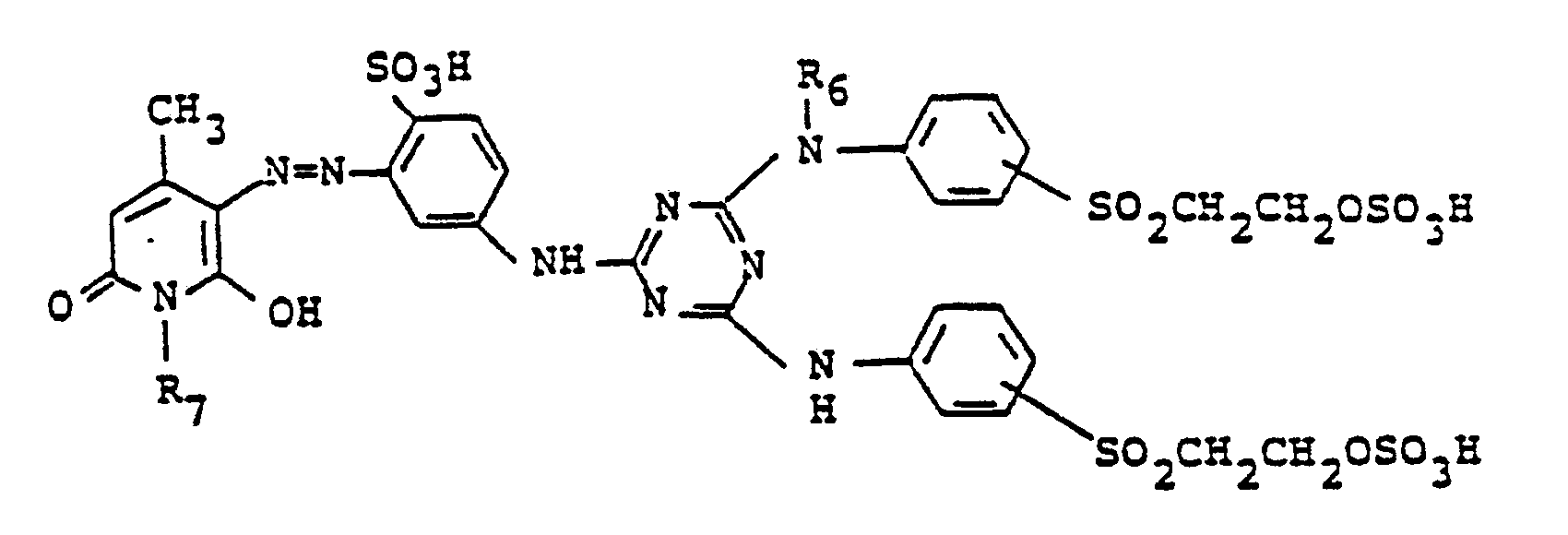
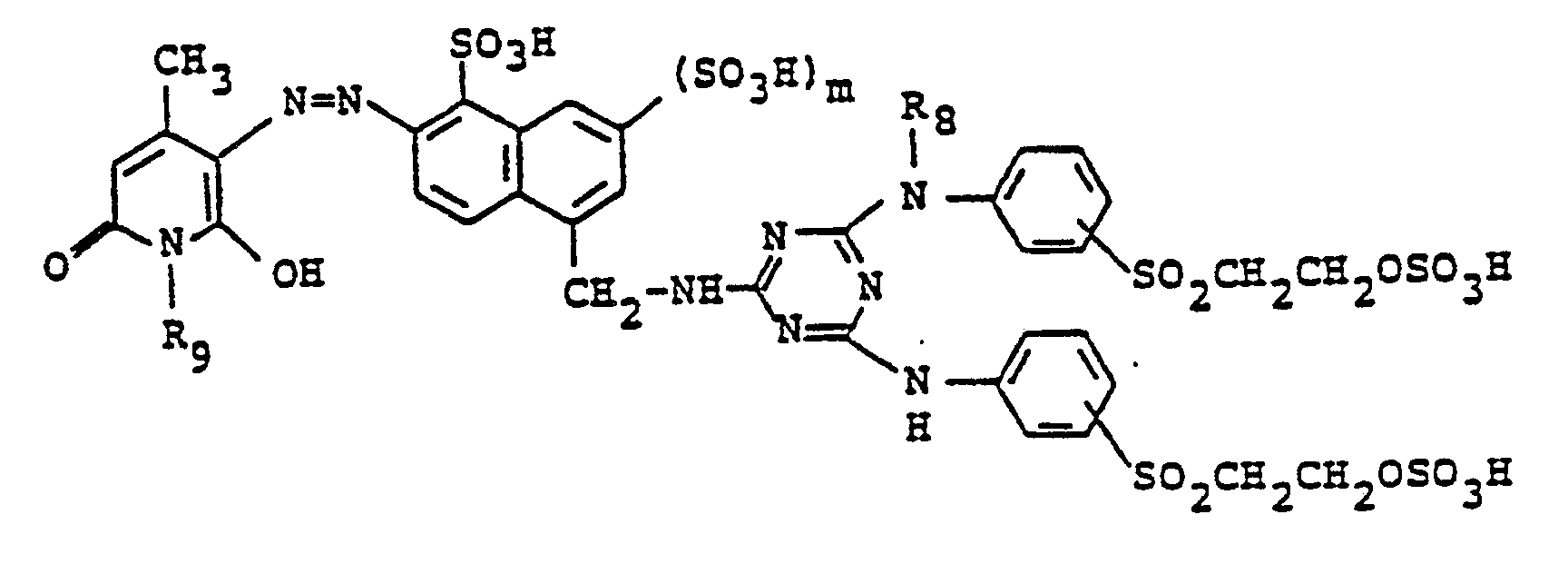
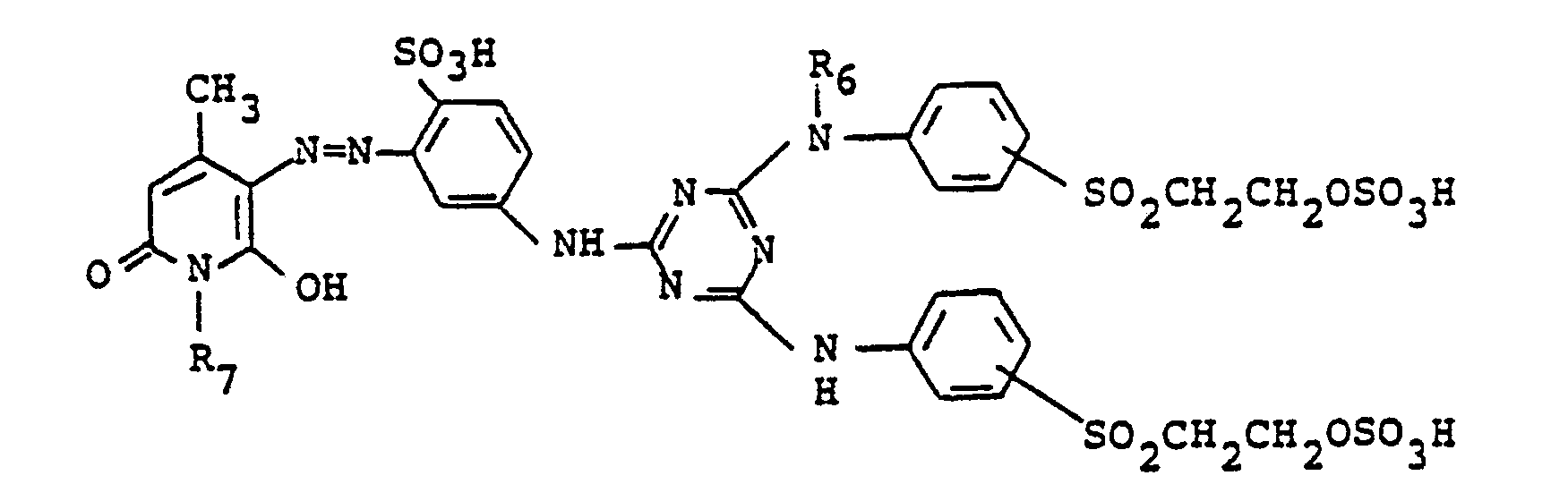
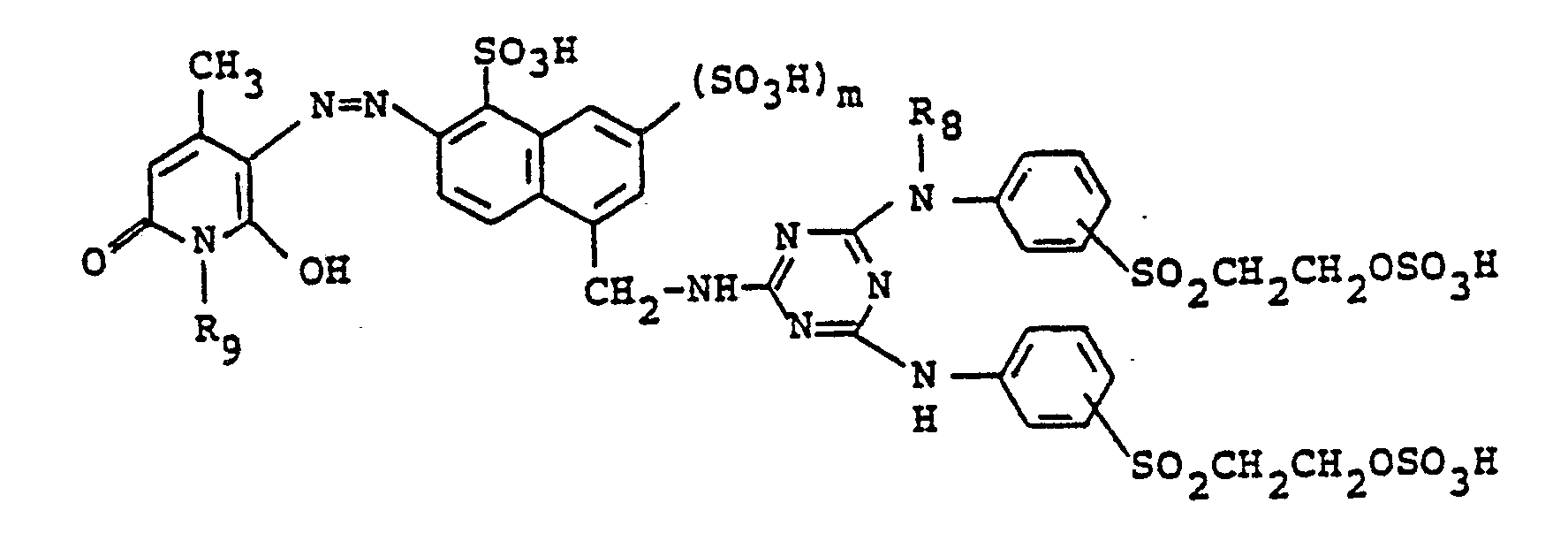
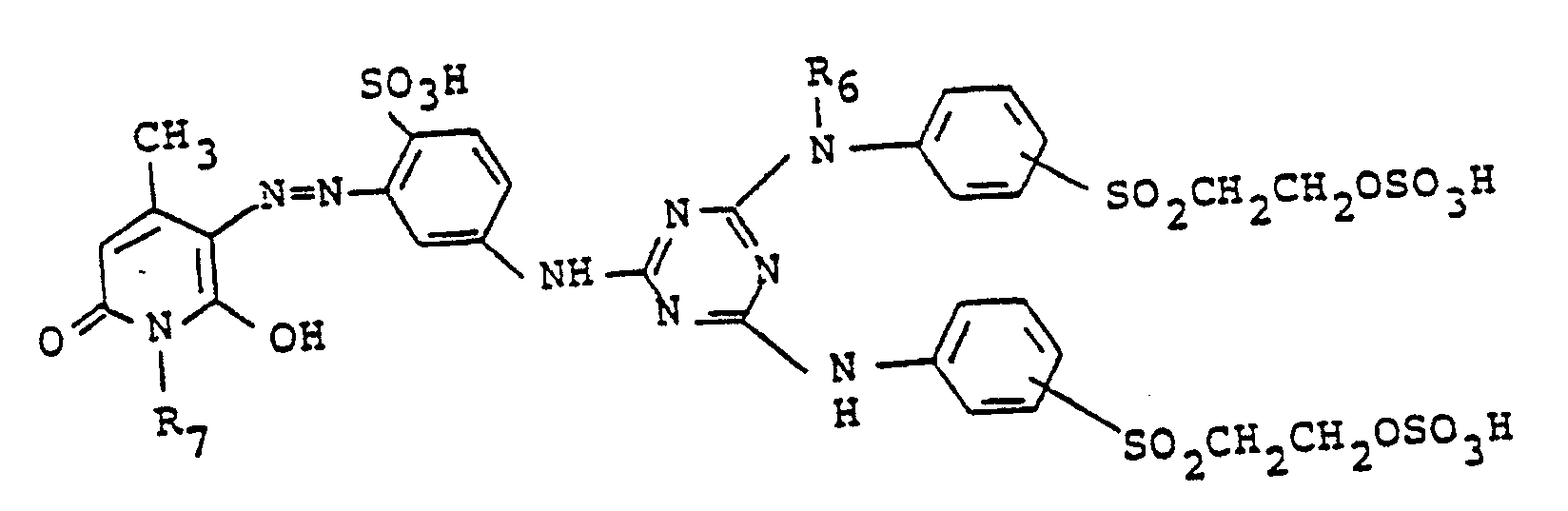
[0014] Among the monoazo compounds of the general formula (I), preferred are those represented by the following formulas (I-1) and (I-2) in each free acid form,
wherein R₆ is hydrogen, methyl or ethyl, and R₇ is methyl or ethyl;
wherein R₈ is hydrogen, methyl or ethyl, R₉ is methyl or ethyl, and m is 0 or 1.
[0015] In the above formulas (I-1) and (I-2), the sulfatoethylsulfonyl (-SO₂CH₂CH₂OSO₃H) may be replaced by a vinylsulfonyl (-SO₂CH=CH₂) in part.
[0016] The present monoazo compound of the formula (I) may be in the form of a free acid or an alkali metal or alkaline earth metal salt, preferably an alkali metal salt such as sodium and potassium salts.
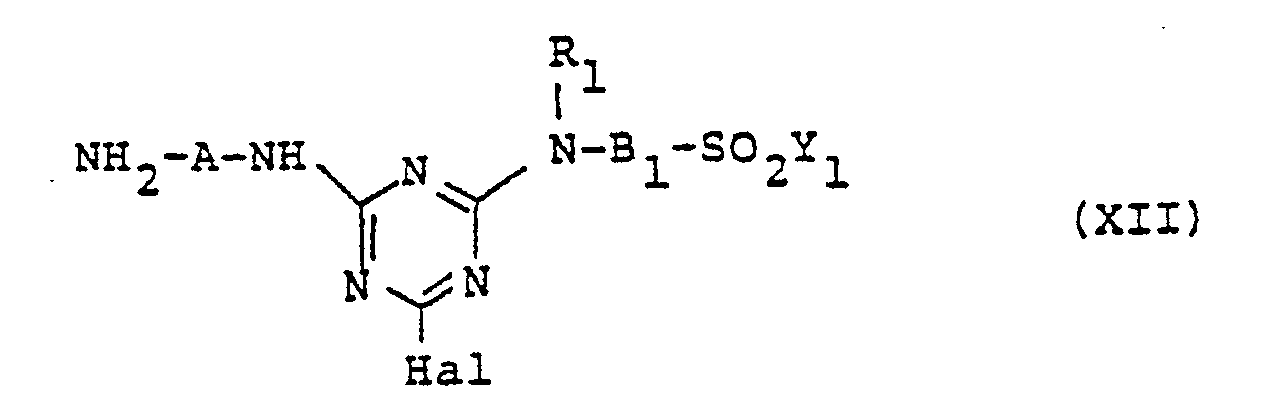
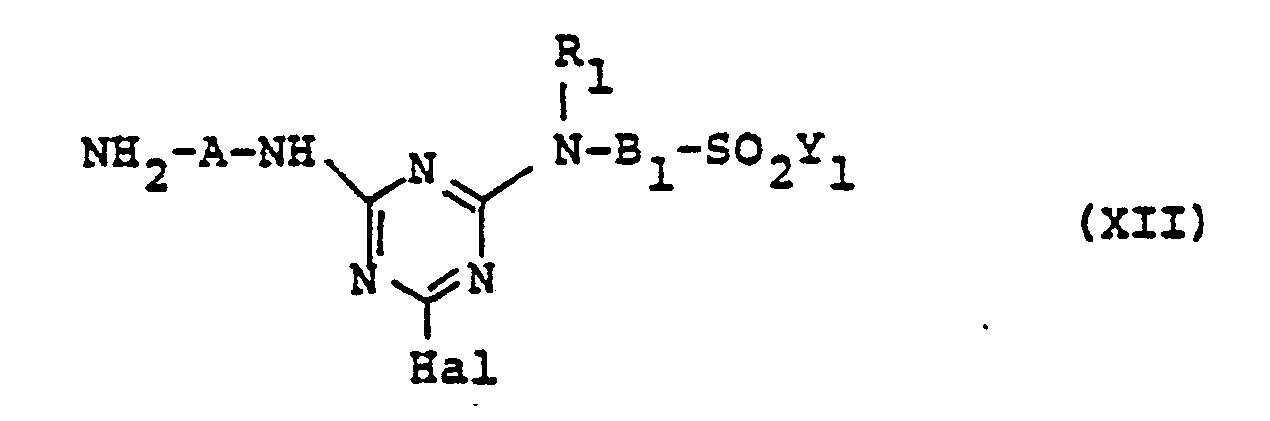
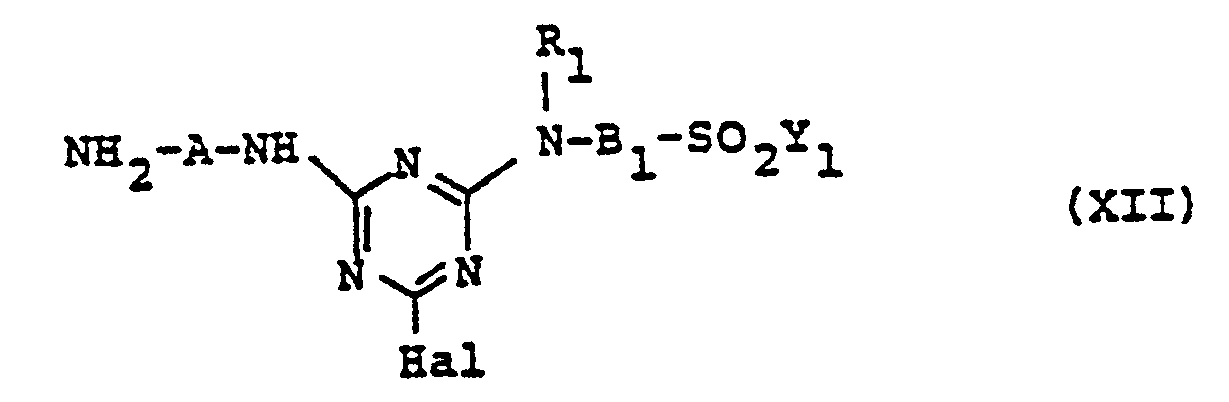
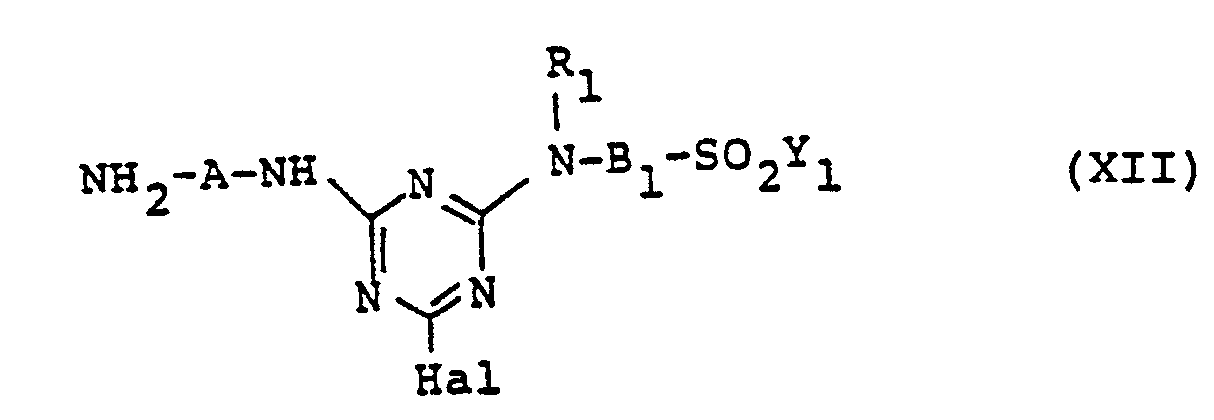
[0017] The present monoazo compound (I) can be produced in a manner known per se. For example, any one of the diamine compound of the formula (IV) and the amine compound of the formula (V) is subjected to first condensation with a cyanuric halide such as cyanuric chloride and cyanuric fluoride, followed by second condensation with the remaining one of the above two. The first and second condensation can be carried out in an aqueous medium at a temperature of 0° to 30°C and 20° to 60°C, respectively. Successively, the resulting monohalogenotriazinyl compound represented by the general formula (XII),
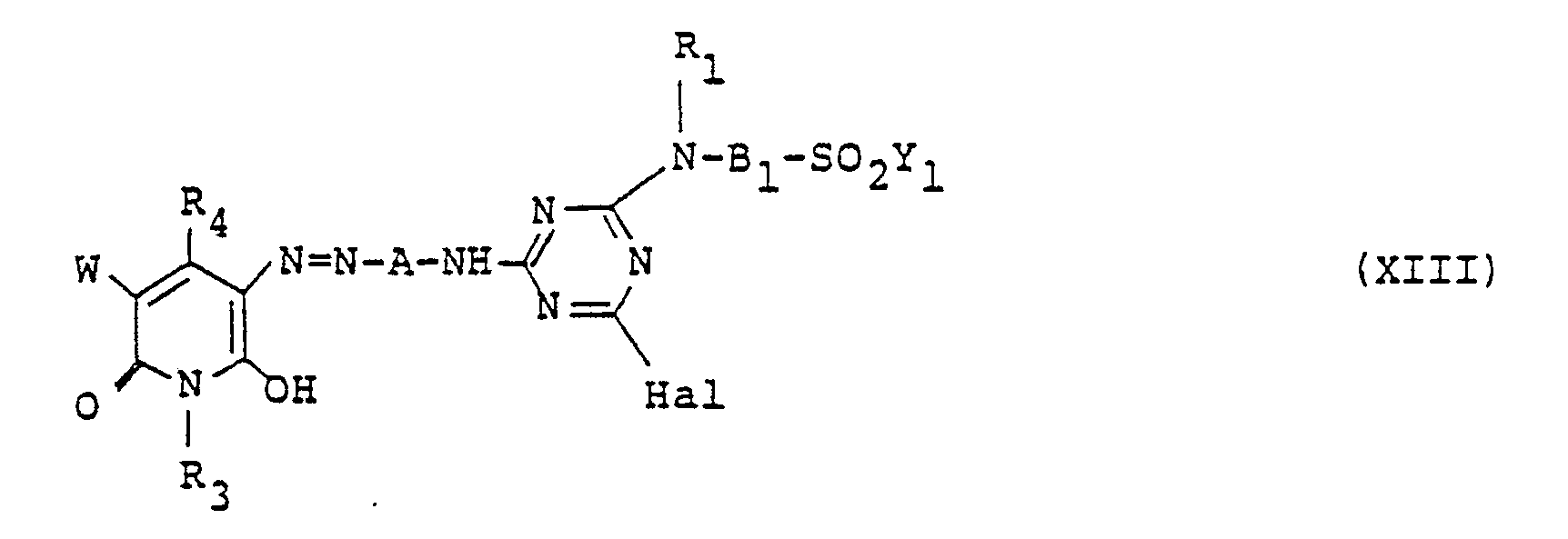
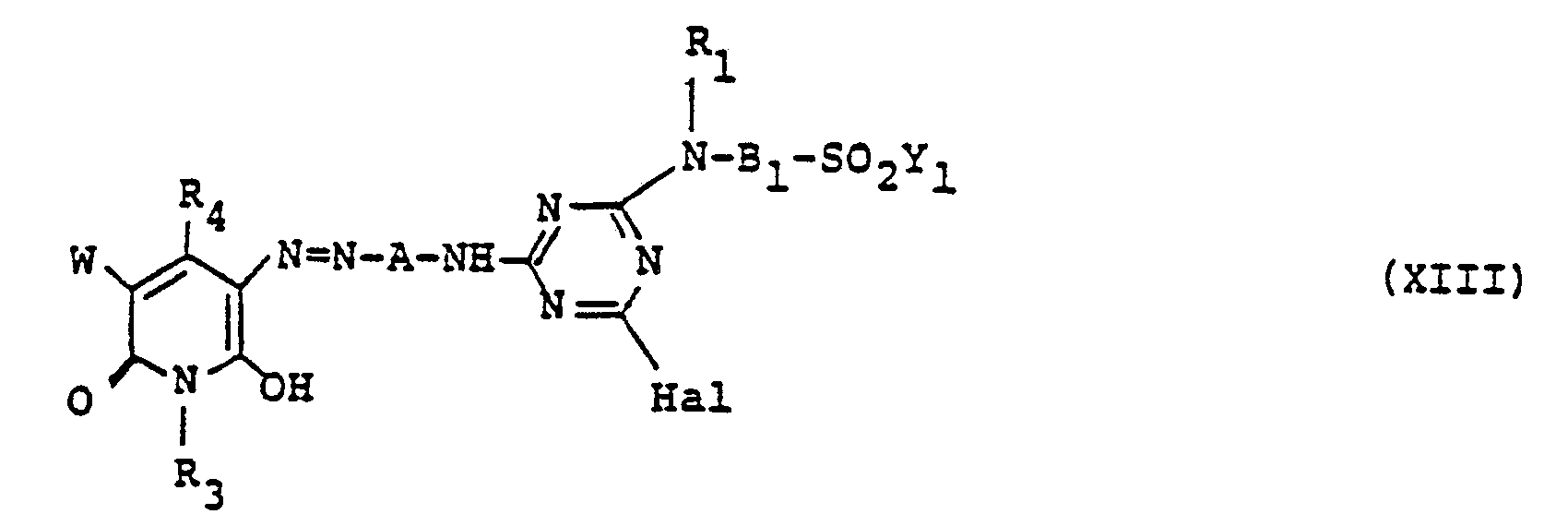
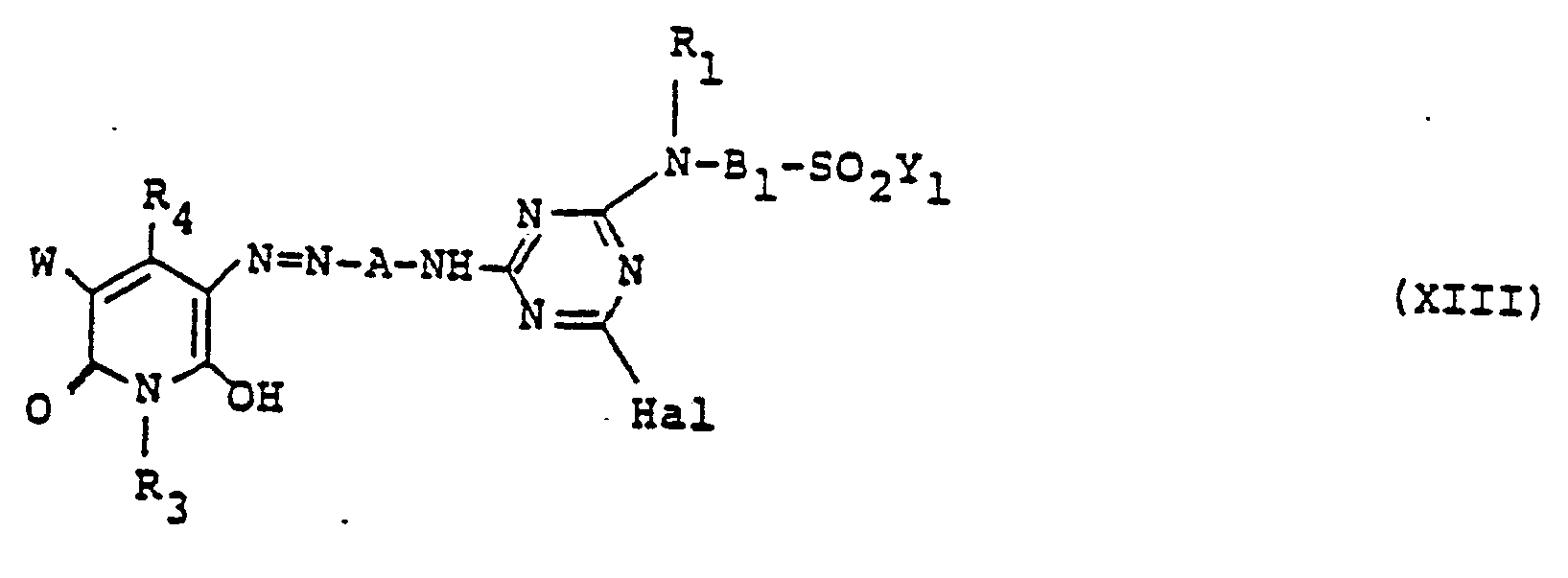
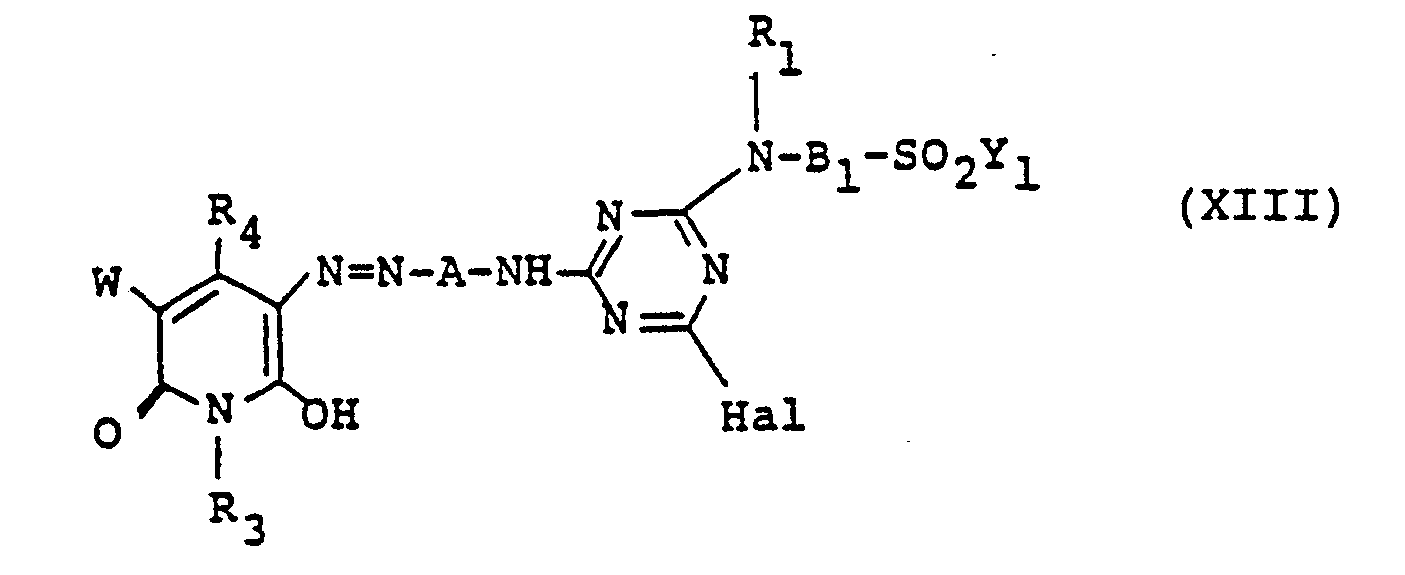
wherein A, R₁, B₁ and Y₁ are as defined above, and Hal is halogeno such as chloro, fluoro and the like is diazotized in a conventional manner, followed by coupling with the pyridone compound of the formula (VII) at a temperature of 0° to 30°C, thereby obtaining a monoazo intermediate compound represented by the general formula (XIII),
wherein R₁, R₃, R₄, A, B₁, Y₁, W and Hal are as defined above. The resulting monoazo intermediate compound is subjected to third condensation with another amine compound of the formula (VI) at a temperature of 60° to 100°C, whereby the desired monoazo compound (I) can be produced.
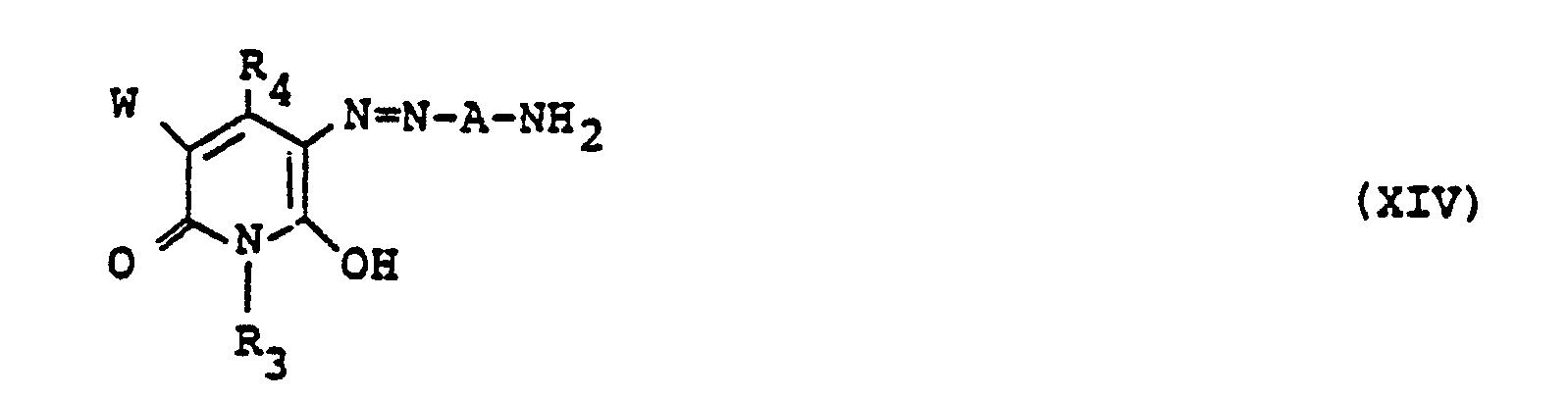
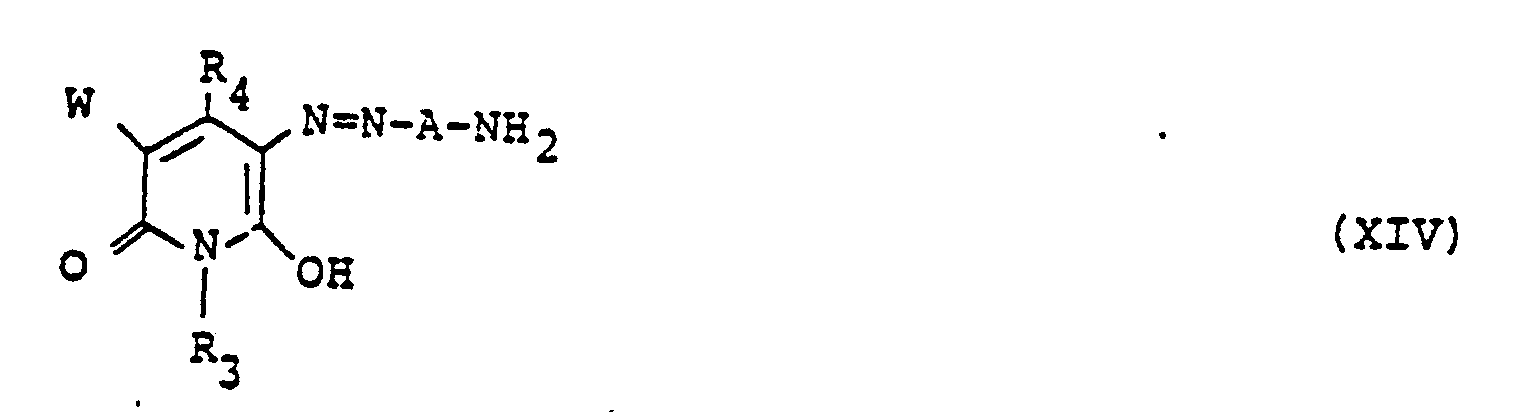
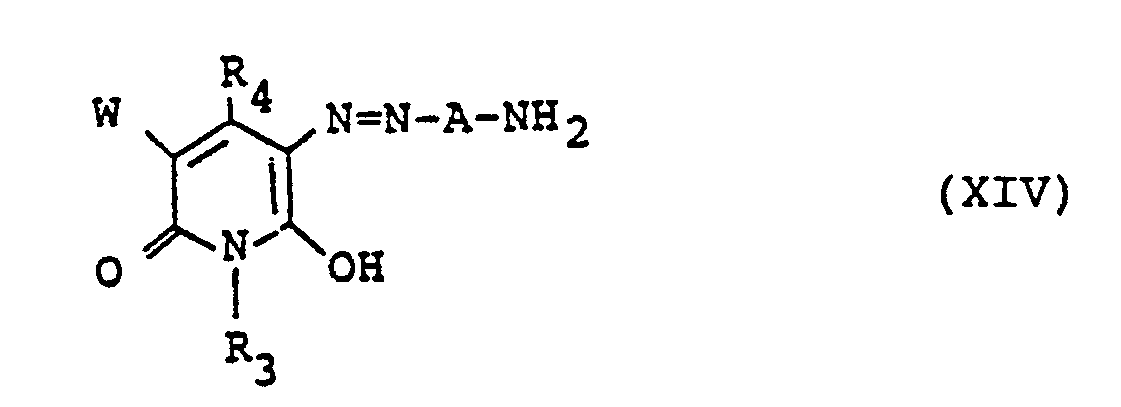
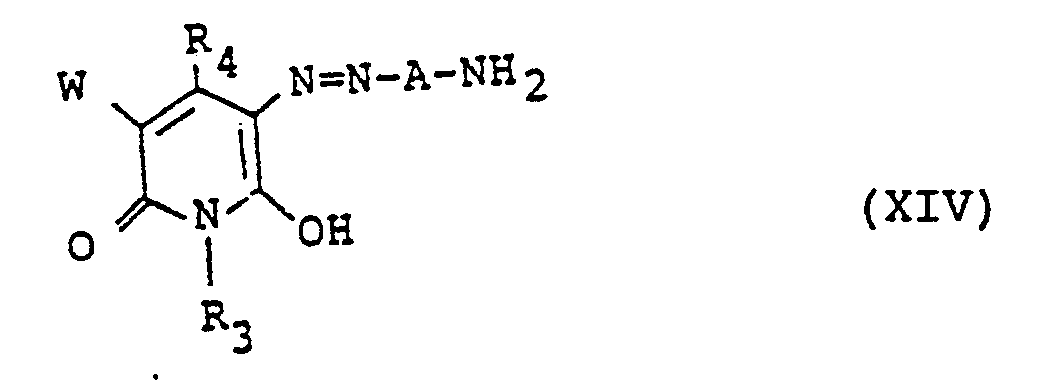
[0018] The present monoazo compound (I) can be also produced in another manner. For example, a monoacyl compound of the diamine compound (IV) is diazotized in a conventional manner, followed by coupling with the pyridone compound (VII), and then deacylation, thereby obtaining another monoazo intermediate compound represented by the general formula (XIV),
wherein R₃, R₄, A and W are as defined above.
[0019] Successively, any one of the monoazo intermediate compound (XIV), the amine compound (V) and another amine compound (VI) is subjected to first condensation with the cyanuric halide, followed by second and third condensations with the remaining whereby the desired monoazo compound (I) can be also produced.
[0020] The starting compounds described above may be used in the form of a free acid or a salt, particularly those such as alkali metal or alkaline earth metal salts, depending on the reaction conditions.
[0021] After completion of the reaction mentioned above, the desired monoazo compound (I)-containing reaction mixture may be formed to a liquid commercial product, if desired, after removing inorganic salts and with addition of a stabilizer or a dyeing improver. The liquid product obtained or the reaction mixture as such may be subjected to evaporation or spray-drying, thereby obtaining a pulverulent commercial product. Alternatively, the reaction mixture may be formed to either a liquid or pulverulent commercial product through salting-out using an electrolyte in a conventional manner.
[0022] The monoazo compound (I) of the present invention is fiber-reactive and useful for dyeing or printing hydroxyl group-containing and carbonamide group-containing materials in a fibrous form including unmixed or mixed fibers.
[0023] The hydroxyl group-containing materials include natural or synthetic hydroxyl group-containing materials such as cellulose fiber materials, regenerated products thereof and polyvinyl alcohol. Examples of the cellulose fiber materials are cotton and other vegetable fibers such as linen, hemp, jute and ramie fibers. Examples of the regenerated cellulose fibers are viscose staple and filament viscose.
[0024] The amide group-containing materials include synthetic or natural polyamides and polyurethanes. Examples of the materials, particularly in the fibrous forms, are wool and other animal furs, silk, leather, polyamide-6,6, polyamide-6, polyamide-11 and polyamide-4.
[0025] The dyeing may be carried out in a suitable manner, which can be selected from conventional manners.
[0026] For example, cellulose fibers can be dyed using the monoazo compound (I) and an acid binding agent such as sodium hydroxide, sodium carbonate, phosphates, silicates or sodium hydrogencarbonate. The dyeing may be carried out in a suitable manner, which can be selected from conventional ones depending on the physical and chemical properties of the fiber materials, and includes, for example, exhaustion dyeing, printing and padding including cold-pad-batch-up dyeing.
[0027] The exhaustion dyeing can be carried out at a relatively low temperature in the presence of an acid binding agent such as sodium carbonate, trisodium phosphate, sodium hydroxide and the like, together with sodium sulfate, sodium chloride or the like.
[0028] The printing can be carried out by printing the fibers with a color paste, followed by pre-drying and heat-treatment such as steaming. The color paste can be prepared in a conventional manner using a thickener or emulsion thickener such as sodium alginate, starch ether or the like, and an alkali or alkali-generating agent such as sodium carbonate, sodium hydrogencarbonate, trisodium phosphate, sodium trichloroacetate and their potassium or alkaline earth metal salts, if desired, together with a usual printing auxiliary agent such as urea and a dispersing agent.
[0029] The cold-pad-batch-up dyeing can be carried out by padding the fiber materials with a padding liquor at ambient temperature, batching up and allowing to stand on a roller for 3 hours or more or over night, followed by washing with water and drying.
[0030] The dyeing of natural or synthetic polyamide and polyurethane fiber materials can be carried out by performing exhaustion in an acid or weak acid bath, while controlling the pH value, and then making the bath neutral, or in some cases alkaline to perform the fixation. The dyeing temperature ranges usually from 60° to 120°C. In order to achieve a level dyeing, there may be used a conventional level dyeing agent such as a condensation product between cyanuric chloride and 3 times by mole of aminobenzenesulfonic acid or aminonaphthalenesulfonic acid, or an addition product between stearylamine and ethylene oxide, and the like.
[0031] The present monoazo compounds (I) can be characterized by excellent dye performance in the dyeing and printing of fiber materials, particularly cellulose fiber materials. For example, the compounds can exhibit extremely high exhaustion and fixation percentages as well as extremely excellent build-up property. Moreover, the compounds can also exhibit excellent level-dyeing and washing-off properties. Furthermore, the compounds can hardly be affected by changes in dyebath conditions such as temperature, bath ratio, pH and salt concentration to some extent, and can give dyed or printed products excellent in various fastness properties, such as light fastness, perspiration-light fastness, perspiration fastness, acid-hydrolysis fastness, washing fastness, chlorine fastness and the like.
[0032] The present invention is illustrated in more detail with reference to the following Examples which are only illustrative, but not limitative. In Examples, all parts and % are by weight.
Example 1
[0033] A solution of m-phenylenediaminesulfonic acid (5.6 parts) in water (100 parts) was added to an aqueous dispersion of cyanuric chloride (5.5 parts), and the mixture was stirred under cooling to complete a first condensation. Thereafter, to this reaction mixture was added N-ethylaniline-3-β-sulfatoethylsulfone (9.2 parts), and the mixture was stirred for 5 hours to complete a second condensation. Successively, the reaction mixture was mixed with sodium nitrite to carry out a diazotization in a conventional manner. The resulting diazonium salt solution was added to an aqueous dispersion of 1-ethyl-4-methyl-6-hydroxy-2-pyridone (4.6 parts) to perform a coupling reaction. After completion of the coupling reaction, 1-aminobenzene-3-β-sulfatoethylsulfone (8.4 parts) was added thereto, and the mixture was stirred at 50° to 80°C to complete a third condensation. Thereafter, sodium chloride was added to the reaction mixture, and the precipitate separated on a filter was dried to obtain a monoazo compound represented by the following formula.
Example 2
[0034] Example 1 was repeated, provided that 2-amino-5-aminomethylnaphthalene-1-sulfonic acid was used in place of m-phenylenediaminesulfonic acid, thereby obtaining a monoazo compound represented by the following formula.
Example 3
[0035] Example 1 was repeated, provided that the diamine compound (to be subjected to first condensation with cyanuric chloride) as shown in a column A of the following table, the amine compound (to be subjected to second condensation) as shown in a column B, the pyridone compound (to be coupled) as shown in a column C and another amine compound (to be subjected to third condensation) as shown in a column D were used, thereby obtaining the corresponding monoazo compound characterized by a shade on cellulose fiber as shown in a column E.
Example 4
[0036] The monoazo compounds obtained in Examples 1 to 3 each (0.3 part) was dissolved in water (200 parts), and sodium sulfate (10 parts) and cotton (10 parts) were added thereto. The bath was heated to 50°C. 20 Minutes thereafter, sodium carbonate (4 parts) was added thereto, and dyeing was continued for 1 hour at that temperature. Thereafter, the cotton taken out was washed with water and soaped to obtain each dyed product of a deep yellow color excellent in various fastness properties.
Example 5
[0037] The monoazo compounds obtained in Examples 1 to 3 each (15 parts) and urea (50 parts) were dissolved in hot water (200 parts). A paste (400 parts) prepared by mixing sodium alginate (40 parts), water (960 parts) and sodium hydrogencarbonate (20 parts) were added thereto. The resulting mixture was mixed with water and the paste to make the whole 1000 parts, thereby preparing a printing paste.
[0038] Cotton fabric was printed with the printing paste prepared above. The printed fabric was pre-dried, steamed at 100° to 103°C for 5 minutes, washed with cool water and then hot water, subjected to boil-soaping, again washed and then dried to obtain each printed product of a deep yellow color excellent in various fastness properties.
1. Monoazo compounds of the general formula (I),
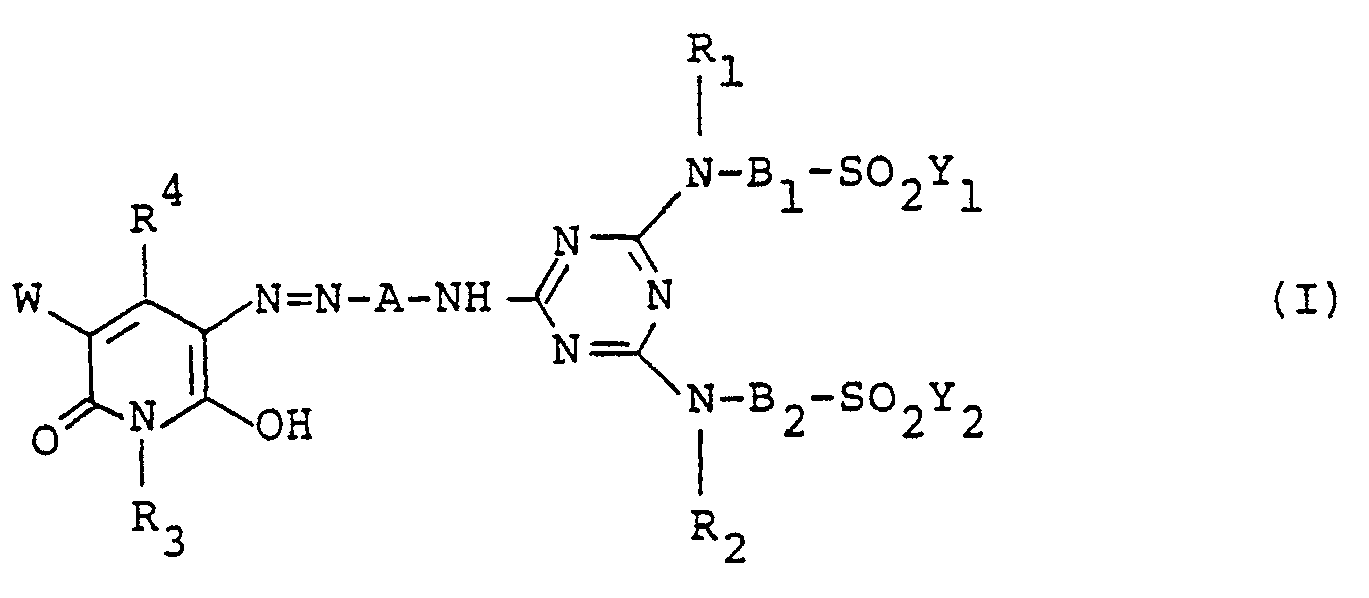
wherein R₁ and R₂ independently of one another are each hydrogen or unsubstituted or substituted alkyl, R₃ is hydrogen or alkyl, R₄ is alkyl or carboxy, A is a divalent group represented by the general formula (II) or (III) in each free acid form,
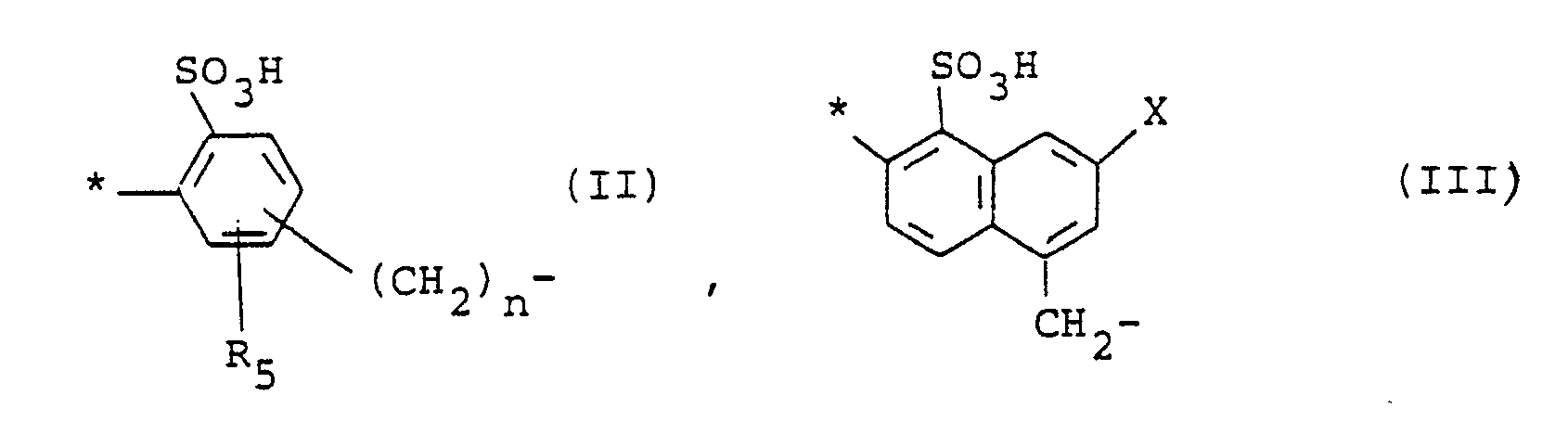
in which R₅ is hydrogen, methyl, methoxy, ethoxy, sulfo or carboxy, X is hydrogen or sulfo, n is 0 or 1, and the asterisked linkage bonds to the azo group, B₁ and B₂ independently of one another are each phenylene unsubstituted or substituted once or twice by methyl, methoxy, ethyl, ethoxy, chloro, bromo, sulfo or carboxy, or naphthylene unsubstituted or substituted by sulfo, W is hydrogen, carbamoyl, sulfoalkyl, cyano, sulfo, chloro or bromo, and Y₁ and Y₂ independently of one another are each -CH=CH₂ or -CH₂CH₂Z in which Z is a group splittable by the action of an alkali.
wherein R₁ and R₂ independently of one another are each hydrogen or unsubstituted or substituted alkyl, R₃ is hydrogen or alkyl, R₄ is alkyl or carboxy, A is a divalent group represented by the general formula (II) or (III) in each free acid form,
in which R₅ is hydrogen, methyl, methoxy, ethoxy, sulfo or carboxy, X is hydrogen or sulfo, n is 0 or 1, and the asterisked linkage bonds to the azo group, B₁ and B₂ independently of one another are each phenylene unsubstituted or substituted once or twice by methyl, methoxy, ethyl, ethoxy, chloro, bromo, sulfo or carboxy, or naphthylene unsubstituted or substituted by sulfo, W is hydrogen, carbamoyl, sulfoalkyl, cyano, sulfo, chloro or bromo, and Y₁ and Y₂ independently of one another are each -CH=CH₂ or -CH₂CH₂Z in which Z is a group splittable by the action of an alkali.
2. A compound according to Claim 1, wherein B₁ and B₂ independently of one another are
each phenylene unsubstituted or substituted by methyl or methoxy.
3. A compound according to Claim 1, wherein any one of R₁ and R₂ is hydrogen, and the
other is hydrogen, methyl or ethyl.
4. A compound according to Claim 1, wherein W is hydrogen.
5. A compound according to Claim 1, wherein A is a divalent group of the formula (II)
as defined in Claim 1 or the following formula
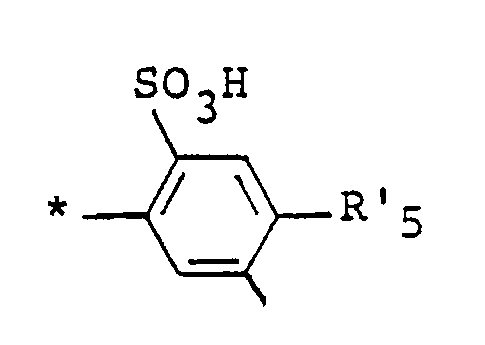
wherein the asterisked linkage is as defined in Claim 1, and Rʹ₅ is hydrogen, methyl, methoxy, sulfo or carboxy.
wherein the asterisked linkage is as defined in Claim 1, and Rʹ₅ is hydrogen, methyl, methoxy, sulfo or carboxy.
6. A compound according to Claim 1, wherein both Y₁ and Y₂ are β-sulfatoethyl.
7. A compound represented by the following formula in a free acid form,
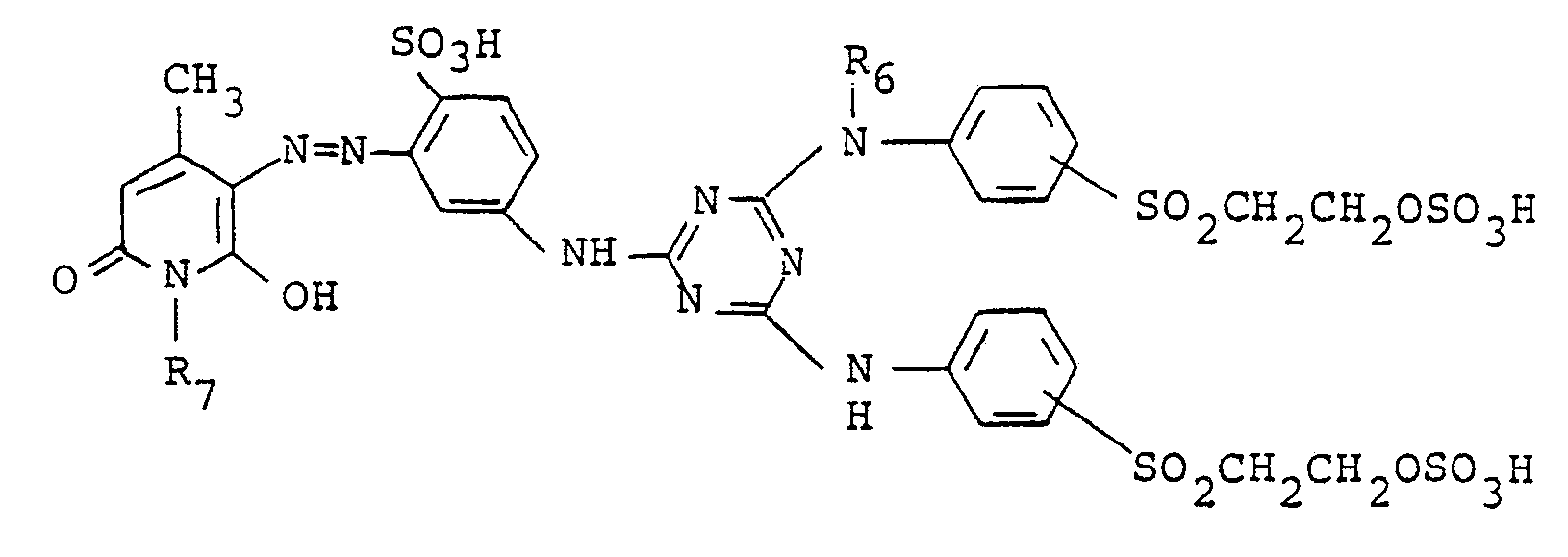
wherein R₆ is hydrogen, methyl or ethyl, and R₇ is methyl or ethyl.
wherein R₆ is hydrogen, methyl or ethyl, and R₇ is methyl or ethyl.
8. A compound represented by the following formula in a free acid form,
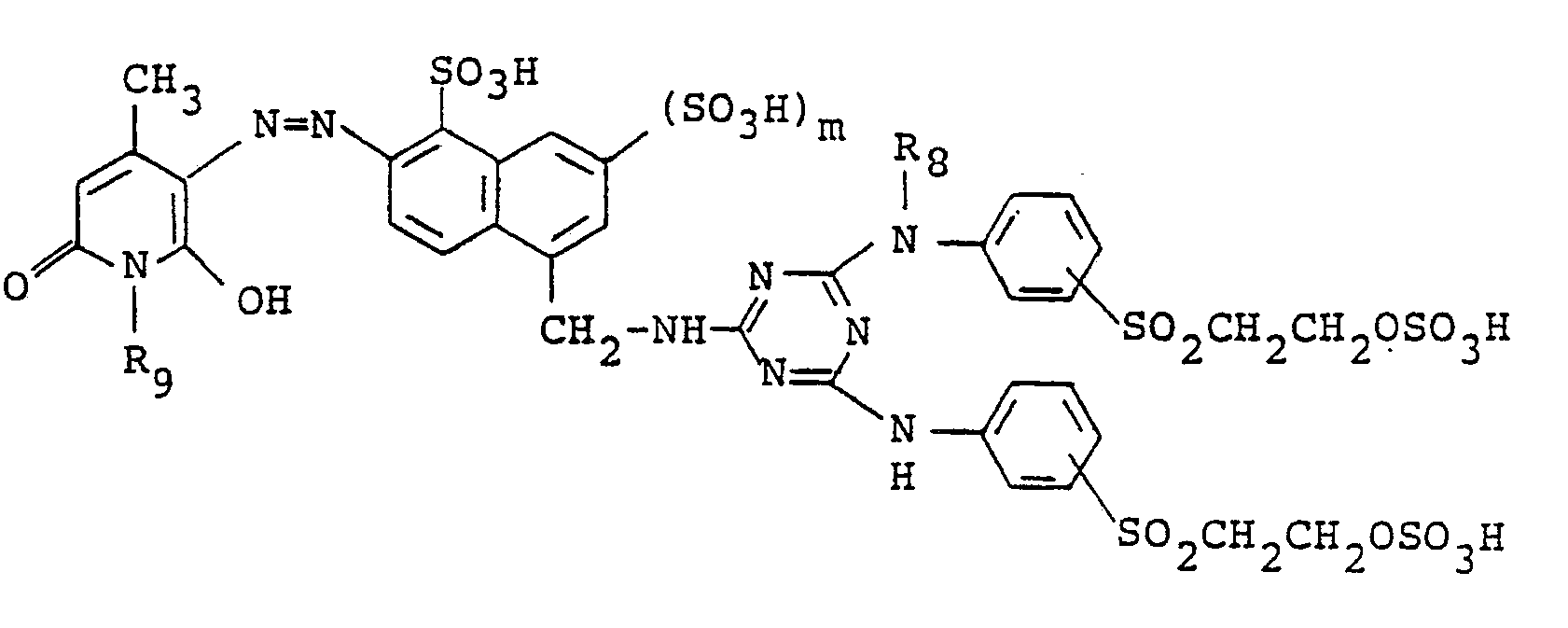
wherein R₈ is hydrogen, methyl or ethyl, R₉ is methyl or ethyl, and m is 0 or 1.
wherein R₈ is hydrogen, methyl or ethyl, R₉ is methyl or ethyl, and m is 0 or 1.
9. A process for producing the monoazo compounds according to claim 1, which comprises
subjecting any one of a diamine compound of the general formula (IV),

wherein A is as defined in claim 1, and an amine compound represented by the general formula (V),
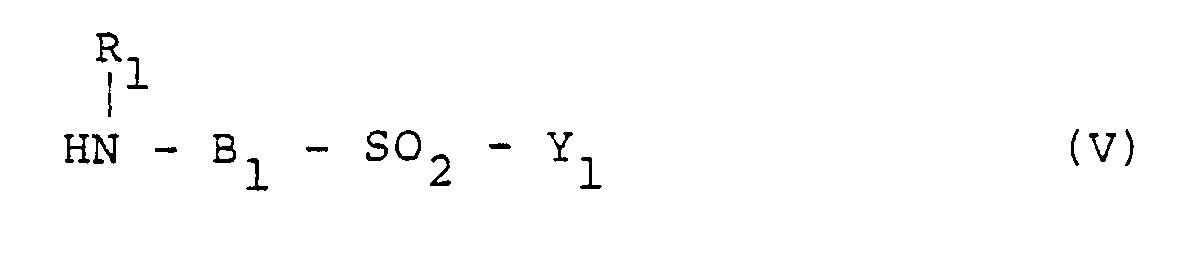
wherein R1 B1 and Y1 are as defined in claim 1, in an aqueous medium to a first condensation with a cyanuric halide followed by a second condensation with the remaining one of formula IV or V to obtain a monohalogenotriazinyl compound represented by the general formula (XII),
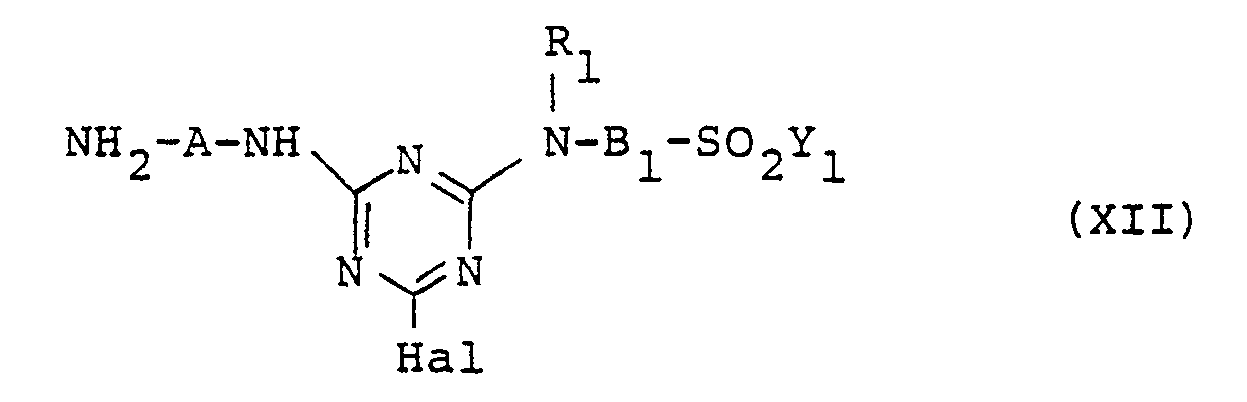
wherein A, R1, B1 and Y1 are as defined in claim 1, and Hal is halogeno such as chloro, fluoro which is then diazotized, followed by coupling with a pyridone compound represented by the general formula (VII)
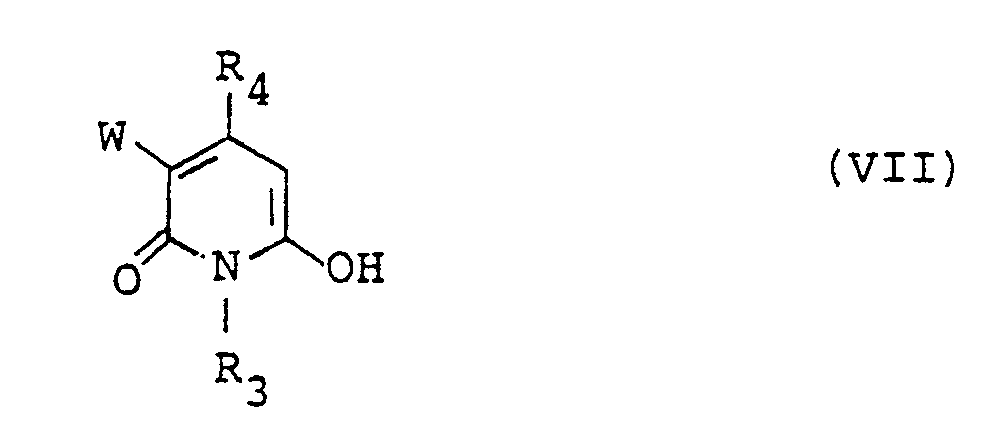
wherein R3, R4 and W are as defined in claim 1, thereby obtaining a monoazo intermediate compound represented by the general formula (XIII),
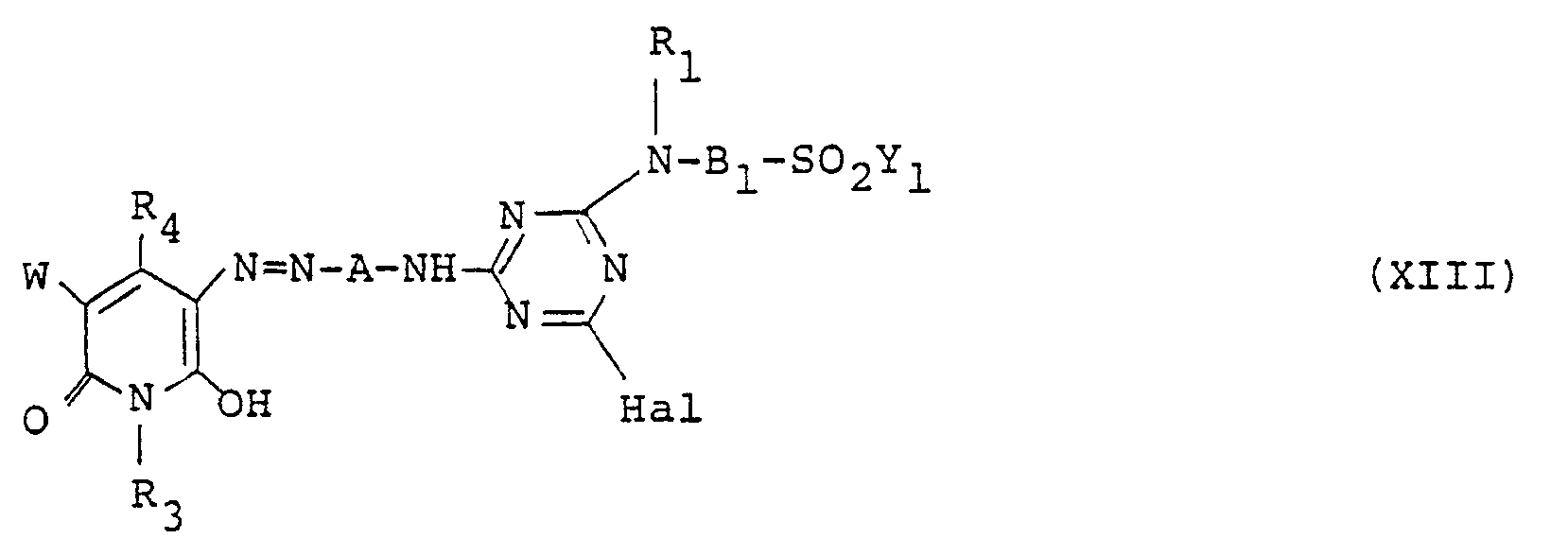
wherein R1, R3, R4, A, B1, Y1, W and Hal are as defined in claim 1 which is subjected to a third condensation with another amine compound represented by the general formula (VI)
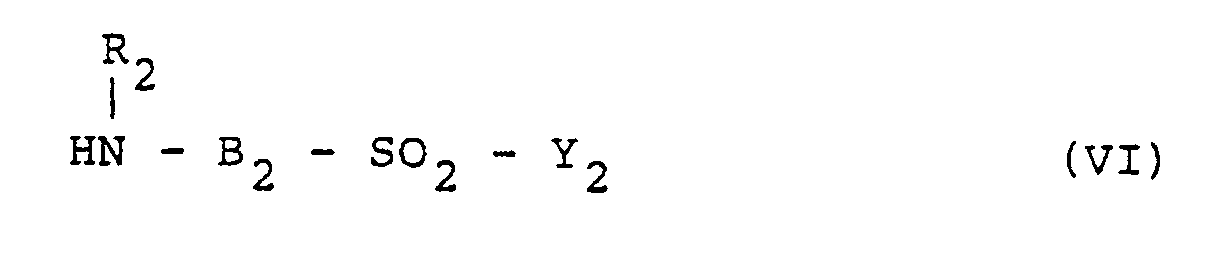
wherein R2, B2 and Y2 are as defined in claim 1;
or alternatively, diazotizing a monoacyl compound of the diamine compound (IV) followed by coupling with the pyridone compound (VII), and then deacylation, thereby obtaining a monoazo intermediate compound represented by the general formula (XIV),
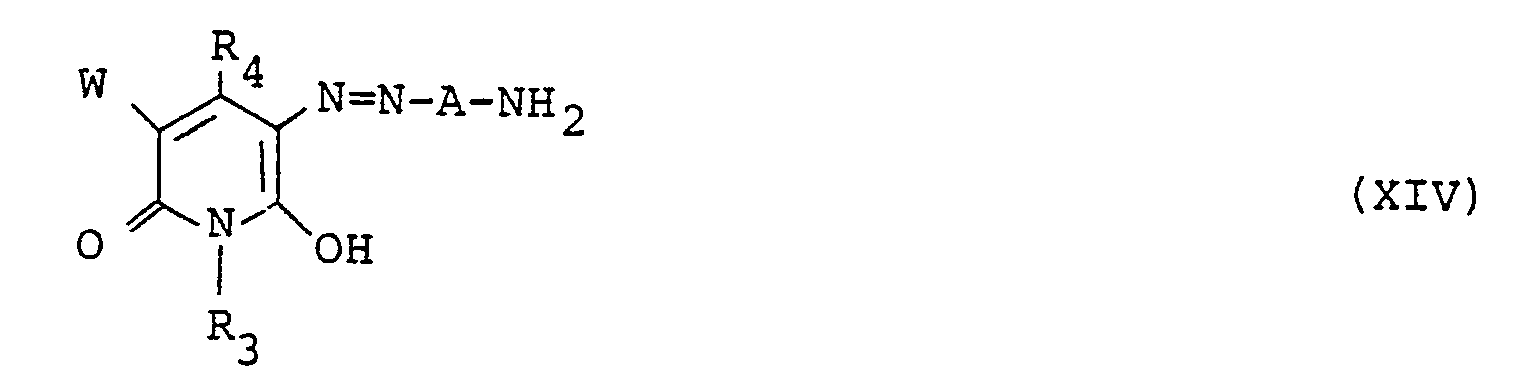
wherein R3, R4, A and W are as defined in claim 1, and then subjecting successively, any one of the monoazo intermediate compound (XIV), the amine compound (V) and another amine compound (VI) to a first condensation with the cyanuric halide, followed by second and third condensations with the remaining ones of (XIV), (V) and (VI).
wherein A is as defined in claim 1, and an amine compound represented by the general formula (V),
wherein R1 B1 and Y1 are as defined in claim 1, in an aqueous medium to a first condensation with a cyanuric halide followed by a second condensation with the remaining one of formula IV or V to obtain a monohalogenotriazinyl compound represented by the general formula (XII),
wherein A, R1, B1 and Y1 are as defined in claim 1, and Hal is halogeno such as chloro, fluoro which is then diazotized, followed by coupling with a pyridone compound represented by the general formula (VII)
wherein R3, R4 and W are as defined in claim 1, thereby obtaining a monoazo intermediate compound represented by the general formula (XIII),
wherein R1, R3, R4, A, B1, Y1, W and Hal are as defined in claim 1 which is subjected to a third condensation with another amine compound represented by the general formula (VI)
wherein R2, B2 and Y2 are as defined in claim 1;
or alternatively, diazotizing a monoacyl compound of the diamine compound (IV) followed by coupling with the pyridone compound (VII), and then deacylation, thereby obtaining a monoazo intermediate compound represented by the general formula (XIV),
wherein R3, R4, A and W are as defined in claim 1, and then subjecting successively, any one of the monoazo intermediate compound (XIV), the amine compound (V) and another amine compound (VI) to a first condensation with the cyanuric halide, followed by second and third condensations with the remaining ones of (XIV), (V) and (VI).
10. A process for dyeing or printing hydroxy group-or carbonamide group-containing materials,
which comprises using a compound according to claim 1.
11. Hydroxy group- or carbonamide group-containing materials dyed or printed by the process
of Claim 10.
Claims for the following Contracting State(s): ES
1. A process for producing a monoazo compound of the general formula (I),
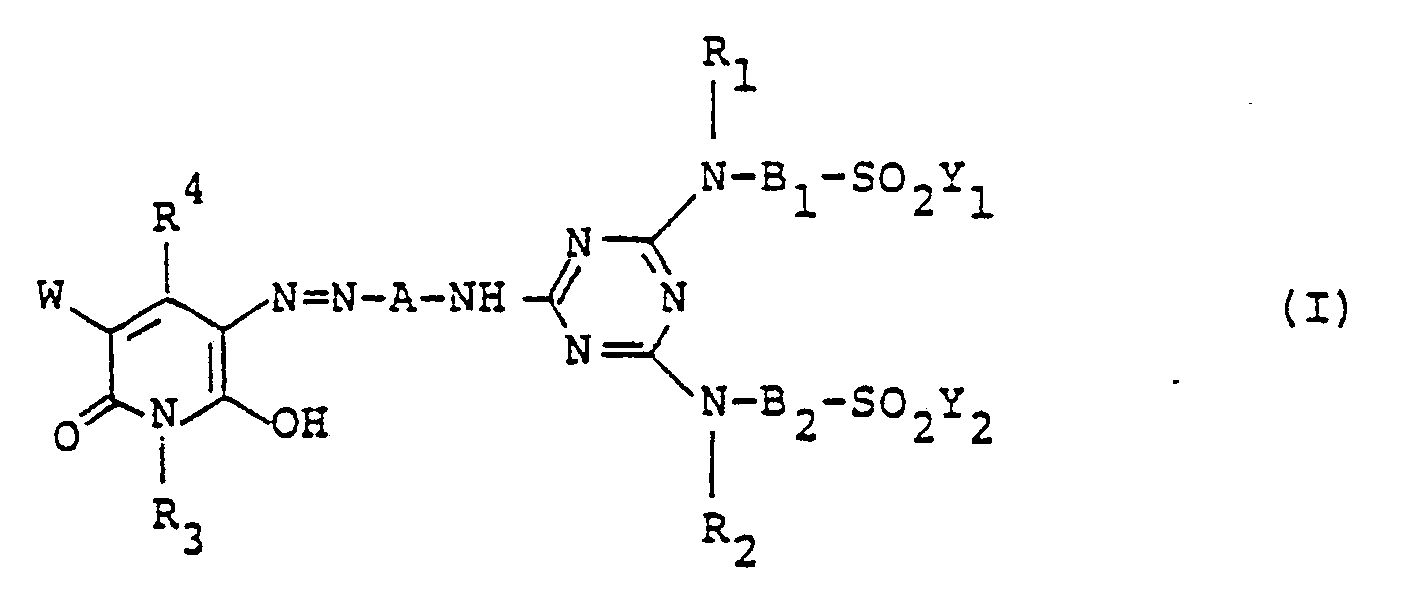
wherein R1 and R2 independently of one another are each hydrogen or unsubstituted or substituted alkyl, R3 is hydrogen or alkyl, R4 is alkyl or carboxy, A is a divalent group represented by the general formula (II) or (III) in each free acid form,
in which R5 is hydrogen, methyl, methoxy, ethoxy, sulfo or carboxy, X is hydrogen or sulfo, n is 0 or 1, and the asterisked linkage bonds to the azo group, B1 and B2 independently of one another are each phenylene unsubstituted or substituted once or twice by methyl, methoxy, ethyl, ethoxy, chloro, bromo, sulfo or carboxy, or naphthylene unsubstituted or substituted by sulfo, W is hydrogen, carbamoyl, sulfoalkyl, cyano, sulfo, chloro or bromo, and Y1 and Y2 independently of one another are each -CH=CH2 or -CH2CH2Z in which Z is a group splittable by the action of an alkali, which comprises subjecting any one of a diamine compound of the general formula (IV),

wherein A is as defined above, and an amine compound represented by the general formula (V),

wherein R1, B1 and Y1 are as defined above, in an aqueous medium to a first condensation with a cyanuric halide followed by a second condensation with the remaining one of (IV) or (V) to obtain a monohalogenotriazinyl compound represented by the general formula (XII),
wherein A, R1, B1 and Y1 are as defined above, and Hal is halogeno such as chloro, fluoro which is then diazotized followed by coupling with a pyridone compound represented by the general formula (VII)
wherein R3, R4 and W are as defined above, thereby obtaining a monoazo intermediate compound represented by the general formula (XIII),
wherein R1, R3, R4, A, B1, Y1, W and Hal are as defined above which is subjected to a third condensation with another amine compound represented by the general formula (VI)
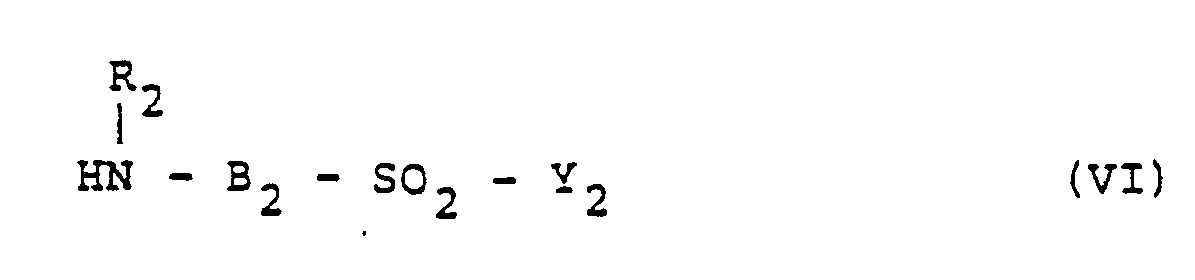
wherein R2, B2 and Y2 are as defined above; or, alternatively, diazotizing a monoacyl compound of the divine compound (IV) followed by coupling with the pyridone compound (VII), and then deacylation, thereby obtaining a monoazo intermediate compound represented by the general formula (XIV),
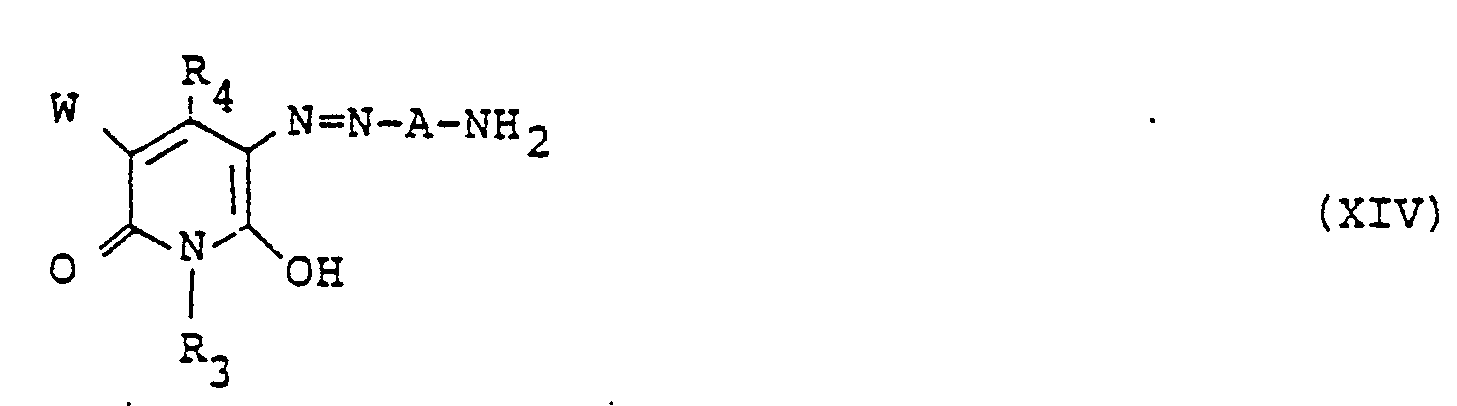
wherein R3, R4, A and W are as defined above, and then subjecting successively, any one of the monoazo intermediate compound (XIV), the amine compound (V) and another amine compound (VI) to a first condensation with the cyanuric halide, followed by second and third condensations with the remaining ones of (XIV),(V) and (VI).
wherein R1 and R2 independently of one another are each hydrogen or unsubstituted or substituted alkyl, R3 is hydrogen or alkyl, R4 is alkyl or carboxy, A is a divalent group represented by the general formula (II) or (III) in each free acid form,
in which R5 is hydrogen, methyl, methoxy, ethoxy, sulfo or carboxy, X is hydrogen or sulfo, n is 0 or 1, and the asterisked linkage bonds to the azo group, B1 and B2 independently of one another are each phenylene unsubstituted or substituted once or twice by methyl, methoxy, ethyl, ethoxy, chloro, bromo, sulfo or carboxy, or naphthylene unsubstituted or substituted by sulfo, W is hydrogen, carbamoyl, sulfoalkyl, cyano, sulfo, chloro or bromo, and Y1 and Y2 independently of one another are each -CH=CH2 or -CH2CH2Z in which Z is a group splittable by the action of an alkali, which comprises subjecting any one of a diamine compound of the general formula (IV),
wherein A is as defined above, and an amine compound represented by the general formula (V),
wherein R1, B1 and Y1 are as defined above, in an aqueous medium to a first condensation with a cyanuric halide followed by a second condensation with the remaining one of (IV) or (V) to obtain a monohalogenotriazinyl compound represented by the general formula (XII),
wherein A, R1, B1 and Y1 are as defined above, and Hal is halogeno such as chloro, fluoro which is then diazotized followed by coupling with a pyridone compound represented by the general formula (VII)
wherein R3, R4 and W are as defined above, thereby obtaining a monoazo intermediate compound represented by the general formula (XIII),
wherein R1, R3, R4, A, B1, Y1, W and Hal are as defined above which is subjected to a third condensation with another amine compound represented by the general formula (VI)
wherein R2, B2 and Y2 are as defined above; or, alternatively, diazotizing a monoacyl compound of the divine compound (IV) followed by coupling with the pyridone compound (VII), and then deacylation, thereby obtaining a monoazo intermediate compound represented by the general formula (XIV),
wherein R3, R4, A and W are as defined above, and then subjecting successively, any one of the monoazo intermediate compound (XIV), the amine compound (V) and another amine compound (VI) to a first condensation with the cyanuric halide, followed by second and third condensations with the remaining ones of (XIV),(V) and (VI).
2. The process according to Claim 1, wherein B1 and B2 independently of one another are each phenylene unsubstituted or substituted by methyl
or methoxy.
3. The process according to Claim 1, wherein any one of R1 and R2 is hydrogen, and the other is hydrogen, methyl or ethyl.
4. The process according to Claim 1, wherein W is hydrogen.
5. The process according to Claim 1, wherein A is a divalent group of the formula (II)
as defined in Claim 1 or the following formula
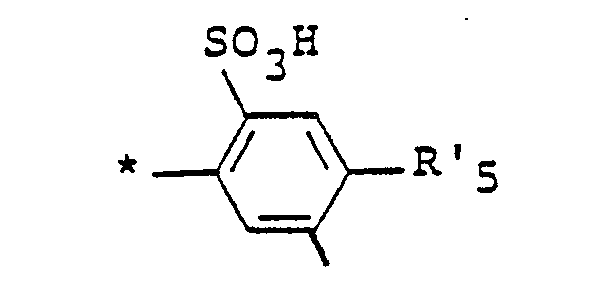
wherein the asterisked linkage is as defined in Claim 1, and R5 is hydrogen, methyl, methoxy, sulfo or carboxy.
wherein the asterisked linkage is as defined in Claim 1, and R5 is hydrogen, methyl, methoxy, sulfo or carboxy.
6. The process according to Claim 1, wherein both Y1 and Y2 are β-sulfatoethyl.
7. The process according to claim 1 for the production of a compound represented by the
following formula in a free acid form,
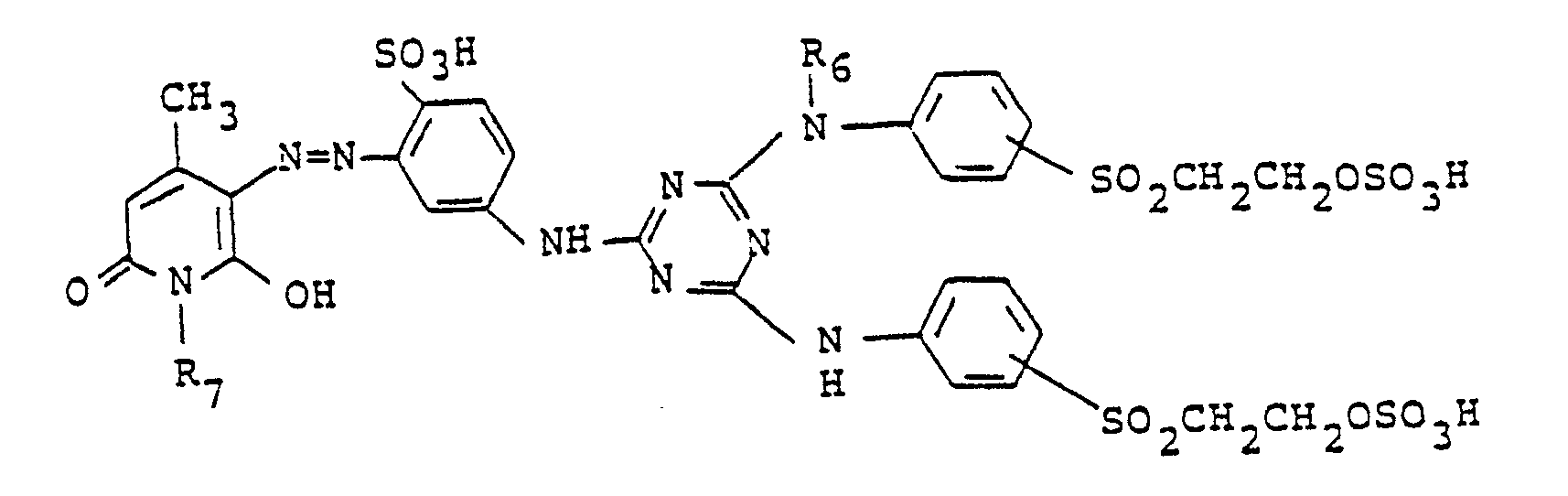
wherein R6 is hydrogen₁ methyl or ethyl, and R7 is methyl or ethyl.
wherein R6 is hydrogen₁ methyl or ethyl, and R7 is methyl or ethyl.
8. The process according to claim 1 for the production of a compound represented by the
following formula in a free acid form,
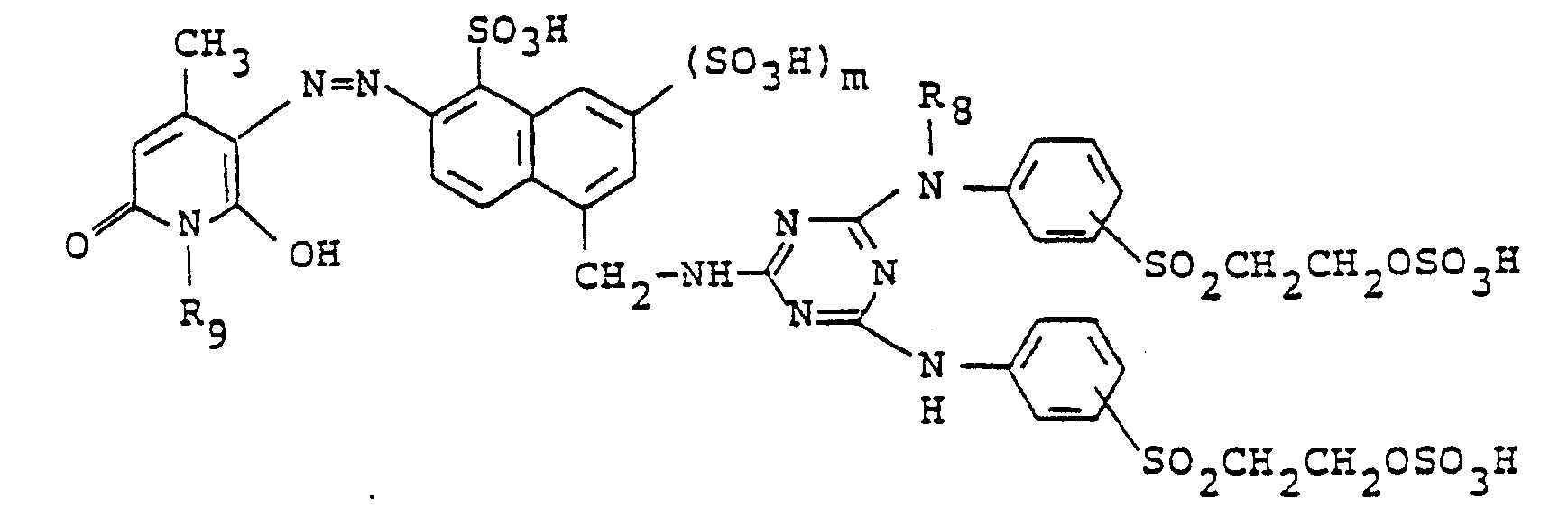
wherein R8 is hydrogen, methyl or ethyl, R9 is methyl or ethyl, and m is 0 or 1.
wherein R8 is hydrogen, methyl or ethyl, R9 is methyl or ethyl, and m is 0 or 1.
9. A process for dyeing or printing hydroxy group-or carbonamide group-containing materials,
which comprises using a compound according to claim 1.
10. Hydroxy group- or carbonamide group-containing materials dyed or printed by the process
of Claim 9.
1. Composés monoazoïques de formule générale (I)
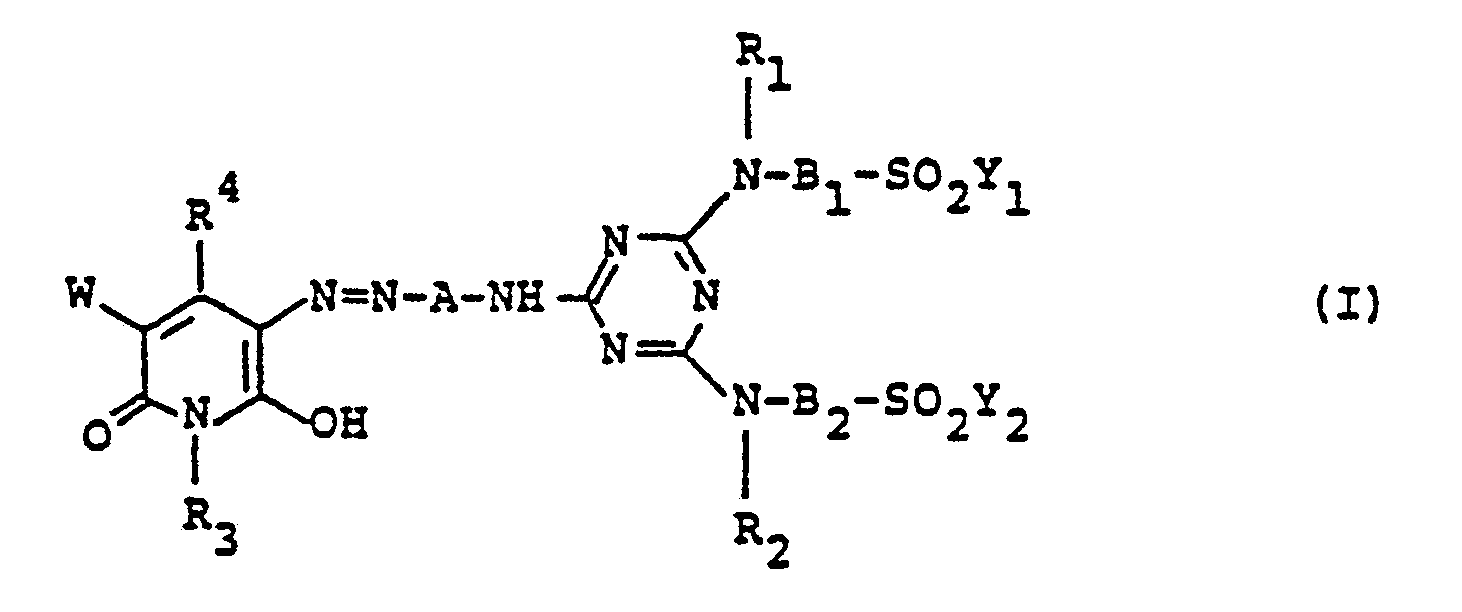
dans laqelle R₁ et R2 sont chacun, indépendamment l'un de l'autre, un atome d'hydrogène ou un radical alkyle non substitué ou substitué, R3 est un atome d'hydrogène ou un radicl alkyle, R4 est un radical alkyle ou carboxy, A est un groupement bivalent représenté par la formule générale (II) ou (III) sous la forme d'acide libre
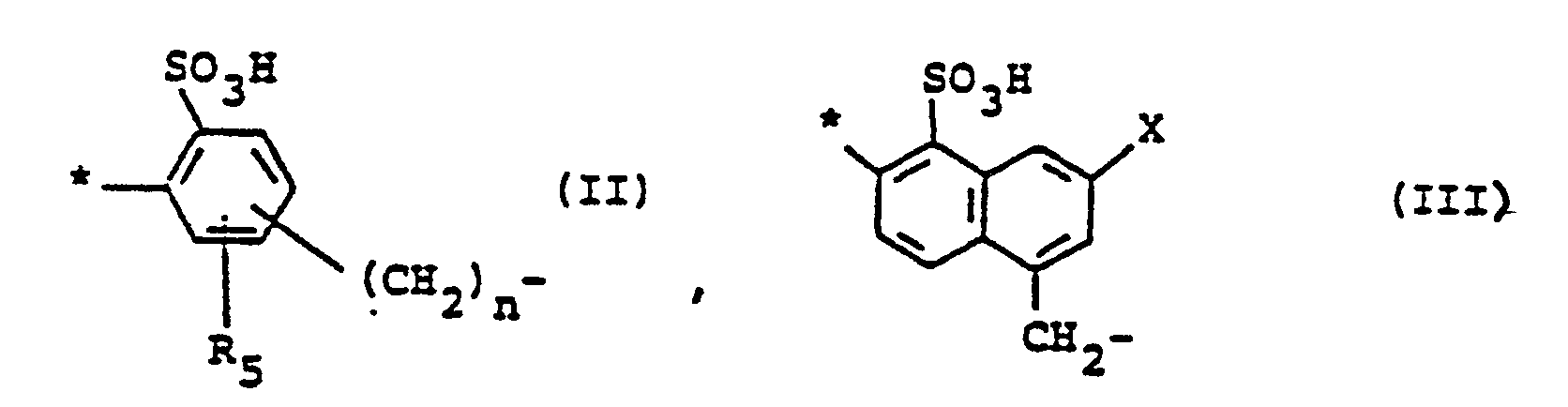
dans laquelle R5 est un atome d'hydrogène ou un radical méthyle, méthoxy, éthoxy, sulfo ou carboxy, X est un atome d'hydrogène ou un radical sulfo, n est mis pour 0 ou 1 et la liaison marquée par un astérisque relie au groupement azoïque, B, et B2 sont chacun, indépendamment l'un de l'autre, un groupement phénylène non substitué ou substitué une ou deux fois par des radicaux méthyle, méthoxy, éthyle, éthoxy, chloro, bromo, sulfo ou carboxy, ou un groupement naphtylène non substitué ou substitué par un radical sulfo, W est un atome d'hydrogène ou un radical carbamoyle, sulfoalkyle, cyano, sulfo, chloro ou bromo, et Y, et Y2 sont chacun, indépendamment l'un de l'autre, un groupement -CH=CH2 ou -CH2CH2Z, Z étant un groupement pouvant être enlevé sous l'action d'une base.
dans laqelle R₁ et R2 sont chacun, indépendamment l'un de l'autre, un atome d'hydrogène ou un radical alkyle non substitué ou substitué, R3 est un atome d'hydrogène ou un radicl alkyle, R4 est un radical alkyle ou carboxy, A est un groupement bivalent représenté par la formule générale (II) ou (III) sous la forme d'acide libre
dans laquelle R5 est un atome d'hydrogène ou un radical méthyle, méthoxy, éthoxy, sulfo ou carboxy, X est un atome d'hydrogène ou un radical sulfo, n est mis pour 0 ou 1 et la liaison marquée par un astérisque relie au groupement azoïque, B, et B2 sont chacun, indépendamment l'un de l'autre, un groupement phénylène non substitué ou substitué une ou deux fois par des radicaux méthyle, méthoxy, éthyle, éthoxy, chloro, bromo, sulfo ou carboxy, ou un groupement naphtylène non substitué ou substitué par un radical sulfo, W est un atome d'hydrogène ou un radical carbamoyle, sulfoalkyle, cyano, sulfo, chloro ou bromo, et Y, et Y2 sont chacun, indépendamment l'un de l'autre, un groupement -CH=CH2 ou -CH2CH2Z, Z étant un groupement pouvant être enlevé sous l'action d'une base.
2. Composé selon la revendication 1, dans lequel B, et B2 sont chacun, indépendamment l'un de l'autre, un groupement phénylène non substitué
ou substitué par un radical méthyle ou méthoxy.
3. Composé selon la revendication 1, dans lequel l'un des groupements R1 et R2 est un atome d'hydrogène et l'autre est un atome d'hydrogène ou un radical méthyle
ou éthyle.
4. Composé selon la revendication 1, dans lequel W est un atome d'hydrogène.
5. Composé selon la revendication 1, dans lequel A est un groupement bivalent de formule
(II) tel que défini dans la revendication 1 ou par la formule suivante
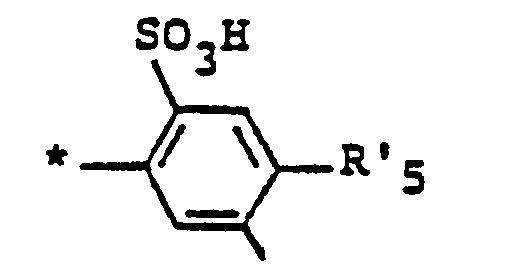
dans laquelle la liaison marquée par un astérisque est telle que définie dans la revendication 1, et R'5 est un atome d'hydrogène ou un radical méthyle, méthoxy, sulfo ou carboxy.
dans laquelle la liaison marquée par un astérisque est telle que définie dans la revendication 1, et R'5 est un atome d'hydrogène ou un radical méthyle, méthoxy, sulfo ou carboxy.
6. Composé selon la revendication 1, dans lequel Y₁ et Y2 sont l'un et l'autre des groupements β-sulfatoéthyle.
7. Composé représenté par la formule suivante sous la forme d'acide libre
dans laquelle R6 est un atome d'hydrogène ou un radical méthyle ou éthyle et R₇ est un radical méthyle ou éthyle.
dans laquelle R6 est un atome d'hydrogène ou un radical méthyle ou éthyle et R₇ est un radical méthyle ou éthyle.
8. Composé représenté par la formule suivante sous la forme d'acide libre
dans laquelle R8 est un atome d'hydrogène ou un radical méthyle ou éthyle, R9 est un radical méthyle ou éthyle et m est mis pour 0 ou 1.
dans laquelle R8 est un atome d'hydrogène ou un radical méthyle ou éthyle, R9 est un radical méthyle ou éthyle et m est mis pour 0 ou 1.
9. Procédé de préparation des composés monoazoïques selon la revendication 1, comprenant
les opérations consistant à soumettre l'un quelconque d'un composé diaminé de formule
générale (IV)

dans laquelle A est tel que défini dans la revendication 1, et d'un composé aminé représenté par la formule générale (V)

dans laquelle R1, B1 et Y₁ sont tels que définis dans la revendication 1, dans un milieu aqueux, à une première condensation avec un halogénure cyanurique, suivie d'une seconde condensation avec le composé restant de formule (IV) ou (V), pour obtenir un dérivé de monohalogénotriazinyle représenté par la formule générale (XII)
dans laquelle A, R₁, B1 et Y1 sont tels que définis dans la revendication 1 et Hal est un atome d'halogène, notamment de chlore au de fluor, dérivé qui est ensuite soumis à une diazotation, suivie d'une copulation avec un dérivé de pyridone représenté par la formule générale (VII)
dans laquelle R3, R4 et W sont tels que définis dans la revendication 1, pour obtenir un composé intermédiaire monoazoïque représenté par la formule générale (XIII)
dans laquelle R₁, R3, R4, A, B1, Y1, W et Hal sont tels que définis dans la revendication 1, composé qui est soumis à une troisième condensation avec un autre composé aminé représenté par la formule générale (VI)

dans laquelle R₂, B2 et Y₂ sont tels que définis dans la revendication 1; ou, à titre de variante, à soumettre un dérivé monoacylé du composé diaminé (IV) à une diazotation, suivie d'une copulation avec le dérivé de pyridone (VII), puis d'une désacylation, pour obtenir un composé intermédiaire monoazoïque représenté par la formule générale (XIV)
dans laquelle R3, R4, A et W sont tels que définis dans la revendication 1, puis à soumettre successivement l'un quelconque du composé intermédiaire monoazoïque (XIV), du composé aminé (Y) et d'un autre composé aminé (VI) à une première condensation avec l'halogénure cyanurique, suivie de seconde et de troisième condensations avec les composés (XIV), (Y) et (VI) restants.
dans laquelle A est tel que défini dans la revendication 1, et d'un composé aminé représenté par la formule générale (V)
dans laquelle R1, B1 et Y₁ sont tels que définis dans la revendication 1, dans un milieu aqueux, à une première condensation avec un halogénure cyanurique, suivie d'une seconde condensation avec le composé restant de formule (IV) ou (V), pour obtenir un dérivé de monohalogénotriazinyle représenté par la formule générale (XII)
dans laquelle A, R₁, B1 et Y1 sont tels que définis dans la revendication 1 et Hal est un atome d'halogène, notamment de chlore au de fluor, dérivé qui est ensuite soumis à une diazotation, suivie d'une copulation avec un dérivé de pyridone représenté par la formule générale (VII)
dans laquelle R3, R4 et W sont tels que définis dans la revendication 1, pour obtenir un composé intermédiaire monoazoïque représenté par la formule générale (XIII)
dans laquelle R₁, R3, R4, A, B1, Y1, W et Hal sont tels que définis dans la revendication 1, composé qui est soumis à une troisième condensation avec un autre composé aminé représenté par la formule générale (VI)
dans laquelle R₂, B2 et Y₂ sont tels que définis dans la revendication 1; ou, à titre de variante, à soumettre un dérivé monoacylé du composé diaminé (IV) à une diazotation, suivie d'une copulation avec le dérivé de pyridone (VII), puis d'une désacylation, pour obtenir un composé intermédiaire monoazoïque représenté par la formule générale (XIV)
dans laquelle R3, R4, A et W sont tels que définis dans la revendication 1, puis à soumettre successivement l'un quelconque du composé intermédiaire monoazoïque (XIV), du composé aminé (Y) et d'un autre composé aminé (VI) à une première condensation avec l'halogénure cyanurique, suivie de seconde et de troisième condensations avec les composés (XIV), (Y) et (VI) restants.
10. Procédé de teinture ou d'impression de matières contenant des groupements hydroxy
ou des groupements carbonamide, consistant à utiliser un composé selon la revendication
1.
11. Matières contenant des groupements hydroxy ou des groupements carbonamide, teintes
ou imprimées par le procédé selon la revendication 10.
Revendications pour l'(les) Etat(s) contractant(s) suivant(s): ES
1. Procédé de préparation d'un composé monoazoïque de formule générale (I)
dans laquelle R₁ et R2 sont chacun, indépendamment l'un de l'autre, un atome d'hydrogène ou un radical alkyle non substitué ou substitué, R3, est un atome d'hydrogène ou un radical alkyle, R4 est un radical alkyle ou carboxy, A est un groupement bivalent représenté par la formule générale (II) ou (III) sous la forme d'acide libre
dans laquelle R5 est un atome d'hydrogène ou un radical méthyle, méthoxy, éthoxy, sulfo ou carboxy, X est un atome d'hydrogène ou un radical sulfo, n est mis pour 0 ou 1 et la liaison marquée par un astérisque relie au groupement azoïque, B1 et B2 sont chacun, indépendamment l'un de l'autre, un groupement phénylène non substitué ou substitué une ou deux fois par des radicaux méthyle, méthocy, éthyle, éthoxy, chloro, bromo, sulfo ou carboxy, ou un groupement naphtylène non substitué ou substitué par un radical sulfo, W est un atome d'hydrogène ou un radical carbamoyle, sulfoalkyle, cyano, sulfo, chloro ou bromo, et Y₁ et Y₂ sont chacun, indépendamment l'un de l'autre, un groupement -CH=CH2 ou -CH2CH2Z, Z étant un groupement pouvant être enlevé sous l'action d'une base, comprenant les opérations consistant à soumettre l'un quelconque d'un composé diaminé de formule générale (IV)

dans laquelle A est tel que défini précédemment, et d'un composé amine représenté par la formule générale (V)

dans laquelle R₁, B1 et Y₁ sont tels que définis précédemment, dans un milieu aqueux, à une première condensation avec un halogénure cyanurique, suivie d'une seconde condensation avec le composé restant de formule (IV) ou (V), pour obtenir un dérivé de monohalogénotriazinyle représenté par la formule générale (XII)
dans laquelle A, R1, B1 et Y, sont tels que définis précédemment et Hal est un atome d'halogène, notamment de chlore ou de fluor, dérivé qui est ensuite soumis à une diazotation, suivie d'une copulation avec un dérivé de pyridone représenté par la formule générale (VII)
dans laquelle R3, R4 et W sont tels que définis précédemment, pour obtenir un composé intermédiaire monoazoïque représenté par la formule générale (XIII)
dans laquelle R₁, R3, R4, A, B1, Y1, W et Hal sont tels que définis précédemment, composé qui est soumis à une troisième condensation avec un autre composé aminé représenté par la formule générale (VI)

dans laquelle R2, B2 et Y2 sont tels que définis précédemment; ou, à titre de variante, à soumettre un dérivé monoacylé du composé diaminé (IV) à une diazotation, suivie d'une copulation avec le dérivé de pyridone (VII), puis d'une désacylation, pour obtenir un composé intermédiaire monoazoïque représenté par la formule générnle (XIV)
dans laquelle R3, R4, A et W sont tels que définis précédemment, puis à soumettre successivement l'un quelconque du composé intermédiaire monoazoïque (XIV), du composé aminé (V) et d'un autre composé aminé (VI) à une première condensation avec l'halogénure cyanurique, suivie de seconde et de troisième condensations avec les composés (XIV), (V) et (VI) restants.
dans laquelle R₁ et R2 sont chacun, indépendamment l'un de l'autre, un atome d'hydrogène ou un radical alkyle non substitué ou substitué, R3, est un atome d'hydrogène ou un radical alkyle, R4 est un radical alkyle ou carboxy, A est un groupement bivalent représenté par la formule générale (II) ou (III) sous la forme d'acide libre
dans laquelle R5 est un atome d'hydrogène ou un radical méthyle, méthoxy, éthoxy, sulfo ou carboxy, X est un atome d'hydrogène ou un radical sulfo, n est mis pour 0 ou 1 et la liaison marquée par un astérisque relie au groupement azoïque, B1 et B2 sont chacun, indépendamment l'un de l'autre, un groupement phénylène non substitué ou substitué une ou deux fois par des radicaux méthyle, méthocy, éthyle, éthoxy, chloro, bromo, sulfo ou carboxy, ou un groupement naphtylène non substitué ou substitué par un radical sulfo, W est un atome d'hydrogène ou un radical carbamoyle, sulfoalkyle, cyano, sulfo, chloro ou bromo, et Y₁ et Y₂ sont chacun, indépendamment l'un de l'autre, un groupement -CH=CH2 ou -CH2CH2Z, Z étant un groupement pouvant être enlevé sous l'action d'une base, comprenant les opérations consistant à soumettre l'un quelconque d'un composé diaminé de formule générale (IV)
dans laquelle A est tel que défini précédemment, et d'un composé amine représenté par la formule générale (V)
dans laquelle R₁, B1 et Y₁ sont tels que définis précédemment, dans un milieu aqueux, à une première condensation avec un halogénure cyanurique, suivie d'une seconde condensation avec le composé restant de formule (IV) ou (V), pour obtenir un dérivé de monohalogénotriazinyle représenté par la formule générale (XII)
dans laquelle A, R1, B1 et Y, sont tels que définis précédemment et Hal est un atome d'halogène, notamment de chlore ou de fluor, dérivé qui est ensuite soumis à une diazotation, suivie d'une copulation avec un dérivé de pyridone représenté par la formule générale (VII)
dans laquelle R3, R4 et W sont tels que définis précédemment, pour obtenir un composé intermédiaire monoazoïque représenté par la formule générale (XIII)
dans laquelle R₁, R3, R4, A, B1, Y1, W et Hal sont tels que définis précédemment, composé qui est soumis à une troisième condensation avec un autre composé aminé représenté par la formule générale (VI)
dans laquelle R2, B2 et Y2 sont tels que définis précédemment; ou, à titre de variante, à soumettre un dérivé monoacylé du composé diaminé (IV) à une diazotation, suivie d'une copulation avec le dérivé de pyridone (VII), puis d'une désacylation, pour obtenir un composé intermédiaire monoazoïque représenté par la formule générnle (XIV)
dans laquelle R3, R4, A et W sont tels que définis précédemment, puis à soumettre successivement l'un quelconque du composé intermédiaire monoazoïque (XIV), du composé aminé (V) et d'un autre composé aminé (VI) à une première condensation avec l'halogénure cyanurique, suivie de seconde et de troisième condensations avec les composés (XIV), (V) et (VI) restants.
2. Procédé selon la revendication 1, dans lequel B1 et B2 sont chacun, indépendamment l'un de l'autre, un groupement phénylène non substitué
ou substitué par un radical méthyle ou méthoxy.
3. Procédé selon la revendication 1, dans lequel l'un des groupements R₁ et R₂ est un
atome d'hydrogène et l'autre est un atome d'hydrogène ou un radical méthyle ou éthyle.
4. Procédé selon la revendication 1, dans lequel W est un atome d'hydrogène.
5. Procédé selon la revendication 1, dans lequel A est un groupement bivalent de formule
(II) tel que défini dans la revendication 1 ou par la formule suivante
dans laquelle la liaison marquée par un astérisque est telle que définie dans la revendication 1, et R'₆ est un atome d'hydrogène ou un radical méthyle, méthoxy, sulfo ou carboxy.
dans laquelle la liaison marquée par un astérisque est telle que définie dans la revendication 1, et R'₆ est un atome d'hydrogène ou un radical méthyle, méthoxy, sulfo ou carboxy.
6. Procédé selon la revendication 1, dans lequel Y1 et Y2 sont l'un et l'autre des groupements β-sulfatoéthyle.
7. Procédé selon la revendication 1 pour la préparation d'un composé représenté par la
formule suivante sous la forme d'acide libre
dans laquelle R6 est un atome d'hydrogène ou un radical méthyle ou éthyle et R₇ est un radical méthyle ou éthyle.
dans laquelle R6 est un atome d'hydrogène ou un radical méthyle ou éthyle et R₇ est un radical méthyle ou éthyle.
8. Procédé selon la revendication 1 pour la préparation d'un composé représenté par la
formule suivante sous la forme d'acide libre
dans laquelle R8 est un atome d'hydrogène ou un radical méthyle ou éthyle, R9 est un radical méthyle ou éthyle et m est mis pour 0 ou 1.
dans laquelle R8 est un atome d'hydrogène ou un radical méthyle ou éthyle, R9 est un radical méthyle ou éthyle et m est mis pour 0 ou 1.
9. Procédé de teinture ou d'impression de matières contenant des groupements hydroxy
ou des groupements carbonamide, consistant à utiliser un composé selon la revendication
1.
10. Matières contenant des groupements hydroxy ou des groupements carbonamide, teintes
ou imprimées par le procédé selon la revendication 9.
1. Monoazoverbindungen der allgemeinen Formel (I)
in der R1 und R2 unabhängig voneinander jeweils ein Wasserstoffatom oder einen unsubstituierten oder substituierten Alkylrest bedeuten, R3 ein Wasserstoffatom oder einen Alkylrest darstellt, R4 einen Alkylrest oder eine Carboxygruppe bedeutet, A einen zweiwertigen Rest der allgemeinen Formel (II) oder (III), jeweils in Form der freien Säure, bedeutet
in denen R5 ein Wasserstoffatom, eine Methyl-, Methoxy-, Ethoxy-, Sulfo- oder Carboxygruppe darstellt, X ein Wasserstoffatom oder eine Sulfogruppe bedeutet, n 0 oder 1 ist, und die mit dem Sternchen bezeichnete Bindung an die Azogruppe gebunden ist, B1 und B2 unabhängig voneinander jeweils eine unsubstituierte oder einfach oder zweifach durch eine Methyl-, Methoxy-, Ethyl-, Ethoxy-, Chlor-, Brom-, Sulfo- oder Carboxygruppe substituierte Phenylengruppe oder eine unsubstituierte oder durch eine Sulfogruppe substituierte Naphthylengruppe bedeutet, W ein Wasserstoffatom, eine Carbamoyl-, Sulfoalkyl-, Cyano- oder Sulfogruppe, ein Chlor- oder Bromatom darstellt und Y1 und Y2 unabhängig voneinander jeweils eine Gruppe der Formel -CH=CH2 oder -CH2CH2Z bedeuten, in der Z eine durch Einwirkung von Alkali abspaltbare Gruppe darstellt.
in der R1 und R2 unabhängig voneinander jeweils ein Wasserstoffatom oder einen unsubstituierten oder substituierten Alkylrest bedeuten, R3 ein Wasserstoffatom oder einen Alkylrest darstellt, R4 einen Alkylrest oder eine Carboxygruppe bedeutet, A einen zweiwertigen Rest der allgemeinen Formel (II) oder (III), jeweils in Form der freien Säure, bedeutet
in denen R5 ein Wasserstoffatom, eine Methyl-, Methoxy-, Ethoxy-, Sulfo- oder Carboxygruppe darstellt, X ein Wasserstoffatom oder eine Sulfogruppe bedeutet, n 0 oder 1 ist, und die mit dem Sternchen bezeichnete Bindung an die Azogruppe gebunden ist, B1 und B2 unabhängig voneinander jeweils eine unsubstituierte oder einfach oder zweifach durch eine Methyl-, Methoxy-, Ethyl-, Ethoxy-, Chlor-, Brom-, Sulfo- oder Carboxygruppe substituierte Phenylengruppe oder eine unsubstituierte oder durch eine Sulfogruppe substituierte Naphthylengruppe bedeutet, W ein Wasserstoffatom, eine Carbamoyl-, Sulfoalkyl-, Cyano- oder Sulfogruppe, ein Chlor- oder Bromatom darstellt und Y1 und Y2 unabhängig voneinander jeweils eine Gruppe der Formel -CH=CH2 oder -CH2CH2Z bedeuten, in der Z eine durch Einwirkung von Alkali abspaltbare Gruppe darstellt.
2. Verbindung nach Anspruch 1, in der B1 und B2 unabhängig voneinander jeweils eine unsubstituierte oder durch eine Methyl- oder
Methoxygruppe substituierte Phenylengruppe bedeuten.
3. Verbindung nach Anspruch 1, in der einer der Reste R1 und R2 ein Wasserstoffatom und der andere ein Wasserstoffatom, eine Methyl- oder Ethylgruppe
ist.
4. Verbindung nach Anspruch 1, in der W ein Wasserstoffatom ist.
5. Verbindung nach Anspruch 1, in der A einen zweiwertigen Rest der Formel (II) gemäß
Anspruch 1 oder der folgenden Formel
bedeutet, wobei die mit einem Sternchen versehene Bindung wie in Anspruch 1 definiert ist, und R'5 ein Wasserstoffatom, eine Methyl-, Methoxy-, Sulfo- oder Carboxygruppe darstellt.
bedeutet, wobei die mit einem Sternchen versehene Bindung wie in Anspruch 1 definiert ist, und R'5 ein Wasserstoffatom, eine Methyl-, Methoxy-, Sulfo- oder Carboxygruppe darstellt.
6. Verbindung nach Anspruch 1, in der beide Reste Y1 und Y2 β-Sulfatoethylgruppen sind.
7. Verbindung der folgenden Formel in Form der freien Säure
in der R6 ein Wasserstoffatom, eine Methyl- oder Ethylgruppe bedeutet und R7 eine Methyl- oder Ethylgruppe darstellt.
in der R6 ein Wasserstoffatom, eine Methyl- oder Ethylgruppe bedeutet und R7 eine Methyl- oder Ethylgruppe darstellt.
8. Verbindung der folgenden Formel in Form der freien Säure
in der R8 ein Wasserstoffatom, eine Methyl- oder Ethylgruppe bedeutet, R9 eine Methyl- oder Ethylgruppe darstellt, und m 0 oder 1 ist.
in der R8 ein Wasserstoffatom, eine Methyl- oder Ethylgruppe bedeutet, R9 eine Methyl- oder Ethylgruppe darstellt, und m 0 oder 1 ist.
9. Verfahren zur Herstellung der Monoazoverbindungen nach Anspruch 1, welches die Durchführung
einer ersten Kondensation mit einer der Verbindungen, nämlich einer Diaminverbindung
der allgemeinen Formel (IV)

in der A wie in Anspruch 1 definiert ist, und einer Aminverbindung der allgemeinen Formel (V)
in der R1, B1 und Y1 wie in Anspruch 1 definiert sind, mit einem Cyanursäurehalogenid in einem wäßrigen Medium umfaßt, gefolgt von einer zweiten Kondensation mit der verbliebenen Verbindung der Formel IV oder V, wobei eine Monohalogenotriazinylverbindung der allgemeinen Formel (XII) erhalten wird
in der A, R1, B1 und Y1 wie in Anspruch 1 definiert sind und Hal ein Halogenatom, wie ein Chlor- oder Fluoratom bedeutet, welche dann diazotiert wird, gefolgt von der Kupplung mit einer Pyridonverbindung der allgemeinen Formel (VII)
in der R3, R4 und W wie in Anspruch 1 definiert sind, wobei eine Monoazo-Zwischenverbindung der allgemeinen Formel (XIII) erhalten wird
in der R1, R3, R4, A, B1, Y1, W und Hal wie in Anspruch 1 definiert sind, welche einer dritten Kondensation mit einer weiteren Aminverbindung der allgemeinen Formel (VI)
unterzogen wird, in der R2, B2 und Y2 wie in Anspruch 1 definiert sind;
oder, alternativ, Diazotierung einer Monoacylverbindung der Diaminverbindung (IV), gefolgt von der Kupplung mit der Pyridonverbindung (VII), anschließend Deacylierung, wobei eine Monoazo-Zwischenverbindung der allgemeinen Formel (XIV) erhalten wird,
in der R3, R4, A und W wie in Anspruch 1 definiert sind, und dann nacheinander Durchführung einer ersten Kondensation mit einer der Verbindungen, nämlich der Monoazo-Zwischenverbindung (XIV), der Aminverbindung (V) und der anderen Aminverbindung (VI) mit dem Cyanursäurehalogenid, gefolgt von zweiten und dritten Kondensationen mit den verbleibenden Verbindungen (XIV), (V) und (VI).
in der A wie in Anspruch 1 definiert ist, und einer Aminverbindung der allgemeinen Formel (V)
in der R1, B1 und Y1 wie in Anspruch 1 definiert sind, mit einem Cyanursäurehalogenid in einem wäßrigen Medium umfaßt, gefolgt von einer zweiten Kondensation mit der verbliebenen Verbindung der Formel IV oder V, wobei eine Monohalogenotriazinylverbindung der allgemeinen Formel (XII) erhalten wird
in der A, R1, B1 und Y1 wie in Anspruch 1 definiert sind und Hal ein Halogenatom, wie ein Chlor- oder Fluoratom bedeutet, welche dann diazotiert wird, gefolgt von der Kupplung mit einer Pyridonverbindung der allgemeinen Formel (VII)
in der R3, R4 und W wie in Anspruch 1 definiert sind, wobei eine Monoazo-Zwischenverbindung der allgemeinen Formel (XIII) erhalten wird
in der R1, R3, R4, A, B1, Y1, W und Hal wie in Anspruch 1 definiert sind, welche einer dritten Kondensation mit einer weiteren Aminverbindung der allgemeinen Formel (VI)
unterzogen wird, in der R2, B2 und Y2 wie in Anspruch 1 definiert sind;
oder, alternativ, Diazotierung einer Monoacylverbindung der Diaminverbindung (IV), gefolgt von der Kupplung mit der Pyridonverbindung (VII), anschließend Deacylierung, wobei eine Monoazo-Zwischenverbindung der allgemeinen Formel (XIV) erhalten wird,
in der R3, R4, A und W wie in Anspruch 1 definiert sind, und dann nacheinander Durchführung einer ersten Kondensation mit einer der Verbindungen, nämlich der Monoazo-Zwischenverbindung (XIV), der Aminverbindung (V) und der anderen Aminverbindung (VI) mit dem Cyanursäurehalogenid, gefolgt von zweiten und dritten Kondensationen mit den verbleibenden Verbindungen (XIV), (V) und (VI).
10. Verfahren zum Färben oder Bedrucken von Hydroxylgruppen oder Carbonamidgruppen enthaltendem
Material, umfassend die Verwendung einer Verbindung nach Anspruch 1.
11. Hydroxylgruppen- oder Carbonamidgruppen enthaltendes Material, gefärbt oder bedruckt
nach dem Verfahren von Anspruch 10.
Patentansprüche für folgende(n) Vertragsstaat(en): ES
1. Verfahren zur Herstellung einer Monoazoverbindung der allgemeinen Formel (I)
in der R1 und R2 unabhängig voneinander jeweils ein Wasserstoffatom oder einen unsubstituierten oder substituierten Alkylrest bedeuten, R3 ein Wasserstoffatom oder einen Alkylrest darstellt, R4 einen Alkylrest oder eine Carboxygruppe bedeutet, A einen zweiwertigen Rest der allgemeinen Formel (II) oder (III), jeweils in Form der freien Säure, bedeutet
in denen R5 ein Wasserstoffatom, eine Methyl-, Methoxy-, Ethoxy-, Sulfo- oder Carboxygruppe darstellt, X ein Wasserstoffatom oder eine Sulfogruppe bedeutet, n 0 oder 1 ist, und die mit dem Sternchen bezeichnete Bindung an die Azogruppe gebunden ist, B1 und B2 unabhängig voneinander jeweils eine unsubstituierte oder einfach oder zweifach durch eine Methyl-, Methoxy-, Ethyl-, Ethoxy-, Chlor-, Brom-, Sulfo- oder Carboxygruppe substituierte Phenylengruppe oder eine unsubstituierte oder durch eine Sulfogruppe substituierte Naphthylengruppe bedeutet, W ein Wasserstoffatom, eine Carbamoyl-, Sulfoalkyl-, Cyano- oder Sulfogruppe, ein Chlor- oder Bromatom darstellt und Y1 und Y2 unabhängig voneinander jeweils eine Gruppe der Formel -CH=CH₂ oder -CH₂CH₂Z bedeuten, in der Z eine durch Einwirkung von Alkali abspaltbare Gruppe darstellt, welches die Durchführung einer ersten Kondensation mit einer der Verbindungen, nämlich einer DiaminVerbindung der allgemeinen Formel (IV)

in der A wie vorstehend definiert ist, und einer Aminverbindung der allgemeinen Formel (V)
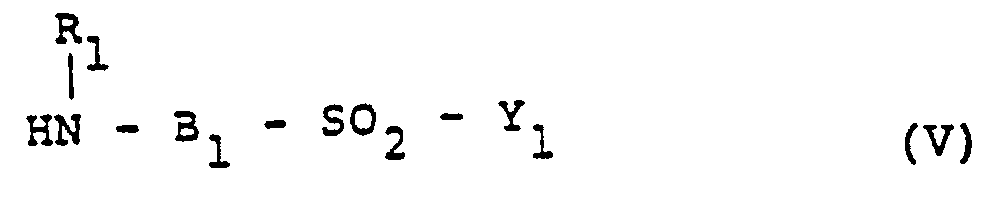
in der R1, B1 und Y1 wie vorstehend definiert sind, mit einem Cyanursäurehalogenid in einem wäßrigen Medium umfaßt, gefolgt von einer zweiten Kondensation mit der verbliebenen Verbindung der Formel IV oder V, wobei eine Monohalogenotriazinylverbindung der allgemeinen Formel (XII) erhalten wird
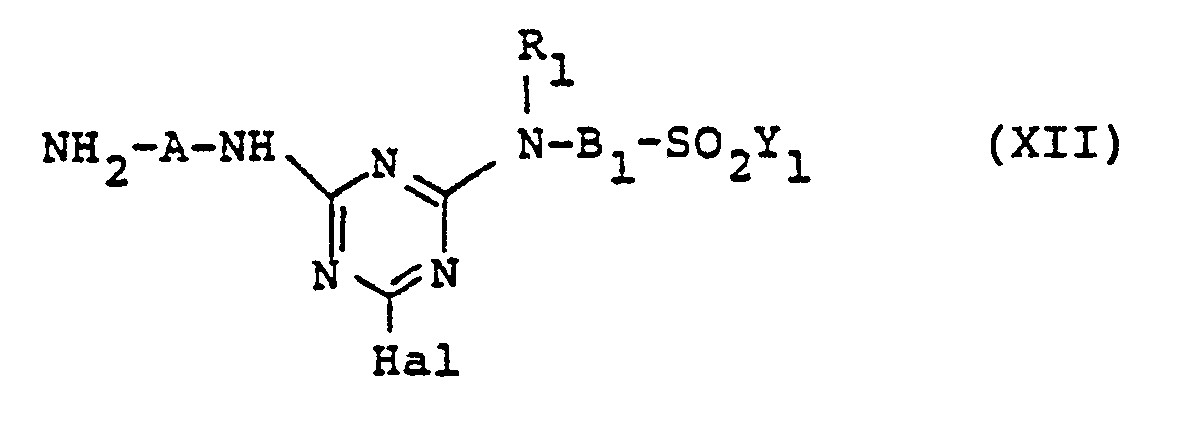
in der A, R1, B1 und Y1 wie vorstehend definiert sind und Hal ein Halogenatom, wie ein Chlor- oder Fluoratom bedeutet, welche dann diazotiert wird, gefolgt von der Kupplung mit einer Pyridonverbindung der allgemeinen Formel (VII)
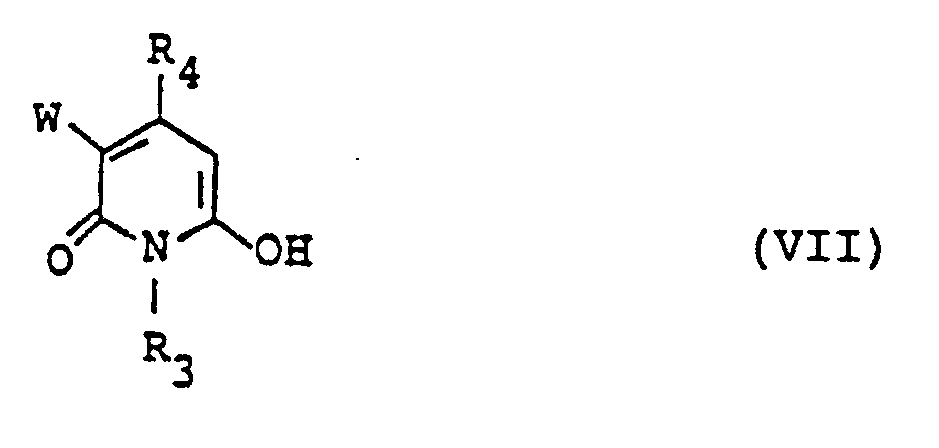
in der R₃, R₄ und W wie vorstehend definiert sind, wobei eine Monoazo-Zwischenverbindung der allgemeinen Formel (XIII) erhalten wird
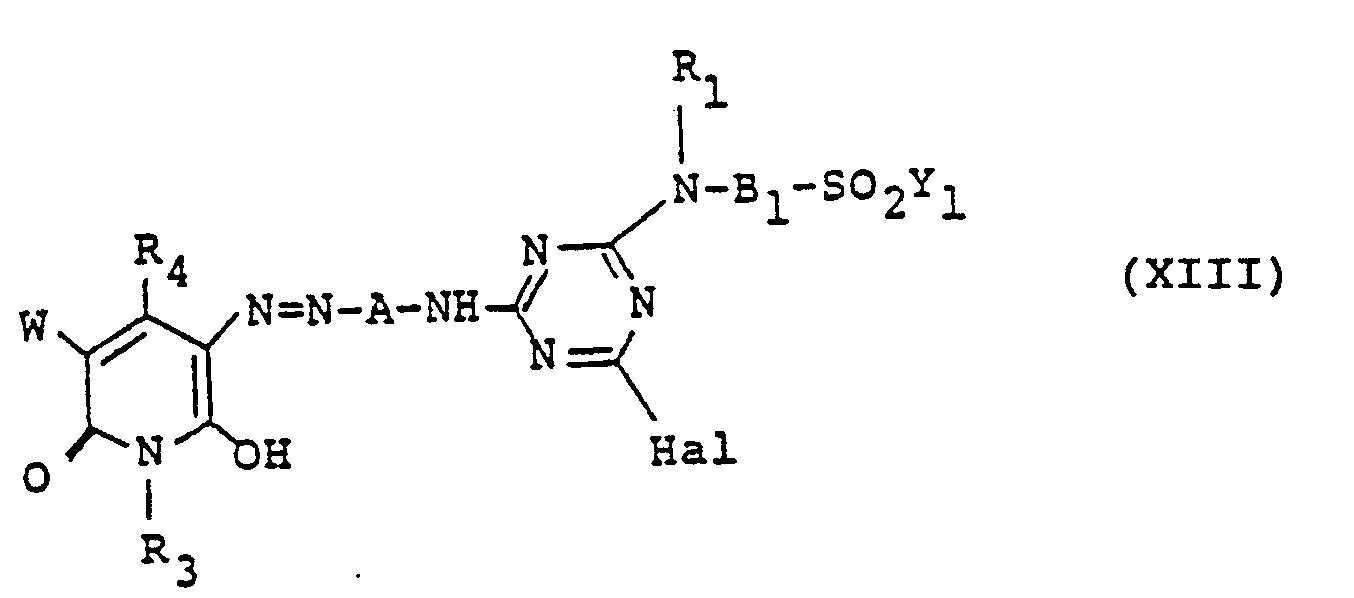
in der R₁, R₃, R₄, A, B1, Y1, W und Hal wie vorstehend definiert sind, welche einer dritten Kondensation mit einer weiteren Aminverbindung der allgemeinen Formel (VI)
unterzogen wird, in der R₂, B2 und Y2 wie vorstehend definiert sind;
oder, alternativ, Diazotierung einer Monoacylverbindung der Diaminverbindung (IV), gefolgt von der Kupplung mit der Pyridonverbindung (VII), anschließend Deacylierung, wobei eine Monoazo-Zwischenverbindung der allgemeinen Formel (XIV) erhalten wird,
in der R₃, R₄, A und W wie vorstehend definiert sind, und dann nacheinander Durchführung einer ersten Kondensation mit einer der Verbindungen, nämlich der Monoazo-Zwischenverbindung (XIV), der Aminverbindung (V) und der anderen Aminverbindung (VI) mit dem Cyanursäurehalogenid, gefolgt von zweiten und dritten Kondensationen mit den verbleibenden Verbindungen (XIV), (V) und (VI).
in der R1 und R2 unabhängig voneinander jeweils ein Wasserstoffatom oder einen unsubstituierten oder substituierten Alkylrest bedeuten, R3 ein Wasserstoffatom oder einen Alkylrest darstellt, R4 einen Alkylrest oder eine Carboxygruppe bedeutet, A einen zweiwertigen Rest der allgemeinen Formel (II) oder (III), jeweils in Form der freien Säure, bedeutet
in denen R5 ein Wasserstoffatom, eine Methyl-, Methoxy-, Ethoxy-, Sulfo- oder Carboxygruppe darstellt, X ein Wasserstoffatom oder eine Sulfogruppe bedeutet, n 0 oder 1 ist, und die mit dem Sternchen bezeichnete Bindung an die Azogruppe gebunden ist, B1 und B2 unabhängig voneinander jeweils eine unsubstituierte oder einfach oder zweifach durch eine Methyl-, Methoxy-, Ethyl-, Ethoxy-, Chlor-, Brom-, Sulfo- oder Carboxygruppe substituierte Phenylengruppe oder eine unsubstituierte oder durch eine Sulfogruppe substituierte Naphthylengruppe bedeutet, W ein Wasserstoffatom, eine Carbamoyl-, Sulfoalkyl-, Cyano- oder Sulfogruppe, ein Chlor- oder Bromatom darstellt und Y1 und Y2 unabhängig voneinander jeweils eine Gruppe der Formel -CH=CH₂ oder -CH₂CH₂Z bedeuten, in der Z eine durch Einwirkung von Alkali abspaltbare Gruppe darstellt, welches die Durchführung einer ersten Kondensation mit einer der Verbindungen, nämlich einer DiaminVerbindung der allgemeinen Formel (IV)
in der A wie vorstehend definiert ist, und einer Aminverbindung der allgemeinen Formel (V)
in der R1, B1 und Y1 wie vorstehend definiert sind, mit einem Cyanursäurehalogenid in einem wäßrigen Medium umfaßt, gefolgt von einer zweiten Kondensation mit der verbliebenen Verbindung der Formel IV oder V, wobei eine Monohalogenotriazinylverbindung der allgemeinen Formel (XII) erhalten wird
in der A, R1, B1 und Y1 wie vorstehend definiert sind und Hal ein Halogenatom, wie ein Chlor- oder Fluoratom bedeutet, welche dann diazotiert wird, gefolgt von der Kupplung mit einer Pyridonverbindung der allgemeinen Formel (VII)
in der R₃, R₄ und W wie vorstehend definiert sind, wobei eine Monoazo-Zwischenverbindung der allgemeinen Formel (XIII) erhalten wird
in der R₁, R₃, R₄, A, B1, Y1, W und Hal wie vorstehend definiert sind, welche einer dritten Kondensation mit einer weiteren Aminverbindung der allgemeinen Formel (VI)
unterzogen wird, in der R₂, B2 und Y2 wie vorstehend definiert sind;
oder, alternativ, Diazotierung einer Monoacylverbindung der Diaminverbindung (IV), gefolgt von der Kupplung mit der Pyridonverbindung (VII), anschließend Deacylierung, wobei eine Monoazo-Zwischenverbindung der allgemeinen Formel (XIV) erhalten wird,
in der R₃, R₄, A und W wie vorstehend definiert sind, und dann nacheinander Durchführung einer ersten Kondensation mit einer der Verbindungen, nämlich der Monoazo-Zwischenverbindung (XIV), der Aminverbindung (V) und der anderen Aminverbindung (VI) mit dem Cyanursäurehalogenid, gefolgt von zweiten und dritten Kondensationen mit den verbleibenden Verbindungen (XIV), (V) und (VI).
2. Verfahren nach Anspruch 1, in dem B1 und B2 unabhängig voneinander jeweils eine unsubstituierte oder durch eine Methyl- oder
Methoxygruppe substituierte Phenylengruppe bedeuten.
3. Verfahren nach Anspruch 1, in dem einer der Reste R₁ und R₂ ein Wasserstoffatom und
der andere ein Wasserstoffatom, eine Methyl- oder Ethylgruppe ist.
4. Verfahren nach Anspruch 1, in dem W ein Wasserstoffatom ist.
5. Verfahren nach Anspruch 1, in dem A einen zweiwertigen Rest der Formel (II) gemäß
Anspruch 1 oder der folgenden Formel
bedeutet, wobei die mit einem Sternchen versehene Bindung wie in Anspruch 1 definiert ist, und R'₅ ein Wasserstoffatom, eine Methyl-, Methoxy-, Sulfo- oder Carboxygruppe darstellt.
bedeutet, wobei die mit einem Sternchen versehene Bindung wie in Anspruch 1 definiert ist, und R'₅ ein Wasserstoffatom, eine Methyl-, Methoxy-, Sulfo- oder Carboxygruppe darstellt.
6. Verfahren nach Anspruch 1, in dem beide Reste Y1 und Y2 ß-Sulfatoethylgruppen sind.
7. Verfahren nach Anspruch 1 zur Herstellung einer Verbindung der folgenden Formel in
Form der freien Säure
in der R6 ein Wasserstoffatom, eine Methyl- oder Ethylgruppe bedeutet und R₇ eine Methyl- oder Ethylgruppe darstellt.
in der R6 ein Wasserstoffatom, eine Methyl- oder Ethylgruppe bedeutet und R₇ eine Methyl- oder Ethylgruppe darstellt.
8. Verfahren nach Anspruch 1 zur Herstellung einer Verbindung der folgenden Formel in
Form der freien Säure
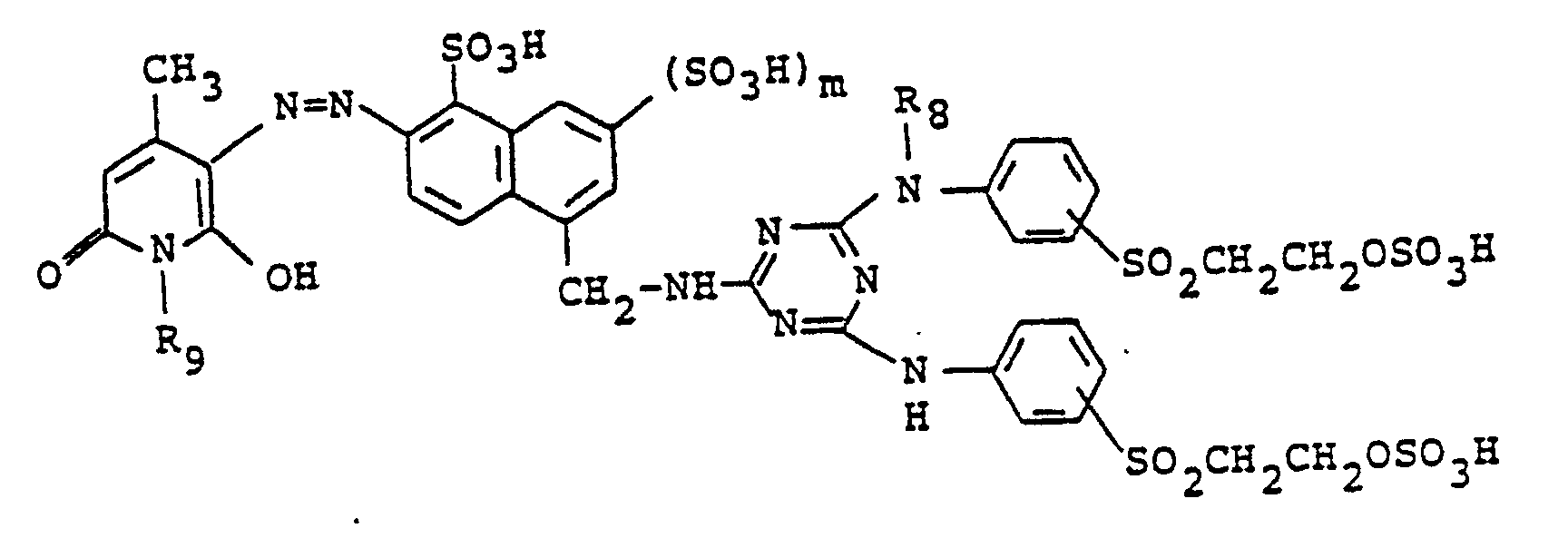
in der R₈ ein Wasserstoffatom, eine Methyl- oder Ethylgruppe bedeutet, R₉ eine Methyl- oder Ethylgruppe darstellt, und m 0 oder 1 ist.
in der R₈ ein Wasserstoffatom, eine Methyl- oder Ethylgruppe bedeutet, R₉ eine Methyl- oder Ethylgruppe darstellt, und m 0 oder 1 ist.
9. Verfahren zum Färben oder Bedrucken von Hydroxylgruppen oder Carbonamidgruppen enthaltendem
Material, umfassend die Verwendung einer Verbindung nach Anspruch 1.
10. Hydroxylgruppen- oder Carbonamidgruppen enthaltendes Material, gefärbt oder bedruckt
nach dem Verfahren von Anspruch 9.