|
(11) | EP 0 274 213 A1 |

| (12) | EUROPEAN PATENT APPLICATION |
|
|
|
|
|||||||||||||||||||||||||||
| (54) | Process for the preparation of alkyl azide-substituted, hydroxy-terminated polyethers |
| (57) The invention disclosed is an improved process for the preparation of hydroxy-terminated
aliphatic polyethers having alkyl substituents, such as glycidyl azide polymer. The
improved process involves formation of the polymer in a single step starting from
epichlorohydrin monomer. The reaction is effected in a suitable polar organic solvent
at elevated temperature for 15 to 24 hours. |
[0001] This invention relates to an improved process for the synthesis of hydroxy-terminated aliphatic polyethers having alkyl azide substituents.
[0002] Hydroxy-terminated aliphatic polyethers having alkyl azide substituents are useful as energetic binders and plasticizers in solid propellants and composite explosives. One such polyether is glycidyl azide polymer (GAP). This polymeric azide is used as an energetic binder (at MW 2000 to 6000) and as a plasticizer (at MW of about 500) in composite explosives and solid rocket propellant systems to impart additional energy to the formulations, increase the performance and enhance the stability and the mechanical properties of the system.
[0003] A process for the preparation of hydroxy-terminated aliphatic polyethers having alkyl azide substituents, e.g. GAP, is described in United States Patent 4,268,450 of 19th May 1981, in the name of M.B. Frankel et al. According to the Frankel et al process, in a first reaction step, the starting material, epichlorohydrin (ECH) is polymerized to polyepichlorohydrin (PECH) using a catalyst, boron trifluoride (BF₃) in the presence of a dichloro compound such as carbon dichloride. In a second step, PECH is azidized using a molar excess of the order of 2:1 sodium azide (NaN₃) in the presence of a polar organic solvent dimethyl formamide (DMF) for three days at 100°C. It is emphasized that a molar excess, of about 2:1, of sodium azide is typically employed. Since sodium azide is of a poisonous nature, the use of large amounts is a distinct disadvantage. A final purification step using methylene chloride and drying over magnesium sulfate is also described. This multi step process is costly and takes from four to seven days to complete.
[0004] According to the invention, a single step process for the preparation of hydroxy-terminated polyethers having alkyl azide substituents, e.g. GAP, is provided which is less time consuming and more cost effective.
[0005] The process according to the invention for the preparation of hydroxy-terminated aliphatic polyethers having alkyl azide substituents, preferably having a structural formula
wherein n is an integer from 5 to 10, comprises the single step of reacting an epoxy compound, preferably epichlorohydrin monomer (ECH), with an ionic azide, selected from the group consisting of sodium azide, lithium azide and potassium azide, in a suitable polar organic solvent at elevated temperatures preferably for about 15 to 24 hours, while agitating.
[0006] The preferred ionic azide is sodium azide. Preferably, the weight ratio of sodium azide to epoxy compound is about 1:1.
[0007] Suitable polar organic solvents include dimethyl formamide (DMF), and dimethyl sulfoxide (DMSO). A small amount of ethylene glycol (EG) is used as an initiator. The solvent:epoxy weight ratio is preferably in the range 0.8:1 to 2:1.
[0008] The reaction temperature is preferably in the range of 70°C to 90°C, most preferably about 90°C.
[0009] More preferably, an initial exothermic reaction is allowed to proceed at a temperature of about 70°C, followed by heating to about 90°C to complete the reaction. Specifically, the exothermic reaction arises from the opening of the epoxide ring of ECH which is caused by sodium azide and proceeds for about thirty minutes. The "30 minutes" period is approximate and depends on the duration of the gradual addition of sodium azide to the mixture ECH/DMF/EG. It is preferable to heat the reaction mixture at 70°C (approx) during the addition of NaN₃ in order to control the exothermic reaction. Once the sodium azide addition is over and no sudden rise in temperature is observed, then heating to 90°C starts.
[0010] Preferably upon cooling, the polymer is washed with water to remove DMF, EG, unreacted sodium azide and the by-product sodium chloride. Three washes with hot water (60°C) have been found appropriate.
[0011] Preferably, the washing step is followed by a purification step which involves dissolving the polymer in a suitable polar organic solvent such as methylene chloride, drying over magnesium sulfate, and passing through a column containing silica gel. The solvent is then driven off by heating.
[0012] As shown in Table I below, the synthesis of GAP according to the invention can be accomplished at about 90°C in about 15 hours or in 24 hours by using less solvent (DMF/ECH = 0.8). At a reaction temperature lower than 90°C, the quantitative conversion of ECH to GAP will require a much longer reaction time, e.g. 48 hours at 80°C and 170 hours at 70°C.
[0013] The hydroxy-terminated aliphatic polyethers having alkyl azide substituents prepared according to the invention are of the lower molecular weight (i.e., average MW of about 500 and n = 5 to 10) variety described above.
Example
[0014] Sodium azide (10g) is gradually added to a mixture of ECH (10g), DMF (20g) and EG (1g); heating at approximately 70°C and agitation are started. Because of an initial exothermic reaction, the temperature is controlled during the first 30 minutes (approx) of the synthesis. Once the addition of sodium azide is over and no sudden rise in temperature is observed, then the reaction mixture is heated to 90°C and the agitation is carried out at this temperature for about 15 hours. Heating and agitation are stopped and the reaction mixture is allowed to cool. The polymer is given three 50 ml hot water (60°C) washes to remove DMF, EG and the salts (sodium azide and sodium chloride). The polymer is dissolved in 75 ml methylene chloride (MC). The MC solution is dried over magnesium sulfate and then is passed through a column containing 5g of silica gel. The resultant solution is heated to 50°C to remove MC and then stripped in vaccuo to yield 8g (80%) of the GAP polymer: a viscous liquid with an amber colour. The GAP was characterized and had the following properties.
Elemental Analysis
[0015] C(35.7); H(5.0); N(39.9); O(18.7); Cl(0.7) wt%
Nitrogen and Chloride analysis of the polymer confirmed that quantitative conversion of ECH to GAP was achieved.
Infrared Spectrum
[0016] The IR absorption spectrum of the polymer showed peaks at 4.8 and 8.0 mµ (characteristics of azides).
Weight Average Molecular Weight (Mw) - 540
Number Average Molecular Weight (Mn) - 400
Equivalent Weight (Me) - 314
Glass Transition Temperature (Tg) - -70°C
Density - 1.3 g/ml
Hydroxyl Functionality (Mn/Me) - 1.3
1. A process for the preparation of alkyl azide-substituted hydroxy-terminated aliphatic
polyethers, which comprises reacting an epoxy compound and an ionic azide, characterised
by reacting the epoxy compound in a single step directly with sodium azide, potassium
azide or lithium azide, said reaction being carried out in a polar organic solvent
and under conditions of agitation at elevated temperature.
2. A process according to claim 1, characterised in that the reaction is carried out
at a temperature in the range 70°C to 90°C.
3. A process according to claim 2, characterised in that the reaction mixture is initially
heated to about 70°C to control the initial exotherm during the addition of the azide,
and the reaction mixture subsequently heated to about 90°C to complete the reaction.
4. A process according to claim 1, 2 or 3, characterised in that the reaction is carried
out over a period of from 15 to 24 hours.
5. A process according to any one of claims 1 to 4, characterised in that the polar
solvent is dimethyl formamide or dimethyl sulfoxide.
6. A process according to any one of claims 1 to 5, characterised in that the epoxy
compound and the azide are employed in a weight ratio of about 1:1.
7. A process according to any one of claims 1 to 6, characterised in that the solvent
is employed in a weight ratio of from 0.8:1 to 2:1 relative to the epoxy compound.
8. A process according to any one of claims 1 to 7, characterised in that ethylene
glycol is present in the reaction medium as an initiator.
9. A process according to any one of claims 1 to 8, characterised in that at the end
of the reaction period the product polymer is recovered and washed with water.
10. A process according to claim 9, characterised in that following washing the polymer
is further purified by dissolving the washed polymer in a polar organic solvent, drying
over magnesium sulfate and passing through a column containing silica gel.
11. A process according to any one of claims 1 to 10, characterised in that the epoxy
reactant is epichlorohydrin.
12. A process according to claim 11, characterised in that the alkyl azide-substituted,
hydroxy-terminated aliphatic polyether product has the formula:
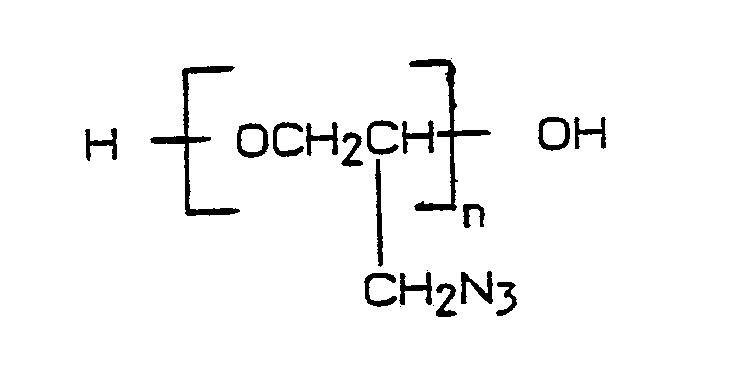
where n has a value of from 5 to 10.
where n has a value of from 5 to 10.