|
(11) | EP 0 275 416 B1 |

| (12) | EUROPEAN PATENT SPECIFICATION |
|
|
| (54) |
Method for enhancing the quality of coded speech Verfahren zur Verbesserung der Qualität kodierter Sprache Procédé pour améliorer la qualité de la parole codée |
|
|
|||||||||||||||||||||||||||||||
| Note: Within nine months from the publication of the mention of the grant of the European patent, any person may give notice to the European Patent Office of opposition to the European patent granted. Notice of opposition shall be filed in a written reasoned statement. It shall not be deemed to have been filed until the opposition fee has been paid. (Art. 99(1) European Patent Convention). |
[0001] Efforts to produce better speech quality at lower coding rates have stimulated the development of numerous block-based coding algorithms. The basic strategy in block-based coding is to buffer the data into blocks of equal length and to code each block separately in accordance with the statistics it exhibits. The motivation for developing blockwise coders comes from a fundamental result of source coding theory which suggests that better performance is always achieved by coding data in blocks (or vectors) instead of scalars. Indeed, block-based speech coders have demonstrated performance better than other classes of coders, particularly at rates 16 kilobits per second and below. An example of such a coder is presented in our prior European patent application serial no. 86 900 480.4, filed December 11, 1985.
[0002] One artifact of block-based coders, however, is framing noise caused by discontinuities at the block boundaries. These discontinuities comprise all variations in amplitude and phase representation of spectral components between successive blocks. This noise which contaminates the entire speech spectrum is particularly audible in sustained high-energy high-pitched speech (female voiced speech). The noise spectral components falling around the speech harmonics are partially masked and are less audible than the ones falling in the interharmonic gaps. As a result, the larger the interharmonic gaps, or higher the pitch, the more audible is the framing noise. Also, due to the "modulation" process underlying the noise generation, the larger the speech amplitude, the more audible is the framing noise.
[0003] The use of block tapering and overlapping can, to some extent, help subdue framing noise, particularly its low frequency components; and the larger the overlap, the better are the results. This method, however, is limited in its application and performance since it requires an increase in the coding rate proportional to the size of the overlap.
[0004] A more effective approach, initially applied to enhance speech degraded by additive white noise, is comb filtering of the noisy signal. This approach is based on the observation that waveforms of voiced sound are periodic with a period that corresponds to the fundamental (pitch) frequency. A comb filtering operation adjusts itself to the temporal variations in pitch frequency and passes only the harmonics of speech while filtering out spectral components in the frequency regions between harmonics. An illustration of the magnitude frequency response of a comb filter is illustrated in Fig. 1. The approach can in principle reduce the amount of audible noise with minimal distortion to speech. Frazier et al. "Enhancement of speech by adaptive filtering," Proc. 1976 IEEE Int. Conf. Acoust., Speech, Signal Processing, Phil, PA, pp 251-253, April 12-14, 1976.
[0005] An example illustration of a speech pattern is illustrated in Fig. 2. It can be seen that the speech has a period P of Np samples which is termed the pitch period of the speech. The pitch period P determines the fundamental frequency fp = 1/P of Fig. 1. The speech waveform varies slowly through successive pitch periods; thus, there is a high correlation between a sample within one pitch period and corresponding samples in pitch periods which precede and succeed the pitch period of interest. Thus, with voiced speech, the sample X(n) will be very close in magnitude to the samples X(n-iNp) and X(n+iNp) where i is an integer. Any noise in the waveform, however, is not likely to be synchronous with pitch and is thus not expected to be correlated in corresponding samples of adjacent pitch periods. Digital comb filtering is based on the concept that, with a high correlation between periods of speech, noise can be deemphasized by summing corresponding samples of adjacent pitch periods. With perfect correlation, averaging of the corresponding samples provides the best filter response. However, where correlation is less than perfect as can be expected, greater weight is given to the sample of interest Xn than to the corresponding samples of adjacent pitch periods.
[0006] The adaptive comb filtering operation can be described by:
where X(n) is the noisy input signal, Y(n) is the filtered output signal, Np is the number of samples in a pitch period, ai is the set of filter coefficients, LB is the number of periods considered backward and LF is the number of periods considered forward. The order of the filter is LB + LF. In past implementations of the comb filter approach, filter coefficients are fixed while the pitch period is adjusted once every pitch period. Therefore, the adaptation period as well as the filter processing segment are a pitch period long (Np samples). In the frequency domain, this pitch adaptation amounts to aligning the "teeth" of the comb filter to the harmonics of speech once every pitch period.
[0007] In another past implementation, a modified comb filter has been proposed to reduce discontinuities attributed to the pitch-synchronous adaptation when pitch varies. Malah et al. "A generalized comb filtering technique for speech enhancement," Proc. 1982 IEEE Int. Conf. Acoust., Speech, Signal Processing, Paris, France, pp 160-163, May 3-5, 1982. To that end, filter coefficients within each speech processing segment (Np samples) are weighted so that the amount of filtering is gradually increased at the first half of the segment and then gradually decreased at the second half of the segment. A symmetrical weighting smooths the transition and guarantees continuity between successive pitch periods. Again, pitch is updated in a pitch-synchronous mode. However, despite increased complexity, the performance of this filter is at most comparable to the performance of the basic adaptive comb filter.
[0008] An electronic comb filter for filtering speech and a method for comb filtering speech according to the invention are claimed in claims 1 and 12, respectively.
[0009] In accordance with one aspect of the present invention, a comb filter is provided which has both pitch period and coefficients adapted to the speech data. By adapting the coefficients to the speech statistics, strong filtering is applied where there is a strong correlation and little or no filtering (all pass filtering) may be applied where there is little or no correlation.
[0010] The pitch and filter coefficients could in principle be adapted at each speech sample. However, based on the quasistationary nature of speech, for processing economy a single value of the period and a single set of coefficients may be determined for each of successive filter segments of speech where each segment is of multiple samples. In past comb filters, the sizes of such filter segments have been made to match the determined pitch. In accordance with a further aspect of the present invention, the filter segments are of a fixed duration. The fixed duration filter segments are particularly advantageous in filtering a decoded speech signal from a block coding decoder. Where the filter segments are of a size which is an integer fraction of the coder block size, each block boundary can be aligned with the center region of a filter segment where filter-data match is best. The period determination and correlation estimate are based on an analysis window of samples which may be significantly greater than the number of samples in the filter segments.
[0011] Preferably, the filter coefficients are determined by a linear prediction approach to minimize the mean-squared-error in predicting the speech sample. In that approach, mean-squared-error E is defined by
where X(n) is the speech sample of interest, the sum SUMW is taken over a range of n contained in W, Np is the period, ai is the coefficient for the sample i periods from n, and M i's are chosen from the set: ...,-2,-1,+1,+2,.... In a simplified approach, the mean-squared-error E is defined by
[0012] In an even more simplified approach to selecting coefficients, the coefficients are determined from a limited number of sets of coefficients. The amplitude of the speech waveform can be used to select the appropriate set. In a very simple yet effective approach, only two sets of coefficents are available.
[0013] The foregoing and other objects, features and advantages of the invention will be apparent from the following more particular description of preferred embodiments of the invention, as illustrated in the accompanying drawings in which like reference characters refer to the same parts throughout the different views. The drawings are not necessarily to scale, emphasis instead being placed upon illustrating the principles of the invention.
Figure 1 is an illustration of the magnitude frequency responses of a comb filter and an all pass filter;
Figure 2 is a schematic illustration of a speech waveform plotted against time;
Figure 3 is a block diagram of a system to which the present invention is applied;
Figure 4 is a schematic illustration of a filter embodying the invention.
Figure 5 is a timing chart of filter segments relative to analysis windows;
Figure 6 is a timing chart of coder blocks relative to filter segments of different fixed lengths.
[0014] A system to which the comb filter of the present invention may be applied as illustrated in block form in Fig. 3. Speech which is to be transmitted is sampled and converted to digital form in an analog to digital converter 7. Blocks of the digitized speech samples are encoded in a coder 8 in accordance with a block coder algorithm. The encoded speech may then be transmitted over a transmission line 9 to a block decoder 10 which corresponds to the coder 8. The block decoder provides on line 12 a sequence of digitized samples corresponding to the original speech. To minimize framing and other noise in that speech, samples are applied to a comb filter 13. Thereafter, the speech is converted to analog form in a digital to analog converter 14.
[0015] Fig. 4 is a schematic illustration of the filter 13 which would in fact be implemented by a microprocessor under software control. A first step of any comb filter is to determine the pitch of the incoming voiced speech signal. Pitch and any periodicity of unvoiced speech is detected in a period detector 16. As with prior comb filters, the pitch may be determined and assumed constant for each filter segment of speech where each filter segment is composed of a predetermined number of samples.
[0016] In prior systems, each filter segment was the length of the calculated pitch period. The filter would then be adapted to a recomputed pitch period and samples would be filtered through the next filter segment which would be equal in duration to the newly calculated pitch period. As will be discussed in greater detail below, the present system is time synchronous rather than pitch synchronous. Pitch is calculated at fixed time intervals which define filter segments, and those intervals are not linked to the pitch period.
[0017] The samples are buffered at 18 to allow for the periodicity and coefficient determinations and are then filtered. The filter includes delays 20, 22 which are set at the calculated pitch period. Thus, a sample of interest X(n) is available for weighting and summing as a preceding sample X(n-Np) and a succeeding sample X(n+Np) are also available. Although the invention will be described primarily with respect to a system which only weights the next preceding and next succeeding pitch samples, samples at any multiple of the pitch period may be considered in the filter and thus the filter can be of any length. Each sample is applied to a respective multiplier 24, 26, 28 where it is multiplied with a coefficient ai selected for that particular sample. The thus weighted samples are summed in summers 30, 32.
[0018] In past systems, the coefficients ai would be established for a particular filter design. Although the coefficients through the filter would differ, and the coefficients might vary through a filter segment, the same set of coefficients would be utilized from filter segment to filter segment. Malah et al. "A generalized comb filtering technique for speech enhancement," Proc. 1982 IEEE Int. Conf. Acoust., Speech, Signal Processing, Paris, France, pp 160-163, May 3-5, 1982. In accordance with the present invention, the coefficients are adaptively selected based on an estimate of the correlation of the speech signal in successive pitch periods. As a result, with a high correlation as in voiced speech the several samples which are summed may be weighted near the same amount; whereas, with speech having little correlation between pitch periods as in unvoiced speech, the sample of interest X(n) would be weighted heavily relative to the other samples. In this way, substantial filtering is provided for the voiced speech, yet muffling of unvoiced speech, which would not benefit from the comb filtering, is avoided.
[0019] The pitch analysis and coefficient analysis are performed using a number of samples preceding and succeeding a sample of interest in an analysis window. In one example, the analysis window is 240 samples long. The pitch analysis and coefficient analysis are most accurate for the sample of interest at the center of that window. The most precise filtering would be obtained by recalculating the pitch period and the coefficients from a new window for each speech sample. However, because the pitch period and expected correlations change slowly from sample to sample, it is sufficient to compute the pitch period and the coefficients once for each of successive filter segments, each segment comprising a number of successive samples. In a preferred system, each filter segment is 90 samples long. The timing relationship between filter segments and analysis windows is illustrated in Fig. 5. The pitch period and coefficients are computed relative to the center sample of each filter segment, as illustrated by the broken lines, and are carried through the entire segment.
[0020] The time synchronous nature of the period and coefficient adaptation makes the filter particularly suited to filtering of framing noise found in speech which has been encoded and subsequently decoded according to a block coding scheme. To filter noise resulting from block transitions, the filter transitions should not coincide with the block transitions. Because both the coding and the filtering are time synchronous, the filter segment length can be chosen such that each block boundary of the block coder output can be centered in a filter segment. To thus center each block boundary within a filter segment, the filter segment should include the same number of samples as are in the coder block or an integer fraction thereof. As illustrated in Fig. 6, for blocks of 180 samples each, the block boundaries can be centered on the filter segments of 180/2 samples, 180/3, and so on.
[0021] More specific descriptions of the periodicity and coefficient determinations follow. The periodicity of the waveform, centered at a sample of interest, may be determined by any one of the standard periodicity detection methods. An example of one method is by use of the Short-Time Average Magnitude Difference Function (AMDF), L. R. Rabiner and R. W. Schafer, Digital Processing of Speech Signals, Prentice-Hall, 1978, page 149. In this method, a segment of the waveform is subtracted from a lagged segment of the waveform and the absolute value of the difference is summed across the segment. This is repeated for a number of lag values. A positive correlation in the waveform at a lag k then appears as a small value of the AMDF at index k. The lag is considered between some allowable minimum and maximum lag values. The lag at which the minimum value of the AMDF occurs then defines the periodicity. In the current embodiment, a segment length of 30 msec is used for the periodicity detection window (240 samples at an 8000 samples/sec rate), centered at the sample of interest. The minimum value of the AMDF is found over a lag range of 25 to 120 samples (corresponding to 320 Hz and 67.7 Hz) and the lag at that minimum point is chosen as the period for the sample of interest.
[0022] The set of filter coefficients are used to weight the waveform samples an integer multiple of periods away from the sample of interest. An optimal (in a minimum mean-squared-error sense) linear prediction (LP) approach is used to find the coefficients that allow the samples a multiple of periods away from the sample of interest to best predict the sample. This LP approach can have many variations, of which three will be illustrated.
[0023] In the full LP approach the following equation is used to define the mean-squared-error, E:
where the sum SUMW is taken over a range of n contained in W, Np is the period, ai is the coefficient for the sample i periods from n, and M i's are chosen from the set:..., -2,-1,+1,+2,... The set of M ai's that minimize E is then found. The coefficient for the sample of interest, a₀, is defined as 1.
[0024] In the current embodiment, samples at one period before the sample of interest and at one period after the sample of interest are used to define the filter (i.e., M = 2, and i = -1, +1). Thus, the following equation is used to define the mean-square-error, E:
where a-1 is the coefficient for the sample one period before and a+1 is the coefficient for the sample one period ahead.
[0025] The solutions for a-1 and a +1 that minimize E are:
where the values are correlations over the window W defined by:
The coefficient for the sample of interest, a₀, is defined as 1.
[0026] A simplified LP approach uses a set of M independent equations, one equation for each ai. Each equation has the form (with variables as above):
Each ai is found independently by minimizing each Ei. In this approach, the coefficient for the sample of interest, a₀, is defined as M.
[0027] In the present embodiment M=2; thus, two independent equations for E-1 and E+1 are used:
with solutions that minimize the two equations:
In this approach, the coefficient for the sample of interest, a₀, is defined as 2.
[0028] The window length W selected in both of the above approaches is 120 samples, centered about the sample of interest. In either approach, if the denominator of a coefficient is found to be zero, that coefficient is set to zero.
[0029] In both of the above approaches, the combination of periodicity detection and minimum mean-squared-error solution for the coefficients serves to predict the sample of interest using samples that are period-multiples ahead and behind of the sample of interest. If the waveform is voiced speech, the periodicity determined will be the pitch and the correlation will be maximized, giving high weight filter coefficients. It may happen that the detected periodicity is a multiple of the true pitch in voiced speech; this is without penalty, as the correlation at that period was found to be high. Also, any errors in pitch determination due to the resolution of the method will be reflected in lesser coefficients for adjacent pitch periods, making the approaches less dependent on precision of pitch determination. If the waveform is unvoiced speech or silence, the periodicity determined will have little meaning. But since the correlations will be small, the coefficients will also be small, and minimal filtering will occur; that is, an all pass filter as illustrated in Fig. 1 will occur.
[0030] A third approach considers only two sets of coefficients. When it is desired that filtering should occur, the first set of coefficients is chosen. This set assumes maximum correlation (1.0) between the sample of interest and each sample a multiple of periods away from the sample of interest. When it is desired that filtering should not occur, the second set of coefficients is chosen. This set assumes minimum correlation (0.0) between the sample of interest and each sample a multiple of periods away from the sample of interest. The decision to choose between the first or second set of coefficients is based on the desirability of filtering the sample of interest. If the waveform is voiced speech, filtering should occur; if the waveform is unvoiced speech or silence, no filtering should occur.
[0031] In the present embodiment, the first set of coefficients, assuming maximum correlations, is defined as:
a-1 = 1.0, a₀ = 2.0, a+1 = 1.0.
The second set of coefficients, assuming minimum correlations, is defined as:
a-1 = 0.0, a₀ = 1.0, a+1 = 0.0.
[0032] Since the perceived degree of framing noise is dependent on the amplitude of the waveform, and since voiced speech is usually of higher amplitude than unvoiced speech or silence, the current embodiment for the reduced approach takes a simplified approach of choosing the first set of coefficients when the maximum absolute waveform amplitude in a short-time window centered about the sample of interest is above a fixed threshold. This threshold may be preset by using prior knowledge of the waveform character or by an adaptive training approach.
[0033] In each approach, the filtering operation consists of adding to the sample of interest the sum of M samples that are integer multiples of the period from the sample of interest, each weighted by the appropriate filter coefficient. This is represented by the equation:
The filter coefficients are always normalized so that their sum is equal to one. In the current embodiment, the filter is represented by the equation:
where the filter coefficients are normalized so that their sum is equal to one.
1. An electronic comb filter (13) for filtering speech by filtering out spectral components
in the frequency regions between pitch harmonics, the filter comprising:
means (16) for determining the pitch period (P) of the speech;
means for determining speech-dependent weighting coefficients based on pitch correlation or the amplitude of the speech to change filter rejection;
means (20,22,24,26,28,30,32) for generating sums of weighted speech samples, the samples being weighted by the determined weighting coefficients and the samples being separated by multiples of the determined period.
means (16) for determining the pitch period (P) of the speech;
means for determining speech-dependent weighting coefficients based on pitch correlation or the amplitude of the speech to change filter rejection;
means (20,22,24,26,28,30,32) for generating sums of weighted speech samples, the samples being weighted by the determined weighting coefficients and the samples being separated by multiples of the determined period.
2. A filter as claimed in claim 1 characterized in that the weighting coefficients (ai) are adapted to increase filter rejection with increasing pitch correlation.
3. A filter as claimed in claim 1 or 2 characterized in that filter rejection is changed asynchronous with pitch.
4. A filter as claimed in claim 1, 2 or 3 characterized in that a single value of the period is determined and a single determination of the weighting
coefficients is made for each of successive multiple-sample filter segments of speech.
5. A filter as claimed in claim 4 characterized in that the filter segments of speech are of a fixed duration.
6. A filter as claimed in claim 4 or 5 in combination with a block coding decoder (8)
for filtering a decoded speech signal, wherein the filter segments are of a size which
is an integer fraction of the coder block size and each coder block boundary is aligned
with the center region of a filter segment.
7. A filter as claimed in any preceding claim characterized in that the coefficients (ai) are determined by a linear prediction approach to minimize the mean-squared-error
in predicting the speech sample.
8. A filter as claimed in any preceding claim characterized in that the period (P) and coefficients (ai) determinations are based on an analysis window of samples which has a greater number
of samples than the filter segment.
9. A filter as claimed in any preceding claim characterized in that the means for determining the coefficients (ai) minimizes the mean-square-error E where:

where X(n) is the speech sample of interest, the sum SUMW is taken over a range of n contained in W, Np is the period, ai is the coefficient for the sample i periods from n, and M i's are chosen from the set:
...,-2,-1,+1,+2,...
where X(n) is the speech sample of interest, the sum SUMW is taken over a range of n contained in W, Np is the period, ai is the coefficient for the sample i periods from n, and M i's are chosen from the set:
...,-2,-1,+1,+2,...
10. A filter as claimed in any preceding claim characterized in that the coefficients (ai) are determined from a limited number of sets of coefficients.
11. A filter as claimed in claim 10 characterized in that only two sets of coefficients are available.
12. A method for comb filtering speech by filtering out spectral components in the frequency
regions between pitch harmonics, the method comprising:
determining the pitch period of the speech; and
generating sums of weighted speech samples separated by the determined period, the coefficients for weighting the speech samples being dynamically adapted to the speech based on pitch correlation or the amplitude of the speech to change filter rejection.
determining the pitch period of the speech; and
generating sums of weighted speech samples separated by the determined period, the coefficients for weighting the speech samples being dynamically adapted to the speech based on pitch correlation or the amplitude of the speech to change filter rejection.
13. A method as claimed inn claim 12 characterized in that the weighting coefficients are adapted to increase filter rejection with increasing
pitch correlation.
14. A method as claimed in claims 12 or 13 characterized in that filter rejection is changed asynchronous with pitch.
15. A method as claimed in claim 12, 13 or 14 characterized in that a single value of the period is determined and a single determination of the coefficients
is made for each of successive multiple-sample filter segments of speech.
16. A method as claimed in claim 15, characterized in that the segments of speech are of a fixed duration.
17. A method as claimed in claims 15 or 16 for filtering a speech signal decoded from
block encoding, wherein each coder block boundary is aligned with the center region
of a filter segment.
1. Elektronisches Kammfilter (13) zum Filtern von Sprache durch Ausfiltern spektraler
Komponenten in Frequenzbereichen zwischen harmonischen Tonlagen mit:
einer Einrichtung (16) zum Feststellen der Tonlagenperiode (P) der Sprache;
einer Einrichtung zum Bestimmen von sprachabhängigen Gewichtungskoeffizienten basierend auf der Tonlagenkorrelation oder der Amplitude der Sprache, um die Filtersperrung zu verändern;
einer Einrichtung (20, 22, 24, 26, 28, 30, 32) zum Erzeugen von Summen gewichteter Sprachabtastungen, wobei die Sprachabtastungen durch die festgelegten Sprachkoeffizienten gewichtet werden und die Abtastungen durch Vielfache der festgestellten Periode beabstandet sind.
einer Einrichtung (16) zum Feststellen der Tonlagenperiode (P) der Sprache;
einer Einrichtung zum Bestimmen von sprachabhängigen Gewichtungskoeffizienten basierend auf der Tonlagenkorrelation oder der Amplitude der Sprache, um die Filtersperrung zu verändern;
einer Einrichtung (20, 22, 24, 26, 28, 30, 32) zum Erzeugen von Summen gewichteter Sprachabtastungen, wobei die Sprachabtastungen durch die festgelegten Sprachkoeffizienten gewichtet werden und die Abtastungen durch Vielfache der festgestellten Periode beabstandet sind.
2. Filter nach Anspruch 1, dadurch gekennzeichnet, daß die Gewichtungskoeffizienten (ai) so angepaßt sind, daß sie die Filtersperrung mit steigender Tonlagenkorrelation
erhöhen.
3. Filter nach einem der Ansprüche 1 oder 2, dadurch gekennzeichnet, daß die Filtersperrung asynchron mit der Tonlage geändert wird.
4. Filter nach Anspruch 1, 2 oder 3, dadurch gekennzeichnet, daß ein einzelner Wert der Periode festgestellt wird und eine einzelne Feststellung
der Gewichtskoeffizienten für jedes der aufeinanderfolgenden mehrfach abgetasteten
Filtersegmente der Sprache ausgeführt wird.
5. Filter nach Anspruch 4, dadurch gekennzeichnet, daß die Filtersegmente der Sprache eine feste Dauer aufweisen.
6. Filter nach Anspruch 4 oder 5 in Kombination mit einem Blockcode-Decoder (8) zum Filtern
eines decodierten Sprachsignals, wobei die Filtersegmente eine Größe aufweisen, die
einen geraden Teil der Codierblockgröße darstellt und wobei jede Codierblockgrenze
mit dem Zentrumsbereich eines Filtersegments übereinstimmt.
7. Filter nach einem der vorhergehenden Ansprüche, dadurch gekennzeichnet, daß die Koeffizienten (ai) durch einen "Linear-prediction-approach" bestimmt werden, um den mittleren quadratischen
Fehler während des Vorhersagens der Sprachabtastung zu minimieren.
8. Filter nach einem der vorhergehenden Ansprüche, dadurch gekennzeichnet, daß die Festlegung der Periode (P) und der Koeffizienten (ai) auf Grundlage eines Analysefensters von Abtastungen vorgenommen wird, welches eine
größere Anzahl von Abtastungen beinhaltet als das Filtersegment.
9. Filter nach einem der vorhergehenden Ansprüche, dadurch gekennzeichnet, daß die Einrichtung zum Festlegen der Koeffizienten (ai) den mittleren quadratischen Fehler E minimiert, wobei:

wobei X(n) die interessierende Sprachabtastung ist, die Summe SUMW über einen Bereich von n enthaltend in W genommen wird, Np die Periode ist, ai der Koeffizient für die Abtastung, die i Perioden von n entfernt ist, ist und M i's aus dem Satz:
...,-2,-1,+1,+2,...
gewählt werden.
wobei X(n) die interessierende Sprachabtastung ist, die Summe SUMW über einen Bereich von n enthaltend in W genommen wird, Np die Periode ist, ai der Koeffizient für die Abtastung, die i Perioden von n entfernt ist, ist und M i's aus dem Satz:
...,-2,-1,+1,+2,...
gewählt werden.
10. Filter nach einem der vorhergehenden Ansprüche, dadurch gekennzeichnet, daß die Koeffizienten (ai) aus einer begrenzten Anzahl von Sätzen von Koeffizienten bestimmt werden.
11. Filter nach Anspruch 10, dadurch gekennzeichnet, daß lediglich zwei Sätze von Koeffizienten verfügbar sind.
12. Verfahren zum Kammfiltern von Sprache durch Ausfiltern spektraler Komponenten in Frequenzbereichen
zwischen harmonischen Tonlagen, wobei das Verfahren umfaßt:
Feststellen der Tonlagenperiode der Sprache; und
Erzeugen von Summen gewichteter Sprachabtastungen, die um die festgestellte Periode voneinander beabstandet sind, wobei die Koeffizienten zum Gewichten der Sprachabtastungen dynamisch an die Sprache basierend auf der Tonlagenkorrelation oder der Amplitude der Sprache angepaßt sind, um die Filtersperrung zu verändern.
Feststellen der Tonlagenperiode der Sprache; und
Erzeugen von Summen gewichteter Sprachabtastungen, die um die festgestellte Periode voneinander beabstandet sind, wobei die Koeffizienten zum Gewichten der Sprachabtastungen dynamisch an die Sprache basierend auf der Tonlagenkorrelation oder der Amplitude der Sprache angepaßt sind, um die Filtersperrung zu verändern.
13. Verfahren nach Anspruch 12, dadurch gekennzeichnet, daß die Gewichtskoeffizienten so angepaßt sind, daß sie die Filtersperrung mit wachsender
Tonlagenkorrelation erhöhen.
14. Verfahren nach Anspruch 12 oder 13, dadurch gekennzeichnet, daß die Filtersperrung asynchron mit der Tonlage geändert wird.
15. Verfahren nach Anspruch 12, 13 oder 14, dadurch gekennzeichnet, daß ein einzelner Wert der Periode festgestellt wird und eine einzelne Festlegung
der Koeffizienten für jedes der aufeinanderfolgenden mehrfach abgetasteten Filtersegmente
der Sprache vorgenommen wird.
16. Verfahren nach Anspruch 15, dadurch gekennzeichnet, daß die Segmente der Sprache eine feste Dauer aufweisen.
17. Verfahren nach Anspruch 15 oder 16 zum Filtern eines Sprachsignals, das mittels Blockcodierung
codiert wurde, wobei jede Codierblockgrenze mit dem Zentralbereich eines Filtersegments
übereinstimmt.
1. Filtre électronique en peigne (13) pour filtrer la parole par enlèvement des composants
spectraux dans les régions de fréquence entre des harmoniques en pas, le filtre comprenant
:
un moyen (16) pour déterminer la période de pas (P) de la parole;
un moyen pour déterminer des coefficients de pondération en fonction de la parole basés sur une corrélation en pas ou l'amplitude de la parole pour modifier la réjection du filtre;
un moyen (20, 22, 24, 26, 28, 30, 32) pour générer des sommes des échantillons pondérés de parole, les échantillons étant pondérés par les coefficients déterminés de pondération et étant séparés par des multiples de la période déterminée.
un moyen (16) pour déterminer la période de pas (P) de la parole;
un moyen pour déterminer des coefficients de pondération en fonction de la parole basés sur une corrélation en pas ou l'amplitude de la parole pour modifier la réjection du filtre;
un moyen (20, 22, 24, 26, 28, 30, 32) pour générer des sommes des échantillons pondérés de parole, les échantillons étant pondérés par les coefficients déterminés de pondération et étant séparés par des multiples de la période déterminée.
2. Filtre selon la revendication 1 caractérisé en ce que les coefficients de pondération
(ai) sont adaptés pour augmenter la réjection du filtre avec l'augmentation de corrélation
en pas.
3. Filtre selon la revendication 1 ou 2 caractérisé en ce que la réjection du filtre
est modifiée de façon asynchrone avec le pas.
4. Filtre selon la revendication 1, 2 ou 3 caractérisé en ce qu'une valeur unique de
la période est déterminée et qu'une détermination unique des coefficients de pondération
est faite pour chaque segment successif de filtre d'échantillons multiples de la parole.
5. Filtre selon la revendication 4 caractérisé en ce que les segments de filtres de parole
ont une durée fixe.
6. Filtre selon la revendication 4 ou 5 en combinaison avec un décodeur de codage par
paquets (8) pour filtrer un signal de parole codé, dans lequel les segments de filtres
ont une taille qui est une fraction entière de la taille de paquet de code et chaque
limite de paquet de code est alignée avec la région centrale d'un segment de filtre.
7. Filtre selon l'une quelconque des revendications précédentes caractérisé en ce que
les coefficients (ai) sont déterminés par une approche d'extrapolation linéaire de manière à minimiser
l'erreur carrée moyenne dans l'extrapolation de l'échantillon de parole.
8. Filtre selon l'une quelconque des revendications précédentes caractérisé en ce que
les déterminations de la période (P) et des coefficients (ai) sont basées sur une fenêtre d'analyse d'échantillons qui a un nombre supérieur d'échantillons
que le segment de filtre.
9. Filtre selon l'une quelconque des revendications précédentes caractérisé en ce que
le moyen de détermination des coefficients (ai) minimise l'erreur carrée moyenne où

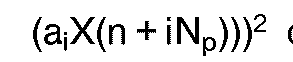
dans laquelle X(n) est l'échantillon de parole étudié, la somme SommeW est prise sur une gamme de n contenus dans W, Np est la période, ai est le coefficient pour les périodes i d'échantillons à partir de n, et M i sont choisis dans l'ensemble : ...,-2,-1,+1,+2,...
dans laquelle X(n) est l'échantillon de parole étudié, la somme SommeW est prise sur une gamme de n contenus dans W, Np est la période, ai est le coefficient pour les périodes i d'échantillons à partir de n, et M i sont choisis dans l'ensemble : ...,-2,-1,+1,+2,...
10. Filtre selon l'une quelconque des revendications précédentes caractérisé en ce que
les coefficients (ai) sont déterminés à partir d'un nombre limité d'ensembles de coefficients.
11. Filtre selon la revendication 10 caractérisé en ce que seuls deux ensembles de coefficients
sont disponibles.
12. Procédé de filtrage en peigne par enlèvement des composants spectraux dans des régions
de fréquences entre des harmoniques en pas, le procédé comprenant des étapes de:
détermination de la période de pas de la parole: et
génération de sommes d'échantillons pondérés de parole séparés par la période déterminée, les coefficients de pondération des échantillons de parole étant dynamiquement adaptés a la parole basés sur une corrélation en pas ou l'amplitude de la parole pour changer le réjection du filtre.
détermination de la période de pas de la parole: et
génération de sommes d'échantillons pondérés de parole séparés par la période déterminée, les coefficients de pondération des échantillons de parole étant dynamiquement adaptés a la parole basés sur une corrélation en pas ou l'amplitude de la parole pour changer le réjection du filtre.
13. Procédé selon la revendication 12 caractérisé en ce que les coefficients de pondération
sont adaptés pour augmenter la réjection du filtre lors d'une augmentation de la corrélation
en pas.
14. Procédé selon la revendication 12 ou 13 caractérisé en ce que la réjection du filtre
est modifiée de façon asynchrone avec le pas.
15. Procédé selon la revendication 12, 13 ou 14 caractérisé en ce qu'une unique valeur
de la période est déterminée et une unique détermination des coefficients est faite
pour chacun des segments successifs de filtre d'échantillons multiples de la parole.
16. Procédé selon la revendication 15 caractérisé en ce que les segments de parole ont
une durée fixe.
17. Procédé selon la revendication 15 ou 16 pour filtrer un signal de parole décodé à
partir d'un codage par paquets, dans lequel chaque limite de paquet codé est alignée
avec la région centrale d'un segment de filtre.