|
(11) | EP 0 280 403 B1 |

| (12) | EUROPEAN PATENT SPECIFICATION |
|
|
| (54) |
Process for dearylation of alkylenebisphenols and alkyltrisphenols Verfahren zur Dearylierung von Alkylenbisphenolen und Alkyltrisphenolen Procédé de déarylation d'alcylènebisphénols et alcoytrisphénols |
|
|
|||||||||||||||||||||||||||||||
| Note: Within nine months from the publication of the mention of the grant of the European patent, any person may give notice to the European Patent Office of opposition to the European patent granted. Notice of opposition shall be filed in a written reasoned statement. It shall not be deemed to have been filed until the opposition fee has been paid. (Art. 99(1) European Patent Convention). |
1. Field of the Invention
[0001] The present invention relates to the production of phenols and alkyl and/or alkenyl substituted phenols by the dearylation or cleavage of alkylenebisphenols and alkyltrisphenols. More specifically, the invention relates to the preparation of alkenyl phenol compounds such as p-isopropenylphenol and other related polymer products by carrying out the dearylation in the presence of hydrogen fluoride under mild conditions.
2. Description of the Prior Art
[0002] The dearylation of alkylenebisphenols such as bisphenol A, i.e., 2,2-bis(4-hydroxyphenyl) propane, has been carried out with acids or bases to yield p-isopropenylphenol and phenol. U.S. Patent 3,466,337, for example, discloses the decomposition of bisphenol A by heating with an acid to form phenol and other products. The reaction is carried out at temperatures of 125°C to 300°C in the presence of an acid catalyst such as benzenesulfonic acid, toluenesulfonic acid, sodium hydrogen sulfate, phosphoric acid or benzenephosphonic acid. This method is also stated to be applicable to treatment of equivalent materials such as trisphenol, the product obtained by condensing isopropenylphenol with bisphenol. In U.S. Patent 3,075,015, bisphenolic condensation products of phenols with aldehydes and ketones are split or dearylated under the influence of dilute aqueous solutions of alkali-metal hydroxides. European Patent 0017852 discloses the cleavage of alkylenebisphenols and trisphenols to phenol and other by-products in the present of hydrogen and a catalyst of nickel oxide, manganese oxide, and a metal oxide support. The reaction is carried out at temperatures of 250°C to 400°C. While such acid or base-induced reactions may offer one or more advantages, all of these methods suffer the disadvantage of using harsh conditions of high temperatures and/or pressure. Accordingly, it is an object of this invention to provide an effective catalyst for the dearylation of alkylenebisphenols under mild conditions of temperature and pressure.
SUMMARY OF THE INVENTION
[0003] In accordance with the present invention, there is provided a method for dearylating alkylenebisphenols and alkyltrisphenols which comprises contacting the phenol with liquid hydrogen fluoride under mild conditions of temperature and pressure and for a period of time sufficient to effect dearylation and produce phenol and alkyl and/or alkenyl substituted phenols, and thereafter recovering a dearylated product.
DETAILED DESCRIPTION OF THE INVENTION
[0004] In a preferred embodiment of the invention, effective dearylation is achieved when the HF to alkylenebisphenol or alkyltrisphenol volume mole ratio is 20-50: 1 at a temperature of about 30°C, under a pressure sufficient to maintain the HF in liquid phase and keep the desired quantity in the reaction zone. The liquid phase is essentially hydrogen fluoride in which the polyhydric phenol feed material is dissolved therein.
[0005] The HF to alkylenebisphenol or alkyltrisphenol volume mole ratio maintained in the reaction zone may broadly range from 1: 1 to about 75: 1, or more, but is generally in the range of 20: 1 to 50: 1.
[0006] The dearylation reaction is carried out by contacting the phenolic charge stock with the hydrogen fluoride under liquid phase conditions at temperatures ranging from 0°C to 120°C, preferably within a range of 20°C to 80°C, and most preferably at temperatures of 30°C to 50°C for a period of time ranging from about 15 minutes to 6 hours, preferably from 30 minutes to 4 hours. Quantitative yields have been obtained at ambient temperatures of 30°C for a reaction period of 1 hour.
[0007] The HF is preferably in substantially anhydrous form but small amounts of water, up to about 2 weight percent, may be present. Minor amounts of boron trifluoride may also be used in conjunction with the hydrogen fluoride, if desired. The term "hydrogen fluoride" as used herein is thus intended to include any homogeneous catalyst whose essential active ingredient is hydrogen fluoride.
[0008] The pressure in the reaction zone is maintained sufficiently high to maintain a substantially liquid phase operation, e.g., from about 2.5 to 500 psig (118 to 3549 kPa absolute).
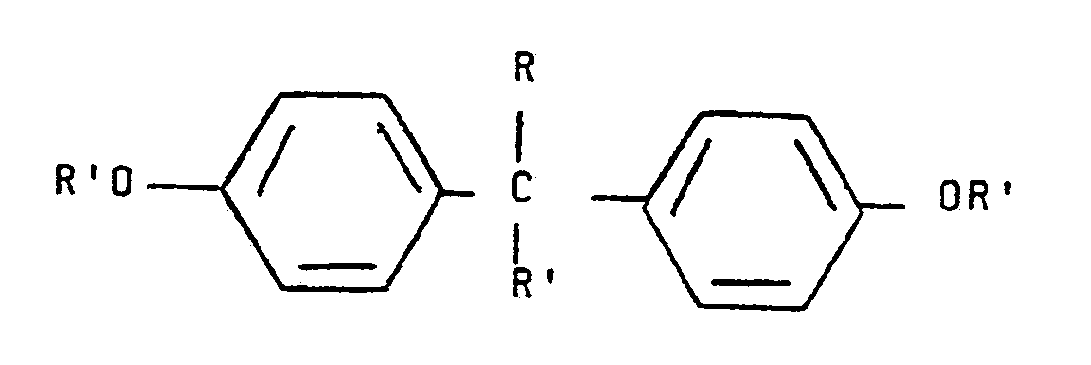
[0009] A wide variety of alkylenebisphenols and alkyltrisphenols may be dearylated according to the invention. Typically, the phenolic charge stocks can be represented by the general formula:
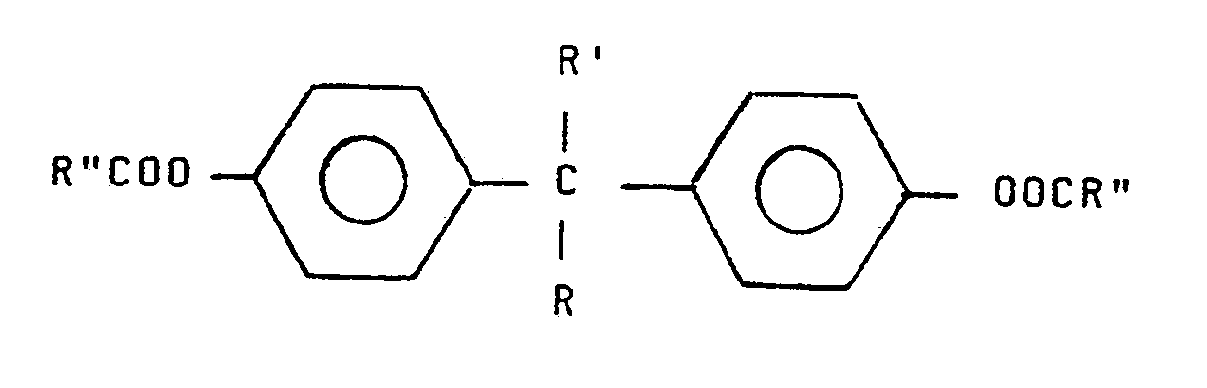
where R is hydrogen or an alkyl group of 1 to 9 carbon atoms and R′ is hydrogen, an alkyl group of 1 to 9 carbon atoms, cycloalkyl, or an aryl group or functional derivative thereof, e.g., an esterified aryl group. The preferred phenolic charge stocks for purposes of dearylation include bis(4-hydroxyphenyl)alkanes and tris(4-hydroxyphenyl)alkanes such as 1,1-bis(4-hydroxyphenyl)methane, 1,1-bis(4-hydroxyphenyl)ethane, 2,2-bis(4-hydroxyphenyl)propane, 2,2-bis(4-hydroxyphenyl)butane, 2,2-bis(4-hydroxyphenyl)pentane, 3,3-bis(4-hydroxyphenyl)pentane, 1,1-bis(4-hydroxyphenyl) cyclohexane, 1,1-bis(4-hydroxyphenyl)-1-phenylethane, 1,1,1-tris(4-hydroxyphenyl)ethane, 4,4′-dihydroxy-trisphenyl-methane, 2,2-(4,4′-dihydroxydiphenyl)-2-phenyl-ethane, 4,4′-benzylidenedi(2-isopropylphenol) and the like. In a preferred embodiment the phenolic charge stocks are represented by the formula:
where R′ is a hydrogen, alkyl, cycloalkyl, or an esterified aryl group, R is a hydrogen or an alkyl group having from 1 to 9 carbon atoms, and R˝ is an alkyl, cycloalkyl or an aryl group or functional derivative thereof.
[0010] The reaction mechanism for the dearylation of 1,1,1-tris(4-hydroxyphenyl)ethane (THPE) and bisphenol A may be illustrated as follows:
[0011] To overcome problems with reaction equilibria, the same reaction may also be carried out in the presence of a protective or blocking agent, e.g., acetic anhydride, propionic anhydride, or other known organic equivalent such as acetic acid, acetyl halides, etc., to yield p-isopropenylphenylacetate monomer and 4-HAP (4-hydroxyacetophenone), the latter by concommitant Fries rearrangement of by-product phenyl acetate. 4-HAP does not react with the vinyl products under these reaction conditions. In the presence of acetic anhydride, reaction I will yield BHPE and stable monomeric products such as 4,4′-bis-acetoxyphenylethylene and 4-hydroxy, 4′-acetoxyphenylethylene. The protective or blocking agent may be any monovalent organo group for R′ and R˝ which does not preclude ester formation during dearylation. Examples include alkyl, alkenyl, aryl, aralkyl and cycloalkyl.
[0012] Esterified alkylidenebisphenols such as bisphenol A diacetate can be dearylated quantitatively as follows:
[0013] The following examples illustrate the best mode now contemplated for carrying out the invention.
EXAMPLE 1
[0014] This example illustrates the preparation of 1,1-bis(p-hydroxyphenyl)ethylene (BHPE) and phenol by dearylation of 1,1,1-tris(p-hydroxyphenyl)ethane (THPE) under liquid phase conditions in the presence of hydrogen fluoride as the catalyst.
[0015] To a 300 ml autoclave (Hastelloy C) were added 30.6 grams (0.1 mole) 1,1,1-tris(p-hydroxyphenyl)ethane. The autoclave was cooled to -10°C and evacuated to 175 Torr whereupon 100 grams (5 moles) of substantially anhydrous hydrogen fluoride was transferred from a cylinder to the autoclave at a temperature of 30°C and pressure of 50 mm Hg (67 kPa absolute). After the transfer of hydrogen fluoride was completed, the internal temperature and pressure of the autoclave were maintained at 30°C and a pressure of 5 psig (136 kPa absolute) using nitrogen. The contents of the autoclave were stirred for 90 minutes at 30°C and at the end of the reaction, excess hydrogen fluoride was vented through a caustic (KOH) scrubber and the contents of the autoclave flushed with nitrogen. The resulting organic phase was dissolved in ethyl acetate and the ethyl acetate phase recovered from the aqueous phase. The ethyl acetate phase was evaporated. 12 Grams (57%) of bishydroxyphenylethylene (BHPE) crystallized and was recovered by filtration. By-product phenol can be removed from the oily residue by steam stripping and additional BHPB recovered. No other organic products or THPE were observed in the product mixture.
EXAMPLE 2
[0016] This example illustrates the liquid phase preparation of p-isopropenyl phenol by the dearylation of bisphenol A using hydrogen fluoride as the catalyst.
[0017] The procedure of Example 1 was repeated using 22.8 grams (0.10 mole) bisphenol A and 100 grams (5 moles) of hydrogen fluoride. The reaction was carried out for 90 minutes at 30°C, after which a mixture containing 8.8 gms of phenol, 7.9 gms of bisphenol A, and 4.1 gms of p-isopropenylphenol (monomer, dimers and oligomers) was recovered.
[0018] The same reaction may also be carried out at 40°C for 3 hours using 22.8 grams (0.10 moles) bisphenol A and 150 grams (7.5 moles) of hydrogen fluoride to yield a mixture containing 6.7 gms of phenol, 11.8 gms of bisphenol A and 5.6 gms of p-isopropenylphenol (monomer, dimers and oligomers).
[0019] Following the same procedure, at 30°C for 3 hours using 22.8 grams (0.10 mole) of bisphenol A and 100 grams (5 moles) of hydrogen fluoride, a mixture containing 5.1 gms of phenol, 7.7 gms of bisphenol A and 8.5 gms of p-isopropenylphenol (monomer, dimers and oligomers) was obtained.
[0020] Following the same procedure, at 40°C for 17 hours using 22.8 gms (0.10 mole) of bisphenol A and 150 gms (7.5 moles) of hydrogen fluoride yielded a mixture containing 7.1 gms of phenol, 12.5 gms of bisphenol A and 5.7 gms of p-isopropenylphenol (monomer, dimers and oligomers).
EXAMPLE 3
[0021] This example illustrates the liquid phase preparation of 1,1-bis(p-hydroxyphenyl)ethylene (BHPE) by the dearylation of 1,1,1-tris(p-hydroxyphenyl)ethane (THPF) using hydrogen fluoride and acetic anhydride.
[0022] The procedure of Example 1 was followed using 30.6 grams (0.1 mol) THPF, 45.9 grams (0.45 mole) acetic anhydride, and 100 grams (5 moles) hydrogen fluoride. The reaction was carried out for about 2 hours at 70°C after which a mixture containing 4-hydroxyacetophenone (4-HAP), 2-hydroxyacetophenone (2-HAP), bishydroxyphenylethylene (BHPE), 4-hydroxy, 4′-acetoxyphenylethylene, and 4,4′-bisacetoxyphenylethylene was recovered. No phenol or THPE was detected in the product mix.
[0023] The same amount of reactants of Example 3 were also reacted to produce the same products at a temperature of 30°C for 90 minutes.
EXAMPLE 4
[0024] This example illustrates the liquid phase preparation of p-isopropenylphenylacetate by the dearylation of bisphenol A diacetate using hydrogen fluoride as the catalyst.
[0025] The procedure of Example 1 was followed using 772 grams (2.5 moles) of bisphenol A diacetate and 3200 grams (80 moles) of hydrogen fluoride. The reaction was carried out for 4 hours at 40°C after which a mixture containing 4-hydroxyacetophenone (4-HAP), 2-hydroxyacetophenone (2-HAP), p-isopropenylphenylacetate, p-isopropenylphenol (monomer, dimers and oligomers) was recovered. A minor amount of phenol (1%) but no bisphenol A diacetate was detected in the product mix.
1. A process for dearylating an alkylenebisphenol or alkyltrisphenol, characterised
in that the said phenol derivative is contacted with hydrogen fluoride under liquid
phase conditions and for a period of time sufficient to dearylate the said phenol
derivative and produce phenol and alkyl and/or alkenyl substituted phenols.
2. The process of claim 1 wherein the said phenol derivative is represented by the
formula:
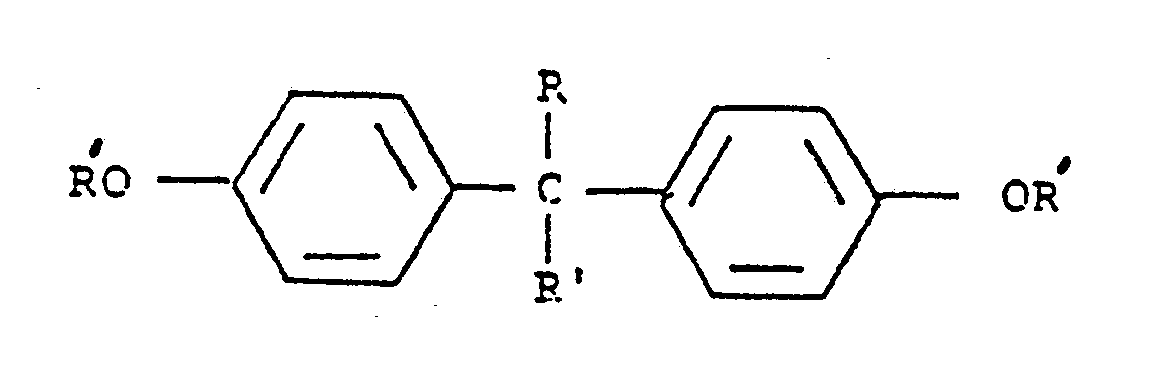
wherein R is hydrogen or an alkyl group of 1 to 9 carbon atoms and R′ is hydrogen, an alkyl group of 1 to 9 carbon atoms, cycloalkyl, and aryl group, or functional derivative thereof.
wherein R is hydrogen or an alkyl group of 1 to 9 carbon atoms and R′ is hydrogen, an alkyl group of 1 to 9 carbon atoms, cycloalkyl, and aryl group, or functional derivative thereof.
3. The process of claim 1 or 2 wherein the temperature is in the range of 0° to 120°C
and the pressure is in the range of 2.5 to 500 psig (118 to 3549 kPa absolute).
4. The process of claim 3 wherein said contacting is carried out for less than 8 hours.
5. The process of any of claims 1 to 4 wherein the said phenol derivative is a bis(4-hydroxyphenyl)
alkane.
6. The process of any of claims 1 to 4 wherein the said phenol derivative is a tris(4-hydroxyphenol)alkane.
7. The process of claim 5 wherein the said phenol derivative is 2,2-bis(4-hydroxyphenyl)propane.
8. The process of claim 6 wherein the said phenol derivative is 1,1,1-tris(4-hydroxyphenyl)ethane.
9. The process of claim 7 or 8 wherein the dearylation is carried out in the presence
of a monovalent organo protective or end blocking group.
10. The process of claim 1 wherein the said phenol derivative is represented by the
formula:
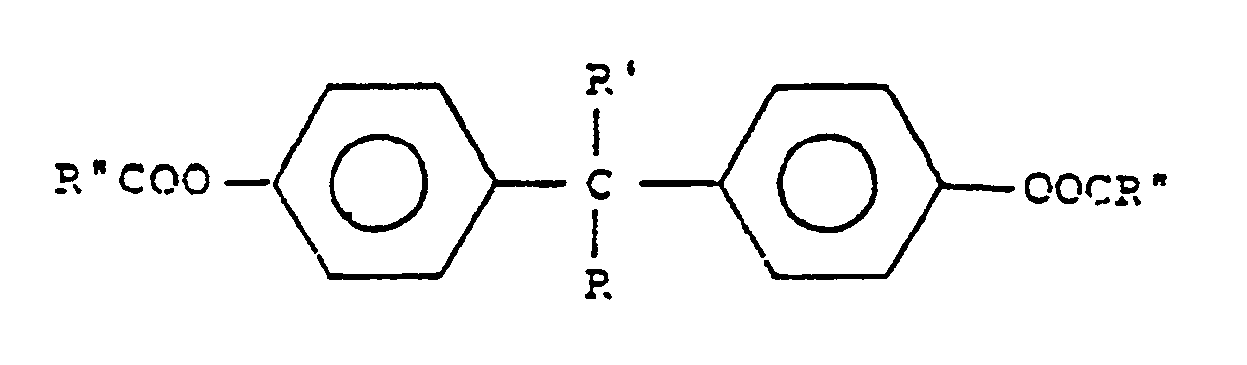
wherein R′ is a hydrogen, alkyl, cycloalkyl, or an esterifield aryl group, R is a hydrogen or an alkyl group having from 1 to 9 carbon atoms and R˝ is an alkyl, cycloalkyl, an aryl group, or functional derivative thereof.
wherein R′ is a hydrogen, alkyl, cycloalkyl, or an esterifield aryl group, R is a hydrogen or an alkyl group having from 1 to 9 carbon atoms and R˝ is an alkyl, cycloalkyl, an aryl group, or functional derivative thereof.
1. Verfahren zur Entarylierung eines Alkylenbisphenols oder Alkyltrisphenols, dadurch
gekennzeichnet, daß das genannte Phenolderivat mit Fluorwasserstoff unter Flüssigphasenbedingungen
und während einer so langen Zeit in Kontakt gebracht wird, daß das genannte Phenolderivat
entaryliert wird und Phenol und Alkyl und/oder alkenylsubstituierte Phenole erzeugt
werden.
2. Verfahren nach Anspruch 1, dadurch gekennzeichnet, daß das genanne Phenolderivat
dargestellt wird durch die Formel
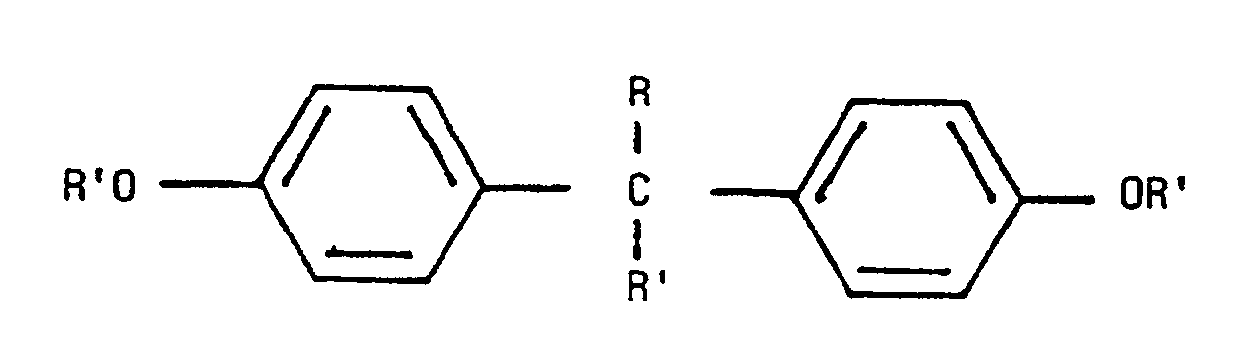
worin R Wasserstoff oder eine Alkylgruppe mit 1 bis 9 Kohlenstoffatomen ist und R' Wasserstoff, eine Alkylgruppe mit 1 bis 9 Kohlenstoffatomen, Cycloalkyl, eine Arylgruppe oder deren funktionelles Derivat ist.
worin R Wasserstoff oder eine Alkylgruppe mit 1 bis 9 Kohlenstoffatomen ist und R' Wasserstoff, eine Alkylgruppe mit 1 bis 9 Kohlenstoffatomen, Cycloalkyl, eine Arylgruppe oder deren funktionelles Derivat ist.
3. Verfahren nach Anspruch 1 oder 2, dadurch gekennzeichnet, daß die Temperatur im
Bereich von 0 bis 120°C und der Druck im Bereich von 118 bis 3549 kPa abs. (2,5 bis
500 psig) liegt.
4. Verfahren nach Anspruch 3, dadurch gekennzeichnet, daß der Kontakt weniger als
8 h lang aufrechterhalten wird.
5. Verfahren nach einem der Ansprüche 1 bis 4, dadurch gekennzeichnet, daß das genannte
Phenolderivat ein bis(4-Hydroxyphenyl)alkan ist.
6. Verfahren nach einem der Ansprüche 1 bis 4, dadurch gekennzeichnet, daß das genannte
Phenolderivat ein tris(4-Hydroxyphenol)alkan ist.
7. Verfahren nach Anspruch 5, dadurch gekennzeichnet, daß das genannte Phenolderivat
2,2-bis(4-Hydroxyphenyl)propan ist.
8. Verfahren nach Anspruch 6, dadurch gekennzeichnet, daß das genannte Phenolderivat
1,1,1-tris(4-Hydroxyphenyl)ethan ist.
9. Verfahren nach Anspruch 7 oder 8, dadurch gekennzeichnet, daß die Entarylierung
in Gegenwart einer einwertigen schützenden oder endneutralisierenden Organogruppe
durchgeführt wird.
10. Verfahren nach Anspruch 1, dadurch gekennzeichnet, daß das genannte Phenolderivat
dargestellt wird durch die Formel
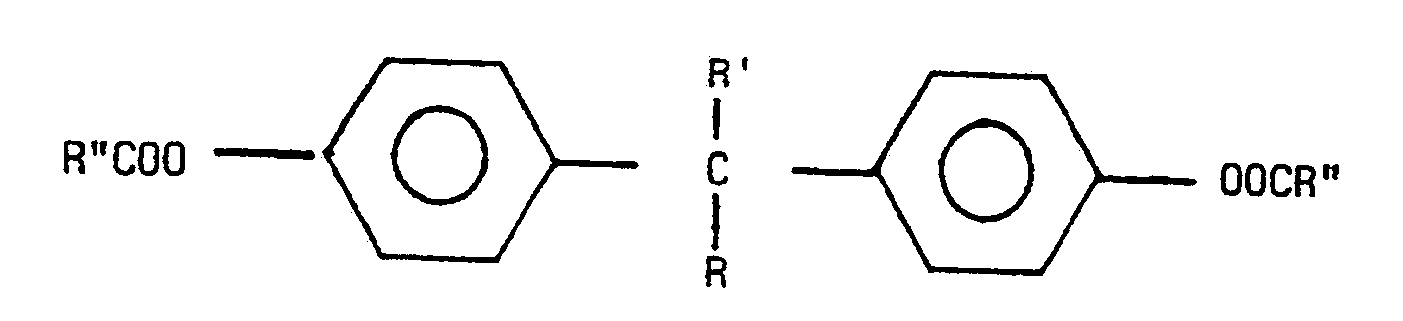
worin R' ein Wasserstoff, Alkyl, Cycloalkyl oder eine veresterte Arylgruppe ist, R ein Wasserstoff oder eine Alkylgruppe mit 1 bis 9 Kohlenstoffatomen ist und R˝ ein Alkyl, Cycloalkyl, eine Arylgruppe oder ein funktionelles Derivat davon ist.
worin R' ein Wasserstoff, Alkyl, Cycloalkyl oder eine veresterte Arylgruppe ist, R ein Wasserstoff oder eine Alkylgruppe mit 1 bis 9 Kohlenstoffatomen ist und R˝ ein Alkyl, Cycloalkyl, eine Arylgruppe oder ein funktionelles Derivat davon ist.
1. Procédé de désarylation d'un alkylènebisphénol ou d'un alkyltrisphénol, caractérisé
en ce que le dérivé du phénol précité est mis en contact avec un fluorure d'hydrogène
sous des conditions de phase liquide et pendant une période de temps suffisante pour
désaryler le dérivé du phénol précité et pour produire du phénol et des phénols substitués
par un alkyle et/ou un alcényle.
2. Procédé selon la revendication 1, où le dérivé du phénol précité est représenté
par la formule:
dans laquelle R est un hydrogène ou un groupement alkyle de 1 à 9 atomes de carbone et R′ est un hydrogène, un groupement alkyle de 1 à 9 atomes de carbone, un groupement cycloalkyle, aryle, ou un de leur dérivé fonctionel.
dans laquelle R est un hydrogène ou un groupement alkyle de 1 à 9 atomes de carbone et R′ est un hydrogène, un groupement alkyle de 1 à 9 atomes de carbone, un groupement cycloalkyle, aryle, ou un de leur dérivé fonctionel.
3. Procédé selon la revendication 1 ou 2, où la température est dans l'intervalle
de 0° à 120°C et la pression est dans l'intervalle de 2,5 à 500 psig (118 à 3549 kPa
absolu).
4. Procédé selon la revendication 3, où la mise en contact précitée est réalisée pendant
moins de 8 heures.
5. Procédé selon l'une quelconque des revendications 1 à 4, où le dérivé du phénol
précité est un bis(4-hydroxyphényl) alcane.
6. Procédé selon l'une quelconque des revendications 1 à 4, où le dérivé du phénol
précité est un tris(4-hydroxyphénol)alcane.
7. Procédé selon la revendication 5, où le dérivé du phénol précité est le 2,2-bis(4-hydroxyphényl)propane.
8. Procédé selon la revendication 6, où le dérivé du phénol précité est le 1,1,1-tris(4-hydroxyphényl)éthane.
9. Procédé selon la revendication 7 ou 8, où la désarylation est réalisée en présence
d'un groupement monovalent organo protecteur ou bloquant l'extrémité.
10. Procédé selon la revendication 1, où le dérivé du phénol précité est représenté
par la formule:
dans laquelle R′ est un hydrogène, un groupement alkyle, cycloalkyle, ou aryle estérifié, R est un hydrogène ou un groupement alkyle ayant de 1 à 9 atomes de carbone et R˝ est un groupement alkyle, cycloalkyle, aryle ou leur dérivé fonctionnel.
dans laquelle R′ est un hydrogène, un groupement alkyle, cycloalkyle, ou aryle estérifié, R est un hydrogène ou un groupement alkyle ayant de 1 à 9 atomes de carbone et R˝ est un groupement alkyle, cycloalkyle, aryle ou leur dérivé fonctionnel.