| (19) |
 |
|
(11) |
EP 0 281 491 B1 |
| (12) |
EUROPEAN PATENT SPECIFICATION |
| (45) |
Mention of the grant of the patent: |
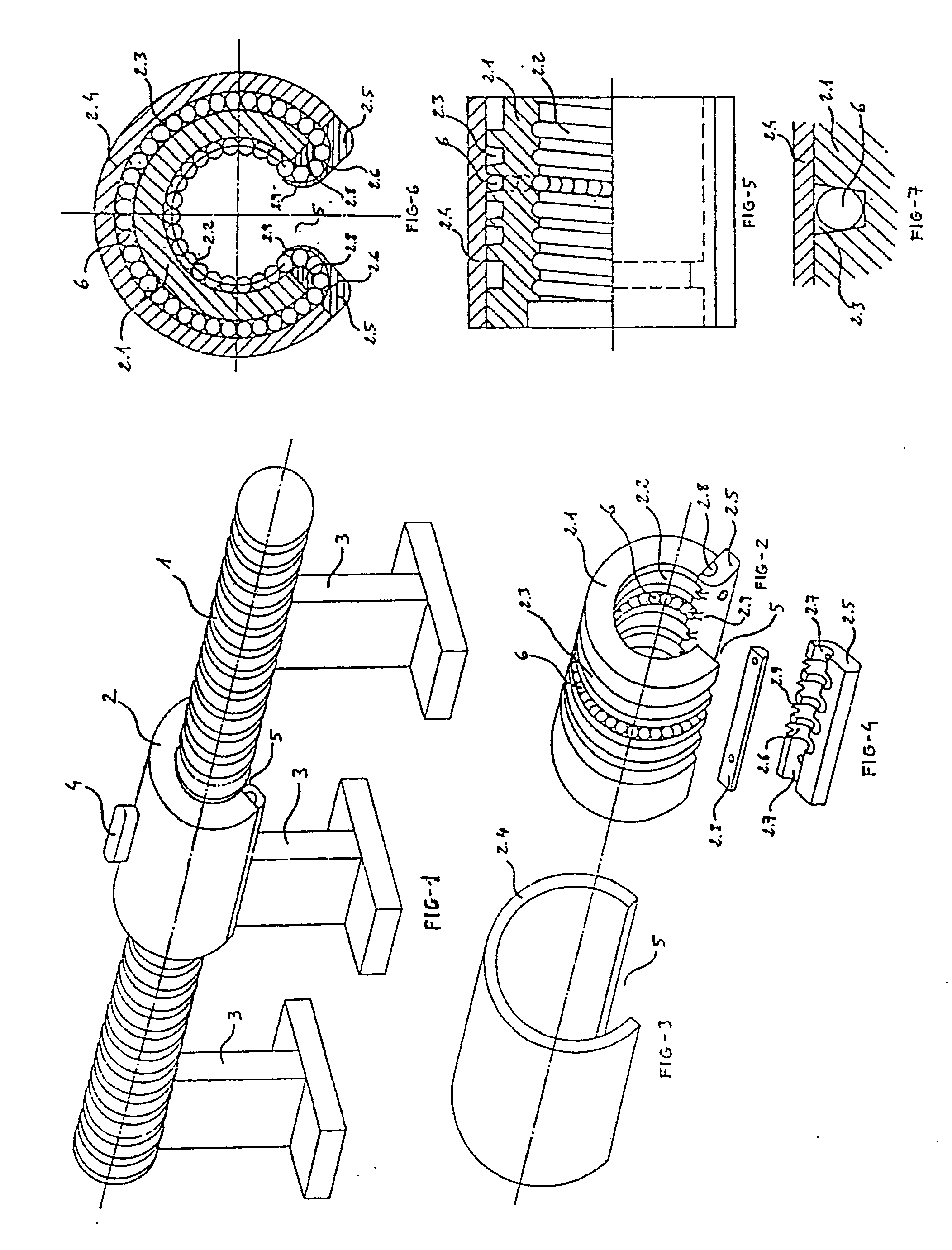
|
17.07.1991 Bulletin 1991/29 |
| (22) |
Date of filing: 28.01.1988 |
|
|
| (54) |
A system comprising a recirculating ball spindle and an associated open nut, of use
for supported screwthreaded spindles
System mit einer Spindel mit umlaufenden Kugeln und einer offenen Schraubenmutter,
um Gewindespindeln zu tragen
Système comprenant une broche à circulation de billes et un écrou ouvert associé,
utilisé pour supporter des broches filetées
|
| (84) |
Designated Contracting States: |
|
DE FR GB IT |
| (30) |
Priority: |
30.01.1987 ES 8700224
|
| (43) |
Date of publication of application: |
|
07.09.1988 Bulletin 1988/36 |
| (73) |
Proprietor: SHUTON, S.A. |
|
Villarreal de Alava
Vitoria (ES) |
|
| (72) |
Inventor: |
|
- Andonegui, Pedro Maria
E-Vitoria (ES)
|
| (74) |
Representative: Elzaburu Marquez, Alberto et al |
|
Sres. Elzaburu
Industrial Property Attorneys
Miguel Angel, 21
28010 Madrid
28010 Madrid (ES) |
| (56) |
References cited: :
DE-A- 2 353 734
GB-A- 1 170 083
US-A- 4 303 280
|
DE-A- 2 412 606
GB-A- 1 231 748
|
|
| |
|
|
- PATENT ABSTRACTS OF JAPAN, vol. 10, no. 130 (M-478)[2187], 14th May 1986; & JP - A
- 60 236 668 (MINORU IZAWA) 18-12-1985
|
|
| |
|
| Note: Within nine months from the publication of the mention of the grant of the European
patent, any person may give notice to the European Patent Office of opposition to
the European patent
granted. Notice of opposition shall be filed in a written reasoned statement. It shall
not be deemed to
have been filed until the opposition fee has been paid. (Art. 99(1) European Patent
Convention).
|
[0001] This invention relates to a system comprising a recirculating ball spindle and an
associated open nut, of use for supported screwthreaded spindles
[0002] Systems of this kind with a conventional closed nut are known. However, since the
spindle of closed nut systems is supported only at both ends a number of disadvantages
arise such as fairly substantial bending of the spindle, leading to a low critical
speed, poor rigidity and pitch inaccuracy. It becomes necessary to provide expensive
retractable rests which are retracted electrically or pneumatically when the closed
nut approaches, inaccurate pitch of the screwthreading being an additional disadvantage
to the high cost.
[0003] From GB-A-1 231 748 a spindle guide is known, as defined in the preamble of claim
1, wherein a nut is guided on a threaded spindle via roller bodies running along closed
paths. In such guide, the nut is split longitudinally, the roller bodies being guided
by various separate paths, each of which extends in the thread between said nut and
said threaded spindle and is completed by a return section on the outside of said
nut, the roller bodies of each path being surrounded by a closed form strip which
in the area of the spindle thread has a width that does not interfere with the abutment
of said roller bodies against the thread grooves. The spindle guide allows both the
use of a divided nut and of an undivided one cut and open on one side. This Patent
1.2317.48 has the drawback of the costly system for recirculating the balls, owing
to the construction and assembly of the closed form strip enclosing the ball circuit,
since a construction without precision would prevent the balls rolling, giving rise
to the balls rubbing on moving through friction instead of rolling, increasing the
temperature and consumption of the revolving engine. Moreover, the spindle thread
also has to be constructed with a sub-spline in the thread profile, so that the strip
can pass between the lower part of the ball and the spindle, without rubbing. All
this makes the mechanism costly and of poor rigidity.
[0004] From GB-A-1 170 083 a ball screw and nut mechanism is known with a screwthreaded
spindle provided with a helical rib, the rib pitch being considerably larger than
the axial width of the same, and a nut which extends part way around the shaft, said
nut having a helical recess formed therein, two rows of balls located in intermediate
position between the side walls of the recess and the side walls of the rib, respectively,
and a pair of return means in or close to the respective circumferential extremeties
of the nut to receive the balls, as these are forcibly driven from one of the rows
and carry them over the rib to the other row. To allow the rolling movement of the
balls, there has to be an axial backlash in the plane formed by the helical recess
section formed in the nut, the two balls and the screwthreaded spindle rib. Such backlash
makes the precision of the positioning passage erroneous in its repetition, such that
this mechanism cannot be applied in machines that demand great repetetiveness of positioning
on changing the operating direction, such as is the case of use in numerical control
machines.
[0005] It is the object of the invention to improve recirculating ball system of the kind
hereinbefore set out by obviating bending of the shaft or spindle and thus increasing
its critical speed, its rigidity and its accuracy of pitch. Systems of this kind are
required to be simple and cheap to produce and must be so devised that the nut is
free to move over the whole length of a very long spindle which is prevented from
bending by means of fixed supports or rests. This invention also improves the diameter-to-length
ratio in that the spindle can be of unlimited length irrespective of the nature of
its end supports; the invention is therefore of use for all recirculating ball systems
in which the nut does not rotate and the spindle does.
[0006] This invention provides a system comprising a recirculating ball spindle and an associated
open nut, of use for supported screwthreaded spindles, with the features set out in
the characterising clause of claim 1.
[0007] In practice, when there is relative rotation between the spindle and the nut the
spindle rotates and the nut moves axially, to which end any kind of means, such as
a key or cotter or the like, is provided to secure the nut against rotation. In operation,
the spindle can of course be supported on stationary supports in the form of columns
along its whole length. When the spindle is rotated the slit nut moves axially, the
spindle support columns passing between the ends of the nut slit.
[0008] The recirculating ball spindle system according to the invention can be used with
a one part nut or with a two part preloaded nut, i.e. the two parts are under pressure
against the edges in opposite directions, using any known kind of preloading.
[0009] An embodiment of the recirculating ball spindle according to the invention will be
described hereinafter, reference being made to the drawings wherein:
Fig. 1 illustrates a system comprising a spindle and a slit or open nut engaging some
of the way around the spindle, the same being supported on stationary columns or rests;
Fig. 2 is a view of the slit nut with the inner and outer helical grooves and a cover
for the assembled recirculating ball mechanism;
Fig. 3 is a view of the open cylindrical sleeve;
Fig. 4 is a view of the two parts which make up a cover of the recirculating ball
mechanism;
Fig. 5 is a longitudinal view of the nut;
Fig. 6 is a front sectioned view of the nut showing the recirculating ball circuit;
and
Fig. 7 shows a detail of the cross-section of the groove in the nut outer periphery.
[0010] Fig. 1 shows a system comprising a spindle 1 and a slit or open nut 2; the spindle
1 rests on stationary columns or rests 3, a key or cotter or the like 4 being provided
to prevent the nut 2 from turning. The operation of a system of this kind is such
that when the spindle 1 turns, the non-rotatable nut 2 moves axially along the spindle
1, the rests 3 passing freely between the ends of the slit nut 5; consequently, the
spindle 1 can be supported at as many places or as many rests 3 as required.
[0011] Figs. 2-4 are views of the slit nut simplified to its four basic parts.
[0012] Figs 2-4 show the basic parts making up the slit nut mechanism; the same comprises
a hollow cylindrical nut 2.1 which is shown in Fig. 2. It is formed with a longitudinal
aperture or slit 5, engages some way around the spindle 1 and is formed on its inner
periphery with a helical groove or channel 2.2, its outer periphery also being formed
with a channel 2.3 of the same pitch and thread as the inner channel 2.2, the two
channels being parallel throughout.
[0013] Fig. 3 shows a cylindrical sleeve or bush 2.4 whose inner periphery has a plain surface
and extends around the outer periphery of the nut 2.1; the sleeve is formed with a
longitudinal opening or slit 5 whose ends are parallel to the slit or opening in the
nut 2.1.
[0014] Fig. 4 shows the two parts which make up the ball recirculating mechanism. The same
is embodied by a cover 2.5 whose inside surface is formed with passages or channels
in the form of parallel U-shaped grooves 2.6 of an appropriate cross-section for the
balls to pass through. The separating walls between the channels 2.6 are also formed
axially with a channel 2.7 in which bears a hemicylinder 2.8 which co-operates with
the channels 2.6 to form passages of a cross-section, height and width appropriate
for the diameter of the recirculating ball. The side surface is formed with parallel
peripheral prolongations defining front spoon-shaped parts 2.9.
[0015] Figs. 5 and 6 are a longitudinal view and a front view respectively of the nut 2,
showing the recirculating ball circuit.
[0016] Fig. 5 shows the operating arrangement of the recirculation of the balls 6 in a slit
nut 2. When there is angular relative movement between the spindle 1 and nut 2 the
balls 6 are collected from the groove in the spindle 1 and from the inner groove 2.2
by the action of the front spoon-shaped 2.9, whereafter the balls pass through the
channel 2.6 in a cover 2.5 and are deposited in the outer groove 2.3 which forms a
closed channel or tube with the sleeve 2.4. After the balls 6 have moved over the
outer surface they return through the opposite cover 2.5 to the groove in the inner
periphery 2.2, and so each inner groove 2.2 forms a closed circuit with its parallel
outer groove 2.3. Fig. 5 shows the arrangement at one end of the slit 5 in the nut
2 of the section of the helical groove or channel 2.2 of the inner periphery and the
outer parallel groove 2.3. The nut 2 can be formed with as many closed ball circuits
as it has grooves 2.1.
[0017] Fig. 7 shows a detail of the cross-section of the closed outer groove 2.3 forming
a tube for the passage of the balls 6 by means of the sleeve 2.4.
1. A system comprising a recirculating ball spindle and an associated open nut, of
use for supported screwthreaded spindles, with a screwthreaded spindle (1) threaded
with a hemispherical-section helical groove or channel in its external cylindrical
surface; a hollow cylindrical nut (2), which engages via balls (6) around the spindle
(1) and which comprises a nut body (2.1) with grooves (2.2.) in its internal periphery
to match the spindle and grooves (2.3) on its external periphery, which are parallel
to said grooves on the internal periphery; a cylindrical sleeve or bush (2.4) whose
inner periphery has a plain surface and extends around the outer periphery of the
nut body (2.1) and a ball recirculating mechanism such that each pair of parallel
internal and external grooves together with the ball recirculating mechanism forms
a closed ball circuit; and a number of said balls (6) inside the closed ball circuits
characterised in that the nutbody (2.1) has a longitudinal slit (5), which is bounded
by the intersection of the nut (2) with two longitudinal planes containing the radius
and rotational axis of the nut and which has a width at the inner circumference of
the nut body (2.1) which is less than the diameter of the spindle (1); and the ball
recirculating mechanism comprises: two elongated prismatic covers (2.5) placed on
each of the plane surfaces of the sides of the slit (5) each such cover being unitary,
the same being formed with passages or channels (2.6) in the form of parallel U-shaped
grooves of a cross-section such as to facilitate the passage of the balls (6); the
channel-separating walls being formed axially with a channel (2.7) in which bears
a hemicylinder (2.8) co-operating with the U-shaped channels (2.6) to bound passages
of a cross-section height and width suitable for the diameter of the recirculating
ball; the cover side surface opposite the spindle surface being formed with parallel
peripheral prolongations bounding spoon-shaped front parts (2.9) matching the channels
in the spindle, so that the balls (6) are collected from the groove in the spindle
(1) and moved to the groove (2.3) in the external periphery.
2. A system according to claim 1, characterised in that when there is relative rotation
between the spindle (1) and the nut (2) the spindle (1) rotates and the nut moves
axially, to which and any kind of means, such as a key or cotter or the like (4),
is provided to secure the nut against rotation.
3. A system according to claims 1-2, characterised in that the spindle (1) is supported
on stationary supports in the form of columns (3) along its whole length in the most
appropriate form, and when the spindle (1) is rotated the slit nut (2) moves axially,
the spindle support columns (3) passing between the ends of the nut slit (5).
4. A system according to claim 1, characterised in that the nut is divided in two
parts which are preloaded to each other.
1. System mit einer Spindel mit umlaufenden Kugeln und einer zugeordneten offenen
Schraubenmutter, um Gewindespindeln zu tragen, mit einer Gewindespindel (1), die mit
einer halbkreisförmigen schraubenförmigen Vertiefung, oder Kanal, auf ihrer äusseren
zylindrischen Oberfläche gebildet ist; eine hohlzylindrische Schraubenmutter (2),
die die Spindel (1) durch Kugeln (6) umgreift und die einen Schraubenmutterkörper
(2.1) mit Vertiefungen (2.2) in ihrem inneren Umfang aufweist, die mit einer Spindel
zusammenpassen, und mit Vertiefungen (2.3) in ihrem äusseren Umfang, die parallel
zu diesen Vertiefungen in ihrem inneren Umfang verlaufen; eine zylindrische Hülse
oder Büchse (2.4), deren innerer Umfang eine glatte Oberfläche hat und sich um den
äusseren Umfang des Schraubenmutterkörpers (2.1) erstreckt und einen kugelumlaufenden
Mechanismus aufweist, so dass jedes Paar innere und äussere parallele Vertiefungen
zusammen mit dem kugelumlaufenden Mechanismus einen geschlossenen Kugelkreis bildet;
und eine Anzahl dieser Kugeln (6) im Inneren der geschlossenen Kugelkreisläufe, dadurch
gekennzeichnet, dass der Schraubenmutterkörper (2.1) einen Längsschlitz (5), der durch
den Schnitt von Schraubenmutter (2) mit zwei Längsebenen begrenzt ist, die den Radius
und die Rotationsachse der Schraubenmutter beinhalten, und der eine Breite am inneren
Umfang des Schraubenmutterkörpers (2.1) hat, der geringer ist als der Durchmesser
der Spindel (1); und der kugelumlaufende Mechanismus zwei längliche prismatische Abdeckungen
(2.5) aufweist, die auf jeder der ebenen Flächen der Seiten des Schlitzes (5) angeordnet
sind, wobei jede dieser Abdeckungen einstückig ist und mit Durchgängen oder Kanälen
(2.6) ausgebildet ist, die die Form von parallelen U-förmigen Vertiefungen mit einem
Querschnitt haben, der den Durchgang der Kugeln (6) ermöglicht; wobei die kanaltrennenden
Wände in axialer Richtung mit einem Kanal (2.7) ausgebildet sind, der einen Halbzylinder
(2.8) aufnimmt, der mit den U-förmigen Kanälen (2.6) zusammenwirkt, um Durchgänge
mit einer Höhe und Breite im Querschnitt, die dem Durchmesser der umlaufenden Kugeln
angepasst sind, zu begrenzen, wobei die der Spindeloberfläche abgewandte Seitenoberfläche
der Abdeckungen mit parallelen vorstehenden Fortsätzen ausgebildet ist, die löffelförmige
Vorderteile (2.9) bilden, die mit den Kanälen in der Spindel zusammenpassen, so dass
die Kugeln (6) von der Vertiefung in der Spindel (1) aufgefangen werden und zur Vertiefung
(2.9) in dem äusseren Umfang abgesetzt werden.
2. System nach Anspruch 1, dadurch gekennzeichnet, dass sich bei einer Ralativdrehung
zwischen Spindel (1) und Schraubenmutter (2) die Spindel (1) dreht und die Schraubenmutter
sich axial bewegt, weswegen irgendeine Art von Einrichtung, wie etwa ein Längskeil
oder Querkeil oder dergleichen (4), vorgesehen ist, um die Schraubenmutter gegen Drehung
zu sichern.
3. System nach den Ansprüchen 1-2, dadurch gekennzeichnet, dass die Spindel (1) auf
feststehenden Lagern in Form von Säulen (2) entlang ihrer gesamten Länge auf die geeignetste
Art gelagert ist, und wenn die Spindel (1) gedreht wird, bewegt sich die geschlitzte
Schraubenmutter (2) axial, wobei die Spindellagersäulen (3) zwischen den Enden des
Schraubenmutterschlitzes (5) durchlaufen.
4. System nach Anspruch 1, dadurch gekennzeichnet, dass die Schraubenmutter in zwei
Teile getrennt ist, die miteinander vorgespannt sind.
1. Système comprenant une broche à recirculation de billes et un écrou ouvert associé,
utilisé pour supporter des broches filetées, avec une broche (1) filetée par un canal
ou rainure hélocoïdal de section hémisphérique à sa surface cylindrique extérieure;
un écrou cylindrique creux (2) qui s'engage par billes (6) autour de la broche (1)
et comporte un corps d'écrou (2.1) et un mécanisme de recirculation de billes tel
que chaque paire de rainures internes et externes parallèles conjointement au mécanisme
de recirculation de billes forme un circuit fermé de billes; et un nombre des dites
billes (6) dans les circuits fermés de billes, caractérisé en ce que le corps d'écrou
(2.1) a une fente longitudinale qui est limitée par l'intersection de l'écrou (2)
avec deux plans longitudinaux contenant le rayon et l'axe de rotation de l'écrou,
et qui a une largeur à la circonférence intérieure du corps d'écrou (2.1) qui est
inférieure au diamètre de la broche (1); et le mécanisme de recirculation de billes
comprend deux couvercles prismatiques oblongs (2.5) disposés sur chacune des surfaces
planes des côtés de la fente (5), chacun de ces couvercles étant d'une seule pièce
et étant pourvue de passages ou canaux (2.6) en forme de rainures parallèles en U,
d'une section transversale telle qu'elle facilite le passage des billes (6); les parois
de séparation du canal étant munies axialement d'un canal (2.7) dans lequel porte
un demi-cylindre (2.8) coopérant avec les canaux en forme de U (2.6) pour définir
des passages d'une hauteur et largeur en section transversale adaptés au diamètre
de la bille de recirculation; la surface latérale du couvercle opposée à la surface
de la broche étant munie d'extensions périphériques parallèles définissant des parties
frontales en forme de cuiller (2.9) correspondant aux canaux de la broche, de sorte
que les billes (6) sont collectées à partir de la rainure de la broche (1) et déplacées
vers la rainure (2.3) de la périphérie extérieure.
2. Système selon la revendication 1, caractérisé en ce qu'il y a une rotation relative
entre la broche (1) et l'écrou (82), la broche (1) tourne et l'écrou se déplace axialement,
des moyens quelconques, tels qu'une clavette, une goupille ou analogue (4) étant prévus
dans ce but pour bloquer l'écrou contre rotation.
3. Système selon les revendication 1 et 2, caractérisé en ce que la broche (1) est
supportée sur des supports fixes en forme de colonnes (3) sur toute sa longueur de
la manière la mieux appropriée et que, lorsque la broche (1) est tournée, l'écrou
fendu (2) se-déplace axialement, les colonnes de support de broche (3) passant entre
les extrémités de la fente (5) de l'écrou.
4. Système selon la revendication 1, caractérisé en ce que l'écrou est divisé en deux
parties qui sont précontraintes l'une contre l'autre.