(19)
(11) EP 0 283 751 A3

(12) EUROPEAN PATENT APPLICATION

(88) Date of publication A3:
18.09.1991 Bulletin 1991/38

(43) Date of publication A2:
28.09.1988 Bulletin 1988/39

(21) Application number: 88102748.6

(22) Date of filing: 24.02.1988
(51) International Patent Classification (IPC)4C01B 13/02, C25B 1/02, B01D 13/04, B01D 53/22, B01D 53/14, H01M 8/06, C07F 15/06, B01D 13/02
(84) Designated Contracting States:
AT BE CH DE FR GB IT LI NL SE

(30) Priority: 25.02.1987 US 18891
25.02.1987 US 18888
25.02.1987 US 18895

(71) Applicant: AQUANAUTICS CORPORATION (a Californian corporation)
Emeryville California 94608 (US)

(72) Inventors:
  • Zenner, Bruce David
    Hercules California (US)
  • Ciccone, Joseph Paul
    Emeryville California 94608 (US)
  • De Castro, Emory Sayre
    Emeryville California 94608 (US)
  • Deardurff, Larrie Alan
    Emeryville California 94608 (US)
  • Kerr, John Borland
    Oakland California 94618 (US)
  • Vinson, Jeffry D.
    Goldsboro North Carolina 27530 (US)

(74) Representative: Reitzner, Bruno, Dr. et al
Patentanwälte Dipl.-Ing. R. Splanemann Dr. B. Reitzner, Dipl.-Ing. K. Baronetzky Tal 13
80331 München
80331 München (DE)


(56) References cited: : 


    (54) Polyalkylamine complexes for ligand extraction and generation


    (57) Methods and apparatus for electrochemical extraction of a ligand such as molecular oxygen from a first fluid environment and for release of a ligand such as molecular oxygen, as well as ligand carrier compounds therefor comprising linear, pentadentate polyalkylamines and transition metal ions. The carrier compounds have the general formula:
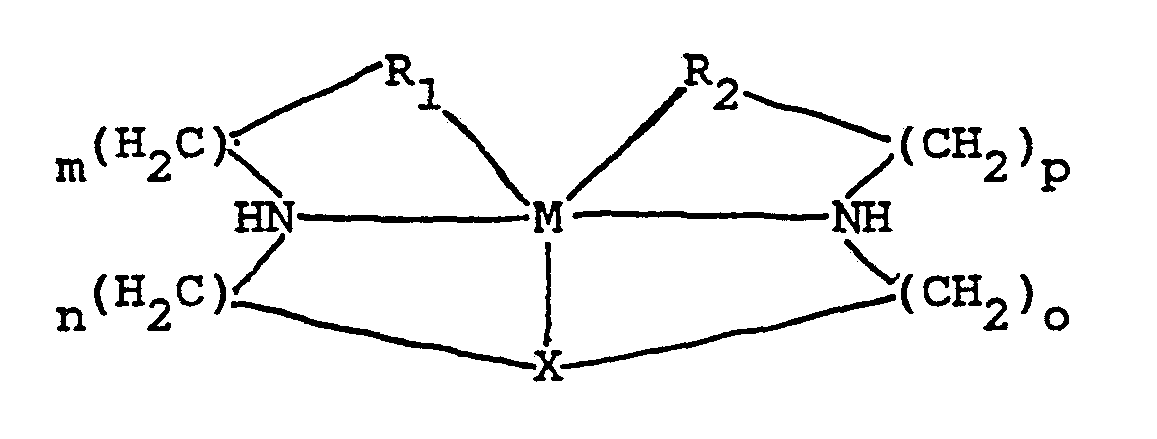
    where:

    M is an electrochemically active transition metal ion;

    R, and R2 are each organic groups including a nitrogen coordinated to M;

    m, n, o, and p are each 1, 2, 3, or 4; and


    X is selected from the group consisting of 2,6-pyridyl, 2,6-piperidyl, 2,5-pyrrolyl, 2,4-imidazolyl, substituted heterocyclic amines, -O-, -S-, -P-, and -N-R, where R is hydrogen lower alkyl, or aralkyl.
    By providing an electrocatalyst capable of rapid electron transfer and having an electropotential less than that of the carrier compound, low energy electron transfer between the carrier compounds and the electrode of the electrochemical cell is achieved. The use of electrodes having catalytically active surface sites leads to efficient electron transfer between the carrier compounds and the electrodes of the electrochemical cell, resulting in lower energy consumption and/or increased oxygen output.


    Search report
