|
(11) | EP 0 284 295 B1 |

| (12) | EUROPEAN PATENT SPECIFICATION |
|
|
| (54) |
Process for the production of aliphatic ketones Verfahren zur Herstellung von aliphatischen Ketonen Procédé pour la préparation de cétones aliphatiques |
|
|
|||||||||||||||||||||||||||||||
| Note: Within nine months from the publication of the mention of the grant of the European patent, any person may give notice to the European Patent Office of opposition to the European patent granted. Notice of opposition shall be filed in a written reasoned statement. It shall not be deemed to have been filed until the opposition fee has been paid. (Art. 99(1) European Patent Convention). |
[0001] The present invention relates in general to the production of ketones and in particular to a process for the production of aliphatic ketones, for example acetone.
[0002] Ketones are organic compounds containing one or more carbonyl groups and are represented by the general formula:
[0003] Depending on the nature of the hydrocarbon groups R-R³ attached to the carbonyl group(s) ketones are classified as symmetric or simple aliphatic, such as acetone CH₃COCH₃, symmetric aromatic such as benzophenone C₆H₅COC₆H₅, unsymmetric or mixed aliphatic-aromatic, such as methyl ethyl ketone CH₃COC₂H₅ and acetophenone CH₃COC₆H₅, alicyclic such as cyclopentanone, or heterocyclic. The present invention is concerned with the production of symmetric aliphatic, unsymmetric aliphatic and alicyclic ketones.
[0004] The lower aliphatic ketones are excellent solvents for nitrocellulose, vinyl resin lacquers, cellulose ethers and esters and various gums and resins. Because of their ability to form azeotropes with water and organic liquids, they are employed in extractive distillation.
[0005] Functionalised and cyclic ketones form metal complexes and are used as solvents and synthetic intermediates. Acetone, cyclohexanone, methyl ethyl ketone and methyl isobutyl ketone are among the hundred largest volume organic chemicals (in order of decreasing volume).
[0006] Ketones are produced on a commercial scale by a variety of methods. Acetone, the highest tonnage ketone, is produced either by the cumene hydroperoxide process, the direct oxidation of hydrocarbons, the catalytic oxidation of isopropyl alcohol or isopropyl alcohol dehydrogenation. In the cumene hydroperoxide process acetone is co-produced with phenol by alkylating benzene to cumene, which is oxidised to cumene hydroperoxide which, in turn, is cleaved to phenol and acetone. In a hydrocarbon oxidation process acetone is co-produced with, inter alia, C₁ to C₄ monocarboxylic acids by the air oxidation of, for example naphtha. Acetone is also produced by the catalytic dehydrogenation of isopropanol (IPA). Although the selectivity of IPA vapour phase dehydrogenation to acetone is high there are a number of by-products that must be removed from the acetone. A clearly desirable objective would be to produce acetone as the principal product by a high selectivity, preferably catalytic, route from simple C₁ chemicals. It would also be desirable for the route to be applicable to the production of a range of ketones.
[0007] There have been many reports of the carbonylation of methyl-metal species to give acetone. Thus, for example, in Bull. Chem. Soc., Japan, 1977, 50, 1319, Ito et al disclose the reaction:
and in J. Chem. Soc., Dalton Trans., 1983, 2473, Saunders et al disclose the reaction:
[0008] The above and most of the other reactions reported have required the prior synthesis of methyl-metal complexes, usually from a metal salt and a methyl Grignard or similar alkylating agent. It is doubtful whether such a reaction sequence could yield an economically viable catalytic route.
[0009] One possible exception to this general conclusion is the reaction reported by Whitmire et al in Organometallics, 1986, 5, 1987 entitled "Kinetics and Mechanism of the Reaction of [Et₄N][HFe(CO)₄] and Alkyl Halides. The Unexpected Formation of Acetone". In this reaction [HFe(CO)₄]⁻ is reacted with MeI at room temperature in acetonitrile solvent to produce methane as the principal product and some acetone in a very much slower subsequent reaction believed by the authors to be the reaction of MeI with product "Fe(CO)₄". The authors also report that in the presence of carbon monoxide the yield of acetone is reduced or eliminated.
[0010] Finally, US Patent No. 4299989 discloses a process for the production of a ketone which comprises treating a carboxylic acid ester in the presence of a catalyst comprising a compound containing a metal of Group VIII of the Periodic Table. In a specific embodiment of this process acetone is produced by treating methyl formate in the presence of a catalyst comprising chlororhodium phthalocyanine at a temperature in the range of from 50 to about 300°C and a pressure in the range of from about 1 to about 300 atmospheres, said pressure being afforded by the presence of carbon monoxide, and in the added presence of dichlorobenzylalkyldimethylammonium chloride.
[0012] Accordingly, the present invention provides a process for the production of an aliphatic ketone which process comprises reacting a carbonyl complex of a noble metal of Group VIII of the Periodic Table of the Elements with an aliphatic hydrocarbyl halide having the formula RX wherein R is methyl or ethyl and X is halide.
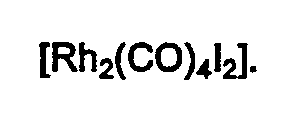
[0013] As regards the metal of Group VIII of the Periodic Table the metal is a noble metal, i.e. rhodium, ruthenium, platinum, palladium, osmium or iridium, preferably rhodium. Any metal carbonyl complex may be employed. Suitably the metal carbonyl complex may be a neutral metal carbonyl complex as opposed to a metal carbonyl complex of the type [Et₄N][HFe(CO)₄]. An example of a suitable metal carbonyl complex is [Rh₂(CO)₄I₂]. Such complexes may be prepared by known methods.
[0014] The aliphatic hydrocarbyl halide is a hydrocarbyl monohalide of the formula RX(I) wherein in the formula (I) R is methyl or ethyl and X is halide. Using a hydrocarbyl monohalide the product ketone will generally be a symmetric aliphatic ketone or an alicyclic ketone. Using a mixture of hydrocarbyl monohalides it is possible to produced a mixture of ketones comprising symmetric and unsymmetric ketones. The halide moiety X of the hydrocarbyl halide may suitably be chloride, bromide or iodide, preferably iodide. Preferred hydrocarbyl halides include methyl iodide and ethyl iodide.
[0015] A preferred reaction is that of a rhodium carbonyl complex, for example [Rh₂(CO)₄I₂], with methyl iodide to produce acetone.
[0016] The process is preferably operated in the liquid phase, which may be provided either by the hydrocarbyl halide itself or by the addition of a suitable inert solvent. Suitable inert solvents include hydrocarbons and halohydrocarbons. Oxygenated solvents, for example ethers, may also be used if desired.
[0017] The process may be operated at ambient or elevated temperature, preferably at elevated temperature.
[0020] In a preferred embodiment the present invention also provides a continuous process for the production of an aliphatic ketone which process comprises in a first step reacting a carbonyl complex of a noble metal of Group VIII of the Periodic Table with a methyl or ethyl halide to produce an aliphatic ketone and a halide complex of the metal carbonyl and either (i) in a second step reacting the halide complex of the noble metal carbonyl with a compound of the formula ROR (II) wherein R is methyl or ethyl and carbon monoxide to produce a product comprising the starting methyl or ethyl halide and the starting noble metal carbonyl and further reacting this product, or (ii) in a second step reacting the halide complex of the noble metal carbonyl with a hydrocarbylformate wherein the hydrocarbyl group is methyl or ethyl to produce a product comprising the starting noble metal carbonyl complex and the starting methyl or ethyl halide and further reacting the product.
[0021] The aforesaid process applied to the production of acetone may be represented by the following reaction scheme:
Example 1
[0023] [Rh₂(CO)₄I₂] and methyl iodide were charged to a tube and the tube sealed under an inert atmosphere. The tube was held at 60°C for 24 hours. At the end of this period the tube was broken and the contents analysed. Acetone was obtained in a 90% stoichiometric yield.
Example 2
[0024] The procedure of Example 1 was repeated except that ethyl iodide was used in place of methyl iodide and the temperature was held at 80°C for 80 hours. Diethyl ketone was obtained in 50% yield.
Example 3
[0025] A 100 ml Hastelloy autoclave was charged with rhodium dicarbonyl chloride dimer (0.1 g) and methyl iodide (25 ml) and pressurised to 40 bar with carbon monoxide. The autoclave was heated to 120°C for 15 hours and then cooled in ice and discharged GC analysis showed a small amount of acetone equivalent to the stoichiometric amount of acetone based on the rhodium charged.
1. A process for the production of an aliphatic ketone which process comprises reacting
a carbonyl complex of a noble metal of Group VIII of the Periodic Table of the Elements
with an aliphatic hydrocarbyl halide having the formula RX wherein R is methyl or
ethyl and X is halide.
2. A process according to claim 1 wherein the noble metal is rhodium.
3. A process according to any one of the preceding claims wherein the carbonyl complex
of a noble metal of Group VIII of the Periodic Table is a neutral complex.
4 A process according to claim 3 wherein the neutral complex is
5. A process according to any one of the preceding claims wherein the aliphatic hydrocarbyl
halide is either methyl iodide or ethyl iodide.
6. A process according to claim 1 wherein a rhodium carbonyl complex is reacted with
methyl iodide to produce acetone.
7. A continuous process for the production of an aliphatic ketone which process comprises
in a first step reacting a carbonyl complex of a noble metal of Group VIII of the
Periodic Table with a methyl or ethyl halide to produce an aliphatic ketone and a
halide complex of the noble metal carbonyl, in a second step reacting the halide complex
of the noble metal carbonyl with a compound of the formula:

wherein R is a methyl or ethyl and carbon monoxide to produce a product comprising the starting methyl or ethyl halide and the starting noble metal carbonyl and thereafter reacting the product of the second step.
wherein R is a methyl or ethyl and carbon monoxide to produce a product comprising the starting methyl or ethyl halide and the starting noble metal carbonyl and thereafter reacting the product of the second step.
8. A continuous process for the production of an aliphatic ketone which process comprises
in a first step reacting a carbonyl complex of a noble metal of Group VIII of the
Periodic Table with a methyl or ethyl halide to produce an aliphatic ketone and a
halide complex of the noble metal carbonyl, in a second step reacting the halide complex
of the noble metal carbonyl with a hydrocarbyl formate wherein the hydrocarbyl group
is methyl or ethyl to produce a product comprising the starting noble metal carbonyl
complex and the starting methyl or ethyl halide and thereafter reacting the product
of the second step.
1. Verfahren zur Herstellung eines aliphatischen Ketons, wobei das Verfahren das Umsetzen
eines Carbonylkomplexes eines Edelmetalles der Gruppe VIII der Periodensystems der
Elemente mit einem aliphatischen Hydrocarbylhalogenid, das die Formel RX hat, worin
R Methyl oder Ethyl ist und X Halogenid ist, umfaßt.
2. Verfahren nach Anspruch 1, worin das Edelmetall Rhodium ist.
3. Verfahren nach einem der vorstehenden Ansprüche, worin der Carbonylkomplex eines
Edelmetalles der Gruppe VIII des Periodensystems ein neutraler Komplex ist.
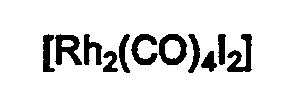
4. Verfahren nach Anspruch 3, worin der neutrale Komplex
ist.
ist.
5. Verfahren nach einem der vorstehenden Ansprüche, worin das aliphatische Hydrocarbylhalogenid
entweder Methyliodid oder Ethyliodid ist.
6. Verfahren nach Anspruch 1, worin ein Rhodiumcarbonylkomplex umgesetzt wird mit
Methyliodid um Aceton herzustellen.
7. Kontinuierliches Verfahren zur Herstellung eines aliphatischen Ketons, wobei das
Verfahren in einem ersten Schritt das Umsetzen eines Carbonylkomplexes eines Edelmetalles
der Gruppe VIII des Periodensystems mit einem Methyl- oder Ethylhalogenid umfaßt,
um ein aliphatisches Keton und einen Halogenidkomplex des Edelmetallcarbonyls herzustellen,
in einem zweiten Schritt das Umsetzen des Halogenidkomplexes des Edelmetallcarbonyls
mit einer Verbindung der Formel:

worin R ein Methyl oder Ethyl ist und Kohlenmonoxid, um ein Produkt herzustellen, umfassend das Ausgangsmethyl- oder -ethylhalogenid und das Ausgangsedelmetallcarbonyl und anschließend das Umsetzen des Produktes des zweiten Schrittes umfaßt.
worin R ein Methyl oder Ethyl ist und Kohlenmonoxid, um ein Produkt herzustellen, umfassend das Ausgangsmethyl- oder -ethylhalogenid und das Ausgangsedelmetallcarbonyl und anschließend das Umsetzen des Produktes des zweiten Schrittes umfaßt.
8. Kontinuierliches Verfahren zur Herstellung eines aliphatischen Ketons, wobei das
Verfahren in einem ersten Schritt das Umsetzen eines Carbonylkomplexes eines Edelmetalles
der Gruppe VIII des Periodensystems mit einem Methyl- oder Ethylhalogenid umfaßt,
um ein aliphatisches Keton und einen Halogenidkomplex des Edelmetallcarbonyls herzustellen,
in einem zweiten Schritt das Umsetzen des Halogenidkomplexes des Edelmetallcarbonyls
mit einem Hydrocarbylformiat, worin die Hydrocarbylgruppe Methyl oder Ethyl ist, um
ein Produkt herzustellen, das den Ausgangsedelmetallcarbonylkomplex und das Ausgangsmethyl-
oder -ethylhalogenid umfaßt, und anschließend das Umsetzen des Produktes des zweiten
Schrittes umfaßt.
1. Procédé de production d'une cétone aliphatique, procédé qui consiste à faire réagir
un complexe carbonyle d'un métal noble du groupe VIII du tableau périodique des éléments
avec un halogénure d'hydrocarbure aliphatique ayant la formule RX dans lequel R est
un méthyle ou un éthyle et X est un halogène.
2. Procédé selon la revendication 1, dans lequel le métal noble est le rhodium.
3. Procédé selon l'une des revendications précédentes, dans lequel le complexe carbonyle
d'un métal noble du groupe VIII du tableau périodique est un complexe neutre.
4. Procédé selon la revendication 3,dans lequel le complexe neutre est:

5. Procédé selon l'une des revendications précédentes, dans lequel l'halogénure d'hydrocarbure
aliphatique est l'iodure de méthyle ou l'iodure d'éthyle.
6. Procédé selon la revendication 1, dans lequel un complexe carbonyle de rhodium
réagit avec l'iodure de méthyle pour produire de l'acétone.
7. Procédé continu pour la production d'une cétone aliphatique, procédé qui consiste,
dans une première étape, à faire réagir un complexe carbonyle d'un métal noble du
groupe VIII du tableau périodique avec un halogénure de méthyle ou d'éthyle pour produire
une cétone aliphatique et un complexe halogéné d'un métal carbonyle de métal noble,
dans une seconde étape, à faire réagir le complexe halogéné de carbonyle d'un métal
noble avec un composé de formule:

dans lequel R est un méthyle ou un éthyle, et avec du monoxyde de carbone pour produire un produit comprenant l'halogénure de méthyle ou d'éthyle initial et le carbonyle de métal noble initial, et ensuite à faire réagir le produit de la deuxième étape.
dans lequel R est un méthyle ou un éthyle, et avec du monoxyde de carbone pour produire un produit comprenant l'halogénure de méthyle ou d'éthyle initial et le carbonyle de métal noble initial, et ensuite à faire réagir le produit de la deuxième étape.
8. Procédé continu pour la production d'une cétone aliphatique, lequel procédé consiste,
dans une première étape, à faire réagir un complexe carbonyle d'un métal noble du
groupe VIII du tableau périodique avec un halogénure de méthyle ou d'éthyle pour produire
une cétone aliphatique et un complexe halogéné de carbonyle de métal noble, dans une
seconde étape, à faire réagir le complexe halogéné de carbonyle de métal noble avec
un formate d'hydrocarbure dans lequel le groupe hydrocarbure est un méthyle ou un
éthyle, pour produire un produit comportant le complexe de carbonyle de métal noble
initial et l'halogénure de méthyle ou d'éthyle initial, et ensuite à faire réagir
le produit de la deuxième étape.