|
(11) | EP 0 285 716 A1 |

| (12) | EUROPEAN PATENT APPLICATION |
|
|
|
|
||||||||||||||||||||||||
| (54) | Polyurea composition useful for coatings |
| (57) Polyurea compositions suitable as 1- pack or 2- pack coatings for a variety of substrates
are obtained by reaction of polyisocyanates with secondary aromatic diamines having
the formula
wherein R₁ and R₂ each represents an alkyl group having from 4 to 20 carbon atoms. N,Nʹ-di(2-butyl)-4,4ʹ- methylene dianiline is a suitable diamine, and the polyisocyanate can be a biuret having the formula Wherein Y is: a) a polymethylene chain, -(CH₂)n-, in which n is an integer from 2 to 10; b) a divalent aromatic radical; c) a cyclohexylene radical; or d) an aralkylene radical. |
[0001] As a subclass of commercially available polymers, polyurethane and polyurea elastomers have several properties whose advantages confer unique benefits on these products. Typically, these materials show high abrasion resistance with high load bearing, excellent cut and tear resistance, high hardness, resistance to ozone degradation, yet are pourable and castable. Compared to metals, polyureas are lighter in weight, less noisy in use, show better wear and excellent corrosion resistance while being capable of cheap fabrication. Compared to other plastics, these products are non-brittle, much more resistant to abrasion, and exhibit good elastomeric memory. These materials find use in such diverse products as aircraft hitches, bushings, cams, gaskets, gravure rolls, star wheels, washers, scraper blades, impellers, gears, and drive wheels.
[0002] Part of the utility of polyurethanes and polyureas derives from their enormous diverstiy of properties resulting from a relatively limited number of reactants. Typically, polyurethanes are prepared on site by curing urethane prepolymers. One class of prepolymers, especially pertinent to this application, result from the reaction of diisocyanates with a limited amount of water to give as prepolymers principally biurets with smaller amounts of higher condensation products according to the reaction,
Although Y is susceptible of great variety, usually being a divalent alkyl, cyclohexyl, or aromatic radical, in fact the most available urethane propolymers are made from toluene-2,4-diisocyanate (TDI) or methylene-4,4ʹ-diphenylisocyanate (MDI), although the biurets show a somewhat greater structural variation.
[0003] Polyureas are formed by curing the biuret. Curing is the reaction of the terminal isocyanate groups of the or biuret with active hydrogens of a polyfunctional compound so as to form high polymers through chain extension and, in some cases, crosslinking. Diols, especially alkylene diols, are the most common curing agents, especially for MDI-based urethane prepolymers, and representing such diols with the structure HO-X-OH, where X is an organic moiety, most usually an alkylene group, the resulting polymer has as its repeating unit,
(-Y-NHCO₂XO₂CNH-Y-NHCO₂-X-O-CONH-)
Where a triol or a higher polyhydric alcohol is used crosslinking occurs to afford a nonlinear polymer. Where biurets are the prepolymer crosslinking occurs even with diols, since the biuret itself is at least trifunctional.
[0004] Although other polyfunctional chemicals, especially diamines, are theoretically suitable as a curing agent, with but a few exceptions none have achieved commercial importance. The major exception is 4,4ʹ-methylene-di-ortho-chloroaniline, usually referred to as MOCA, a curing agent which is both a chain extender and a crosslinker. TDI-based urethane prepolymers typically are cured with MOCA, and the resulting products account for perhaps most of the polyurethane elastomer market. One reason that polyhydric alcohols generally have gained acceptance as curing agents is that their reaction with urethane prepolymers is sufficiently fast to be convenient, but not so fast as to make it difficult to work with the resulting polymer. In casting polymers it is desirable that the set-up time be reasonably short, yet long enough for the material to be cast into molds. This property is conventionally referred to as pot life. Generally speaking, diamines react with prepolymers, and especially MDI-based prepolymers, so quickly that they are not usable as curing agents. However, primary aromatic diamines with electronegative groups on the aromatic ring, or with alkyl groups ortho to the amino moiety, exhibit sufficiently decreased reactivities with some prepolymers as to afford a desirable pot life, hence the use of, for example, MOCA as a curing agent for TDI-based urethane prepolymers. However, MOCA and other of the aforementioned diamines still remain too reactive to be used, for example, with MDI-based urethane prepolymers.
[0005] Previously only primary aromatic diamines seem to have been used as curing agents. Presumably this is because secondary diamines were expected to have an unacceptably long pot life, and because they could act only as chain extenders with urethane prepolymers in contrast to the crosslinking capabilities of primary diamines. Recently, however, in U.S. Patent No. 4,578,446, we reported our finding that certain N,Nʹ-dialkyl-4,4ʹ-methylenedianilines are generally effective curing agents for a broad range of urethane prepolymers. The resulting polyurethanes often have the advantage of being thermoplastic rather than thermosetting, thereby making them especially useful as coatings, adhesives, and sealants. We have now found that such aromatic alkyl diamines are effective curing agents for biurets which, because of the latter's trifunctionality (and higher functionality), are crosslinked by these diamines to afford polyurea resins with quite desirable properties.
[0006] Polyureas find extensive application as coatings and adhesives. Among the properties of polyureas particularly desirable in the coating art are their chemical resistance, light stability, flexibility, toughness, weatherability, moisture resistance, abrasion resistance, gloss and color retention, and impact resistance. We have found that biuret prepolymers cured with the secondary amines we previously described afford resins which are particularly suitable as coatings, and this application is directed toward that use as well as the novel polyurea composition resulting therefrom.
[0007] The object of this invention is to disclose particular unique polyurea compositions and their use as coatings and adhesives. A broad embodiment comprises polyurea compositions resulting from curing a diisocyanate-terminated biuret prepolymer with an aromatic alkyl diamine. In a more specific embodiment the alkyl is a secondary alkyl moiety. In a still more specific embodiment the biuret is that from 1,6-hexamethylene diisocyanate. An important embodiment involves the use of the unique polyurea composition as a coating or adhesive. Other embodiments will be apparent from the description which follows.
[0008] The invention herein is a polyurea composition resulting from curing a polyisocyanate which is at least trifunctional, especially a diisocyanate-terminated biuret prepolymer, with an aromatic alkyl diamine, especially those with a secondary alkyl moiety. It has been found that such polyureas have properties which lend themselves especially well to the coating art, hence these polyureas find particular application as coatings.
[0009] The isocyanates used in the practice of this invention are polyisocyanates which are at least triisocyanates. Prime examples of such polyisocyanates are the adducts of water and a diisocyanate in such a ratio as to give a biuret as the predominant product according to the equations written above. Thus, the biuret has the formula,
The structural unit Y is capable of great diversity, and in one commercially significant variant Y is a polymethylene moiety, -(CH₂)n-, where n is an integer from 2 to about 10, with n = 6 being especially important. In another variation Y is a divalent aromatic moiety, its completely saturated cyclic (cyclohexyl) counterpart, or a divalent aralkyl moiety. Examples of the resulting diisocyanates, OCN-Y-NCO, which may be used in the practice of this invention include phenylene diisocyanate, toluene diisocyanate, xylene diisocyanate, 1,5-naphthalene diisocyanate, chlorophenylene 2,4-diisocyanate, bitoluene diisocyanate, dianisidine diisocyanate, tolidine diisocyanate and alkylated benzene diisocyanates generally; methylene-interrupted aromatic diisocyanates such as methylenediphenyl diisocyanate, especially the 4,4ʹ-isomer including alkylated analogues such as 3,3ʹ-dimethyl-4,4ʹ-diphenylmethane diisocyanate; such hydrogenated materials as cyclohexylene diisocyanate, 4,4ʹ-methylenedicyclohexyl diisocyanate; mixed aralkyl diisocyanates such as the tetramethylxylyl diisocyanates,
OCN-C(CH₃)₂-C₆H₄C(CH₃)₂NCO, and the diisocyanate popularly referred to as isophorone diisocyanate, which is 3,3,5-trimethyl-5-isocyanatomethylcyclohexyl isocyanate; and polymethylene isocyanates as 1,4-tetramethylene diisocyanate, 1,5- pentamethylene diisocyanate, 1,6-hexamethylene diisocyanate, 1,7-heptamethylene diisocyanate, 2,2,4- and 2,4,4- trimethylhexamethylene diisocyanate, 1,10-decamethylene diisocyanate. The biuret prepolymers are adducts of 1 mole water to about 3 molar proportions of diisocyanate, with the proportions commonly ranging between 1:1 and about 1:6.
[0010] The polyurea elastomer is made by reacting the polyisocyanate with a secondary aromatic alkyl diamine of the structure.
Each alkyl group, R, contains from 4 up to about 20 carbon atoms. Alkyl groups containing from 4 to 10 carbon atoms, and especially from 4 to about 8 carbon atoms, are particularly preferred. The alkyl group may be a primary, secondary, or tertiary alkyl group, although when the alkyl is tertiary there is the risk that cure time may be too long to be commercially accpetable. Secondary alkyl groups are preferred, and among these the secondary butyl group is particularly preferred. Of the positional isomers possible the 4,4ʹ-methylenedianilines are most desirable.
[0011] Defining an equivalent of diamine as an amount which furnishes as many amino groups as there are isocyanate groups in the polyisocyanate or biuret prepolymer, from about 0.80 to about 1.2 equivalents of diamine are used in curing, with the range from about 0.85 to about 1.1 being the more usual one. Since each amino group has only one hydrogen, such secondary amines act by themselves only as a chain extender and not as a crosslinker. However, since the polyisocyanates are at least trifunctional the resulting polyurea will be extensively crosslinked. The curing mix may contain other materials, including polyols, in addition to, or partly replacing, the diamines of this invention. Where a polyol is present it typically will replace from about 5% to about 35% of the diamine. It is to be understood that such a curing mixture is contemplated as being within the scope of this invention.
[0012] The initial reaction between the polyisocyanate and the diamine is between about 75 deg and about 130 deg C. The temperature is chosen, in part, to afford a convenient pot life, that is, the time interval from mixing the diamine and polyisocyanate until the mixture is very difficult to pour. The elastomer is then cured to a tack-free state by heating at the same temperature range for an additional period from about 2 to about 24 hours.
[0013] The polyureas of this invention may be used as a coating for objects of metal, glass, wood, or plastic, for one feature of these polyureas is their ability to adhere strongly to a great variety of surfaces. Such versatility makes the materials of this invention particulrly valuable.
[0014] The polyurea surface coatings described here may be applied as 1-pack or 2-pack systems. See R. Heath, Urethanes Technology, March, 1985, 17-20. In the 1-pack system the fully reacted polyurea is either in solution or is dispersed in a suitable medium. Examples of solvents which are suitable for use in the practice of this invention are aromatics generally, such as benzene, toluene, the xylenes, ethylbenzene, propylbenzene, and so forth; ketones, especially acetone and methylethylketone; and halogenated solvents such as chloroform, carbon tetrachloride, trichloroethylene, and so forth. The nature of the solvent is not particularly critical so long as it is unreactive with the polyurea, although a solvent which can be readily evaporated is desirable. The same attributes apply to the dispersing medium, where a suspension of the polyurea is used instead of a solution, with water often being a suitable dispersing medium.
[0015] The solution or dispersion of the polyurea may be applied to the surface of the object in any convenient way. Often such material is sprayed on a surface, although it may be painted on, the surface may be dip-coated, roller coated, and so on. Such methods of application are well known in the art and need not be elaborated upon further. After the coating has been applied the solvent or dispersing medium is evaporated, generally at a somewhat elevated temperature depending upon the nature of the solvent or dispersing medium. Generally, such temperatures do not exceed about 120 deg C.
[0016] In the 2-pack system a polyisocyanate and a suitable diamine are applied to a surface of the object, and the mixture is reacted or cured at an elevated temperature to form the polyurea. Conventionally, the polyisocyanate and the curing agent diamine are mixed immediately before applying to the surface of the object. However, it is possible to apply the polyisocyanate and the diamine separately. In either event, the final polyurea results from their reaction at elevated temperature, i.e., post-application curing is necessary. Curing occurs between about 75 deg and about 130 deg C, although higher temperatures may be employed if very short cure times are desired.
[0017] The example which follows is only illustrative of the invention, which is not to be limited thereby in any way.
Preparation of Polyurea Coatings.
[0018] N,Nʹ-di(2-butyl)-4,4ʹ-methylenedianiline was mixed with acetic acid (0.05% based on total weight) and then mixed with Desmodur N-100 at different NCO indexes. Desmodur N-100 is an adduct of hexamethylene diisocyanate and water in a ratio related to yield a biuret as the predominant product. This adduct has an equivalent weight of 190, is supplied by Mobay Chemical Co., and is often used as an industry standard. Dry xylene was added to obtain a uniform solution with about 50% solids content. This transparent solution was coated on the clean aluminum panels using a doctor blade and baked at 130 deg C for 30 minutes. A polyurea coating made from Desmodur N-100 and Desmophen 650A-65, a saturated hydroxyl-containing polyester resin of equivalent weight 325 supplied by Mobay Chemical Co., was used as a control.
[0019] The sward and pencil hardness of the polyurea coatings were measured on a Sward Rocker and Brumbaugh pencil. The solvent resistance was determined on the surface of the polyurea coatings by using the double rub technique with MEK or xylene. The number of double rubs was recorded to express the solvent resistance properties. The impact resistance of the polyurea coatings was measured on a Gardner-SPI Modified Variable Height Impact Tester using both the direct and indirect techniques. The chemical resistance was measured by placing the panels with polyurea coating and wax (to protect the metal square) into a 10% NaOH or HCl solution at room temperature for one week. Any change of the surface (such as transparency, color and gloss, etc.) was recorded.
[0020] Table 1 summarizes some properties of coatings prepared as previously described. The adduct (190 parts by weight) was mixed with different amounts (in parts by weight) of the secondary diamine to afford coatings of varying NCO/NH ratio. As shown there, the coating from N,Nʹ-di(2-butyl)-4,4ʹ-methylenedianiline with different NCO indexes exhibits better Gardner impact resistance and hardness than the control. The chemical resistance and the solvent resistance are the same as the control, except for the MEK solvent resistance properties.
1. A polyurea composition obtained by reacting a polyisocyanate having at least three
isocyanate moieties with from 0.8 to 1.2 equivalents of a diamine, characterized in
that the diamine is a secondary aromatic diamine having the formula
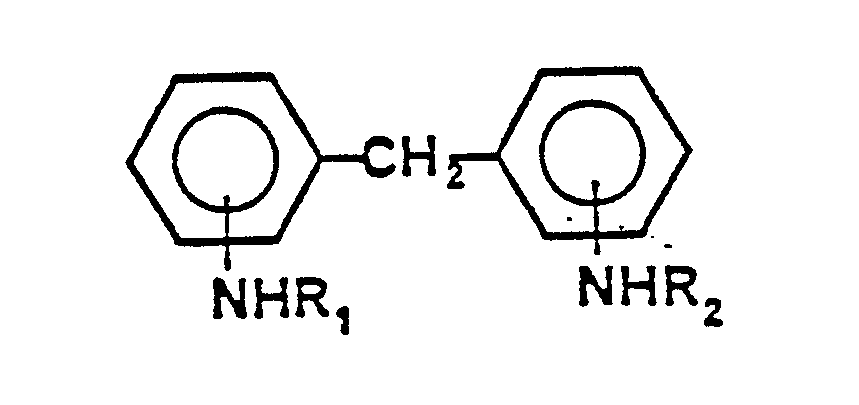
wherein R₁ and R₂ each represents an alkyl group having from 4 to 20 carbon atoms.
wherein R₁ and R₂ each represents an alkyl group having from 4 to 20 carbon atoms.
2. A composition according to Claim 1 characterized in that the diamine is N,Nʹ-di(2-butyl)-4,4ʹ-methylenedianiline.
3. A composition according to Claim 1 or 2 characterized in that the polyisocyanate
is a biuret having the formula
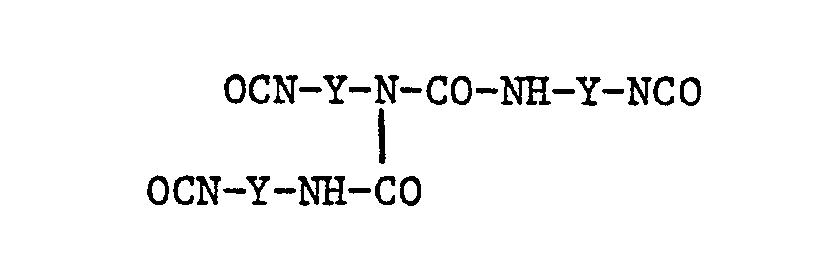
Wherein Y is:
Wherein Y is:
a) a polymethylene chain, -(CH₂)n-, in which n is an integer from 2 to 10;
b) a divalent aromatic radical;
c) a cyclohexylene radical; or
d) an aralkylene radical.
4. A composition according to claim 3 characterized in that the biuret is derived
from an aromatic diisocyanate selected from phenylene, toluene, xylene, naphthalene,
methylenediphenyl,and 3,3ʹ-dimethyldiphenylmethane diisocyanate, or is a cyclohexyl
diisocyanate selected from cyclohexyl, methylcyclohexyl, and methylenedicyclohexyl
diisocyanate, or is tetramethylxylyl or isophorone diisocyanate.
5. A composition according to any of claims 1 to 4, characterized in that the diamine
is supplemented by from 5 to 35%, based on diamine, of a polyol.
6. A method of coating an object of metal, glass, wood or plastic comprising applying
to the surface of the object a solution or dispersion of the polyurea composition
and evaporating the solvent or dispersing medium, characterized in that the polyurea
comprises a composition according to any of Claims 1 to 5.
7. A method of coating an object of metal, glass, wood, or plastic comprising applying
to a suface of the object a polyisocyanate prepolymer having at least three isocyanate
moieties and 0.8 to 1.2 equivalents of a diamine, and reacting the prepolymer with
the diamine at a temperature from 75 deg to 130 deg C, so as to form a polyurea composition
on said surface, characterized in that the diamine is a secondary aromatic diamine
having the formula
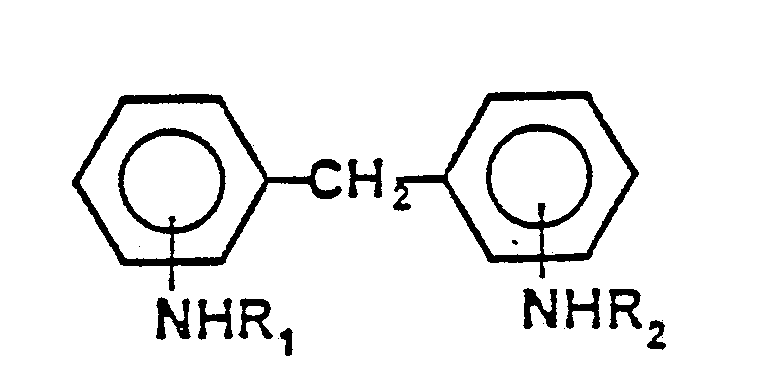
wherein R₁ and R₂, each represents an alkyl group having from 4 to 20 carbon atoms.
wherein R₁ and R₂, each represents an alkyl group having from 4 to 20 carbon atoms.
8. A method according to Claim 7 characterized in that the diamine is N,Nʹ-di(2-butyl)-4,4ʹ-methylenedianiline.
9. A method according to Claim 7 or 8, characterized in that the polyisocyanate is
a biuret having the formula
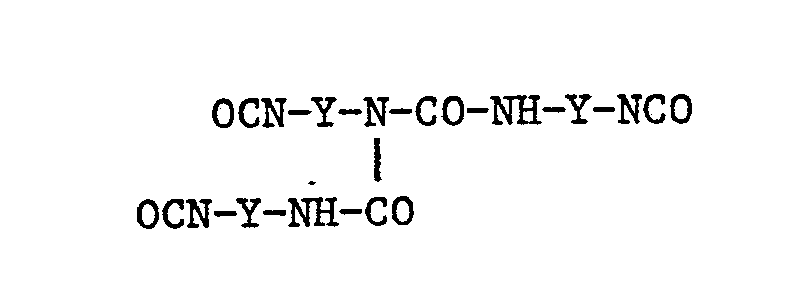
Wherein Y is:
Wherein Y is:
a) a polymethylene chain, -(CH₂)n-, in which n is an integer from 2 to 10;
b) a divalent aromatic radical;
c) a cyclohexylene radical; or
d) an aralkylene radical.
10. A method according to Claim 9 characterized in that the biuret is derived from
an aromatic diisocyanate selected from phenylene, toluene, xylene, naphthalene, methylenediphenyl,
and 3,3ʹ-dimethyldiphenylmethane diisocyanate, or is a cyclohexyl diisocyanate selected
from cyclohexyl, methylcyclohexyl, and methylenedicyclohexyl diisocyanate, or is tetramethylxylyl
or isophorone diisocyanate.
11. A method according to any of claims 7 to 10 characterized in that the diamine
is supplemented by from 5 to 35%, based on diamine, of a polyol.