|
(11) | EP 0 286 113 B1 |

| (12) | EUROPEAN PATENT SPECIFICATION |
|
|
| (54) |
Water-soluble monoazo colorant and dyeing process by using the same Wasserlöslicher Monoazofarbstoff und Färbeverfahren unter dessen Verwendung Colorant monoazoique soluble dans l'eau et procédé de teinture l'utilisant |
|
|
|||||||||||||||||||||||||||||||
|
||||||||||||||||||||||||||||||||
| Note: Within nine months from the publication of the mention of the grant of the European patent, any person may give notice to the European Patent Office of opposition to the European patent granted. Notice of opposition shall be filed in a written reasoned statement. It shall not be deemed to have been filed until the opposition fee has been paid. (Art. 99(1) European Patent Convention). |
[0001] This invention relates to novel greenish yellow water-soluble monoazo colorants and a dyeing process by using the same. More particularly, it relates to water-soluble monoazo colorants, which have a vinylsulfone type reactive group at the side of the diazo component and a monohalogenotriazine type reactive group or a difluoromonochloropyrimidine type reactive group at the side of the coupling component and are particularly useful in dyeing cellulose or nitrogen-containing fibers, and a dyeing process by using the same.
[0002] There have been usually employed water-soluble reactive dyestuffs in dyeing cellulose or nitrogen-containing fibers. It is required that these reactive dyestuffs have excellent heat-sensitivity and level dyeing property and can intensely dye fibers. It is further required that the fibers thus dyed are fast to various factors. The properties of these reactive dyestuffs would delicately vary depending on their chemical structure, especially on the basic skeleton, substituents, reactive groups and the combination thereof. There have been proposed a number of dyestuffs of various structures and considerably satisfactory ones have been put into practical use hitherto.
[0003] Among reactive dyestuffs, however, no greenish yellow dyestuff satisfying every requirement has been developed so far. That is to say, a conventional greenish yellow reactive dyestuff having an excellent level dyeing property is inferior in, for example, fastness to light, chlorine or perspiration and daylight. On the other hand, many of conventional dyestuffs which are highly fast to various factors would be largely affected by temperature and salt concentration, and are inferior in the level dyeing property.
[0004] For example, the following dyestuffs disclosed in JP-A-155469/86 and 199763/84 largely depend on temperature and salt concentration, although they are highly fast to, for example, light, chlorine, perspiration and daylight:
(disclosed in JP-A-155469/86); and
(disclosed in JP-A-199763/84).
[0005] EP-A-40 790 concerns a process for dyeing or printing fiber materials containing hydroxy and/or carbonamide groups, wherein a fiber-reactive water-soluble dye is used containing one or more groups of the formulae 1a, 1b or 1c
-SO₂-CH=CH₂ (1a)
-SO₂-CH₂-CH₂-Hal (1b)
-SO₂-CH₂-CH₂-A (1c)
and a 6-fluoro-1,3,5-triazine-2-ylamino residue as well as at least one sulfonic acid group.
[0006] The present invention is to provide novel greenish yellow water-soluble monoazo colorants, which are highly fast to, for example, light, chlorine, perspiration and daylight, less dependent on temperature or salt concentration and have excellent level dyeing properties, as well as a dyeing process by using the same.
[0007] Accordingly, it is the primary object of the present invention to provide a water-soluble monoazo colorant of formula (I):
wherein D represents
wherein W² represents lower alkoxy having 1 or 2 carbon atoms, and Z represents -CH=CH₂ or -CH₂CH₂OSO₃H, W¹ represents lower alkoxy having 1 or 2 carbon atoms and V represents
wherein X represents chlorine or fluorine, Y represents lower alkylamino having from 1 to 4 carbon atoms or phenylamino each substituted by one or two sulfo groups, as well as a dyeing process by using the same.
[0008] Now the present invention will be described in detail. In formula (I) as shown above, D represents
wherein W² and Z are as defined above. Among these groups,
and
are preferable.
[0009] On the other hand, V represents
or
wherein X and Y are as defined above. V preferably represents
wherein X and Y are as defined above.
[0010] Examples of lower alkylamino having from 1 to 4 carbon atoms or phenylamino each substituted by one or two sulfo groups represented by Y include :
[0012] A particularly preferable example of the water-soluble monoazo colorant of the present invention represented by the general formula (I) as shown above is a colorant of formula (I-2) in the form of a free acid:
wherein Z represents -CH=CH₂ or -CH₂CH₂OSO₃H;
X' represents chlorine or fluorine; and
Y" represents lower alkylamino having from 1 to 4 carbon atoms or, phenylamino each substituted by one or two sulfo groups.
[0013] In addition, a colorant of formula (I-3) in the form of a free acid is also preferable therefor:
wherein Z represents -CH=CH₂ or -C₂H₄OSO₃H;
Xʹ represents chlorine or fluorine; and
Yʺ represents lower alkylamino having from 1 to 4 carbon atoms or phenylamino each substituted by one or two sulfo groups.
[0014] The water-soluble monoazo colorants of the present invention are usually present in the form of the free acid or a salt thereof. Examples of the salts include alkali metal salts and alkaline earth metal salts. Among these salts, lithium, sodium and potassium salts are particularly preferable.
[0015] The monoazo colorants of the present invention represented by formula (I) as shown above may be prepared by, for example, the following method.
[0016] One mol of a triazine or pyrimidine compound of formula (II):
V-X (II)
wherein V and X are as defined in formula (I);
in the form of the free acid is condensed with 1 mol of a compound of formula (III):
wherein W¹ is as defined in formula (I);
in an aqueous medium to obtain a compound of formula (IV):
wherein W¹ and V are as defined in formula (I);
in the form of the free acid.
[0017] Separately 1 mol of a compound of formula (V):
D-NH₂ (V)
wherein D is as defined in formula (I);
is converted into a diazo derivative in a conventional manner. Then the product thus obtained is coupled with 1 mol of the compound (IV) as obtained above to obtain the aimed monoazo colorant (I). The aimed product may be recovered from the reaction mixture by a conventional manner such as salting-out or spray-dry.
[0018] The monoazo colorants of the present invention are widely available as, for example, a dyestuff for dyeing fibers and fabrics, a colorant for coloring paper and synthetic resins and an ink for ink-jet printers. They are particularly useful as a dyestuff.
[0019] The monoazo colorants of the present invention are useful as a dyestuff for dyeing various fibers including cellulose fibers such as cotton, viscose rayon, cuprammonium rayon and linen and nitrogen-containing fibers such as polyamide, wool and silk. They are particularly suitable in dyeing cellulose fiber. These fibers may be mixed with, for example, polyester, triacetate or polyacrylonitrile.
[0020] Cellulose or nitrogen-containing fibers may be dyed with the monoazo dyestuffs of the present invention by a conventional process in the presence of an acid binder selected from inorganic alkalis such as sodium bicarbonate and sodium carbonate or organic bases such as triethylamine.
[0021] As dyeing process of the present invention, dip dyeing is suitable. The dyeing may be carried out at a temperature of approximately 40 to 80°C, preferably 40 to 60°C.
[0022] The monoazo colorants of the present invention may be further applied to other dyeing processes which can be applied in the case of using conventional reactive dyestuffs such as cold pad batching, pad steaming and printing.
[0023] The water-soluble monoazo colorants of the present invention are novel greenish yellow monoazo colorants characterized by having a vinylsulfone type reactive group at the side of the diazo component and a mono-halogenotriazine type reactive group or a difluoromonochloropyrimidine type reactive group at the side of the coupling component. They are particularly suitable in dyeing cellulose or nitrogen-containing fibers. By using the water-soluble monoazo colorants of the present invention as dyestuffs, cellulose or nitrogen-containing fibers can be intensely and uniformly dyed. In addition, the fibers thus dyed are highly fast to, for example, light, chlorine, perspiration and daylight. Furthermore, the colorants of the present invention have a low temperature dependence, a lower salt concentration dependence and an excellent build-up property, compared with conventional greenish yellow reactive dyestuffs. Therefore they are superior to conventional dyestuffs in all respects and thus highly useful in industrial use.
[0024] To further illustrate the present invention, and not by way of limitation, the following Examples will be given.
EXAMPLE 1
[0025] An amino compound of formula :
in the form of a free acid was converted into a diazo compound by a conventional manner. Then the obtained product was coupled with an equimolar amount of a compound of formula:
in the form of the free acid in an aqueous medium at 0 to 5°C and at a pH of 7 to 8. After the completion of the coupling, the reaction mixture was salted out by using potassium chloride. The precipitate was separated by filtration and was dried. Thus a monoazo colorant of formula (represented as a free acid) having the maximum absorption wavelength as shown below was obtained:
λmax: 394 nm (water).
[0026] 0.2 g of the monoazo colorant as obtained above was dissolved in 200 ml of water and then 10 g of Glauber's salt were added to obtain a dyeing bath. The Glauber's salt concentration thereof was 50 g/ℓ. 10 g of an unmercerized cotton knitted fabric were immersed in the dyeing bath and heated to 60°C within 30 minutes. Then 3.0 g of sodium carbonate were added thereto and dyeing was effected at 60°C for additional one hour. Subsequently the fabric was washed with water, soaped, washed with water again and dried to thereby give a fabric dyed greenish yellow.
[0027] The resulting fabric was uniformly and intensely dyed. The fastness to light of this dyed fabric was good, i.e., the 6th grade as determined according to JIS L-0842. The fastness to chlorine thereof was excellent, i.e., the 4th to 5th grades as determined according to JIS L-0844 at an effective chlorine concentration of 20 ppm. The fastness to perspiration and daylight thereof was extremely good, i.e., the 4th grade as determined according to JIS L-0888 A: Alkali.
[0028] The surface density of the dyed fabric was evaluated by measuring the surface reflectance with a color difference meter (manufactured by Nippon Denshoku Kogyo K.K.).
[0029] In order to examine the salt-concentration dependence, temperature dependence and build-up property of the colorant as used in the present Example at the dyeing step, the above procedure was followed except that (1) the Glauber's salt concentration of the dyeing bath was adjusted to 20 g/ℓ; (2) the dyeing was carried out at 40°C; or (3) 0.8 g of the colorant was employed. Then the surface density of each fabric thus dyed was determined. Thus the salt-concentration dependence, temperature dependence and build-up property were determined according to the following equations:
COMPARATIVE EXAMPLES 1 AND 2
[0031] The procedure of Example 1 was followed except that the monoazo colorant was replaced by the following ones. Table 1 shows the results.
Comparative Example 1:
Comparative Example 2:
[0033]
disclosed in JP-A-199763/84.
Table 1
| Dyed Fabric | Salt-Concentration Dependence (20 g/ℓ/50 g/ℓ) | Temperature Dependence (40°C/60°C) | Build-Up Property (0.8 g/0.2 g) |
| Example 1 | 90 | 90 | 300 |
| Comparative Example 1 | 80 | 80 | 260 |
| Comparative Example 2 | 70 | 50 | 315 |
EXAMPLES 2 TO 12
[0034] Monoazo colorants of the present invention of formulae as shown in Tables 2 and 3 (each given as a free acid) were prepared according to the method as described in Example 1. By using each colorant thus obtained, a cotton fabric was dyed in the same manner as the one described in Example 1. Thus the fabric uniformly and intensely dyed greenish yellow. Tables 2 and 3 show the results. Each fabric thus dyed had high fastnesses to light (the 6th grade), to chlorine (the 4th to 5th grades) and to perspiration and daylight (the 4th grade).
1. Water-soluble monoazo colorants represented by formula (I) in the form of a free acid:
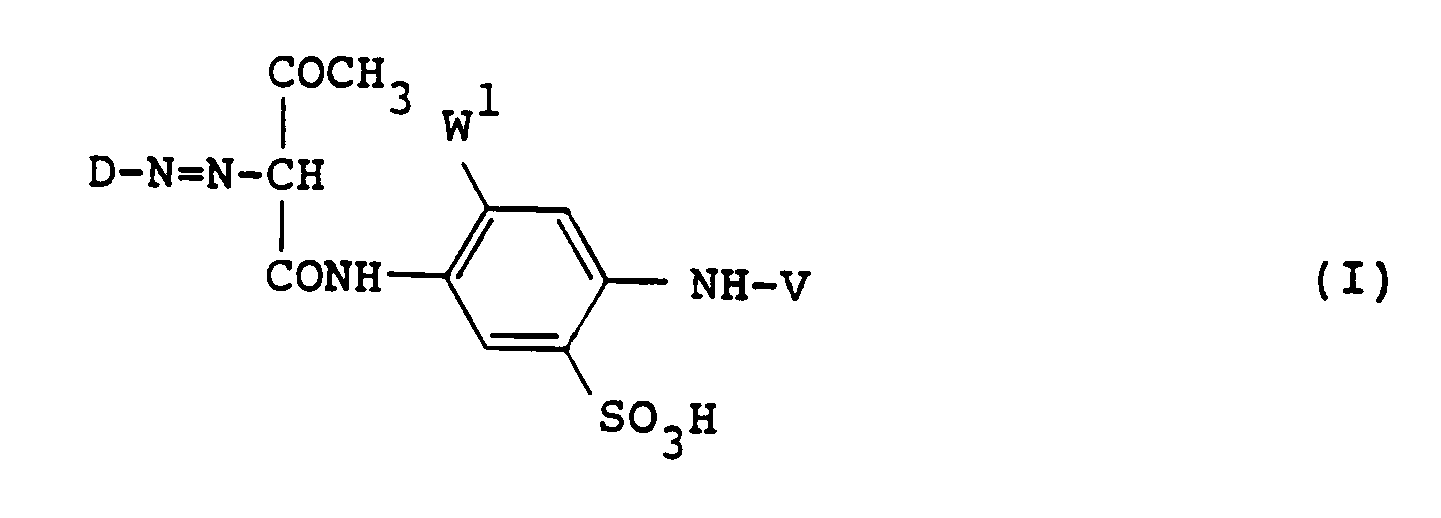
wherein D represents
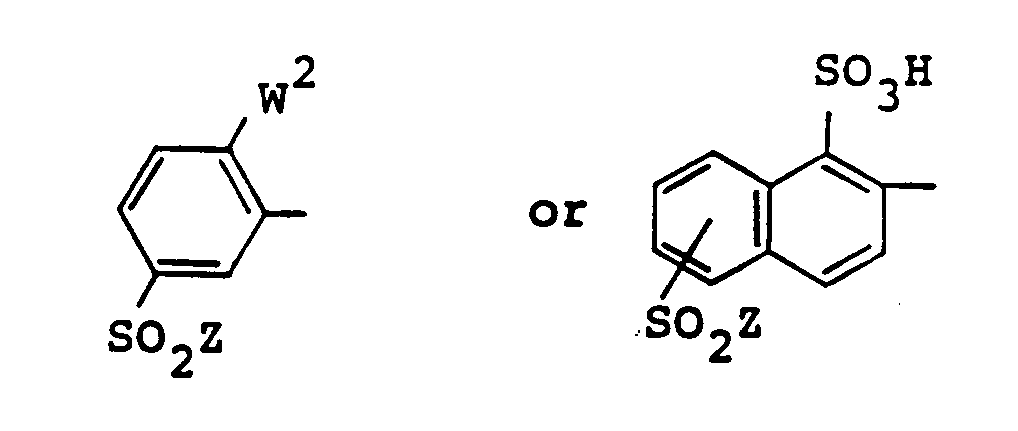
wherein W² represents lower alkoxy having 1 or 2 carbon atoms and Z represents -CH=CH₂ or -CH₂CH₂OSO₃H, W¹ represents lower alkoxy having 1 or 2 carbon atoms and V represents
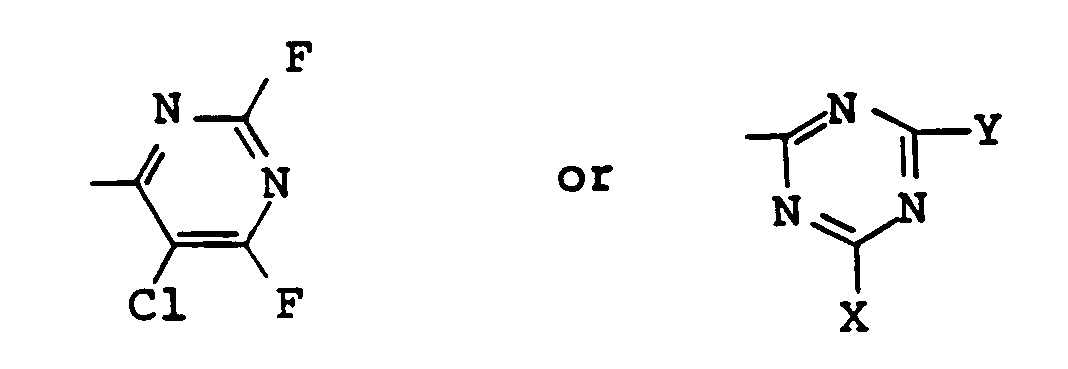
wherein X represents chlorine or fluorine, Y represents lower alkylamino having from 1 to 4 carbon atoms or phenylamino each substituted by one or two sulfo groups.
wherein D represents
wherein W² represents lower alkoxy having 1 or 2 carbon atoms and Z represents -CH=CH₂ or -CH₂CH₂OSO₃H, W¹ represents lower alkoxy having 1 or 2 carbon atoms and V represents
wherein X represents chlorine or fluorine, Y represents lower alkylamino having from 1 to 4 carbon atoms or phenylamino each substituted by one or two sulfo groups.
2. Water-soluble monoazo colorants according to Claim 1, wherein D represents
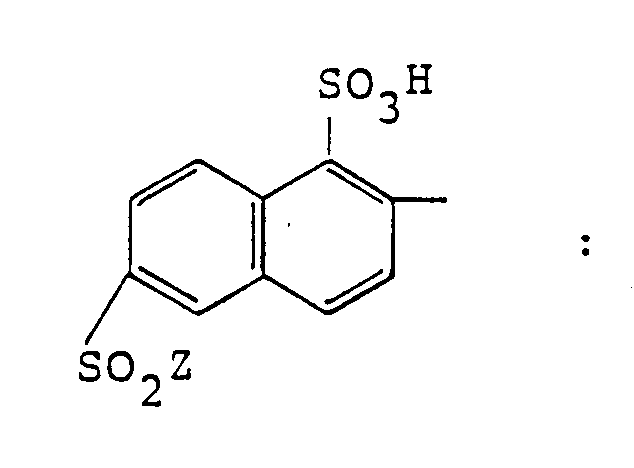
wherein Z is as defined in Claim 1.
wherein Z is as defined in Claim 1.
3. Water-soluble monoazo colorants according to Claim 1, wherein D represents
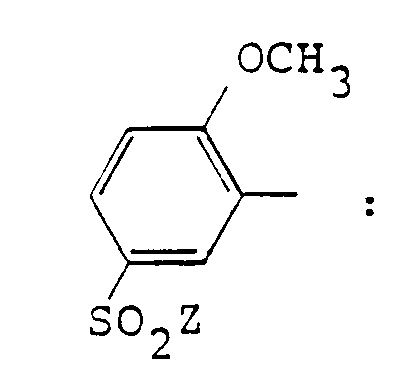
wherein Z is as defined in Claim 1.
wherein Z is as defined in Claim 1.
4. Water-soluble monoazo colorants according to Claim 1, wherein V represents
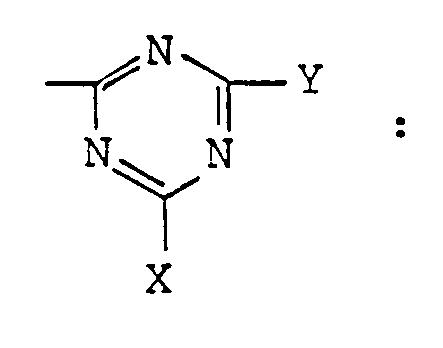
wherein X represents chlorine or fluorine; and
Y represents lower alkylamino having from 1 to 4 carbon atoms or phenylamino each substituted by one or two sulfo groups.
wherein X represents chlorine or fluorine; and
Y represents lower alkylamino having from 1 to 4 carbon atoms or phenylamino each substituted by one or two sulfo groups.
5. Water-soluble monoazo colorants according to anyone of Claims 1 to 4, wherein W¹ represents
methoxy.
6. Water-soluble monoazo colorants according to anyone of Claims 1 to 5, which are dyestuffs
for dyeing cellulose or nitrogen-containing fibers.
7. Water-soluble monoazo colorants represented by formula (I-2) in the form of a free
acid:
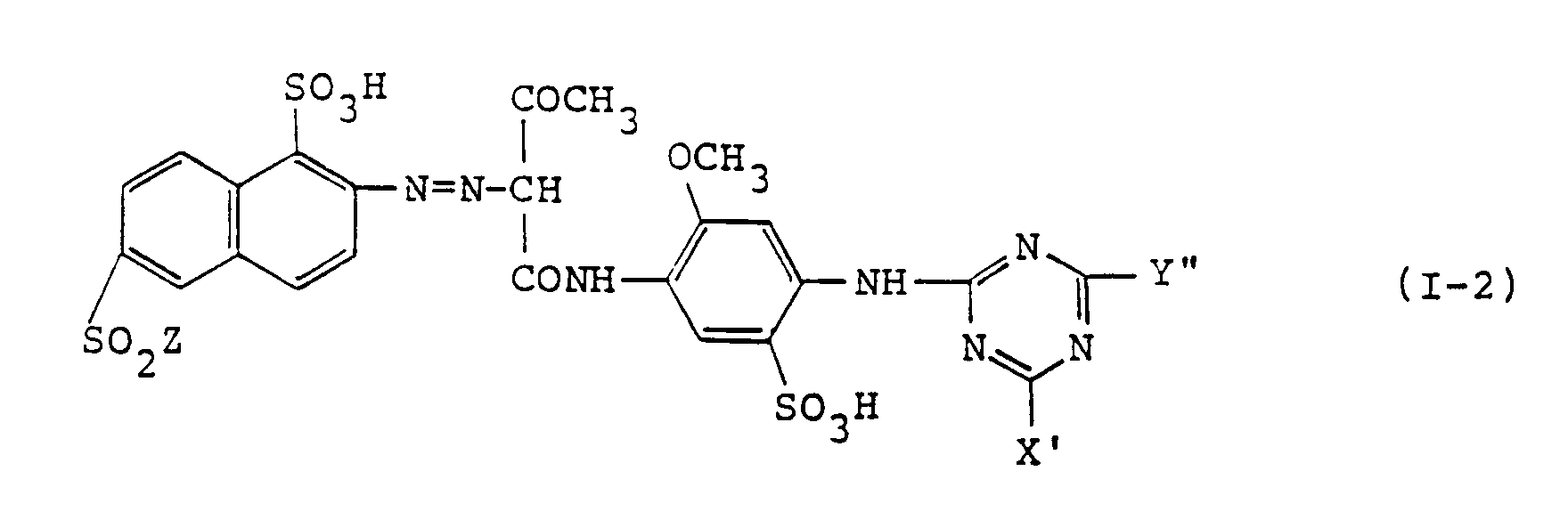
wherein Z represents -CH=CH₂ or -CH₂CH₂OSO₃H;
X' represents chlorine or fluorine; and
Y" represents lower alkylamino having from 1 to 4 carbon atoms or, phenylamino each substituted by one or two sulfo groups.
wherein Z represents -CH=CH₂ or -CH₂CH₂OSO₃H;
X' represents chlorine or fluorine; and
Y" represents lower alkylamino having from 1 to 4 carbon atoms or, phenylamino each substituted by one or two sulfo groups.
8. Water-soluble monoazo colorants represented by formula (I-3) in a form of a free acid:
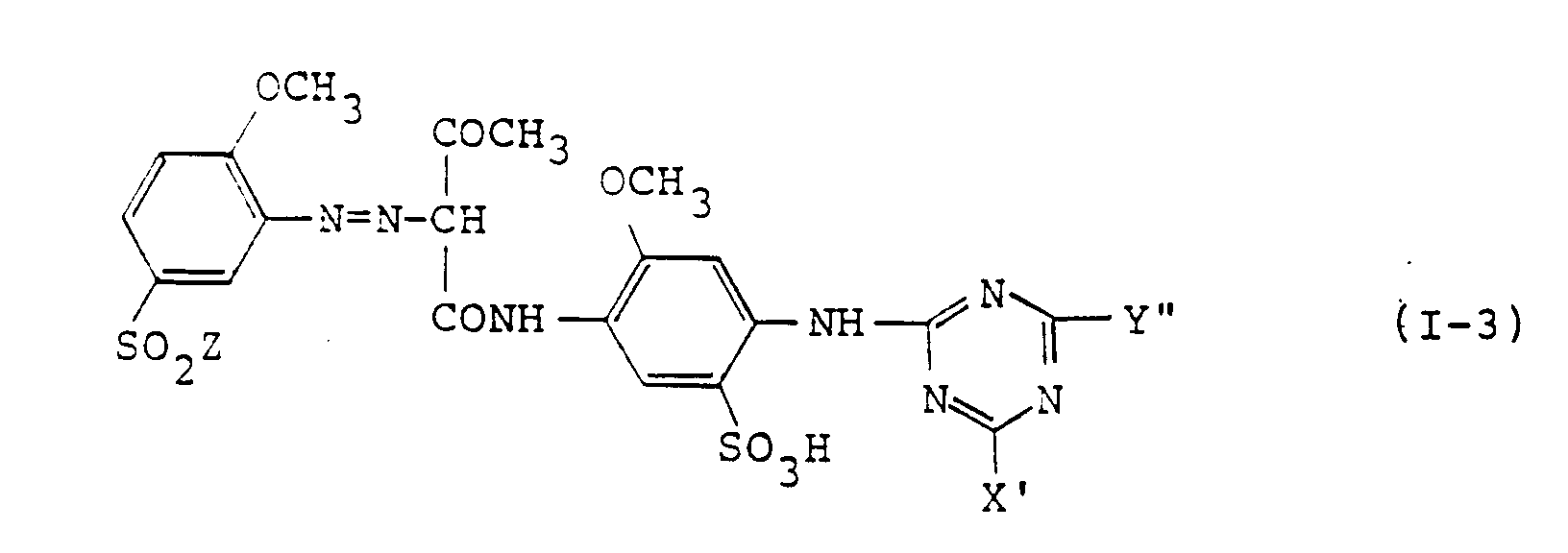
wherein Z represents -CH=CH₂ or -CH₂CH₂OSO₃H;
X' represents chlorine or fluorine; and
Y" represents lower alkylamino having from 1 to 4 carbon atoms or phenylamino each substituted by one or two sulfo groups.
wherein Z represents -CH=CH₂ or -CH₂CH₂OSO₃H;
X' represents chlorine or fluorine; and
Y" represents lower alkylamino having from 1 to 4 carbon atoms or phenylamino each substituted by one or two sulfo groups.
9. A process for dyeing a cellulose or nitrogen-containing fiber which comprises using
a water-soluble monoazo colorant according to any one of claims 1 to 8.
1. Colorants monoazoîques solubles dans l'eau représentés par la formule (I) sous la
forme d'un acide libre :
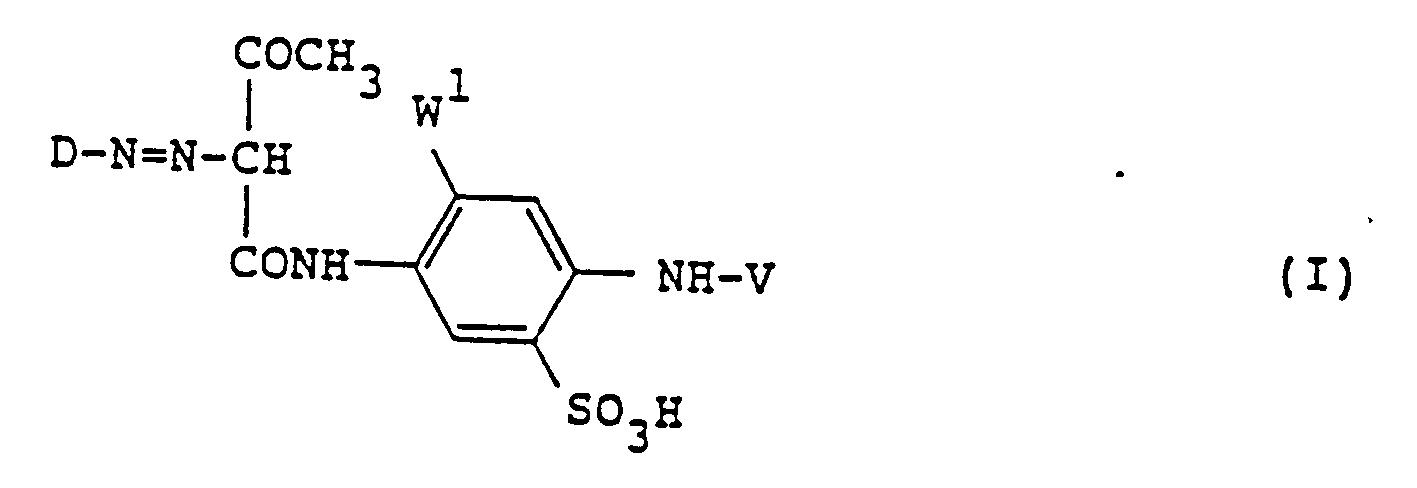
dans laquelle D représente
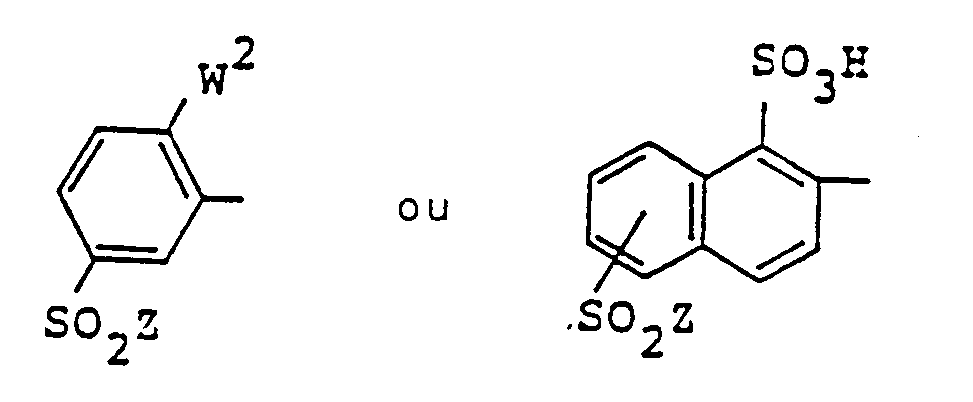
dans lesquels W² représente un groupe alcoxy inférieur en C₁ ou C₂ et Z représente -CH=CH₂ ou -CH₂CH₂OSO₃H, W¹ représente un groupe alcoxy inférieur en C₁ ou C₂ et V représente
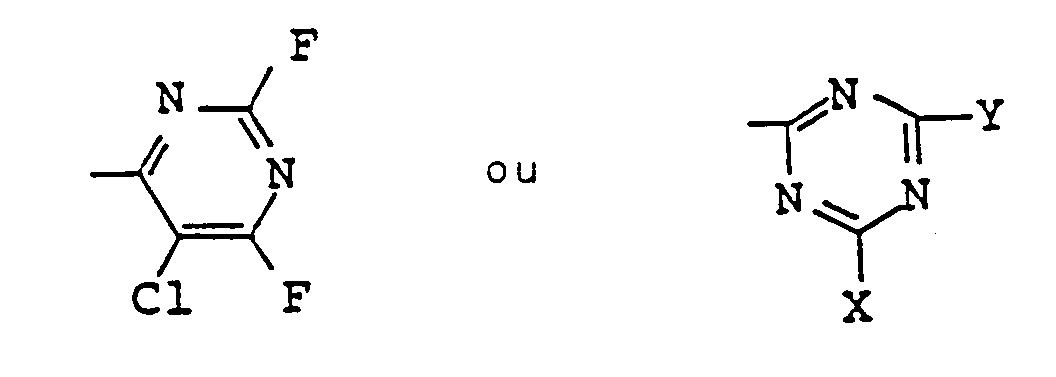
dans lequel X représente le chlore ou le fluor, Y représente un groupe alkylamino inférieur en C₁-C₄ ou phénylamino substitué chaque fois par un ou deux groupes sulfo.
dans laquelle D représente
dans lesquels W² représente un groupe alcoxy inférieur en C₁ ou C₂ et Z représente -CH=CH₂ ou -CH₂CH₂OSO₃H, W¹ représente un groupe alcoxy inférieur en C₁ ou C₂ et V représente
dans lequel X représente le chlore ou le fluor, Y représente un groupe alkylamino inférieur en C₁-C₄ ou phénylamino substitué chaque fois par un ou deux groupes sulfo.
2. Colorants monoazoîques solubles dans l'eau selon la revendication 1, dans lesquels
D représente
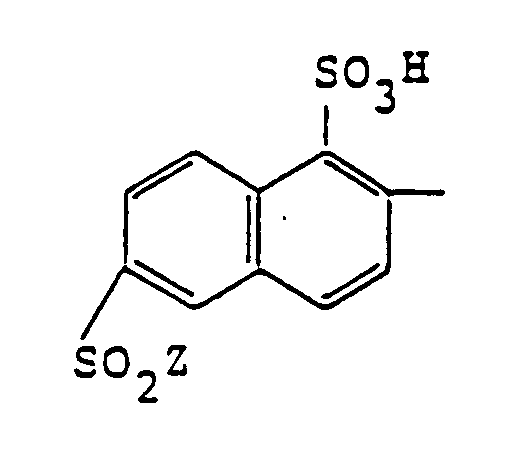
dans lequel Z est défini à la revendication 1.
dans lequel Z est défini à la revendication 1.
3. Colorants monoazoîques solubles dans l'eau selon la revendication 1, dans lesquels
D représente
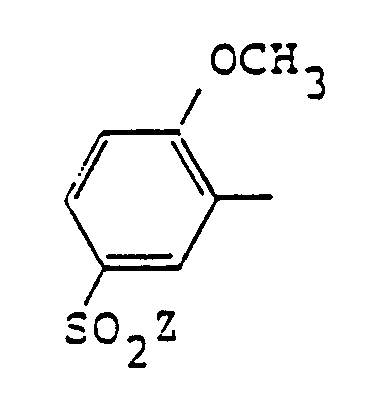
dans lequel Z est défini à la revendication 1.
dans lequel Z est défini à la revendication 1.
4. Colorants monoazoîques solubles dans l'eau selon la revendication 1, dans lesquels
V représente
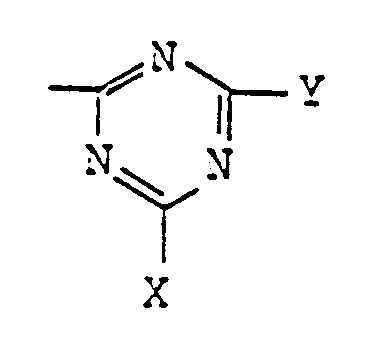
dans lequel X représente le chlore ou le fluor ; et Y représente un groupe alkylamino inférieur en C₁-C₄ ou phénylamino substitué chaque fois par un ou deux groupes sulfo.
dans lequel X représente le chlore ou le fluor ; et Y représente un groupe alkylamino inférieur en C₁-C₄ ou phénylamino substitué chaque fois par un ou deux groupes sulfo.
5. Colorants monoazoîques solubles dans l'eau selon l'une quelconque des revendications
1 à 4, dans lesquels W¹ représente un groupe méthoxy.
6. Colorants monoazoîques solubles dans l'eau selon l'une quelconque des revendications
1 à 5, qui sont des colorants pour teindre des fibres cellulosiques ou des fibres
azotées.
7. Colorants monoazoîques solubles dans l'eau représentés par la formule (I-2) sous la
forme d'un acide libre
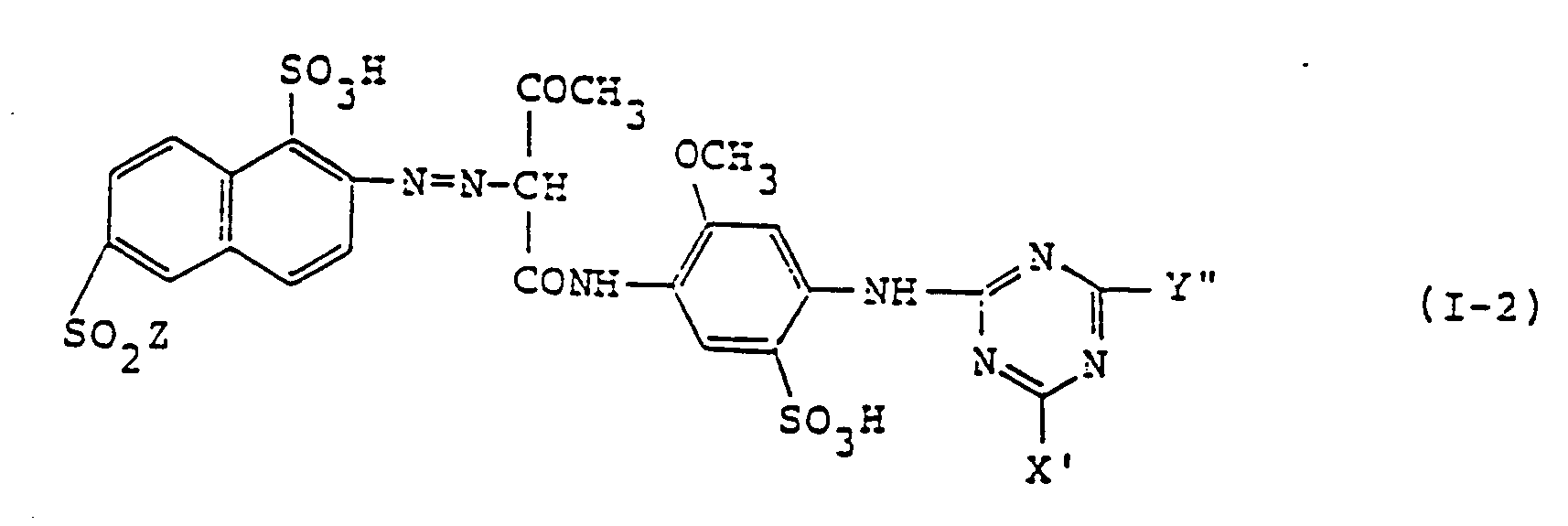
dans laquelle Z représente -CH=CH₂ ou -CH₂CH₂OSO₃H ; X' représente le chlore ou le fluor ; et Y" représente un groupe alkylamino inférieur en C₁-C₄ ou phénylamino substitué chaque fois par un ou deux groupes sulfo.
dans laquelle Z représente -CH=CH₂ ou -CH₂CH₂OSO₃H ; X' représente le chlore ou le fluor ; et Y" représente un groupe alkylamino inférieur en C₁-C₄ ou phénylamino substitué chaque fois par un ou deux groupes sulfo.
8. Colorants monoazoîques solubles dans l'eau représenté par la formule (I-3) sous la
forme d'un acide libre
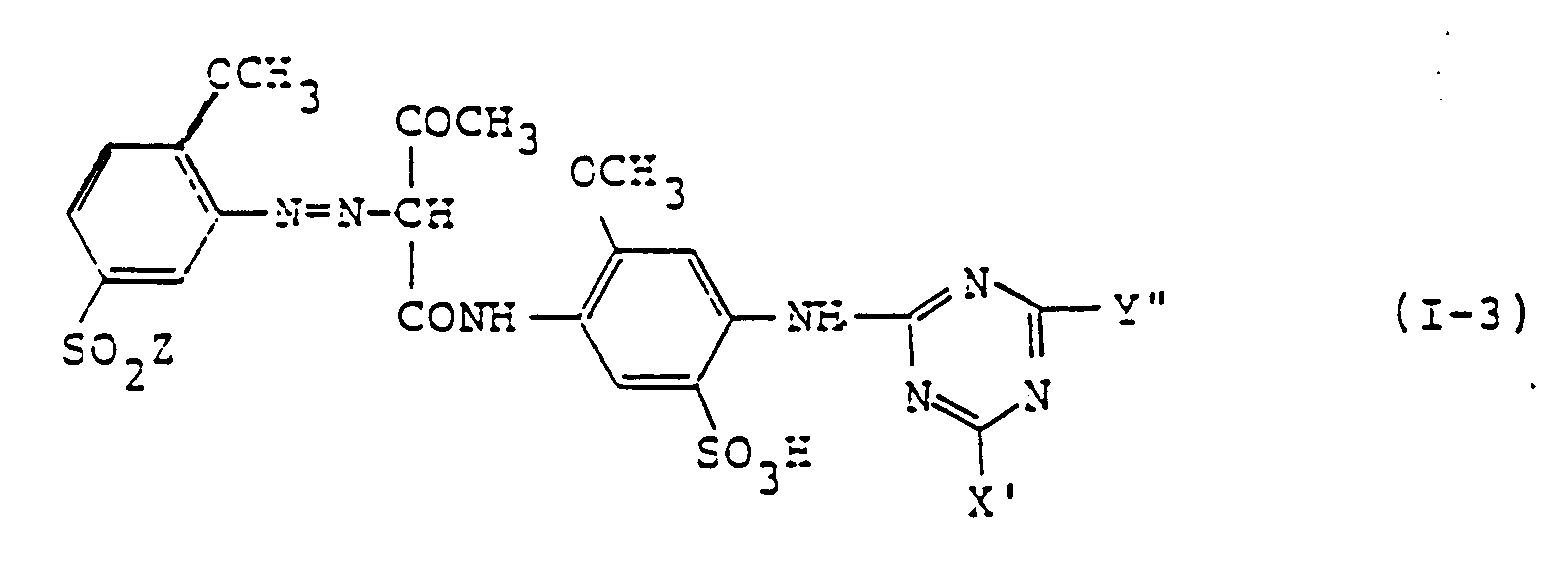
dans laquelle Z représente -CH=CH₂ ou -CH₂CH₂OSO₃H ; X' représente le chlore ou le fluor ; et Y" représente un groupe alkylamino inférieur en C₁-C₄ ou phénylamino substitué chaque fois par un ou deux groupes sulfo.
dans laquelle Z représente -CH=CH₂ ou -CH₂CH₂OSO₃H ; X' représente le chlore ou le fluor ; et Y" représente un groupe alkylamino inférieur en C₁-C₄ ou phénylamino substitué chaque fois par un ou deux groupes sulfo.
9. Un procédé pour teindre une fibre cellulosique ou une fibre azotée qui consiste à
utiliser un colorant monoazoîque soluble dans l'eau selon l'une quelconque des revendications
1 à 8.
1. Wasserlösliche Monoazofarbstoffe der Formel (I) in Form einer freien Säure:
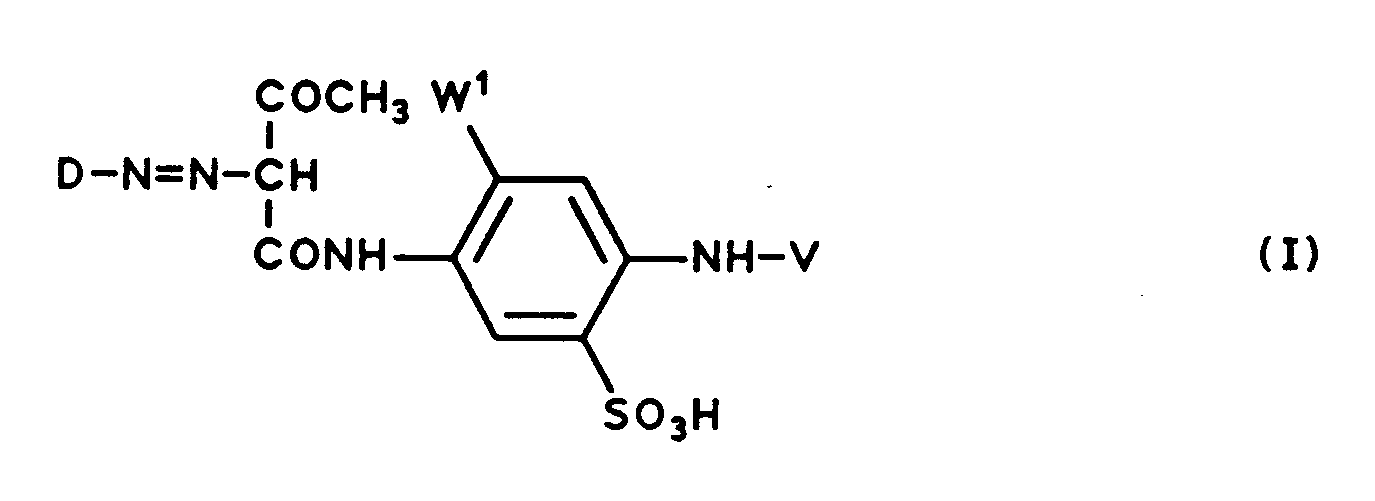
in der D einen Rest der Formel
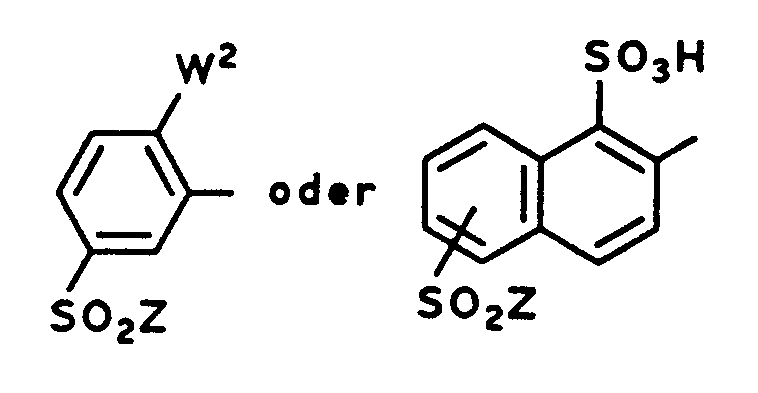
bedeutet, in der W² einen Niederalkoxyrest mit 1 oder 2 Kohlenstoffatomen bedeutet, und Z einen Rest der Formel -CH=CH₂ oder der Formel -CH₂CH₂OSO₃H bedeutet, W¹ einen Niederalkoxyrest mit 1 oder 2 Kohlenstoffatomen bedeutet, und V einen Rest der Formel
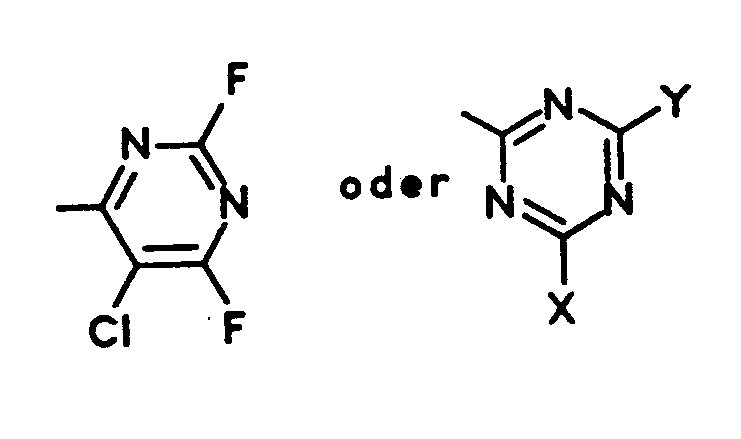
bedeutet, in der X ein Chlor- oder Fluoratom bedeutet, Y einen Niederalkylaminorest mit 1 bis 4 Kohlenstoffatomen oder eine Phenylaminogruppe, die jeweils mit einer oder zwei Thiogruppen substituiert sind, bedeutet.
in der D einen Rest der Formel
bedeutet, in der W² einen Niederalkoxyrest mit 1 oder 2 Kohlenstoffatomen bedeutet, und Z einen Rest der Formel -CH=CH₂ oder der Formel -CH₂CH₂OSO₃H bedeutet, W¹ einen Niederalkoxyrest mit 1 oder 2 Kohlenstoffatomen bedeutet, und V einen Rest der Formel
bedeutet, in der X ein Chlor- oder Fluoratom bedeutet, Y einen Niederalkylaminorest mit 1 bis 4 Kohlenstoffatomen oder eine Phenylaminogruppe, die jeweils mit einer oder zwei Thiogruppen substituiert sind, bedeutet.
2. Wasserlösliche Monoazofarbstoffe gemäß Anspruch 1, wobei D einen Rest der Formel
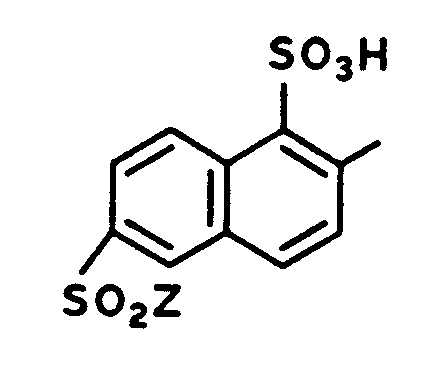
bedeutet, in der Z wie in Anspruch 1 definiert ist.
bedeutet, in der Z wie in Anspruch 1 definiert ist.
3. Wasserlösliche Monoazofarbstoffe gemäß Anspruch 1, wobei D einen Rest der Formel
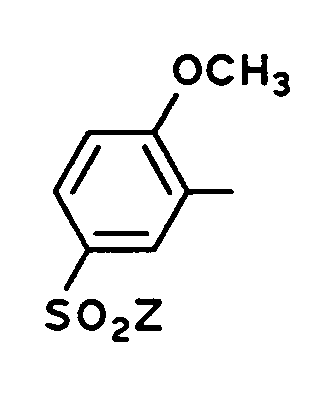
bedeutet, in der Z wie in Anspruch 1 definiert ist.
bedeutet, in der Z wie in Anspruch 1 definiert ist.
4. Wasserlösliche Monoazofarbstoffe gemäß Anspruch 1, wobei V einen Rest der Formel
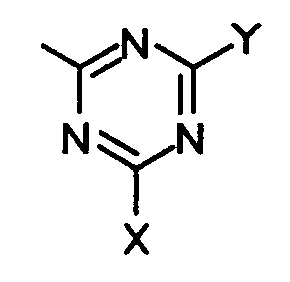
bedeutet, in der X ein Chlor- oder Fluoratom bedeutet; und Y einen Niederalkylaminorest mit 1 bis 4 Kohlenstoffatomen oder eine Phenylaminogruppe, die jeweils mit einer oder zwei Thiogruppen substituiert sind, bedeutet.
bedeutet, in der X ein Chlor- oder Fluoratom bedeutet; und Y einen Niederalkylaminorest mit 1 bis 4 Kohlenstoffatomen oder eine Phenylaminogruppe, die jeweils mit einer oder zwei Thiogruppen substituiert sind, bedeutet.
5. Wasserlösliche Monoazofarbstoffe gemäß einem der Ansprüche 1 bis 4, wobei W¹ eine
Methoxygruppe bedeutet.
6. Wasserlösliche Monoazofarbstoffe gemäß einem der Ansprüche 1 bis 5, die Farbstoffe
zum Färben von Cellulose- oder stickstoffhaltigen Fasern sind.
7. Wasserlösliche Monoazofarbstoffe der Formel (I-2) in Form einer freien Säure:
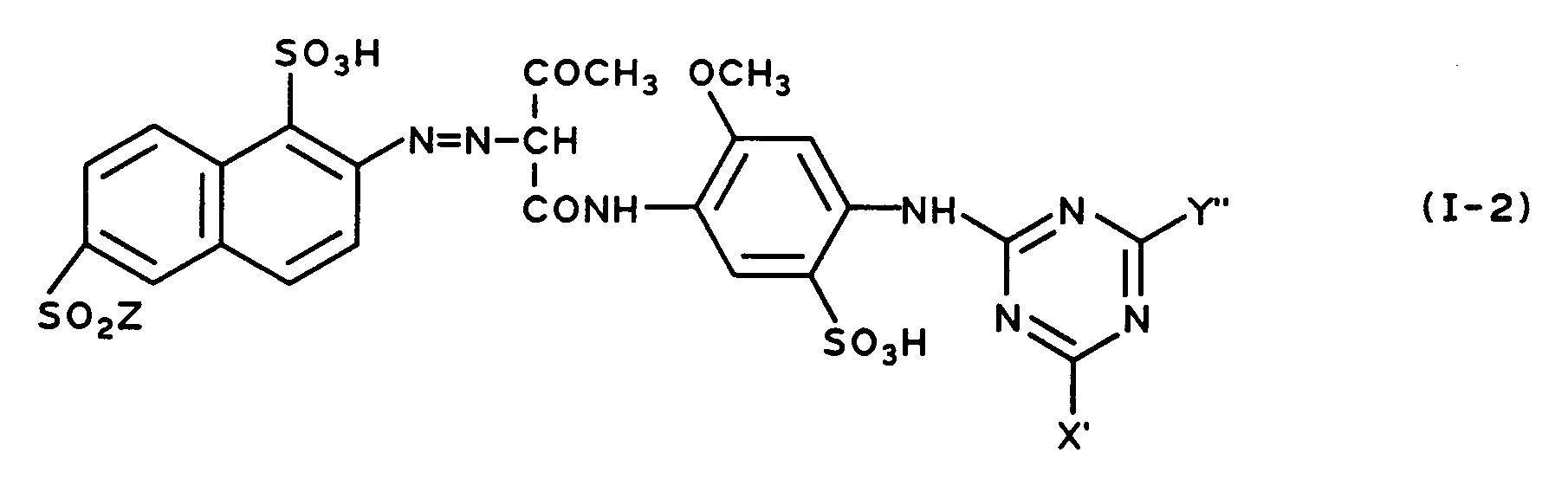
in der Z einen Rest der Formel -CH=CH₂ oder -CH₂CH₂OSO₃H bedeutet;
X' ein Chlor- oder Fluoratom bedeutet; und
Y" einen Niederalkylaminorest mit 1 bis 4 Kohlenstoffatomen oder eine Phenylaminogruppe, die jeweils mit einer oder zwei Thiogruppen substituiert sind, bedeutet.
in der Z einen Rest der Formel -CH=CH₂ oder -CH₂CH₂OSO₃H bedeutet;
X' ein Chlor- oder Fluoratom bedeutet; und
Y" einen Niederalkylaminorest mit 1 bis 4 Kohlenstoffatomen oder eine Phenylaminogruppe, die jeweils mit einer oder zwei Thiogruppen substituiert sind, bedeutet.
8. Wasserlösliche Monoazofarbstoffe der Formel (I-3) in Form einer freien Säure:
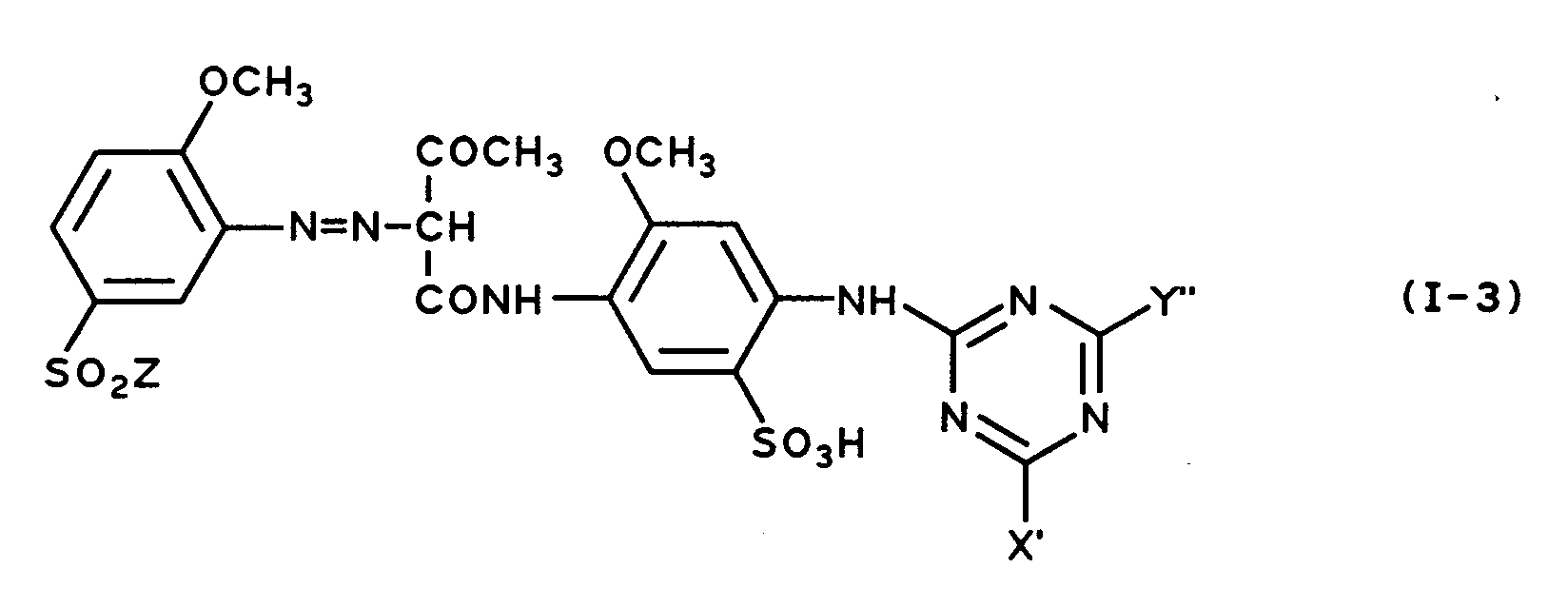
in der Z einen Rest der Formel -CH=CH₂ oder -CH₂CH₂OSO₃H bedeutet;
X' ein Chlor- oder Fluoratom bedeutet; und
Y" einen Niederalkylaminorest mit 1 bis 4 Kohlenstoffatomen oder eine Phenylaminogruppe, die jeweils mit einer oder zwei Thiogruppen substituiert sind, bedeutet.
in der Z einen Rest der Formel -CH=CH₂ oder -CH₂CH₂OSO₃H bedeutet;
X' ein Chlor- oder Fluoratom bedeutet; und
Y" einen Niederalkylaminorest mit 1 bis 4 Kohlenstoffatomen oder eine Phenylaminogruppe, die jeweils mit einer oder zwei Thiogruppen substituiert sind, bedeutet.
9. Verfahren zum Färben einer Cellulose- oder stickstoffhaltigen Faser, umfassend die
Verwendung eines wasserlöslichen Monoazofarbstoffes gemäß einem der Ansprüche 1 bis
8.