|
(11) | EP 0 288 974 B1 |

| (12) | EUROPEAN PATENT SPECIFICATION |
|
|
| (54) |
Process for the preparation of diether diphthalic anhydrides Verfahren zur Herstellung von Diätherdiphthalsäureanhydriden Procédé de préparation d'anhydrides diéther-diphtaliques |
|
|
|||||||||||||||||||||||||||||||
| Note: Within nine months from the publication of the mention of the grant of the European patent, any person may give notice to the European Patent Office of opposition to the European patent granted. Notice of opposition shall be filed in a written reasoned statement. It shall not be deemed to have been filed until the opposition fee has been paid. (Art. 99(1) European Patent Convention). |
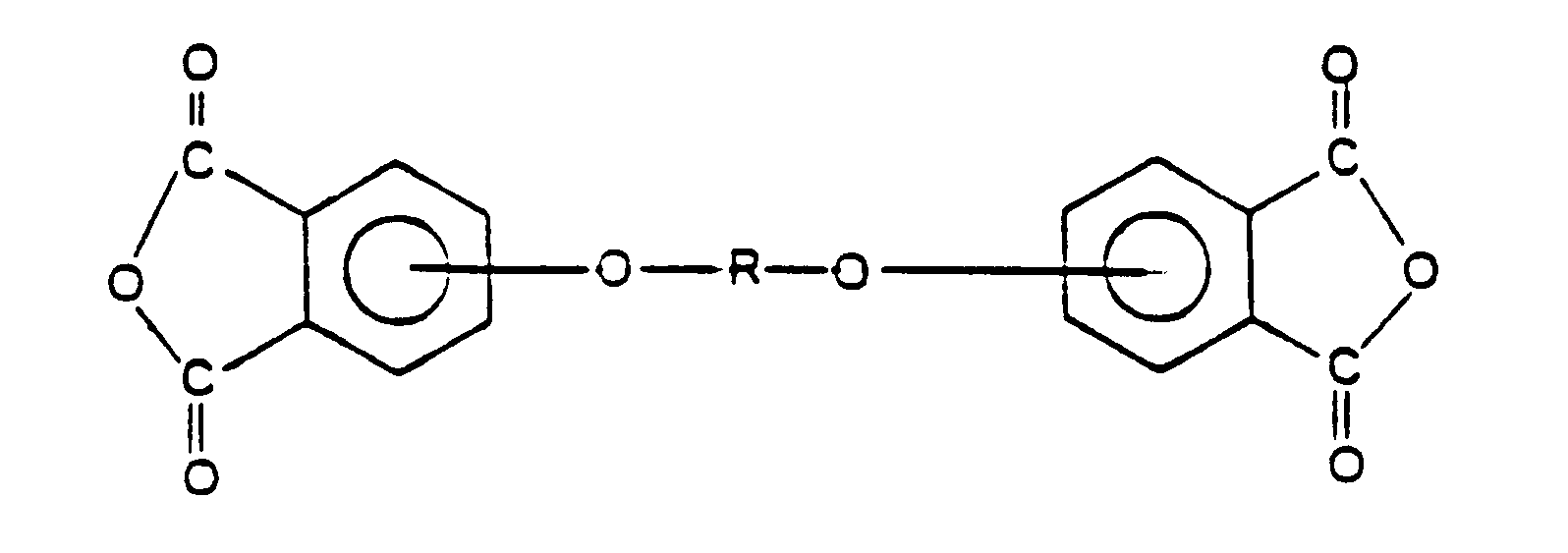
[0001] This invention relates to a method for the preparation of diphthalic anhydrides. The products are useful chemical intermediates for the further preparation of various compounds such as the corresponding tetra-carboxylic acids and the various derivatives thereof, including for example, the salts, esters, acyl halides, amides, imides and the like. The diphthalic anhydrides are particularly useful as monomers in the preparation of polyimides, for example by polycondensation with a suitable diamine, such as ethylenediamine or phenylenediamine.
[0002] Various methods for the preparation of diether diphthalic anhydrides have been described in the chemical literature. Earlier preparations were directed to the formation of the diether di-o-xylyl groups followed by oxidation to the diether diphthalic anhydride. See Koton et al, Zh. Org. Khim. 4, 774 (1968); and Zh. Org. Khim. 6, 88 (1970).
[0003] U.S. Patent No. 3,965,125 to Myers teaches the preparation of halogenated phthalimides from halogenated phthalic anhydride and reaction of the phthalimide with an alkaline metal salt of a phenol or a diphenol to form the bis-ether imide which is then hydrolyzed, acidified, and dehydrated to the bis-ether phthalic anhydride.
[0004] Heath et al (U.S. Patent No. 3,956,320) disclose the preparation of aromatic bis(ether anhydride) by reaction of a nitro-substituted phenyl dinitrile with a metal salt of a dihydroxy aryl compound in the absence of a dipolar aprotic solvent and conversion of the resultant aryl- oxy tetranitrile to the tetra-acid followed by dehydration to the aryloxy dianhydride. Thus, for example, the patentees disclose the reaction of hydroquinone with 4-nitrophthalolnitrile in the presence of potassium carbonate, followed by hydrolysis, acidification and dehydration to form the hydroquinone di-ether phthalic anhydride.
[0005] Johnson et al (U.S. Patent No. 4,020,069) teach the reaction of a 4-nitro-N-alkyl phthalimide and an aromatic dihydroxy compound in the presence of potassium carbonate and dimethyl sulfoxide followed by hydrolysis to form a bis-ether dicarboxylic acid which may then be dehydrated to form the aromatic ether dianhydride.
[0006] U.S. Patent No. 3,850,964 to Williams discloses a method for making aromatic bis(ether anhydrides) by reaction of alkali metal diphenoxides with halo or nitro-substituted aromatic anhydrides. Thus, for example, a sodium salt of 2,2-bis-(4-hydroxyphenyl)propane was reacted with 3-fluorophthalic anhydride in anhydrous dimethyl formamide to form 2,2-bis[4-(2,3-dicarboxyphenoxy)phenyl]propane dianhydride.
[0007] Markezich (U.S. Patent No. 3,992,407) discloses the preparation of aromatic bisimides by reaction of a 3- or 4-fluoro-N-substituted phthalimide with an aromatic dihydroxy compound in the presence of a solid alkali metal fluoride, such as potassium fluoride, and using a dipolar aprotic compound as a solvent. In U.S. Patent No. 3,992,407, Markezich discloses the preparation of aromatic bisimides by reaction of a 3- or 4-nitro-N-substituted phthalimide with an aromatic dihydroxy compound in the presence of a solid alkali metal fluoride in a dipolar aprotic solvent.
[0008] In accordance with the present invention there is provided a process for the preparation of diether diphthalic anhydrides of the formula
wherein R is selected from the group consisting of
where R₁ and R₂ are independently selected from the group consisting of -phenyl, -phenoxy, -H, -CF₃, -CH₃, -OCH₃, -NO₂, -CN;
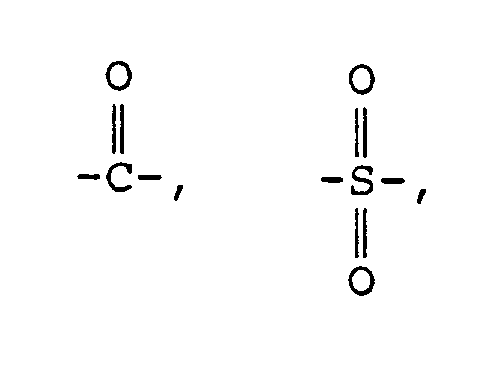
and -F; Y is -H or -F; and X is selected from the group consisting of -(CH₂)n-,
-O- and -S-; and n is a whole number from 1 to 5; which comprises reacting a fluorophthalic anhydride of the formula
with an aromatic dihydroxy compound of the formula HO-R-OH where R is as defined above, in the presence of an alkali metal fluoride, preferably potassium fluoride or cesium fluoride or a mixture thereof, and a polar aprotic solvent.
[0009] Among the dihydroxy compounds that may be employed in the process of the invention are included:
hydroquinone;
resorcinol;
3,4′-dihydroxydiphenylmethane;
4,4′-dihydroxybenzophenone;
4,4′-dihydroxydiphenyl ether;
2,2-bis-(2-hydroxyphenyl)propane;
2,4′-dihydroxydiphenylmethane;
bis-(2-hydroxyphenyl)methane;
2,2-bis-(4-hydroxyphenyl)propane (i.e., bisphenol-A);
1,1-bis-(4-hydroxyphenyl)ethane;
1,1-bis-(4-hydroxyphenyl)propane;
2,2-bis-(4-hydroxyphenyl)pentane;
3,3-bis-(4-hydroxyphenyl)pentane;
4,4′-dihydroxybiphenyl;
4,4′-dihydroxy-3,3′,5,5′-tetramethylbiphenyl;
2,4′-dihydroxybenzophenone;
4,4′-dihydroxybenzophenone;
4,4′-dihydroxydiphenyl sulfone;
2,4′-dihydroxydiphenyl sulfone;
4,4′-dihydroxydiphenyl sulfoxide;
4,4′-dihydroxydiphenyl sulfide; and the like.
[0010] The proportions of fluorophthalic anhydride and dihydroxy compound may vary considerably. However, it is preferred to employ a molar ratio of fluorophthalic anhydride: dihydroxy compound of at least about 2:1 and most preferably about 2.1-2.3:1. Higher ratios may be employed but generally provide no special advantage and may be uneconomical since the fluorophthalic anhydride is generally the more expensive reactant.
[0011] The fluorophthalic anhydride reactant may be either 3-fluoro- or 4-fluorophthalic anhydride or a mixture thereof and may be provided as an initial component of the reaction mixture or may be formed in-situ by the reaction of a bromo-, chloro-, or iodo-phthalic anhydride with KF. In the process of the invention, the fluorine atom on the fluorophthalic anhydride reactant functions as a leaving group and becomes the site for the formation of the ether bridge.
[0012] The process of the invention is preferably carried out at atmospheric pressure, but super-atmospheric pressure, for example under autogeneous conditions may be employed, if desired. The process is preferably carried out in the presence of a polar, aprotic solvent such as N-methyl-pyrrolidone, dimethyl formamide, dimethyl acetamide, triglyme, sulfolane, or the like. The preferred solvent is sulfolane.
[0013] The temperature at which the process is carried out may vary considerably, but will generally be within the range of about 120° to about 220° Celsius. Higher or lower temperatures may be employed but are less efficient. The choice of solvent may govern the temperature employed. For example, at atmospheric conditions the boiling point of the solvent becomes a limiting condition. The preferred temperature is in the range of about 160°-210°, and most preferably, about 170°-190° Celsius. Sulfolane is a particularly useful solvent for this preferred temperature range.
[0014] The proportions of reactants may vary considerably, however, it is preferred that the alkali metal fluoride be employed in sufficient proportions to provide about one equivalent of potassium (or cesium) per mole of fluorophthalic anhydride. In the reaction, the alkali metal fluoride functions as a hydrogen fluoride acceptor. When the fluorophthalic anhydride reactant is to be formed in-situ from an initial mixture of chlorophthalic anhydride, bromophthalic anhydride or iodophthalic anhydride, it is preferred to provide at least about two equivalents of alkali metal fluoride per mole of chloro- or bromo- or iodophthalic anhydride. Preferably the alkali metal compound is employed in substantial excess, for example, up to about 50 percent excess, of the aforesaid equivalent proportions.
[0015] The following examples are provided to further illustrate this invention and the manner in which it may be carried out. It will be understood, however, that the specific details given in the examples have been chosen for purposes of illustration only and are not to be construed as limiting the invention. In the examples, unless otherwise indicated, all parts and percentages are by weight and all temperatures are in degrees Celsius.
Example 1
[0016]
A mixture of 11.0 parts (0.1 mole) of hydroquinone, 36.5 parts (0.22 mole) of 4-fluorophthalic anhydride, and 18.0 parts (0.5 mole) of anhydrous potassium fluoride, in 126 parts of sulfolane was heated to about 180°C and maintained thereat, with stirring for about one hour. The reaction mixture was cooled to room temperature and washed with water to remove sulfolane. The solid residue was dried, dissolved in dimethyl formamide and analyzed by liquid chromatography. The product (based on area percent) consisted of 0.5 percent 4-fluorophthalic anhydride, 2.6 percent hydroquinone, and 92.7 percent hydroquinone-bis(4-phthalic anhydride) diether.
Example 2
[0017]
The procedure of Example 1 was repeated except that resorcinol was substituted for the hydroquinone. Analysis of the reaction product by liquid chromatographic techniques indicated, in area percent, 82.8 percent resorcinol-bis(4-phthalic anhydride) diether.
Example 3
[0018]
To a solution of 42.7 parts (0.25 mole) of 4-fluorophthalic anhydride in 117 parts of sulfolane was added 27.4 parts (0.12 mole) of bisphenol-A and 15.7 parts (0.27 mole) of dried potassium fluoride. This mixture was heated at 180-185°C, with stirring, for 3 hours. HPLC analysis of the reaction mixture showed the absence of starting material and a major product component consisting of 87.5% of the reaction mixture. Mass spectral analysis confirmed the identity of this component as the desired bisphenol-A diphthalic anhydride (as set forth in the structural formula above). The HPLC retention time was also the same as that found with a known sample of the desired dianhydride.
Example 4
[0019]
To a solution of 0.429 parts (0.002 mole) of 4,4′-dihydroxybenzophenone and 0.787 parts (0.005 mole) of 4-fluorophthalic anhydride in 3.6 parts of sulfolane, was added 0.25 parts (0.004 mole) of dried potassium fluoride. The resultant mixture was heated to about 175°C and maintained thereat, with stirring, for about 3-3/4 hours. Analysis of the reaction mixture by HPLC/MS showed 79.7% (by area) of desired product. (Confirmation by mass spec.)
Example 5
[0020]
Dried potassium fluoride (0.25 parts; 0.004 mole) was added to a solution of 0.8 parts (0.006 mole) of 4-fluorophthalic anhydride and 0.37 parts (0.002 mole) of 4,4′-biphenol dissolved in approximately 3.5 parts of sulfolane. After stirring for 3-3/4 hours at 175°C, the mixture was analyzed by HPLC/MS and found to contain 77.6 area percent of 4,4′-biphenol diphthalic anhydride.
1. A process for the preparation of diether diphthalic anhydrides of the formula
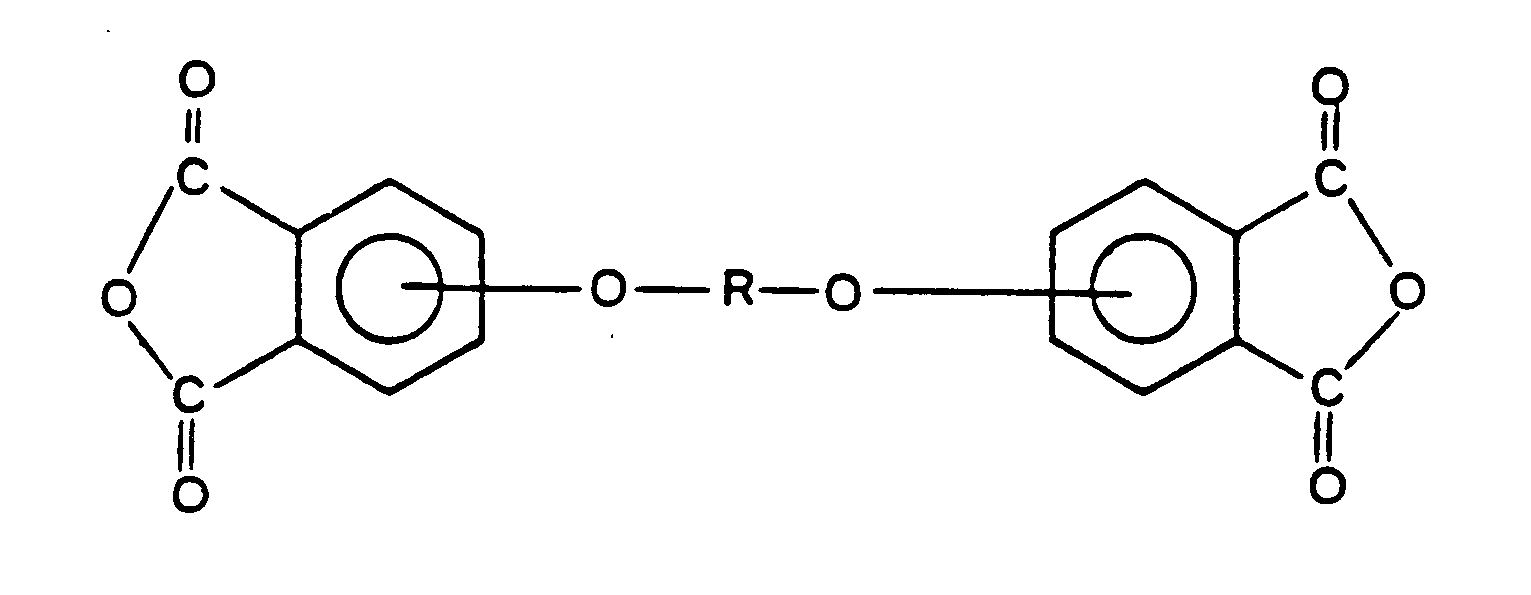
wherein R is selected from the group consisting of
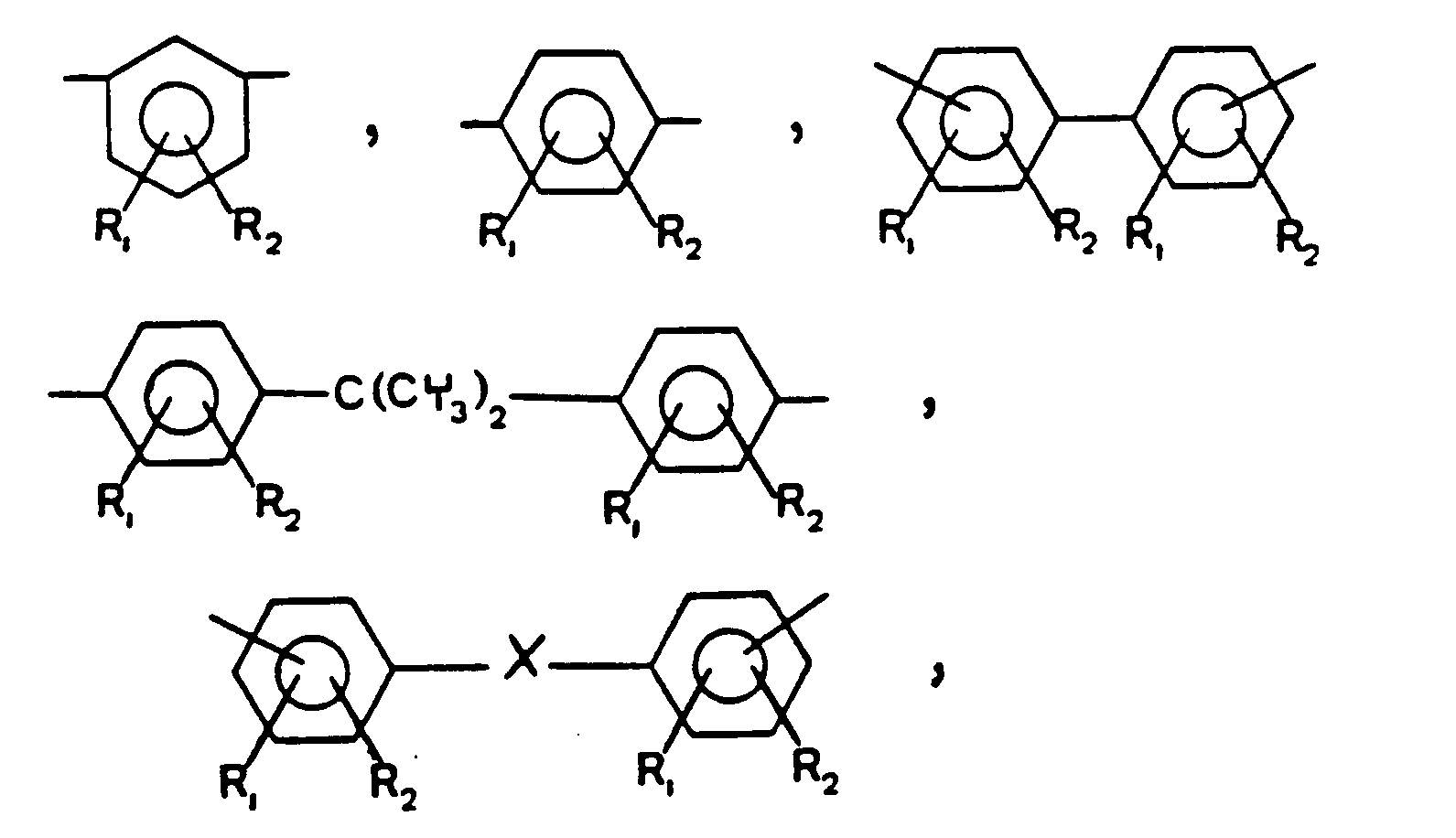
where R₁ and R₂ are independently selected from the group consisting of -phenyl, -phenoxy, -H, -CF₃, -CH₃, -OCH₃, -NO₂, -CN; and -F; Y is -H or -F; and X is selected from the group consisting of -(CH₂)n-,
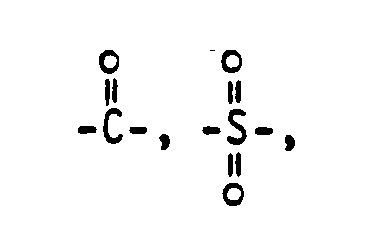
-O- and -S-; and n is a whole number from 1 to 5; which comprises reacting a fluorophthalic anhydride of the formula
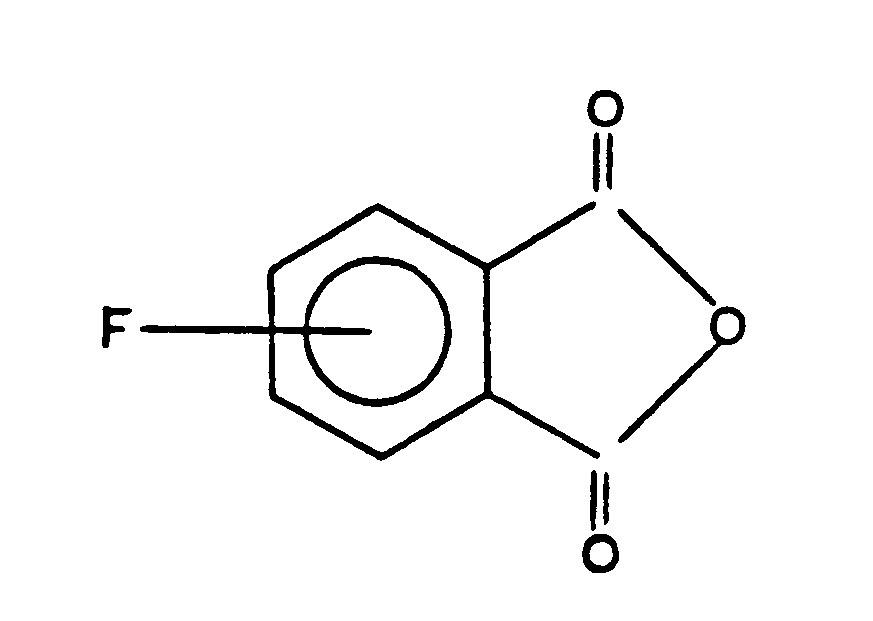
with an aromatic dihydroxyl compound of the formula HO-R-OH where R is as defined above, in the presence of alkali metal fluoride, preferably potassium fluoride or cesium fluoride or a mixture thereof, and a polar aprotic solvent.
wherein R is selected from the group consisting of
where R₁ and R₂ are independently selected from the group consisting of -phenyl, -phenoxy, -H, -CF₃, -CH₃, -OCH₃, -NO₂, -CN; and -F; Y is -H or -F; and X is selected from the group consisting of -(CH₂)n-,
-O- and -S-; and n is a whole number from 1 to 5; which comprises reacting a fluorophthalic anhydride of the formula
with an aromatic dihydroxyl compound of the formula HO-R-OH where R is as defined above, in the presence of alkali metal fluoride, preferably potassium fluoride or cesium fluoride or a mixture thereof, and a polar aprotic solvent.
2. A process according to Claim 1 carried out at a temperature of about 120° to about
220° Celsius.
3. A process according to Claim 2 carried out at a temperature of about 160° to about
210° Celsius.
4. A process according to Claim 1 wherein the solvent is sulfolane.
5. A process according to Claim 1 wherein the aromatic dihydroxy compound is hydroquinone,
resorcinol, 2,2-bis(4-hydroxyphenyl)propane, 4,4′-dihydroxybenzophenone or 4,4′-biphenol.
6. A process according to Claim 1 wherein the fluorophthalic anhydride is formed in-situ
by the reaction of a halophthalic anhydride selected from the group consisting of
chlorophthalic anhydride, bromophthalic anhydride, and iodophthalic anhydride with
an alkali metal fluoride; and the initial amount of alkali metal fluoride is sufficient
to provide at least about 2 equivalents of alkali metal per mole of halophthalic anhydride.
7. A process according to Claim 6 wherein the fluorophthalic anhydride is formed in-situ
by the reaction of chlorophthalic anhydride with potassium fluoride.
8. A process according to Claim 6 wherein the fluorophthalic anhydride is formed in-situ
by the reaction of bromophthalic anhydride with potassium fluoride.
9. A process for the preparation of a diether diphthalic anhydride according to Claim
1 which comprises reacting 4-fluorophthalic anhydride with hydroquinone, resorcinol,
2,2-bis(4-hydroxyphenyl)propane, 4,4′-dihydroxybenzophenone or 4,4′-biphenol in the
presence of potassium fluoride and sulfolane as a polar aprotic solvent at a temperature
of about 160° to about 210° Celsius.
1. Verfahren zur Herstellung von Dietherdiphthalsäureanhydriden der Formel
in der R ausgewählt ist aus der Gruppe
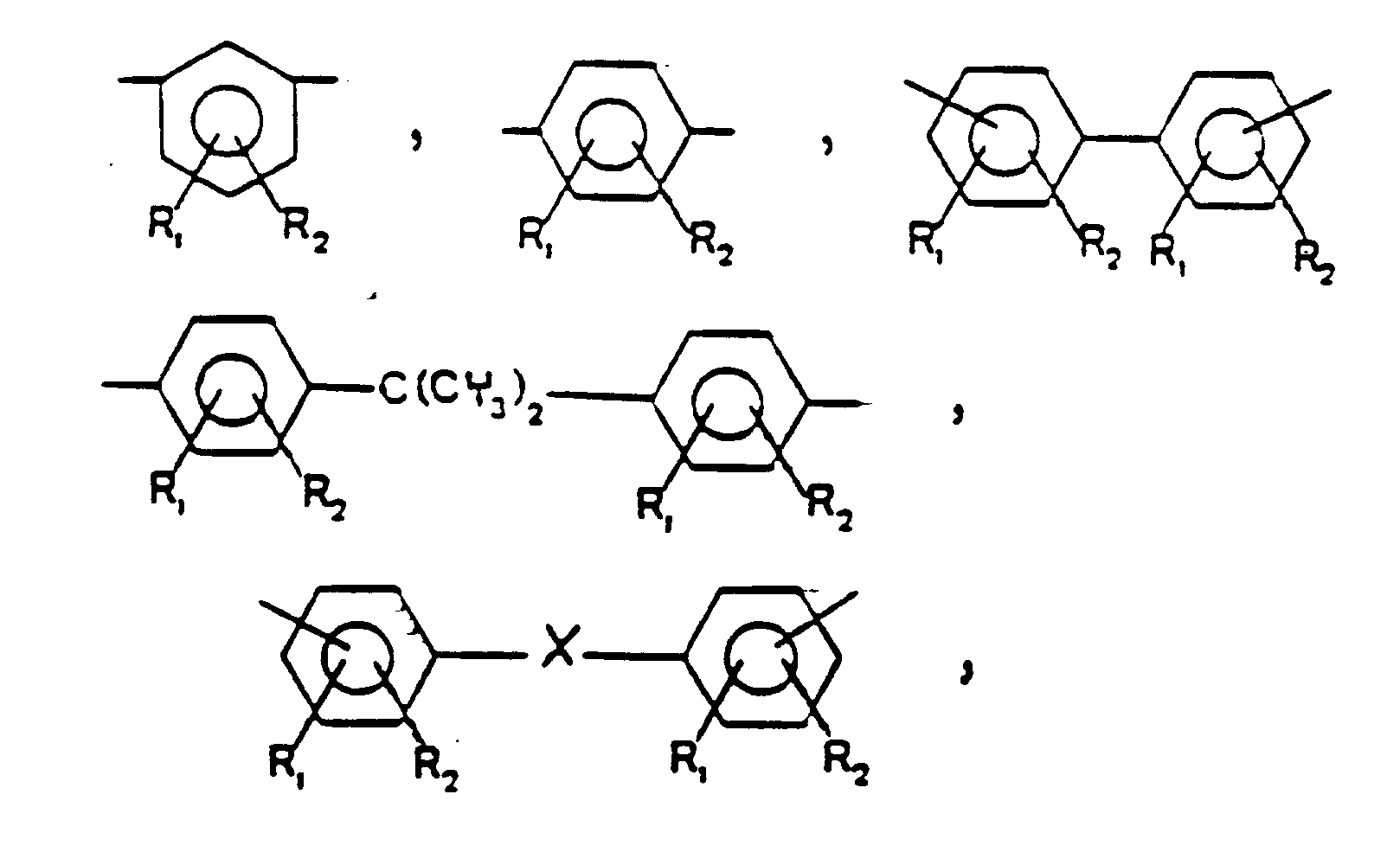
wobei R₁ und R₂ unabhängig voneinander Phenyl- oder Phenoxygruppen, Wasserstoffatome, CF₃-, CH₃-, OCH₃- NO₂- oder CN-Gruppen oder Fluoratome bedeuten; Y ein Wasserstoffatom oder ein Fluoratom darstellt, und X ausgewählt ist aus
-(CH₂)n-,
-O- und -S-;
und n eine ganze Zahl im Wert von 1 bis 5 ist, umfassend die Umsetzung eines Fluorphthalsäureanhydrids der Formel
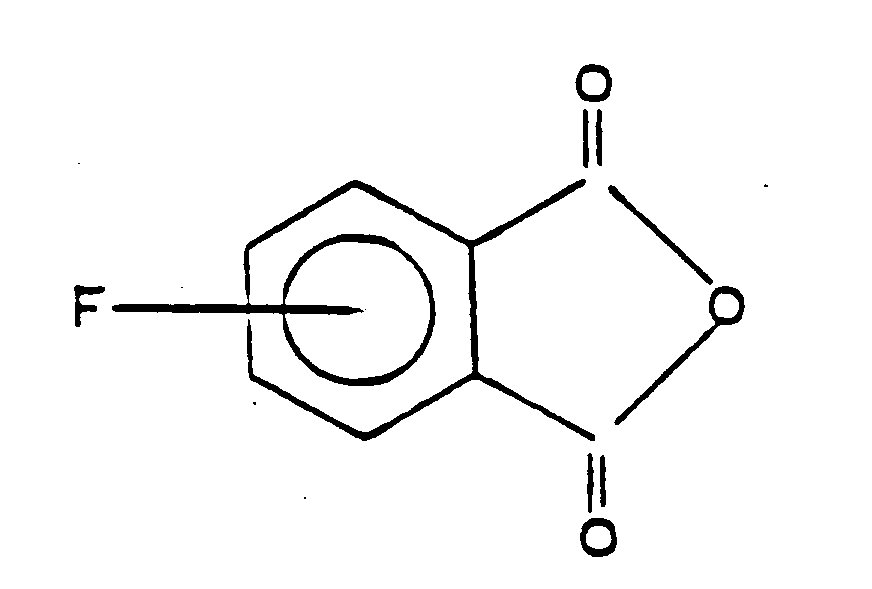
mit einer aromatischen Dihydroxyverbindung der Formel HO-R-OH, in der R die vorstehend angegebene Bedeutung hat, in Gegenwart eines Alkalimetallfluorids, vorzugsweise Kaliumfluorid oder Cesiumfluorid oder einem Gemisch davon, und eines polaren aprotischen Lösungsmittels.
in der R ausgewählt ist aus der Gruppe
wobei R₁ und R₂ unabhängig voneinander Phenyl- oder Phenoxygruppen, Wasserstoffatome, CF₃-, CH₃-, OCH₃- NO₂- oder CN-Gruppen oder Fluoratome bedeuten; Y ein Wasserstoffatom oder ein Fluoratom darstellt, und X ausgewählt ist aus
-(CH₂)n-,
-O- und -S-;
und n eine ganze Zahl im Wert von 1 bis 5 ist, umfassend die Umsetzung eines Fluorphthalsäureanhydrids der Formel
mit einer aromatischen Dihydroxyverbindung der Formel HO-R-OH, in der R die vorstehend angegebene Bedeutung hat, in Gegenwart eines Alkalimetallfluorids, vorzugsweise Kaliumfluorid oder Cesiumfluorid oder einem Gemisch davon, und eines polaren aprotischen Lösungsmittels.
2. Verfahren nach Anspruch 1, durchgeführt bei einer Temperatur von etwa 120 bis etwa
220°C.
3. Verfahren nach Anspruch 2, durchgeführt bei einer Temperatur von etwa 160 bis etwa
210°C.
4. Verfahren nach Anspruch 1, wobei das Lösungsmittel Sulfolan ist.
5. Verfahren nach Anspruch 1, wobei die aromatische Dihydroxyverbindung Hydrochinon,
Resorcin, 2,2-Bis(4-hydroxyphenyl)propan, 4,4'-Dihydroxybenzophenon oder 4,4'-Biphenol
ist.
6. Verfahren nach Anspruch 1, wobei das Fluorphthalsäureanhydrid in situ durch Umsetzung
eines Halophthalsäureanhydrids aus der Gruppe Chlorphthalsäureanhydrid, Bromphthalsäureanhydrid
und Jodphthalsäureanhydrid mit einem Alkalimetallfluorid erzeugt wird, und die Anfangsmenge
des Alkalimetallfluorids ausreicht, um mindestens etwa 2 Äquivalente des Alkalimetalls
pro Mol Halophthalsäureanhydrid bereitzustellen.
7. Verfahren nach Anspruch 6, wobei das Fluorphthalsäureanhydrid in situ durch Umsetzung
von Chlorphthalsäureanhydrid mit Kaliumfluorid erzeugt wird.
8. Verfahren nach Anspruch 6, wobei das Fluorphthalsäureanhydrid in situ durch Umsetzung
von Bromphthalsäureanhydrid mit Kaliumfluorid erzeugt wird.
9. Verfahren zur Herstellung eines Dietherdiphthalsäureanhydrids nach Anspruch 1, umfassend
die Umsetzung von 4-Fluorphthalsäureanhydrid mit Hydrochinon, Resorcin, 2,2-Bis(4-hydroxyphenyl)propan,
4,4'-Dihydroxybenzophenon oder 4,4'-Biphenol in Gegenwart von Kaliumfluorid und Sulfolan
als polarem aprotischen Lösungsmittel bei einer Temperatur von etwa 160 bis etwa 210°C.
1. Procédé pour la préparation d'anhydrides diéther diphtalique de formule :
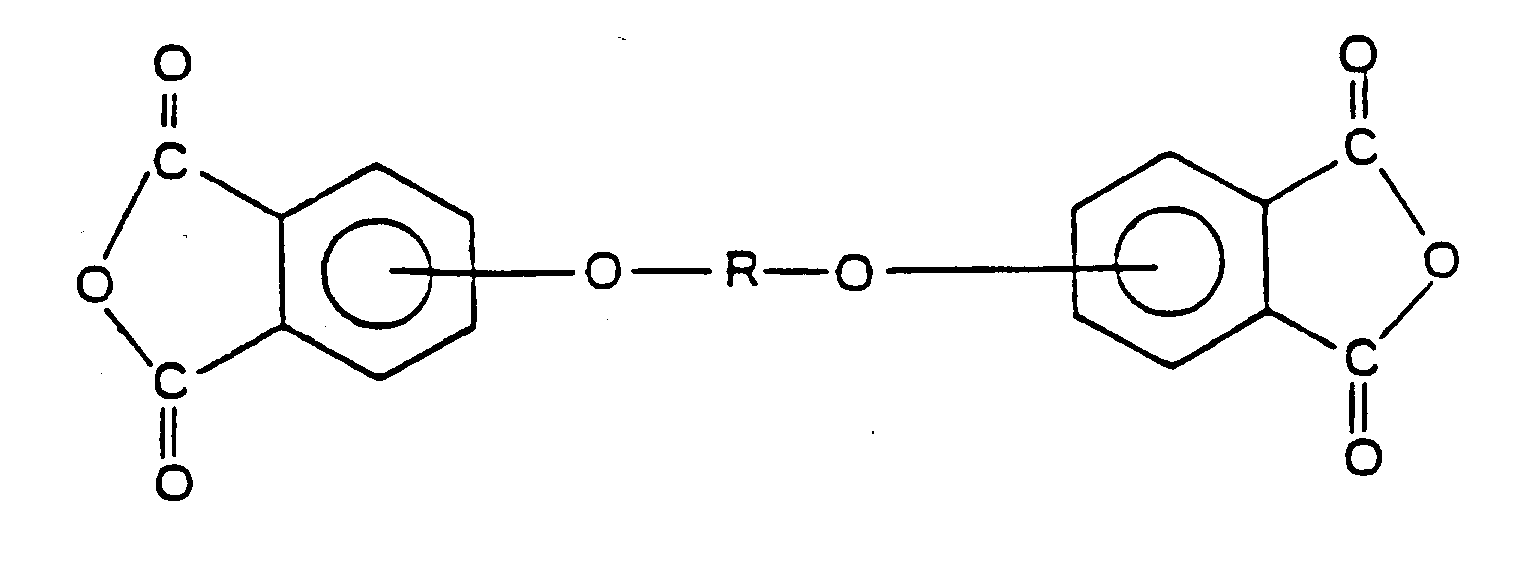
où R est choisi parmi le groupe consistant en :
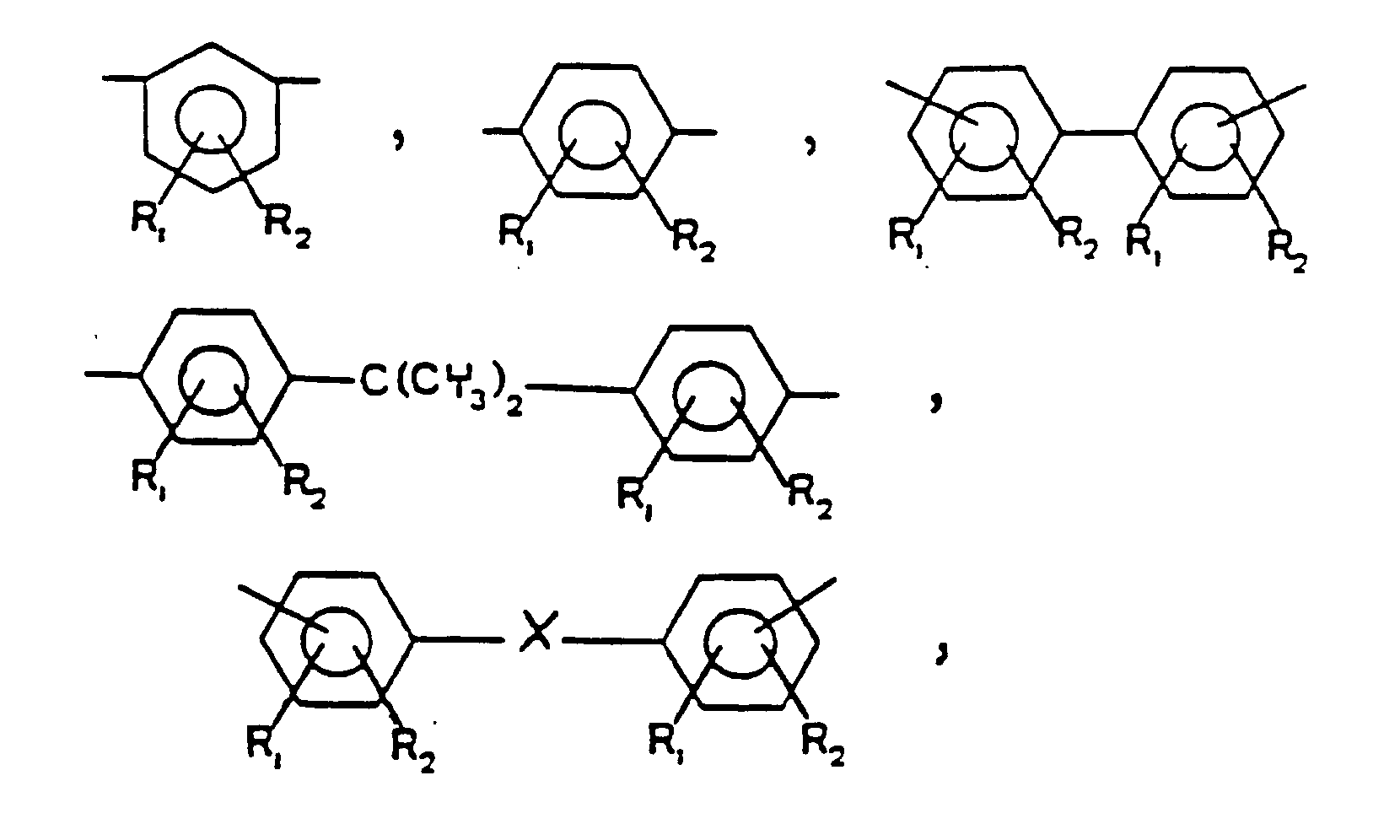
où R₁ et R₂ sont choisis indépendamment parmi le groupe consistant en phényle, phénoxy, -H, -CF₃, -CH₃, -OCH₃, -NO₂, -CN et F; Y est -H ou -F; et X est choisi parmi le groupe consistant en -(CH₂)n-, -C(O)-, -S(O₂)-, -O- et -S-; et n est un nombre entier de 1 à 5; qui comprend la réaction d'un anhydride fluorophtalique de formule :
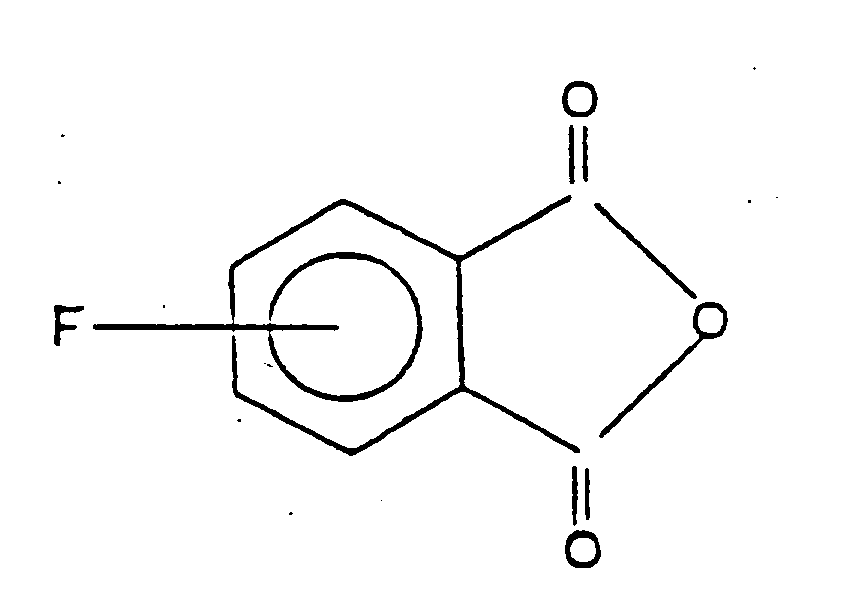
avec un composé dihydroxyaromatique de formule HO-R-OH, où R est tel que défini ci-dessus, en présence d'un fluorure de métal alcalin, de préférence le fluorure de potassium ou le fluorure de césium ou un mélange de ceux-ci, et un solvant polaire aprotique.
où R est choisi parmi le groupe consistant en :
où R₁ et R₂ sont choisis indépendamment parmi le groupe consistant en phényle, phénoxy, -H, -CF₃, -CH₃, -OCH₃, -NO₂, -CN et F; Y est -H ou -F; et X est choisi parmi le groupe consistant en -(CH₂)n-, -C(O)-, -S(O₂)-, -O- et -S-; et n est un nombre entier de 1 à 5; qui comprend la réaction d'un anhydride fluorophtalique de formule :
avec un composé dihydroxyaromatique de formule HO-R-OH, où R est tel que défini ci-dessus, en présence d'un fluorure de métal alcalin, de préférence le fluorure de potassium ou le fluorure de césium ou un mélange de ceux-ci, et un solvant polaire aprotique.
2. Procédé suivant la revendication 1, réalisé à une température d'environ 120°C à environ
220°C.
3. Procédé suivant la revendication 2, réalisé à une température d'environ 160°C à environ
210°C.
4. Procédé suivant la revendication 1, dans lequel le solvant est du sulfolane.
5. Procédé suivant la revendication 1, dans lequel le composé dihydroxyaromatique est
l'hydroquinone, le résorcinol, le 2,2-bis(4-hydroxyphényl)propane, la 4,4'-dihydroxybenzophénone
ou le 4,4'-biphénol.
6. Procédé suivant la revendication 1, dans lequel l'anhydride fluorophtalique est formé
in situ par réaction d'un anhydride halophtalique choisi parmi le groupe consistant en l'anhydride
chlorophtalique, l'anhydride bromophtalique et l'anhydride iodophtalique, avec un
fluorure de métal alcalin; et la quantité initiale de fluorure de métal alcalin est
suffisante pour fournir au moins environ deux équivalents du métal alcalin par mole
d'anhydride halophtalique.
7. Procédé suivant la revendication 6, dans lequel l'anhydride fluorophtalique est formé
in situ par la réaction d'anhydride chlorophtalique avec du fluorure de potassium.
8. Procédé suivant la revendication 6, dans lequel l'anhydride fluorophtalique est formé
in situ par la réaction d'anhydride bromophtalique avec du fluorure de potassium.
9. Procédé pour la préparation d'un anhydride diéther diphtalique suivant la revendication
1, qui comprend la réaction de l'anhydride 4-fluorophtalique avec de l'hydroquinone,
du résorcinol, du 2,2-bis(4-hydroxyphényl)-propane, de la 4,4'-dihydroxybenzophénone
ou du 4,4'-biphénol en présence de fluorure de potassium et de sulfolane en tant que
solvant aprotique polaire, à une température d'environ 160°C à environ 210°C.