|
(11) | EP 0 290 164 A1 |

| (12) | EUROPEAN PATENT APPLICATION |
|
|
|
|
|||||||||||||||||||||||||||
| (54) | Removal of water haze from distillate fuel |
| (57) The specification discloses a method of de-hazing distillate fuel which comprises
adding to the fuel an organosiloxane having at least one quaternary ammonium substituted
siloxane unit having the general formula
in which a has the value 1 or 2, each R represents a substituted or unsubstituted hydrocarbon group of up to 10 carbon atoms provided that one of the Rs may be a hydroxyl group when has the value 2, Z represents a quaternary ammonium qroup linked to the silicon atom of the siloxane unit, R' represents a divalent hydrocarbon group linking the silicon and nitrogen atoms, each R2 represents an alkyl group having up to 20 carbon atoms and X- represents a halogen ion. Preferred organosiloxanes also comprise siloxane units according to the general formula in which each R is a substituted or unsubstituted hydrocarbon group of up to 10 carbon atoms and b has the value 1, 2, or 3 and may be according to the average general formula (iv) R2SiO(R2SiO)x(RSiOR'N+(R2)3X-)ySiR3 in which x has a value in the range 1 to 150, y has a value in the range 1 to 10 and the ratio of x+y/y lies in the range 2 to 25. In preferred. organosiloxanes two of the groups R2 have 1 to 5 carbon atoms and one of the groups R2 has a chain of 10 to 15 carbon atoms. |
[0002] By the expression "distillate fuel" where used herein, we mean distilled hydrocarbon fuels which boil in the range of about 70°C to about 500°C. The distillate fuel may comprise atmospheric distillate or cracked gas oil or a blend of straight run or cracked distillates. The common distillate fuels are motor spirit, kerosene, jet fuel and diesel fuel.
[0003] Distillate fuels usually contain a minor amount of water i.e. about 100 to 300 parts of water per million parts of the fuel. Water is present in an aqueous phase in most fuel storage tanks and it is very difficult to ensure the fuel does not contain water. The water manifests itself as a haze in the liquid fuel. Presence of the haze in the fuel is regarded as technically unsatisfactory, for example, in view of the possibility of the water to coalesce slowly during storage and so provide a source of corrosion of storage vessels and pipes and in view of the possibility of the water to form ice at lower temperatures of use and thus interfere with supply of the fuel through supply pipes. The haze is also regarded as unsatisfactory from the aesthetic point of view.
[0004] It has been proposed to accelerate clearance of the haze by use of additives. For example, U.S. patent specification 4 002 558 discloses a method for removing water haze from a middle distillate fuel which comprises contacting the fuel with a specified amount of a solution of an inorganic halide or nitrate of calcium, magnesium, cadmium, copper or nickel in a fuel immiscible aliphatic monohydric alcohol, polyhydric alcohol or glycol ether. The preferred additive composition referred to in the specification is a solution of MgC12.6H20 dissolved in methanol.
[0005] U.S. patent specification 4 460 380 discloses the use of certain block copolymers of organosiloxane and polyoxyalkylene oxide for separating out or otherwise reducing water haze in middle distillate petroleum fuel. Block copolymers employed in the examples of the patent include a primary hydroxyl functional polydimethylsiloxanepolyoxyethylene copolymer commercially available as Dow Corning@ Q4-3667. Block copolymers as referred to in this specification are effective dehazing materials for certain fuels.
[0006] We have now found that certain quaternary ammonium substituted- polydiorganosiloxanes have excellent de-hazing properties. In particular, we have now found that certain organosiloxanes having at least one siloxane unit which has a trialkyl quaternary ammonium group attached to its silicon atom are operative de-hazing materials for certain distillate fuels.
[0007] The present invention provides in one of its aspects a method of de-hazing distillate fuel which comprises adding to the fuel an organosiloxane having at least one quaternary ammonium substituted siloxane unit having the general formula
in which a has the value 1 or 2, each R represents a substituted or unsubstituted hydrocarbon group of up to 10 carbon atoms provided that one of the Rs may be a hydroxyl group when a has the value 2, Z represents a quaternary ammonium group
(ii) R'N"(R2)3X-
linked to the silicon atom of the siloxane unit, R represents a divalent hydrocarbon group linking the silicon and nitrogen atoms, each R2 represents an alkyl group having up to 20 carbon atoms and X- represents a halogen ion.[0008] A method according to the present invention is applicable to distillate fuels in general and in particular is beneficial in respect of diesel fuel. By the expression "diesel fuel" where used herein is meant gas oil and fuel oil including those materials which are referred to as light domestic and heating oils and diesel fuel and irrespective of whether they are intended for vehicular, marine, heating or other use. These materials are loosely characterised as having a viscosity of not more than 115 Redwood 1 at 38°C and a boiling point in the range of about 200°C to about 380°C. Particularly embraced within the expression are those hydrocarbon liquids having a viscosity of about 30 to about 40 Redwood 1 at 38°C including those having a viscosity at 20°C in the range of about 2.9 to about 10.2 centistokes and at 38°C in the range of about 1.6 to about 6.0 cS.
[0009] In a method according to the invention the distillate fuel is preferably a diesel fuel used as a fuel for motor vehicles, e.g. cars and heavy goods vehicles, as a heating fuel or as a marine engine fuel. However, a method according to the invention may also find use, at least to a limited extent, for de-hazing of other distillate fuels, for example, motor spirit i.e. light oil distilling between 70°C and 200°C and treated to reach an octane number (RON) >85, aviation spirit, fuels for jet engines, residual fuel oils having a viscosity at 38°C of greater than 115 Redwood 1, light medium and heavy naphthas and vapourising oils.
[0010] Distillate fuel frequently contains additives intended to enhance various properties of the fuel but which under some conditions may serve to stabilize haze in the fuel. Additives may be present for example as wax crystal modifiers, pour point depressants, cold flow improvers, or viscosity modifiers. Materials often present as additives in diesel fuel include, for example, copolymers of ethylene with unsaturated ester e.g. vinyl acetate, vinyl butyrate, various acrylates and fumarates, polymeric esters of higher olefins and unsaturated alkyl esters, amine salts and amides.
[0011] The selection of the most effective quaternary ammonium organosiloxane de-hazer for a particular distillate fuel varies from distillate fuel to distillate fuel and appears to depend on characteristics of the oil and aqueous phases. The effectiveness of the de-hazing agents under field operating conditions is not readily predictable, but may be ascertained by a simple testing procedure. Thus, samples of the organosiloxanes may be mixed with the hazy distillate fuel, the mixture shaken and blended. At intervals, the light transmittance properties of samples of the fuel may be determined and thus a measure of the effectiveness of the organosiloxane as a de-hazer may be found. Whilst not wishing to be bound by any particular theory, we believe the effectiveness of these materials as de-hazers derives from a number of factors including, for example, the ability of the organosiloxane to permit at least some of its substituents to be present in the oily phase of the fuel whilst its quaternary ammonium groups are able to disturb the emulsifier system supporting the haze sufficiently for the haze to clear more quickly.
[0012] The organosiloxanes used in a method according to the invention may be linear or branched and may have any desired number of siloxane units. Preferably the organosiloxane has 2 to 2000 silicon atoms. The organosiloxane may be composed exclusively of units (i). However, we prefer that the organosiloxane is a polydiorganosiloxane composed of siloxane units (i) and siloxane units according to the general formula
in which each R is a substituted or unsubstituted hydrocarbon group of up to 10 carbon atoms and b has the value 1, 2, or 3. The units (iii) may thus be present as chain units, chain branching units or terminal units of the organosiloxane molecule and the units (i) may be present as chain units or as terminal units. The group R of units (i) and (iii) is preferably an unsubstituted alkyl, aryl, alkaryl, aralkyl or cycloaliphatic group. The most preferred groups are the lower alkyl groups, for example methyl, ethyl and propyl and the phenyl group. Preferably not less than 80% of the groups R are methyl.
[0013] In units of formula (i) the group R' linking the silicon and nitrogen atoms is a divalent hydrocarbon group, for example an alkylene group according to the formula -(CHz)"-where _n has a value in the range 2 to 10.
[0014] In units of formula (i), the alkyl groups R2 may be the same or different. Preferably, two of the groups R2 have 1 to 5 carbon atoms, for example the methyl or ethyl groups, and one of the groups R2 has a chain of 10 to 15 carbon atoms.
[0015] In units of formula (i), the halogen ion X- may be any of those commonly available, for example, iodide or chloride.
[0016] The organosiloxanes which are most effective de-hazers for particular distillate fuels may be determined by inspection of light transmittance as aforesaid. The effectiveness of the organosiloxanes in a particular fuel appears to be related to the structure of the organosi loxane and some of the organosiloxanes are more effective in de-hazing fuels containing additives than are others. Organosiloxanes which are effective de-hazers include the linear polvdioraanosiloxanes accordina to the averaae aeneral formula
in which x has a value in the range 1 to 150 and y has a value in the range 1 to 10. The ratio (x+y)/y conveniently lies in the range 2 to 25. Preferably, the sum of x+y lies in the range 2 to 20. Preferably, y has a value less than 5. Organosiloxanes which are effective de-hazers also include hydrolysates of dialkoxy silanes which consist principally of a mixture of linear and cyclic polysiloxanes having siloxane units according to the general formula
in which one group R2 is an alkyl group having 12 to 14 carbon atoms, y has a value of about 5 to about 10,X- is chloride or iodide and Me represents a methyl group.
[0017] Quaternary ammonium salts of organosiloxanes are known materials. Organosiloxanes suitable for use in the present invention may be made by methods known in the art. They may be prepared, for example, from the corresponding tertiary amine and halogenated polysiloxane. A halohydrocarbyl polydiorganosiloxane may be prepared by hydrosilylation reaction between a hydrosiloxane and a halogenated unsaturated organic material or by copolymerisation of the corresponding dialkoxy haloalkylsilane with a polydiorganosiloxane. Quaternary ammonium salts also may be made by hydrolysis of the corresponding dialkoxy dialkyl quaternary ammonium silane, or by hydrolysis of the alkyl dialkoxy haloalkylsilane and subsequent treatment with the required trialkyl amine. We prefer to prefer the appropriate iodoalkyl substituted polydiorganosiloxane and then bring about reaction of this with the appropriate trialkyl amine.
[0018] In a method according to the invention, the organosiloxane may be incorporated into the distillate fuel in any convenient way e.g. via a metering device and may be introduced in diluted or undiluted condition. The materials are effective to accelerate de-hazing of the fuel when stirred or otherwise mixed into the fuel. They may also be effective de-hazers when applied on the surface of the fuel and allowed to spread on the surface of the fuel and diffuse into the body of the fuel. The amount introduced may be determined on a trial basis, but normally is not more than about 500 parts de-hazer per million parts fuel by volume. The organopolysiloxane may be introduced as sole de-hazer or may be introduced in conjunction with other materials, for example organic de-hazers of known type.
[0019] By use of a method according to the invention we have been able to de-haze some distillate fuels to a comparable or greater extent than was previously achieved. Particular benefits of the invention are shown with the more stable distillate fuel hazes.
[0020] In order that the invention may become more clear, there now follows a description of examples selected to illustrate the invention. In the examples all parts are by volume unless otherwise stated. The symbol Me represents the methyl group.
[0021] In examples 1 to 5, the performances as de-hazers for distillate fuels of various quaternary ammonium salts of organosiloxanes is compared with the performance of other materials. The comparisons were made using samples taken from a test batch. Test batches were prepared by mixing portions of distillate fuels with 0.1% distilled water using a high shear mixer. Stirring of the mixture in the high shear mixer was continued for 5 minutes in order to produce a batch of diesel fuel containing a stable haze. To portions of this mixture the desired amount of the subject de-hazer was introduced to provide the test batches. Periodically, sample portions were removed from the test batches, charged into clear glass containers and their light transmittance measured using a WPA C065 colorimeter. The proportion of incident light transmitted through each sample was recorded as a percentage. As the haze cleared the proportion of light transmitted increased. No haze was visible to the naked eye when the light transmittance had increased to about 97%. Preparation of the batches and testing of the samples were all undertaken at room temperature, i.e. 22°C.
[0022] Each of the illustrative organosiloxanes had at least one quaternary ammonium substituted siloxane unit according to the general formula
in which a has the value 1, 2 R represents Me, Z represents a quaternary ammonium qroup
linked to the silicon atom of the siloxane unit, R' represents the group -(CH2)3-linking the silicon and nitrogen atoms, each R2 represents an alkyl group having up to 20 carbon atoms and X- represents a halogen ion. Illustrative organosiloxanes 1, 2 and 3 were polyorganosiloxanes according to the general formula
in which R is -(CH2)3-, two groups R2 are methyl and one is an alkyl group having 12 to 14 carbon atoms. These illustrative organosiloxanes had the following characteristics:
[0023] Fourth and fifth illustrative organosiloxanes were hydrolysates of dimethoxy silanes and consisted principally of a mixture of linear and cyclic polysiloxanes having siloxane units according to the general formula
terminal units of the linear polysiloxanes having the general formula
in which units (vii) and (viii) Z is as defined above, R is -(CH2)3-, two groups R2 are methyl and one is an alkyl group having 12 to 14 carbon atoms and y had a value of about 7. In the fourth illustrative organosiloxane X- was chloride and in the fifth illustrative organosiloxane X- was iodide.
[0025] Comparative material B was a polydiorganosiloxane polyoxyethylene glycol block copolymer comprising a centre block of about 15 dimethylsiloxane units and two hydroxyl terminated polyoxyethylene oxypropyl dimethyl silyl end blocks.
[0026] Comparative material C was a trimethylsilyl end-blocked polydiorganosiloxane polyoxyethyleneox- ypropylene glycol copolymer surfactant having a viscosity at 25°C in the range 500 to 2500 mmz!s.
Example 1
[0027] Samples were prepared and tested as referred to above, using as the distillate fuel a commercial vehicle fuel supplied as Gulf diesel and 100 parts of the de-hazing material under test per 1,000,000 parts distillate fuel. The test was carried out at room temperature. The percentage light transmittance was determined after 0, 24, 48 and 96 hours. The results are recited in Table 1. From this Table it can be seen that under the test conditions, the illustrative organosiloxane performed better than the comparative materials over each of the 24, 48 and 96 hour periods.
Example 2
[0028] Samples were prepared and tested as referred to above, using as the distillate fuel a commercial vehicle fuel supplied as Shell diesel and 100 parts of the de-hazing material under test to 1,000,000 parts distillate fuel. The test was carried out at room temperature. The percentage transmittance was determined after 0, 24, 48 and 96 hours. The results are recited in Table 2. From this Table it can be seen that under the test conditions, the illustrative organosiloxane performed better than the comparative materials over each of the 24, 48 and 96 periods.
Example 3
[0029] Samples were prepared and tested as referred to above, using as the distillate fuel a commercial vehicle fuel supplied as U.K. diesel and 100 parts of the de-hazing material under test to 1,000,000 parts distillate fuel. The test was carried out at room temperature. The percentage transmittance was determined after 0, 24, 48 and 96 hours. The results are recited in Table 3. From this Table it can be seen that under the test conditions, the illustrative organosiloxane performed better than the comparative materials over each of the 48 and 96 hour periods.
Example 4
[0030] Samples were prepared and tested as referred to above, using as the distillate fuel a commercial vehicle fuel supplied as Esso diesel and 400 parts of the de-hazing material under test to 1,000,000 parts distillate fuel to which was added 0.1 % by weight of detergent additive composition including materials effective as detergents, cold flow improvers, viscosity modifiers, or the like and which has the characteristic of stabilising the haze. The test was carried out at room temperature. The percentage light transmittance was determined before addition of the detergent additive and then after the addition after 24, 48 and 96 hours. The results are recited in Table 5. From this Table it can be seen that under the test conditions, the illustrative organosiloxanes performed better than the comparative material over each of the 24, 48 and 96 hour periods.
Example 5
[0031] Example 4 was repeated using different de-hazer materials. The results are recited in Table 5. From this Table it can be seen that under the test conditions, the illustrative organosiloxanes performed better than the comparative material over each of the 24, 48 and 96 hour periods, the first and fourth illustrative organosiloxanes being the most effective over the 48 hour period.
Examples
[0032] The performances in preventing formation of a haze in Esso Diesel containing 0.1% addition of the detergent additive used in Example 4, of various quaternary ammonium salts of organosiloxanes is compared with the performance of materials previously advocated for use as de-hazers for distillate fuel. The comparisons were made using samples taken from a test batch prepared in a similar manner to those used for Examples 1 to 5 by mixing the materials in a high shear mixer, except that the de-hazer was added to the distillate fuel before measured quantities of water were mixed in. Periodically, sample portions were removed from the test batches, charged into clear glass containers and their light transmittance measured using a WPA C065 colorimeter. The proportion of incident light transmitted through each sample was recorded as a percentage. As the haze cleared the proportion of light transmitted increased. No haze was visible to the naked eye when the light transmittance had increased to about 97%. The results are shown in Table 6. Preparation of the batch and testing of the samples were all undertaken at room temperature, i.e. 22°C.
1. A method of de-hazing distillate fuel which comprises adding to the fuel an organosiloxane
having at least one quaternary ammonium substituted siloxane unit having the general
formula
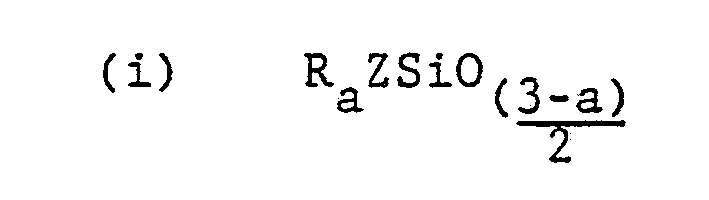
in which a has the value 1 or 2, each R represents a substituted or unsubstituted hydrocarbon group of up to 10 carbon atoms provided that one of the Rs may be a hydroxyl group when a has the value 2, Z represents a Quaternary ammonium qroup

linked to the silicon atom of the siloxane unit, R represents a divalent hydrocarbon group linking the silicon and nitrogen atoms, each R2 represents an alkyl group having up to 20 carbon atoms and X- represents a halogen ion.
in which a has the value 1 or 2, each R represents a substituted or unsubstituted hydrocarbon group of up to 10 carbon atoms provided that one of the Rs may be a hydroxyl group when a has the value 2, Z represents a Quaternary ammonium qroup
linked to the silicon atom of the siloxane unit, R represents a divalent hydrocarbon group linking the silicon and nitrogen atoms, each R2 represents an alkyl group having up to 20 carbon atoms and X- represents a halogen ion.
2. A method according to Claim 1 wherein the organosiloxane is composed exclusively
of units (i).
3. A method according to Claim 1 wherein the organosiloxane is a polydiorganosiloxane
composed of siloxane units (i) and siloxane units according to the general formula
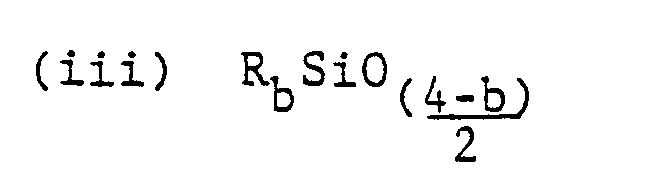
in which each R is a substituted or unsubstituted hydrocarbon group of up to 10 carbon atoms and b has the value 1, 2, or 3.
in which each R is a substituted or unsubstituted hydrocarbon group of up to 10 carbon atoms and b has the value 1, 2, or 3.
4. A method according to Claim 3 wherein the organosiloxane is a polydiorganosiloxane
according to the average general formula

in which x has a value in the range 1 to 150, y has a value in the range 1 to 10 and the ratio of x+Y/y lies in the range 2 to 25.
in which x has a value in the range 1 to 150, y has a value in the range 1 to 10 and the ratio of x+Y/y lies in the range 2 to 25.
5. A method according to any one of the preceding claims wherein the group R is an
alkylene group according to the formula -(CH2)n-where n has a value in the range 2 to 10.
6. A method according to any one of the preceding claims wherein two of the groups
R2 have 1 to 5 carbon atoms and one of the groups R2 has a chain of 10 to 15 carbon atoms.
7. A method according to any one of the preceding claims wherein the halogen ion X-
is an iodide or chloride ion.
8. A distillate fuel when treated by a method according to any one of the preceding
claims.
9. A distillate fuel comprising a de-hazing amount of an organosiloxane having at
least one quaternary ammonium substituted siloxane unit having the general formula
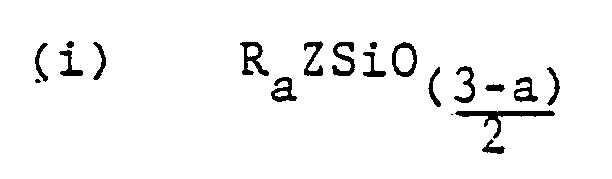
in which a has the value 1 or 2, each R represents a substituted or unsubstituted hydrocarbon group of up to 10 carbon atoms provided that one of the Rs may be a hydroxyl group when a has the value 2, Z represents a quaternary ammonium group

linked to the silicon atom of the siloxane unit, R represents a divalent hydrocarbon group linking the silicon and nitrogen atoms, each R2 represents an alkyl group having up to 20 carbon atoms and X- represents a halogen ion.
in which a has the value 1 or 2, each R represents a substituted or unsubstituted hydrocarbon group of up to 10 carbon atoms provided that one of the Rs may be a hydroxyl group when a has the value 2, Z represents a quaternary ammonium group
linked to the silicon atom of the siloxane unit, R represents a divalent hydrocarbon group linking the silicon and nitrogen atoms, each R2 represents an alkyl group having up to 20 carbon atoms and X- represents a halogen ion.
10. A fuel according to either one of Claims 10 and 11 wherein the fuel is a diesel
fuel.