|
(11) | EP 0 292 161 A2 |

| (12) | EUROPEAN PATENT APPLICATION |
|
|
|
|
|||||||||||||||||||||||||||
| (54) | New photosensitive calcium chelators |
| (57) The present invention discloses a new class of calcium chelating compounds which
have a decreased affinity for calcium following illumination. These new compounds
contain a photolabile nitrobenzyl derivative coupled to a tetracarboxylate Ca²⁺ chelating
parent compound having the octacoordinate chelating groups characteristic of EGTA
or BAPTA. However unlike EGTA or BAPTA-like compounds, in which the two halves of
the chelator are linked by a simple 1,2-ethanediyl moiety, the compounds of the present
invention modify the stereochemical conformation of this linkage by adding bulky substituents
or incorporating the linkage into a carbocyclic or heterocyclic ring. In a first form,
the new compounds are comprised of a BAPTA-like chelator coupled to a single 2-nitrobenzyl
derivative, which in turn is a photochemical precursor of a 2-nitrosobenzophenone.
In a second form, the new compounds are comprised of a BAPTA-like chelator coupled
to two 2-nitrobenzyl derivatives, themselves photochemical precursors of the related
2-nitrosobenzophenones. |
[0001] The present invention relates to photolabile calcium 2+ chelators whose affinity for calcium is decreased by illumination.
[0002] This invention was made with government support under Grant No. EY-04372 with the National Institutes of Health and the University of California. The government has certain rights in this invention.
[0003] Although Ca²⁺ is a well-established intra-cellular messenger, there are still many unanswered questions concerning the kinetics and spatial localization of its effects. As a means of supplying the data needed to answer some of these questions, chelators whose affinity for calcium is decreased by illumination, such as those disclosed in U.S. Patent No. 4,689,432, are now being used to induce fluctuations in free calcium levels similar to those which occur in vivo. Also see, Gurney and Lester (1987).
[0004] Although the photolabile chelator compounds disclosed in U.S. Patent No. 4,689,432 are useful for examining some processes which involve calcium, unfortunately the calcium 2+ affinity of some of these compounds is not strong enough for studying others. For example, with chelators such as nitr-2, a compound disclosed in U.S. Patent No. 4,689,432, at values of cytosolic free calcium 2+ typical for resting cells, only about 1/2 or less of the unphotolyzed chelator molecules bear calcium 2+ ions. Obviously the less calcium 2+ ions that are bound over to the chelator, the less that can be released by photolysis. In addition, those molecules which escape photolysis during the light flash tend to buffer the free calcium rise generated by those molecules which do photolyse.
[0005] The present invention discloses a new class photolabile calcium chelator compound. Unlike the calcium chelators disclosed in U.S. Serial No. 648,536, in which the two halves of the chelator are linked by a simple 1,2-ethanediyl (-CH₂CH₂-) moiety, the compounds of the present invention modify the stereochemical conformation of this linkage by adding bulky substituents or incorporating the linkage into a carbocyclic or heterocyclic ring. Such stereochemical modifications can decrease the Ca²⁺ affinity 75-fold or increase it 4-fold compared to prior art compounds. The new compounds also release Ca²⁺ more rapidly after photolysis than do compounds of the prior art such as nitr-2. These differences make the compounds of the present invention especially useful for studying the effects of Ca²⁺ on such phenomena as ion-channel gating and muscle contraction.
[0006] FIGURE 1 (having parts -1 and -2) is a flow chart illustrating synthesis of chelators of the present invention.
[0007] In the chart, reagents which were bought or prepared by known standard procedures are identified with Arabic numbers within brackets. Newly synthesized compounds are identified with Roman numerals and lower case letters such as a, b, c, etc. In this notation, a means containing a cis-cyclopentanediyl linkage; b means containing a trans-cyclopentanediyl linkage; c means containing a cis-cyclohexanediyl llinkage; d means containing a trans-cyclohexanediyl linkage; e means containing a cis-2,3-butanediyl lilnkage; f means containing a trans-2,3-butanediyl linkage; and g means containing a cis-3,4-tetrahydrofurandiyl linkage.
[0008] Figure 2 is a chart showing the chemical formulas of precursor models (Va-g) of one type of chelator of the present invention. The chart also shows the formula of a known compound having the "parent" linkage as shown below.
[0009] The new photolabile Ca²⁺ chelators disclosed herein are named with hyphens to distinguish the number 1 from the letter l, e.g., nitr-7.
[0010] As used herein, nitr-7 means cis-1-(2-bis (carboxymethyl)amino-5-(1-hydroxy-1-(2-nitro-5,6-methylenedioxyphenyl)methyl)phenoxy)-2-(2-bis(carboxymethyl)amino-5-methylphenoxy)cyclopentane. In the flow chart of Figure 1, nitr-7 is shown as compound VIIa.
[0013] As used herein, EGTA means ethylene glycol bis(beta-aminoethyl ether)-N,N,N′,N′-tetracetic acid.
[0014] As used herein, BAPTA means 1,2-bis(2-aminophenoxy)ethane N,N,N′,N′-tetraacetic acid; the chemical structure for BAPTA is:
[0015] As used herein, quin1 means 2-[[2-[bis(carboxymethyl)amino]-5-methylphenoxy]-methyl]-8-[bis(carboxymethyl)amino]-quinoline.
[0016] As used herein, quin2 means 2-[[2-[bis( carboxymethyl)amino]-5-methylphenoxy]-methyl]-6-methoxy-8-[bis(carboxymethyl)amino]-quinoline; the chemical structure for quin2 is:
[0017] As used herein, BAPTA-like means substituted derivatives of BAPTA which retain the essential characteristic of two bis(carboxymethyl)amino-substituted phenyl rings, said rings being linked at the positions ortho to the amines through a four atom bridge wherein the atom adjacent to each phenyl ring is N or O and the two center atoms are each C. By this definition, it is meant that "BAPTA-like" includes compounds like quin-1 and quin-2.
[0018] As used herein, pharmaceutically acceptable esters means those readily hydrolyzable esters which are known and used in the pharmaceutical industry, especially alpha-acyloxyalkyl esters.
[0019] As used herein, pharmaceutically acceptable non-toxic salts mean carboxylic acid salts wherein the counterion or ions are all Na, K, NR₄⁺ (where R=H, C₁-C₄ alkyl or a mixture thereof), choline, N-methylglucamine, Ca, or Mg, or some combination of these counterions, or some combination of acid salts or these counterions plus free acid groups.
REFERENCE LIST
Publications
[0022] The scientific publications cited herein are expressly incorporated by reference. 1. Gurney, A.M. and Lester, H.A., (1987) "Light-Flash Physiology with Synthetic Photosenstive Compounds", Physiol. Rev. 67(2):583-617.
2. Gurney, A.M., Tsien, R.Y., and Lester, H.A., (1987) "Activation of a potassium current by rapid photochemically generated step increases of intracellular calcium in rat sympathetic neurons", Proc. Natl. Acad. Sci., USA, 84:3496-3500.
3. March, J., (1977) Advanced Organic Chemistry, Second Edition, McGraw Hill at pp. 498-499.
4. Martell, A.E. and Smith, R.M., (1974) Critical Stability Constants, Vol. 1, Plenum Press, NY.
5. Noyori, R., Murata, S. and Suzuki, M., (1981) Tetrahedron 37:3899-3910.
6. Tsien, R.Y., (1980) Biochemistry 19:2396-2404.
Patents
DESCRIPTION OF THE INVENTION
[0024] The present invention comprises a new class of compounds, which when illuminated, change their affinity for calcium. The compounds contain a photolabile nitrobenzyl derivative coupled to a tetracarboxylate parent compound having the octa coordinate chelating groups characteristic of EGTA or BAPTA. However unlike EGTA or BAPTA-like compounds, in which the two halves of the chelator are linked by a simple 1,2-ethanediyl (-CH₂CH₂-) moiety, the compounds of the present invention modify the stereochemical conformation of this linkage by adding bulky substituents or incorporating the linkage into a carbocyclic or heterocyclic ring. Such stereochemical modifications can decrease the Ca²⁺ affinity 75-fold or increase it 4-fold compared to prior art compounds. The new class of calcium chelators disclosed herein also differ from prior art compounds in the time they take to release calcium in response to flash illumination. This makes the compounds of the present invention especially useful for studying physiological processes such as ion-channel gating and muscle contraction. The new chelators are also useful, in combination with prior art chelators, for studying various physiological processes by comparing the effects induced by different chelators. See generally Gurney, et al. (1987) and Gurney and Lester (1987).
[0025] In a first form, the new compounds are comprised of a BAPTA-like chelator, in which the two halves of the chelator are linked by a linkage selected from the group comprised of: (a) a simple 1,2-ethanediyl (-CH₂CH₂-) moiety having bulky substituents such as -CH₃-, -C₂H₅, or -CH₂OH added thereto, (b) a 1,2-ethanediyl moiety incorporated into a carbocyclic ring and, (c) a 1,2-ethanediyl moiety incorporated into a heterocyclic ring; wherein the chelator is coupled to a single 2-nitrobenzyl derivative, which in turn is a photochemical precursor of a 2-nitrosobenzophenone. In this form the new compounds are comprised of a chemical compound having the generic formula:
and the pharmaceutically acceptable nontoxic salts and esters thereof wherein:
A is -NO₂ or -H;
R¹ is selected from the group comprised of -H (unless R² is also H), -CH₃, -F, -Cl, and -Br;
R² is selected from the group comprised of -H (unless R¹ is also H), -CH₃, -F, -Cl, -Br, and C₁-C₄ alkoxy;
R³, R⁴ and R⁵ are independently -H, OH, NR⁶R⁷, or alkoxy, or
R³ and R⁴ together are -OCH₂O- or -OCH₂CH₂O- and R⁵ is -H, OH, NR⁶R⁷, or alkoxy, or
R⁴ and R⁵ together are -OCH₂O- or -OCH₂CH₂O- and R³ is -H, OH, NR⁶R⁷, or alkoxy;
X is selected from the group comprised of -OH, alkoxy, -Cl, -Br, -NR⁶R⁷, -OCOCH₃, -OCOCF₃, -OCOCH₂NH₂, -OPO₃H, and -OSO₂CH₃;
R⁶ and R⁷ are independently -H, methyl or ethyl;
R⁸ and R⁹ are independently -H, -CH₃, -C₂H₅, or -CH₂OH except that both may not be -H simultaneously; or R⁸ and R⁹ together are -(CH₂)m-Y-(CH₂)n- where m and n are independently 1 or 2 and Y is selected from the group comprised of -CH₂-, -O-, -NR⁶-, -S-, and -S-S-; and
W is -H, -OH, or -NHR⁶.
[0026] In a second form, the new compounds are comprised of a BAPTA-like chelator, in which the two halves of the chelator are linked by a linkage selected from the group comprised of: (a) a simple 1,2-ethanediyl (-CH₂CH₂-) moiety having bulky substituents such as -CH₃-, -C₂H₅, or -CH₂OH added thereto, (b) a 1,2-ethanediyl moiety incorporated into a carbocyclic ring and, (c) a 1,2-ethanediyl moiety incorporated into a heterocyclic ring; wherein the chelator is coupled to two 2-nitrobenzyl derivatives, themselves photochemical precursors of the related 2-nitrosobenzophenones. In this form, the new compounds are comprised of a chemical compound having the generic formula:
and the pharmaceutically acceptable non-toxic salts and esters thereof wherein:
A is -NO₂ or -H;
R³, R⁴ and R⁵ are independently -H, OH, NR⁶R⁷, or alkoxy, or
R³ and R⁴ together are -OCH₂O- or -OCH₂CH₂O- and R⁵ is -H, OH, NR⁶R⁷, or alkoxy, or
R⁴ and R⁵ together are -OCH₂O- or -OCH₂CH₂O- and R³ is -H, OH, NR⁶R⁷, or alkoxy;
X is selected from the group comprised of -OH, alkoxy, -Cl, -Br, -NR⁶R⁷, -OCOCH₃, -OCOCF₃, -OCOCH₂NH₂, -OPO₃H, and -OSO₂CH₃;
R⁶ and R⁷ are independently -H, methyl or ethyl;
R⁸ and R⁹ are independently -H or -CH₃ or -C₂H₅ or -CH₂OH except that both may not be -H simultaneously; or R⁸ and R⁹ together are -(CH₂)m-Y-(CH₂)n- where m and n are independently 1 or 2 and Y is selected from the group comprised of -CH₂-, -O-, -NR⁶-, -S-, and -S-S-; and
W is -H, -OH, or -NHR⁶.
[0027] The present invention comprises a new class of photosensitive calcium chelating compounds which decrease their affinity for calcium when exposed to light. Generic formulas for these photolabile compounds are given above. Compounds of the type disclosed and claimed herein consist of a calcium 2+ chelating portion containing two 2-bis(carboxymethyl) aminophenoxy groups linked through a 1,-2-propanediyl or 2,3-butanediyl or a 1,2-cycloalkanediyl or through two adjacent carbon atoms in a heterocyclic ring, for example a 3,4-tetrahydrofurandiyl, and a nitroary portion linked to the chelating portion by a substituted methylene bridge.
[0028] The synthesis of the new photolabile compounds claimed herein is illustrated in the detailed synthesis of nitr-7 (See Figure 1). Those skilled in the art will recognize that other new forms of these photolabile Ca²⁺ chelators can be prepared by using related synthetic methods and starting materials.
[0029] Full descriptions of the reaction conditions are described below. In both Figure 1 and the discussion that follows, numerals, both Roman and Arabic, and lower case letters are sometimes used as a shorthand means of identifying the various chemical compounds. Reagents used but not synthesized are labeled on the flow chart in Figure 1 with bracketed Arabic numerals. In the synthesis section that follows, these reagents are identified with bracketed Arabic numbers.
[0030] Preparations of calcium chelating compounds suitable for use as intermediates in this invention have been described (see Tsien, 1980). In addition to the compounds described therein, those skilled in the art will realize that by using standard techniques it is possible to prepare derivatives of said compounds containing various R¹, R², and W groups (see generic formulas in Description of the Invention section, supra). Such derivatives are within the scope of the present invention.
[0031] The nitrophenyl portion of the new compounds comes from a suitable 2-nitro-benzaldehyde or 2,6-dinitrobenzaldehyde. In preferred synthesis methods, the aldehyde is used directly to prepare the compounds.
[0032] The various R and W substituents allow a number of related compounds to be prepared. When W is -OH, -alkoxy, or -NHR⁶, the heteroatom may exert electronic and steric effects to modify the stability of the photoactive transition state. R¹ and R² can be altered to modify the Kd of the chelator portion of the molecule, and to control the electrophilic aromatic substitution of the nitrobenzaldehyde derivative so that one or two photolabile groups are incorporated in the final molecule. R³ through R⁵ substituents will influence the electron density of the nitrophenyl ring and therefore can influence the wavelength needed to activate the photo reaction.
[0033] The key step in preparing compounds of the type disclosed and claimed herein is the condensation of a 2-nitrobenzaldehyde with an aromatic, BAPTA-like chelator. The obvious, textbook methods for synthesizing benzhydrols either failed or were unsuitable because of the many other substituents on the desired molecule. For example, the classic methods for condensing aromatic rings with aldehydes or ketones ("hydroxyalkylation", see March, 1977) are known not to stop at the benzhydrol stage but to go on to triarylmethanes. Also conventional Lewis acids needed to activate the aldehyde would deactivate the BAPTA-like substrates because of their amino functionality. Therefore we used the selective Lewis acid, trimethylsilyl trifluoromethane sulfonate (see Noyori, et al., 1092), to carry out the required electrophilic aromatic substitution. The method can be practiced by mixing together one equivalent of an aryl compound and a hindered, tertiary amine, then adding TMS-triflate, and finally adding a 2-nitroaryl aldehyde or dialkyl acetal thereof.
[0034] In the preparation of compounds of the invention that contain only one photolabile nitrobenzyl group, if R² is anything except hydrogen, the 5 position of that ring will be blocked and nitrobenzylation can proceed only at the desired 5 position of the 4-W-phenyl ring or equivalent quinoline or benzopyran. If R² is hydrogen, the presence of halogen at R¹ will deactivate that ring for electrophilic substitution and nitrobenzylation will occur mainly at the desired position. Products of the first type where R²=H and R¹=H or alkyl can be prepared only by controlled nitrobenzylation and separation of the desired product, so preparation of such compounds is not recommended.
[0035] To prepare compounds containing two nitrobenzyl groups, R² must be hydrogen and R¹ can be hydrogen, alkyl or any form appropriate for substituent W. In this case, the desired nitrobenzylation occurs at the 5 position of both phenyl rings or the 5 position of both the R¹, R² phenyl and of the quinoline.
[0036] It is known that cation affinities of BAPTA derivatives can be increased or decreased by appropriate electron-donating or electron-withdrawing substituents on the benzene rings (see generally Tsien, 1980). For example, substitution of two methyl groups for the two hydrogens para to the two nitrogens of BAPTA strengthened Ca²⁺ binding by 0.4 log unit and similar disubstitution with bromine weakened Ca²⁺ binding by 1.2 log units (see generally, Tsien, 1980). We have found that monosubstitution gives half as much effect on calcium affinity (data not shown). Those skilled in the art will realize that the effect of other substituents on the cation affinities of the present compounds should be quantitatively predictable by a Hammett-type linear free-energy relation.
[0037] It is also known that the greatest change in chelating characteristics occurs within 2 log [Ca²⁺] units of the Kd of any particular chelator (see Tsien, 1980). As a result, it would be helpful to have chelators available which have a range of Kd's. To this end, R¹ and R² can be varied to adjust the Kd up or down. As expected, the nitrobenzyl component of the molecule weakens Ca²⁺ binding by 0-0.3 log units (compare Kd=160 nM with BAPTA Kd=100 nM, (see Tsien, 1980).
[0038] The photolabile compounds disclosed and claimed herein can also be esterified using an alpha-alkyloxyalkyl bromide. Such esters are hydrophobic enough to readily cross cell membranes, but once within the cell are cleaved by cytosolic esterases to regenerate the free acids.
[0039] Methods of synthesizing the new photolabile Ca²⁺ chelators disclosed herein are outlined in the following Compound Synthesis section.
Compound Synthesis
[0040] Most reagents and solvents used in the syntheses were ACS or HPLC grade, and used as received from Aldrich, Mallinkradt, Fisher, or J.T. Baker unless otherwise stated. Dry dimethylformamide (DMF) was obtained from Aldrich, Gold Label, stored over 4A molecular sieves and used as received. Dimethoxyethane was dried over sodium-lead alloy. CD₂Cl₂ and CHCl₃ were redistilled from P₂O₅; tetrahydrofuran (THF) was redistilled from CaH₂. In testing the various reaction products, proton magnetic resonance were recorded on a Varian EM-390 90 MHz spectrometer in CDCL₃ unless otherwise noted. Peaks are reported below in the following format: NMR (solvent, operating frequency): chemical shift in ppm from tetramethyl-silane, multiplicity (s=singlet, d=doublet, t=triplet, q=quartet, m=multiplet, br=broad), spin-spin coupling constant if appropriate, integrated number of protons. Sometimes several adjacent peaks are too close for their integrals to be separated, in which case only the total integral for a cluster is stated.
[0041] UV absorbance spectra were recorded on a Cary 210 or a Perkin Elmer Lambda Array 3840 spectrophotometer at 22 ± 22°C. Melting points are uncorrected and elemental analysis were performed by the Microanalytical Laboratory in the Department of Chemistry at the University of California Berkeley. Temperatures are in degrees centigrade.
[0042] Thin-layer chromatography (TLC) was carried out on precoated silica gel (60F-254, E. Merck) or reverse phase (RP-18 F-254s, E. Merck) plates. For column chromatography, silica gel 60(230-400 mesh, E. Merck) was used. Since all 2-nitrobenzaldehyde and 2-nitrobenzyl alcohol derivatives are sensitive to near ultraviolet light, handlings were performed under an orange safety lamp.
[0043] Those skilled in the art will realize that starting from esters such as (VI) or acids (VII) where X=OH (see generic formula in Brief Description of the Invention section), analogs containing X=-OCOCH₃, -OCOCF₃, -O-glycyl, -OPO₃H, -OSO₂CH₃ could be readily prepared by acylation, phosphorylation, or methanesulfonylation under standard conditions. Also starting from esters where X=OH, analogs with X=Cl or Br could be prepared using SOCl₂ or PCl₃ or PBr₃ or other standard means for converting alcohols to halides. Esters with X=NR⁶R⁷ could be prepared from esters with X=Br or X=OSO₂CH₃ by nucleophilic substitution under standard conditions.
COMPOUND Ib
[0045] Cyclopentene oxide [reagent 2] 8.73 mL, 0.1 mol), 5-methyl-2-nitrophenol (15.3g, 0.1 mol) [reagent 1] and potassium 5-methyl-2-nitrophenoxide (1.91g, 0.01 mol) were dissolved in dry DMF (5mL) and refluxed for 20h. under argon. The cooled reaction mixture was diluted with aq.NaOH solution (100mL 1M) and extracted with toluene (three 50 mL portions). The combined extracts were washed with H₂O (3 x 50mL), dried (Na₂SO₄), toluene removed by evaporation and the product [compound Ib] collected to give 17.0g (72%) of an orange oil which crystallized on cooling. M.p 42-44°.
[0046] ¹H NMR delta 1.9(br m, 6H, cyclopentyl-CH₂-), 2.40 (s, 3H, CH₃), 4.40 (br m, 1H, -CH-OH) 4.65 (m, 1H, -CH-OAr) 6.80(d, 1H, J=8Hz, H-64) 6.93 (s, 1H, H-6) 7.67 (d, 1H, J=8hz, H-3).
COMPOUND Id
[0047] Compound Id was synthesized by the same method as Ib but using cyclohexene oxide [reagent 3] instead of cyclopentene oxide. Recrystallization from hexane gave yellow crystals, yield 56%. M.p. 55-57°. ¹H NMR delta 1.50, 1.78, 2.1 (br. m, 8H, cyclohexyl) 2.40 (s, 3H, CH₃), 3.30 (s, br, 1H, OH), 3.73 (m, 1H, -CH-OH), 4.05 (m, 1H, -CH-OAr), 6.78 (d, 1H, J=8Hz, H-4) 6.90 (s, 1H,H-6)7.67 (d, 1H, J=8Hz, H-3).
COMPOUND Ie
[0048] Compound Ie was synthesized by the same method as Ib but using trans-2,3-epoxybutane [reagent 4] instead of cyclopentene oxide. The resulting oil (16% yield of Ie) was used without further purification.
[0049] ¹H NMR delta 1.20, 1.30 (2d, 6H, J=5Hz, butylCH₃) 2.40 (s, 3H, Ar-CH₃), 2.72 (s, 1H, -OH), 4.00, 4.53 (2m, 2H, J=3Hz, -CH-), 6.85 (d, 2H J=8Hz H=4) 6.95 (s, 1H, H-6) 7.80 (d, 2H, J=8Hz H-3).
COMPOUND IIa
[0051] Compound Ib (8.3g, 35 mmol) dissolved in CH₂Cl₂ (10mL) was added in one portion to a stirred suspension of pyridinium chlorochromate [reagent 5] (11.3g, 55 mmol) in CH₂Cl₂ (70 ml) and stirred at room temperature for 16h. The reaction mixture was diluted with Et₂O (350mL) and decanted from the dark tar which was washed (3 x 50mL) with Et₂O. The combined extracts were filtered through Celite and evaporated to dryness to yield an oil which crystallized. Recrystallization from MeOH gave IIa as yellow crystals (6.60g, 80%) M.p 65-66°.
[0052] ¹H NMR delta 2.10 (m, 6H, -(CH₂)₃-), 2.33 (s, 3H, CH₃), 4.63 (t, 1H, CH), 6.80 (d, 1H J=8Hz, H-4) 7.02 (s, 1H, H-6) 7.70 (d, 2H J=8Hz, H-3)
COMPOUND IIc
[0053] Oxidation of the cyclohexanol derivative Id required a six-fold excess of pyridinium chlorochromate and a reaction time of 5 days to give compound IIc (88% yield) as a yellow solid, recrystallized from isopropyl ether. M.p. 125-8°.
[0054] ¹H NMR delta 1.6-2.6 (m's, 8H, -(CH₂)₄-) 2.33 (s, 3H, CH₃) 4.63 (t, 1H, CH) 6.80 (d, 1H, J=8Hz H-4) 7.02 (s, 1H, H-6) 7.73 (d, 2H, J=8Hz, H-3).
COMPOUNDIa
[0055] IIa (5.86g, 25 mmol) dissolved in dry THF (25 mL) at -10°C was added dropwise with stirring to a solution of lithium trisiamylborohydride [reagent 6] (30 mmol) in THF (30 ml) at -78°C under a N₂ atmosphere. After 2h, the red reaction mixture was allowed to warm up to room temperature (1h), quenched with H₂O (4mL) and EtOH (15 mL), made alkaline with aqueous KOH (6 mL, 10M), and oxidized by cautious addition of 30% aq.H₂O₂ (15 mL) with cooling. After saturating with K₂CO₃, the aqueous layer was separated and washed with Et₂O:THF (1:1, 2 x 10 mL). The combined organic extracts were dried (MgSO₄), evaporated to dryness, and the product distilled bulb-to-bulb at 180-200°C at 0.1 mm Hg to yield Ia as an orange oil (4.55g, 77%).
[0056] ¹H NMR delta 1.9 (br m, 6H,-(CH₂)₃-) 2.40 (s,3H, CH₃) 3.05 (br s, 1H, OH), 4.20, 4.66 (2m, 2H, CH) 6.82 (d, 1H, J=8Hz, H-4), 6.90 (s, 1H, H-6) 7.76 (d, 1H, J=8Hz, H-3).
[0057] TLC in a system which separated the cis and trans-isomers Ia and Ib respectively, indicated completed conversion to the cis-isomer.
COMPOUND Ic
[0058] In analogy to the above preparation of Ia, IIc was reduced to Ic, a dark orange oil (54% yield) after chromatography on SiO₂ in ethyl acetate-hexane. ¹H NMR delta 1.68 (br m's, 8H, -(CH₂)₄-), 2.40 (s, 3H, CH₃), 2.70 (br d, 1H, OH), 3.83 (br m, 1H, CH-), 4.53 (m, 1H, CH-OAr), 6.80 (d, 1H J=8Hz H-4), 6.90 (s, 1H, H-6) 7.76 (d, 1H, J=8Hz H-3).
COMPOUND Ig
[0060] NaH (42 mg 57% suspension in oil, 1 mmol) was added portionwise with stirring to a solution of cis-tetrahydrofuran-3,4-diol [reagent 8] (0.21g, 2 mmol) and 2-fluoronitrobenzene [reagent 7] (105 microL, 1 mmol) in dry DMF (1 mL). Thirty minutes after the final addition, the reaction mixture was diluted with H₂O (15 mL) and cooled on ice for at least 30 min. The solid precipitate of the diarylated byproduct was filtered off, the filtrate extracted with toluene (3 x 5 mL) and combined extracts dried (Na₂SO₄), and evaporated to dryness to yield the product, (Ig) as a yellow oil that crystallized on trituration with isopropyl ether, yield 111 mg. M.p. 59-61°. TLC (5% MeOH-CHCl₃) showed less than 5% disubstituted by-product. The product was used without further purification.
[0061] ¹H NMR delta 3.13 (d, 1H, OH) 3.4-4.2 (m's, 4H, -CH₂OCH₂-), 4.45, 5.80 (2m, 2H, CH) 6.90-8.0 (m, 4H, aromatic).
COMPOUND If
[0062] Similarly to the preparation of compound Ig, addition of NaH (4 mmol) to a solution of (R,R)-(-)-2,3-butanediol [reagent 9] (5 mmol) and 2-fluoronitrobenzene [reagent 7] (4 mmol) in dry N-methylpyrrolidinone (2.5 mL), quenching with H₂O after 30 min., and extraction into ethyl acetate gave a mixture of the mono and di-substituted products which were separated on SiO₂ by eluting with ethylacetate-hexane to give a yellow oil, If (45%) and white solid (14%) respectively.
COMPOUND IIIa
[0064] NaH (1.05g, 57% oil suspension, 25 mmol) was added portionwise with stirring and cooling to a solution of Ia (4.27g, 18 mmol) and 2-fluoronitrobenzene [reagent 7] (2.11 mL, 20 mmol) in dry 1,2-dimethoxyethane (25 mL). After standing at room temperature for 1h, the reaction mixture was diluted with H₂O (100 mL) and extracted with CHCl₃ (3 x 50 mL); the extracts dried and evaporated to dryness to yield the crude product IIIa as an oil which crystallized on chilling. Recrystallization from acetone-methanol gave yellow crystals, m.p. 109-110° yield, 4.8g (74%).
[0065] ¹H NMR delta 1.7-2.2 (m, 6H, -(CH₂)₃-), 2.35 (s, 3H, CH₃) 4.87 (m, 2H, CH), 6.7-7.8 (m's, 7H, aromatic).
COMPOUNDS III b, c, d and e
[0066] Compounds IIIb, IIIc, IIId and IIIe were synthesized from the corresponding alcohols by the same method used to synthesize compound Ia. The yield, physical and spectral properties were as follows:
[0068] ¹H NMR delta 1.6-2.1 (m, 6H, -(CH₂)₃-), 2.40 (s, 3H, CH₃), 4.75 (m, 2H, CH), 6.8-7.8 (m, 7H, aromatic).
[0070] ¹H NMR delta 1.3-2.2 (m's, 8H, -(CH₂)₄-), 2.37 (s, 3H, CH₃), 4.70 (br d, 2H, CH), 6.8-7.8 (m's, 7H aromatic).
[0072] ¹H NMR delta 1.3-2.2 (m's, 8H, -(CH₂)₄-, 2.40 (s, 3H, CH₃) 4.63 (m, 2H, CH), 6.8-7.8 (m's, 7H, aromatic).
[0074] ¹H NMR delta 1.47 (d, 6H, J=6.5Hz, CH₃) 2.42 (s, 3H, Ar-CH₃), 4.75 (q, d, 2H J=6.5, 3Hz, CH) 6.8-8.0 (m, 7H aromatic).
COMPOUNDS IIIf and g
[0075] As in the synthesis of compounds IIIb, c, d and e, compounds IIIf and IIIg were similarly prepared from alcohols If and Ig respectively, but substituting 3-fluoro-4-nitrotoluene [reagent 10] for 2-fluoronitrobenzene. IIIf was an orange oil, separated by SiO₂ chromatography (ethyl acetate-hexane) yield 45%.
[0076] ¹H NMR delta 1.33 (d, 6H, J=6.5Hz, CH₃) 2.40 (s, 3H, Ar-CH₃) 4.75 (m, 1H, CH) 6.7-7.8 (m's 7H, aromatic).
[0077] IIIg was obtained as a pale yellow precipitate on quenching the reaction mixture followed by recrystallization from ethanol. Yield 63% M.p. 145-148°
[0078] ¹H NMR delta 2.37 (s, 3H, CH₃), 4.21 (m, 4H, -CH₂OCH₂-), 5.07 (m, 2H, CH) 6.8-7.8 (m's, 7H, aromatic).
COMPOUND IVa
[0079] Cis-1-(2′-amino-5′-methylphenoxy)-2-(2˝-aminophenoxy)cyclopentane was prepared as follows:
IIIA (2.0g, 5.58 mmol) was catalytically hydrogenated at room temperature and pressure with 200 mg 5% Pd/C in ethylacetate: 95% aq.EtOH (2:1). Uptake was complete within 1h and after a further 1h, the reaction mixture was filtered and evaporated to dryness to yield the product IVa as a pale brown oil which was used in the following reaction without further purification.
[0080] ¹H NMR delta 1.6-2.2 (br m, 6H, -(CH₂)₃-) 2.18 (s, 3H, CH₃) 3.67 (br s, 4H, NH₂) 4.63 (m, 2H, CH) 6.4-6.8 (m, 7H, aromatic).
COMPOUNDS IV b-g
[0081] Similarly to the preparation of compound IVa, nitroethers IIIb-g were hydrogenated over Pd/C catalyst in ethyl acetate or ethanol. The amine products IVb-g were usually oils which darkened on exposure to air, gave the expected NMR spectra and were used without further purification.
COMPOUND Va
[0082] All the amine Va resulting from the reduction of IVa, assumed to be 5.58 mmol, 1,8-bis(dimethyl amino)napthalene (7.29g, 34 mmol), NaI (0.45g, 3 mmol) and methyl bromoacetate [reagent 11] (3.22 mL, 34 mmol) were refluxed in dry CH₃CN (75 mL) under N₂ for 16h. The cooled reaction mixture was diluted with toluene (150 mL), filtered, washed with phosphate buffer pH 2 until washings were pH 2, and washed with H₂O. the organic layer was dried (MgSO₄) and evaporated to dryness to yield an oil, which was chromatographed on SiO₂ eluting with ethyl acetate- hexane to yield Va as a colorless oil (2.77g, 85%).
[0083] ¹H NMR delta 2.0 (br m, 6H, -(CH₂)₃-) 2.15 (s, 3H, Ar-CH₃), 3.61 (s, 12H -OCH₃, 4.13, 4.18 (2s, 8H, -CH₂-) 4.77 (m, 2H, CH), 6.5-6.8 (m, 7H, aromatic).
COMPOUNDS Vb-g
[0084] Similarly, amines IVb-g were alkylated with ethyl or methyl bromoacetate and after SiO₂ chromatography gave the expected products Vb-g as oil of which only one, Ve, crystallized (recrystallized from isopropyl ether M.p. 67-9°). Yields 30-80%.
[0085] ¹H NMR spectra were as expected; the shifts (ppm) of the ethane bridge protons were as follows:
Vd, 4.50; Vc, 4.65; Vf, 4.77; Ve, 4.51; Vb, 4.80; Vg, 5.13.
COMPOUND VIa
[0087] TMSOTf (0.5 mL, 2.54 mmol) was added dropwise to a solution of Va (293 mg, 0.5 mmol), 6-nitropiperonal [reagent 12] (127 mg., 0.65 mmol) and 2,6-di-tert-butylpyridine (0.67 mL, 3 mmol) in dry CHCl₃, (3 mL) at room temperature under a N₂ atmosphere. (It is important for the CHCl₃ to be throughly dry; therefore fresh distillation from P₂O₅ is recommended.) After standing overnight, the reaction solution was diluted with CHCl₃ (10 mL) and poured into saturated aqueous NaHCO₃ (50 mL), separated and the aqueous extracted (2 x 15 mL) with CHCl₃. The combined extracts were washed with H₂O, dried (MgSO₄) and evaporated to dryness to yield the crude TMS-ether as a yellow oil. This was dissolved in CHCl₃, (25 mL) and tetrabutylammonium fluoride trihy- drate (475 mg, 1.5 mmol) added in one portion. After 15 min. at room temperature, the solution was evapora- ted to dryness, dissolved in ethyl acetate: toluene (1:9 v/v, 100 mL), washed with H₂O (3 x 20 mL), dried (MgSO₄) and evaporated to yield the crude product as an orange oil. Separation by SiO₂ chromatography eluting with ethyl acetate-hexane gave VIa as a yellow, glassy foam. Yield 53%, M.p. 44-9°.
[0088] ¹H NMR delta 2.0 (br m, 6H, -(CH₂)₃-), 2.18, 2.23 (2s, 3H, Ar-CH₃), 3.58, 3.60, 3.62, 3.64 (4s, 12H, -OCH₃), 3.99, 4.02, 4.15 (3s, 8H, NCH₂-), 4.83 (br m, 2H, cyclopentane -CH-O), 6.03 (s, 2H, -OCH₂O-), 6.30 (d, 1H, -Ar₂CH-), 6.60-6.93 (m aromatic), 7.11 (s, 1H, piperonyl H-2), 7.28 (s, 1H, -OH), 7.37, 7.41 (2s, 1H, piperonyl H-5).
SAPONIFICATION OF ESTERS:
[0089] Esters Va-g and VIa were dissolved in dioxane - methanol 1:1 and saponified by addition of an excess of 1 M aqueous KOH, warming as necessary to aid dissolution. Reaction was complete within a few hours or after standing overnight. Usually, chelators were stored frozen in these diluted saponification mixtures. The free acids could be isolated by acidification and collection of the precipitate.
EXAMPLES
[0090] Specific properties of some of the compounds of the present invention are outlined in the following example. The example is for illustrative purposes only and is not intended to limit the scope of the claims in any way.
Example I
[0091] This example illustrates that, from the teaching of the present invention, those skilled in the art can now predict changes in Ca²⁺ affinity and Ca²⁺:Mg²⁺ selectivity resulting from changes in the stereochemistry of the linkage between the two aromatic rings of the chelators.
[0092] As Table I shows, drastic changes in Ca²⁺ affinity and Ca²⁺:Mg²⁺ selectivity can result from seemingly minor changes in the stereochemistry of the linkage between the two aromatic rings of the chelators. For example, in the cyclopentanediyl series, the cis-isomer (Va) has 300-fold higher affinity for Ca²⁺ than the trans-isomer (Vb). By contrast, in the cyclohexanediyl series, the cis-isomer (Vc) has about 1.8-fold lower affinity for Ca²⁺ and 1.7-fold higher affinity for Mg²⁺ than the trans-isomer, but both are poorer than the unsubstituted parent chelator.
[0093] The magnitude and even the direction of these stereochemical effects was not predictable from prior art chelators. For example, in prior art analogs of ethylenediamine-N,N′-tetraacetic acid (EDTA) in which the central 1,2-ethanediyl linkage is substituted or replaced by rings, the cis-cyclopentanediyl analog is unknown, the trans-cyclopentanediyl analog has 3.7-fold higher affinity for Ca²⁺ than the parent, the cis-cyclohexanediyl analog has 17-fold weaker Ca²⁺ affinity than the parent, whereas the trans-cyclohexanediyl analog is 324-fold stronger than the parent (data from Martell and Smith, 1974). This pattern of response to substitution is strikingly different from our results in Table I.
[0094] The data from Table I can be explained and used to predict affinities for other compounds by constructing space-filling molecular models of the chelators. Stronger affinities for Ca²⁺ are associated with conformations in which the distance between the ether oxygens is minimized and in which the lone pairs of the two amino nitrogens and two ether oxygens can all point into a central cavity. Structures such as (Va) (Vg) and (VIIa) which tend to form such favorable conformations given the highest Ca²⁺ affinities, whereas flexible structures such as the parent and Vf give intermediate affinities, and structures for which such conformations are excluded give the lowest affinities (Vb, Vc, Vd). Therefore by construction of physical or computer molecular models and consideration of the above rules for steric relations of the ether oxygens and amino nitrogens, the cation affinities can be predicted.
[0095] The effects of adding substituents on the benzene rings meta or para to the amino groups are also quite predictable, not on the basis of stereochemistry but instead by linear free-energy relationships. Electron-donating and withdrawing groups respectively raise the lower the cation affinities in a semiquantitatively predictable manner without significant steric effects. Thus the Ca²⁺ affinities of the nitrobenzhydrols VII containing one nitrobenzyl substituent are 2-2.5 fold lower than their precursors V, and the effect of photoisomerization to VIII is to reduce affinities a further 40-60 fold. Specifically, nitr-7 (VIIa) has a dissociation constant for Ca²⁺ of 53 nanomolar at 22°C, 0.1M ionic strength. Rejection of Mg²⁺ is excellent (>10⁵), the dissociation constant for Mg² being 5.7 millimolar. Upon photolysis to the nitrosobenzophenone VIII, the dissociation constant for Ca²⁺ increases to 3 micromolar. Release of Ca²⁺ is quite fast, occurring with an exponential time constant of 1.8 millisecond after a submillisecond light flash.
[0096] Addition of nitrobenzyl substituents to both benzene rings (see Brief Description of the Invention) would reduce Ca²⁺ affinities 4-6 fold from the precursors V, and photolysis of both nitrobenzyl substituents would then reduce affinities a further 1600-3600 fold.
Summary
[0097] Thus it can be seen that the present invention discloses a new class of photolabile Ca²⁺ chelators which store Ca²⁺ in a physiologically inactive form until illuminated with ultraviolet light, whereupon the Ca²⁺ tends to be released. This released Ca²⁺ is then free to activate physiological processes. Since the new class of chelators disclosed herein extend the ability to use light to control the release of Ca²⁺ inside cells they will be extremely useful to biological researchers trying to study the many cellular functions which calcium is now believed to control. Such functions include ion-gating and muscle contraction.
1. A chemical compound having the general formula:
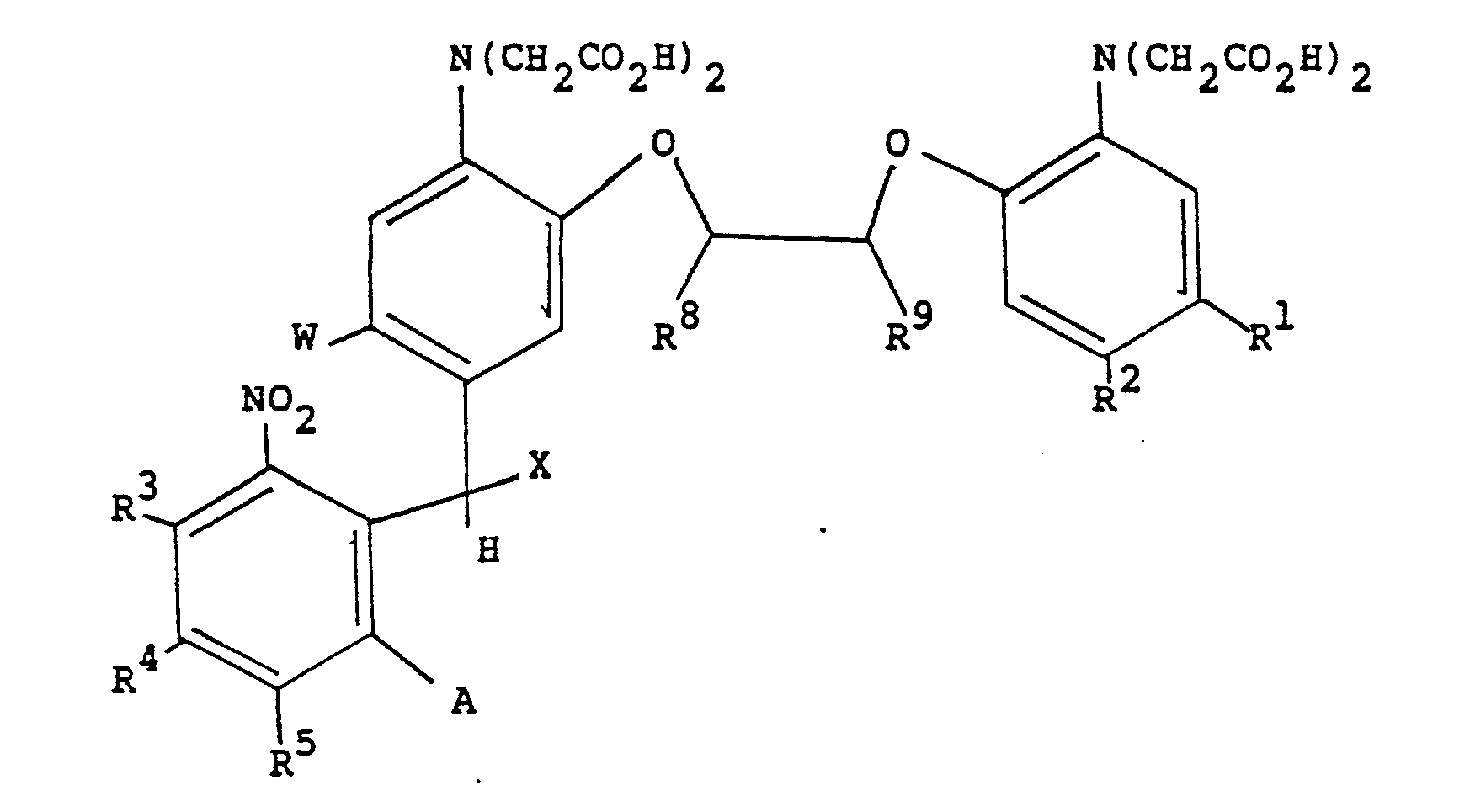
and the pharmaceutically acceptable non-toxic salts and esters thereof wherein: A is -NO₂ or -H; R¹ is selected from the group comprised of -H (unless R² is also H), -CH₃, -F, -Cl, and -Br; R² is selected from the group comprised of -H (unless R¹ is also H), -CH₃, -F, -Cl, -Br, and C₀-C₄ alkoxy; R³, R⁴ and R⁵ are independently -H, OH, NR⁶R⁷, or alkoxy, or R³ and R⁴ together are -OCH₂O- or -OCH₂CH₂O- and R⁵ is -H, OH, NR⁶R⁷, or alkoxy, or R⁴ and R⁵ together are -OCH₂O- or OCH₂CH₂O- and R³ is -H, OH, NR⁶R⁷, or alkoxy; X is selected from the group comprised of -OH, alkoxy, -Cl, -Br, -NR⁶R⁷, -OCOCH₃, -OCOCF₃, -OCOCH₂NH₂, -OPO₃H, and -OSO₂CH₃; R⁶ and R⁷ are independently -H, methyl or ethyl; and R⁸ and R⁹ are independently -H, CH₃, -C₂H₅, or -CH₂OH except that both may not be -H simultaneously; or R⁸ and R⁹ together are -(CH₂)m-Y-(CH₂)n- where m and n are independently 1 or 2 and Y is selected from the group comprised of -CH₂-, -O-, NR⁶-, -S-, and -S-S-; and W is -H, -OH, or -NHR⁶.
and the pharmaceutically acceptable non-toxic salts and esters thereof wherein: A is -NO₂ or -H; R¹ is selected from the group comprised of -H (unless R² is also H), -CH₃, -F, -Cl, and -Br; R² is selected from the group comprised of -H (unless R¹ is also H), -CH₃, -F, -Cl, -Br, and C₀-C₄ alkoxy; R³, R⁴ and R⁵ are independently -H, OH, NR⁶R⁷, or alkoxy, or R³ and R⁴ together are -OCH₂O- or -OCH₂CH₂O- and R⁵ is -H, OH, NR⁶R⁷, or alkoxy, or R⁴ and R⁵ together are -OCH₂O- or OCH₂CH₂O- and R³ is -H, OH, NR⁶R⁷, or alkoxy; X is selected from the group comprised of -OH, alkoxy, -Cl, -Br, -NR⁶R⁷, -OCOCH₃, -OCOCF₃, -OCOCH₂NH₂, -OPO₃H, and -OSO₂CH₃; R⁶ and R⁷ are independently -H, methyl or ethyl; and R⁸ and R⁹ are independently -H, CH₃, -C₂H₅, or -CH₂OH except that both may not be -H simultaneously; or R⁸ and R⁹ together are -(CH₂)m-Y-(CH₂)n- where m and n are independently 1 or 2 and Y is selected from the group comprised of -CH₂-, -O-, NR⁶-, -S-, and -S-S-; and W is -H, -OH, or -NHR⁶.
2. The compound of Claim 1 wherein said tetraacetic acid esters are alpha-acyloxyalkyl
esters.
3. The compound of Claim 2 wherein said alpha-acyloxyalkyl esters are acetoxymethyl
esters.
4. The compound of Claim 1 wherein R² is methyl.
5. A chemical compound having the general formula:
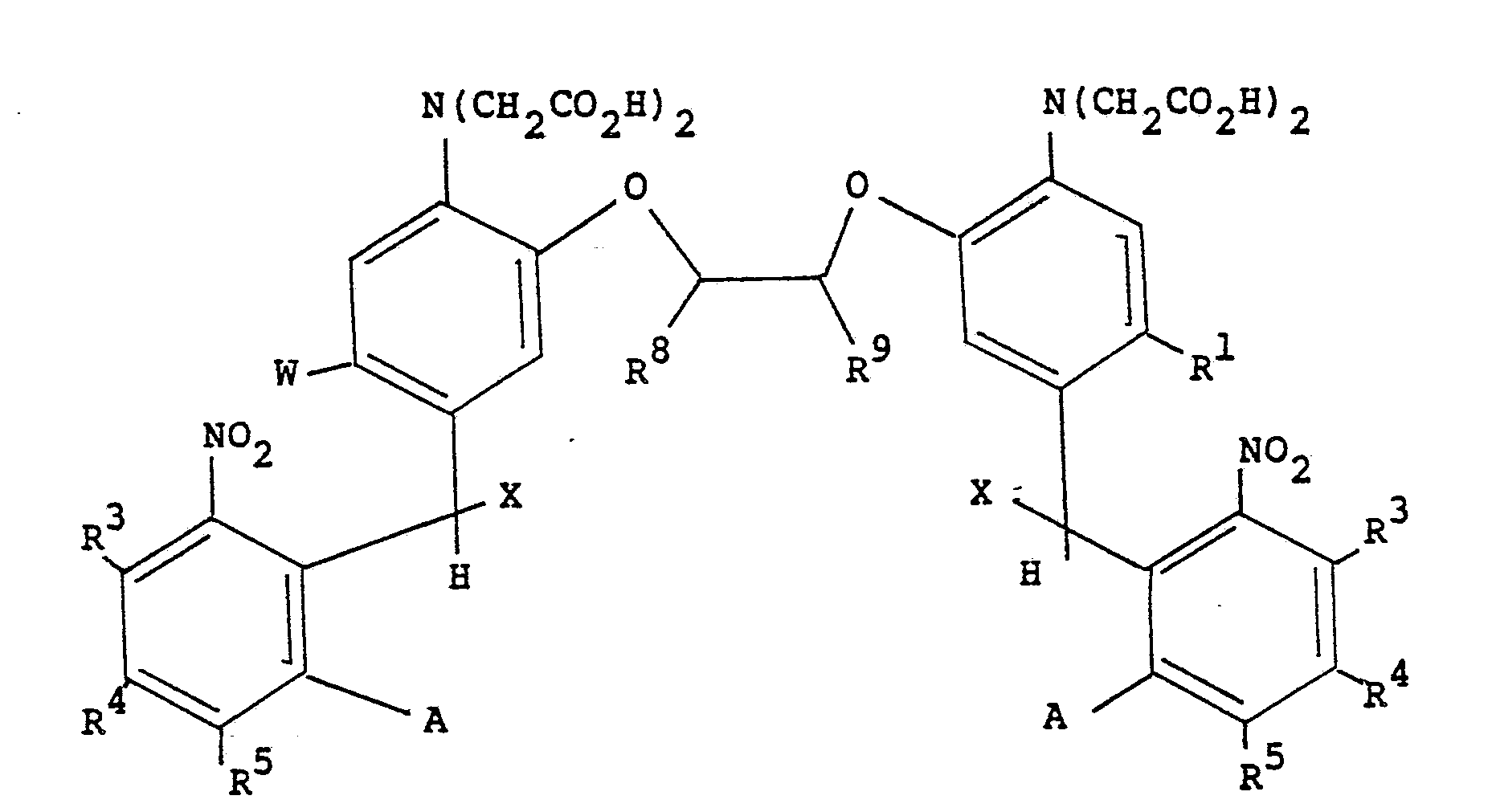
and the pharmaceutically acceptable non-toxic salts and esters thereof wherein: A is -NO₂ or -H; R³, R⁴ and R⁵ are independently -H, OH, NR⁶R⁷, or alkoxy, or R³ and R⁴ together are -OCH₂O- or -OCH₂CH₂O- and R⁵ is -H, OH, NR⁶R⁷, or alkoxy, or R⁴ and R⁵ together are -OCH₂O- or -OCH₂CH₂O- and R³ is -H, OH, NR⁶R⁷, or alkoxy; X is selected from the group comprised of -OH, alkoxy, -Cl, -Br, -NR⁶R⁷, -OCOCH₃, -OCOCF₃, -OCOCH₂NH₂, -OPO₃H, and -OSO₂CH₃; R⁶ and R⁷ are independently -H, methyl or ethyl; and R⁸ and R⁹ are independently -H, CH₃, -C₂H₅, or -CH₂OH except that both may not be -H simultaneously; or R⁸ and R⁹ together are -(CH₂)m-Y-(CH₂)n- where m and n are independently 1 or 2 and Y is selected from the group comprised of -CH₂-, -O-, NR⁶-, -S-, and -S-S-; and W is -H, -OH, or NHR⁶R⁷.
and the pharmaceutically acceptable non-toxic salts and esters thereof wherein: A is -NO₂ or -H; R³, R⁴ and R⁵ are independently -H, OH, NR⁶R⁷, or alkoxy, or R³ and R⁴ together are -OCH₂O- or -OCH₂CH₂O- and R⁵ is -H, OH, NR⁶R⁷, or alkoxy, or R⁴ and R⁵ together are -OCH₂O- or -OCH₂CH₂O- and R³ is -H, OH, NR⁶R⁷, or alkoxy; X is selected from the group comprised of -OH, alkoxy, -Cl, -Br, -NR⁶R⁷, -OCOCH₃, -OCOCF₃, -OCOCH₂NH₂, -OPO₃H, and -OSO₂CH₃; R⁶ and R⁷ are independently -H, methyl or ethyl; and R⁸ and R⁹ are independently -H, CH₃, -C₂H₅, or -CH₂OH except that both may not be -H simultaneously; or R⁸ and R⁹ together are -(CH₂)m-Y-(CH₂)n- where m and n are independently 1 or 2 and Y is selected from the group comprised of -CH₂-, -O-, NR⁶-, -S-, and -S-S-; and W is -H, -OH, or NHR⁶R⁷.
6. The compound of Claim 5 wherein said tetraacetic acid esters are alpha-acyloxyalkyl
esters.
7. The compound of Claim 5 wherein said alpha-acyloxyalkyl esters are acetoxymethyl
esters.
8. The compound cis-1-(2-bis(carboxymethyl) amino-5-(1-hydroxy-1-(2-nitro-5,6-methyl-enedioxyphenyl)methyl)phenoxy)-2-(2-bis(carboxy-methyl)amino-5-methylphenoxy)
cyclopentane.