(57) A light guide has a central path comprising the locus of points which are the centroids
of the segments contained within the light guide of all planes which intersect the
light guide and which are oriented such that the area of each of the plane segments
is a minimum. The light guide also has an average cross-sectional dimension comprising,
for each one of the plane segments aforesaid, the average length of those portions
of all lines within the light guide which lie on the one plane segment and which intersect
the light guide. The length of the light guide is substantially greater than the average
cross-sectional dimension of substantially all of the plane segments. The fractional
rate of change, along the light guide, of substantially all randomly selected cross-sectional
dimensions of the light guide, is substantially less than the reciprocal of the average
cross-sectional dimension of substantially all of the plane segments aforesaid. The
radius of curvature of the central path at substantially all randomly selected points
on the central path is substantially greater than the average cross-sectional dimension
of substantially all of the plane segments aforesaid.
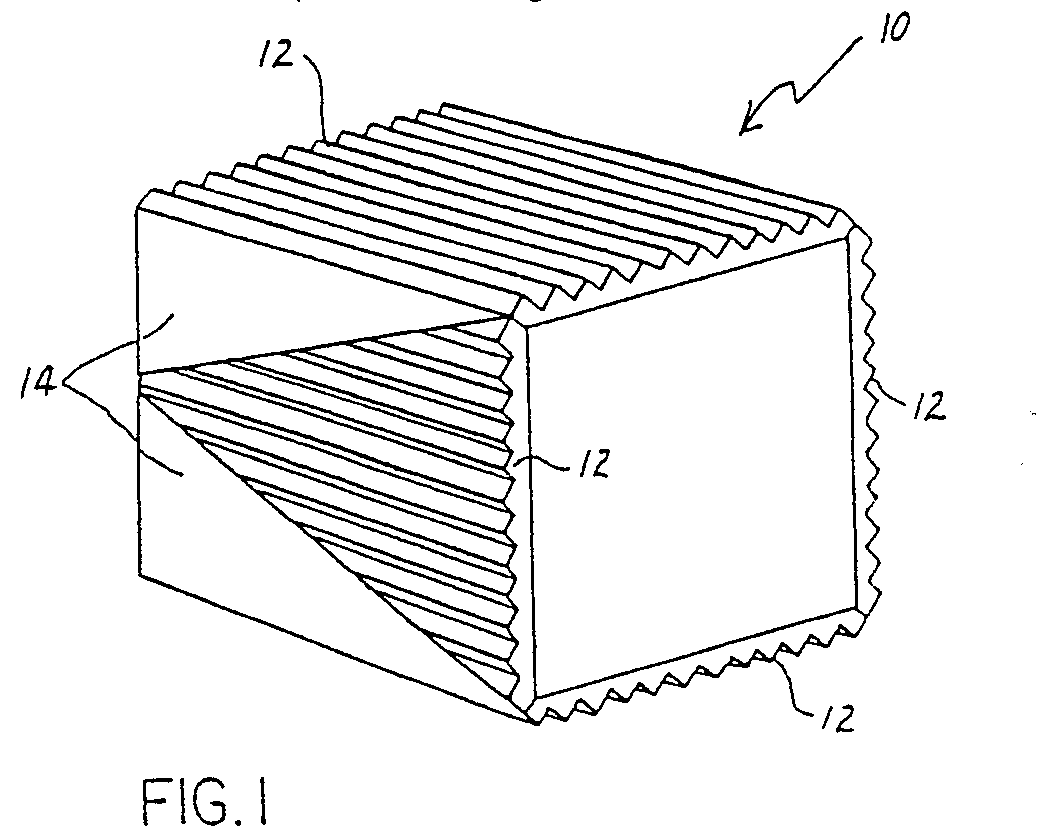
A variety of techniques are used to effect continuously controlled emission of light
from the light guide. For example, the light guide may contain a mechanism which causes
light to escape from the light guide at a rate which varies along the length of the
light guide, such that the amount of light escaping, per unit length, along the light
guide has a selected distribution of values. Alternatively, the light guide's central
path may be non-linear. As a further alternative, the average cross-sectional dimension
of each of the plane segments aforesaid may be non-constant. As yet another alternative,
a first portion of the light guide may comprise prism light guide material and the
remaining portion may be such that a substantial portion of light incident thereupon
is allowed to escape therethrough.
|
|
