|
(11) | EP 0 292 735 A1 |

| (12) | EUROPEAN PATENT APPLICATION |
|
|
|
|
|||||||||||||||||||||||||||
| (54) | Process for preparing alpha-(alkylphenyl)-4-(hydroxydiphenylmethyl)-1-piperidine butanol |
| (57) A process for preparing alpha-(alkylphenyl)-4-(hydroxy diphenylmethyl)-1-piperidine
butanol of formula (I)
in which R is a C₁-C₅ alkyl, consisting of reacting an isonipecotate of formula (II): in which R′ is a C₁-C₅ alkyl or an arylalkyl such as benzyl, with 1-(alkylphenyl)-4-chlorobutanol (III) or with 1-(alkylphenyl)-3-chloropropylketone (VI), in both of which the alkyl group is C₁-C₅, to obtain the compound (IV) either directly or after reduction of the ketone group: and reacting (IV) with phenylmagnesium halide (V) to obtain (I). |
[0001] This invention relates to a new process for preparing alpha-(alkylphenyl)-4-(hydroxy diphenylmethyl)-1-piperidine butanol of formula (I)
in which R is a C₁-C₅ alkyl.
[0002] The process according to the present invention is particularly useful for preparing alpha-(p-tert.butylphenyl)-4-(hydroxy diphenylmethyl)-1-piperidine butanol, known as terfenadine, an important pharmaceutical principle demonstrating antihistaminic activity.
[0003] Processes for preparing terfenadine are known, such as those described for example by J. Castañer in "Drugs of the Future" vol. III, No. 3, 1978. In these processes the starting substance used is azacyclonol or alpha, alpha-diphenyl-4-piperidinemethanol which is a very costly compound.
[0004] We have now discovered a new process by which the compounds of formula (I) are produced by using as starting substance an isonipecotate of formula (II):
in which R′ is a C₁-C₅ alkyl or an arylalkyl such as benzyl.
[0005] This process is much simpler and more economical than known processes and also leads to the formation of purer products.
[0006] The process for preparing (I) according to the present invention is characterised by reacting an isonipecotate (II) with 1-(alkylphenyl)-4-chlorobutanol (III) or with 1-(alkylphenyl)-3-chloropropylketone (VI), in which the alkyl group is C₁-C₅, to obtain the compound (IV) either directly or after reduction of the ketone group:
and reacting (IV) with phenylmagnesium halide (V) to obtain (I).
[0007] These and other characteristics of the process according to the invention will be more apparent from the following detailed description.
[0008] In a preferred form, said process is implemented by the reactions of the following scheme, in which R and R′ have the aforesaid meanings and X is Cl or Br:
[0009] The condensation of (II) with (III) is conducted by boiling under reflux in a reaction medium consisting of an organic solvent in the presence of an inorganic base.
[0010] The preferred solvent is acetonitrile, but dimethylformamide, dimethylacetamide, ethyl acetate, dioxane, tetrahydrofuran, acetone, methylethylketone, toluene or their mixtures can be used.
[0011] The inorganic base used can be either a carbonate or bicarbonate of an alkaline or alkaline-earth metal, such as Na₂CO₃, NaHCO₃, K₂CO₃, CaCO₃ or Li₂CO₃.
[0013] In this manner the compound (IV) is obtained, this being a new product and representing the intermediate for the preparation of the compound (I).
[0014] The reaction between the compound (IV) and the phenylmagnesium halide (V) is conducted in a medium in the form of an organic solvent at a temperature of between 40 and 50°C.
[0015] The organic solvent preferred for this reaction is tetrahydrofuran, but other solvents can also be used such as ethyl ether, isopropyl ether, butyl ether and others.
[0016] The phenylmagnesium halide is preferably phenylmagnesium chloride or phenylmagnesium bromide.
[0018] Alternatively the process according to the invention can be implemented by the reactions of the following scheme in which R and R′ have the aforesaid meanings:
[0019] When operating in accordance with this scheme, by reacting isonipecotate (II) with 1-(alkylphenyl)-3-chloropropylketone (VI), the compound (VII) is obtained, this being a new compound and which on reduction of the ketone group gives the compound (IV).
[0020] The reaction between the compound (II) and the compound (VI) is conducted preferably in dioxane in the presence of Na₂CO₃, however the solvents and bases stated for the first reaction of the preceding scheme can be used.
[0022] The reaction mixture is then treated with NaBH₄ at a temperature of between 10 and 25°C to reduce the compound (VII) to the compound (IV). From this, the compound (I) is obtained by operating in accordance with the second reaction of the preceding scheme.
[0023] The following examples of the preparation of alpha-(p-tert.butylphenyl)-4-(hydroxy diphenylmethyl)-1-piperidine butanol are given by way of non-limiting illustration.
EXAMPLE 1
[0024] The following are fed into a flask fitted with a reflux condenser, stirrer and thermometer:
- 300 g of 1-(p-tert.butylphenyl)-4-chlorobutanol
- 1 g of acetonitrile
- 160 g of ethyl isonipecotate
- 200 g of potassium carbonate
and the mixture heated under reflux for 24 hours.
[0025] The reaction mixture is then poured into a mixture of 5 litres of water with 1 litre of methylene chloride.
[0026] The mixture is stirred and the methylene chloride containing the product is separated and evaporated to dryness under vacuum.
[0027] The residue is treated with 500 ml of tetrahydrofuran and heated to 40-50°C until completely dissolved.
[0028] To this solution at 40°C there are slowly added 1420 g of a 25% solution of phenylmagnesium chloride in tetrahydrofuran, and on completion of the addition the mixture is heated to 50°C for 5 hours.
[0029] The reaction mixture is then cooled to 20°C and poured into 1 litre of water, the mixture acidified with hydrochloric acid to acid pH and alkalified with a dilute caustic soda solution to basic pH in the presence of methylene chloride.
[0030] The organic phase is separated, dried with anhydrous sodium sulphate, filtered and then concentrated to dryness.
[0031] The residue is crystallised from acetone to obtain 350 g of the required product having the following characteristics:
Titre 99.95%
M.P. 150-152°C
Elementary analysis: for C₃₂H₄₁NO₂; M.W. = 471.69:
calculated:
C 81.48%; H 8.76%; N 2.97%; O 6.78%
found:
C 81.42%; H 8.71%; N 2.94%; O 6.78%.
EXAMPLE 2
[0032] The following are fed into a flask fitted with a reflux condenser, stirrer and thermometer:
- 150 g of 1-(p-tert.butylphenyl)-3-chloropropylketone
- 750 ml of dioxane
- 80 g of ethyl isonipecotate
- 80 g of sodium carbonate
and the mixture heated under reflux for 24 hours.
[0033] It is cooled to 10°C and a separately prepared solution of 20 g of sodium borohydride in 100 ml of water and 2 ml of 30% caustic soda is dripped in.
[0034] The reaction mixture is stirred for 2 hours at ambient temperature and then poured into 2.5 litres of water and 0.5 litres of methylene chloride.
1. A process for preparing alpha-(alkylphenyl)-4-(hydroxy diphenylmethyl)-1-piperidine
butanol of formula (I)
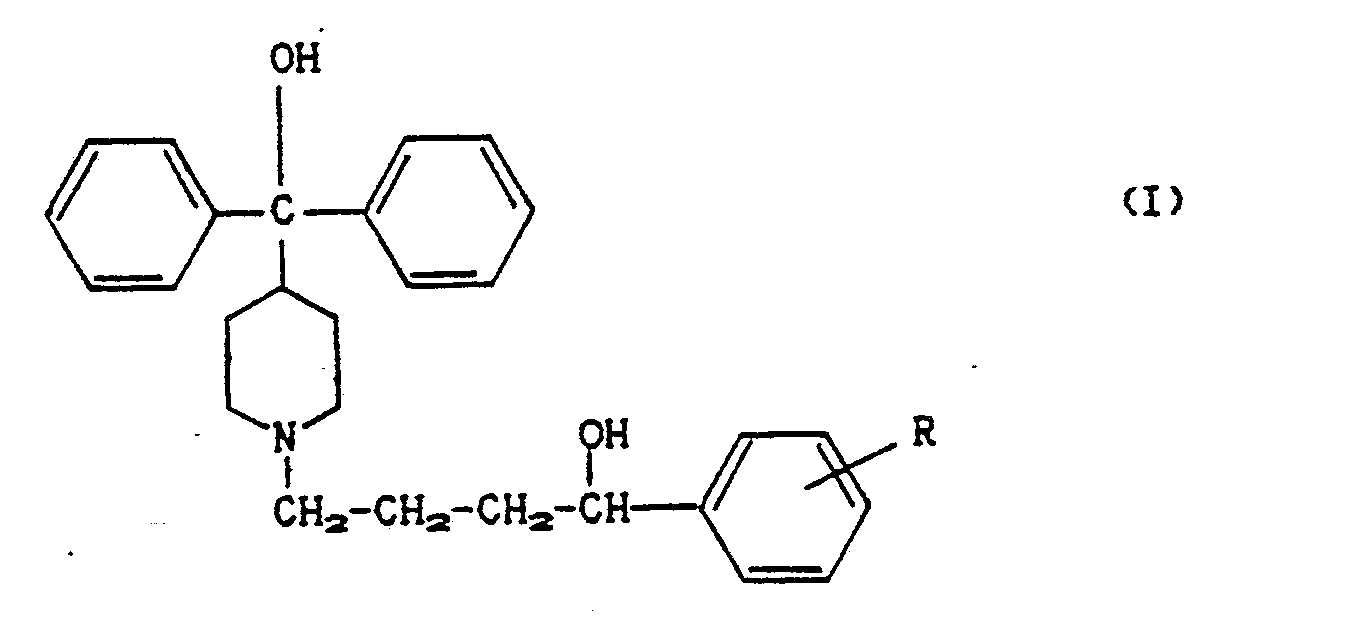
in which R is a C₁-C₅ alkyl, characterised by reacting an isonipecotate of formula (II):
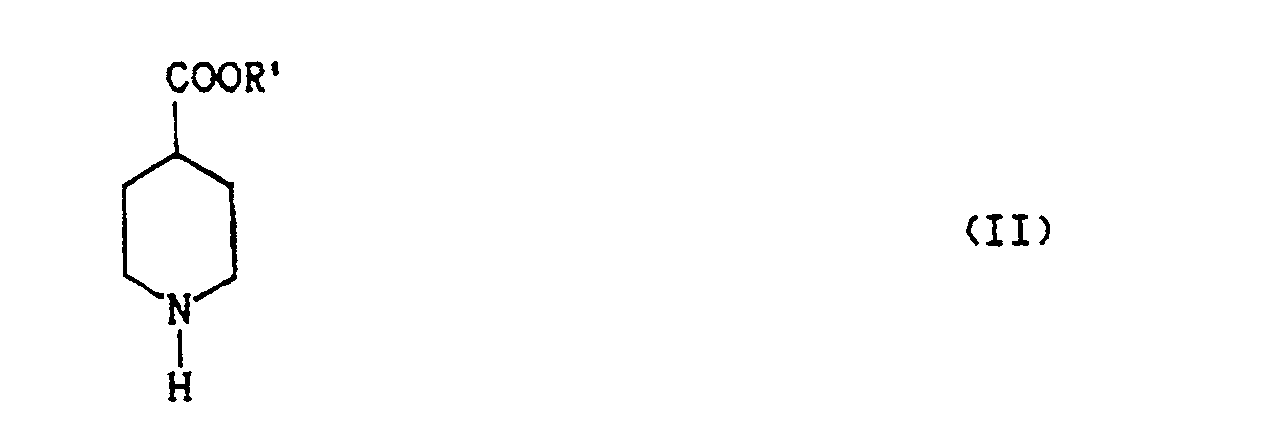
in which R′ is a C₁-C₅ alkyl or an arylalkyl such as benzyl, with 1-(alkylphenyl)-4-chlorobutanol (III) or with 1-(alkylphenyl)-3-chloropropylketone (VI), in both of which the alkyl group is C₁-C₅, to obtain the compound (IV) either directly or after reduction of the ketone group:
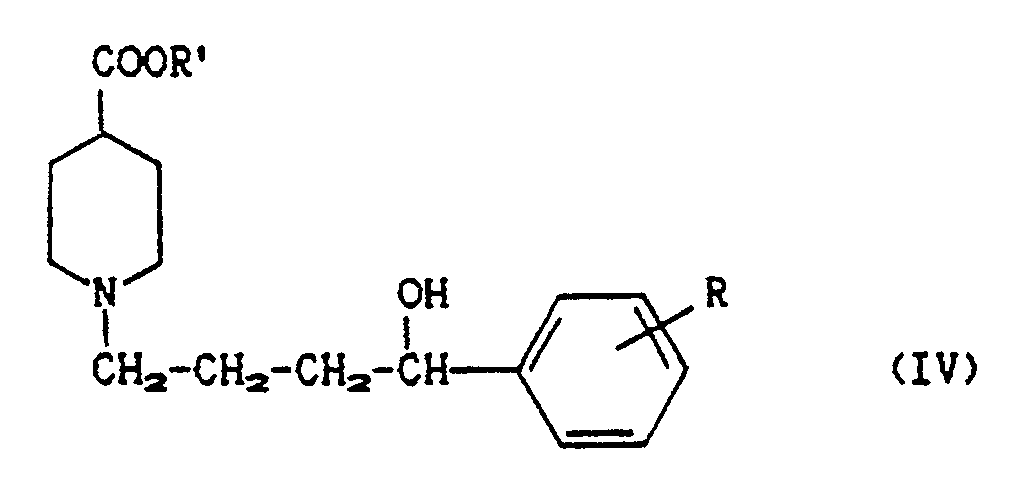
and reacting (IV) with phenylmagnesium halide (V) to obtain (I).
in which R is a C₁-C₅ alkyl, characterised by reacting an isonipecotate of formula (II):
in which R′ is a C₁-C₅ alkyl or an arylalkyl such as benzyl, with 1-(alkylphenyl)-4-chlorobutanol (III) or with 1-(alkylphenyl)-3-chloropropylketone (VI), in both of which the alkyl group is C₁-C₅, to obtain the compound (IV) either directly or after reduction of the ketone group:
and reacting (IV) with phenylmagnesium halide (V) to obtain (I).
2. A process as claimed in claim 1, characterised in that said reaction between the
compound (II) and the compound (II) or (VI) is conducted in a reaction medium consisting
of an organic solvent such as acetonitrile, dioxane, dimethylformamide, dimethylacetamide,
ethyl acetate, tetrahydrofuran, acetone, methylethylketone, toluene or their mixtures.
3. A process as claimed in claim 1, characterised in that said reaction between the
compound (II) and the compound (III) or (VI) is conducted in the presence of an inorganic
base such as a carbonate or bicarbonate of an alkaline or alkaline-earth metal.
4. A process as claimed in claim 1, characterised in that said reaction between the
compound (II) and the compound (III) or (VI) is conducted at boiling point under reflux.
5. A process as claimed in claim 1, characterised in that said reaction between the
compound (II) and the compound (III) or (VI) is conducted with a stoichiometric molar
ratio.
6. A process as claimed in claim 1, characterised in that said phenylmagnesium halide
is phenylmagnesium chloride or phenylmagnesium bromide.
7. A process as claimed in claim 1, characterised in that said reaction between the
compound (IV) and the compound (V) is conducted in a medium consisting of an organic
solvent such as tetrahydrofuran, ethyl ether, isopropyl ether or butyl ether.
8. A process as claimed in claim 1, characterised in that said reaction between the
compound (IV) and the compound (V) is conducted at a temperature of between 40 and
50°C.
9. A process as claimed in claim 1, characterised in that said reaction between the
compound (IV) and the compound (V) is conducted with a stoichiometric molar ratio.
10. Compounds of formula:
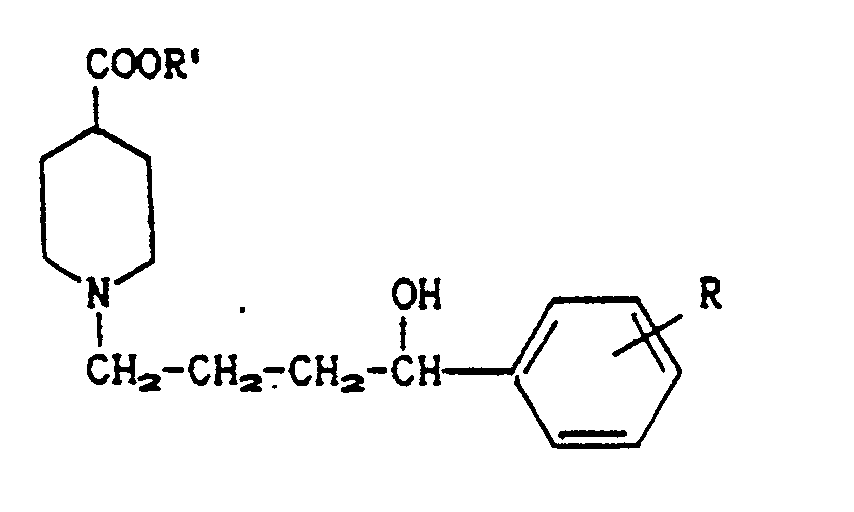
in which R′ is a C₁-C₅ alkyl and preferably a tert.butyl, and R is a C₁-C₅ alkyl or an arylalkyl such as benzyl.
in which R′ is a C₁-C₅ alkyl and preferably a tert.butyl, and R is a C₁-C₅ alkyl or an arylalkyl such as benzyl.
11. Compounds of formula:
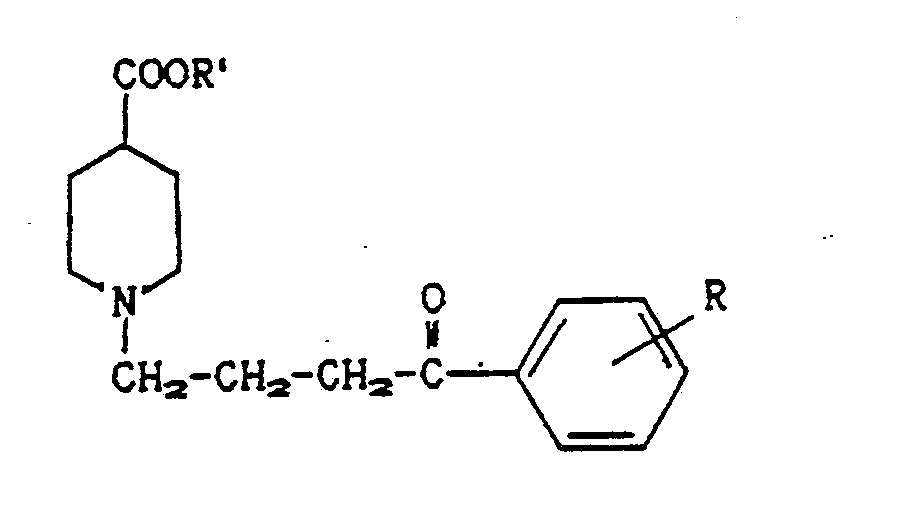
in which R′ is a C₁-C₅ alkyl and preferably a tert.butyl, and R is a C₁-C₅ alkyl or an arylalkyl such as benzyl.
in which R′ is a C₁-C₅ alkyl and preferably a tert.butyl, and R is a C₁-C₅ alkyl or an arylalkyl such as benzyl.