|
(11) | EP 0 293 768 A1 |

| (12) | EUROPEAN PATENT APPLICATION |
|
|
|
|
|||||||||||||||||||||||||||
| (54) | Process for making propargyl ethers of hydroxyaromatic compounds |
| (57) A process of preparing an aromatic propargyl ether, preferably bispropargyl ether,
from hydroxyaromatic compounds comprising vigorously stirring a propargyl halide,
preferably propargyl chloride, with a hydroxyaromatic compound, such as bisphenol
A, in an aqueous sodium hydroxide solution at a temperature of from 0°C to 100°C,
in the presence of a phase transfer catalyst such as tetrabutylammonium bromide. The
mixture is then filtered to recover a solid product. That product is washed with water
and propanol. This process provides a product having greater than 95 percent purity
in yields ranging from 85 to 97 percent of theoretical. |
[0001] The invention is related to the synthesis of aromatic propargyl ethers. More particularly, the present invention provides a process for preparing propargyl ethers derived from hydroxyaromatic compounds.
[0002] Propargyl ethers are a class of acetylene-terminated monomers which show great promise for use in the preparation of thermoset resins with excellent properties.
[0003] U.S. Patent No. 3,594,175 to Allan S. Hay discloses producing dipropargyl ethers by reacting dihydric phenol with a propargyl halide in the presence of a base, e.g., alkali metal and alkaline earth metal hydroxides, carbonates, bicarbonates, etc. Because an alkali metal hydroxide reacts with the phenol to produce a salt of the phenol, the preformed alkali metal salt of the dihydric phenol can also be used. The propargyl ether product is purified by recrystallization.
[0004] U.S. Patent No. 4,226,800 to Picklesimer discloses a process wherein a phenolic material is reacted with propargyl bromide in aqueous sodium hydroxide solution. The process suffers from the disadvantage of providing both O-propargylated (desired) and C-propargylated (undesired) materials. For example, bisphenol A is claimed to provide 45.4 percent yield of the desired bispropargyl ether and 43.6 percent yield of the undesired C-propargylated bisphenol. Additionally, the process employs rather vigorous conditions, such as reflux conditions of 100°C for 1 to 3 hours. A further drawback of the process is that propargyl bromide is used rather than propargyl chloride. Propargyl bromide is relatively expensive, inaccessible on a commercial scale, and shock sensitive according to Fire Technology, 5, 100 (1969).
[0005] It is desirable to prepare propargyl ethers from hydroxyaromatic compounds by means of a suitable process utilizing less expensive and safe reagents under mild conditions.
[0006] It is desirable to prepare propargyl ethers from hydroxyaromatic materials in dilute aqueous caustic solution at ambient temperatures.
[0007] It is further desirable to prepare propargyl ethers from hydroxyaromatic compounds combined with propargyl chloride.
[0008] It is further desirable to prepare propargyl ethers directly in excellent purity and high yields to avoid recovering the propargyl ethers by recrystallization.
[0010] The present invention concerns a process for preparing a propargyl ether of a hydroxyaromatic compound which process comprises contacting a hydroxy aromatic compound with a propargyl halide in an aqueous solution of an alkaline agent in the presence of a phase transfer catalyst under reaction conditions sufficient to produce the propargyl ether of the hydroxyaromatic compound.
[0011] If desired, the propargyl ether of hydroxyaromatic compound when formed as a solid can be filtered out of the reaction solution and the solid product can then be washed with water and an alcohol such as methanol, ethanol isopropanol and the like to recover 95 to 100 percent of a theoretical yield of the propargyl ether compound having a purity greater than 95 percent is obtained.
[0012] Alternatively, the produce when formed as a liquid, can be extracted into an organic solvent such as methylene chloride, ethyl acetate, ethyl ether and the like and recovered after removal of the solvent.
[0013] The present invention differs from processes of the aforementioned prior art in that small amounts of a phase transfer catalyst is used which enables the reaction to be carried out in dilute aqueous, caustic solution at ambient temperatures within a few hours. Surprisingly, the present invention can use propargyl chloride rather than the bromide. This will lead to less hazardous situations during scale-up. An even more surprising finding is that the process provides the propargyl ethers directly in excellent purity (greater than 95 percent) and in high yields of at least 80 percent, preferably 86 to 97 percent, without significant contamination of the carbon-alkylated materials, as reported in U.S. Patent No. 4,226,800. This finding is indeed remarkable because there are reports of C-alkylated materials formed as by-products during the phase transfer-catalyzed alkylation of phenols with the related allyl and benzyl halides according to E. D'Ican et P. Viout, Tetrahedron, 31, 159 (1975).
[0014] Hydroxyaromatic compounds employed in the present invention are aromatic compounds having one or more hydroxyl groups per molecule. The hydroxyaromatic compounds may bear groups or substituents which do not interfere with the reaction of the present invention. These hydroxyaromatic compounds can be monocyclic or polycyclic aromatic compounds. Polycyclic aromatic compounds can have two or more aromatic ring nuclei which are (a) connected to each other by a direct bond, (b) connected to each other by a suitable bridging group, or (c) fused to each other. These hydroxyaromatic compounds are generally represented by the following formulae:
wherein A is a direct bond, -O-, -S-, -SO-, SO₂-, -CO-, a divalent hydrocarbon radical, a divalent halogen substituted hydrocarbon radical, or a divalent cycloaliphatic radical; B is independently in each occurrence a divalent hydrocarbon radical, X is independently in each occurrence hydrogen, an alkyl radical, an alkoxy radical, an aryl radical, an aryloxy radical; R is independently in each occurrence hydrogen, an alkyl radical, an alkoxy radical, hydroxy, or halogen; n is 0, 1 or 2; and m is an integer of from 1 to 100, preferably an integer of from 1 to 10, most preferably 5 to 10.
[0015] The divalent hydrocarbon radicals contemplated by A and B in the foregoing formulae contain from 1 to 12 carbon atoms and can be branches or unbranched radicals. These radicals can also be substituted with one or more aromatic hydrocarbon radicals having from 6 to 12 carbon atoms, such as phenyl, biphenyl, bisphenyl, naphthyl and the like. Preferably, the divalent hydrocarbon radical contains from 1 to 8 carbon atoms most preferably from 1 to 4 carbon atoms. Examples of preferred divalent hydrocarbon radicals are methylene, 1,2-ethylene, 1,1-ethylene, 1,3-propylene, 1,2-propylene, 2,2-propylene, 1,4-butylene, diphenylmethylene, phenylmethylene etc.
[0016] The divalent halogen substituted hydrocarbon radicals contemplated by A in the foregoing formulae are bromo-, chloro-, fluoro- and iodo-substituted hydrocarbon radicals having from 1 to 12, preferably 1 to 8, most preferably 1 to 4 carbon atoms. Preferred halogen-substituted hydroxycarbon radicals are fluoroalkylene radicals having from 1 to 4 carbon atoms. The most preferred is 2,2-perfluoropropylene (-C(CF₃)₂-).
[0017] The divalent cycloaliphatic radicals contemplated by A in the foregoing formulae contain from 8 to 20 carbon atoms, preferably 8 to 12 carbon atoms, most preferably 8 to 10 carbon atoms. Dicyclopentadienyl radical is particularly preferred divalent cycloaliphatic radical. This radical is represented by the following formula
[0018] The alkyl radicals contemplated by X and R in the foregoing formulae are straight and branched chain radicals having from 1 to 12 carbon atoms. Preferably the alkyl radicals contain from 1 to 8 carbon atoms, most preferably 1 to 4 carbon atoms. Examples of these alkyl radicals are methyl, ethyl, propyl, butyl, pentyl, heptyl, octyl, monyl, decyl undecyl, dodecyl and the branched chain isomers thereof.
[0019] The alkoxy radicals contemplated by X and R in the foregoing formula are straight and branched chain radicals having from 1 to 12 carbon atoms, preferably 1 to 8 carbon atoms, most preferably 1 to 4 carbon atoms. Examples of these radicals are methoxy, ethoxy, propoxy, butyloxy, pentyloxy, hexyloxy, heptyloxy, octyloxy, nonyloxy, decyloxy, undecyloxy, dodecyloxy and the branched chain isomers thereof.
[0020] Halogens contemplated by X and R in the foregoing formula re bromine, chlorine, fluorine and iodine. Chlorine and bromine are preferred halogens.
[0021] The aryl radicals contemplated by X in the foregoing formulae contains from 6 to 14 carbon atoms, preferably from 6 to 10 carbon atoms. Examples of the aryl radicals are phenyl, naphthyl and anthracyl. Phenyl is the most preferred aryl radical.
[0022] The aryloxy radicals contemplated by X in the foregoing formulae contain from 6 to 14 carbon atoms preferably from 6 to 10 carbon atoms. Examples of the aryloxy radicals are phenoxy, naphthyloxy and anthracyloxy. The most preferred aryloxy radical is phenoxy radical.
[0023] The preferred hydroxyaromatic compounds of formula I are those in which n is 0. The most preferred are those in which n is 0, four X substituents are hydrogens and one X is 4-phenoxy, 3-methyl or 4-methyl.
[0024] The preferred hydroxyaromatic compounds of formula II are those in which the two hydroxyl groups are in the 4 and 4′ positions. These compounds are commonly referred to as bisphenols. Particularly suitable bisphenols include for example, bisphenol A, hexafluorobisphenol A, bisphenol F, bisphenol S, bisphenyl K, bisphenol, tetrabromobisphenol A, tetrabromobisphenol F, tetrabromobisphenol K, and tetrabromobisphenol, wherein the bromine atoms are in meta position to the hydroxyl and the like group.
[0025] The preferred hydroxyaromatic compounds of formula III are phenol novolac and resorcinol novolac resins having, respectively the repeating units represented by the following formulae
wherein m is defined as hereinbefore.
[0026] Propargyl halides suitable employed in the practice of this invention are represented by formula III as follows:
HC≡C-CH₂-Hal (VII)
wherein Hal is chlorine, bromine or iodine. Preferred propargyl halides are propargyl chloride and propargyl bromide. The most preferred propargyl halide is propargyl chloride. For every one hydroxyl equivalent of the hydroxyaromatic compound, the present invention employs 1 to 1.5 mole equivalents of the propargyl halide, preferably 1 to 1.15 mole equivalents of the propargyl halide.
[0027] An alkaline agent is used in the practice of the present invention. For example, the alkaline agent may be an alkaline metal hydroxide or an alkaline earth metal hydroxide. Preferred alkaline agents are potassium hydroxide, sodium hydroxide, lithium hydroxide or mixtures thereof. Sodium hydroxide is the most preferred alkaline agent. For every 1 mole equivalent of the hydroxyaromatic compound 1 to 10 mole equivalents of caustic solution are used, preferably 2 to 4 mole equivalents of caustic solution.
[0028] Water is typically used in the process of the present invention for the purpose of solubilizing transient phenate salts and co-produced alkali or alkaline earth metal salts. Water facilitates resolution of the bisphenol ether products from water soluble catalysts, co-produced salts, and residual alkaline agent, if any. Generally, from 1 to 20 moles of water will be used per mole of hydroxyaromatic reactant. Using more than this amount of water is disadvantageous because of the reduced rate of the overall reaction. The use of excess water requires more energy to maintain a given elevated reaction temperature. Using less water than the previously indicated minimum is disadvantageous because it may result in inadequate mixing and dissolution of the reactants as well as inadequate separation of the propargyl ether product.
[0029] A phase transfer catalyst is used in the process of present invention. It is critical to the process. It is used for the purpose of providing unexpected yields of propargyl ether product at higher conversion of the hydroxy aromatic reactants to the desired product. The purity of the product resulting from selectivity of the catalyst are unexpected. In many cases, the catalyst speeds the rate of reaction and improves and speeds the dissolution of transient phenate salts. Suitable phase-transfer catalysts include (a) quaternary ammonium, phosphonium or arsonium salts, (b) poly(ethylene glycols), (c) poly(ethylene glycol alkylethers), (d) macrocyclic polyethers commonly known as crown ethers, and (e) cryptates.
[0030] Quaternary ammonium, phosphonium and arsonium salt are represented by formula VII
wherein Z is a tetravalent ammonium or phosphonium or arsonium ion, Y is any suitable counter ion, and each R₁, R₂, R₃ and R₄ is independently an alkyl, arylalkyl, aromatic or alkylaromatic moiety containing from 1 to 50 carbon atoms, preferably 1 to 12 carbon atoms, most preferably 1 to 6 carbon atoms. Examples of these moieties are methyl, ethyl, propyl, butyl, pentyl, hexyl, heptyl, octyl, nonyl, decyl, undecyl, dodecyl phenyl, naphthyl, toyl, xylyl, benzyl and the like.
[0032] Tetravalent ammonium ions are the preferred Z cations in formula VIII. Typical Y counter ions include chloride, bromide, fluoride, iodide and hydroxyl ions. Iodide and bromide are the preferred counter ions. Quaternary ammonium halides are the preferred catalysts. Tetraalkylammonium halides where the sum of the number of carbon atoms in the alkyl groups R₁, R₂, R₃ and R₄ is 16 or less, and benzyl trialkylammonium halides, such as benzyl trimethyl ammonium halides, are the most preferred catalysts. Any effective amount of catalyst may be used. It must be sufficient to catalyze the reaction. Typically, 0.001 to 0.1 mole equivalent of phase transfer catalyst is used per mole equivalent of hydroxyaromatic reactant. From 0.005 to 0.05 mole equivalents of phase transfer catalyst is preferred. Most preferably 0.02 to 0.05 mole equivalents is used.
[0033] Catalytic quaternary ammonium, phosphonium or arsonium salts may be bound in a polymeric support in the form of ion-exchange resins. Typical ion-exchange resins are those which bear quaternary ammonium salts on macroporous styrene-divinyl benzene resins. Examples of these bound quaternary salts include DOWEX MSA-1 and the like. DOWEX is a registered trademark of The Dow Chemical Company. The ion-exchange resin form of catalyst is advantageous in that it is easily recovered, or, if used in a fixed bed, obviates the need for a catalyst recovery step. It should be noted that a catalyst bound in a polymeric support does not go into solution when used according to the method of the present invention. When solid particles of bound catalyst are used, it is preferred that they be dispersed uniformly in the reaction mixture or form a fixed bed.
[0034] The poly(ethylene glycol) that may be used as a phase transfer catalyst in the present invention has the formula H(OCH₂CH₂)n OH and a molecular weight ranging from 200 to 50,000.
[0035] The poly(ethylene glycol alkyl ether) that may be used as a phase transfer catalyst in the present invention has the formula:
R(OCH₂CH₂)nOH
wherein R is an alkyl group having 1 to 50 carbon atoms and the ether has a molecular weight ranging from 200 to 50,000.
[0036] The crown ether that may be used as a catalyst in the present invention is a macrocyclic polyether whose structure exhibits a conformation with a so-called hole capable of trapping cations by coordination with a lone pair of electrons on the oxygen atoms. An example of a crown ether is 15-crown-5 as follows:
Other examples are shown in the text Phase Transfer Catalysts, C. M. Starks, C. Liotta, page 78, Academic Press (1978). Suitable crown ether catalysts include 18-crown-6, dicyclohexane-18-crown-6, dibenzyl-18-crown-6, 15-crown-5 and the like.
[0037] Cryptates that the present invention may be use are macrobicyclic ethers having the following general formula:
When m = 0 and n = 1, this is a 2.1.1 cryptate. When m = 1 and n = 0, this is 2.2.1 cryptate. When m = n = 1 this is a 2.2.2 cryptate. Phase transfer catalysts are further discussed by Phase Transfer Catalysts, C. M. Starks, C. Liotta, Academic Press (1978).
[0038] Reactants may be combined in any order. However, it is preferred to add the hydroxy aromatic reactant to a mixture of water, alkaline agent and catalyst, and to add the propargyl halide as the last component. It is equally preferred to add the hydroxy aromatic reactant and the catalyst first, followed by the alkaline agent and water, then followed by the propargyl halide.
[0039] The reaction is typically conducted at a temperature of from 0°C to 100°C at atmospheric pressure, preferably from 20° to 50°C. At temperatures below °C the reaction proceeds more slowly. Temperatures greater than 100°C may be used but may lead to catalyst instability, which is undesirable. If a temperature greater than 100°C is used, pressures higher than atmospheric pressure should then be used to reduce the loss of water and propargyl halide.
[0040] The reaction time is a function of temperature, type and concentration of catalyst and the concentration of the hydroxy aromatic reactant. The reaction to form the propargyl ether typically takes between 2 and 30 hours, more typically between 2 and 24 hours, most typically between 2 and 12 hours.
[0041] When the reactants, alkaline agent, catalyst and water are properly combined under reaction conditions as herein specified, a product mixture will be formed. At least one component of the product mixture will contain a propargyl group and will correspond structurally to the particular hydroxy aromatic reactant used as a staring material.
[0042] The present invention has the advantages in that small amounts of phase transfer catalyst enable the reaction to be carried out in dilute aqueous caustic solution at ambient temperatures within a short period of time. Surprisingly, propargyl chloride can be used, rather than the bromide (although the latter works equally well). This leads to less hazardous situations during scale-up. An even more surprising finding is that the process provides the propargyl ethers directly in excellent purity (greater than 95) percent) and in high yields of at least 80 percent, preferably 85 to 97 percent of theoretical yield without significant contamination of the carbonalkylated materials, as reported in U.S. Patent No. 4,226,800. This finding is indeed remarkable because there are reports of C-alkylated materials formed as by-products during the phase transfer-catalyzed alkylation of phenols with the related allyl and benzyl halides (e.g., E. D'Incan et P. Viout, Tetrahedron, 31, 159 (1975)). Also, U.S. Patent No. 4,613,703 to Hefner, Jr., discloses producing an isomeric mixture of C- and O-alkylated aromatic compounds by contacting an allyl halide, a hydroxy aromatic reactant, an alkaline agent, and water in the presence of a phase transfer catalyst.
[0043] The products prepared by the process of the present invention can be converted to polymers by thermal polymerization of the acetylene groups. The polymers obtained are useful as adhesives and matrix resins in the fabrication of composites. Because volatile by-products are not evolved during the polymerization, the composites are free of undesirable voids.
[0044] A more complete understanding of the invention can be obtained by referring to the following illustrative examples.
Comparative Example A
[0045] This example illustrates the general procedure used in Example 1 of U.S. Patent No. 3,594,175 for the preparation of the dipropargyl ethers of dihydric phenols. A solution of 1 mole of 4,4′-isopropylidenediphenol (bisphenol A) (288 grams) in two liters of acetone was reacted with 2.4 moles of propargyl bromide (284 grams) in the presence of 2.4 moles of potassium carbonate (332 grams), by heating under reflux for 12 to 48 hours. After filtering the reaction mixture, the filtrate was evaporated to dryness on a steam bath. The residue was dissolved in diethyl ether and extracted with 5 percent potassium hydroxide and then washed with water. After removal of the diethyl ether, the residue was recrystallized from methanol. This recovered a 75 percent yield of bisphenol a bispropargyl ether represented by the following formula:
Comparative Example B
[0046] This example illustrates the general procedure used in U.S. Patent No. 4,226,800 in which a run was conducted using bisphenol A as the phenolic material. See Example VII. The amounts of the materials used were as follows:
Table 1
[0047] Bisphenol A 228 grams, 1.0 mole
Propargyl bromide 238 grams, 2.0 moles
Sodium hydroxide 80 grams, 2.0 moles
[0048] The bisphenol A and sodium hydroxide were dissolved in 1 liter of water in a reaction flask. The propargyl bromide was added in one addition as an 80 percent solution in toluene. The mixture was heated rapidly to reflux temperature and refluxed for 2.5 hours. The aqueous phase was neutral at this point indicating completion of the reaction. The product was separated as a dark resinous liquid by means of a separatory funnel. Toluene was permitted to evaporate. The product was extracted with 500 milliliters of 2-propanol. The 2-propanol insoluble material was dried and weighed 138.0 grams (45.4 percent yield). U.S. Patent No. 4,226,800 teaches that the product is bispropargyl ether of bisphenol A as indicated by a melting point of 84° to 85°C and infrared spectra. The 2-propanol-soluble component was recovered in 43.6 percent yield, and the infrared spectra confirmed the presence of propargyl groups as well as hydroxyl groups. The two recovered product are represented by the following formulae
[0049] Thus, the process of U.S. Patent No. 4,266,800 suffers from the disadvantage of providing both O-alkylated (desired) and C-alkylated (undesired) materials. For example, bisphenol A is claimed to provide 45.4 percent yield of the desired bispropargyl ether and the balance is the unwanted C-propargylated bisphenol. Additionally, the process employs rather vigorous conditions such as reflux temperatures of 100°C for two and one-half hours. A further drawback of the process is that propargyl bromide is employed rather than propargyl chloride.
Example 1
[0050] The following illustrates the general method of the present invention. 45.6 Grams of bisphenol A (0.2 moles), 200 milliliters of 20 percent aqueous sodium hydroxide, and 3.22 grams of tetrabutylammonium bromide (0.01 moles) were combined at 20°C. To this mixture at 20°C, 34.27 grams of propargyl chloride (0.46 moles) was added over a 10 minute period, and the mixture was stirred overnight at room temperature for 16 hours. This produced white crystals that were filtered, washed two times with 200 milliliters of water and two times with 50 milliliters of isopropanol. This produced the desired bispropargyl ether. The bispropargyl ether weighed, after drying, 57.9 grams, for a yield of 95.2 weight percent. Also it had a melting point of 83°C and a purity, measured by gas chromatograph, of 99.7 percent.
Example 2
[0053] Example 1 was repeated. However the reactants were stirred at 50°C for a period of 4 hours and 2 to 5 mole percent of tetrabutyl ammonium bromide was used as the phase transfer catalyst. This produced an 85 to 97 percent yield of bisphenol A bispropargyl ether having greater than 98 percent purity. Accordingly, no recrystallization was necessary to recover the bispropargyl ether.
Example 3
[0054] Example 1 was repeated except bisphenol A was replaced by bisphenol S (4,4′-dihydroxydiphenyl sulfone). The bispropargyl ether of bisphenol S was recovered as light tan crystals, mp 184 to 186°C, yield 96.2 percent. The product was further characterized by proton magnetic resonance spectroscopy (pmr). solvent (DMSO -d₆) δ7.92 (d, 4H,J = 8.3 Hz), 7.16 (d, 4H, J = 8.3 Hz), 4.86 (d, 4H, J= 2.2 Hz) and 3.58 (t, 2H, J = 2.2 Hz).
Example 4
[0056] Example 1 was repeated except bisphenol A was replaced by bisphenol K (4,4′-dihydroxy benzophenone). The bispropargyl ether of bisphenol K was obtained as off-white crystals, mp 79-81°C, yield 95.6 percent. Pmr data: CDCl₃ solvent, δ7.84 (d, 4H, J = 8.4 Hz), 7.20 (d, 4H, J = 8.4 Hz), 4.76 (d, 4H J = 2.2 Hz) and 2.58 (t, 2H, J = 2.2 Hz). The bispropargyl ether of bisphenol K is represented by the following formula
Example 5
[0057] Example 1 was repeated except bisphenol A was replaced by bisphenol F. The bispropargyl ether of bisphenol F was extracted with ethyl acetate and recovered as viscous brown oil with an isolated yield of 98.7 percent and Gc purity of 98.2 percent. Pmr data: CDCl₃ solvent δ7.20 (d, 4H, J = 9 Hz), 6.95 (d, 4H J= 9 Hz), 4.66 (d, 4H, J - 2.2 Hz), 3.88 (S, 2H, Ch₂), and 2.54 (t, 2H, J = 2.2 Hz). The bispropargyl ether of bisphenol F is represented by the following formula
Example 6
[0058] Example 1 was repeated except bisphenol A was replaced by 4,,4′-thiodiphenol. The bispropargyl ether was obtained as brown oil and recovered by extraction with ethyl acetate. The product has an isolated yield of 96 percent and a purity of 98 percent as shown by Gc. Pmr data: CDCl₃ solvent, δ7.28 (d, 4H, J = 8.2 Hz), 6.,6.88 = 2.2 Hz). The recovered bispropargyl ether of thiodiphenol is represented by the following formula
Example 7
[0059] 97.5 Grams of hexafluorobisphenol A (0.29 ml), 350 ml of 20 percent aqueous sodium hydroxide and 4.8 grams of tetrabutylammonium bromide (0.015 mol) were combined at 20°C. To this mixture was added 59.6 grams of propargyl chloride (0.8 mol) and the mixture was heated at 45 to 50°C for 5 hours. The mixture was cooled, diluted with 200 ml of water and the product was extracted with ethyl acetate (300 ml). The organic solution was dried (MgSO₄) and evaporated to recover the bispropargyl ether of hexafluorobisphenol A as viscous, brown liquid (113.4 grams, 94.8 percent). Gc purity is found to be 98.6 percent. Pmr data: CDCl₃ solvent, δ7.40 (d, 4H, J = 8.5 Hz), 7.05 (d, 4H, J = 8.5 Hz), 4.80 (d, 4H, J = 2.15 Hz) and 2.68 (t, 2H, J = 2.15 Hz). Bispropargyl ether of hexafluorobisphenol A is represented by the following formula
Example 8
[0060] Example 7 was repeated except hexafluorobisphenol A was replaced by 4,4′-oxydiphenol. The bispropargyl ether of 4,4′-oxydiphenol was recovered as a brown, oily liquid in 97 percent yield and 97.6 percent Gc purity. Pmr data: CDCl₃ solvent, δ6.86 (m, 8H, aromatic), 4,58 (4H, d, J = 2.2 Hz), 2.48 (t, 2H, J = 2.2 Hz). Bispropargyl ether of 4,4′-oxydiphenol is represented by the following formula
Example 9
[0061] Example 7 was repeated except hexafluorobisphenol A was replaced by 4,4′-dihydroxybiphenyl. The bispropargyl ether was recovered as off-white powder in 98.8 percent yield and a Gc of 97 percent. Pmr data: DMSO - d₆ solvent, δ7.78 (d, 4H, J = 8.5 Hz), 7.24 (d, 4H, J = 8.5 Hz), 4.92 (d, 4H, J = 2.2 Hz) and 3.62 (t, 2H, J = 2.2 Hz). Bispropargyl ether of 4,4′-dihydroxybiphenyl is represented by the following formula
Example 10
[0062] Example 7 was repeated except hexafluorobisphenol A was replaced by 1,7-dihydroxynaphthalene. The bispropargyl ether of 1,7-dihydroxynaphthalene was recovered a a viscous semi-solid in 91 percent yield. Pmr data: CDCl₃ solvent δ7.8 to 6.6 (m, 6H, aromatic), 4.78 (d, 4H, J = 2.2Hz), 2.51 (t, 2H, J = 2.2 Hz). Bispropargyl ether of 1,7-dihydroxynaphthalene is represented by the following formula
Example 11
[0063] Example 7 was repeated except hexafluorobisphenol A was replaced by tris(4-hydroxyphenyl) methane. 3.6 Equivalents of propargyl chloride was used in this experiment. The trispropargyl ether was recovered as yellow crystals in 90 percent yield. Pmr data: CDCl₃ solvent, δ6.70 (m, 12H, aromatic), 5.18 (S, 1H CH), 4.45 (d, 6H, J = 2.2 Hz) and 2.50 (t, 4H, J = 2.2 Hz). Trispropargyl ether of tris(4-hydroxy-phenyl) methane is represented by the following formula
Example 12
[0064] Example 7 was repeated except hexafluorobisphenol A was replaced by DCPD-phenol Novolac (diglycopentadiene-phenol novolac). The propargyl ether was recovered as brown viscous syrup in 98 percent yield. Pmr data: solvent CDCl₃, δ7.50 (m, 8H, aromatic), 4.64 (m, 4H) 2.44 (m, 2H) and 2.40 to 0.7 (m, 14H). Bispropargyl ether of DCPD-novolac is represented by the following formula
Example 13
[0065] Example 7 was repeated except hexafluorobisphenol A was replaced by phenol-formaldehyde-novolac resin (n=7). The propargyl ether was recovered in 94.5 percent yield and characterized by pmr spectral data and having the repeating units represented by the following formula
Example 14
[0066] A mixture of p-cresol (100 g, 0.926 mol), propargyl chloride (85.7, 0.115 mol), 20 percent NaOH (400 ml) and tetrabutylammonium iodide (11.10 g, 0.03 mol) was vigorously agitated at ambient temperature for 30 hours. The product propargyl ether was recovered after dilution with 500 ml water and extraction with 500 ml methylene chloride. The propargyl ether of p-cresol was recovered as yellow liquid in 99 percent yield which was distilled and characterized by pmr spectroscopy. Propargyl ether of p-cresol is represented by the following formula
Example 15
[0067] Example 14 was repeated except that p-cresol was replaced by 4-t-butylphenol. The product, 4-t-butylphenyl propargyl ether was isolated as a colorless liquid in 98 percent yield and characterized by pmr spectroscopy. The product is represented by the following formula
Example 16
[0068] A solution of potassium hydroxide (85 percent, 2.3 grams, 0.035 mol) in 15 ml water, 2.28 grams of bisphenol A (0.01) mol and 0.166 gm of tetrabutylammonium bromide (0.0005 mol) were combined at 20°C was added propargyl chloride (1.8 grams, 0.024 mol) and the mixture was stirred at room temperature for 24 hours. This produces the desired bispropargyl ether of bisphenol A as colorless solid which was filtered washed with water followed by isopropanol. The product weighed 2.86 grams after drying (94.5 yield) and melts at 82 to 83°C. Gc purity is found to be 99.4 percent.
Example 17
[0069] Example 16 was repeated except potassium hydroxide was replaced by lithium hydroxide (0.040 mol). 2.92 Grams of the bispropargyl ether of bisphenol A (96 percent) was isolated as in Example 18.
Example 18
[0070] Example 1 was repeated except propargyl bromide (as a solution in toluene) was used instead of propargyl chloride. The desired bispropargyl ether of bisphenol A was isolated in 94.9 percent yield. The product has a melting point of 83°C and exhibits consistent pmr spectral data.
Example 19
[0071] The results of several experiments wherein a number of different phase transfer catalysts have been used in the dipropargylation of bisphenol A are given in Table 2. The results clearly indicate that a wide range of catalysts are effective for the preparation of propargyl ethers in 20 percent aqueous caustic solution at room temperature.
1. A process for preparing a propargyl ether of a hydroxyaromatic compound comprising
contacting the hydroxyaromatic compound with a propargyl halide in an aqueous solution
of an alkaline agent in the presence of a phase transfer catalyst under reaction conditions
sufficient to produce the propargyl ether of the hydroxyaromatic compound.
2. The process of Claim 1 wherein the reaction is conducted at a temperature of from
0°C to 100°C at atmospheric pressure.
3. The process of Claim 1 wherein the propargyl halide has the following formula
HC≡C-CH₂-Hal VIII
wherein Hal is chlorine bromine or iodine and the phase transfer catalyst is selected from the group consisting of quaternary ammonium, phosphonium or arsonium salts represented by the following formula
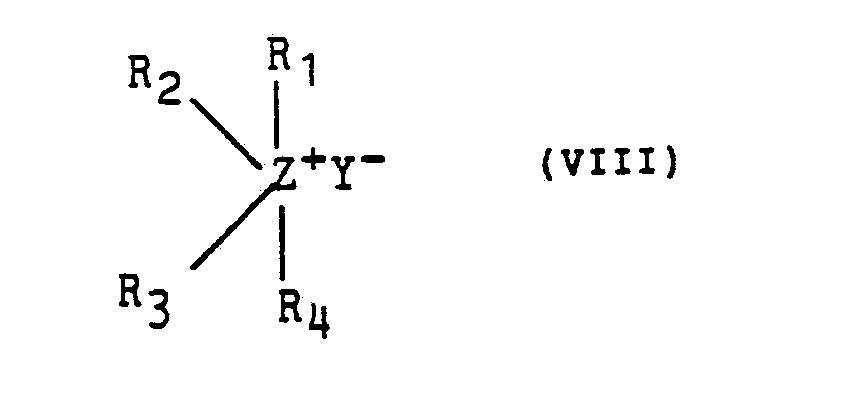
wherein Z is tetravalent ammonium, phosphonium or arbonium ion, y is any suitable counter ion and each R₁, R₂, R₃, and R₄ is independently an alkyl, arylalkyl, aromatic or alkylaromatic moiety containing from1 to 50 carbon atoms; poly(ethylene glycol) having the formula H(OCH₂CH₂)nOH and a molecular weight ranging from 200 to 50,000; poly(ethylene glycol alkyl ether) having the formula R(OCH₂CH₂)nOH wherein R is an alkyl group having from 1 to 50 carbon atoms and the ether has a molecular weight ranging from 200 to 50,000, crown ethers and cryptates.
HC≡C-CH₂-Hal VIII
wherein Hal is chlorine bromine or iodine and the phase transfer catalyst is selected from the group consisting of quaternary ammonium, phosphonium or arsonium salts represented by the following formula
wherein Z is tetravalent ammonium, phosphonium or arbonium ion, y is any suitable counter ion and each R₁, R₂, R₃, and R₄ is independently an alkyl, arylalkyl, aromatic or alkylaromatic moiety containing from1 to 50 carbon atoms; poly(ethylene glycol) having the formula H(OCH₂CH₂)nOH and a molecular weight ranging from 200 to 50,000; poly(ethylene glycol alkyl ether) having the formula R(OCH₂CH₂)nOH wherein R is an alkyl group having from 1 to 50 carbon atoms and the ether has a molecular weight ranging from 200 to 50,000, crown ethers and cryptates.
4. The process of Claim 1 wherein from 0.001 to 0.01 mole equivalent of the phase
transfer catalyst is used for each mole equivalent of the hydroxyaromatic compound.
5. The process of Claim 1 wherein from 1 to 1.5 mole equivalents of the propargyl
halide is used for each hydroxyl equivalent of the hydroxyaromatic compound.
6. The process of Claims 1 wherein from 1 to 10 mole equivalent of the alkaline agent
13 used for each mole equivalent of the hydroxyaromatic compound.
7. The process of Claim 1 wherein the alkaline agent is sodium hydroxide, potassium
hydroxide, lithium hydroxide or mixtures thereof.
8. The process of Claim 1 wherein the propargyl halide is propargyl chloride or propargyl
bromide.
9. The process of Claim 1 wherein the phase transfer catalyst is bound in a polymeric
support.
10. The process of Claim 1 further comprising filtering the formed solid propargyl
ether of the hydroxyaromatic compound from the solution and washing the solid product
with water and isopropanol to recover 85 to 97 percent of a theoretical yield of the
product having a purity of greater than 95 percent.