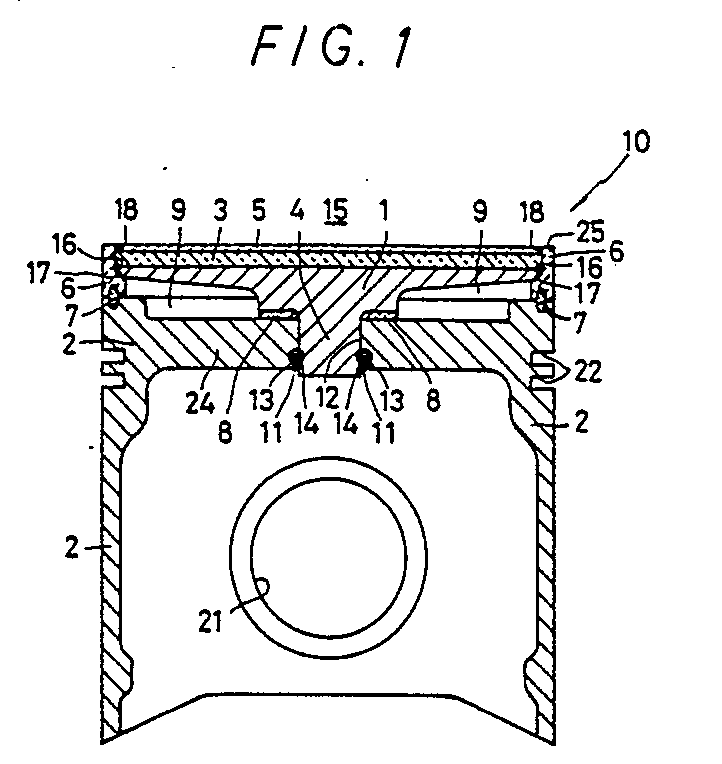
(57) The heat-insulating piston structure (10) according to the present invention is formed
by fixing a piston head (4), which consists of a material the coefficient of thermal
expansion of which is substantially equal to that of a ceramic material, to a piston
skirt (2), and setting a thin, flat plate (5) portion of a ceramic material on the
whole of the flat surface of the piston head which is on the side of a combustion
chamber via a heat-insulating member. Accordingly, the piston (10) can be formed so
that it has excellent heat-insulating characteristics and high thermal resistance,
deformation resistance and corrosion resistance. Especially, the thin plate portion
of a ceramic material (5), which is exposed to a combustion gas, can be formed to
the smallest possible thickness to reduce the thermal capacity thereof greatly. Therefore,
the temperature of the wall of the combustion chamber varies easily with that of the
combustion gas (in other words, the amplitude of the temperature of this wall becomes
large). Consequently, a difference between the temperature of the thin plate portion
of a ceramic material and those of the gases (combustion gas and suction air) becomes
small momentarily, so that the heat transfer rate of the thin plate portion decreases.
This causes a decrease in the quantity of heat which the suction air receives from
the wall surface. As a result, the suction air smoothly enters the combustion chamber
without being expanded therein. This enables the suction efficiency and cycle efficiency
to be improved.
|
|
