|
(11) | EP 0 294 907 A1 |

| (12) | EUROPEAN PATENT APPLICATION |
|
|
|
|
|||||||||||||||||||||||||||
| (54) | Process for the preparation of 3,3-diaryl acrylic acid amides |
| (57) The invention provides a process for the preparation 3,3-diaryl acrylic acid amides
of the formula
in which A, B and Q are as defined in the specification, characterised by condensing a compound of formula with a compound of formula ZCH₂-CO-Q (III) in which Z represents a hydrogen or halogen atom, and, if an intermediate compound is formed of formula dehydrating the intermediate compound. |
[0001] The invention concerns a new process for the preparation of 3,3-diaryl acrylic acid amides of the formula
where
R₁ represent a C₁₋₄ alkyl, C₁₋₄ alkoxy, amino, mono- or di-(C₁₋₄ alkyl)amino, C₃₋₄ alkenyl, C₃₋₄ alkynyl, C₃₋₄ alkenyloxy, C₃₋₄ alkynyloxy or C₃₋₆ cycloalkyl group;
R₂ represents a C₁₋₄ alkyl or C₁₋₄ alkoxy group or a halogen atom;
R₃ represents a hydrogen or halogen atom,
R₄ represents a hydrogen or halogen atom or a C₁₋₄ alkyl or C₁₋₄ alkoxy group;
R₅ represents a hydrogen atom, a phenyl group optionally substituted by one or more substituents selected from C₁₋₄ alkyl, C₁₋₄ alkoxy, halogen, phenyl and phenoxy moieties, a C₁₋₁₂ alkyl group optionally substituted by one or more halogen atoms, a C₃₋₇ cycloalkyl group, a C₂₋₆ alkenyl or a C₂₋₆ alkynyl group each optionally substituted by a phenyl group, or a naphthyl or C₅₋₈ cycloalkenyl group;
-X-Y- represents a single bond or a -O-, -S(O)p- where p is 0, 1 or 2, -N=N-, -CHR₁₀-O-, -O-CHR₁₀-, -CHR₁₀-S(O)p-, -S(O)p-CHR₁₀-, - CnH2n- where n is an integer from 1 to 10, -HC=CH- or -C≡C- moiety;
R₆ represents a C₁₋₄ alkyl, C₃₋₇ cycloalkyl, benzyl, C₃₋₄ alkenyl or C₃₋₄ alkynyl group;
R₇ represents a C₁₋₄ alkyl group;
R₈ represents a hydrogen atom or a C₁₋₄ alkyl or C₁₋₄ alkoxy group; and
R₉ and R₁₀ independently represent a hydrogen atom or a C₁₋₄ alkyl group.
[0002] Compounds of formula I are fungicidally active and are particularly useful in the control of phytopathogenic fungi, especially Plasmopara victicola and Phytophthora infestans. Particularly preferred compounds of formula I in this respect are those in which A represents a 3,4-dimethoxyphenyl, 3-ethoxy-4-methoxyphenyl, 3-chloro-4-methoxyphenyl, 3-bromo-4-methoxyphenyl, 3-methyl-4-methoxyphenyl, 3-ethyl-4-methoxyphenyl, 3-propyl-4-methoxyphenyl, 3,4-dimethylphenyl, 3-amino-4-methoxyphenyl, 3,5-dichloro-4-aminophenyl or 3-methoxy-4-methylphenyl group and, of these, 3,4-dimethoxyphenyl is especially preferred. It is also preferred that Q represents a morpholino group. An especially preferred compound of formula I is 3-(4-chlorophenyl)-3-(3,4-dimethoxyphenyl) acrylic acid morpholide.
[0003] Compounds of formula I form the subject of European patent applications nos. 84102012.6 and 86113835.2, published as EP 0 120 321 A1 and EP 0219756 A1 respectively, and these documents describe the only methods previously disclosed for the preparation of these compounds. However, it has now been surprisingly discovered that compounds of formula I can also be prepared by reacting a benzophenone with an appropriate acetamide, in a modification of a known reaction, followed, if necessary, by dehydration.
[0004] According to the present invention there is therefore provided a process for the preparation of a compound of formula I, as defined above, characterised by condensing a compound of formula
in which A and B have the meanings given above, with a compound of formula
ZCH₂-CO-Q (III)
in which Z represents a hydrogen or halogen, especially a chlorine or bromine, atom and Q has the meaning given above, and, if an intermediate compound is formed of formula
in which A, B and Q have the meanings given above, dehydrating the intermediate compound.
[0005] The above process can be represented by the following reaction scheme:-
In this scheme A, B, Q and Z are as defined above. As shown in the scheme, depending on the reaction conditions and reagents used, the above reaction may proceed directly to the final product of formula I in one step or may proceed in two steps via an intermediate or formula IV. In the latter case, a separate dehydration step is required to produce the final product of formula I.
[0006] In the case where Z represents a hydrogen atom, the condensation reaction may be carried out in the presence of a strong base. Suitable strong bases include alkali hydroxides, alkali carbonates, potassium tert-butylate and tert-butyl lithium. Depending on the base used and the temperature at which the reaction is carried out, compounds of formula I are sometimes formed directly by elimination of water without the need for a separate dehydration step. (cf. W. Chodkiewicz et al, Bull. Soc. Chim. France, 1958, 1586-9).
[0007] In the case where Z represents a halogen, especially a bromine, atom, the condensation reaction is suitably carried out in the presence of zinc (cf. N.L. Drake et al, J. Am. Chem. Soc., 70, 677 (1948)). In this case, the reaction usually proceeds via an isolatable intermediate of formula IV thus requiring a separate dehydration step.
[0008] The reactions may be carried out in the presence of an inert solvent, such as toluene, benzene, diethyl ether, diisopropyl ether, diglyme, tetrahydrofuran, dimethyl formamide, acetone or ethylene chloride. Alternatively, an excess of one of the reactants may also serve as a solvent. Depending on the reactivity of the reactants, the condensation reaction may be carried out at any temperature from room temperature to the reflux temperature of the reaction mixture.
[0009] If a compound of formula IV is formed as an intermediate product, dehydration can be started by heating the compound in an inert solvent, such as toluene, benzene, etc, optionally, in the presence of an acid such as toluene sulphonic acid, sulphuric acid, phosphoric acid and hydrochloric acid. Alternatively, dehydration may be accomplished simply by reaction with an appropriate acid, such as those listed above. Many acids, such as glacial acetic acid, are useful principally as a solvent. However, some acids, such as formic acid, have both acid and solvent functions.
[0010] Compounds of formula II and formula III are either known compounds or can be produced from known compounds by known methods.
Example 1
Preparation of 3-(4-chlorophenyl)-3-(3,4-dimethoxyphenyl)acrylic acid morpholide
[0012] 6.92g (25 mmol) 4-chloro-3′,4′-dimethoxybenzophenone, 12.9g (100 mmol) N-acetylmorpholine and 11.2g (170 mmol) powdered potassium hydroxide (85%) were mixed well and allowed to stand at room temperature for 30 minutes, with occasional stirring. The viscous mass so obtained was then added to a vigorously stirred mixture of 100 ml water and 50 ml toluene. The toluene phase was dried and separated over a column containing 50g silica gel using 150 ml each of 95:5, 90:10 and 80:20 toluene-acetone mixture as eluant. The fractions with an Rf value of 0.37 (Toluene/Acetone 7:3) were evaporated in a rotary evaporator, after which 0.8 g of the title compound were obtained by trituration with a little diisopropyl ether.
[0013] By evaporating the fractions with an Rf value of 0.52, 3.4g (33.5% of theory) of 3-(4-chlorophenyl)-3-(3,4-dimethoxyphenyl)-3-hydroxypropionic acid morpholide were obtained, m.pt. 150°C. For the dehydration step, this substance was then dissolved in 10 ml glacial acetic acid by warming, 0.1 ml conc. sulphuric acid were added and the mixture was then boiled under reflux for 5 minutes. After cooling to 50°C, the mixture was stirred into 100 ml water. The oil that initially separated out solidified on further stirring. The substance was then filtered off under suction, washed with water and dried. Thin layer chromatography (TLC) indicated that the final product was substantially pure.
Yield: 2.9g (30% of theory)
Total yield: 3.7g (38% of theory), TLC - pure.
Example 2
Preparation of 3-(4-chlorophenyl)-3-(3,4-dimethoxyphenyl)acrylic acid morpholide
[0014] 13.84g (50 mmol) 4-chloro-3′,4′-dimethoxybenzophenone, 7.75g (60 mmol) N-acetylmorpholine, 7.29g (65 mmol) potassium tert-butylate and 75 ml anhydrous toluene were mixed and stirred for 2 hours under nitrogen at 80°C. The solution was then cooled, extracted with 100ml water, dried and evaporated in a rotary evaporator. 11.5g of a viscous oil were obtained, which were then heated with 50 ml diisopropyl ether whilst stirring. The oil crystallised on cooling and rubbing. The crystals were then filtered off under suction, washed with a little diisopropyl ether and dried.
Yield : 9.25g (48% of theory)
M.pt : 122-148°C
TLC-pure, R.f. value: 0.38 in 7:3 toluene/acetone.
Example 3
Preparation of 3-(4-chlorophenyl)-3-(3,4-dimethoxyphenyl) acrylic acid morpholide
[0015] 5.53g (20 mmol) 4-chloro-3′,4′-dimethoxybenzophenone, 3.23g (25 mmol) N-acetylmorpholine, 3.29g (50 mmol) powdered potassium hydroxide (85%) and 30 ml absolute tetrahydrofuran were stirred under reflux for 5 hours under nitrogen. After cooling, the liquid paste so obtained was added to a well stirred mixture of 100 ml water and 50 ml toluene. The toluene phase was dried and separated over a column containing 50g silica gel, using 100 ml each of 95:5, 90:10 and 80:20 toluene-acetone mixture as eluant. The fractions containing a substance with an Rf-value of 0.38 (Toluene/Acetone 7:3) were then evaporated in a rotary evaporator. The oil thus obtained solidified on trituration with a little diisopropyl ether.
M.pt: 125-145°C
Yield 3.25g (42% of theory)
Example 4
Preparation of 3-(4-chlorophenyl)-3-(3,4-dimethoxyphenyl) acrylic acid morpholide
[0016] 20.9g (76 mmol) 4-chloro-3′,4′-dimethoxybenzophenone, 32.7g (200 mmol) chloroacetylmorpholine, 50 ml toluene and 50 ml benzene were mixed together to form a solution. 10% of this solution was added to 16.3g (250 mmol) freshly activated zinc (30 mesh) and a few crystals of iodine and rapidly stirred under reflux. The remainder of the solution was then added dropwise and the resulting mixture refluxed for 4 hours. The mixture was cooled, 150 ml of ethylene chloride was added and the solids filtered off. The filtrate was shaken with 200 ml of a 10:1 mixture of ice and conc. sulphuric acid. The organic phase was separated and washed once with 50 ml water, then with 30 ml 2N sodium hydroxide, then with 50 ml water and finally with 30 ml saturated sodium chloride solution. The organic phase was then dried over magnesium sulphate and evaporated. The residue was treated with 30 ml of diisopropyl ether and chilled and the product was then filtered off under suction and washed with a little diisopropyl ether.
Yield: 22.0g (74.3% of theory)
Purity: > 95%
NMR: consistent with product structure
1. A process for the preparation of a compound of formula
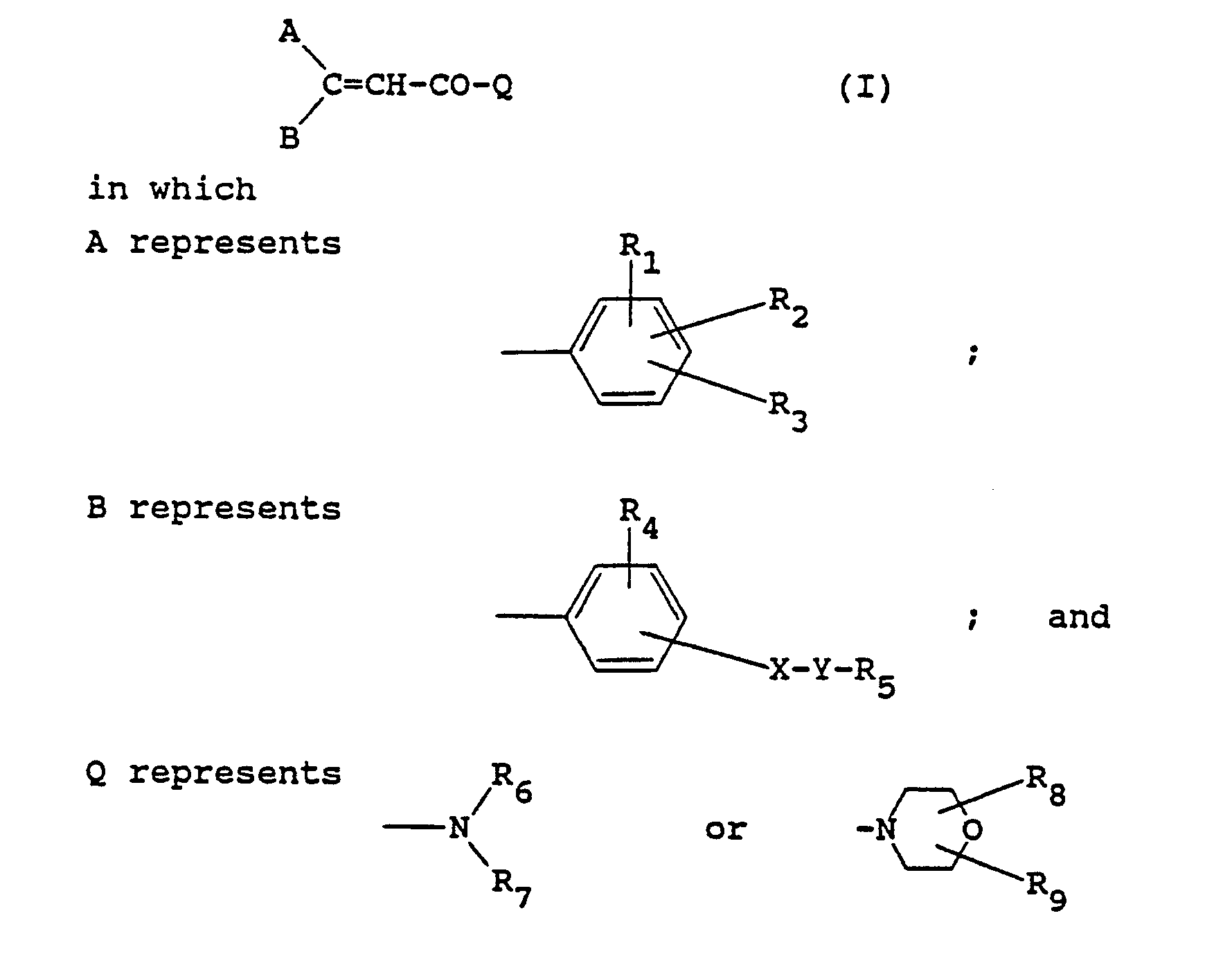
where
R₁ represents a C₁₋₄ alkyl, C₁₋₄ alkoxy, amino, mono- or di-(C₁₋₄ alkyl) amino, C₃₋₄ alkenyl, C₃₋₄ alkynyl, C₃₋₄ alkenyloxy, C₃₋₄ alkynyloxy or C₃₋₆ cycloalkyl group;
R₂ represents a C₁₋₄ alkyl or C₁₋₄ alkoxy group or a halogen atom;
R₃ represents a hydrogen or halogen atom;
R₄ represents a hydrogen or halogen atom or a C₁₋₄ alkyl or C₁₋₄ alkoxy group;
R₅ represents a hydrogen atom, a phenyl group optionally substituted by one or more substituents selected from C₁₋₄ alkyl, C₁₋₄ alkoxy, halogen, phenyl and phenoxy moieties, a C₁₋₁₂ alkyl group optionally substituted by one or more halogen atoms, a C₃₋₇ cycloalkyl group, a C₂₋₆ alkenyl or C₂₋₆ alkynyl group each optionally substituted by a phenyl group, or a naphthyl or C₅₋₈ cycloalkenyl group;
-X-Y- represents a single bond or a -O-, -S(O)p- where p is 0, 1 or 2, -N=N-, -CHR₁₀-O-, -O-CHR₁₀-, -CHR₁₀-S(O)p-, -S(O)p-CHR₁₀-, -CnH2n- where n is an integer from 1 to 10, HC=CH- or -C≡C- moiety;
R₆ represents a C₁₋₄ alkyl, C₃₋₇ cycloalkyl, benzyl, C₃₋₄ alkenyl or C₃₋₄ alkynyl group;
R₇ represents a C₁₋₄ alkyl group;
R₈ represents a hydrogen atom or a C₁₋₄ alkyl or C₁₋₄ alkoxy group; and
R₉ and R₁₀ independently represent a hydrogen atom or a C₁₋₄ alkyl group; characterised by condensing a compound of formula
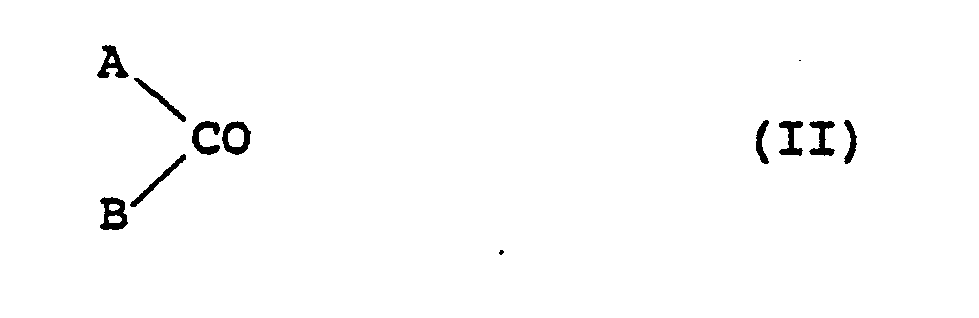
in which A and B have the meanings given above, with a compound of formula
ZCH₂-CO-Q (III)
in which Z represents a hydrogen or halogen atom and Q has the meaning given above, and, if an intermediate compound is formed of formula
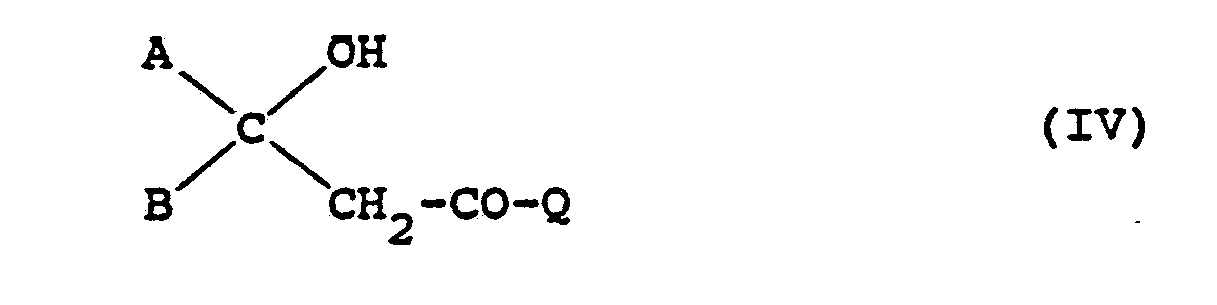
in which A, B and Q have the meanings given above, dehydrating the intermediate compound.
where
R₁ represents a C₁₋₄ alkyl, C₁₋₄ alkoxy, amino, mono- or di-(C₁₋₄ alkyl) amino, C₃₋₄ alkenyl, C₃₋₄ alkynyl, C₃₋₄ alkenyloxy, C₃₋₄ alkynyloxy or C₃₋₆ cycloalkyl group;
R₂ represents a C₁₋₄ alkyl or C₁₋₄ alkoxy group or a halogen atom;
R₃ represents a hydrogen or halogen atom;
R₄ represents a hydrogen or halogen atom or a C₁₋₄ alkyl or C₁₋₄ alkoxy group;
R₅ represents a hydrogen atom, a phenyl group optionally substituted by one or more substituents selected from C₁₋₄ alkyl, C₁₋₄ alkoxy, halogen, phenyl and phenoxy moieties, a C₁₋₁₂ alkyl group optionally substituted by one or more halogen atoms, a C₃₋₇ cycloalkyl group, a C₂₋₆ alkenyl or C₂₋₆ alkynyl group each optionally substituted by a phenyl group, or a naphthyl or C₅₋₈ cycloalkenyl group;
-X-Y- represents a single bond or a -O-, -S(O)p- where p is 0, 1 or 2, -N=N-, -CHR₁₀-O-, -O-CHR₁₀-, -CHR₁₀-S(O)p-, -S(O)p-CHR₁₀-, -CnH2n- where n is an integer from 1 to 10, HC=CH- or -C≡C- moiety;
R₆ represents a C₁₋₄ alkyl, C₃₋₇ cycloalkyl, benzyl, C₃₋₄ alkenyl or C₃₋₄ alkynyl group;
R₇ represents a C₁₋₄ alkyl group;
R₈ represents a hydrogen atom or a C₁₋₄ alkyl or C₁₋₄ alkoxy group; and
R₉ and R₁₀ independently represent a hydrogen atom or a C₁₋₄ alkyl group; characterised by condensing a compound of formula
in which A and B have the meanings given above, with a compound of formula
ZCH₂-CO-Q (III)
in which Z represents a hydrogen or halogen atom and Q has the meaning given above, and, if an intermediate compound is formed of formula
in which A, B and Q have the meanings given above, dehydrating the intermediate compound.
2. A process according to claim 1 in which Z is hydrogen and the condensation reaction
is carried out in the presence of a strong base.
3. A process according to claim 2 in which the strong base is selected from alkali
hydroxides, alkali carbonates, potassium tert-butylate and tert-butyl lithium.
4. A process according to claim 1 in which Z is halogen and the condensation reaction
is carried out in the presence of zinc.
5. A process according to any preceding claim in which the condensation reaction is
carried out at a temperature from room temperature to the reflux temperature of the
reaction mixture.
6. A process according to any preceding claim in which the intermediate compound of
formula IV is dehydrated by heating in an inert solvent.
7. A process according to any preceding claim in which the intermediate compound of
formula IV is dehydrated by reaction with an acid.
8. A process according to any preceding claim which is carried out in the presence
of a solvent.
9. A process according to claim 8 in which the solvent is selected from toluene, benzene,
diethylether, diisopropyl ether, diglyme, tetrahydrofuran, dimethyl formamide, acetone
and ethylene chloride.