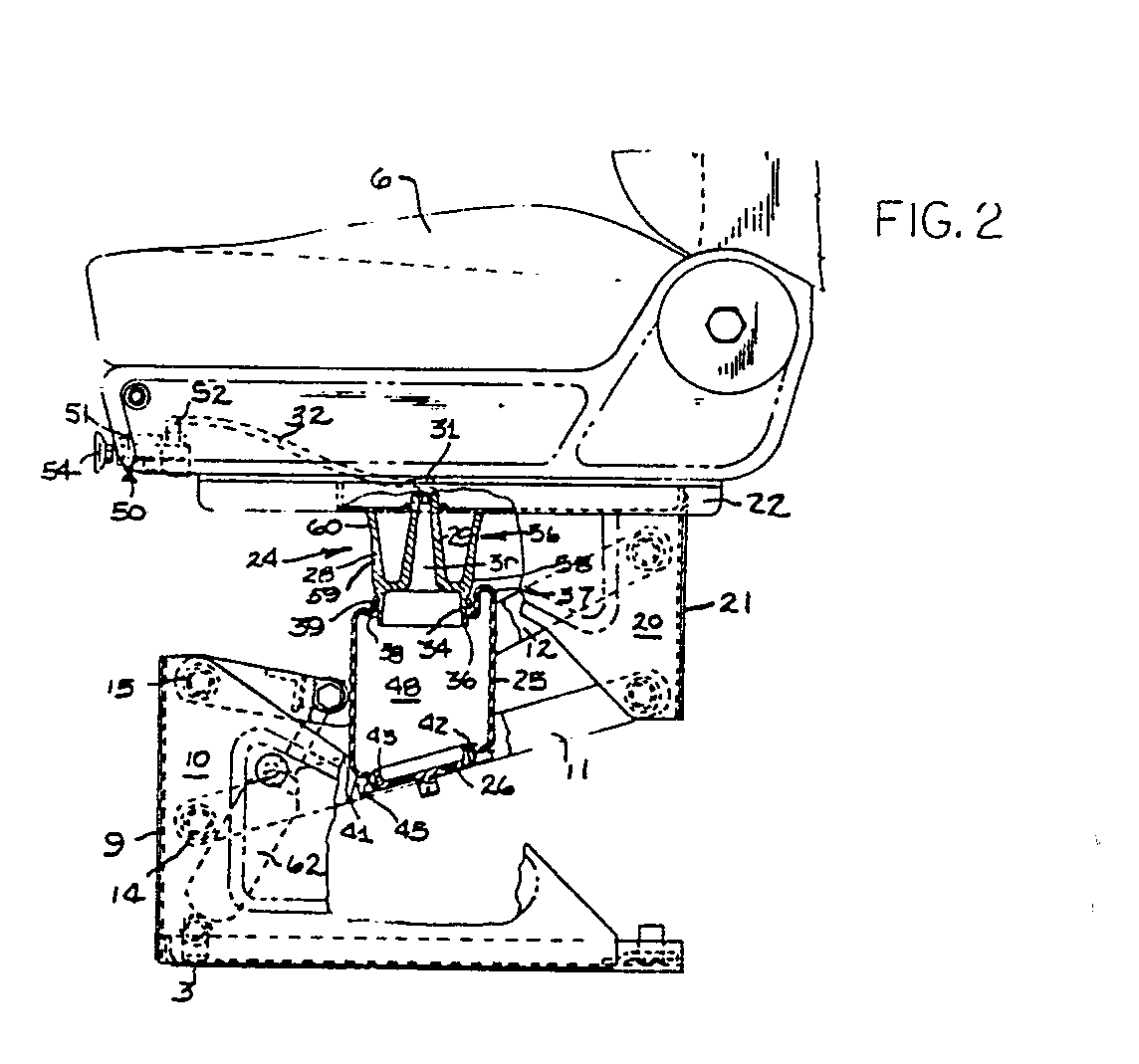
(57) A vehicle seat (1) mounted for relative vertical movement has, a rolling lobe air
spring support (2). The air spring (2) includes a piston (24), a plug (26) and a flexible
tubular sleeve (25) extending between and connected at its opposite ends to the piston
(24) and plug (26). The piston (24) has a positively, radially outwardly tapered control
surface (56) on the piston sidewall (28). The control surface (56) has a plurality
of segments of different respective tapers. The positive taper of the control surface
(56) has a composite radial increase in segmented steps from (58, 59, 60) to control
surface end closest to the plug to the control surface end farthest from the plug.
The segmented, positive taper piston control surface (56) provides a variable spring
rate as the tubular sleeve lobe (37) rolls along the piston control surface (56) during
spring compression caused by seat loading. The variable spring rate created by the
piston control surface provides a soft feel to the seat occupant under normal load
conditions and provides rapid air pressure build up in the air spring (2) during increased
load conditions to slow or arrest seat movement. The positively tapered control surface
provides a progressively larger piston area giving the piston (24) more lifting ability
at the same pressure increases as the lobe (37) rolls down the piston (24). The pressure
increases faster and the piston (24) also becomes more effective as the lobe (37)
rolls down the surface as compared to a cylindrical or negative taper piston.
|
|
