|
(11) | EP 0 296 848 A1 |

| (12) | EUROPEAN PATENT APPLICATION |
|
|
|
|
|||||||||||||||||||||||||||
| (54) | Biological response modifiers, their production, and their use in therapy or in prophylaxis |
| (57) Compounds having biological response modifying activity and their methods of production
are described. The compounds have the formula:
wherein each X is (CH₂)n wherein 1 ≦ n ≦ 3; where R⁴ is lower alkyl; CH₂S; or CH₂O; and R³ and R⁵, independently, are H, fluoro, nitro, amino, alkylamino, dialkylamino, arylamino, acylamido, carboxy, azido, lower alkoxy, trimethylsulphonyl, trifluoromethanesulphonyl, or lower alkoxycarbonyl, provided that when X is (CH₂)₂, R³ cannot be H; or a pharmaceutically acceptable salt thereof. |
[0001] This invention relates to biological response modifiers, to methods for their production, and to their use in therapy or in prophylaxis.
[0002] In general, the invention features compounds having biological response-modifying activity and having the general formula:
wherein each X is (CH₂)n where 1 ≦ n ≦ 3;
where R⁴ is lower alkyl; CH₂S: or CH₂O; and R³ and R⁵, independently, are H, fluoro, nitro, amino, alkylamino, dialkylamino, arylamino, acylamido (more preferably lower acylamido, e.g., trifluoroacetylamido), carboxy, azido, lower alkoxy, trimethylsulphonyl, trifluoromethanesulphonyl, or lower alkoxycarbonyl (containing an ester linkage), provided that when X is (CH₂)₂, R³ cannot be H; or a pharmaceutically acceptable salt thereof.
[0003] Throughout this specification and in the accompanying claims, the term "lower" as in "lower alkyl" means 1 to 6 carbon atoms.
[0004] Preferred compounds are
2-amino-10-fluoro-4-oxo-5, 6, 7-trihydrobenzocyclohepta (6, 5-d)-pyrimidine; 2-amino-10-nitro-4-oxo-5, 6, 7-trihydrobenzocyclohepta (6, 5-d)-pyrimidine; 2-amino-10-azido-4-oxo-5, 6, 7-trihydrobenzocyclohepta (6, 5-d)-pyrimidine; or 2, 10-diamino-4-oxo-5, 6, 7-trihydrobenzocyclohepta (6, 5-d)-pyrimidine.
[0005] We have found these compounds to exhibit potent biological response-modifying activity. In other words, they exhibit antiviral, antibacterial, and anticancer activity. They are also chemically stable, are not toxic to mammals, and do not decompose in stomach. The compounds can be particularly valuable in the treatment of immunocomprised patients, e.g., cancer patients, who are at risk of contracting viral infections, particularly herpes simplex virus type II infections. They are also useful in treating cancer, particularly melanoma, alone or in combination with other anti-cancer agents.
[0006] The invention is hereinafter more particularly described by way of example only with reference to a number of Examples of preparation of specific compounds in accordance with this invention and with reference to the single figure of the accompanying drawing, which shows a plan view, partially broken away, of a packet containing a towlette impregnated with a biological response-modifying compound in accordance with the invention.
[0007] The compounds in accordance with the present invention have the general formula (1) recited above.
[0008] The compounds, or pharmaceutically acceptable salts thereof, can be administered alone or in combination with a pharmaceutically acceptable carrier.
[0009] Acceptable salts include those made with, e.g., hydrochloric, hydrobromic, hydroiodic, sulphuric, maleic, or fumaric acid; or with potassium, sodium hydroxide, or dicyclohexylamine.
[0010] For oral administration the pharmaceutical composition can most conveniently be in the form of pills, capsules or tablets. The composition can also take the form of an ingestible liquid, e.g. syrup. The compounds can also be provided in the form of topical preparations, e.g., ointments, lotions, creams, powders, gels and sprays.
[0011] Referring now to the Figure, flexible sheet 10 of fibrous, absorbant paper can be impregnated with a biological response-modifying compound of the invention, diluted, if desired, with a carrier, e.g., distilled water. The impregnated towelette 10 is folded and enclosed in rectangular, sealed, gas tight envelope 12, having fused periphery 14, in a manner such as is described in Clancy U.S. Patent No. 3,398,826 or Williams U. S. Patent No. 3,057,467, the disclosures of both of which are to be regarded as hereby incorporated by reference. The towelette is impregnated using conventional techniques, e.g., that disclosed in Bauer U. S. Patent no. 3,786,615, the disclosure of which is also to be regarded as hereby incorporated by reference.
Synthesis
[0012] To synthesize a compound of formula (1) a mixture of the appropriate alpha-ketoester and a guanidine salt, suitably the carbonate, in an inert solvent, suitably xylene, is suitably refluxed overnight, and the final product is then collected e.g. by filtration and purified.
[0013] The alpha-ketoester, if not commercially available, can be prepared by any of several methods, e.g., the reaction of a cyclic ketone with diethyloxalate followed by pyrolysis; or esterification of the commercially available alpha-keto acid, e.g., camphor carboxylic acid; or the reaction of a cyclic ketone with diethylcarbonate at elevated temperature in the presence of guanidine salts in an appropriate solvent, e.g., alcohols, xylene, toluene.
[0014] General references describing the synthesis of alpha-ketoesters can be found in The Pyrimidines, A. Weissberger, Ed., Interscience, New York, 1962; J. Org. Chem., 30, 1837 (1965); J. Org. Chem 33, 4288 (1968); J. Het. Chem. 7, 197 (1970); J. Het. Chem., 13, 675 (1976); Org. Syn. 47, 20 (1967).
[0015] Another method of synthesizing a compound of formula (1) involves the formation of a 2, 4-diaminopyrimidine derivative by the reaction of a cyclic ketone with dicyandiamide, either in the absence of or in an appropriate solvent, e.g., dimethylformamide, ethoxyethoxyethanol, followed by selective hydrolysis of one amino group.
2-amino-10-fluoro-4-oxo-5, 6, 7-trihydrobenzocyclohepta (6, 5-d) pyrimidine
[0018] To a stirred mixture of fuming nitric acid (36 ml, density 1.49 g/ml) and concentrated sulfuric acid (18 ml) cooled to -15°C was added slowly benzosuberone (15 g). The temperature was maintained below -10°C during addition. When the addition was complete, the mixture was stirred for another hour. It was then poured into a large excess of ice, and the resulting pale yellow solid was collected by filtration, washed with ice water, and dissolved in ethylacetate (700 ml). The ethylacetate solution was washed with 5% aqueous NaHCO₃ followed by water, and then dried over anhydrous MgSO₄. After evaporation of solvent, the residue was recrystallized from ethanol to give 12.33 g of 3-nitrobenzosuberone. TLC (Silica gel: CHCl₃) Rf = 0.35.
[0019] Second, 3-nitrobenzosuberone was converted to 3-nitrobenzosuberone ethyleneketal as follows. A mixture of 3-nitrobenzosuberone (12.1 g) and ethyleneglycol (16.6 ml) in benzene (210 ml) containing p-toluenesulfonic acid (0.4 g) was refluxed using a Dean-Stark Trap for 6 hours. The benzene layer was separated, washed with 5% aqueous NaHCO₃ and water, and then dried over MgSO₄. The solvent was evaporated in vacuo to give 11.2 g of 3-nitrobenzosuberone ethyleneketal as a pale yellow solid. TLC (Silica gel: CHCl₃) Rf = 0.38.
[0020] Third, 3-nitrobenzosuberone ethyleneketal was converted into 3-aminobenzosuberone ethyleneketal as follows. To a solution of 3-nitrobenzosuberone ethyleneketal (14.17 g) in ethanol-tetrahydrofuran (4:1, 100 ml) was added 0.4 g 10% palladium-charcoal; hydrogenation was carried out at room temperature under 30 psi (210000 N/m²) atmosphere overnight. The reaction mixture was filtered through celite pad, washed with ethylacetate, and the filtrate concentrated in vacuo to give 12.15 g of the product. TLC (Silica gel: CHCl₃/Acetone = 9 : 1) Rf = 0.31.
[0021] Fourth, 3-aminobenzosuberone ethyleneketal was converted into 3-aminobenzosuberone as follows. 3-aminobenzosuberone ethyleneketal (12.15 g) was dissolved in 2N HCl (150 ml) and stirred at room temperature for 2 hours. The solution then was basified to pH 11-12 using 10N-NaOH and extracted with dichloromethane. The organic extracts were combined and dried (MgSO₄), and the solvent removed in vacuo to give 9.4 g of product. TLC (Silica gel: CHCl₃/Methanol = 9:1) Rf = 0.58.
[0022] Fifth, 3-aminobenzosuberone was converted into 3-fluorobenzosuberone via a standard Schieman reaction as follows. (General references describing the Schieman reaction are listed in J. March, Advanced Organic Chem. 647 (1986)). To an ice-cooled solution of 3-aminobenzosuberone (12.43 g) in 2N HCl (50 ml) was added gradually a cold solution of NaNO₂ (5.85 g) in water (16 ml). When addition was complete, 65% hexafluorophosphoric acid (14.9 ml) was added, and the reaction was stirred at 0°C for 30 minutes. The brownish white solid formed was collected by filtration, washed with cold water, washed with small amounts of ether-methanol (9:1), and dried. It was then added in portions to hot xylene (bath temp. 125°C-130°C) and, after gas evolution ceased, the mixture was fractionally distilled to give 101 g of the product as a colorless liquid at 84-90°C/0.5 mm Hg. TLC (Silica gel: CHCl₃) Rf = 0.38.
[0023] Sixth, 3-fluorobenzosuberone was converted into 2-amino-10-fluoro-4-oxo-5, 6, 7-trihydrobenzocyclohepta (6, 5-d)-pyrimidine as follows. 6-ethoxycarbonyl-3-fluoro-1-benzosuberone was prepared by placing 4.77 g of 50% NaH mineral oil dispersion in a 250 ml three-necked flask, fitted with an additional funnel and a water condenser, under nitrogen atmosphere. The mineral oil was removed by washing several times with dry benzene, and the residue was then resuspended in dry benzene (60 ml). Diethylcarbonate (8.29 g) was then added in one portion. Ater refluxing, a solution of 3-fluoro-benzosuberone (6.21 g) in dry benzene (8 ml) was added dropwise to the mixture over a 3 hour period, and the refluxing was continued for another 30 minutes. The mixture was cooled to room temperature, treated with acetic acid (8.4 ml) and water (50 ml) to dissolve the solid, and the organic layer was washed several times with water and then dried over MgSO₄. The solvent and unreacted diethylcarbonate were removed in vacuo to give 7.92 g of product. TLC (Silica gel: CHCl₃) Rf = 0.48.
[0024] A mixture of 6-ethoxycarbonyl-3-fluoro-1-benzosuberone (3.96 g) and guanidine carbonate (3.42 g) in ethoxyethanol (50 ml) was refluxed for 4 1/2 hours, and, after cooling to room temperature, the solid was filtered off. After the evaporation of the solvent from the filtrate, the residue was dissolved in 2N NaOH, filtered, washed with ether, and the aqueous layer acidified to pH 5. The tan solid obtained was dissolved in hot dimethylsulfoxide (10 ml) and, while stirring, acetone (80 ml) was added. 2-amino-10-fluoro-4-oxo-5, 6, 7-trihydrobenzocyclohepta (6, 5-d)-pyrimidine was collected as a colorless solid by filtration, washed with small amounts of acetone and ether-acetone (4:1), and then dried to yield 1.38 g. m.p. 288-298°C. TLC (Silica gel: CHCl₃/MeOH = 9:1) RF = 0.33.
2-amino-10-nitro-4-oxo-5, 6, 7-trihydrobenzocyclohepta (6, 5-d)-pyrimidine
[0025] To a solution of 2-amino-4-oxo-5, 6, 7-trihydrobenzocyclohepta (6, 5-d)-pyrimidine (30 g) in concentrated sulfuric acid (150 ml) cooled to -20°C was added dropwise fuming nitric acid (9ml, density 1.49 g/ml). The temperature was maintained between -15°C and -20°C during addition. When addition was complete, the mixture was stirred at that temperature for another hour. The mixture then was poured into a large amount of ice-water (800 ml), and the solid collected by filtration and washed with cold water. The solid was dissolved in aqueous NaOH, and acetic acid was added to pH 6. The resulting solid was collected by filtration, washed with water, and dried to give 22.6 g of product. m.p. > 300°C. TLC (Silica gel: CHCl₃/MeOH = 5:1) Rf = 0.51.
2, 10-diamino-4-oxo-5, 6, 7-trihydrobenzocyclohepta (6, 5-d) pyrimidine
[0026] To a solution of 2-amino-10-nitro-4-oxo-5, 6, 7-trihydrobenzocyclohepta (6, 5-d)-pyrimidine (400 mg) in dimethylformamide (10 ml) and ethanol (2 ml) was added 10% Pd-C (100 mg). Hydrogenation was carried out under 30 psi (210000 N/m²) atmosphere overnight. The mixture was then filtered through celite pad, washed with alcohol, and the solvents removed in vacuo. Following evaporation of solvent and excess HCl, the residue was recrystallized from ethanol-ether to give 200 mg of product. m.p. 200°C (slowly decomposed). TLC (Silica gel: CHCl₃/MeOH = 5:1) Rf = 0.27.
2-amino-10-azido-4-oxo-5, 6, 7-trihydrobenzo cyclohepta (6,5-d)-pyrimidine
[0027] 5.0 g of 2-amino-10-nitro-4-oxo-5, 6, 7-trihydrobenzocyclohepta (6,5-d)-pyrimidine was prepared as described above and was suspended in acetic anhydride (100 ml) and refluxed for 2 1/2 hours. It was then cooled and the colorless solid (2-acetylamino-10-nitro-4-oxo-5, 6, 7-trihydrobenzocyclohepta (6,5-d)-pyrimidine) was collected by filtration, washed with ether, and dried. TLC (Silica gel: CHCl₃/MeOH = 9:1) Rf = 0.61.
[0028] 4.0 g of the above acetylated derivative was suspended in dimethylformamide (150 ml) and ethanol (26 ml), and 10% Pd/C (400 mg) added. Hydrogenation was carried out under 30 psi (210000 N/m²) atmosphere overnight. The mixture was then filtered through celite pad, washed with ethanol, and the solvents removed in vacuo to yield 4.0 g of 2-acetyl-10-amino-4-oxo-5, 6, 7-trihydrobenzocyclohepta (6,5-d)-pyrimidine. TLC (Silica gel: CHCl₃/MeOH = 9:1) Rf = 0.31.
[0029] 600 mg of the above acetylated 10-amino derivative was suspended in methanol (20 ml) and excess methanolic HCl added. A clear solution initially formed which subsequently became a suspension. The solvent and excess HCl were then removed in vacuo at room temperature to dryness. Next, the solid was resuspended in cold water (20 ml), treated with 2N HCl (1.5 ml) and a cold solution of sodium nitrite (300 mg) in water (2 ml), and then stirred at 0-5°C for 15 min. A yellow suspension formed, to which was then added a cold solution of sodium azide (300 mg) in water (2 ml). The mixture was stirred for 20 min. at 0-5°C, after which the colorless solid (2-acetylamino-10-azido-4-oxo-5, 6, 7-trihydrocyclohepta (6,5-d)-pyrimidine) was collected by filtration, washed with cold water, and dried. TLC (Silica gel: CHCL₃/MeOH = 9:1) Rf = 0.71.
[0030] The above acetylated derivative was deacetylated to form 2-amino-10-azido-4-oxo-5, 6, 7-trihydrocylohepta (6,5-d)-pyrimidine by suspending the derivative (560 mg) in methanol (20 ml) and adding methanolic HCl (2 ml). The mixture was refluxed for 2 hours, and then cooled. The resulting pale grey solid was filtered off, concentrated in vacuo to dryness, and then triturated with ethyl acetate to yield 280 mg of the deactylated product. m.p. 178°C (slowly decomposed). TLC (Silica gel: CHCl₃/MeOH = 9:1) Rf = 0.35. IR (Nujol) 2120 cm⁻¹ (azide).
[0031] When administered to mammals (e.g., orally, nasally, topically, parenterally, intravenously, or by suppository), we have found the compounds to have an antiviral effect, and to be particularly effective against herpes simplex viruses occurring in the eye, cutaneously, orally, genitally, or in upper respiratory areas.
[0032] Good in vivo test results, compared to in vitro results, suggest that the compounds, rather than acting directly on the virus, act via immunomodulation (e.g., delayed-type-hypersensitivity stimulation). The compounds should therefore also be useful in treating other types of infections (e.g., bacterial or fungal), tumors, and arthritis. We have found the compounds to be effective anticancer agents, particularly against melanoma, when administered alone or, more preferably, in combination with other anticancer agents, e.g., cytoxin or DTIC.
[0033] The compounds can be administered to a mammal, e.g. a human, in a dosage of 25 to 300 mg/kg/day, preferably 100 to 200 mg/kg/day.
[0034] Referring again to the Figure, when it is desired to apply the compound topically, sealed envelope 12 containing the impregnated towlette 10 is torn open and the towlette is removed and used, and the packet and used towlette are then discarded.
[0035] The impregnated towlette can be used in the treatment and/or prevention of herpes simplex type II infections. In the case of the treatment of a skin lesion associated with herpes, the impregnated towlette can be used to apply the compound to the affected area and then discarded. For prevention of herpes infections, the impregnated towlette can be used to apply the compound to an area which the user suspects has been recently exposed to herpes virus, e.g., to the genitals following sexual relations.
[0037] For example, the impregnated sheet can be, in addition to absorbant paper, another suitable material such as unwoven fabric. Instead of sealing wet towlettes in individual packets, multiple impregnated sheets can be provided in one container, e.g., a jar or a metal or plastic can. Impregnated towlettes can be used to treat or prevent other viral or bacterial infections, e.g., the common cold; for treatment of colds, for example, facial tissues can be impregnated with the compounds, application of the tissue to the nose providing the compound to that area.
1. A compound having the formula:
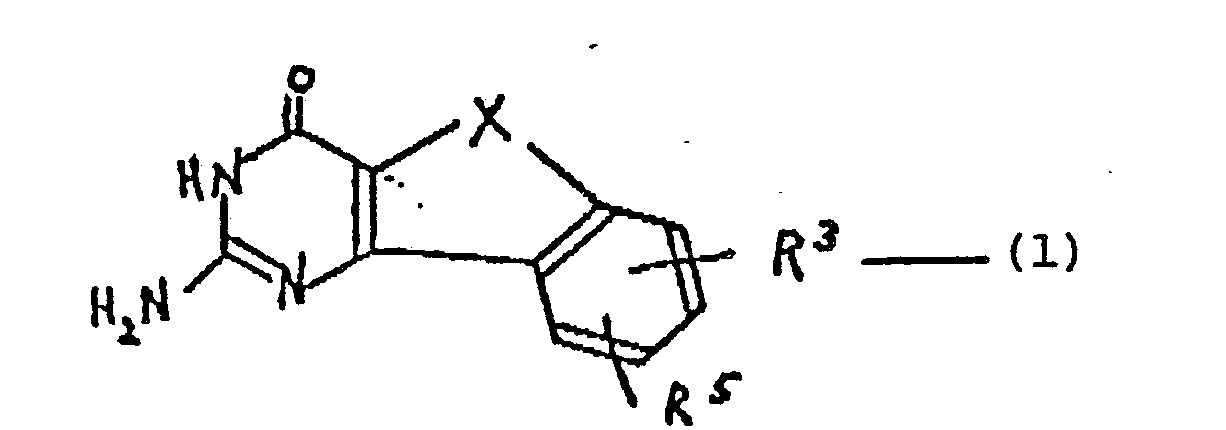
wherein
X is (CH₂) wherein 1 ≦ n ≦ 3;
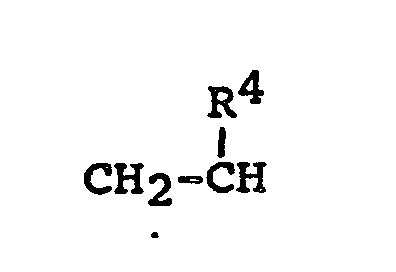
where R⁴ is an alkyl group having fewer than 6 carbon atoms; CH₂S; or CH₂O; and
R³ and R⁵, independently, are H, fluoro, nitro, amino, alkylamino, dialkylamino, arylamino, acylamido, carboxy, azido, an alkoxy group having fewer than 6 carbon atoms, trimethylsulphonyl, trifluoromethanesulphonyl, or alkoxy(with few than 6 carbon atoms)carbonyl, provided that when X is (CH₂)₂, R³ cannot be H;
or a pharmaceutically acceptable salt thereof.
wherein
X is (CH₂) wherein 1 ≦ n ≦ 3;
where R⁴ is an alkyl group having fewer than 6 carbon atoms; CH₂S; or CH₂O; and
R³ and R⁵, independently, are H, fluoro, nitro, amino, alkylamino, dialkylamino, arylamino, acylamido, carboxy, azido, an alkoxy group having fewer than 6 carbon atoms, trimethylsulphonyl, trifluoromethanesulphonyl, or alkoxy(with few than 6 carbon atoms)carbonyl, provided that when X is (CH₂)₂, R³ cannot be H;
or a pharmaceutically acceptable salt thereof.
2. A compound according to Claim 1, wherein X is (CH₂)₃, R³ is fluoro, and R⁵ is H;
said compound having the formula 2-amino-10-fluoro-4-oxo-5, 6, 7-trihydrobenzocyclohepta (6, 5-d)-pyrimidine.
said compound having the formula 2-amino-10-fluoro-4-oxo-5, 6, 7-trihydrobenzocyclohepta (6, 5-d)-pyrimidine.
3. A compound according to Claim 1, wherein X is (CH₂)₃, R³ is nitro, and R⁵ is H;
said compound having the formula 2-amino-10-nitro-4-oxo-5, 6, 7-trihydrobenzocyclohepta (6, 5-d)-pyrimidine.
said compound having the formula 2-amino-10-nitro-4-oxo-5, 6, 7-trihydrobenzocyclohepta (6, 5-d)-pyrimidine.
4. A compound according to Claim 1, wherein X is (CH₂)₃, R³ is amino, and R⁵ is H;
said compound having the formula 2, 10-diamino-4-oxo-5, 6, 7-trihydrobenzocyclohepta (6, 5-d)-pyrimidine.
said compound having the formula 2, 10-diamino-4-oxo-5, 6, 7-trihydrobenzocyclohepta (6, 5-d)-pyrimidine.
5. A compound according to Claim 1, wherein X is (CH₂)₃, R³ is azido, and R⁵ is H;
said compound having the formula 2-amino-10-azido-4-oxo-5, 6, 7-trihydrobenzocyclohepta (6, 5-d)-pyrimidine.
said compound having the formula 2-amino-10-azido-4-oxo-5, 6, 7-trihydrobenzocyclohepta (6, 5-d)-pyrimidine.
6. A biological response modifying composition comprising a bilogical response modifying
amount of a compound according to any preceding claim together with a pharmaceutically
acceptable carrier.
7. A composition according to Claim 6, wherein said composition is in the form of
a pill, capsule, or tablet for oral administration to a human or other mammalian patient;
or in the form of an ointment, lotion, cream, powder, gel, or spray for application
to the skin of a human or other mammalian patient; or in the form of pharmaceutically
acceptable ingestible liquid; or in parenteral, intravenous or suppository form for
administration to a human or other mammalian patient; containing a biological response
modifying concentration of a compound according to any of Claims 1 to 5.
8. A biological response modifying towlette, said towlette being impregnated with
a compound according to any of Claims 1 to 5 or with a said compound in combination
with a pharmaceutically acceptable carrier.
9. A compound according to any of Claims 1 to 5, for the treatment or prophylaxis
of viral, bacterial or fungal infections, or for the treatment of inflammatory diseases
such as arthritis, or of cancer.
10. A compound according to any of Claims 1 to 5, for the treatment or prophylaxis
of herpes simplex type II viral infections, or of the common cold.
11. In combination: a compound according to any of Claims 1 to 5, and cytoxin or DTIC,
for the treatment of cancer.
12. An anti-cancer treatment pack, comprising first and second compositions for simultaneous
or successive administrative to a human or other mammalian patient, said first composition
comprising a composition according to Claim 7, and said second composition comprising
cytoxin or DTIC together with a pharmaceutically acceptable carrier.
13. A method for the production of a compound as defined in any of Claims 1 to 5 or
a pharmaceutically aceeptable salt thereof;
the method comprising the steps of providing the corresponding alpha-ketoester, reacting the same with a guanidine salt in an inert solvent, and retrieving the product.
the method comprising the steps of providing the corresponding alpha-ketoester, reacting the same with a guanidine salt in an inert solvent, and retrieving the product.
14. A method for the production of a compound as defined in any of Claims 1 to 5 or
a pharmaceutically acceptable salt thereof;
the method comprising the steps of formation of the corresponding 2,4-diaminopyrimidine derivative by the reaction of a cyclic ketone with dicyandiamide followed by selective hydrolysis of one amino group, and recovery of the said compound.
the method comprising the steps of formation of the corresponding 2,4-diaminopyrimidine derivative by the reaction of a cyclic ketone with dicyandiamide followed by selective hydrolysis of one amino group, and recovery of the said compound.
15. Use of a compound as defined in any of Claims 1 to 5, or of a pharmaceutically
acceptable salt thereof, for the manufacture of a medicament for the treatment or
prophylaxis of viral, bacterial or fungal infections, or for the treatment of inflammatory
diseases such as arthritis, or of cancer.