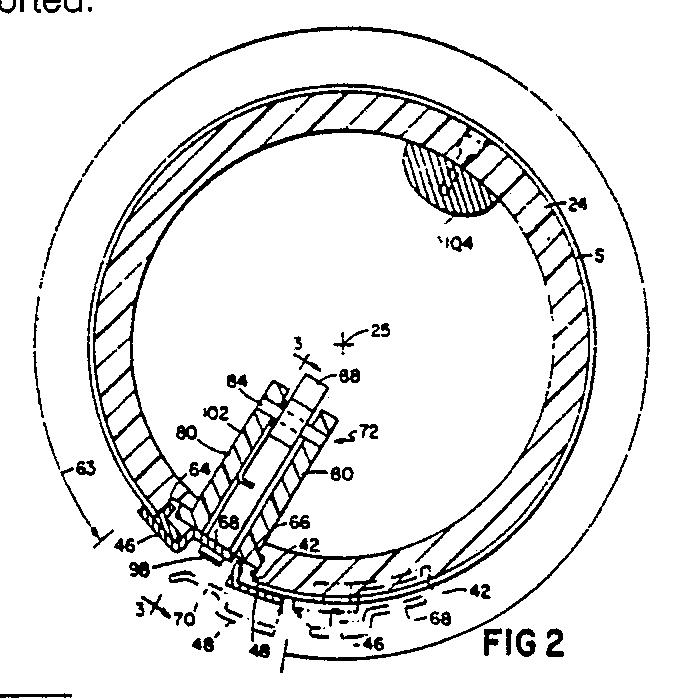
(57) A counterbalancing and sheet clamp retention system for high speed sheet handling
drums (24) of the type in which leading and trailing edge clamping bars (46, 48) extend
along the length of the drum periphery and are capable of movement between retracted
and sheet clamping positions for automatic loading and unloading successive sheets
to and from the drum (24). The clamping bars (46, 48), supported at opposite ends
for movement between their respective retracted and clamping positions, are engaged
centrally along their length by a retaining device (72) which moves to a clamping
bar engaging position under centrifugal force as the rotational velocity of the drum
(24) reaches a predetermined value. The retaining device (72) is a self-contained
unit insertable through a radial opening in the drum (24) and contains a pair of bell
crank retainers (88, 90) each having a clamping bar engaging claw (98) on one arm
and a weight (100) on the other arm so that centrifugal force operates to pivot the
bell crank and bring the claws (98) thereon into engagement with the closed sheet
clamping bars (46, 48). The drum (24) is further counterbalanced by a fixed weight
(104) opposite from the movable bell crank weights. Further, the ends of the clamping
bars (46, 48) are moved against the drum periphery to their sheet clamping positions
by centrifugal force acting on counterbalancing weights carried by radially movable
brackets (38, 40) from which the ends of the respective clamping bars (46, 48) are
supported.
|
|
