(57) A method for determining the porosity of a subsurface geological formation traversed
by a borehole is provided. The method generally comprises obtaining a means which
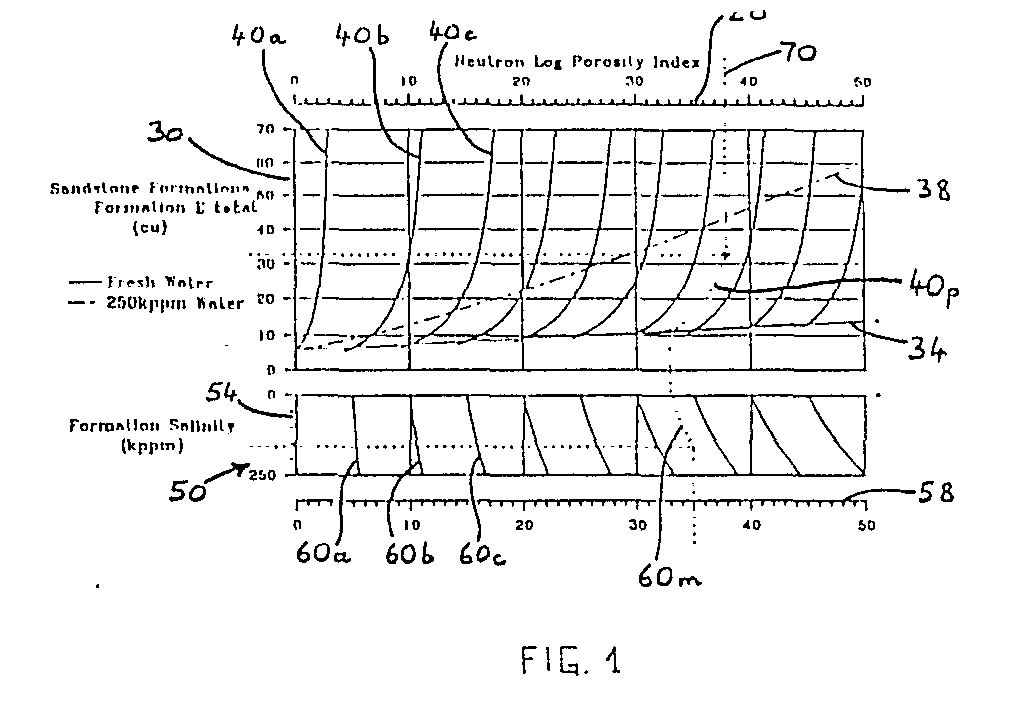
relates ranges of apparent formation porosity (<pa) as determined by a neutron-neutron
log, formation fluid salinities, formation total capture cross sections (E), formation
matrix and fluid constituents, and true formation porosity (ϕT) according to a predetermined equation. The predetermined equation relates the apparent
porosity to a function of a modified migration length which is obtained in a semi-empirical
manner (i.e. physics modified by data). The modified migration length includes a slowing
down length and a diffusion length, but causes at least the diffusion length to be
a function of the slowing down length. The means which relates the apparent porosity
to salinity, E, matrix and fluid constituents, and ϕT solves a forward problem. Thus, the inverse problem of determining true porosity
may be solved by obtaining determinations of salinity, formation matrix and fluid
constituents, E, and ϕa, and using the relating means to provide the true porosity.
The provided method properly and separately accounts for the effects of capture cross
section and salinity, and can be used to correct the apparent porosity determination
of a neutron-neutron tool, regardless of the formation matrix or formation fluid constituents.
|
|
