|
(11) | EP 0 300 490 B1 |

| (12) | EUROPEAN PATENT SPECIFICATION |
|
|
| (54) |
Dry blending process for the quaternization of polyvinyl alcohol Trockenmischungsverfahren für die Quatärnisation von Polyvinylalkohol Procédé de mélange à l'état sec pour la quaternisation de l'alcool polyvinylique |
|
|
|||||||||||||||||||||||||||||||
| Note: Within nine months from the publication of the mention of the grant of the European patent, any person may give notice to the European Patent Office of opposition to the European patent granted. Notice of opposition shall be filed in a written reasoned statement. It shall not be deemed to have been filed until the opposition fee has been paid. (Art. 99(1) European Patent Convention). |
[0001] This invention relates to a process for the quaternization of polyvinyl alcohol (sometimes, hereinafter referred to as PVA) to a polymer having cationic groups. That product usually is known as cationic polyvinyl alcohol (or cationic PVA).
[0002] Two basic processes for preparing cationic PVA are known. The first is a two-step process which involves, first, copolymerization of vinyl acetate with a comonomer containing a quaternary ammonium group and, next, hydrolysis of acetate groups to hydroxyl groups. The second requires post-treatment of PVA.
[0003] Representative of the first type of PVA quaternization processes are U.S. Patents 4,311,805 and 4,308,189 to Tohei at al., which disclose copolymerization of vinyl acetate with cationically substituted acrylamides and methacrylamides.
[0004] U.S. Patent 4,109,068 to Allen teaches copolymerization of vinyl acetate with a vinyl haloacetate, which then is partially saponified and quaternized through the remaining halovinyl acetate groups.
[0005] Representative of the second type of PVA quaternization processes is Japanese Patent 52-3689 to Yokkaichi, which discloses a process for post-quaternization of PVA in a slurry of acetone or other organic liquids, optionally containing water.
[0006] U.S. Patent 4,645,794 discloses a process for the post-quaternization of PVA in an aqueous solution or an aqueous slurry, using as the quaternizing agent (chlorohydroxypropyl)trimethylammonium chloride.
[0007] Some of those processes, however, are not entirely satisfactory either because of the fact that they require expensive, not readily available starting materials, or involve multistep reactions, or result in rather low yields of the desired product, or require expensive purification methods such as dialysis.
[0008] It thus is desirable to provide a simple, inexpensive method of quaternizing PVA in satisfactory yields to a reasonably pure product which does not require difficult or expensive recovery or purification techniques.
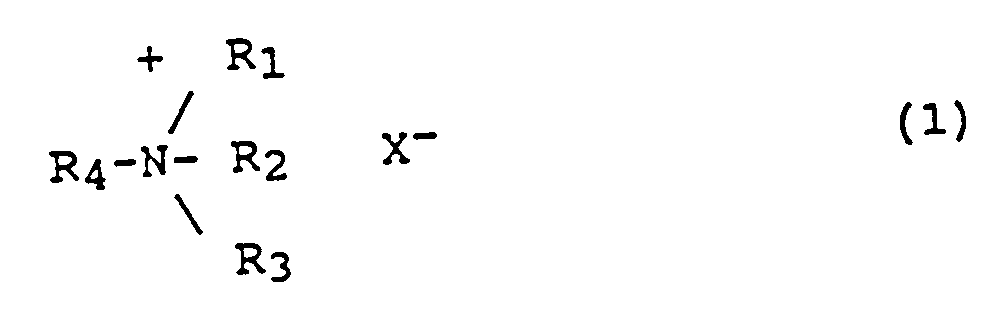
[0009] According to this invention, there is provided a process for the preparation of cationic polyvinyl alcohol, wherein dry polyvinyl alcohol powder is blended under high shear conditions at a temperature of about 0-100°C with an amount of water of 5-50% of the weight of polyvinyl alcohol, a base, and a quaternizing agent represented by the following formula (1):
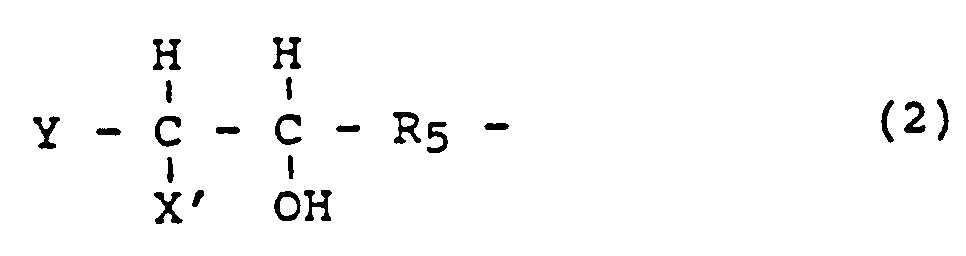
in which each one of R₁, R₂, and R₃ is alkyl or substituted alkyl; X⁻ is an anion; and R₄ is a halohydrin radical represented by formula (2):
where X' is a halide; R₅ is an alkylene radical; and Y is hydrogen or an alkyl radical;
the amount of the quaternizing agent being 0.5 to 5 equivalents of X' halogen atoms per 100 equivalents of OH groups in the starting polyvinyl alcohol, and the amount of base being such that there is an excess of 0.3 to 5 weight percent of the base, based on the amount of polyvinyl alcohol, over the amount of base required to completely convert the halohydrin radical to the oxirane form; both the starting solid polyvinyl alochol and the resulting quaternized polyvinyl alcohol remaining during the reaction essentially in the form of a free-flowing powder or granular material;
and recovering the resulting quaternized polyvinyl alcohol, with the proviso that the preparation of such compositions is excluded in which the reaction composition contains 11 to 30% by weight water, based on their total weight, and additionally substituent Y in formula (2) has the meaning hydrogen.
[0010] While the quaternizing agent is a quaternary ammonium compound carrying a halohydrin group, it is believed that the latter is converted to an oxirane (epoxy) group, and that the oxirane group is the actual reacting species in the PVA quaternization reaction. Oxiranes of this type are rather unstable, and it is therefore preferred to prepare them in situ. The halohydrin radical preferably has 3-5 carbon atoms (R₅ has 1 to 3 carbon atoms), three carbon atoms being preferred.
[0011] The anion X⁻ can be any suitable anion but normally will be hydroxyl, halide, or alkoxide, preferably a halide anion, such as chloride, bromide, or iodide.
[0012] Each of the alkyl radicals R¹, R², and R³ individually has 1 to 8 carbon atoms, particularly 1 carbon atom. The most preferred quaternizing agent is N-(3-chloro-2-hydroxypropyl)-N,N,N-trimethylammonium chloride.
[0013] The preferred amount of the quaternizing agent is 1.5 to 2.5 equivalents of X' halogen atoms of the halohydrin radical per 100 equivalents of polyvinyl alcohol hydroxyl groups.
[0014] The base which is used in the process of the present invention can be any strong base, such as an alkali metal or a quaternary ammonium hydroxide. The most convenient base, because of its ready availability and low price, is sodium hydroxide. The preferred excess of sodium hydroxide over the amount required to convert the halohydrin radical of the quaternizing agent to the oxirane form is about 1.5-2.5 weight percent, based on the weight of PVA, especially 1.7-2.0 weight percent. In order to calculate the excess of the base, it should be kept in mind that one equivalent of OH⁻ or OR⁻ is required to form the oxirane group from the halohydrin. Once the oxirane compound is formed, it is believed to react with the pendant OH groups of PVA as follows:
[0015] The amount of water, based on the weight of PVA, used in the process of this invention preferably is 10-15%, especially 11-13%.
[0016] Blending is carried out in high shear mixing equipment and the resulting quaternized PVA remains in the form of a free-flowing powder. The polymer can be neutralized and washed to remove the excess NaOH and quaternizing agent, or it can be used as such. It is important that all ingredients (PVA, water, base, and quaternizing agent) be intimately mixed. For the purpose of the present disclosure and claims, "high shear" means conditions such that the powder and the liquid are very efficiently dispersed in each other. Special equipment that can produce this result such as, for example, high intensity mixers, is available and generally known. An example of such equipment is the high intensity bowl type mixer known as the Wellex® mixer.
[0017] The preferred temperature of the quaternization reaction is 25-80°C. This parameter varies more or less inversely with time. For example, at room temperature, about the same conversion of the quaternizing agent may be obtained in 2 days as at 75°C in 30 minutes.
[0018] Quaternized PVA made according to the process of this invention has a broad utility in many areas, e.g., as a flocculating agent, as a stabilizing colloid in the preparation of cationic polymer emulsions, in secondary oil recovery, in paper and textile sizing or in adhesive formulations. It can be used in all those applications where quaternized PVA has been used heretofore.
[0019] This invention is now illustrated by representative examples of certain preferred embodiments thereof, where all parts, proportions, and percentages are by weight unless otherwise indicated. Conversions are based on the stoichiometry of the reactions.
Examples 1-39
[0020] A series of dry blends of PVA with N-(3-chloro-2-hydroxypropyl)-N,N,N-trimethylammonium chloride, available from Dow Chemical Company under the name QUAT®-188, containing varying amounts of water and of NaOH were prepared. All weighings were carried out to ±0.01 g. The desired amount of a 20% NaOH solution was added to 10.00 g PVA and immediately mixed with a small stainless steel spatula. This mixture was then stirred for a few minutes in a Sorvall Omni mixer at 12,000 rpm, while shaking the mixer by hand to prevent cavitation. After the stirring was stopped, the contents were mixed by hand with a spatula, and the stirring at 12,000 rpm was repeated. Thereafter 1.75 g of the quaternizing agent was weighed into the PVA, mixed in by hand with a spatula, and stirred, with shaking, in the mixer. This sequence of mixing with a spatula, followed by stirring in the Sorvall mixer, was repeated twice more.
[0021] Finally, the still free-flowing mixture of PVA, NaOH, and QUAT®-188 was ground by hand in a mortar using a porcelain pestle. The polymer was put into tightly sealed glass jars and allowed to react at ambient temperature. At given time intervals, portions of the PVA were neutralized by suspending the polymer in methanol containing a slight excess of HCl. The polymer was filtered, washed three times with a 1:3 mixture of water and methanol, followed by two washings with methanol. The polymer was dried under vacuum at 80°C to a constant weight. The percent nitrogen was determined analytically, and the degree of quaternization was calculated.
[0022] The quaternization conditions are summarized in Table I. In these experiments the amount of water was varied, as well as the excess of NaOH, but the ratio of equivalents of quaternizing agent to -OH groups in the PVA was kept constant at 2.56/100.
[0023] Similar data are summarized in Table II. For these examples the excess NaOH was kept constant at 1.88%, based on the weight of PVA, but the ratio of the quaternizing agent was varied from 1.82 to 3.28 moles/100 equivalents of OH groups in the PVA.
[0024] The data in these tables indicate that, for best utilization of the quaternizing agent, the total amount of water should be 11-13%, based on the weight of the PVA, and the excess of NaOH should be 2%, again based on the weight of the PVA. The ratio of the quaternizing agent to PVA does not seem to be critical, although at lower concentrations the quaternizing agent seems to be used more efficiently.
Examples 40-42 and comparative examples C1 to C-3
[0026] Two identical samples, A and B, were prepared by intimately mixing, as above, the following ingredients:
10.0 g dry PVA (medium molecular weight, fully hydrolyzed)
2.00 g QUAT®-188 (60% active ingredient)
2.20 g 20% aqueous NaOH.
Each sample thus had 1.84% excess NaOH, and 2.81 equivalents quaternizing agent per 100 equivalents of -OH groups in the polymer. Sample A was dried for 10 minutes in a vacuum over an 80°C, during which time 0.30 g water was lost. Sample B was dried, at ambient temperature under vacuum, for about 70 hours. It was substantially water-free. Samples A and B were heated, as indicated below. After heating, they were worked up in the same manner as described for examples 1-39. It is apparent that quaternization of PVA is enhanced by the presence of small amounts of water.
| Example | Portion | % Water | Heating | % N in the PVA | |
| Min. | °C | ||||
| 40 | A | 22.6 | 45 | 90 | 0.181 |
| C-1 | B | 0 | 45 | 90 | 0.087 |
| 41 | A | 22.6 | 120 | 95 | 0.166 |
| C-2 | B | 0 | 120 | 95 | 0.082 |
| 42 | A | 22.6 | 240 | 95 | 0.183 |
| C-3 | B | 0 | 240 | 95 | 0.092 |
Larger scale quaternization
[0027] A 2 gallon (7.6 L) capacity Wellex mixer, equipped with jacket cooling, was used. Dry PVA powder was put into the mixing chamber, and the QUAT®-188, as well as an aqueous solution of NaOH were added, while mixing, from a spray bottle. These additions, done in succession, usually took only a few minutes.
Example 43
[0028]
| Ingredients: | |
| PVA (High molecular weight, fully hydrolyzed) | 2000 g |
| 50% NaOH | 150 g |
| 62.3 % QUAT®-188 | 302 g |
Thus, this sample contained 1.75 % excess NaOH, and 2.20 equivalents of quaternizing agent per 100 equivalents of -OH groups in the polymer. Samples were taken at 22, 32, 52, and 57 minutes of elapsed time (samples 1-4, respectively). After taking sample 4, the excess NaOH was neutralized in the mixer with 55 g of glacial acetic acid. Samples 1 through 4 were suspended, immediately after taking them from the mixer, in methanol containing a slight excess of HCl. The polymer was worked up as in examples 1-39. The reaction conditions and % conversion are shown in the table below:
Example 44
[0029]
| Ingredients: | |
| PVA (same as in Ex. 43) | 2000 g |
| 50 % NaOH | 143 g |
| 62.3% QUAT®-188 | 250 g |
Thus, the composition had 1.92% excess NaOH and 1.82 equivalents of quaternizing agent per 100 equivalents of polymer -OH groups. The procedure was similar to that of example 43, except that 60 g of glacial acetic acid was used for neutralizing and that somewhat higher temperatures were used. Samples were taken for analysis at 21, 31, 41, 51, 61, and 76 minutes of elapsed time. The conditions and results are seen in the table below:
It is apparent from these results that the quaternization takes place readily in a rather short time. The quaternized polymer remains a free-flowing powder.
1. A process for the preparation of cationic polyvinyl alcohol, wherein dry polyvinyl
alcohol powder is blended under high shear conditions at a temperature of 0-100°C
with an amount of water equal to 5-50% of the weight of polyvinyl alcohol, a base,
and a quaternizing agent represented by the following formula (1):
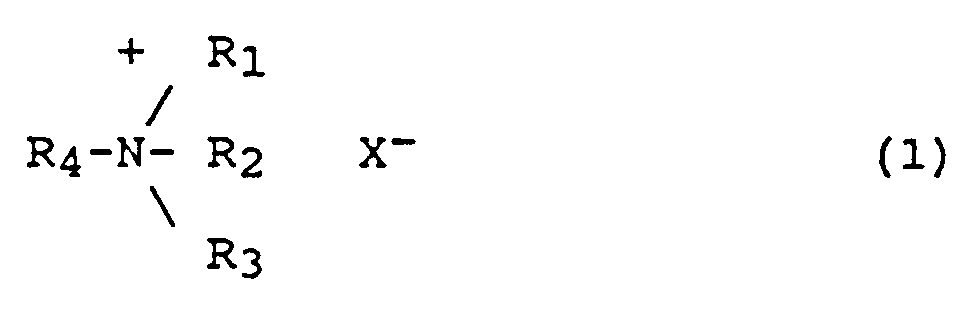
in which each one of R₁, R₂, and R₃, independently, is alkyl or substituted alkyl; X⁻ is an anion; and R₄ is a halohydrin radical represented by formula (2):
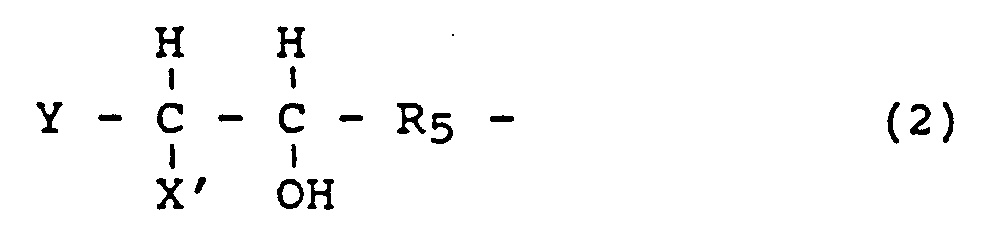
where X' is a halide; R₅ is an alkylene radical; and Y is hydrogen or an alkyl radical;
the amount of the quaternizing agent being 0.5 to 5 equivalents of X' halogen atoms per 100 equivalents of OH groups in the starting polyvinyl alcohol, and the amount of base being such that there is an excess of 0.3 to 5 weight percent of the base, based on the weight of polyvinyl alcohol, over the amount of base required to completely convert the halohydrin radical to the oxirane form; both the starting polyvinyl alcohol and the resulting quaternized polyvinyl alcohol product remaining throughout the reaction essentially in the form of free-flowing powder or granular material;
and recovering the resulting quaternized polyvinyl alcohol, with the proviso that the preparation of such compositions is excluded in which the reaction composition contains 11 to 30% by weight water, based on their total weight, and at the same time additionally substituent Y in formula (2) has the meaning hydrogen.
in which each one of R₁, R₂, and R₃, independently, is alkyl or substituted alkyl; X⁻ is an anion; and R₄ is a halohydrin radical represented by formula (2):
where X' is a halide; R₅ is an alkylene radical; and Y is hydrogen or an alkyl radical;
the amount of the quaternizing agent being 0.5 to 5 equivalents of X' halogen atoms per 100 equivalents of OH groups in the starting polyvinyl alcohol, and the amount of base being such that there is an excess of 0.3 to 5 weight percent of the base, based on the weight of polyvinyl alcohol, over the amount of base required to completely convert the halohydrin radical to the oxirane form; both the starting polyvinyl alcohol and the resulting quaternized polyvinyl alcohol product remaining throughout the reaction essentially in the form of free-flowing powder or granular material;
and recovering the resulting quaternized polyvinyl alcohol, with the proviso that the preparation of such compositions is excluded in which the reaction composition contains 11 to 30% by weight water, based on their total weight, and at the same time additionally substituent Y in formula (2) has the meaning hydrogen.
2. The process of Claim 1 wherein the amount of water is 10-15%, preferably 11-13% of
the weight of polyvinyl alcohol.
3. The process of Claim 1 wherein the base is sodium hydroxide and the excess of base
is 1.5-2.5%, preferably 1.7-2.0% based on the weight of polyvinyl alcohol.
4. The process of Claim 1 which is carried out at a temperature at 25-80°C.
5. The process of Claim 1 wherein the quaternizing agent is a quaternary ammonium halide.
6. The process of Claim 5 wherein the quaternizing agent is a quaternary ammonium chloride.
7. The process of Claim 6 wherein R₅ in the quaternizing agent has 1 to 3 carbon atoms.
8. The process of Claim 7 wherein the quaternizing agent is N-(3-chloro-2-hydroxypropyl)-N,N,N-trimethylammonium
chloride.
9. The process of Claim 1 wherein the amount of quaternizing agent is 1.5 to 2.5 equivalents
of X′ halogen atoms per 100 equivalents of polyvinyl alcohol hydroxyl groups.
10. The process of Claim 9, wherein the quaternizing agent is N-(3-chloro-2-hydroxypropyl)-N,N,N-trimethylammonium
chloride.
1. Verfahren zur Herstellung von kationischem Polyvinylalkohol, bei welchem trockenes
Polyvinylalkoholpulver unter hohen Scherbedingungen bei einer Temperatur von 0-100°C
mit einer Menge an Wasser entsprechend 5-50 % des Gewichts des Polyvinylalkohols,
einer Base und einem Quaternisierungsmittel vermischt wird, das der folgenden Formel
(1) entspricht:
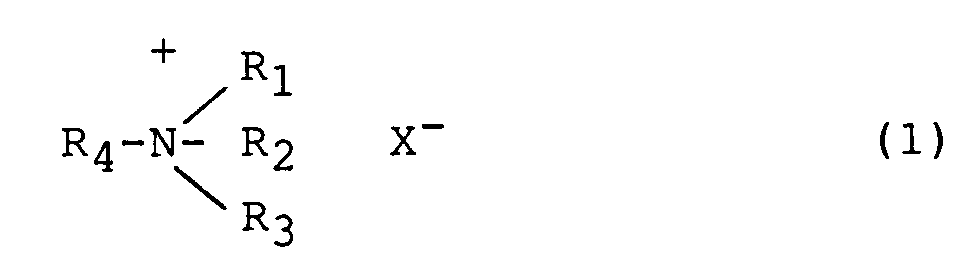
in welcher jeder der Reste R₁, R₂ und R₃, unabhängig voneinander, Alkyl oder substituiertes Alkyl bedeutet, X⁻ ein Anion ist und R₄ einen der Formel (2) entsprechenden Halogenhydrinrest bedeutet:
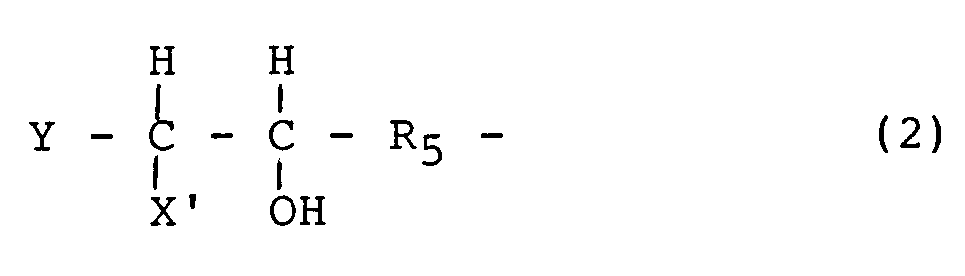
worin X' ein Halogenid, R₅ einen Alkylenrest und Y Wasserstoff oder einen Alkylrest bedeuten;
wobei die Menge an Quaternisierungsmittel 0,5 bis 5 Äquivalenten an X' Halogenatomen pro 100 Äquivalente OH-Gruppen in dem Ausgangspolyvinylalkohol entspricht, die Menge an Base derart ist, daß ein Überschuß von 0,3 bis 5 Gew.-% an Base, bezogen auf das Gewicht des Polyvinylalkohols, über derjenigen Menge an Base vorliegt, die benötigt wird, um den Halogenhydrinrest vollständig in die Oxiranform zu überführen; und wobei sowohl der Ausgangspolyvinylalkohol als auch das sich ergebende quaternisierte Polyvinylalkoholprodukt während der gesamten Reaktion im wesentlichen in der Form eines frei fließenden Pulvers oder granularen Materials verbleiben;
und bei welchem der erhaltene quaternisierte Polyvinylalkohol gewonnen wird, mit der Maßgabe, daß die Herstellung von solchen Zusammensetzungen ausgeschlossen ist, bei denen die Reaktionszusammensetzung 11 bis 30 Gew.-% Wasser, bezogen auf ihr Gesamtgewicht, enthält, und gleichzeitig zusätzlich der Substituent Y in Formel (2) die Bedeutung von Wasserstoff hat.
in welcher jeder der Reste R₁, R₂ und R₃, unabhängig voneinander, Alkyl oder substituiertes Alkyl bedeutet, X⁻ ein Anion ist und R₄ einen der Formel (2) entsprechenden Halogenhydrinrest bedeutet:
worin X' ein Halogenid, R₅ einen Alkylenrest und Y Wasserstoff oder einen Alkylrest bedeuten;
wobei die Menge an Quaternisierungsmittel 0,5 bis 5 Äquivalenten an X' Halogenatomen pro 100 Äquivalente OH-Gruppen in dem Ausgangspolyvinylalkohol entspricht, die Menge an Base derart ist, daß ein Überschuß von 0,3 bis 5 Gew.-% an Base, bezogen auf das Gewicht des Polyvinylalkohols, über derjenigen Menge an Base vorliegt, die benötigt wird, um den Halogenhydrinrest vollständig in die Oxiranform zu überführen; und wobei sowohl der Ausgangspolyvinylalkohol als auch das sich ergebende quaternisierte Polyvinylalkoholprodukt während der gesamten Reaktion im wesentlichen in der Form eines frei fließenden Pulvers oder granularen Materials verbleiben;
und bei welchem der erhaltene quaternisierte Polyvinylalkohol gewonnen wird, mit der Maßgabe, daß die Herstellung von solchen Zusammensetzungen ausgeschlossen ist, bei denen die Reaktionszusammensetzung 11 bis 30 Gew.-% Wasser, bezogen auf ihr Gesamtgewicht, enthält, und gleichzeitig zusätzlich der Substituent Y in Formel (2) die Bedeutung von Wasserstoff hat.
2. Verfahren nach Anspruch 1, bei welchem die Menge an Wasser 10-15 %, vorzugsweise 11-13
%, des Gewichts des Polyvinylalkohols beträgt.
3. Verfahren nach Anspruch 1, bei welchem die Base Natriumhydroxid ist und der Überschuß
an Base 1,5-2,5 %, vorzugsweise 1,7-2,0 %, bezogen auf das Gewicht des Polyvinylalkohols,
beträgt.
4. Verfahren nach Anspruch 1, welches bei einer Temperatur von 25-80°C durchgeführt wird.
5. Verfahren nach Anspruch 1, bei welchem das Quaternisierungsmittel ein quaternäres
Ammoniumhalogenid ist.
6. Verfahren nach Anspruch 5, bei welchem das Quaternisierungsmittel ein quaternäres
Ammoniumchlorid ist.
7. Verfahren nach Anspruch 6, bei welchem R₅ in dem Quaternisierungsmittel 1 bis 3 Kohlenstoffatome
aufweist.
8. Verfahren nach Anspruch 7, bei welchem das Quaternisierungsmittel N-(3-Chlor-2-hydroxypropyl)-N,N,N-trimethylammoniumchlorid
ist.
9. Verfahren nach Anspruch 1, bei welchem die Menge an Quaternisierungsmittel 1,5 bis
2,5 Äquivalenten an X' Halogenatomen pro 100 Äquivalente an Polyvinylalkoholhydroxylgruppen
entspricht.
10. Verfahren nach Anspruch 9, bei welchem das Quaternisierungsmittel N-(3-Chlor-2-hydroxypropyl)-N,N,N-trimethylammoniumchlorid
ist.
1. Un procédé pour la préparation d'alcool polyvinylique cationique, dans lequel une
poudre sèche d'alcool polyvinylique est mélangée dans des conditions de fort cisaillement
à une température d'environ 0 à 100°C avec une quantité d'eau égale à 5 à 50 % du
poids d'alcool polyvinylique, une base et un agent de quaternisation représenté par
la formule (1) suivante :
dans laquelle chacun de R₁, R₂ et R₃ est indépendamment un groupe alkyle ou alkyle substitué ; X⁻ est un anion ; et R₄ est un radical halogénhydrine représenté par la formule (2) :
dans laquelle X' est un halogénure ; R₅ est un radical alkylène ; et Y est l'hydrogène ou un radical alkyle ;
la quantité de l'agent de quaternisation étant de 0,5 à 5 équivalents d'atomes d'halogène X' pour 100 équivalents de groupes OH dans l'alcool polyvinylique de départ, et la quantité de base étant telle qu'il y ait un excès de 0,3 à 5 pour cent en poids de la base, par rapport au poids d'alcool polyvinylique, au-dessus de la quantité de base nécessaire pour convertir complètement le radical halogénhydrine en la forme oxiranne ; l'alcool polyvinylique de départ et l'alcool polyvinylique quaternisé résultant comme produit restant tous deux, durant toute la réaction, essentiellement sous la forme de poudre ou de matière granulaire s'écoulant librement ;
et l'alcool polyvinylique quaternisé résultant est recueilli, avec la condition que soit exclue la préparation de telles compositions où la composition réactionnelle contient 11 à 30 % en poids d'eau, par rapport à leur poids total, et où, de plus, le substituant Y dans la formule (2) représente l'hydrogène.
dans laquelle chacun de R₁, R₂ et R₃ est indépendamment un groupe alkyle ou alkyle substitué ; X⁻ est un anion ; et R₄ est un radical halogénhydrine représenté par la formule (2) :
dans laquelle X' est un halogénure ; R₅ est un radical alkylène ; et Y est l'hydrogène ou un radical alkyle ;
la quantité de l'agent de quaternisation étant de 0,5 à 5 équivalents d'atomes d'halogène X' pour 100 équivalents de groupes OH dans l'alcool polyvinylique de départ, et la quantité de base étant telle qu'il y ait un excès de 0,3 à 5 pour cent en poids de la base, par rapport au poids d'alcool polyvinylique, au-dessus de la quantité de base nécessaire pour convertir complètement le radical halogénhydrine en la forme oxiranne ; l'alcool polyvinylique de départ et l'alcool polyvinylique quaternisé résultant comme produit restant tous deux, durant toute la réaction, essentiellement sous la forme de poudre ou de matière granulaire s'écoulant librement ;
et l'alcool polyvinylique quaternisé résultant est recueilli, avec la condition que soit exclue la préparation de telles compositions où la composition réactionnelle contient 11 à 30 % en poids d'eau, par rapport à leur poids total, et où, de plus, le substituant Y dans la formule (2) représente l'hydrogène.
2. Le procédé de la revendication 1, dans lequel la quantité d'eau est de 10 à 15 %,
de préférence 11 à 13 %, du poids d'alcool polyvinylique.
3. Le procédé de la revendication 1, dans lequel la base est l'hydroxyde de sodium et
l'excès de base est de 1,5 à 2,5 %, de préférence 1,7 à 2,0 %, par rapport au poids
d'alcool polyvinylique.
4. Le procédé de la revendication 1, qui est conduit à une température de 25 à 80°C.
5. Le procédé de la revendication 1, dans lequel l'agent de quaternisation est un halogénure
d'ammonium quaternaire.
6. Le procédé de la revendication 5, dans lequel l'agent de quaternisation est un chlorure
d'ammonium quaternaire.
7. Le procédé de la revendication 6, dans lequel R₅ dans l'agent de quaternisation compte
1 à 3 atomes de carbone.
8. Le procédé de la revendication 7, dans lequel l'agent de quaternisation est le chlorure
de N-(3-chloro-2-hydroxypropyl)-N,N N-triméthylammonium.
9. Le procédé de la revendication 1, dans lequel la quantité d'agent de quaternisation
est de 1,5 à 2,5 équivalents d'atomes d'halogène X' pour 100 équivalents de groupes
hydroxyle d'alcool polyvinylique.
10. Le procédé de la revendication 9, dans lequel l'agent de quaternisation est le chlorure
de N-(3-chloro-2-hydroxypropyl)-N,N,N-triméthylammonium.