|
(11) | EP 0 300 542 B1 |

| (12) | EUROPEAN PATENT SPECIFICATION |
|
|
| (54) |
Thermally stable diphosphonate-type flame retardant additive for plastics Thermisch stabiles Flammschutzmittel vom Diphosphonattyp für Kunststoffe Retardateur de flamme thermostable du type diphosphonate pour des matières plastiques |
|
|
|||||||||||||||||||||||||||||||
| Note: Within nine months from the publication of the mention of the grant of the European patent, any person may give notice to the European Patent Office of opposition to the European patent granted. Notice of opposition shall be filed in a written reasoned statement. It shall not be deemed to have been filed until the opposition fee has been paid. (Art. 99(1) European Patent Convention). |
[0001] The present invention relates to novel flame retardant plastic compositions. This invention also teaches a novel process for making a flame retardant composition.
[0002] Polymers as a class of materials are generally flammable. Considerable attention has been given the development of materials for incorporation into polymers to render them flame retardant.
[0003] A wide variety of phosphorus and halogen containing compounds have been shown in the prior art to impart flame retardancy to polymers, however, there are usually problems attendant the use of these materials. One source of difficulty for the incorporation of flame retardants relates to modern methods of hot milling polymer compositions. In hot milling techniques, the polymer is extruded with a heated screw mechanism, typically at temperatures above 210°C and often as high as 390°C. Under these high temperature conditions both thermosetting and thermoplastic materials become workable and permit uniform inclusion of additional agents such as flame retardants. Unfortunately, flame retardants often participate in decomposition or side reactions which impart undesirable odor or color to the base polymer being processed. Other flame retardant become somewhat volatile under processing conditions and are not effectably retained during processing.
[0004] It is desirable to develop new flame retardant agents which are thermally stable, essentially non-volatile, and adaptable to high temperature milling technology.
[0005] According to the present invention, improved polymeric compositions are prepared by incorporating therein 1 to 20 wt.-% of a tetraaryl alkylene-oxygen-alkylene diphosphonate flame retardant.
[0006] This invention also refers to a process for preparing improved flame retardant polymers wherein the improvement comprises incorporating into the polymer the flame retardant of this invention.
[0007] The tetraaryl alkylene diphosphonates used as flame retardants in this invention may be prepared by transesterification/Arbuzov rearrangement. These rearrangement reactions and transesterifications are described in DE-B-2,167,077 wherein triphenylphosphite reacts with an alkanediol in the presence of metallic sodium.
[0008] The general formula of the flame retardant used in the composition and method of this invention is
wherein Ar is an aryl group or alkyl-substituted aryl group or polyalkyl-substituted aryl group of 6 to 30 carbon atoms and R and R′ are each an alkylene bridging group of from 1 to 6 carbon atoms and can be the same or different.
[0009] Preferably Ar is independently an aryl group selected from phenyl, methylphenyl, dimethylphenyl, ethylphenyl, isopropylphenyl, or tertiary butylphenyl. The Ar groups in the tetraaryl alkylene diphosphonate molecule may be the same or different, if desired.
[0010] The alkylene bridging groups (R and R′) between the two phosphonate radicals and the oxygen heteroatom in the chain have the general formula -(CnH2n)- and are preferably 2 to 4 carbon atoms. They can be the same or different.
[0011] The polymeric component of the present invention comprises polyester resins such as polyethylene terephthalate, polybutylene terephthalate, and the like.
[0012] The tetraaryl alkylene diphosphonates of the invention may be used as substantially the sole flame retardant in the composition. If desired, a mixture of tetraaryl alkylene diphosphonates may be used.
[0013] The compositions of the invention contain 1 to 20 wt.-% referred to the composition of tetraaryl alkylene diphosphonate flame retardant.
[0014] Optionally, the flame retardant of this invention may be used in combination with other known flame retardants, particularly, organic bromine or phosphorous compounds having known flame retardant utility. Nevertheless, the benefits arising from the presence of the flame retardants of this invention generally require that approximately at least one half of the flame retardant content of the desired flame retardant formulation originate from the inclusion of the tetraaryl alkylene diphosphonate. Examples of flame retardants and smoke suppressants which may be included in the formulations of this invention are decabromodiphenyl oxide, bis(pentabromophenoxy)ethane, polybrominated polystyrene,bis(tetrabromophthalimido)ethane, tetrabromobisphenol-A, hexabromocyclododecane, bis(tribromophenoxy)ethane, octabromodiphenyl oxide, molybdenum oxide and molybdates, zinc oxide and zinc salts, magnesium oxide and carbonate, antimony oxides, and alumina trihydrate.
[0015] The flame retardant is incorporated into the polyester polymer by a variety of mixing techniques. One technique is to granularize the polymer and flame retardant, mix these materials, and feed them to a hot mill extruder which melts the polymer and uniformly distributes the flame retardant throughout the molten polymer mass.
[0016] Alternatively, the flame retardant can be added to the polymer during the process of hot mill extrusion, for example, through a feed port incorporated into the milling apparatus.
Example 1
[0019] Triphenyl phosphite (2158.6 g, 6.95 moles), 2-hydroxyethyl ether (368.7 g, 3.47 moles) and methyl iodide catalyst (7.0 g) were placed into a 3000 ml threeneck reaction flask fitted with a thermometer, magnetic stirrer, dropping funnel, air and dry ice condenser, and oil-heat bath. The mixture was heated and stirred while adding small, additional portions of methyl iodide. The reaction was followed gravimetrically by trivalent phosphorus analysis (mercuric chloride method).
[0020] The reaction proceeded as follows:
| Time Hrs/min | Pot Temp. (°C) | CH₃I* (gms) | % Reaction** |
| 0/0 | 25 | 7.0 | 0 |
| 0/20 | 120 | 7.0 | - |
| 1/05 | 217 | 7.0 | - |
| 7/20 | 217 | 9.6 | - |
| 14/50 | 219 | 9.6 | 90 |
| 21/50 | 220 | 10.6 | 97 |
| 26/50 | 220 | 10.6 | - |
| * total cumulative amount added | |||
| ** by mercuric chloride analysis |
[0021] The reaction mixture was then stripped:
| Time Hrs/min | Pot Temp. (°C) | Pressure (mm Hg) |
| 0/0 | 104 | 76 |
| 1/00 | 130 | 0.1 |
| 2/00 | 160 | 0.1 |
[0022] The product was recrystallized from isopropanol and the resulting crystals were stripped at 100°C and 10 mm Hg to constant weight. The product (oxy-di-2,1-ethanediyl) bisphosphonic acid tetraphenyl ester having Chemical Abstracts Registry No. 69981-95-9) was a white crystalline solid with a melting point of 140.5°-146°C.
Example 2
[0023] The compound from Example 1 was mixed with polybutylene terephthalate resin (VALOX 325® brand) in varying amounts by placing the polymer and compound in a test tube which was heated and stirred with a glass rod while keeping the test tube in a heated oil bath until all of the ingredients melted.
[0024] A fiberglass wick-equipped tube of polytetrafluoroethylene of 6 mm inside diameter was introduced into the melted mixture of polymer and flame retardant compound.
Negative pressure was then applied to allow the molten polymer/flame retardant mixture to fill the tube, and the mixture was allowed to cool.
1. A flame retardant polyester composition comprising a polyester resin in admixture
with 1 to 20 weight percent of the composition of a flame retardant represented by
the formula:
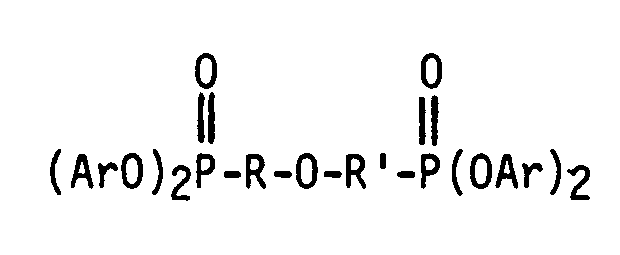
where Ar is aryl, alkyl-substituted aryl, or polyalkyl-substituted aryl group of 6 to 30 carbon atoms and R and R' are independently an alkylene bridging group of from 1 to 6 carbon atoms.
where Ar is aryl, alkyl-substituted aryl, or polyalkyl-substituted aryl group of 6 to 30 carbon atoms and R and R' are independently an alkylene bridging group of from 1 to 6 carbon atoms.
2. The composition of Claim 1 wherein the flame retardant is oxy-di-2,1-ethanediyl bisphosphonic
acid tetraphenyl ester.
3. The composition of Claim 1 or 2 wherein the polymer is polyethylene terephthalate
or polybutylene terephthalate.
4. The composition of any of the Claims 1-3 wherein the group Ar is selected from phenyl,
dimethylphenyl, methylphenyl, ethylphenyl, isopropylphenyl, tertiarybutylphenyl, or
mixtures thereof.
5. The composition of any of the Claims 1-4 wherein the alkylene bridging group has 2
to 4 carbon atoms.
6. A process for making a flame retardant polyester composition by hot milling with the
polyester 1 to 20 weight percent of the composition of a flame retardant represented
by the formula:
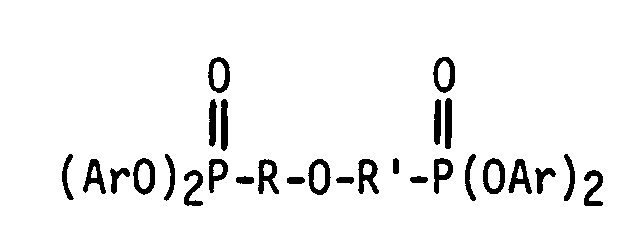
wherein Ar is aryl, alkyl-substituted aryl, and polyalkyl-substituted aryl group of 6 to 30 carbon atoms, and R and R' are independently an alkylene bridging group of from 1 to 6 carbon atoms.
wherein Ar is aryl, alkyl-substituted aryl, and polyalkyl-substituted aryl group of 6 to 30 carbon atoms, and R and R' are independently an alkylene bridging group of from 1 to 6 carbon atoms.
7. The process of Claim 6 wherein the flame retardant is oxy-di-2,1-ethanediyl bisphosphonic
acid tetraphenyl ester.
8. The process of Claim 7 wherein the hot milling is performed at a temperature in the
range of from 210°C to 390°C.
9. The process of any one of the claims 6-8 wherein the polymer is polybutylene terephthalate
or polyethylene terephthalate.
1. Flammhemmende Polyesterzubereitung enthalten ein Polyesterharz in Mischung mit 1-20
Gew.% der Zubereitung eines Flammhemmittels entsprechend der Formel
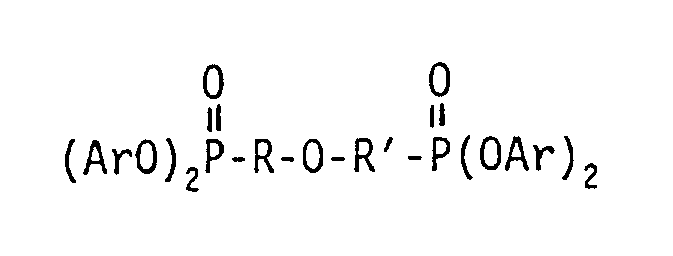
worin Ar eine Aryl-, alkylsubstituierte Aryl- oder polyalkylsubstituierte Arylgruppe mit 6 bis 30 Kohlenstoffatomen ist, und R und R' unabhängig voneinander eine Alkylenbrückengruppe von 1 bis 6 Kohlenstoffatomen sind.
worin Ar eine Aryl-, alkylsubstituierte Aryl- oder polyalkylsubstituierte Arylgruppe mit 6 bis 30 Kohlenstoffatomen ist, und R und R' unabhängig voneinander eine Alkylenbrückengruppe von 1 bis 6 Kohlenstoffatomen sind.
2. Zubereitung nach Anspruch 1, bei welcher das Flammhemmittel Oxy-di-2,1-ethandiyl-bisphosphonsäuretetraphenylester
ist.
3. Zubereitung nach Anspruch 1 oder 2, bei welcher das Polymer Polyethylenterephthalat
oder Polybutylenterephthalat ist.
4. Zubereitung nach einem der Ansprüche 1-3, bei welcher die Gruppe Ar gewählt ist aus
Phenyl, Dimethylphenyl, Methylphenyl, Ethylphenyl, Isopropylphenyl, tert.Butylphenyl
oder Mischungen hiervon.
5. Zubereitung nach einem der Ansprüche 1-4, bei welcher die Alkylenbrückengruppe 2 bis
4 Kohlenstoffatome aufweist.
6. Verfahren zur Herstellung einer flammhemmenden Polyesterzubereitung durch Heissverarbeitung
des Polyesters mit 1 bis 20 Gew.% der Zubereitung eines Flammhemmittels entsprechend
der Formel
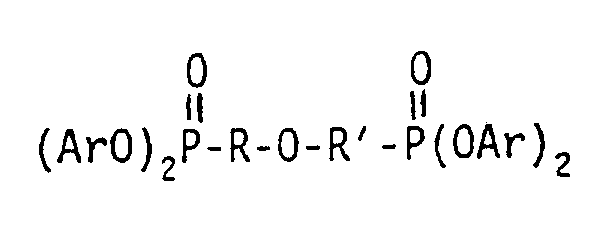
in welcher Ar eine Aryl-, alkylsubstituierte Aryl- oder polyalkylsubstituierte Arylgruppe mit 6 bis 30 Kohlenstoffatomen und R und R' unabhängig eine Alkylenbrückengruppe mit 1 bis 6 Kohlenstoffatomen ist.
in welcher Ar eine Aryl-, alkylsubstituierte Aryl- oder polyalkylsubstituierte Arylgruppe mit 6 bis 30 Kohlenstoffatomen und R und R' unabhängig eine Alkylenbrückengruppe mit 1 bis 6 Kohlenstoffatomen ist.
7. Verfahren nach Anspruch 6, bei welchem das Flammhemmittel Oxy-di-2,1-ethandiyldiphosphonsäuretetraphenylester
ist.
8. Verfahren nach Anspruch 7, bei welchem die Heissverarbeitung bei einer Temperatur
im Bereich von 210 bis 390°C erfolgt.
9. Verfahren nach einem der Ansprüche 6-8, bei welchem das Polymer Polybutylenterephthalat
oder Polyethylenterephthalat ist.
1. Composition de polyester ignifugeante comprenant une résine de polyester mélangée
avec de 1 à 20 % en poids de la composition d'un ignifugeant représenté par la formule
:
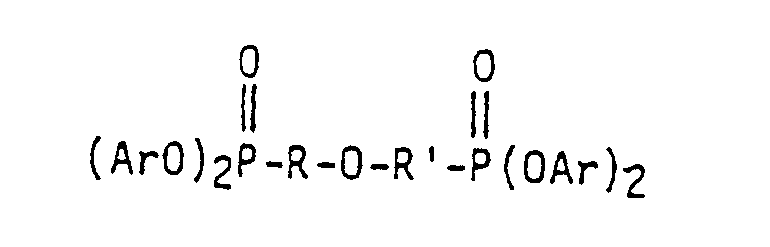
dans laquelle Ar représente un groupement aryle, un groupement aryle substitué par un groupement alkyle, ou un groupement aryle substitué par un groupement polyalkyle en C₆-C₃₀ et R et R' représentent indépendamment un groupement alkylène formant un pont en C₁-C₆.
dans laquelle Ar représente un groupement aryle, un groupement aryle substitué par un groupement alkyle, ou un groupement aryle substitué par un groupement polyalkyle en C₆-C₃₀ et R et R' représentent indépendamment un groupement alkylène formant un pont en C₁-C₆.
2. Composition selon la revendication 1, dans laquelle l'ignifugeant est l'ester d'acide
oxy-di-2,1-éthanediylbisphosphonique de tétraphényle.
3. Composition selon la revendication 1 ou 2, dans laquelle le polymère est le polytéréphtalate
d'éthylène ou le polytéréphtalate de butylène.
4. Composition selon l'une quelconque des revendications 1 à 3, dans laquelle le groupe
Ar est choisi parmi les suivants : phényle, diméthylphényle, méthylphényle, éthylphényle,
isopropylphényle, tertiobutylphényle ou des mélanges de ceux-ci.
5. Composition selon l'une quelconque des revendications 1 à 4, dans laquelle le groupement
alkylène formant un pont contient de 2 à 4 atomes de carbone.
6. Procédé de préparation d'une composition de polyester ignifugeante par malaxage à
chaud du polyester et de 1 à 20 % en poids de la composition d'un ignifugeant représenté
par la formule :
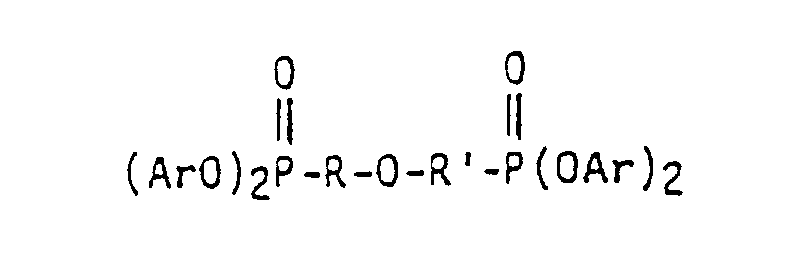
dans laquelle Ar représente un groupement aryle, un groupement aryle substitué par un groupement alkyle, un groupement aryle substitué par un groupement polyalkyle en C₆-C₃₀ et R et R' représentent indépendamment un groupement alkylène formant un pont en C₁-C₆.
dans laquelle Ar représente un groupement aryle, un groupement aryle substitué par un groupement alkyle, un groupement aryle substitué par un groupement polyalkyle en C₆-C₃₀ et R et R' représentent indépendamment un groupement alkylène formant un pont en C₁-C₆.
7. Procédé selon la revendication 6, dans lequel l'ignifugeant est l'ester d'acide oxy-di-2,1-éthanediylbisphophonique
de tétraphényle.
8. Procédé selon la revendication 7, dans laquelle le malaxage à chaud est effectué à
une température comprise entre 210°C et 390°C.
9. Procédé selon l'une quelconque des revendications 6 à 8, dans laquelle le polymère
est le polytéréphtalate de butylène ou le polytéréphtalate d'éthylène.