|
(11) | EP 0 301 508 B1 |

| (12) | EUROPEAN PATENT SPECIFICATION |
|
|
| (54) |
Method for producing a silver halide photographic emulsion Methode zur Herstellung einer photographischen Silberhalogenidemulsion Méthode de préparation d'une émulsion photographique à l'halogénure d'argent |
|
|
|||||||||||||||||||||||||||||||
| Note: Within nine months from the publication of the mention of the grant of the European patent, any person may give notice to the European Patent Office of opposition to the European patent granted. Notice of opposition shall be filed in a written reasoned statement. It shall not be deemed to have been filed until the opposition fee has been paid. (Art. 99(1) European Patent Convention). |
FIELD OF THE INVENTION
[0001] The present invention relates to a method for producing a spectrally sensitized silver halide emulsion and, more particularly, to a method of making a silver halide emulsion, in which a cyanine dye of the kind which forms a J-aggregate and a supersensitizer are used-during the formation of silver halide grains.
BACKGROUND OF THE INVENTION
[0002] In making spectrally sensitized silver halide emulsions, sensitizing dyes are usually added to emulsions after formation of silver halide grains. Methods of adding sensitizing dyes to emulsions prior to completion of grain formation of silver halide are disclosed in US-A-2, 735,766, 3,628,960, 4,183,756 and 4,225,666 and JP-A-196749/85 (US-A-4,683,193), JP-A-61-103149, JP-A-61-249053, and JP-A-61-210345 (the term "JP-A" as used herein means an "unexamined published Japanese patent application").
[0003] Particularly in US-A- 4,183,756 and 4,225,666, it is disclosed that advantages such as an increase in sensitivity and a strengthening of adsorption of sensitizing dyes to silver halide grains are obtained by adding sensitizing dyes to emulsions after the stable nucleation, and during the course of the formation of silver halide grains.
[0004] However, frequently silver halide emulsions made in accordance with the methods disclosed in the above-cited patents, which involve adding a J-aggregated cyanine dye prior to the grain formation of silver halide, are spectrally sensitized with markedly low efficiency, or cannot provide a high spectral sensitizing effect.
[0005] The efficiency of spectral sensitization can be determined by measuring a relative quantum yield Φr in spectral sensitization. The procedures for measuring Φr are well-known to those skilled in the art, and are described in detail, e.g., in J. Spence & B.H. Carroll, Journal of Physical and Colloid Chemistry, vol. 52, p. 1090 (1948), and Tada-aki Tani & Hitoshi Urabe, Nippon Shashin Gakkai-Shi, vol.41, p. 325 (1978).
SUMMARY OF THE INVENTION
[0006] A first object of the present invention is to provide an improved method for spectral sensitization, in which adsorption of dyes is strengthened and thereby a high efficiency of spectral sensitization can be obtained.
[0007] A second object of the present invention is to provide an improved method for spectral sensitization, in which the desensitization of dyes is depressed and thereby a high efficiency of spectral sensitization can be obtained.
[0008] A third object of the present invention is to provide an improved method for spectral sensitization, in which a large amount of dyes are added to provide high efficiency spectral sensitization.
[0009] We have found that an improved silver halide photographic emulsion, which has a high spectral sensitizing effect, and in which adsorption of a sensitizing dye is strengthened, can be made by forming silver halide grains in the presence of not only a J-aggregated cyanine dye but also a sensitizing amount of a supersensitizer. Further, we have found that in accordance with the above-described method, the desensitizing effect of dyes can be depressed and the efficiency of spectral sensitization can be heightened, so an improved silver halide photographic emulsion which has spectral sensitization of high efficiency and chemical sensitization can be prepared. Furthermore, we have found that in accordance with this method, the desensitizing effect of dyes can be depressed to enable the preparation of an improved silver halide photographic emulsion with a high spectral sensitizing efficiency by addition of a large amount of spectral sensitizing dye.
[0010] Accordingly, the present invention relates to a method for producing a spectrally sensitized silver halide photographic emulsion by the step of forming silver halide grains in the presence of at least one J-aggregated cyanine dye and a supersensitizer.
DETAILED DESCRIPTION OF THE INVENTION
[0011] The term "supersensitizer" as used herein means any compound having a supersensitizing effect conventionally used in the field of silver halide photographic emulsions, and includes compounds capable of increasing the spectral sensitivity of an emulsion when a cyanine dye is used in combination therewith, compared with the use of the cyanine dye alone.
[0012] A cyanine dye of the kind which forms the J-aggregate and a supersensitizer can be added to a silver halide emulsion at any time, provided that it preceeds the completion of the formation of silver halide grains. The addition time can be properly chosen depending on the types of sensitizing dyes and emulsion used. Whole amounts of sensitizing dye and supersensitizer may be added to the reaction system simultaneously with or prior to the beginning of grain formation. On the other hand, the sensitizing dye and the supersensitizer each may be divided into several portions, and added intermittently. In the latter case, for instance, one portion is added at the beginning of the grain formation, and the others can be added at regular time intervals during the course of grain formation. On the other hand, the sensitizing dye and the supersensitizer can be continuously added before completion of the grain formation. These ingredients may be added together with a silver nitrate solution, a halide solution or independently of these solutions. In the latter case, the addition may be initiated simultaneously with or prior to the beginning of grain formation, or at a time after the beginning of grain formation. When an emulsion-making method including a step of growing seed crystals is employed, the dye and the supersensitizer may be continuously or intermittently added during the growing step.
[0013] Even though the addition of the J-aggregated sensitizing dyes and the supersensitizer is continued after the completion of grain formation of silver halide, some benefit can be obtained, provided that the amounts added after the completion of grain formation are below one-half the respective total amounts added. However, the continued addition departing from the scope of the present invention causes the lowering of absorbance in the spectrally sensitizable region, and further deterioration in keeping qualities of the emulsion prepared and the sensitive material containing the emulsion.
[0014] A sensitizing dye and a supersensitizer can be added in various manners as described above, provided that the addition thereof is finished prior to the completion of the grain formation of silver halide. The sensitizing dye and the supersensitizer may be added separately, or as a mixture thereof. They may be added simultaneously or alternately with each other. When both are added simultaneously, each ingredient may be added separately before or afterward. More specifically, it is preferred that the addition of a first ingredient should be started before the quantity of the second ingredient exceeds one-half the total amount to be added, and more than one-half of the total amount of the first ingredient should be finished by the conclusion of the addition of the second ingredient. More preferably, more than two-thirds of the respective total amounts should be added simultaneously. In particular, the simultaneous addition of the respective total amounts is favoured over other manners of addition.
[0015] The amounts of each of a sensitizing dye and a supersensitizer to be added to a silver halide photographic emulsion in accordance with the present invention, though depending on the shape and the size of silver halide grains to be supersensitized thereby, preferably range from 1x10⁻⁶ to 5x10⁻³ mol, particularly from 1x10⁻⁵ to 2.5x10⁻³ mol, per mole of silver halide.
[0016] In adding a sensitizing dye to be used in the present invention to a silver halide photographic emulsion in accordance with the method of the present invention, the dye may be directly dispersed into the emulsion, or dissolved in advance in a solvent, such as water, acetone, methanol, ethanol, propanol, methyl cellosolve, 2,2,3,3-tetrafluoropropanol, N,N-dimethylformamide or a mixture of two or more thereof, and then added to the emulsion
[0017] Also, the dissolving a sensitizing dye can be performed with ultrasonic waves. Further, various methods can be employed in adding the sensitizing dyes of the present invention, including a method as described in US-A-3, 469,987, in which a sensitizing dye is dissolved in a volatile organic solvent, the resulting solution is dispersed into water or a hydrophilic colloid, and then the resulting dispersion is added to an emulsion; a method as described in JP-B-46-24185 (the term "JP-B" as used herein means an "examined published Japanese patent publication"), in which a water-insoluble dye is dispersed into a water-soluble solvent without undergoing any dissolution treatment, and the resulting dispersion is added to an emulsion; a method as described in JP-B-44-23389, JP-B-44-27555, JP-B-57-22091, in which a sensitizing dye dissolved in an acid is added to an emulsion, or a sensitizing dye which is dissolved in the presence of an acid or a base is added to an emulsion; a method as described in US-A-3,822,135 and 4,006,025, in which a sensitizing dye is made an aqueous or collidal dispersion in the presence of a surface active agent, and then added to an emulsion; a method as described in JP-A-53-102733 and JP-A-58-105141, in which a sensitizing dye is dispersed directly into a hydrophilic colloid, and then added to an emulsion; and a method as described in JP-A-51-74624, in which a sensitizing dye is dissolved by the use of a red-shift compound, and the resulting solution is added to an emulsion.
[0018] Cyanine dyes of the kind which form the J-aggregate, which are preferably used in the present invention, are represented by the following general formulae (I), (II) or (III). These dyes can also be employed as compounds referred to as the supersensitizers used in the present invention.
In the foregoing formula (I), Z¹ represents oxygen, sulfur, selenium, or -CH=CH-, and Z² represents sulfur, selenium, or -CH=CH-.
[0019] R₁ and R₂, which may be the same or different, each represents an unsubstituted or substituted alkyl group.
[0020] V¹ and V⁴, which may be the same or different, each represents hydrogen or an atomic group necessary for forming a condensed benzene ring with V² and V⁵, respectively; V², V³, V⁵ and V⁶, which may be the same or different, each represents a straight- or branched-chain alkyl group containing at most 5 carbon atoms, an alkoxy group containing at most 4 carbon atoms, a hydroxy group, an acylamino group containing at most 4 carbon atoms, an unsubstituted or substituted phenyl group containing at most 8 carbon atoms, a halogen atom, an alkoxycarbonyl group containing at most 5 carbon atoms, a carboxyl group, or a hydrogen atom.
[0021] Provided that V³ may be linked with V² and V⁶ may be linked with V⁵, to form a condensed benzene ring.
[0022] m₁ represents 0 or 1; and X₁ represents a counter ion residue necessary for charge balance. Specific examples of a cationic counter ion residue represented by X₁ include Na⁺, K⁺, a pyridinium cation, and an ammonium cation such as triethylammonium cation, and anionic counter ion residue include Cl⁻, Br⁻, I⁻, SCN⁻, p-toluenesulfonium, benzenesulfonium, ClO₄⁻, and ethylsulfate.
In the foregoing formula (II), Z²¹ represents an atomic group necessary for completing a 4-thiazoline, thiazolidine, benzo-4-thiazoline, naphtho[1,2-d]-4-thiazoline, naphtho[2,3-d]-4-thiazoline, selenazolidine, 4-selenazoline, benzo-4-selenazoline, naphtho[1,2-d]-4-selenazoline, naphtho[2,3-d]-4-selenazoline, benzo-4-oxazoline, naphtho[1,2-d]-4-oxazoline, naphtho[2,3-d]-4-oxazoline or benzo-4-imidazoline nucleus, each of which may be unsubstituted or substituted.
[0023] R₂₁, R₂₂ and R₂₃, which may be the same or different, each represents an unsubstituted or substituted alkyl group.
[0024] R₂₄ represents a hydrogen atom or an atomic group necessary for completing a 5- or 6-membered ring in combination with R₂₃.
[0025] V²¹ represents an electron attracting group including fluorine, chlorine, a cyano group, an alkoxycarbonyl group containing at most 4 carbon atoms, and an alkylsulfonyl group containing at most 4 carbon atoms.
[0026] V²² can be a group represented by V²¹, and further may be hydrogen or an atomic group necessary for completing a condensed benzene ring in combination with V²¹.
[0027] X₂₁ has the same meaning as X₁ in formula (I), and m₂₁ represents 0 or 1.
In the foregoing formula (III), Z³¹ represents oxygen, sulfur, or selenium.
[0028] Z³² represents an atomic group necessary for completing a thiazole, benzothiazole, naphtho[1,2-d]thiazole, 8,9-dihydro-naphtho[1,2-d]thiazole, naphtho[2,3-d]thiazole, selenazole, benzoselenazole, naphtho[1,2-d]selenazole, benzoxazole, naphtho[1,2-d]oxazole, or naphtho[2,3-d]oxazole nucleus.
[0031] V³¹, V³² and V³³ have the same meanings as V¹, V² and V³, respectively, and further, V³² and V³³ may combine with each other to form a 5- or 6-membered ring, which can contain oxygen atoms.
[0032] R₃₄ represents a hydrogen atom, or an atomic group necessary for completing a 5- or 6-membered ring in combination with R₃₂.
[0034] Preferred examples of a substituent group by which alkyl groups represented by R₁, R₂, R₂₁, R₂₂, R₂₃, R₃₁ and R₃₂ in the foregoing general formulae (I), (II) and (III) can be substituted include a lower alkyl group, a halogen atom, a carbamoyl group, a carboxyl group, an alkoxycarbonyl group, an acylamino group, a hydroxyl group, a sulfo group, and a substituted phenyl group such as a sulfo-substituted phenyl, a carboxy-substituted phenyl. Specific examples of unsubstituted and substituted alkyl groups preferred as R₁, R₂, R₂₁, R₂₂, R₂₃, R₃₁ and R₃₂ include methyl, ethyl, propyl, pentyl, methoxymethyl, ethoxyethyl, 2,2,2-trifluoroethyl, 2,2,3,3,-tetra-fluoropropyl, carbamoylethyl, hydroxyethyl, carboxymethyl, carboxyethyl, 2-sulfoethyl, 3-sulfopropyl, 3-sulfobutyl, 4-sulfobutyl, p-sulfophenetyl, ethoxycarbonylethyl, 2-hydroxy-3-sulfopropyl, 2-acetylaminoethyl, 2-chloro-3-sulfopropyl and 2-[2-(3-sulfopropoxy)ethoxy]ethyl group.
[0035] Specific examples of J-aggregated cyanine dyes which can be used in the present invention are illustrated below. However, the invention is not to be construed as being limited to these examples.
Preferred examples of a supersensitizer which can be used in the present invention include sensitizing dyes described in US-A-3,703,377, 2,688,545, 3,397,060, 3,615,635 and 3,628,964, GB-B-1,242,588 and 1,293,862, JP-B-43-4936, JP-B-44-14030 and JP-B-43-10773, US-A-3,416,927, JP-B-43-4930, US-A-3,615,613, 3,615,632, 3,617,295 and 3,635,721; holopolar cyanine dyes described in GB-B-1,153,343, US-A-4,546,073, JP-A-59-148053; hemicyanines and hemicyanine bases described in US-A-4,152,163, JP-B-49-17525 and JP-B-48-38406; and aminostyryl compounds described in GB-B-1,351,149, 1,230,449 and 1,310,994.
[0036] Specific examples of representative supersensitizers which are preferably used in the present invention include cyanine dyes cited above as the compounds forming a J-aggregate, which are represented by the foregoing general formulae (I), (II) or (III), the compounds illustrated below, and azole compounds represented by general formula (IV) described hereinafter, but the present invention is not to be construed as being limited thereto.
wherein Z represents a nitrogen-containing heterocyclic residue (preferably a 5- or 6-membered ring).
[0037] The heterocyclic group for Z may be a condensed ring, and preferably includes imidazole, triazole, tetrazole, thiazole, oxazole, selenazole, benzimidazole, benzoxazole, benzothiazole, thiadiazole, oxadiazole, benzoselenazole, pyrazole, pyrimidine, triazine, pyridine, naphthothiazole, naphthoimidazole, naphthoxazole, azabenzimidazole, purine and azaindene (e.g., triazaindene, tetraazaindene, pentaazaindene, etc.).
[0038] Further, these heterocyclic groups or condensed rings may be substituted with appropriate substituents. Examples of the substituents are an alkyl group (e.g., methyl, ethyl, hydroxyethyl, trifluoromethyl group, sulfopropyl, di-propylaminoethyl, adamantane), an alkenyl group (e.g., allyl), an aralkyl group (e.g., benzyl, p-chlorophenethyl), an aryl group (e.g., phenyl, naphthyl, p-carboxyphenyl, 3,5-dicarboxyphenyl, m-sulfophenyl, p-acetamidophenyl, 3-capramidophenyl, p-sulfamoylphenyl, m-hydroxyphenyl, p-nitrophenyl, 3,5-dichlorophenyl, 2-methoxyphenyl), a heterocyclic group (e.g., pyridyl), a halogen atom (e.g., chlorine, bromine), a mercapto group, a cyano group, a carboxyl group, a sulfo group, a hydroxyl group, a carbamoyl group, a sulfamoyl group, an amino group, a nitro group, an alkoxy group (e.g., methoxy, ethoxy), an aryloxy group (e.g., phenoxy), an acyl group (e.g., acetyl), an acylamino group (e.g., acetylamino, capramido) a sulfonylamino group (e.g. a methylsulfonylamino group). a substituted amino group (e.g., diethylamino, hydroxyamino), an alkylthio or arylthio group (e.g., methylthio, carboxyethylthio, sulfobutylthio), an alkoxycarbonyl group (e.g., methoxycarbonyl) and an aryloxycarbonyl group (e.g., phenoxycarbonyl).
[0039] The mercapto-containing compounds may be disulfides (Z-S-S-Z) that can be easily cleaved into the form of the formula (IV) in the emulsion.
[0040] Specific compounds represented by general formula (IV) include the compounds represented by general formula (1) described in JP-A-222843/85.
[0041] In addition, materials which can exhibit a supersensitizing effect in combination with sensitizing dyes although they themselves do not spectrally sensitize silver halide emulsions or do not absorb light in the visible region, for example, aminostilbene compounds substituted with nitrogen-containing heterocyclic groups (e.g., as described in US-A-2,933,390 and 3,635,721), aromatic organic acid-formaldehyde condensates (e.g., US-A-3,743,510), cadmium salts, azaindene compounds, can be employed as the supersensitizer in the method of the present invention.
[0042] Sensitizing dyes and supersensitizers which can be used in the present invention can be synthesized according to methods described in F.M. Hamer, Heterocyclic Compounds - Cyanine Dyes and Related Compounds - (John Wiley & Sons, New York-London 1964), D.M. Sturmer, Heterocyclic Compounds - Special Topics in Heterocyclic Chemistry-, chapter 8, paragraph 4, pages 482-515 (John Wiley & Sons, New York-London 1977), and JP-A-60-78445.
[0043] The silver halide emulsion which can be used in the present invention is generally made by mixing a solution of a water-soluble silver salt (e.g., silver nitrate) with a solution of a water-soluble halide (e.g., potassium bromide) in the presence of a solution of a water-soluble high polymer, such as gelatin. The silver halide formed therein may be any of silver chloride, silver bromide, and mixed silver halides such as silver chlorobromide, silver iodobromide, silver chloroiodobromide and so on. The mean grain size thereof is preferably less than 4 µm (microns). The term "mean grain size "as used herein refers to the grain diameter in case of grains spherical or approximately spherical in shape, while it refers to the edge length in case of cubic grains. In both cases, it is represented by the mean based on the projected areas of grains. The distribution of grain size may be narrow (monodisperse) or broad.
[0044] These silver halide grains may assume any crystal form, such as that of a cube, a tetradecahedron, a rhombic dodecahedron or an octahedron, a composite form of two or more thereof, a sphere and a plate.
[0045] Also, an emulsion in which silver halide grains having a tabular shape such that the grain diameter is 5 or more times the grain thickness are contained in a fraction of 50% or more, based on the total projected area, may be used. The preferred grain size of these grains ranges from 0.5 to 10 µm. (The term "grain size "as used herein refers to the diameter of a circle having the same area as the projected area of a grain, and the term thickness refers to the distance between two parallel faces.) Detailed descriptions are given, e.g., in JP-A-58-127921 and JP-A-58-113927.
[0046] The crystal structure of silver halide grains may be uniform throughout, or the silver halide grains may have a multilayer structure in which the interior and the surface of the grains differ in halide composition, or a conversion type structure described in GB-B-635,841, and US-A-3,622,318. Either silver halide grains of the kind which form latent image predominantly at the surface of the grains, or those of the kind which mainly form latent image inside the grains may be used.
[0047] Photographic emulsions which can be used in the present invention can be prepared using methods as described in P. Glafkides, Chimie et Physique Photographique, (Paul Montel 1967), G.F. Duffin, Photographic Emulsion Chemistry, (Focal Press 1966), and V.L. Zelikman et al., Making and Coating Photographic Emulsion, (Focal Press 1964).
[0048] More specifically, any of an acid process, a neutral process and an ammonia process can be employed for preparation of photographic emulsions. Suitable methods for reacting a water-soluble silver salt with a water-soluble halide may be any of a single jet method, a double jet method and a combination thereof. Also, a method in which silver halide grains are produced in the presence of excess silver ion (the reverse mixing method) can be employed in the present invention. The controlled double jet method, in which the pAg of the liquid phase in which silver halide grains are precipitated is maintained constant, can be also employed. According to this method, a silver halide emulsion having a regular crystal form and grain sizes nearly uniform can be obtained.
[0049] In a process of the formation or physical ripening of silver halide grains, a cadmium salt, a zinc salt, a lead salt, a thallium salt, a iridium salt or a complex salt thereof, a rhodium salt or a complex salt thereof, an iron salt or a complex salt thereof may be present.
[0050] In order to control the crystal growth of silver halide grains in the step of forming silver halide grains, silver halide solvents, such as ammonia, potassium thiocyanate, ammonium thiocyanate, thioether compounds, thione compounds (e.g., those described in JP-A-53-144319, JP-A-53-82408 and JP-A-55-77737), amine compounds (e.g., those described in JP-A-54-100717) can be used.
[0051] While the silver halide emulsion can be employed without being chemically sensitized, that is to say, without being subjected to after-ripening (in the form of a primitive emulsion), it is preferably chemically sensitized. For the chemical sensitization, methods described in H. Frieser, Die Grundlagen der Photographischen Prozesse mit Silberhalogeniden, pp. 675-734, (Akademische Verlagsgesellschaft 1968) can be employed.
[0052] More specifically, sulfur sensitization methods using active gelatin, and compounds containing sulfur capable of reacting with silver ions (e.g., thiosulfates, thioureas, mercapto compounds, and rhodanines), reduction sensitization methods using reducing materials (e.g., stannous salts, amines, hydrazine derivatives, formamidine sulfinic acid and silane compounds, noble metal sensitization methods using noble metal compounds (e.g., gold compounds, and complex salts of Group VIII metals such as platinum, iridium and palladium, etc.) can be employed independently or as a combination thereof.
[0053] In addition, other sensitizers such as polyoxyethylene derivatives (as described in GB-B-981,470, JP-B-31-6475, US-A-2,716,062), polyoxypropylene derivatives and derivatives having a quaternary ammonium group may be employed.
[0054] The photographic emulsion employed in the present invention can contain a wide variety of compounds for purposes of preventing fog or stabilizing photographic functions during production, storage, or photographic processing, including azoles, such as benzothiazolium salts, nitroimidazoles, nitrobenzimidazoles, chlorobenzimidazoles, benzotriazoles, aminotriazoles; mercapto compounds, such as mercaptothiazoles, mercaptobenzothiazoles, mercaptobenzimidazoles, mercapto-thiadiazoles, mercaptotetrazoles (especially 1-phenyl-5-mercaptotetrazole), mercaptopyrimidines, mercapto-triazines; thioketo compounds such as oxazolinethione; azaindenes, such as triazaindenes, tetraazaindenes (especially 4-hydroxy-substituted (1,3,3a,7)-tetraazaindenes), pentaazaindenes; and compounds which have been known as antifoggants or stabilizers, such as benzenethiosulfones, benzenesulfinic acid and benzenesulfonic acid amide.
[0055] More specific examples and usages of the above-cited compounds are disclosed in US-A-3,954,474 and 3,982,947, JP-B-52-28660.
[0056] As for the binder or the protective colloid which can be used in applying the silver halide emulsion, which is spectrally sensitized in accordance with the present invention, to a photosensitive material, gelatin can be used. Also, hydrophilic synthetic high polymers can be used. Gelatin which can be used includes lime-processed gelatin, acid-processed gelatin, and derived gelatins. Such gelatins are described in Research Disclosure, Vol, 176, No. 17643, IX (Dec. 1976).
[0057] The spectrally sensitized silver halide emulsion prepared according to the method of the present invention and the photographic light-sensitive material using the same may contain color image-forming couplers, that is to say, compounds capble of forming colors by color development processing by oxidative coupling with aromatic primary amine developing agents (e.g., phenylenediamine derivatives, aminophenol derivatives. Nondiffusible couplers which contain a hydrophobic group called a ballast group in a molecule, or polymeric couplers are preferred over others. These couplers may be either four-equivalent or two-equivalent to silver ion. In addition, the emulsion and the light-sensitive material may contain colored couplers having a color compensating effect, couplers capable of releasing a development inhibitor with the progress of development ("DIR couplers"), and couplers capable of releasing a development accelerator or a fogging agent ("DAR couplers" and "FR couplers"). Further, those may contain colorless DIR coupling compounds which can yield a colorless compound by the coupling reaction, that release a development inhibitor.
[0058] Suitable examples of magenta couplers include those of 5-pyrazolone type, pyrazolobenzimidazole type, cyanoacetylcumarone type, open-chain acylacetonitrile type, and pyrazoloazole type. Suitable examples of yellow couplers include those of acylacetamide type (such as benzoylacetanilides, pivaloylacetanilides). Suitable examples of cyan couplers include those of naphthol type, phenol type.
[0059] In order to provide characteristics required of photosensitive materials, two or more of the above-described couplers can be incorporated in the same layer, or one of them can be added to two or more of different layers.
[0060] Compounds which can be additionally used in the silver halide emulsion prepared in accordance with the method of the present invention, and in the photographic light-sensitive material using this emulsion include desensitizers, brightening agents, high boiling organic solvents (coupler solvents), dye-image stabilizers, stain inhibitors, absorbers (dyes, light absorbers and UV absorbers), hardeners, coating aids (surface active agents), plasticizers, lubricants, antistatic agents, matting agents and development accelerators. . As for the additives described hereinbefore and these additives, those described in Research Disclosure, Vol. 176, No. 17643, I to XVI (pages 22 to 28) (Dec. 1978) can be used.
[0061] The finished emulsion is coated on an appropriate support such as baryta paper, resin-coated paper, synthetic paper, a triacetate film, a polyethylene terephthalate film, another plastic base, or a glass plate. Various coating methods, including a dip coating method, an air knife coating method, a curtain coating method and an extrusion coating method utilizing a hopper as described in US-A-2,681,294, can be employed.
[0062] Such a support may be either transparent or opaque depending upon the intended use of the light-sensitive material When a support used is transparent, it can be colorless or colored by addition of a dye or a pigment.
[0063] The exposure for obtaining a photographic image may be carried out in a conventional manner. Any of various known light sources including natural light (sunlight), a tungsten lamp, a fluorescent lamp, a mercury lamp, a xenon arc lamp, a carbon arc lamp, xenon flash lamp and cathode-ray flying spot can be employed for the exposure. Suitable exposure times which can be used include not only exposure times commonly used in cameras ranging from about 1/1000 to about 1 sec., but also exposure times shorter than 1/1000 sec., e.g., about 1/104 to about 1/106, as used with xenon flash lamps and cathode-ray tubes. Exposure times longer than 1 second can also be used. The spectral distribution of the light employed for the exposure can be controlled using color filters, if desired. Laser beams can also be employed for the exposure. Moreover, the emulsion prepared according to the method of the present invention may also be exposed to light emitted from phosphors excited by electron beams, X-rays, γ-rays and α-rays.
[0064] Photographic light-sensitive materials to which the emulsion prepared according to the method of the present invention can be applied include various color and black-and-white photosensitive materials. Specific examples of such materials include color negative films (for amateur use and motion picture use), color reversal films (for slide use and motion picture use, which may be the coupler-in-emulsion type, or not), color photographic papers, color positive films (for motion picture use), color reversal photographic papers, heat-developable color photosensitive materials, color photosensitive materials for a silver dye bleach process, photographic light-sensitive materials for a photomechanical process (lith films and scanner films), X-ray photographic light-sensitive materials (for medical use employing radiography or fluorography, for industrial use), black-and-white negative films, black-and-white photographic papers, microphotographic light-sensitive materials (COM and microfilms) color diffusion transfer photosensitive materials (DTR), silver salt diffusion transfer photosensitive materials and printout photosensitive materials.
[0065] In the photographic processing of a photosensitive material to which the silver halide emulsion prepared in accordance with the method of the present invention is applied, any known processing method and any known processing solution can be employed. The processing temperature is generally in the range of about 18°C to about 50°C. Of course, temperatures lower than about 18°C or higher than about 50°C may be employed. The photographic processing may include either development processing for forming a silver image (black-and-white photographic processing) or development processing for forming a dye image (color photographic processing).
[0066] Specifically, the development processing can be performed using the methods described in Research Disclosure, Vol. 176, No. 17643, pages 28-29, and idi, Vol. 187, No. 18716, page 651, left and right columns.
[0067] The present invention is illustrated in greater detail by reference to the following examples. However, the invention is not to be construed as being limited to these examples. Unless otherwise indicated, all parts, percents and ratios are by weight.
EXAMPLE 1
Method 1 (Comparative example)
[0068] In a reaction container, 1,000 ml of water, 30 g of deionized bone gelatin, 15 ml of a 50 % NH₄NO₃ aqueous solution and 7.5 ml of a 25 % aqueous ammonia were placed, and kept at 50°C with thoroughly stirring. Thereto, 750 ml of a 1N AgNO₃ aqueous solution and a 1N KBr aqueous solution were added over a 40-minute period, and the silver potential relative to a saturated calomel electrode was kept at +50 mV all through the reaction.
[0069] The silver bromide grains obtained had a cubic form, and their edge length was 0.62±0.06 µm. The foregoing emulsion was desalted, and thereto were added 140 g of deionized bone gelatin and 700 ml of water. The resulting emulsion was adjusted to pH 6.5 and pAg 8.3 at 50°C (which was called Emulsion (1)-1).
[0070] This emulsion was divided into 7 fractions, and each was allowed to stand for 20 minutes at 40°C with thorough stirring in order to effect ripening. During the ripening, the sensitizing dye II-12 was added, in the form of 5x10⁻⁴, 1x10⁻³ and 2x10⁻³ mol/l of methanol solutions, to three of these fractions in amounts of 8.6x10⁻⁵ mol, 1.72x10⁻⁴ mol and 3.44x10⁻⁴ mol, respectively, per mol of silver, while the sensitizing dye II-12 and the sensitizing dye III-1 to function as a supersensitizer were added to the other four fractions in equimolar amounts of 4.3x10⁻⁵ mol, 8.6x10⁻⁵ mol, 1.72x10⁻⁴ mol and 3.44x10⁻⁴ mol, respectively, per mole of silver. To all of these fractions were further added 0.033 g of sodium 2-(N-methylstearoylamino)ethylsulfonate, 0.016 g of sodium dodecylbenzenesulfonate and 0.784 g of 1,3-bis(vinylsulfonyl)-2-propanol. Each of the resulting emulsion fractions was coated on a cellulose triacetate film base at a coverage of 7 g/m² based on the silver bromide. Each of the coated emulsions was exposed to a tungsten lamp (color temperature: 2,854 K) through interference filters transmitting light of 400 nm, 541 nm and 571 nm, respectively, and a continuous wedge. The exposed emulsion coats were developed at 30°C for 10 minutes using the Developer D19 (comprising 2.2 g of Metol, 96 g of sodium sulfite, 8.8 g of hydroquinone, 48 g of sodium carbonate, and 5 g of potassium bromide in 1 liter of water).
[0071] In addition to sensitometric evaluation, the relative quantum yields of the spectral sensitization with the dye II-12 were determined as described in Tada-aki Tani & Hitoshi Urabe, Nippon Shashin Gakkai-Shi, volume 41, page 325 (1978). The results obtained are shown in Table 1.
Method 2 (comparative example)
[0072] Silver halide grains were formed in the same manner as in Method 1, except that the methanol solution of sensitizing dye II-12 was added continuously at an uniform rate over a period from 4 minutes to 38 minutes after the start of the addition of the aqueous solution of silver nitrate. Therein, the amounts of the sensitizing dye II-12 added were 8.6x10⁻⁵ mol, 1.72x10⁻⁴ mol and 3.44x10⁻⁴ mol, respectively, per mol of silver. The silver bromide grains formed had a cubic form in every case, and edge lengths were 0.62±0.05 µm, 0.61±0.07 µm and 0.60±0.06 µm, respectively (These emulsions were named (2)-1, (2)-2 and (2)-3, respectively).
[0073] To each of the foregoing emulsions, 140 g of deionized gelatin and 700 ml of water were added after desalting and washing, and then each was adjusted to pH 6.5 and pAg 8.3. Thereafter, ripening was carried out at 40°C for 20 minutes with thorough stirring. During the ripening, sodium 2-(N-methylstearoylamino)-ethylsulfonate, sodium dodecyl-benzenesulfonate and 1,3-bis(vinylsulfonyl)-2-propanol were added to each emulsion. The resulting emulsions were each coated on a cellulose triacetate base film, exposed and developed in the same manner as used in Method 1.
Method 3 (Present invention)
[0075] The same experiments as in Method 2 were performed, except that the sensitizing dye III-1 to function as a supersensitizer was added at an uniform rate in the form of 2.5x10⁻⁴, 5x10⁻⁴ and 1x10⁻³ mol/l methanol solutions simultaneously with addition of the sensitizing dye II-12 in equimolar amounts.
[0076] The thus obtained silver bromide grains were also cubic in all cases, and edge lengths were 0.62±0.07 µm, 0.60±0.07 µm and 0.60±0.07 µm, respectively.
[0078] As can be seen from the data set forth in Table 1, the values of sensitivity and Φr in case the exposure was carried out with light of 571 nm, at which the sensitizing dye II-12 exhibits its absorption maximum, were extremely low when the sensitizing dye II-12 forming the J-aggregate was added to an emulsion prior to completion of the formation of the silver halide grains (experiments 8 to 10), as compared with the case where the sensitizing dye was added after the completion of the grain formation (experiments 1 to 3). On the other hand, although the simultaneous addition of the sensitizing dye II-12 and the dye III-1 after the grain formation produced a supersensitizing effect (experiments 4 to 7), the simultaneous addition of these dyes prior to the completion of the grain formation in accordance with the method of the present invention (experiments 11 to 14) achieved much higher sensitivities and/or higher Φr values.
[0079] That is, the method of the present invention has proved excellent, since not only was the supersensitizing efficiency higher when the supersensitization was effected prior to the completion of the grain formation than when the supersensitization was carried out after the grain formation, but also very high sensitivity was attained in the former case.
EXAMPLE 2
Method 4 (Comparative example)
[0080] To an aqueous 3% gelatin solution which contained 1.6x10⁻⁴ mol/mol silver of the following compound (compound A);
and was kept at 75°C, a 750 ml of 1N aqueous solution of silver nitrate and an aqueous solution containing a mixture of 0.98 mol of potassium bromide and 0.02 mol of potassium iodide in 1 liter of water were simultaneously added with thorough stirring at a constant rate over a period of 60 minutes as the silver potential in the reaction system was maintained constant (-90 mV vs a standard calomel electrode SCE). Thus, octahedral silver iodobromide grains having an iodide content of 2 mol% were formed. The resulting emulsion was desalted according to a conventional flocculation process, to prepare a photographic emulsion.
[0081] Therein, a methyl cellosolve 2.5x10⁻³ mol/l solution of the sensitizing dye 1-18 was further added in an amount of 7.2x10⁻⁴ mol per mol of silver over a period from 10 minutes after the start of the addition of the aqueous solution of silver nitrate to 5 minutes before the conclusion of the addition of the aqueous solution of silver nitrate. The mean grain size of the thus obtained silver halide grains was about 1.03 µm, and the variation coefficient was 8.9 %.
[0082] To the above emulsion, a water solution of Na₃Au(S₂O₃)₃ was added in an optimal amount, and aged at 50°C for 60 minutes to effect gold-sulfur sensitization. This emulsion was named (4)-1.
Method 5 (Present invention)
[0083] Two kinds of silver iodobromide grains were formed in the same manner as in Method 4, except that a methyl cellosolve solution containing a mixture of the sensitizing dye I-18 and the following compound B,
instead of the sensitizing dye I-18 alone were added at a constant rate so that the total amount of the sensitizing dye I-18 added was 7.2x10⁻⁴ mol/mol Ag, and those of the compound B 7.2x10⁻⁵ mol/mol Ag and 2.1x10⁻⁴ mol/mol Ag, respectively. Then, in the same manner as Method 4, the resulting emulsions were desalted by a flocculation process, and subjected to gold-sulfur sensitization at 50°C by adding an optimal amount of a water solution of Na₂Au(S₂O₃)₃. These emulsions were named (5)-1 and (5)-2, respectively.
[0084] The mean grain size of each of the two kinds of octahedral silver iodobromide grains formed was about 1.04 µm (and the variation coefficients were 13.5% and 13.9%, respectively).
[0085] After addition of 100 g of 10% gelatin gel, the emulsion (4)-1 obtained according to Method 4 was divided into three fractions, and thereto compound B was added at 40°C in amounts of 0, 7.2x10⁻⁵ mol and 2.1x10⁻⁴ mol, respectively, per mole of silver. To these emulsions, and to those obtained by further adding 100 g of 10% gelatin gel to the emulsions (5)-1 and (5)-2, respectively, were added successively 4-hydroxy-6-methyl-(1,3,3a,7)-tetraazaindene in an amount of 0.2 g per Kg of emulsion, sodium 2-hydroxy-4,6-dichloro-1,3,5-triazine in an amount of 1.0 g per Kg of emulsion, and sodium dodecylbenzenesulfonate in an amount of 0.1 g per Kg of emulsion. Each of the resulting emulsions was coated in an amount of 3.7 g (as Ag)/m² on a polyethylene terephthalate film base to prepare a photographic light-sensitive material.
[0086] In coating the above-described emulsion, an aqueous solution containing 5.0 wt% of gelatin as a main component and 0.02 wt% of sodium dodecylbenzenesulfonate (a surface active agent), and 0.057 wt% of sulfostyrene potassium homopolymer (a viscosity-increasing agent) as additives was coated simultaneously on top of the emulsion layer. The gelatin coverage of the thus-formed protective layer was about 1.0 g/m².
[0087] Each of the coated samples was exposed to a tungsten lamp (color temperature: 2854 K) through interference filters capable of transmitting light of 545 nm and 400 nm, respectively, which corresponded to the absorption maxima of main absorption peaks in the distribution of spectral sensitization, and a continuous wedge. The exposed samples were developed at 20°C for 7 minutes using a developer prepared by diluting the following concentrated liquid developer with an equal volume of water.
Composition of Concentrated Liquid Developer
[0088]
| Water | 700 ml |
| Metol (p-methylaminophenol sulfate) | 3.1 g |
| Anhydrous Sodium Sulfite | 45 g |
| Hydroquinone | 12 g |
| Sodium carbonate (monohydrate) | 79 g |
| Potassium Bromide | 1.9 g |
| Water to make | 1 ℓ |
[0089] The results obtained are shown in Table 2 together with relative quantum yields, Φr, of the spectral sensitization with the dye I-18. The relative quantum yields Φr were determined by the same method in Example 1.
Table 2
| Experiment Number | Emulsion | Addition Amount of Compound B mol/mol Ag | Absorption Coefficient at 545 nm | Relative Sensitivity at 545 nm | at Φr 545 nm |
| 1 (Comparison) | (4)-1 | 0.573 | 100 | 0.32 | |
| 2 (Comparison) | (4)-1 | 7.2x10⁻⁵ | 0.565 | 214 | 0.68 |
| 3 (Comparison) | (4)-1 | 2.1x10⁻⁴ | 0.462 | 151 | 0.72 |
| 4 (Invention) | (5)-1 | 7.2x10⁻⁵ | 0.608 | 265 | 0.80 |
| 5 (Invention) | (5)-2 | 2.1x10⁻⁴ | 0.532 | 201 | 0.85 |
[0090] Though compound B had a supersensitizing effect on the sensitizing dye I-18 in all the experiments, the spectrally sensitizing effect was enhanced to a greater extent by adding both compounds before the completion of the grain formation of silver halide in accordance with the present invention.
[0091] In another experiment where the emulsion was prepared in the same manner as in Method-4, except that the sensitizing dye I-18 was not added during the grain formation of silver halide, but it was added in the same amount during a period after the gold-sulfur sensitization and before the coating, was employed, Φr was 0.36 and the relative sensitivity to light of 545 nm was 112.
[0092] According to the method of the present invention, not only can the relative quantum yield of spectral sensitization Φr be heightened, but also high spectral sensitivities can be achieved over the main portion of the spectral sensitization range, which is important in practical use. The present method is unexpectedly superior to a spectral sensitization method in which a sensitizing dye is added to an emulsion during a period after the grain formation and before the coating, or a spectral sensitization method in which a sensitizing dye forming the J-aggregate is added during the grain formation, while another supersensitizing sensitizing dye is added after the grain formation and before the coating.
1. A method for producing a spectrally sensitized silver halide photographic emulsion
which involves the addition of a J-aggregated cyanine dye, characterized by the step
of forming silver halide grains in the presence of at least one J-aggregated cyanine
dye and at least one supersensitizer.
2. The method as claimed in claim 1, wherein said J-aggregated cyanine is represented
by formula (I):
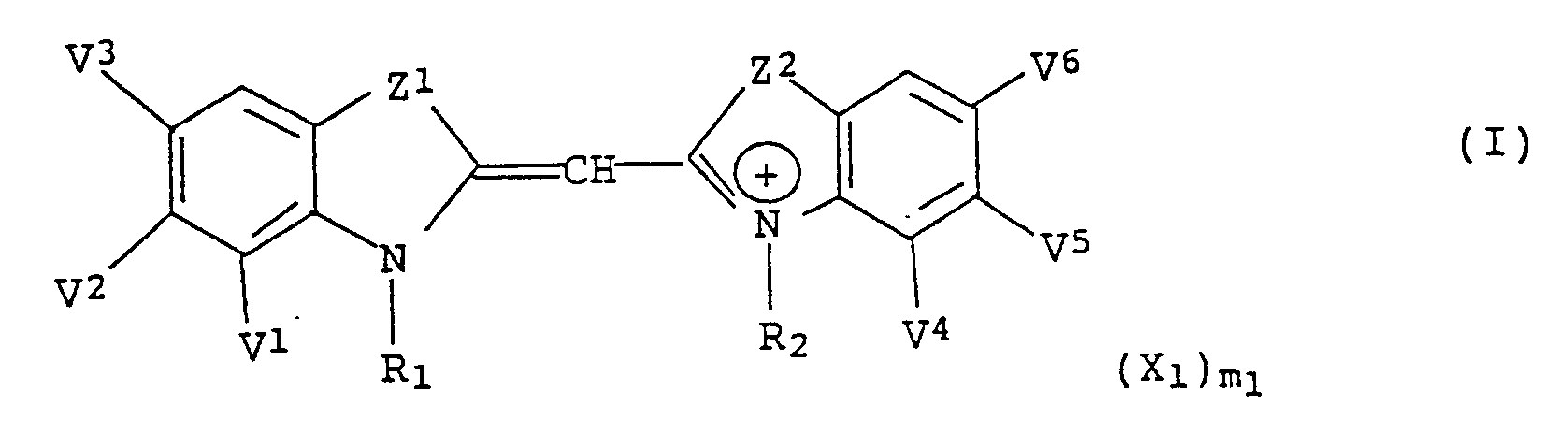
wherein Z¹ represents oxygen, sulfur, selenium, or -CH=CH-; Z² represents sulfur, selenium, or -CH=CH-; R₁ and R₂, which may be the same or different, each represents an unsubstituted or substituted alkyl group; V¹ represents hydrogen or an atomic group necessary for forming a condensed benzene ring with V²; V⁴ represents hydrogen or an atomic group necessary for forming a condensed benzene ring with V⁵; V², V³, V⁵ and V⁶, which may be the same or different, each represents a straight-chain or branched chain alkyl group containing at most 5 carbon atoms, an alkoxy group containing at most 4 carbon atoms, a hydroxyl group, an acylamino group containing at most 4 carbon atoms, an unsubstituted or substituted phenyl group containing at most 8 carbon atoms, a halogen atom, an alkoxycarbonyl group containing at most 5 carbon atoms, a carboxyl group or hydrogen, provided that V³ may be linked with V² to form a condensed benzene ring and V⁶ may be linked with V⁵ to form a condensed benzene ring; m₁ is 0 or 1; and X₁ represents a counter ion necessary for charge balance.
wherein Z¹ represents oxygen, sulfur, selenium, or -CH=CH-; Z² represents sulfur, selenium, or -CH=CH-; R₁ and R₂, which may be the same or different, each represents an unsubstituted or substituted alkyl group; V¹ represents hydrogen or an atomic group necessary for forming a condensed benzene ring with V²; V⁴ represents hydrogen or an atomic group necessary for forming a condensed benzene ring with V⁵; V², V³, V⁵ and V⁶, which may be the same or different, each represents a straight-chain or branched chain alkyl group containing at most 5 carbon atoms, an alkoxy group containing at most 4 carbon atoms, a hydroxyl group, an acylamino group containing at most 4 carbon atoms, an unsubstituted or substituted phenyl group containing at most 8 carbon atoms, a halogen atom, an alkoxycarbonyl group containing at most 5 carbon atoms, a carboxyl group or hydrogen, provided that V³ may be linked with V² to form a condensed benzene ring and V⁶ may be linked with V⁵ to form a condensed benzene ring; m₁ is 0 or 1; and X₁ represents a counter ion necessary for charge balance.
3. The method as claimed in claim 1, wherein said J-aggregated cyanine dye is represented
by formula (II):
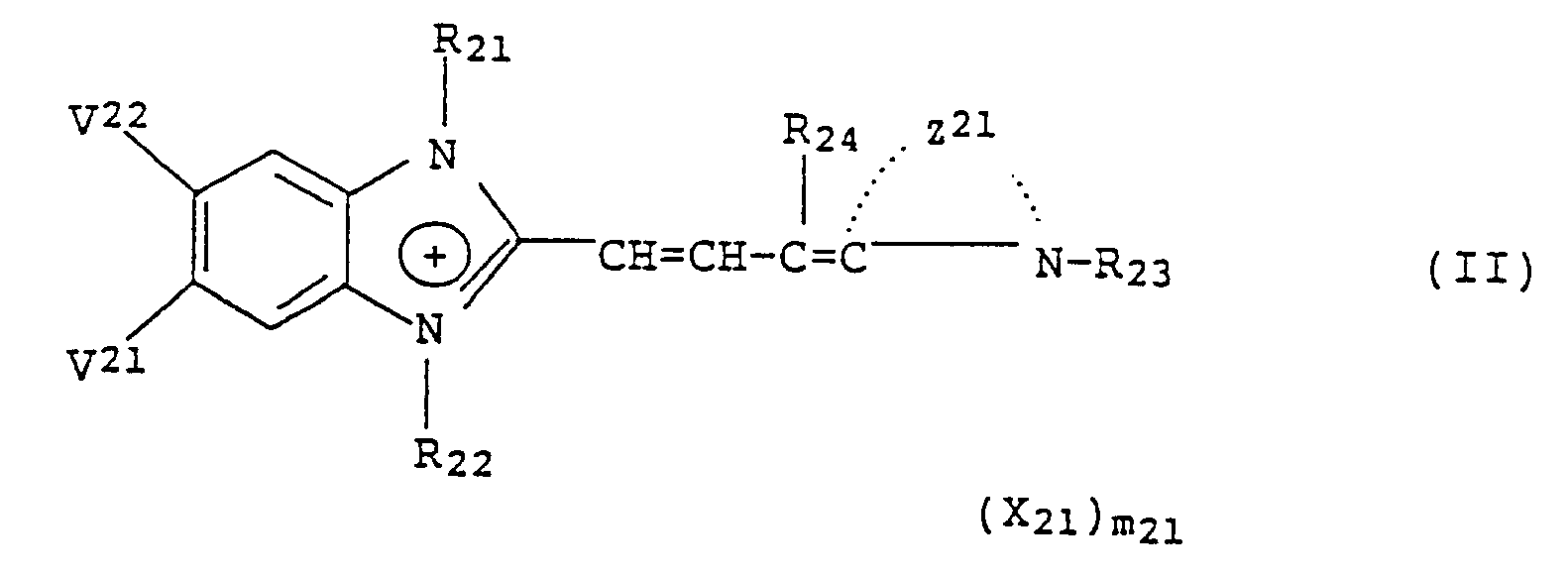
wherein Z²¹ represents an atomic group necessary for forming an nucleus selected from 4-thiazoline, thiazolidine, benzo-4-thiazoline, naphtho[1,2-d]-4-trtiazoline, naphtho[2,3-d]-4-thiazoline, selenazolidine, 4-selenazoline, benzo-4-selenazoline, naphtho[1,2-d]-4-selenazoline, naphtho[2,3-d]-4-selenazoline, benzo-4-oxazoline, naphtho[1,2-d]-4-oxazoline, naphtho[2,3-d]-4-oxazoline and benzo-4-imidazoline nucleus; R₂₁, R₂₂ and R₂₃, which may be the same or different, each represents an unsubstituted or substituted alkyl group; R₂₄ represents hydrogen or atomic group necessary for forming a 5-membered or 6-membered ring in combination with R₂₃; V²¹ represents an electron attracting group; V²² represents an electron attracting group, hydrogen or an atomic group necessary for forming a condensed benzene ring in combination with V²¹; m₂₁ is 0 or 1; X₂₁ is a counter ion necessary for charge balance.
wherein Z²¹ represents an atomic group necessary for forming an nucleus selected from 4-thiazoline, thiazolidine, benzo-4-thiazoline, naphtho[1,2-d]-4-trtiazoline, naphtho[2,3-d]-4-thiazoline, selenazolidine, 4-selenazoline, benzo-4-selenazoline, naphtho[1,2-d]-4-selenazoline, naphtho[2,3-d]-4-selenazoline, benzo-4-oxazoline, naphtho[1,2-d]-4-oxazoline, naphtho[2,3-d]-4-oxazoline and benzo-4-imidazoline nucleus; R₂₁, R₂₂ and R₂₃, which may be the same or different, each represents an unsubstituted or substituted alkyl group; R₂₄ represents hydrogen or atomic group necessary for forming a 5-membered or 6-membered ring in combination with R₂₃; V²¹ represents an electron attracting group; V²² represents an electron attracting group, hydrogen or an atomic group necessary for forming a condensed benzene ring in combination with V²¹; m₂₁ is 0 or 1; X₂₁ is a counter ion necessary for charge balance.
4. The method as claimed in claim 1, wherein said J-aggregated cyanine dye is represented
by formula (III):
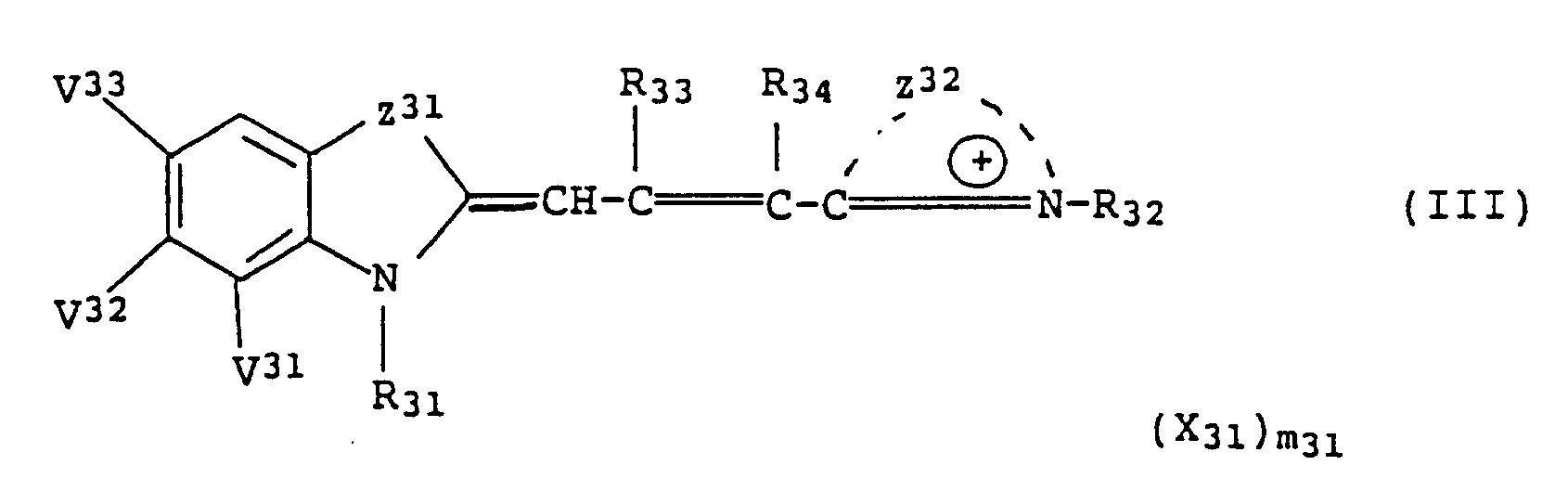
wherein Z³¹ represents oxygen, sulfur or selenium ; Z³² represents an atomic group necessary for forming a nucleus selected from thiazole, benzothiazole, naphtho[1,2-d]thiazole, 8,9-dihydronaphtho[1,2-d]thiazole, naphtho[2,3-d]-thiazole, selenazole, benzoselenazole, naphtho[1,2-d]-selenazole, benzoxazole, naphtho[1,2-d]oxazole, or naphtho[2,3-d]oxazole; R₃₁ and R₃₂, which may be the sane or different, each represents an unsubstituted or substituted alkyl group; R₃₃ represents ethyl, propyl, butyl, phenyl, or phenetyl; V³¹ represents a hydrogen atom or an atomic group necessary for forming a condensed benzene ring with V³²; V³² and V³³, which may be the same or different, each represents a straight-chain or branched-chain alkyl group containing at most 5 carbon atoms, an alkoxy group containing at most 4 carbon atoms, a hydroxyl group, an acylamino group containing at most 4 carbon atoms, an unsubstituted or substituted phenyl group containing at most 8 carbon atoms, a halogen atom, an alkoxycarbonyl group containing at most 5 carbon atoms, a carboxyl group, or hydrogen; provided that V³² and V³³ may be linked to form a 5-membered or 6-membered ring; R₃₄ represents a hydrogen atom, or an atomic group necessary for completing a 5- or 6-membered ring in combination with R₃₂; m₃₁ is 0 or 1 and X₃₁ represents a counter ion necessary for charge balance.
wherein Z³¹ represents oxygen, sulfur or selenium ; Z³² represents an atomic group necessary for forming a nucleus selected from thiazole, benzothiazole, naphtho[1,2-d]thiazole, 8,9-dihydronaphtho[1,2-d]thiazole, naphtho[2,3-d]-thiazole, selenazole, benzoselenazole, naphtho[1,2-d]-selenazole, benzoxazole, naphtho[1,2-d]oxazole, or naphtho[2,3-d]oxazole; R₃₁ and R₃₂, which may be the sane or different, each represents an unsubstituted or substituted alkyl group; R₃₃ represents ethyl, propyl, butyl, phenyl, or phenetyl; V³¹ represents a hydrogen atom or an atomic group necessary for forming a condensed benzene ring with V³²; V³² and V³³, which may be the same or different, each represents a straight-chain or branched-chain alkyl group containing at most 5 carbon atoms, an alkoxy group containing at most 4 carbon atoms, a hydroxyl group, an acylamino group containing at most 4 carbon atoms, an unsubstituted or substituted phenyl group containing at most 8 carbon atoms, a halogen atom, an alkoxycarbonyl group containing at most 5 carbon atoms, a carboxyl group, or hydrogen; provided that V³² and V³³ may be linked to form a 5-membered or 6-membered ring; R₃₄ represents a hydrogen atom, or an atomic group necessary for completing a 5- or 6-membered ring in combination with R₃₂; m₃₁ is 0 or 1 and X₃₁ represents a counter ion necessary for charge balance.
5. The method as claimed in claim 3, wherein said electron attracting group represented
by V²¹ and V²² is selected from fluorine, chlorine, a cyano group, an alkoxycarbonyl
group containing at most 4 carbon atoms and an alkylsulfonyl group containing at most
4 carbon atoms.
6. The method as claimed in claim 4, wherein R₃₃ represents ethyl.
7. The method as claimed in claim 2, wherein said substituted alkyl group represented
by R₁, and R₂ is substituted with a substituent selected from a lower alkyl group,
a halogen atom, a carbamoyl group, a carboxyl group, an alkoxycarbonyl group, an acylamino
group, a hydroxyl group, a sulfo group and a substituted phenyl group.
8. The method as claimed in claim 3, wherein said substituted alkyl group represented
by R₂₁, R₂₂ and R₂₃ is substituted with a substituent selected from a lower alkyl
group, a halogen atom, a carbamoyl group, a carboxyl group, an alkoxycarbonyl group,
an acylamino group, a hydroxyl group, a sulfo group and a substituted phenyl group.
9. The method as claimed in claim 4, wherein said substituted alkyl group represented
by R₃₁, and R₃₂ is substituted with a substituent selected from a lower alkyl group,
a halogen atom, a carbamoyl group, a carboxyl group, an alkoxycarbonyl group, an acylamino
group, a hydroxyl group, a sulfo group and a substituted phenyl group.
10. The method as claimed in claim 1, wherein said silver halide grains comprise from
about 1x10⁻⁶ to 5x10⁻³ mol of each of said sensitizing dye and said supersensitizer
per mol of said silver halide.
11. The method as claimed in claim 1, wherein said silver halide grains comprise from
about 1x10⁻⁵ to 2.5x10⁻³ mol of each of said sensitizing dye and said supersensitizer
per mol of said silver halide.
12. The method as claimed in claim 1, wherein said J-aggregated cyanine dye and said supersensitizer
are present at the beginning of grain formation.
13. The method as claimed in claim 1, wherein said J-aggregated cyanine dye and said supersensitizer
are each added to an aqueous solution containing at least one water-soluble silver
salt and at least one water-soluble halide salt during grain formation.
14. The method as claimed in claim 13, wherein at least one-half of said J-aggregated
cyanine dye and at least one-half of said supersensitizer are simultaneously added
during grain formation.
15. The method as claimed in claim 13, wherein at least two-thirds of said J-aggregated
cyanine dye and at least two-thirds of said supersensitizer are simultaneously added
during grain formation.
16. The method as claimed in claim 15, wherein the total amounts of said J-aggregated
cyanine dye and said supersensitizer are simultaneously added during grain formation.
1. Verfahren zur Herstellung einer photographischen spektral sensibilisierten Silberhalogenidemulsion,
welches die Zugabe eines J-aggregierten Cyaninfarbstoffs beinhaltet,
gekennzeichnet durch
den Schritt der Bildung von Silberhalogenid-Körnern in Gegenwart von mindestens einem J-aggregierten Cyaninfarbstoff und von mindestens einem Übersensibilisator.
gekennzeichnet durch
den Schritt der Bildung von Silberhalogenid-Körnern in Gegenwart von mindestens einem J-aggregierten Cyaninfarbstoff und von mindestens einem Übersensibilisator.
2. Verfahren nach Anspruch 1, bei dem das J-aggregierte Cyanin durch Formel (I) dargestellt
wird:
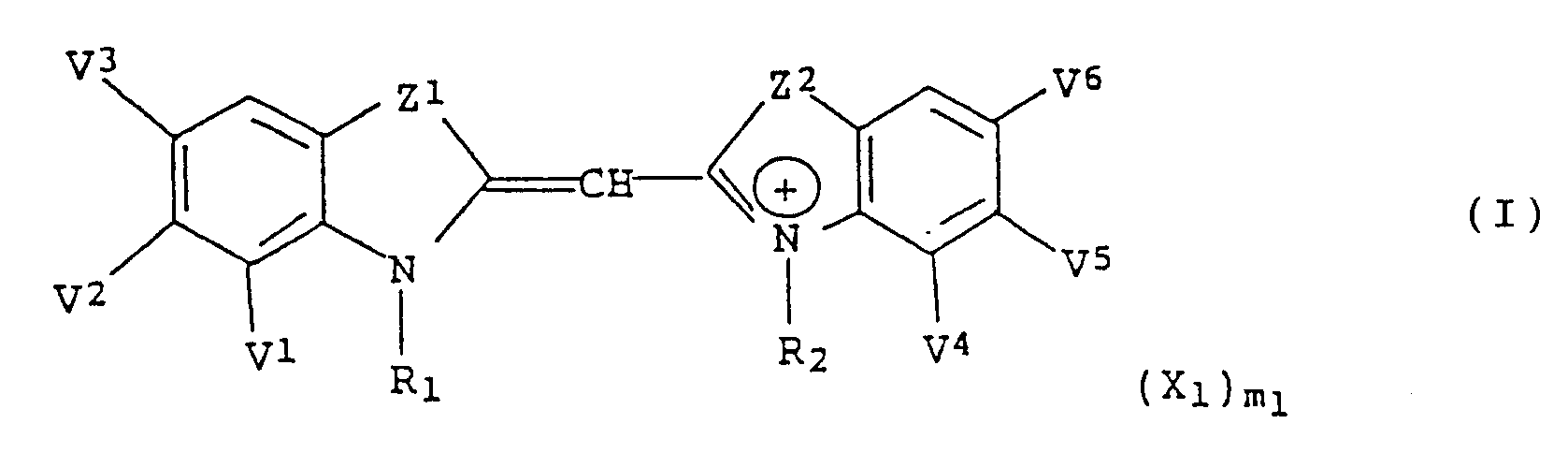
worin Z¹ Sauerstoff, Schwefel, Selen oder -CH=CH- darstellt; z² Schwefel, Selen oder -CH=CH- darstellt; R₁ und R₂, die gleich oder verschieden sein können, jeweils eine unsubstituierte oder substituierte Alkylgruppe darstellen; V¹ stellt Wasserstoff oder eine Atomgruppe, die zur Bildung eines kondensierten Benzolrings mit V² notwendig ist, dar; V⁴ stellt Wasserstoff oder eine Atomgruppe, die zur Bildung eines kondensierten Benzolrings mit V⁵ notwendig ist, dar; V², V³, V⁵ und V⁶, die gleich oder verschieden sein können, stellen jeweils eine geradkettige oder verzweigte Alkylgruppe mit höchstens 5 Kohlenstoffatomen, eine Alkoxygruppe mit höchstens 4 Kohlenstoffatomen, eine Hydroxylgruppe, eine Acylaminogruppe, die mindestens 4 Kohlenstoffatome enthält, eine unsubstituierte oder substituierte Phenylgrupe, die mindestens 8 Kohlenstoffatome enthält, ein Halogenatom, eine Alkoxycarbonylgruppe, die höchstens 5 Kohlenstoffatome enthält, eine Carboxylgruppe oder Wasserstoff dar, vorausgesetzt, daß V³ mit V² eine Bindung unter Bildung eines kondensierten Benzolrings eingehen kann und V⁶ mit V⁵ unter Bildung eines kondensierten Benzolrings eine Bindung eingehen kann; m₁ 0 oder 1 ist; und X₁ ein für den Ladungsausgleich notwendiges Gegenion darstellt.
worin Z¹ Sauerstoff, Schwefel, Selen oder -CH=CH- darstellt; z² Schwefel, Selen oder -CH=CH- darstellt; R₁ und R₂, die gleich oder verschieden sein können, jeweils eine unsubstituierte oder substituierte Alkylgruppe darstellen; V¹ stellt Wasserstoff oder eine Atomgruppe, die zur Bildung eines kondensierten Benzolrings mit V² notwendig ist, dar; V⁴ stellt Wasserstoff oder eine Atomgruppe, die zur Bildung eines kondensierten Benzolrings mit V⁵ notwendig ist, dar; V², V³, V⁵ und V⁶, die gleich oder verschieden sein können, stellen jeweils eine geradkettige oder verzweigte Alkylgruppe mit höchstens 5 Kohlenstoffatomen, eine Alkoxygruppe mit höchstens 4 Kohlenstoffatomen, eine Hydroxylgruppe, eine Acylaminogruppe, die mindestens 4 Kohlenstoffatome enthält, eine unsubstituierte oder substituierte Phenylgrupe, die mindestens 8 Kohlenstoffatome enthält, ein Halogenatom, eine Alkoxycarbonylgruppe, die höchstens 5 Kohlenstoffatome enthält, eine Carboxylgruppe oder Wasserstoff dar, vorausgesetzt, daß V³ mit V² eine Bindung unter Bildung eines kondensierten Benzolrings eingehen kann und V⁶ mit V⁵ unter Bildung eines kondensierten Benzolrings eine Bindung eingehen kann; m₁ 0 oder 1 ist; und X₁ ein für den Ladungsausgleich notwendiges Gegenion darstellt.
3. Verfahren nach Anspruch 1, bei dem der J-aggregierte Cyaninfarbstoff durch die Formel
(II)
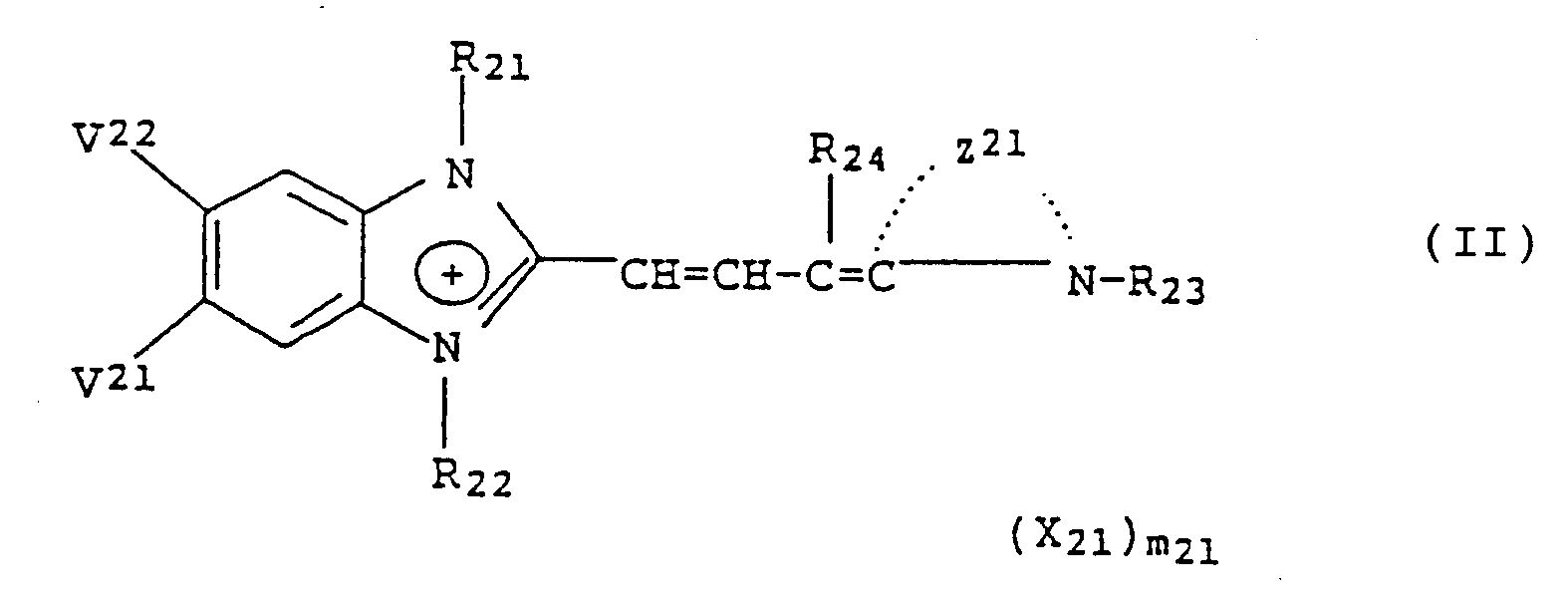
dargestellt wird,
worin Z²¹ eine Atomgruppe darstellt, die zur Bildung eines Kerns, ausgewählt unter einem 4-Thiazolin-, Thiazolidin-, Benzo-4-thiazolin-, Naphto[1,2-d]-4-thiazolin, Naphtho[2,3-d]-4-thiazolin-, Selenazolidin-, 4-Selenazolin-, Benzo-4-selenazolin-, Naphtho[1,2-d]-4-selenazolin-, Naphto[2,3-d]-4-selenazolin-, Benzo-4-oxazolin-, Naphtho[1,2-d]-4-oxazolin-, Naphtho[2,3-d]-4-oxazolin- und einem Benzo-4-imidazolin-Kern notwendig ist; R₂₁, R₂₂ und R₂₃, welche gleich oder verschieden sein können, jeweils eine unsubstituierte oder substituierte Alkylgruppe darstellen; R₂₄ ein Wasserstoffatom oder eine Atomgruppe, die in Kombination mit R₂₃ zur Bildung eines 5-gliedrigen oder 6-gliedrigen Rings notwendig ist, darstellt; V²¹ eine elektronenanziehende Gruppe darstellt; V²² eine elektronenanziehende Gruppe, Wasserstoff oder eine Atomgruppe, die mit V²¹ zur Bildung eines kondensierten Benzolrings notwendig ist, darstellt; m₂₁ 0 oder 1 ist; X₂₁ ein für den Ladungsausgleich notwendiges Gegenion ist.
dargestellt wird,
worin Z²¹ eine Atomgruppe darstellt, die zur Bildung eines Kerns, ausgewählt unter einem 4-Thiazolin-, Thiazolidin-, Benzo-4-thiazolin-, Naphto[1,2-d]-4-thiazolin, Naphtho[2,3-d]-4-thiazolin-, Selenazolidin-, 4-Selenazolin-, Benzo-4-selenazolin-, Naphtho[1,2-d]-4-selenazolin-, Naphto[2,3-d]-4-selenazolin-, Benzo-4-oxazolin-, Naphtho[1,2-d]-4-oxazolin-, Naphtho[2,3-d]-4-oxazolin- und einem Benzo-4-imidazolin-Kern notwendig ist; R₂₁, R₂₂ und R₂₃, welche gleich oder verschieden sein können, jeweils eine unsubstituierte oder substituierte Alkylgruppe darstellen; R₂₄ ein Wasserstoffatom oder eine Atomgruppe, die in Kombination mit R₂₃ zur Bildung eines 5-gliedrigen oder 6-gliedrigen Rings notwendig ist, darstellt; V²¹ eine elektronenanziehende Gruppe darstellt; V²² eine elektronenanziehende Gruppe, Wasserstoff oder eine Atomgruppe, die mit V²¹ zur Bildung eines kondensierten Benzolrings notwendig ist, darstellt; m₂₁ 0 oder 1 ist; X₂₁ ein für den Ladungsausgleich notwendiges Gegenion ist.
4. Verfahren nach Anspruch 1, bei dem der J-aggregierte Cyaninfarbstoff durch Formel
(III)
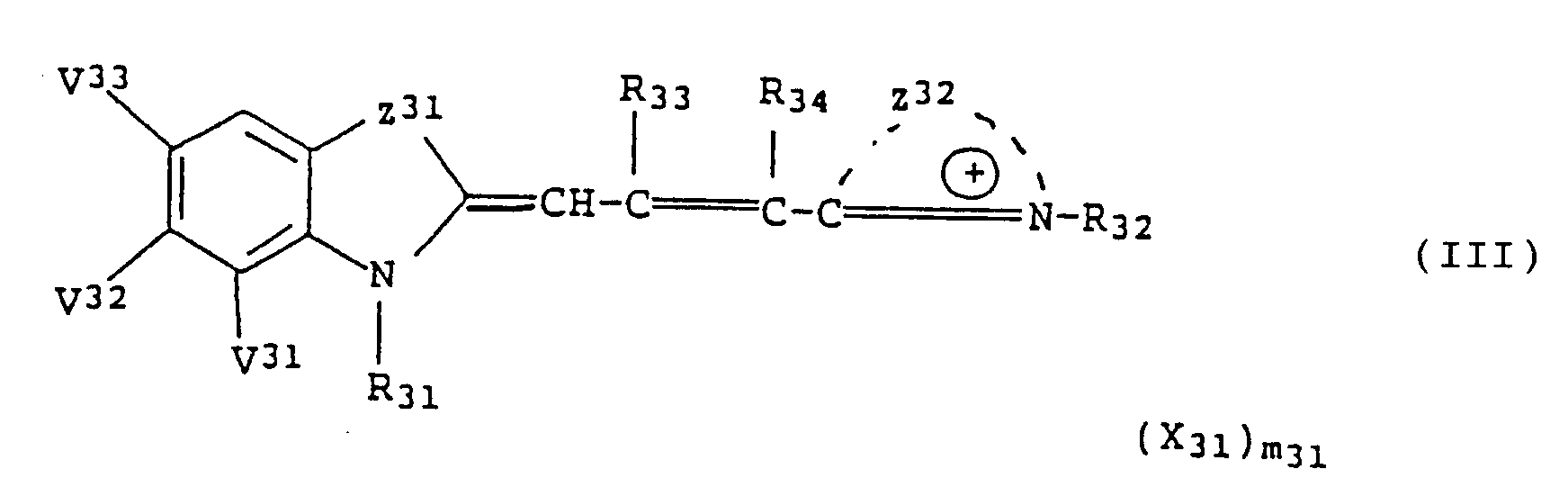
dargestellt ist,
worin Z³¹ Sauerstoff, Schwefel oder Selen darstellt; Z³² eine Atomgruppe, die zur Bildung eines Kerns, ausgewählt aus Thiazol, Benzothiazol, Naphtho[1,2-d]-thiazol, 8,9-Dihydronaphtho[1,2-d]-thiazol, Naphtho[2,3-d]-thiazol, Selenazol, Benzoselenazol, Naphtho[1,2-d]-selenazol, Benzoxazol, Naphtho[1,2-d]-oxazol oder Naphtho[2,3-d]-oxazol, notwendig ist, darstellt; R₃₁ und R₃₂, welche gleich oder verschieden sein können, jeweils eine unsubstituierte oder substituierte Alkylgruppe darstellen; R₃₃ Ethyl, Propyl, Butyl, Phenyl oder Phenetyl darstellt; V³¹ ein Wasserstoffatom oder eine Atomgruppe, die zur Bildung eines kondensierten Benzolrings mit V³² notwendig ist, darstellt; V³² und V³³, welche gleich oder verschieden sein können, jeweils eine geradkettige oder verzweigte Alkylgruppe, die höchstens 5 Kohlenstoffatome enthält, eine Alkoxygruppe, die höchstens 4 Kohlenstoffatome enthält, eine Hydroxylgruppe, eine Acylaminogruppe, die höchstens 4 Kohlenstoffatome enthält, eine unsubstituierte oder substituierte Phenylgruppe, die höchstens 8 Kohlenstoffatome enthält, ein Halogenatom, eine Alkoxycarbonylgruppe, die höchstens 5 Kohlenstoffatome enthält, eine Carboxylgruppe oder Wasserstoff darstellen; vorausgesetzt, daß V³² und V³³ sich unter Bildung eines 5-gliedrigen oder 6-gliedrigen Rings verbinden; R₃₄ ein Wasserstoffatom oder eine Atomgruppe, die in Kombination mit R₃₂ zur Vervollständigung eines 5- oder 6-gliedrigen Rings notwendig ist, darstellt; m₃₁ gleich 0 oder 1 ist, und X₃₁ ein für den Ladungsausgleich notwendiges Gegenion darstellt.
dargestellt ist,
worin Z³¹ Sauerstoff, Schwefel oder Selen darstellt; Z³² eine Atomgruppe, die zur Bildung eines Kerns, ausgewählt aus Thiazol, Benzothiazol, Naphtho[1,2-d]-thiazol, 8,9-Dihydronaphtho[1,2-d]-thiazol, Naphtho[2,3-d]-thiazol, Selenazol, Benzoselenazol, Naphtho[1,2-d]-selenazol, Benzoxazol, Naphtho[1,2-d]-oxazol oder Naphtho[2,3-d]-oxazol, notwendig ist, darstellt; R₃₁ und R₃₂, welche gleich oder verschieden sein können, jeweils eine unsubstituierte oder substituierte Alkylgruppe darstellen; R₃₃ Ethyl, Propyl, Butyl, Phenyl oder Phenetyl darstellt; V³¹ ein Wasserstoffatom oder eine Atomgruppe, die zur Bildung eines kondensierten Benzolrings mit V³² notwendig ist, darstellt; V³² und V³³, welche gleich oder verschieden sein können, jeweils eine geradkettige oder verzweigte Alkylgruppe, die höchstens 5 Kohlenstoffatome enthält, eine Alkoxygruppe, die höchstens 4 Kohlenstoffatome enthält, eine Hydroxylgruppe, eine Acylaminogruppe, die höchstens 4 Kohlenstoffatome enthält, eine unsubstituierte oder substituierte Phenylgruppe, die höchstens 8 Kohlenstoffatome enthält, ein Halogenatom, eine Alkoxycarbonylgruppe, die höchstens 5 Kohlenstoffatome enthält, eine Carboxylgruppe oder Wasserstoff darstellen; vorausgesetzt, daß V³² und V³³ sich unter Bildung eines 5-gliedrigen oder 6-gliedrigen Rings verbinden; R₃₄ ein Wasserstoffatom oder eine Atomgruppe, die in Kombination mit R₃₂ zur Vervollständigung eines 5- oder 6-gliedrigen Rings notwendig ist, darstellt; m₃₁ gleich 0 oder 1 ist, und X₃₁ ein für den Ladungsausgleich notwendiges Gegenion darstellt.
5. Verfahren nach Anspruch 3, bei dem die elektronenanziehende Gruppe, die durch V²¹
und V²² dargestellt wird, unter Fluor, Chlor, einer Cyanogruppe, einer Alkoxycarbonylgruppe,
die höchstens 4 Kohlenstoffatome enthält, und einer Alkylsulfonylgruppe, die höchstens
4 Kohlenstoffatome enthält, ausgewählt wird.
6. Verfahren nach Anspruch 4, bei dem R₃₃ Ethyl darstellt.
7. Verfahren nach Anspruch 2, bei dem die substituierte Alkylgruppe, die durch R₁ und
R₂ dargestellt wird, mit einem Substituenten, ausgewählt aus einer niedrigeren Alkylgruppe,
einem Halogenatom, einer Carbamoylgruppe, einer Carboxylgruppe, einer Alkoxycarbonylgruppe,
einer Acylaminogruppe, einer Hydroxylgruppe, einer Sulfogruppe und einer substituierten
Phenylgruppe substituiert ist.
8. Verfahren nach Anspruch 3, bei dem die substituierte Alkylgruppe, die durch R₂₁, R₂₂
und R₂₃ dargestellt wird, mit einem Substituenten, ausgewählt unter einer niedrigeren
Alkylgruppe, einem Halogenatom, einer Carbamoylgruppe, einer Carboxylgruppe, einer
Alkoxycarbonylgruppe, einer Acylaminogruppe, einer Hydroxylgruppe, einer Sulfogruppe
und einer substituierten Phenylgruppe substituiert ist.
9. Verfahren nach Anspruch 4, bei dem die substituierte Alkylgruppe, die durch R₃₁ und
R₃₂ dargestellt wird, mit einem Substituenten, ausgewählt unter einer niedrigeren
Alkylgruppe, einem Halogenatom, einer Carbamoylgruppe, einer Carboxylgruppe, einer
Alkoxycarbonylgruppe, einer Acylaminogruppe, einer Hydroxylgruppe, einer Sulfogruppe
und einer substituierten Phenylgruppe, substituiert ist.
10. Verfahren nach Anspruch 1, bei dem die Silberhalogenid-Körner von etwa 1 x 10⁻⁶ bis
5 x 10⁻³ Mol Sensibilisierungsfarbstoff wie auch Übersensibilisator pro Mol Silberhalogenid
enthalten.
11. Verfahren nach Anspruch 1, bei dem die Silberhalogenid-Körner von etwa 1 x 10⁻⁵ bis
2,5 x 10⁻³ Mol Sensibilisierungsfarbstoff wie auch Übersensibilisator pro Silberhalogenid
enthalten.
12. Verfahren nach Anspruch 1, bei dem der J-aggregierte Cyaninfarbstoff und der Übersensibilisator
zu Beginn der Kornbildung vorhanden sind.
13. Verfahren nach Anspruch 1, bei dem der J-aggregierte Cyaninfarbstoff und der Übersensibilisator
einer wäßrigen Lösung, die mindestens ein wasserlösliches Silbersalz und mindestens
ein wasserlösliches Halogenidsalz enthält, während der Kornbildung zugesetzt werden.
14. Verfahren nach Anspruch 13, bei dem mindestens eine Hälfte des J-aggregierten Cyaninfarbstoffs
und mindestens eine Hälfte des Übersensibilisators gleichzeitig während der Kornbildung
zugegeben werden.
15. Verfahren nach Anspruch 13, bei dem mindestens zwei Drittel des J-aggregierten Cyaninfarbstoffs
und mindestens zwei Drittel des Übersensibilisators gleichzeitig während der Kornbildung
zugegeben werden.
16. Verfahren nach Anspruch 15, bei dem die gesamten Mengen des J-aggregierten Cyaninfarbstoffs
und des Übersensibilisators gleichzeitig während der Kornbildung zugegeben werden.
1. Procédé pour produire une émulsion photographique d'halogénure d'argent sensibilisée
spectralement qui comprend l'addition d'un colorant de cyanine J-aggloméré, caractérisé
par l'étape de formation de grains d'halogénure d'argent en présence d'au moins un
colorant de cyanine J-aggloméré et d'au moins un hypersensibilisateur.
2. Procédé selon la revendication 1, dans lequel ledit colorant de cyanine J-aggloméré
est représenté par la formule (I) :
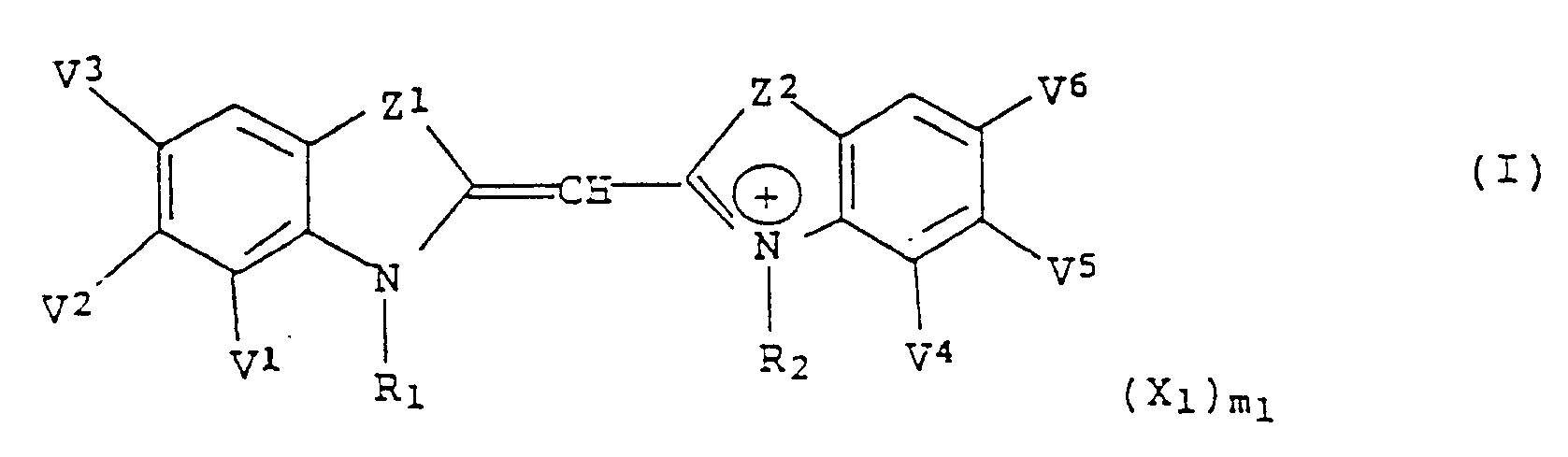
dans laquelle Z¹ représente un atome d'oxygène, de soufre ou de sélénium ou un groupe -CH=CH- ; Z² représente un atome de soufre ou de sélénium ou un groupe -CH=CH-; R₁ et R₂ peuvent être identiques ou différents et représentent chacun un groupe alkyle substitué ou non ; V¹ représente un atome d'hydrogène ou un groupe atomique nécessaire pour former avec V² un noyau benzénique condensé ; V⁴ représente un atome d'hydrogène ou un groupe atomique nécessaire pour former avec V⁵ un noyau benzénique condensé ; V², V³, V⁵ et V⁶, qui peuvent être identiques ou différents, représentent chacun un groupe alkyle à chaîne droite ou ramifiée jusqu'en C₅ au plus, un groupe alcoxy jusqu'en C₄ au plus, un groupe hydroxyle, un groupe acylamino jusqu'en C₄ au plus, un groupe phényle substitué ou non jusqu'en C₈ au plus, un atome d'halogène, un groupe alcoxycarbonyle jusqu'en C₅ au plus, un groupe carboxyle ou un atome d'hydrogène, à condition que V³ puisse être relié à V² pour former un noyau benzénique condensé et que V⁶ puisse être relié à V⁵ pour former un noyau benzénique condensé ; m₁ est égal à 0 ou 1 ; et X₁ représente un contre-ion nécessaire pour l'équilibre des charges.
dans laquelle Z¹ représente un atome d'oxygène, de soufre ou de sélénium ou un groupe -CH=CH- ; Z² représente un atome de soufre ou de sélénium ou un groupe -CH=CH-; R₁ et R₂ peuvent être identiques ou différents et représentent chacun un groupe alkyle substitué ou non ; V¹ représente un atome d'hydrogène ou un groupe atomique nécessaire pour former avec V² un noyau benzénique condensé ; V⁴ représente un atome d'hydrogène ou un groupe atomique nécessaire pour former avec V⁵ un noyau benzénique condensé ; V², V³, V⁵ et V⁶, qui peuvent être identiques ou différents, représentent chacun un groupe alkyle à chaîne droite ou ramifiée jusqu'en C₅ au plus, un groupe alcoxy jusqu'en C₄ au plus, un groupe hydroxyle, un groupe acylamino jusqu'en C₄ au plus, un groupe phényle substitué ou non jusqu'en C₈ au plus, un atome d'halogène, un groupe alcoxycarbonyle jusqu'en C₅ au plus, un groupe carboxyle ou un atome d'hydrogène, à condition que V³ puisse être relié à V² pour former un noyau benzénique condensé et que V⁶ puisse être relié à V⁵ pour former un noyau benzénique condensé ; m₁ est égal à 0 ou 1 ; et X₁ représente un contre-ion nécessaire pour l'équilibre des charges.
3. Procédé selon la revendication 1, dans lequel ledit colorant de cyanine J-aggloméré
est représenté par la formule (II) :
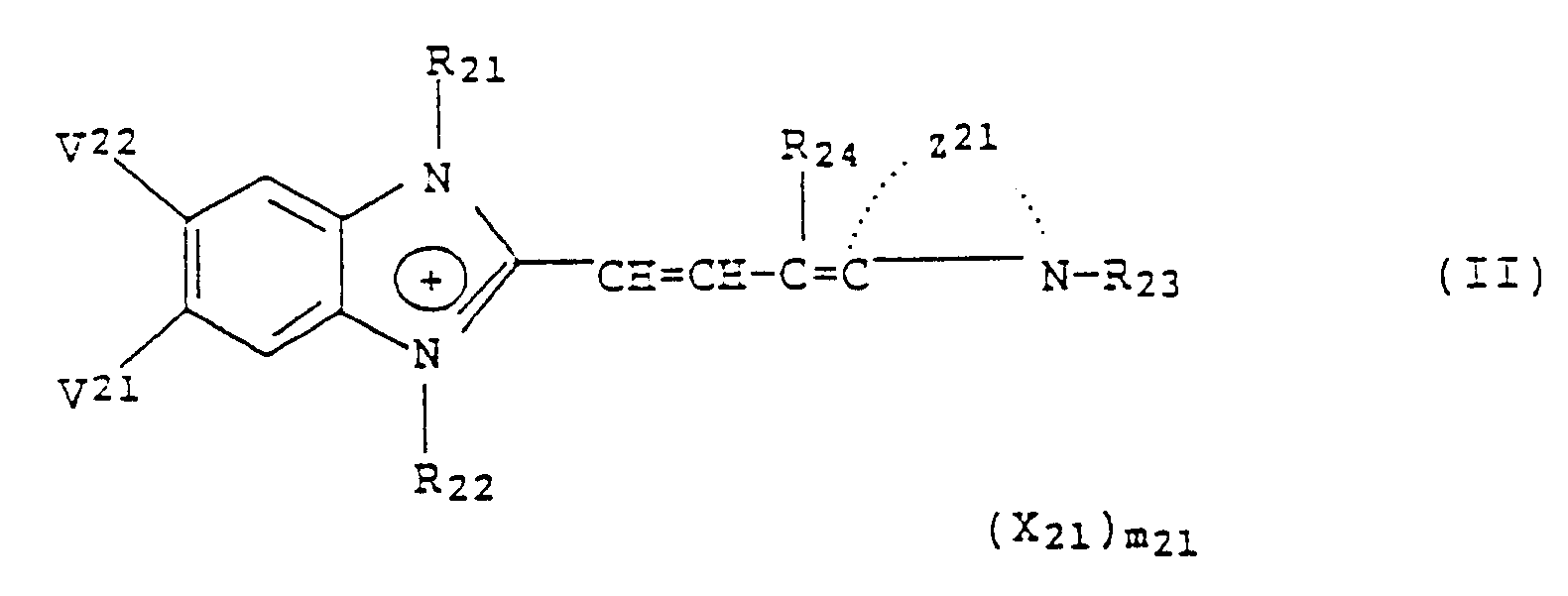
dans laquelle Z²¹ représente un groupe atomique nécessaire pour former un noyau choisi parmi les noyaux 4-thiazoline, thiazolidine, benzo-4-thiazoline, naphto-[1,2-d]-4-thiazoline, naphto[2,3-d]-4-thiazoline, sélénazolidine, 4-sélénazoline, benzo-4-sélénazoline, naphto[1,2-d]-4-sélénazoline, naphto[2,3-d]-4-sélénazoline, benzo-4-oxazoline, naphto[1,2-d]-4-oxazoline, naphto[2,3-d]-4-oxazoline et benzo-4-imidazoline ; R₂₁, R₂₂ et R₂₃, qui peuvent être identiques ou différents, représentent chacun un groupe alkyle substitué ou non; R₂₄ représente un atome d'hydrogène ou un groupe atomique nécessaire pour former en combinaison avec R₂₃ un noyau à 5 ou 6 chaînons ; V²¹ représente un groupe attirant les électrons ; V²² représente un groupe attirant les électrons, un atome d'hydrogène ou un groupe atomique nécessaire pour former en combinaison avec V²¹ un noyau benzénique condensé ; m₂₁ est égal à 0 ou 1 ; X₂₁ est un contreion nécessaire pour l'équilibre des charges.
dans laquelle Z²¹ représente un groupe atomique nécessaire pour former un noyau choisi parmi les noyaux 4-thiazoline, thiazolidine, benzo-4-thiazoline, naphto-[1,2-d]-4-thiazoline, naphto[2,3-d]-4-thiazoline, sélénazolidine, 4-sélénazoline, benzo-4-sélénazoline, naphto[1,2-d]-4-sélénazoline, naphto[2,3-d]-4-sélénazoline, benzo-4-oxazoline, naphto[1,2-d]-4-oxazoline, naphto[2,3-d]-4-oxazoline et benzo-4-imidazoline ; R₂₁, R₂₂ et R₂₃, qui peuvent être identiques ou différents, représentent chacun un groupe alkyle substitué ou non; R₂₄ représente un atome d'hydrogène ou un groupe atomique nécessaire pour former en combinaison avec R₂₃ un noyau à 5 ou 6 chaînons ; V²¹ représente un groupe attirant les électrons ; V²² représente un groupe attirant les électrons, un atome d'hydrogène ou un groupe atomique nécessaire pour former en combinaison avec V²¹ un noyau benzénique condensé ; m₂₁ est égal à 0 ou 1 ; X₂₁ est un contreion nécessaire pour l'équilibre des charges.
4. Procédé selon la revendication 1, dans lequel ledit colorant de cyanine J-aggloméré
est représenté par la formule (III) :
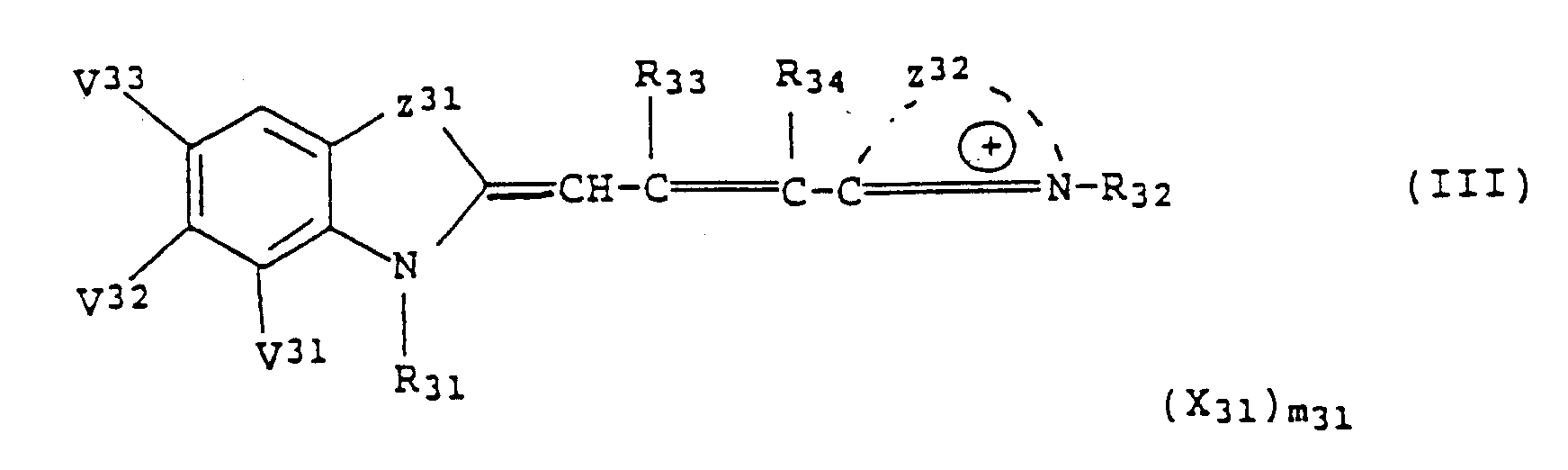
dans laquelle Z³¹ représente un atome de soufre ou de sélénium ; Z³² représente un groupe atomique nécessaire pour former un noyau choisi parmi thiazole, benzothiazole, naphto[1,2-d]thiazole, 8,9-dihydronaphto[1,2-d]thiazole, naphto[2,3-d]thiazole, sélénazole, benzosélénazole, naphto[1,2-d]sélénazole, benzoxazole, naphto[1,2-d]oxazole et naphto[2,3-d]oxazole ; R₃₁ et R₃₂,qui sont identiques ou différents, représentent chacun un groupe alkyle substitué ou non ; R³³ représente un groupe éthyle, propyle, butyle, phényle ou phénéthyle ; V³¹ représente un atome d'hydrogène ou un groupe atomique nécessaire pour former avec V³² un noyau benzénique condensé ; V³² et V³³, qui peuvent être identiques ou différents, représentent chacun un groupe alkyle à chaîne droite ou ramifiée jusqu'en C₅ au plus, un groupe alcoxy jusqu'en C₄ au plus, un groupe hydroxyle, un groupe acylamino jusqu'en C₄ au plus, un groupe phényle substitué ou non jusqu'en C₈ au plus, un atome d'halogène, un groupe alcoxycarbonyle jusqu'en C₅ au plus, un groupe carboxyle ou un atome d'hydrogène ; à condition que V³² et V³³ puissent être reliés pour former un noyau a 5 ou 6 chaînons ; R₃₄ représente un atome d'hydrogène ou un groupe atomique nécessaire pour former en combinaison avec R₃₂ un cycle à 5 ou 6 chaînons ; m₃₁ est égal à 0 ou 1 et X₃₁ représente un contre-ion nécessaire pour l'équilibre des charges.
dans laquelle Z³¹ représente un atome de soufre ou de sélénium ; Z³² représente un groupe atomique nécessaire pour former un noyau choisi parmi thiazole, benzothiazole, naphto[1,2-d]thiazole, 8,9-dihydronaphto[1,2-d]thiazole, naphto[2,3-d]thiazole, sélénazole, benzosélénazole, naphto[1,2-d]sélénazole, benzoxazole, naphto[1,2-d]oxazole et naphto[2,3-d]oxazole ; R₃₁ et R₃₂,qui sont identiques ou différents, représentent chacun un groupe alkyle substitué ou non ; R³³ représente un groupe éthyle, propyle, butyle, phényle ou phénéthyle ; V³¹ représente un atome d'hydrogène ou un groupe atomique nécessaire pour former avec V³² un noyau benzénique condensé ; V³² et V³³, qui peuvent être identiques ou différents, représentent chacun un groupe alkyle à chaîne droite ou ramifiée jusqu'en C₅ au plus, un groupe alcoxy jusqu'en C₄ au plus, un groupe hydroxyle, un groupe acylamino jusqu'en C₄ au plus, un groupe phényle substitué ou non jusqu'en C₈ au plus, un atome d'halogène, un groupe alcoxycarbonyle jusqu'en C₅ au plus, un groupe carboxyle ou un atome d'hydrogène ; à condition que V³² et V³³ puissent être reliés pour former un noyau a 5 ou 6 chaînons ; R₃₄ représente un atome d'hydrogène ou un groupe atomique nécessaire pour former en combinaison avec R₃₂ un cycle à 5 ou 6 chaînons ; m₃₁ est égal à 0 ou 1 et X₃₁ représente un contre-ion nécessaire pour l'équilibre des charges.
5. Procédé selon la revendication 3, dans lequel ledit groupe attirant les électrons
représenté par V²¹ et V²² est choisi parmi le fluor, le chlore, un groupe cyano, un
groupe alcoxycarbonyle jusqu'en C₄ au plus et un groupe alkylsulfonyle jusqu'en C₄
au plus.
6. Procédé selon la revendication 4, dans lequel R₃₃ représente un groupe éthyle.
7. Procédé selon la revendication 2, dans lequel ledit groupe alkyle représenté par R₁
et R₂ est substitué par un substituant choisi parmi un groupe alkyle inférieur, un
atome d'halogène, un groupe carbamoyle, un groupe carboxyle, un groupe alcoxycarbonyle,
un groupe acylamino, un groupe hydroxyle, un groupe sulfo et un groupe phényle substitué.
8. Procédé selon la revendication 3, dans lequel ledit groupe alkyle substitué représenté
par R₂₁, R₂₂ et R₂₃ est substitué par un substituant choisi parmi un groupe alkyle
inférieur, un atome d'halogène, un groupe carbamoyle, un groupe carboxyle, un groupe
alcoxycarbonyle, un groupe acylamino, un groupe hydroxyle, un groupe sulfo et un groupe
phényle substitué.
9. Procédé selon la revendication 4, dans lequel ledit groupe alkyle substitué représenté
par R₃₁ et R₃₂ est substitué par un substituant choisi parmi un groupe alkyle inférieur,
un atome d'halogène, un groupe carbamoyle, un groupe carboxyle, un groupe alcoxycarbonyle,
un groupe acylamino, un groupe hydroxyle, un groupe sulfo et un groupe phényle substitué.
10. Procédé selon la revendication 1, dans lequel lesdits grains d'halogénure d'argent
comprennent d'environ 1.10⁻⁶ à 5.10⁻³ mole dudit colorant sensibilisateur et 1.10⁻⁶
x 5 x 10⁻³ mole dudit hypersensibilisateur par mole dudit halogénure d'argent.
11. Procédé selon la revendication 1, dans lequel lesdits grains d'halogénure d'argent
comprennent d'environ 1.10⁻⁵ à 2,5.10⁻³ mole dudit colorant sensibilisateur et 1.10⁻⁵
x 2,5 x 10⁻³ mole dudit hypersensibilisateur par mole dudit halogénure d'argent.
12. Procédé selon la revendication 1, dans lequel ledit colorant de cyanine J-aggloméré
et ledit hypersensibilisateur sont présents au début de la formation des grains.
13. Procédé selon la revendication 1, dans lequel ledit colorant de cyanine J-aggloméré
et ledit hypersensibilisateur sont ajoutés chacun à une solution aqueuse contenant
au moins un sel d'argent soluble dans l'eau et au moins un sel halogénure soluble
dans l'eau pendant la formation des grains.
14. Procédé selon la revendication 13, dans lequel la moitié au moins dudit colorant de
cyanine J-aggloméré et la moitié au moins dudit hypersensibilisateur sont ajoutés
simultanément pendant la formation des grains.
15. Procédé selon la revendication 13, dans lequel au moins les deux tiers dudit colorant
de cyanine J-aggloméré et au moins les deux tiers dudit hypersensibilisateur sont
ajoutés simultanément pendant la formation des grains.
16. Procédé selon la revendication 15, dans lequel les quantités totales dudit colorant
de cyanine J-aggloméré et dudit hypersensibilisateur sont ajoutées simultanément pendant
la formation des grains.