|
(11) | EP 0 304 521 A1 |

| (12) | EUROPEAN PATENT APPLICATION |
|
|
|
|
||||||||||||||||||||||||
| (54) | Perfluoroalkylnaphthalene compounds their preparation and use |
| (57) Novel compounds having greatest interest as biologically-active materials for the
treatment of diabetic complications in mammals, or intermediates for such materials,
are perfluoroalkyl compounds corresponding to the formula:
wherein R and R′ are independently selected from chloro, fluoro, nitro, hydroxy, and alkyl and alkoxy substituents containing 1-6 carbons; Q is -CN, -COOL, -COX, or -CTN(R˝)CH₂COOL; L is hydrogen, alkali metal, or saturated hydrocarbyl; X is halo; T is oxygen or sulfur; R˝ is an alkyl group containing 1-6 carbons; m is 0 or 1; and n is an integer of at least one. |
[0001] This invention relates to certain perfluoroalkylnaphthalene compounds, which compounds contain at least two carbons in the perfluoroalkyl groups. These compounds may have biological activity.
[0002] As disclosed in McLoughlin et al, Tetrahedron, Vol. 25, pp. 5921-5940, 1969, Kobayashi et al, Tetrahedron Letters, No. 42, pp. 4071-4072, 1979, Gassman et al, Tetrahedron Letters, Vol. 26, No. 43, pp. 5243-5246, 1985, and U.S. Patents 3,408,411 (McLoughlin et al) and 4,439,617 (Sestanj et al), it is known that perfluoroalkylnaphthalene compounds are apt to be useful as biologically-active compounds, surfactants, coatings, sealants, dyestuffs, and alkyd-type resins; and that they can be prepared in various ways.
[0003] The invention provides compounds corresponding to the formula:
wherein R and R′ are independently selected from chloro, fluoro, nitro, hydroxy, and alkyl and alkoxy substituents containing 1-6 carbons; Q is -CN, -COOL, -COX, or -CTN(R˝)CH₂COOL; L is hydrogen, alkali metal, or saturated hydrocarbyl; X is halo; T is oxygen or sulfur; R˝ is an alkyl group containing 1-6 carbons; m is 0 or 1; and n is an integer of at least one.
[0004] The compounds of the invention are substituted naphthalenes that can be prepared in any suitable manner. In fact, although they have not previously been identified or contemplated as potentially useful, it is believed that some of them may have been inadvertently formed in the past as by-products of certain reactions for preparing their trifluoromethyl homologs. However, because of the very small yield of higher perfluoroalkyl compounds apt to be obtained in reactions designed to prepare trifluoromethyl compounds, it is generally preferred to synthesize the compounds of the invention by procedures such as those described below.
Preparation of (Perfluoroalkyl) cyanonaphthalenes
[0005] Compounds of the above formula wherein Q is cyano can be prepared by reacting the appropriate potassium perfluoroalkanoate with the appropriate halocyanonaphthalene corresponding to the formula:
wherein R and R′ are independently selected from chloro, fluoro, nitro, hydroxy, and alkyl and alkoxy substituents containing 1-6 carbons; Z is bromo or iodo; and m is 0 or 1, at a suitable temperature, conveniently at reflux temperatures, in the presence of cuprous iodide and a dipolar aprotic solvent, such as N-methylpyrrolidone, N,N-dimethylformamide, N,N-dimethylacetamide, and hexamethylphosphoric triamide. Ordinarily, the temperature is in the range of 140-160°C., the amount of cuprous iodide employed is 0.5-5 mols per mol of halocyanonaphthalene, and the solvent is used in solvent amounts, e.g., an amount such as to provide an organic solids concentration of up to about 15%.
[0006] Since there does not appear to be any maximum to the number of CF₂ groups that can desirably be incorporated into the substituted naphthalene molecule, the potassium perfluoroalkanoate employed in the reaction may be any compound corresponding to the formula KOOC(CF₂)nCF₃ wherein n is an integer of at least one, and it is generally the salt which contains the same number of CF₂ groups as is desired in the product. However, because of cost and availability factors, as well as the fact that the reaction typically permits the formation of at least some (perfluooroalkyl) cyanonaphthalene containing more CF₂ groups in the substituent than are present in the perfluoroalkanoate, the preferred reactants are those containing 1-16 CF₂ groups, such as potassium pentafluoropropionate, heptafluorobutyrate, nonafluorovalerate, tridecafluoroheptanoate, pentadecafluorooctanoate, heptadecafluorononanoate, and nondecafluorodecanoate. The amount of perfluoroalkanoate used is ordinarily 1-20, most commonly 1.5-3, mols per mol of halocyanonaphthalene.
[0007] The halocyanonaphthalenes that may be employed in the reaction are preferably compounds wherein m is 0, Z is in the 5-position, and R is an alkyl or alkoxy substituent in the 6-position. When the R and R′ substituents are alkyl or alkoxy, they are generally straight-chain groups of 1-3 carbons or branched-chain groups of 3 or 4 carbons, such as methyl, ethyl, propyl, 1-methylethyl, butyl, 2-methylpropyl, 1,1-dimethylethyl, and the corresponding alkoxy groups, although, as indicated above, larger groups such as hexyl and hexanoxy are also utilizable. Particularly preferred halonaphthalenes are 5-bromo-6-methoxy-1-cyanonaphthalene and 5-iodo-6-methoxy-1-cyanonaphthalene.
[0008] The halocyanonaphthalenes used as starting materials in this reaction are compounds that can be prepared by cyanating the appropriately substituted tetralone, e.g., 6-methoxytetralone, to form the appropriately substituted 1-cyano-3,4-dihydronaphthalene, e.g., 6-methoxy-1-cyano-3,4-dihydronaphthalene, aromatizing the product in any suitable manner, and brominating or iodinating the resultant substituted 1-cyanonaphthalene by known techniques.
Preparation of Perfluoroalkylnaphthoate Esters
[0009] Compounds of the invention wherein Q is an ester group can be prepared in essentially the same manner as the (perfluoroalkyl) cyanonaphthalenes except for the use as the starting material of a halonaphthoate corresponding to the formula:
wherein R and R′ are independently selected from chloro, fluoro, nitro, hydroxy, and alkyl and alkoxy substituents containing 1-6 carbons; G is a saturated hydrocarbyl group (i.e., a hydrocarbyl group that is free of aliphatic unsaturation), Z is bromo or iodo; and m is 0 or 1. These compounds are already known and are generally esters wherein G is an alkyl, cycloalkyl, aryl, alkaryl, or aralkyl group containing 1-10 carbons, especially methyl, ethyl, propyl, cyclohexyl, phenyl, tolyl and benzyl. As in the case of the corresponding nitriles, the esters are preferably compounds wherein m is 0, Z is in the 5-position, and R is an alkyl or alkoxy substituent in the 6-position.
Preparation of Perfluoroalkylnaphthoic Acids and Salts
[0010] Compounds of the invention wherein Q is an acid or alkali metal salt group may be prepared by using conventional techniques to hydrolyze the corresponding (perfluoroalkyl)cyanonaphthalenes or perfluoroalkylnaphthoate esters in the presence of a base such as sodium or potassium hydroxide.
Additional Syntheses
[0011] The remaining compounds of the invention can be prepared by procedures analogous to those employed for the preparation of the trifluoromethyl homologs by Sestanj et al. Thus, (1) a perfluoroalkylnaphthoic acid of the invention can be halogenated, e.g., by reaction with thionyl chloride, to form the corresponding acid halide, (2) the acid halide may be reacted with a saturated hydrocarbyl ester of an acid corresponding to the formula:
R˝NHCH₂COOH
(e.g., methyl, ethyl, propyl, cyclohexyl, phenyl, tolyl, or benzyl sarcosinate, the corresponding esters of aminoacetic acids having N-ethyl and N-propyl substituents) to form an amide corresponding to the formula:
(3) the amide may be saponified to form the corresponding salt, then hydrolyzed to the corresponding acid, and then thiated, e.g., with phosphorus pentasulfide or the like, to form a thioamide corresponding to the formula:
or (4) the thioamide may be prepared by thiating the amide and then subjecting the product to the saponification and hydrolysis steps.
[0012] The invention is advantageous in that it provides new perfluoroalkyl compounds having the potential for utility in various applications, such as surfactants, coatings, sealants, resins,and dyestuffs, but having greatest interest as biologically-active materials or precursors therefor, especially as materials to be used in preventing or relieving diabetic complications in a diabetic mammal. Because of their longer perfluoroalkyl chains, they have greater lipophilicity than the corresponding trifluoromethyl compounds -- a factor that alters their in vivo absorption and transport rates.
[0013] Thus, the invention includes the use of a compound as defined above in the manufacture of a surfactant, coating, sealant, resin or dyestuff.
[0014] The invention further provides the use of a compound as defined above in the prevention or relief of diabetic complications in a diabetic mammal or in making a compound for such use.
[0015] Importantly, the invention also provides the use of a compound as defined above in making a medicament.
[0016] The invention also embraces a process for the preparation of a pharmaceutical or veterinary formulation which comprises formulating a compound as defined above or a compound made using a compound as aforesaid as an intermediate for pharmaceutical or veterinary use, respectively, optionally in unit dosage form and/or with an acceptable diluent, carrier or excipient.
[0017] The following Examples are given to illustrate the invention and are not intended as a limitation thereof.
EXAMPLE I
[0018] A suitable reaction vessel was charged with 8.1 g of 6-methoxy-5-bromo-1-cyanonaphthalene, 11.8 g of CuI, 35 ml of toluene, and 55 ml of N,N-dimethylformamide. The reaction mixture was heated to 165°C. with concurrent azeotropic removal of toluene/water (25 ml) and then maintained at 155°C. when 11.8 g of potassium pentafluoropropionate was added. The reaction was monitored by VPC. After five hours no starting material was detected and the reaction mixture was poured into 150 ml of water and 125 ml of methylene chloride. The two phases were filtered, after which the organic layer was separated, washed with brine, and concentrated in vacuo to provide a crude 6-methoxy-5-pentafluoroethyl-1-cyanonaphthalene (6-MPCN) having a purity of greater than 95%.
EXAMPLE II
[0019] The crude 6-MPCN product of Example I was dissolved in 135 ml of methanol and 40 ml of a potassium hydroxide solution (4.5 g of KOH in 40 ml of water) and heated to 125°C./70 psi for seven hours. The reaction mixture was then worked up and acidified to yield 6.6 g of 6-methoxy-5-pentafluoroethyl-1-naphthoic acid.
1. A compound corresponding to the formula:
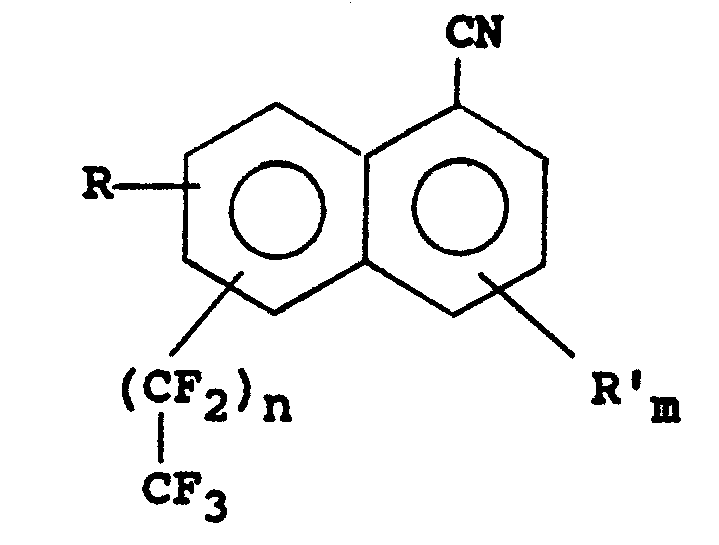
wherein R and R′ are independently selected from chloro, fluoro, nitro, hydroxy, and alkyl and alkoxy substituents containing 1-6 carbons; m is 0 or 1; and n is an integer of at least one.
wherein R and R′ are independently selected from chloro, fluoro, nitro, hydroxy, and alkyl and alkoxy substituents containing 1-6 carbons; m is 0 or 1; and n is an integer of at least one.
2. A compound as claimed in Claim 1 in which m is 0, the (CF₂)nCF₃ substituent is in the 5-position, and R is an alkyl or alkoxy substituent in the
6-position.
3. A compound as claimed in Claim 1 or Claim 2 in which n is 1-16.
4. A 6-methoxy-5-perfluoroalkyl-1-cyanonaphthalene.
5. A process for the preparation of a compound as defined in claim 1 which comprises
reacting a compound of formula MOOC(CF₂)nCF₃, in which M is an alkali metal preferably potassium, with a compound of the formula
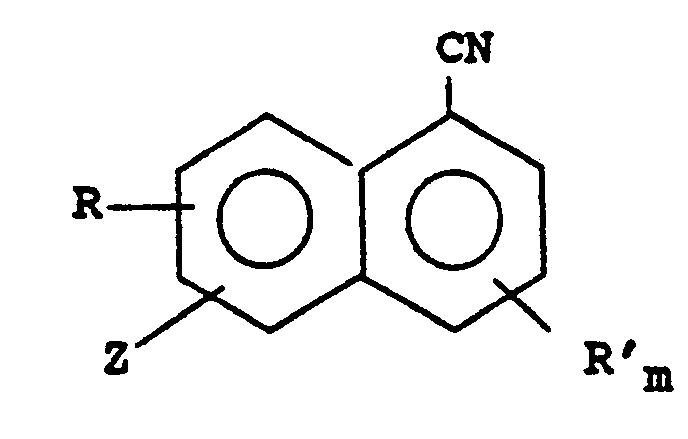
in which Z is bromo or iodo.
in which Z is bromo or iodo.
6. The use of a compound as defined in any one of claims 1 to 4 in the manufacture
of a surfactant, coating, sealant, resin or dyestuff.
7. The use of a compound as defined in any one of claims 1 to 4 in the prevention
or relief of diabetic complications in a diabetic mammal or in making a compound for
such use.
8. The use of a compound as defined in any one of claims 1 to 4 in making a medicament.
9. A process for the preparation of a pharmaceutical or veterinary formulation which
comprises formulating a compound as defined in any one of claims 1 to 4 or a compound
made using a compound as aforesaid as an intermediate for pharmaceutical or veterinary
use, respectively, optionally in unit dosage form and/or with an acceptable diluent,
carrier or excipient.