|
(11) | EP 0 305 114 A1 |

| (12) | EUROPEAN PATENT APPLICATION |
|
|
|
|
|||||||||||||||||||||||||||
| (54) | Heat treating oil |
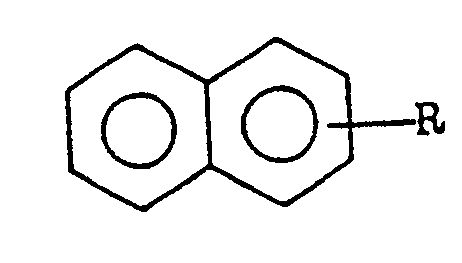
| (57) A heat treating oil comprising at least one of monoalkylnaphthalenes represented
by the general formula:
wherin R stands for a secondary or tertiary alkyl group having 10 to 24 carbon atoms. The heat treating oil has high oxidation stability and is excellent in safety and in cooling and brightening performances. |
[0001] The present invention relates to a novel heat treating oil. Particularly, it relates to a heat treating oil which comprises a monoalkylnaphthalene having a specified structure and which will exhibit excellent performances when used in the heat treatment (for example, quenching and tempering) of iron, steel and other metals.
[0002] A heat treating oil to be used in the heat treatment of iron, steel or other metals must exhibit excellent stability to heat and oxidation with high safety (i.e., low vapor pressure and high flash point), when used as a tempering oil, while it must exhibit excellent cooling (quenching) and brightening properties in addition to the above performances, when used as a quenching oil.
[0003] Among these performances required, it has been known that the cooling property can be suitably changed by adding an oil-soluble high-molecular weight substance to the treating oil, while the brightening property can be effectively enhanced by the addition of a small amount of an organic acid or ester thereto. Therefore, most of the commercially available heat treating oils comprise a mineral oil as a main component and further contain one or more of these additives as required.
[0004] However, it is not too much to say that no definitive method for enhancing the stability of a heat treating oil (i.e., the resistance thereof to heat and oxidation) to thereby prolong the service life thereof has been found as yet. Although some commercially available heat treating oils are improved in service life by adding an antioxidant thereto, the effect of the antioxidant is lost in a short period of time under severe conditions required in heat treatment to fail in sufficient improvement. Therefore, as the period of service of such an oil is prolonged, the degradation of the oil proceeds to cause the adhesion of degradation products to the surface of the substance to be treated, thus reducing the brightness thereof, though this problem does not occur in the initial stage of the service of the oil. Similarly, the cooling property of the oil varies with a prolonged period of the service thereof. Namely, the cooling property is also so lowered as to fail in desired quenching, so that troublesome control such as change of quenching conditions or oil change is necessitated, which exerts a great influence upon the operation cost.
[0005] Meanwhile, alkylnaphthalenes have been know to have unique oxidation stability and the use thereof as a lubricant oil, thermal medium oil or the like has been proposed on the basis of said stability (see Japanese Patent Laid-Open Nos. 127781, 127782, 127795 and 127796/1986). An alkylnaphthalene is an oil exhibiting a suitable viscosity at ordinary and high temperatures and is superior to a cut or fraction of an ordinary mineral oil having the same viscosity as that of the alkylnaphthalene, in terms of low vapor pressure, high flash point, slight odor and high safety for the human body. However, no information with respect to the cooling and brightening properties of the alkylnaphthalene has been given as yet, though both the properties are essential for its use as a heat treating oil.
[0006] The inventors of the present invention have paid their attention to the high oxidation stability of an alkylnaphthalene and have made intensive studies on the cooling and brightening properties thereof. As a result of these studies, they have found that a monoalkylnaphthalene having a specific structure has cooling property equivalent to that of an ordinary mineral base oil, and the change of cooling property by the oxidative degradation under specified conditions is small as compared with that of an ordinary mineral base oil, while, unlike a metal having been quenched with an ordinary mineral base oil, a metal having been quenched with such a specific monoalkylnaphthalene causes, with respect to brightness, neither blackening nor uneven coloration on its surface nor other degradations of the appearance thereof, and the degradation of the appearance of the monoalkylnaphthalene-quenched metal is not appreciated or is tolerably extremely slight even after the oxidative degradation thereof. The present invention has been accomplished on the basis of this finding.
[0007] The present invention has its object to provide a synthetic heat treating oil which can be used stably (with reduced changes in its brightening, cooling and like performances) for a long period of time without the addition of any antioxidant thereto.
[0008] In one aspect, the present invention resides in a heat treating oil consisting of, or comprising as the main component, a monoalkylnaphthalene represented by the general formula:
wherein R stands for a secondary or tertiary alkyl group having 10 to 24 carbon atoms.
[0009] In another aspect, the present invention resides in a heat treating oil comprising, as one essential component, (A) 100 parts by weight of a monoalkylnaphthalene represented by the general formula:
wherein R stands for a secondary or tertiary alkyl group having 10 to 24 carbon atoms,
and, as another essential component, (B) 1 to 30 parts by weight of an oil-soluble high-molecular weight substance having an average molecular weight of at least 800.
[0011] The heat treating oil according to the present invention is characterized by comprising at least one of the monoalkylnaphthalenes represented by the general formulae:
wherein R₁, R₂, R₃, R₄ and R₅ are each an alkyl group with the proviso that the total number of carbon atoms in R₁and R₂ and that in R₃, R₄ and R₅ are each 9 to 23, preferably 9 to 19.
[0012] The alkylnaphthalene which constitutes the heat treating oil according to the present invention must satisfy the following three requirements:
(1) the alkylnaphthalene be a monoalkylnaphthalene,
(2) the number of carbon atoms of the alkyl group be 10 to 24, and
(3) the alkyl group directly bonded to the naphthalene ring be a secondary or tertiary alkyl group.
[0013] An alkylnaphthalene lacking even any one of the above three requirements is inferior to the alkylnaphthalene according to the present invention in oxidation stability and physical properties as a heat treating oil, thus being unsuitable for use as a heat treating oil.
[0014] The secondary alkyl-substituted monoalkylnaphthalene according to the present invention includes α-substituted monoalkylnaphthalenes represented by the general formula:
and β-substituted monoalkylnaphthalenes represented by the general formula:
[0015] On the other hand, the tertiary alkyl-substituted monoalkylnaphthalene according to the present invention includes α-substituted monoalkylnaphthalenes represented by the general formula:
and β-substituted monoalkylnaphthalenes represented by the general formula:
[0016] A monoalkylnaphthalene having an alkyl group whose total number of carbon atoms is less than 10, is unsuitable for use as a heat treating oil since it will exhibit a high vapor pressure, low flash point and great evaporation loss and odor when used as such. Further, another monoalkylnaphthalene having an alkyl group whose total number of carbon atoms exceeds 24, is also unsuitable for use as a heat treating oil since it has lessened oxidation stability due to a relative decrease in effects of the naphthalene ring, is inconvenient to handle in the operation due to its high viscosity at ordinary temperatures and will adhere to heat-treated metal articles in a more amount thereby causing a great loss when used.
[0017] The secondary alkyl group of the monoalkylnaphthalene according to the present invention is represented by the general formula:
and examples thereof include 1-methylnonyl, 1-ethyloctyl 1-propylheptyl, 1-butylhexyl, 1-methyldecyl, 1-ethylnonyl, 1-propyloctyl, 1-butylheptyl, 1-pentylhexyl, 1-methylundecyl, 1-ethyldecyl, 1-propylnonyl, 1-butyloctyl, 1-pentylheptyl, 1-methyldodecyl, 1-ethylundecyl, 1-propyldecyl, 1-butylnonyl, 1-pentyloctyl, 1-hexylheptyl, 1-methyltridecyl, 1-ethyldodecyl, 1-propylundecyl, 1-butyldecyl, 1-pentylnonyl, 1-hexyloctyl, 1-methyltetradecyl, 1-ethyltridecyl, 1-propyldodecyl, 1-butylundecyl, 1-pentyldecyl, 1-hexylnonyl, 1-heptyloctyl, 1-methylpentadecyl, 1-ethyltetradecyl, 1-propyltridecyl, 1-butyldodecyl, 1-pentylundecyl, 1-hexyldecyl, 1-heptylnonyl, 1-methylhexadecyl, 1-ethylpentadecyl, 1-propyltetradecyl, 1-butyltridecyl, 1-pentyldodecyl, 1-hexylundecyl, 1-heptyldecyl, 1-octylnonyl, 1-methylheptadecyl, 1-ethylhexadecyl, 1-propylpentadecyl, 1-butyltetradecyl, 1-pentyltridecyl, 1-hexyldodecyl, 1-heptylundecyl, 1-octyldecyl, 1-methyloctadecyl, 1-ethylheptadecyl, 1-propylhexadecyl, 1-butylpentadecyl, 1-pentyltetradecyl, 1-hexyltridecyl, 1-heptyldodecyl, 1-octylundecyl, 1-nonyldecyl, 1-methylnonadecyl, 1-ethyloctadecyl, 1-propylheptadecyl, 1-butylhexadecyl, 1-pentylpentadecyl, 1-hexyltetradecyl, 1-heptyltridecyl, 1-octyldodecyl, 1-nonylundecyl, 1-methyleicosyl, 1-ethylnonadecyl, 1-propyloctadecyl, 1-butylheptadecyl, 1-pentylhexadecyl, 1-hexylpentadecyl, 1-heptyltetradecyl, 1-octyltridecyl, 1-nonyldodecyl, 1-decylundecyl, 1-methylheneicosyl, 1-ethyleicosyl, 1-propylnonadecyl, 1-butyloctadecyl, 1-pentylheptadecyl, 1-hexylhexadecyl, 1-heptylpentadecyl, 1-octyltetradecyl, 1-nonyltridecyl, 1-decyldodecyl, 1-methyldocosyl, 1-ethylheneicosyl, 1-propyleicosyl, 1-butylnonadecyl, 1-pentyloctadecyl, 1-hexylheptadecyl, 1-heptylhexadecyl, 1-octylpentadecyl, 1-nonyltetradecyl, 1-decyltridecyl, 1-undecyldodecyl, 1-methyltricosyl, 1-ethyldocosyl, 1-propylheneicosyl, 1-butyleicosyl, 1-pentylnonadecyl, 1-hexyloctadecyl, 1-heptylheptadecyl, 1-octylhexadecyl, 1-nonylpentadecyl, 1-decyltetradecyl and 1-undecyltridecyl groups.
[0018] The tertiary alkyl group of the monoalkylnaphthalene according to the present invention is represented by the general formula:
and examples thereof include 1,1-dimethyloctyl, 1-ethyl-1-methylheptyl, 1,1-diethylhexyl, 1,1-dimethylnonyl, 1-ethyl-1-methyloctyl, 1,1-diethylheptyl, 1,1-dimethyldecyl, 1-ethyl-1-methylnonyl, 1,1-diethyloctyl, 1,1-dimethylundecyl, 1-ethyl-1-methyldecyl, 1,1-diethylnonyl, 1,1-dimethyldodecyl, 1-ethyl-1-methylundecyl, 1,1-diethyldecyl, 1,1-dimethyl-tridecyl, 1-ethyl-1-methyldodecyl, 1,1-diethylundecyl, 1,1-dimethyltetradecyl, 1-ethyl-1-methyltridecyl, 1,1-diethyldodecyl, 1,1-dimethylpentadecyl, 1-ethyl-1-methyltetradecyl, 1,1-diethyltridecyl, 1,1-dimethylhexadecyl, 1-ethyl-1-methylpentadecyl, 1,1-diethyltetradecyl, 1,1-dimethylheptadecyl, 1-ethyl-1-methylhexadecyl, 1,1-diethylpentadecyl, 1,1- dimethyloctadecyl, 1-ethyl-1-methylheptadecyl, 1,1-diethylhexadecyl, 1,1-dimethylnonadecyl, 1-ethyl-1-methyloctadecyl, 1,1-diethylheptadecyl, 1,1-dimethyleicosyl, 1-ethyl-1-methylnonadecyl, 1,1-diethyloctadecyl, 1,1-dimethylheneicosyl, 1-ethyl-1-methyleicosyl, 1,1-diethylnonadecyl, 1,1-dimethyldocosyl, 1-ethyl-1-methylheneicosyl and 1,1-diethyleicosyl groups.
[0019] The heat treating oil of the present invention may be composed either of a monoalkylnaphthalene or of a mixture of two or more monoalkylnaphthalenes, as far as the structure of the monoalkylnaphthalene is as defined above.
[0020] The mixture of monoalkylnaphthalenes according to the present invention can be prepared by mixing in any mixing ratios monoalkylnaphthalenes which have each been prepared separately. Alternatively, the mixture may be prepared in one step by Friedel-Crafts' alkylating reaction. In the Friedel-Crafts' alkylating reaction, naphthalene is reacted with an alkyl source such as a secondary or tertiary alkyl halide, alcohol or monoolefin each having 10 to 24 carbon atoms at a reaction temperature of 0 to 250°C in the presence of an ocid catalyst, for example, a metal halide such as aluminum chloride, zinc chloride or iron chloride, sulfuric acid, phosphoric acid, phosphorus pentoxide, boron fluoride, acid clay or activated clay.
[0021] The heat treating oil of the present invention which consists of, or comprises as the main component, at least one specified monoalkylnaphthalene, per se, has a cooling property equivalent to that of an ordinary mineral base oil. However, in order to further enhance the cooling property when required depending upon the purpose of use, the heat treating oil may additionally contain an oil-soluble high-molecular weight substance having an average molecular weight of at least 800, preferably 2,000 to 10,000 in an amount of 1 to 30 parts by weight, preferably 1 to 10 parts by weight, per 100 parts by weight of the monoalkylnaphthalene.
[0022] Preferred examples of the oil-soluble high-molecular weight substance to be used in the second invention include asphalt, polybutene, polyvinyl chloride, polystyrene, polymethyl methacrylate, acrylonitrile-styrene resin, silicone resin, polyvinyl butyral and other resins. The monoalkylnaphthalene according to the present invention is highly capable of dissolving an oil-soluble high-molecular weight substance, so that the monoalkylnaphthalene can be advantageously incorporated even with a high-molecular weight substance which is too difficulty soluble in an ordinary mineral base oil to be incorporated therein.
[0023] Further, the heat treating oil of the present invention may, if necessary, contain a mineral oil or known synthetic oil in an amount of at most 40% by weight, as far as the high oxidation stability thereof is not damaged thereby. Furthermore, the heat treating oil may additionally contain conventional additives for heat treating oil, such as a brightness improver, antioxidant or detergent dipersant.
[0024] The present invention will now be described in more detail by the following Examples and Comparative Examples.
Example 1
[0025] The reaction of naphthalene with 1-decene was carried out by a conventional process (as described in Japanese Patent Laid-Open Nos. 127781 and 127782 / 1986) to give a C₁₀-monoalkylnaphthalene mixture having the following composition (as determined by gas chromatography and ¹³C-NMR)
[Composition]
[0026] α-(1-methylnonyl)naphthalene 18 mol %
α-(1-ethyloctyl)naphthalene 12 mol %
α-(1-propylheptyl)naphthalene 10 mol %
α-(1-butylhexyl)naphthalene 4 mol %
β-(1-methylnonyl)naphthalene 25 mol %
β-(1-ethyloctyl)naphthalene 13 mol %
β-(1-propylheptyl)naphthalene 11 mol %
β-(1-butylhexyl)naphthalene 7 mol %
[Viscosity]
[0029] The kinematic viscosity of the mixture was determined at 40°C and 100°C according to the method for testing kinematic viscosity of crude oils and petroleum products as prescribed in JIS K 2283.
[Flash point]
[0030] The flash point of the mixture was determined according to the method for testing flash point of crude oils and petroleum products as prescribed in JIS K 2265.
[Lifetime in oxidation test]
[0031] The mixture was subjected to a high-temperature oxidation test using the equipment prescribed in IP-280 under the following conditions to determine the time taken for the mixture to reach 1.0 mgKOH/g in acid value:
test temperature : 170°C
flow rate of oxygen : 3ℓ/hr
catalyst : copper wire 1 mm ⌀ x 80 cm
Example 2
[0032] The same procedure as that described in Example 1 was repeated except that the 1-decene was replaced by 2-methyl-1-undecene, to give a 1,1-dimethyldecylnaphthalene mixture, the composition of which is as follows:
[Composition]
[0034] This mixture was evaluated according to the same methods as those used in Example 1. The results are shown in Table 1.
Example 3
[0035] The same procedure as that described in Example 1 was repeated except that the 1-decene was replaced by a 1- hexadecene/1-octadecene (1 : 1) mixture, to give a C16∼ C₁₈₋ monoalkylnaphthalene mixture, the composition of which is as follows:
[Composition]
[0036] a mixture of α-(1-methylpentadecyl)naphthalene and α-(1-methylheptadecyl)naphthalene 19 mol %
a mixture of α-(l-ethyltetradecyl)naphthalene and α-(1-ethylhexadecyl)naphthalene 11 mol %
a mixture of α-(1-propyltridecyl)naphthalene and α-(1-propylpentadecyl)naphthalene 8 mol %
a mixture of α-(1-butyldodecyl)naphthalene, α-(1-butyltetradecyl)naphthalene, α-(1-pentylundecyl)naphthalene, α-(1-pentyltridecyl)naphthalene, α-(1-hexyldecyl)naphthalene, α-(1-hexyldodecyl)naphthalene, α-(1-heptylnonyl)naphthalene, α-(1-heptylundecyl)naphthalene and α-(1-octyldecyl)naphthalene. 16 mol%
a mixture of β-(1-methylpentadecyl)naphthalene and β-(1-methylheptadecyl)naphthalene 15 mol %
a mixture of β-(1-ethyltetradecyl)naphthalene and β-(1-ethylhexadecyl)naphthalene 9 mol %
a mixture of β-(1-propyltridecyl)naphthalene and β-(1-propylpentadecyl)naphthalene 7 mol %
a mixture of β-(1-butyldodecyl)naphthalene, β-(1-butyltetradecyl)naphthalene, β-(1-pentylundecyl)naphthalene, β-(1-pentyltridecyl)naphthalene, β-(1-hexyldecyl)naphthalene, β-(1-hexyldodecyl)naphthalene, β-(1-heptylnonyl)naphthalene, β-(1-heptylundecyl)naphthalene and β-(1-octyldecyl)naphthalene. 15 mol %
[0037] This mixture was evaluated according to the same methods as those used in Example 1. The results are shown in Table 1.
Comparative Example 1
[0038] The same procedure as that described in Example 1 was repeated except that the 1-decene was replaced by 1-octene, to give a C₈-monoalkylnaphthalene mixture, the composition of which is as follows:
[Composition]
[0039] α-(1-methylheptyl)naphthalene 19 mol %
α-(1-ethylhexyl)naphthalene 12 mol %
α-(1-propylpentyl)naphthalene 11 mol %
β-(1-methylheptyl)naphthalene 28 mol %
β-(1-ethylhexyl)naphthalene 15 mol %
β-(1-propylpentyl)naphthalene 15 mol %
[0040] This mixture was evaluated according to the same methods as those used in Example 1. The results are shown in Table 1.
Comparative Example 2
[0041] The same procedure as that described in Example 1 was repeated except that the 1-decene was replaced by a C
C₂₈-α-olefin mixture, to give a C
C₂₈-monoalkylnaphthalene mixture, the composition of which is as follows:
[Composition]
[0042] a mixture of α-(1-methylpentacosyl)naphthalene and α-(1-methylheptacosyl)naphthalene 11 mol %
a mixture of α-(1-ethyltetracosyl)naphthalene and α-(1-ethylhexacosyl)naphthalene 6 mol %
a mixture of α-(1-propyltricosyl)naphthalene and α-(1-propylpentacosyl)naphthalene 5 mol %
a mixture of α-C₂₆-monoalkylnaphthalenes and α-C₂₈-monoalkylnaphthalenes except the ones described above 11 mol %
a mixture of β-(1-methylpentacosyl)naphthalene and β-(1-methylheptacosyl)naphthalene 21 mol %
a mixture of β-(1-ethyltetracosyl)naphthalene and β-(1-ethylhexacosyl)naphthalene 13 mol %
a mixture of β-(1-propyltricosyl)naphthalene and β-(1-propylpentacosyl)naphthalene 12 mol %
a mixture of β-C₂₆-monoalkylnaphthalenes and β-C₂₈-monoalkylnaphthalenes except the ones described above 21 mol %
[0043] This mixture was evaluated according to the same mehtods as those used in Example 1. The results are shown in Table 1.
Comparative Example 3
[0044] Asphalt having an average molecular weight of about 3,000 was added to a mineral base oil, which has been known to be useful as a heat treating oil, in an amount of 7 % by weight to give a mixture. This mixture was evaluated according to the same methods as those used in Example 1. The results are shown in Table 1.
Example 4
[0045] The oil prepared in Example 2 was evaluated for its performances as a heat treating oil according to the following methods. The results are shown in Table 2.
[Cooling performance]
[0046] The oil was evaluated for cooling performance according to the cooling test prescribed in JIS K 2242-5.2 to determine its characteristic temperature and the time (sec) taken for a sample to be cooled with the oil of 80°C from 800°C to 400°C. The sample used herein was a silver rod (at least 99.99 % pure) having a size of 0.6 mm ⌀ x 1,000 mm, and the word "characteristic temperature" used herein means a specific temperature at which a specific vapor film formed on the sample collapsed during the quenching and cooling step.
[Brightening performance]
[0047] A test piece made of S 45 C which had been red heated to 850°C was immersed in a sample oil kept at 80°C in a nitrogen atmosphere to observe the surface of the test piece thus cooled. The state of the surface was evaluated according to the following five grades: Grade 5 : the best surface (the surface is completely bright like the one before the quenching)
Grade 4 : the surface is slightly colored (the gloss is lowered)
Grade 3 : the surface is considerably colored and exhibits unevenness in color
Grade 2 : a major part of the surface is covered with foreign substances
Grade 1 : the surface is completely covered with foreign substances
[0048] Further, in order to evaluate the performances, as a heat treating oil, of the oil of Example 2 after being used for a long period of time, the oil of Example 2 was subjected to accelerated oxidation according to the stability test prescribed in JIS K 2242-5.3 (i.e., the oil being oxidized with dry air in the presence of a steel/copper catalyst at 165°C for 24 hours) and then evaluated for performances according to the methods described above. The results are shown in Table 2.
Example 5
[0049] The oil of Example 3 was evaluated for performances as a heat treating oil in a manner similar to that used in Example 4. Further, in a manner similar to that described in Example 4, the oil of Example 3 was also subjected to accelerated oxidation and then evaluated for performances. The results are shown in Tabel 2.
Example 6
[0050] The same asphalt as that used in Comparative Example 3 was added to the oil of Example 3 in an amount of 7% by weight to give a mixture. This mixture was evaluated for performances as a heat treating oil in a manner similar to that described in Example 4. Further, in a manner similar to that described in Example 4, the mixture was also subjected to accelerated oxidation and then evaluated for performances. The results are shown in Table 2.
Example 7
[0051] Polybutene having an average molecular weight of 2,350 was added to the oil of Example 3 in an amount of 3% by weight to give a mixture. This mixture was evaluated for performances as a heat treating oil in a manner similar to that described in Example 4. Further, in a manner similar to that described in Example 4, the oil was subjected to accelerated oxidation and evaluated for performances. The results are shown in Table 2.
Comparative Example 4
[0052] The oil of Comparative Example 3 was eveluated for performances as a heat treating oil in a manner similar to that described in Example 4. Further, in a manner similar to that described in Example 4, the oil was subjected to accelerated oxidation and evaluated for performances. The results are shown in Table 2.
Table 1
| Example and Comparative Example | Compound | Kinematic viscosity (cSt) | Flash point (°C) | Life time in oxidation test | |
| 40°C | 100°C | ||||
| Example 1 | C₁₀-monoalkylnaphthalene mixture | 11.9 | 2.52 | 182 | 22 |
| Example 2 | 1,1-dimethyldecylnaphthalene mixture | 17.6 | 3.42 | 197 | 60 |
| Example 3 | C₁₆ C₁₈-monoalkylnaphthalene mixture | 31.1 | 5.12 | 230 | 50 |
| Comparative Example 1 | C₈-monoalkylnaphthalene mixture | 9.45 | 1.31 | 161 | 37 |
| Comparative Example 2 | C₂₆ C₂₈-monoalkylnaphthalen mixture | 58.2 | 10.1 | > 250 | 7 |
| Comparative Example 3 | mineral oil and asphalt | 17.4 | 3.81 | 170 | < 5 |
Table 2
| Example and Comparative Example | Sample oil | Cooling performance | Brightening performance | |
| characteristic temperature(°C) | cooling rate (sec) | |||
| Example 4 | Oil of Example 2 | 513 | 5.05 | 5 |
| Example 4 | Oil thereof, oxidized | 517 | 4.93 | 4 |
| Example 5 | Oil of Example 3 | 540 | 4.46 | 5 |
| Example 5 | Oil thereof, oxidized | 546 | 4.21 | 4 |
| Example 6 | Mixture of oil of Example 3 with asphalt | 635 | 3.45 | 5 |
| Example 6 | The mixture, oxidized | 640 | 2.95 | 4 |
| Example 7 | Mixture of oil of Example 3 with polybutene | 641 | 3.39 | 5 |
| Example 7 | The Mixture, oxidized | 644 | 3.02 | 4 |
| Comparative Example 4 | Oil of Comparative Example 3 | 611 | 3.10 | 5 |
| Comparative Example 4 | Oil thereof, oxidized | 649 | 2.80 | 1 |
[0053] It can be understood from the results, shown in Table 1, of the lifetime in the oxidation test that the heat treating oil comprising at least one specified monoalkylnaphthalene according to the present invention has a remarkably high oxidation stability, while conventional purified mineral oils for use as a heat treating oil and monoalkylnaphthalenes having an alkyl group containing 25 or more carbon atoms are remarkably inferior to the heat treating oil of the present invention in the lifetime as determined from the oxidation test. Further, the results of the flash point test reveal that monoalkylnaphthalenes having an alkyl group containing 9 or less carbon atoms are dangerous in the operation due to their low flash point.
[0054] Additionally, it can be understood from the results shown in Table 2 that the heat treating oils comprising a specified monoalkylnaphthalene according to the present invention can be remarkably improved in cooling performance by adding an oil-soluble high-molecular weight substance thereto. Fruther, the results of the test for brightening performance after the oxidative degradation reveal that the heat treating oils comprising at least one specified monoalkylnaphthalene according to the present invention will be little lowered in brightening performance even after the oxidative degradation thereof, while the conventional purified mineral oils for use as a heat treating oil will be remarkably lowered after the oxidative degradation thereof as compared with the heat treating oils of the present invention.
[0055] As described above, the heat treating oils comprising at least one specified monoalkylnaphthalene according to the present invention have high oxidation stability which cannot be attained by the conventional mineral oils for use as a heat treating oil and are excellent in cooling and brightening performances and safety. Further, the heat treating oils of the present invention can be further improved in cooling performance by adding thereto an oil-soluble high-molecular weight substance having an average molecular weight of at least 800.
1. A heat treating oil consisting of, or comprising as the main component, at least
one of the monoalkylnaphthalenes represented by the general formula:

wherein R stands for a secondary or tertiary alkyl group having 10 to 24 carbon atoms.
wherein R stands for a secondary or tertiary alkyl group having 10 to 24 carbon atoms.
2. A heat treating oil comprising (A) 100 parts by weight of at least one of the monoalkylnaphthalenes
represented by the general formula:
wherein R stands for a secondary or tertiary alkyl group having 10 to 24 carbon atoms,
and (B) 1 to 30 parts by weight of an oil-soluble high-molecular weight substance having an average molecular weight of at least 800.
wherein R stands for a secondary or tertiary alkyl group having 10 to 24 carbon atoms,
and (B) 1 to 30 parts by weight of an oil-soluble high-molecular weight substance having an average molecular weight of at least 800.
3. A heat treating oil according to claim 1 or 2, wherein the secondary alkyl group
R is the one represented by the formula:
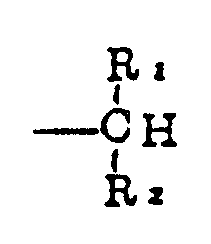
wherein R₁ and R₂ are each an alkyl group and the total number of carbon atoms of R₁ and R₂ is 9 to 23.
wherein R₁ and R₂ are each an alkyl group and the total number of carbon atoms of R₁ and R₂ is 9 to 23.
4. A heat treating oil according to claim 1 or 2, wherein the tertiary alkyl group
R is the on represented by the formula:

wherein R₃, R₄ and R₅ are each an alkyl group and the total number of carbon atoms of R₃, R₄ and R₅ in 9 to 23.
wherein R₃, R₄ and R₅ are each an alkyl group and the total number of carbon atoms of R₃, R₄ and R₅ in 9 to 23.
5. A heat treating oil according to claim 1 or 2, wherein the secondary alkyl group-substituted
monoalkylnaphthalene is an α-substituted monoalkylnaphthalene represented by the formula:
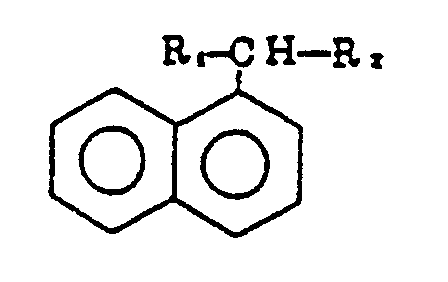
wherein R₁ and R₂ are as defined above.
wherein R₁ and R₂ are as defined above.
6. A heat treating oil according to claim 1 or 2, wherein the secondary alkyl group-substituted
monoalkylnaphthalene is a β-substituted monoalkylnaphthalene represented by the formula:
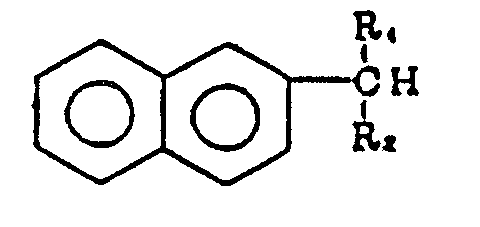
wherein R₁ and R₂ are as defined above.
wherein R₁ and R₂ are as defined above.
7. A heat treating oil according to claim 1 or 2, wherein the tertiary alkyl group-substituted
monoalkylnaphthalene is an α-substituted monoalkylnaphthalene represented by the formula:
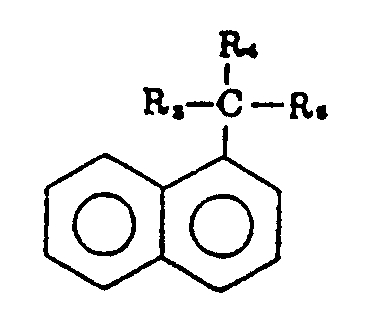
wherein R₃, R₄ and R₅ are as defined above.
wherein R₃, R₄ and R₅ are as defined above.
8. A heat treating oil according to claim 1 or 2, wherein the tertiary alkyl group-substituted
monoalkylnaphthalene is a β-substituted monoalkylnaphthalene represented by the formula:
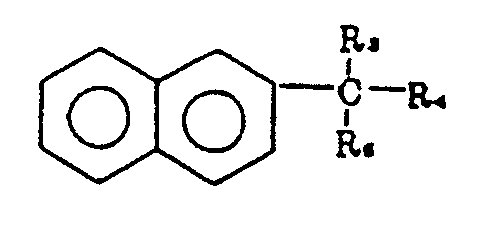
wherein R₃, R₄ and R₅ are as defined above.
wherein R₃, R₄ and R₅ are as defined above.