|
(11) | EP 0 305 625 A1 |

| (12) | EUROPEAN PATENT APPLICATION |
|
|
|
|
||||||||||||||||||||||||
| (54) | Crystalline cephalosporine derivative |
| (57) The invention provides crystalline (6R, 7R)-7-[[2-(2-Amino-4-thiazolyl)-(Z)-2-(1-diphenylmethoxycarbonyl-1-methylethoxy)imino]acetamido]-3-(1-pyridiniummethyl)-3-cephem-4-carboxylate
and a process for its production. |
[0001] The present invention provides a new crystalline, highly pure and stable form of the syn-isomer of the cephalosporin derivative of formula
as well as a process for its production.
[0002] The cephalosporin derivative of formula I is useful as an intermediate for the production of highly active cephalosporin antibiotics which can be administered parenterally and show a very broad spectrum of activity against pathogenic microorganisms, particularly in the gram negative area.
[0003] The syn-isomer compound of formula I has usually been isolated in the form of a salt, such as the dihydrochloride or chloride hydrochloride. Hitherto, the free betaine form has only been isolated from complex solvents mistures which has resulted in a product, in particular a solvate, with less than optimal purity and stability. It has now surprisingly been found that the syn-isomer of the compound of formula I can be isolated in free betaine form, and free of acid or solvent adducts, in excellent yield and purity (≧97%) as a stable highly crystalline product, direct from the reaction mixture used to produce it. The product has the physical characteristics set out in the Example hereinafter.
[0004] The present invention provides more particularly a process for the production of the syn-isomer of compound of formula I in crystalline form, comprising reacting the syn-isomer of a compound of formula II and/or IIa
in which
signify a 5-or 6-membered heterocyclic ring which may contain in addition to the nitrogen atom one or two further hetero atoms for example oxygen, nitrogen or sulphor, and which may be substituted, and which may be fused to a benzene ring which may itself be substituted,
with a compound of formula III,
in which R is hydrogen or an amino protecting group, or salt thereof, e.g. the hydrochloride, mixing the resulting reaction mixture with a mixture of an acetic acid ester and a lower alkanol at a temperature of from 0 to 40°C, preferably 15° to 25°, and recovering the precipitated product. In this manner, the product crystallises out in a matter of a few minutes to a few hours in practically quantitative yield and high purity (≧97% yield and purity). Preferred acetic acid esters include C₁₋₆ alkyl acetates, preferably ethyl, propyl and butyl acetate. Preferred lower alkanols include ethanol and particularly, methanol. The ratio of acetate to lower alkanol to reaction mixture depends on the chosen acetate and alkanol but is usually about 2-3:1:1 by volume, particularly in the case of ethyl or butylacetate and methanol.
[0005] The nature of the "Het" ring in the compounds II and IIa is not critical, the preferred compounds being determined by such factors as availability of starting materials and ease of production. The preferred rings are 2-pyridyl and, in particular 2-benzylthiazolyl or less preferably pyrimidinyl, triazolyl or thiazolyl, and the corresponding thiones as in compounds IIa.
[0006] The compounds of formula II, IIa and III are known and may be produced in conventional manner.
Example: (6R, 7R)-7-[[2-(2-Amino-4-thiazolyl)-(Z)-2-(1-diphenylmethoxycarbonyl-1-methylethoxy)imino]acetamido]-3-(1pyridiniummethyl)-3-cephem-4-carboxylate
[0008] 212g of 2-(2-Amino-4-thiazolyl)-(Z)-2-(1-diphenylmethoxycarbonyl-1-methylethoxy)iminoacetic acid are suspended together with 138g of triphenylphosphine in 800 ml of methylene dichloride, the mixture is cooled to 0° and 175 g of mercaptobenzthiazole disulphide are added. After 2 hours stirring at 0°, the formation of the thioester II or the corresponding compound IIa is complete (as determined by DC) and 260 g of 7-amino-3-pyridiniummethylcephalosporanic acid hydrochloride and 61 g of triethylamine are added at 0°. The mixture is stirred for 15 hours at 0° until the reaction is complete (as determined by HPLC) and the reaction mixture (yellow-brown) (ca. 1400 ml) is introduced into a mixture of 1400 ml of methanol and 3.5 litres of butylacetate at about 20°. The resulting clear solution is stirred at room temperature for 2 hours and then at 0° for a further 2 hours. The resulting highly crystalline precipitate is filtered off, washed with cold methanol and dried in vacuo. The highly pure (≧97%) by weight, free-flowing heading compound results.
1. Crystalline (6R, 7R)-7- 2-(-Amino-4-thiazolyl)-(Z)-2-(1-diphenylmethoxycarbonyl-1-methylethoxy)imino
acetamido -3-(1-pyridiniummethyl)-3-cephem-4-carboxylate.
2. The product of claim 1 in a purity of at least 97%.
3. A process for the production of the product of claim 1 comprising reacting a compound
of formula II of IIa
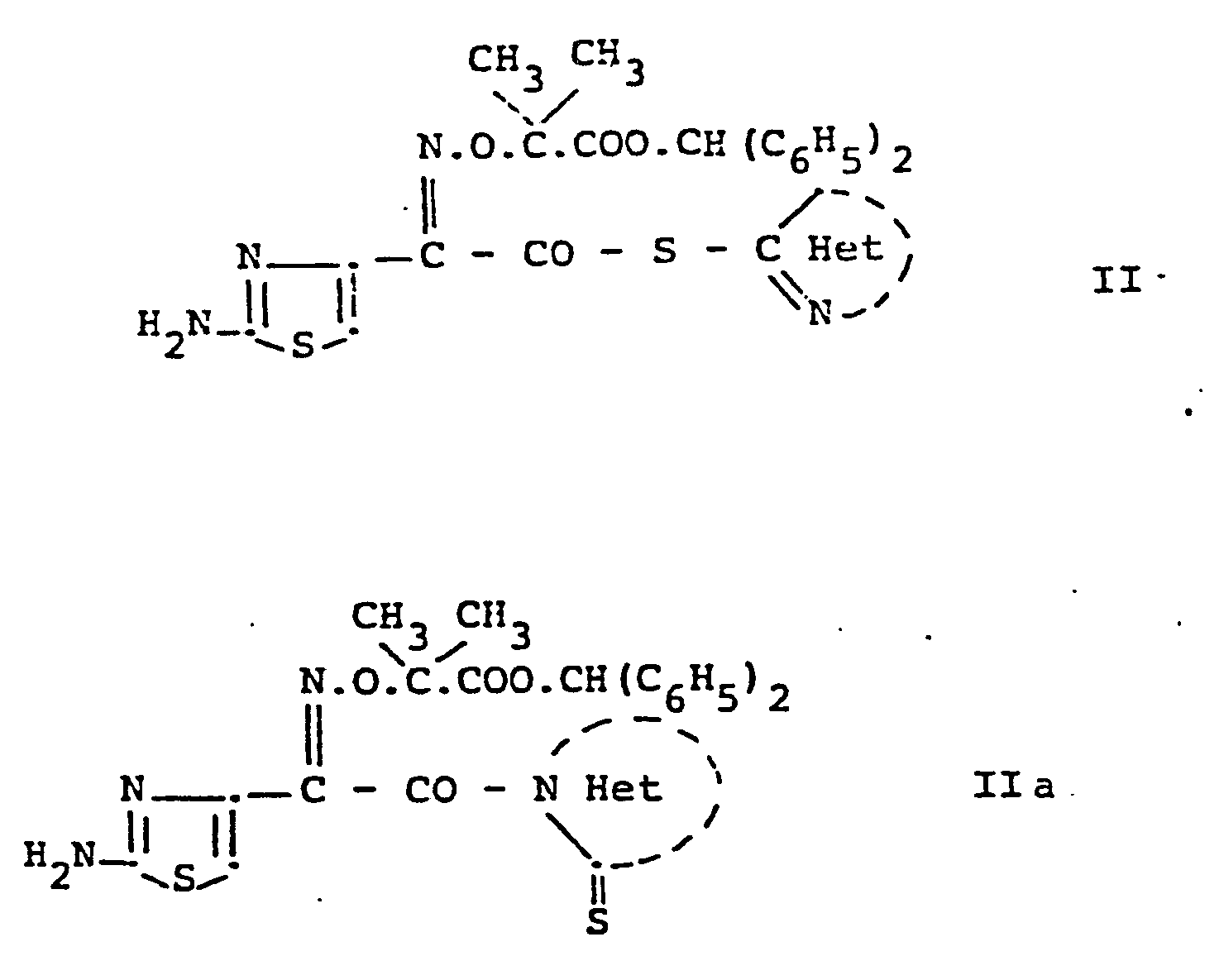
in which
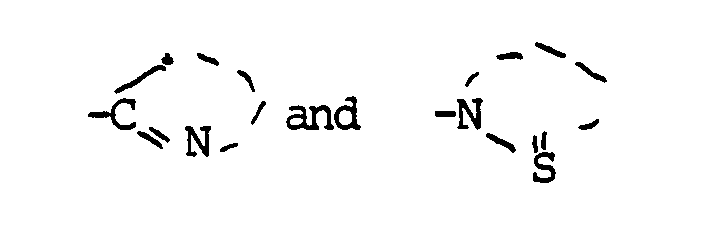
signify a 5-or 6-membered heterocyclic ring which may contain in addition to the nitrogen atom one or two further hetero atoms, and which may be substituted, and which may be fused to a benzene ring which may itself be substituted,
with compound of formula III,
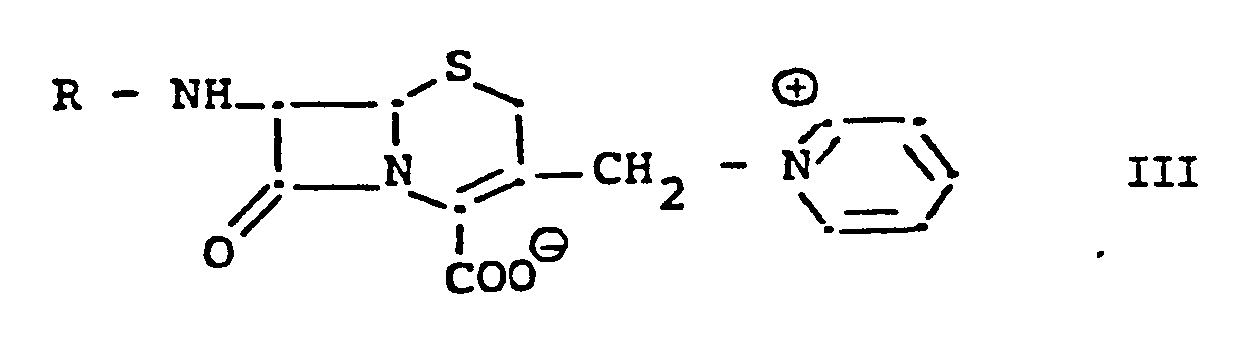
in which R is hydrogen or an amino protecting group, or a salt thereof, characterised by mixing the resulting reaction mixture with a mixture of an acetic acid ester and a lower alkanol at a temperature of from 0 to 40°C, recovering the precipitated product.
in which
signify a 5-or 6-membered heterocyclic ring which may contain in addition to the nitrogen atom one or two further hetero atoms, and which may be substituted, and which may be fused to a benzene ring which may itself be substituted,
with compound of formula III,
in which R is hydrogen or an amino protecting group, or a salt thereof, characterised by mixing the resulting reaction mixture with a mixture of an acetic acid ester and a lower alkanol at a temperature of from 0 to 40°C, recovering the precipitated product.
4. A process according to claim 3, in which the acetic acid ester is ethyl propyl
or butylacetate.
5. A process according to claim 3, in which the lower alkanol is methanol.