|
(11) | EP 0 305 718 B1 |

| (12) | EUROPEAN PATENT SPECIFICATION |
|
|
| (54) |
Polycarbonate-polyisobutylene block copolymer Polycarbonat-Polyisobutylen - Blockcopolymere Copolymères séquencés de polycarbonate et de polyisobutène |
|
|
|||||||||||||||||||||||||||||||
| Note: Within nine months from the publication of the mention of the grant of the European patent, any person may give notice to the European Patent Office of opposition to the European patent granted. Notice of opposition shall be filed in a written reasoned statement. It shall not be deemed to have been filed until the opposition fee has been paid. (Art. 99(1) European Patent Convention). |
[0002] Kennedy describes in U.S. -A- 4,316,973 a class of telechelic polymers of the general formula:-
wherein PIB is a divalent polyisobutylene moiety and Y represents one of the monovalent groups of the formulae:
These polymers have been found useful as soft segment components of certain block copolymers. For example, the U.S. -A- 4,276,394 describes the halogenated species as being usefully incorporated into a polystyrene elastomer. Also, Wondraczek and Kennedy described the synthesis of nylon-polyisobutylene-nylon triblock copolymers employing the hydroxyl-terminated polyisobutylene species; see Polymer Bulletin 2, 675-682 (1980) published by Springer-Verlag. The same hydroxyl-terminated species was incorporated into a block copolymer of polyisobutylene and polycarbonate; see Liao and Kennedy, Polymer Bulletin 7, pp. 233-240 (1982).
[0003] Baldwin, in U.S -A- 3,392,154 described the desirability of obtaining relatively low molecular weight, carboxy-terminated difunctional polymers of polyisobutylene. However, the process described, ozonolysis of a butyl rubber followed by oxidation or reduction of the product of ozonolysis, apparently did not result in a difunctional, carboxy-terminated polymer as would be evidenced by a curable mastic. As stated by Baldwin, "it is difficult to approach the objective of two functional groups per polymer molecule by the process of the invention when the unsaturation in the chain is not of type II". A type II copolymer is not inclusive of isobutylene-isoprene copolymer (butyl rubber).
[0004] The invention comprises a polycarbonate - polyisobutylene block copolymer having recurring structural units of the formula :
wherein D is a divalent aromatic radical of a dihydric phenol, interrupted by at least one divalent moiety of the formula :-
wherein n is an integer such that the moiety has a molecular weight contribution of from 5,000 to 30,000 Daltons as determined by gel permeation chromatography.
[0005] The polycarbonate-polyisobutylene block copolymers of the present invention are formed from a prepolymer of the formula :-
wherein X is selected from the group consisting of halogen, hydroxyl and alkoxy and n is an integer such that the polymer has a weight average molecular weight (Mw) within the range of from 5,000 to 30,000.
[0006] The term "halogen" is used herein in its commonly accepted sense as being embracive of chlorine, bromine and iodine.
[0007] The term "alkoxy" is used herein to mean the monovalent group of the formula:-
― O ― Alkyl
Preferably alkyl is represented by lower alkyl of 1 to 4 carbon atoms such as methyl, ethyl, propyl, butyl and isomeric forms thereof.
[0008] A method of preparing the polymers of formula (I), comprises oxidizing poly(isobutylene-co-isoprene) or poly(isobutylene-co-butadiene).
[0009] The polymer compounds having the formula (I) given above are telechelic, i.e., terminally functional polymers which may be incorporated into block co-polymers through condensation co-polymerization with reactable monomers or pre-polymers having active (labile) hydrogen atoms.
[0010] The polymer compounds of the formula (I) given above wherein X represents a hydroxyl group are dicarboxylic acids, useful as a diacid reactant in the preparation of block copolymers. The dicarboxylic acids of formula (I) may be prepared by oxidizing the double bonds in poly(isobutylene-co-isoprene) or poly(isobutylene-co-butadiene). The oxidation proceeds in accordance with the schematic formulae:-
wherein n is as defined previously, m represents an integer such that m and n together provide the polymer of which the moiety of formula (II) is a repeating unit, with a Mw value of from 50,000 to 500,000. Generally, m is an integer of about one-tenth the value of n. The symbol R' in the formula (II) represents one of hydrogen and methyl. The polymers having repeating units of the formula (II) are well known compounds and are the commercially available poly(isobutylene-co-butadiene) and poly (isobutylene-co-isoprene) copolymers commonly referred to in the art as "butyl rubber". They may be prepared by the method decribed in U.S. -A- 2,356,128.
[0011] The oxidation may be carried out by heating the poly(isobutylene-co-butadiene), poly(isobutylene-co-isoprene) or mixtures thereof in the presence of an oxidizing agent such as dichromate, alkaline permanganate and preferably nitric acid. Advantageously the oxidation is carried out in the presence of an inert organic solvent for the copolymer starting material. The term "inert organic solvent" is used herein to mean an organic solvent that does not enter into or otherwise adversely affect the desired course of the reaction. Representative of inert organic solvents which may be employed in the oxidation are hydrocarbon solvents such as n-hexane, n-octane and the like. Any proportion of solvent may be employed, preferably sufficient to dissolve the starting polymer.
[0012] In a preferred method, the starting rubber polymer (II) is dissolved in the inert organic solvent and nitric acid is added slowly, in a molar excess (preferrably a 4 to 10 X molar excess), with stirring of the reactants.
[0013] Although a wide range of temperature and pressure conditions may be employed in the oxidation process of the invention, the temperature is advantageously within the range of from 50° to 150° C.; preferably 60° to 100°C. The pressure employed may be subatmospheric or super-atmospheric; preferably atmospheric.
[0014] Progress of the oxidation may be followed by employment of conventional analytical technique. For example, disappearance of the unsaturated bonds in the starting polymers may be followed by infrared analytical technique.
[0015] Upon completion of the oxidation, the reaction mixture may be allowed to cool to room temperature, washed with water to remove residual oxidizing agent and the desired polymers of formula (III) separated by precipitation following conventional precipitation techniques and procedure. However, it is not necessary that the polymeric dicarboxylic acids of the formula (III) be isolated from the neutralized reaction mixture to be useful. The crude product mixture may be employed, for example, to prepare the polymeric diacyl halides and the polymeric dialkoxy compounds of formula (I) hereinafter described more fully without first separating the dicarboxylic acid polymer of the formula (III).
[0016] Polymer compounds having the formula (I) wherein X represents halogen are diacyl halides, which may be prepared by reaction of the polymeric dicarboxylic acids of formula (III) with a phosphorus halide; see for example the general procedure described by Cloke et al., J.A.C.S., 53, 2794 (1931). In general, a phosphorus trihalide is employed in molar excess over the dicarboxylic acid. In a preferred embodiment of the invention, the halide is chloride and the diacyl chloride of formula (I) is prepared by the action of a molar excess of thionyl chloride on the polymeric dicarboxylic acid of formula (III), in the presence of a catalytic proportion of pyridine and an inert organic solvent for the compound of formula (III) as described above. The reaction is well known and may be carried out by the method described by Ralls et al., J.A.C.S., 77, 6073 (1955). Most preferably the catalyst is dimethylformamidinium chloride which may be formed in situ in the reaction mixture by employing dimethylformamide as a solvent for the thionyl chloride in an excess proportion of about 10 percent of an equivalent of dimethylformamide to thionyl chloride; see the method of Zollinger et al., Helv. Chim. Acta. 42, 1653 (1959).
[0017] The carboalkoxy terminated polymers of the formula (I) given above wherein X represents alkoxy may be prepared by esterification, employing known methods, of the polymeric dicarboxylic acids or the diacyl halides of the formula (I) given above. For example, the esterification can be carried out by esterifying the dicarboxylic acid or the diacyl halide of formula (I) with an alcohol of the formula:
Alkyl ― OH (IV)
wherein alkyl is as defined herein. The esterification conditions are conventional and well known. In general, the polymeric dicarboxylic acid (I) may be refluxed with a molar excess of the alcohol (IV) in the presence of a mineral acid. A convenient synthesis of polymeric diester from the polymeric diacyl halide may be carried out by the Schotten-Baumann reaction [C. Schotten, Ber. 17, 2544 (1884)]. In a preferred method, the polymeric diacyl halide is esterified with the sodium alcoholate of the alcohol of formula (IV) in the presence of an inert organic solvent as previously defined.
POLYCARBONATE - POLYISOBUTYLENE BLOCK COPOLYMERS
[0018] Polycarbonate block copolymers of the prepolymer compounds having the formula (I) given above may be obtained by the copolymerization of the compounds (I) with conventionally employed polycarbonate resin precursors. The polycarbonate-polyisobutylene copolymer product resins of the invention so obtained comprise the polymerized reaction products of
(i) at least one dihydric phenol;
(ii) a carbonate precursor; and
(iii) a polymer compound of the formula (I).
The copolymer resin obtained may be represented by those having recurring or repeating structural units of the formula:-wherein D is a divalent aromatic radical of the dihydric phenol employed in the polymerization reaction.
[0019] The recurring or repeating units of the formula (V) are interrupted by at least one divalent moiety of the formula:-
wherein n is as defined previously.
[0020] The polycarbonate - polyisobutylene block copolymers or the invention may be prepared by known, conventional methods such as is described in the U.S. -A- 3,028,365; 3,334,154; 3,275,601; 3,915,926; 3,030,331; 3,169,121; 3,027,814; and 4,188,314. In general, the preparation may be carried out by interfacial polymerization or phase boundary separation, transesterification, solution polymerization, melt polymerization, and interesterification. Interfacial polymerization is preferred.
[0021] Although the preparative processes may vary, several of the preferred processes typically involve dissolving or dispersing the reactants in a suitable water immiscible solvent medium and contacting the reactants with a carbonate precursor, such as phosgene, in the presence of a suitable catalyst and an aqueous caustic solution under controlled pH conditions. The most commonly used water immiscible solvents include methylene chloride, 1,2-dichloroethane, chlorobenzene, and toluene. A molecular weight regulator, i.e., a chain stopper, is generally added to the reactants prior to or during the contacting of them with a carbonate precursor. Useful molecular weight regulators include, but are not limited to, monohydric phenols such as phenol, chroman-I, para-tertiary-butylphenol, and the like. Techniques for the control of molecular weight are well known in the art and may be used for controlling the molecular weight of the copolycarbonate-resins of the invention.
[0022] The catalysts employed, if an interfacial polymerization technique is used, accelerate the rate of polymerization of the dihydric phenol reactant with the carbonate precursor such as phosgene. Suitable catalysts include but are not limited to tertiary amines such as triethylamine, quaternary phosphonium compounds, and quaternary ammonium compounds.
[0023] The preferred process for preparing polycarbonate-polyisobutylene copolymer resins of the invention comprises a phosgenation reaction. The temperature at which the phosgenation reaction proceeds may vary from below 0°C, to above 100°C. The phosgenation reaction preferably proceeds at temperatures of from room temperatures (25°C) to 50°C. Since the reaction is exothermic, the rate of phosgene addition may be used to control the reaction temperature. The amount of the phosgene required will generally depend upon the amount of the dihydric phenol and the amount of dicarboxylic polymer acid present, and may be a stoichiometric proportion.
[0024] Representative of dihydric phenols which may be employed are those of the formula:-
wherein:
each R is independently selected from halogen, hydrocarbyl and monovalent hydrocarbonoxy radicals;
W is selected from divalent hydrocarbon radicals, -O-, -S-, -S-S-,
and
each m is independently selected from whole numbers having a value of from 0 to 4 inclusive; and
b is either zero or one, preferably one.
[0025] Preferred halogen radicals represented by R are chlorine and bromine. The preferred monovalent hydrocarbyl radicals represented by R include alkyl, cycloalkyl, aryl, aralkyl, and alkaryl radicals.
[0026] The preferred alkyl radicals represented by R are those containing from 1 to 10 carbon atoms. The preferred cycloalkyl radicals represented by R are those containing from 6 to 12 ring carbon atoms; preferred aryl radicals are phenyl, naphthyl, and biphenyl. The preferred aralkyl and alkaryl radicals represented by R are those containing from 7 to 14 carbon atoms, inclusive.
[0027] The monovalent hydrocarbonoxy radicals represented by R have the general formula -OR'', wherein R'' has the same meaning as R (but not halogen). Preferred hydrocarbonoxy radicals are the alkoxy and the aryloxy radicals.
[0028] The divalent hydrocarbon radicals represented by W include the alkylene radicals, alkylidene radicals, cycloalkylene radicals, and cycloalkylidene radicals. Preferred alkylene radicals are those containing from 2 to 20 carbon atoms. Preferred alkylidene radicals are those containing from 1 to 20 carbon atoms. Preferred cycloalkylene and cycloalkylidene radicals are those containing from 6 to 16 ring carbon atoms.
[0029] Some illustrative, non-limiting examples of the dihydric phenols represented by Formula VII include:
2,2-bis(4-hydroxyphenyl)propane; i.e., bisphenol-A;
2,2-bis(3,5-dimethyl-4-hydroxyphenyl)propane;
2,2-bis(3,5-dibromo-4-hydroxyphenyl)propane;
1,1-bis(4-hydroxyphenyl)cyclohexane;
1,1-bis(3,5-dimethyl-4-hydroxyphenyl)cyclohexane;
1,1-bis(4-hydroxyphenyl)pentane;
bis(4-hydroxyphenyl)methane;
bis(3,5-diethyl-4-hydroxyphenyl)methane;
1,3-bis(4-hydroxyphenyl)propane;
4,4'-thiodiphenol; and
4,4'-dihydroxy-2,6-dimethyldiphenyl ether.
[0030] The dihydric phenols which may be used in the preparation of the copolymer resins of the invention are well known in the art and are described, inter alia, in U.S. -A- 3,018,365; 2,999,835; 3,148,172; 3,271,368; 2,991,273; 3,271,367; 3,280,078; 3,041,891 and 2,999,846.
[0031] As a class, the most preferred dihydric phenols employed in the preparation of the polycarbonate moiety in the polycarbonate - polyisobutylene block copolymers of the invention are those that provide repeating or recurring chain units of the formula (V) given above, having the more specific formula:-
wherein R₁ and R₄ are each selected from a divalent aromatic hydrocarbon radical, a divalent, halogen-substituted aromatic hydrocarbon radical and a divalent, alkyl-substituted aromatic hydrocarbon radical; and R₂ and R₃ are each selected from the group consisting of hydrogen and hydrocarbyl.
[0032] As used throughout this specification and claims, the term "hydrocarbyl" is used to mean the monovalent moiety obtained upon removal of a hydrogen atom from a parent hydrocarbon. Representative of hydrocarbyl are alkyl of 1 to 25 carbon atoms, inclusive, such as methyl, ethyl, propyl, butyl, pentyl, hexyl, heptyl, octyl, nonyl, undecyl, decyl, dodecyl, octadecyl, nonodecyl, eicosyl, heneicosyl, docosyl, tricosyl, tetracosyl, pentacosyl and the isomeric forms thereof; aryl of 6 to 25 carbon atoms, inclusive, such as phenyl, tolyl, xylyl, napthyl, biphenyl, and tetraphenyl; aralkyl of 7 to 25 carbon atoms, inclusive, such as benzyl, phenethyl, phenpropyl, phenbutyl, phenhexyl, and napthoctyl; cycloalkyl of 3 to 8 carbon atoms, inclusive, such as cyclopropyl, cyclobutly, cyclopentyl, cyclohexyl, cycloheptyl, and cyclooctyl; alkenyl of 2 to 25 carbon atoms, inclusive, such as vinyl, allyl, butenyl, pentenyl, hexenyl, octenyl, nonenyl, decenyl, undececyl, dodecenyl, tridecenyl, pentadeceyl, octadecenyl, pentacosynyl and isomeric forms thereof.
[0033] The carbonate precursors useful in the preparation of the polycarbonate - polyisobutylene copolymer resins of the instant invention include the carbonyl halides, the bishaloformates, and diaryl carbonates.
[0035] Also included herein are polycarbonate moieties which are randomly branched. These randomly branched polycarbonate moieties are obtained by adding a minor amount, typically between about 0.05 and 2.0 mole percent, based on the amount of dihydric phenol used, of a polyfunctional aromatic compound which functions as a branching agent. These polyfunctional aromatic compounds contain at least three functional groups which may be hydroxyl, carboxyl, carboxylic anhydride, haloformyl, and mixtures thereof. Some illustrative non-limiting examples of these compounds include trimellitic anhydride, trimellitic acid, trimellityl trichloride, 4-chloro formyl phthalic anhydride, pyromellitic dianhydride, mellitic acid, mellitic anhydride, and trimesic acid. The method of incorporating branching in the polycarbonate units of the block copolymers of the invention are known to those skilled in the art; see for example the description in U.S. -A- 4,001,184.
[0036] The relative proportion of chain units of the formula (V) and of the chain units of formula (VI) found in the polycarbonate - polyisobutylene block copolymer resins of the invention generally depend upon the amounts of compounds of Formulae (I) and (VII) used in the preparation of the copolymer. Thus, for example, if 10 weight percent of polymer (I) is used the resin will contain about 10 weight percent of structural unit (VI) in the polymer chain. Any relative proportion of the chain units of the formulae IV) and (VI) may be found in the copolymer resins of the invention. Preferably, from 0.5 to 50 weight percent of the polymer of formula (I) is used. At the higher proportion, the copolymer of the invention will exhibit increasing properties of elasticity as compared to copolymers made with lower proportions of the polymer of formula (I).
[0037] The polycarbonate - polyisobutylene block copolymers of the instant invention described above may have a weight average molecular weight of from 20,000 to 200,000, preferably from 30,000 to 150,000 and an intrinsic viscosity, as measured in methylene chloride at 25°C., of at least 0.4 dl/gm, preferably from 0.45 to 1.40 dl/gm.
[0038] The polycarbonate-polyisobutylene block copolymers of the invention are useful as thermoplastic molding compositions. The moldable resins and resin compositions are useful to mold a wide variety of useful articles such as component parts of automobiles, and tool housings by conventional molding techniques including injection molding, and solvent casting procedures.
[0039] When employed as the active ingredient in a thermoplastic molding composition, the polycarbonate-polyisobutylene block copoymers of the instant invention may optionally have admixed therewith the commonly known and used processing or product additives such as, for example, antioxidants; antistatic agents; inert fillers such as glass, talc, mica, and clay; ultraviolet radiation absorbers such as the benzophenones, benzotriazoles, and cyanoacrylates; hydrolytic stablizers such as the epoxides; color stabilizers such as the organophosphites; and flame retardents.
[0040] Some particularly useful flame retardants are the alkali and alkaline earth metal salts of organic sulfonic acids. These types of flame retardants are disclosed, inter alia, in U.S. -A- 3,933,734; 3,948,851; 3,926,908; 3,919,167; 3,909,490; 3,953,396; 3,931,100; 3,978,024; 3,953,399; 3,917,559; 3,951,910 and 3,940,366.
[0041] The following examples and preparations describe the manner and process of making and using the invention and set forth the best mode contemplated by the inventor of carrying out the invention but are not to be construed as limiting the invention. Where reported, the following tests were carried out.
Glass Transition Temperature (Tg)
[0042] The glass transition temperatures were determined by using a Perkin-Elmer DSC-2B instrument which measures the glass transition temperature by differential scanning calorimetry.
Intrinsic Viscosity (I.V.)
[0043] The intrinsic viscosity was measured at a temperature of 25°C. in the indicated solvent and is reported in deciliters/gram (dl/g).
Melt Flow:
ASTM TEST METHOD D-1238
[0044] The Kasha Index (KI) of a resin is an indication or measure of the processability of the resin. The lower the KI the greater the melt flow rate and, therefore, the better the processability of the resin. Basically, the KI is a measurement of the melt viscosity of the resin. The procedure for determining the Kasha Index is as follows: 7 grams of resin pellets, dried a minimum of 90 minutes at 125°C., are added to a modified Tinius-Olsen model T-3 melt indexer; the temperature in the indexer is maintained at 300°C. and the resin is heated at this temperature for 6 minutes; after 6 minutes the resin is forced through a 1.05mm (0.04125 inch) radius orifice using a plunger of radius of 4.74mm (0.1865 inch) and an applied force of 78.73 N (17.7 pounds); the time required for the plunger to travel 5.08cm (2 inches) is measured in centiseconds and this is reported as the KI. The higher the KI the greater the melt miscosity and the more viscous the resin, and the more difficult it is to process. The lower the KI the better the processibility of the resin.
Number Average Molecular Weight (Mn):
Tensile Strength, Modulus and Elongation:
Flexural Properties:
Notched Izod Impact Strength (NI):
Heat Deflection Temperature:
PREPARATION OF CARBOXY-TERMINATED POLYISOBUTYLENE
[0050] A 3-liter flask equipped with a mechanical stirrer and a condensor is charged with 700 g. of butyl rubber (Exxon 365; Exxon Chemicals Co.; molecular weight viscosity average X 10⁻³ = 350; 4.5 mole percent unsaturation) dissolved in 1250 ml. of n-octane. The charge is heated to a temperature of 70°C. and 150 ml. of concentrated (70%) nitric acid is added dropwise with stirring. After about 2 hours, the temperature of the resulting reaction mixture is increased to 90°C. After 8 hours at the higher temperature the reaction mixture is allowed to cool to room temperature. The cooled mixture is washed with water until neutral. Methanol is added to the washed mixture to precipitate carboxy-terminated polyisobutylene. The precipitate is separated by decantation and dried in a vacuum oven at a temperature of 125°C. to obtain 650 g. of the polymer product. The physical properties of the product in comparison to the starting butyl rubber are given in the Table 1, below. Infra-red analysis confirms the dicarboxy terminated polymer structure of the formula (III) given above.
Table 1
| Butyl Rubber | Polymer Product | |
| Mn | 70,000 | 11,500 |
| Iodine No. | 10.2 g/100g. | 0.5 g/100g. |
| I.V. (dl/g.) | 1.30 | 0.25 |
Example 1
[0051] A 100 ml four neck flask is fitted with a mechanical stirrer, a pH probe, an aqueous caustic inlet tube and a Claisen adapter to which there is attached a dry ice condenser and a gas inlet tube. The flask is charged with 450 ml of water, 600 ml of methylene chloride, 1.0 ml of triethylamine, 2.0 gm (0.0133 moles; 3.3 molar percent of p-tertiary - butylphenol), 5.0 gm (0.0005 moles) of the carboxy terminated polyisobutylene whose preparation is described above and 91.3 gm (0.40 moles) of bisphenol-A. With stirring, phosgene is introduced into the flask at a rate of 1 g/min. for 50 minutes with the pH maintained in a range of 10.5 to 11.5 by addition of 50% aqueous sodium hydroxide. The resin layer is then separated from the brine layer, washed with 3 wt. percent aqueous HCl until washing remains acidic, then twice with distilled water. The obtained polycarbonate-polyisobutylene block copolymer is then precipitated into methanol in a Waring blender and washed with methanol. The dried resin so obtained is characterized by an intrinsic viscosity of 0.49 dl/g, a Tg of 148°C., a melt flow of 64 g./10min., a K.I. of 500 and an I.V. strand of 0.43 dl/g. The resin is useful as a molding resin to prepare exterior components of automobiles.
Example 2
[0052] The procedure of Example 1, is repeated except that the proportion of p-tertiary - butylphenol is increased from 2.0 gms. to 2.15 gms (0.014 moles; 3.6 molar percent) to obtain a polycarbonate - polyisobutylene resin having an I.V. of 0.51 dl/g, a Tg of 149°C., an I.V. strand of 0.47 dl/g, a melt flow of 33.3 g/ 10 min. and a K.I. of 960. This resin is useful to thermoplastically mold thin-walled parts (by injection molding) and laser/video discs.
Control
[0054] The procedure of Example 2, is repeated except that the charge does not include any carboxy terminated polyisobutylene. The polycarbonate resin obtained is characterized by an I.V. strand of 0.47, a melt flow of 14.3 g/ 10 min. and a K.I. of 2230.
Example 3
[0055] A 1000 ml. four-necked flask fitted with a mechanical stirrer, a pH probe, an aqueous caustic inlet and a Claisen adapter to which there is attached a dry ice condenser and a gas inlet tube, is charged with 30 gms. (0.131 moles) of bisphenol-A, 45 gms (0.083 moles) of tetrabromo-bisphenol-A, 40 gms (0.007 moles) of the carboxy-terminated polyisobutylene whose preparation is described above, 0.65 gms (0.004 moles) of p-tertiary - butylphenol, 3 ml. of triethylamine, 500 ml. of methylene chloride and 400 ml. of water. With stirring, phosgene is introduced at a rate of 1 gm/minute for 5 minutes at an initial pH of from 8.0 to 9.0. Then, phosgenation is continued for an additional 21 minutes while maintaining the pH within the range of 10.5 to 11.5 by addition of 50 percent aqueous sodium hydroxide. The resin layer is then separated from the brine layer, washed with 3 weight percent aqueous hydrochloric acid until the washing remains acidic, then twice with distilled water. The resin, precipitated into methanol is characterized by an I.V. of 0.77 dl/g and a bromine content of 21.9 percent. When compression molded into plaques, the resin exhibits a Flexural modulus of 1066.4 MPa, a Flexural strength of 44.13 MPa and a heat distortion temperature (HDT @ 0.46 MPa of 118°C.) The resin is useful for extruding radio-opaque tubing for use as venous catheters.
1. A polycarbonate - polyisobutylene block copolymer having recurring structural units
of the formula :
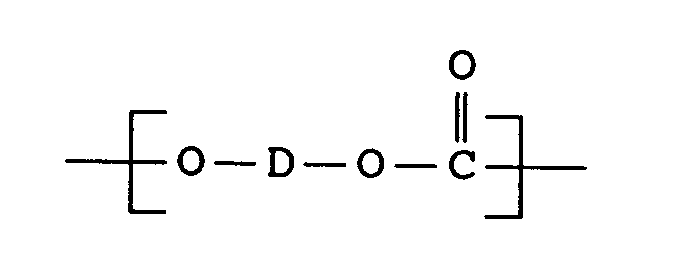
wherein D is a divalent aromatic radical of a dihydric phenol, interrupted by at least one divalent moiety of the formula :-
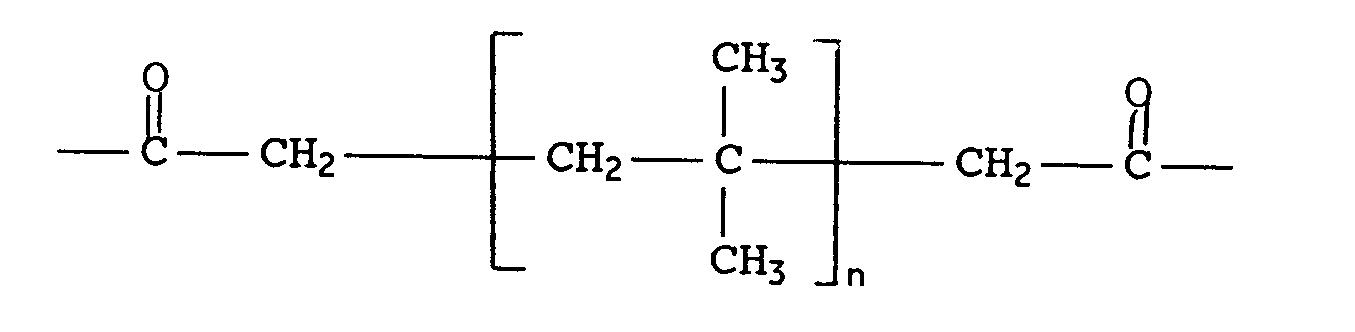
wherein n is an integer such that the moiety has a molecular weight contribution of from 5,000 to 30,000 Daltons as determined by gel permeation chromatography.
wherein D is a divalent aromatic radical of a dihydric phenol, interrupted by at least one divalent moiety of the formula :-
wherein n is an integer such that the moiety has a molecular weight contribution of from 5,000 to 30,000 Daltons as determined by gel permeation chromatography.
2. A block copolymer according to Claim 1 wherein D is
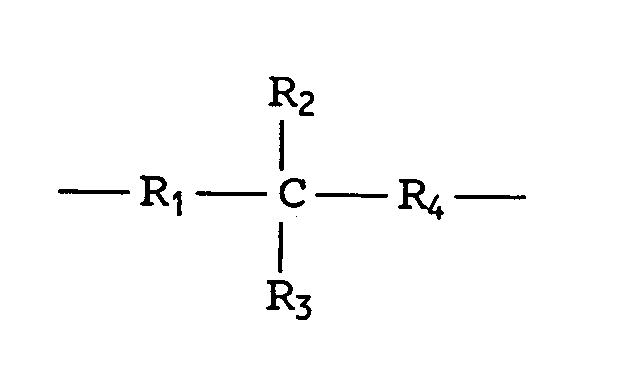
wherein R₁ and R₄ are each selected from a divalent aromatic hydrocarbon radical, a divalent, halogen-substituted aromatic hydrocarbon radical, and a divalent alkyl-substituted aromatic hydrocarbon radical; and R₂ and R₃ are each selected from the group consisting of hydrogen and hydrocarbyl.
wherein R₁ and R₄ are each selected from a divalent aromatic hydrocarbon radical, a divalent, halogen-substituted aromatic hydrocarbon radical, and a divalent alkyl-substituted aromatic hydrocarbon radical; and R₂ and R₃ are each selected from the group consisting of hydrogen and hydrocarbyl.
1. Polycarbonat-Polyisobutylen-Blockcopolymer mit wiederkehrenden Struktureinheiten der
Formel
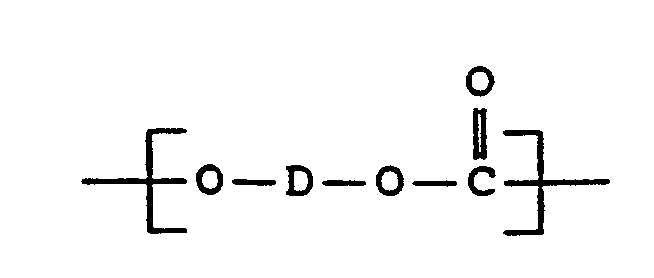
worin D ein zweiwertiger aromatischer Rest eines zweiwertigen Phenols ist, unterbrochen durch wenigstens einen zweiwertigen Anteil der Formel
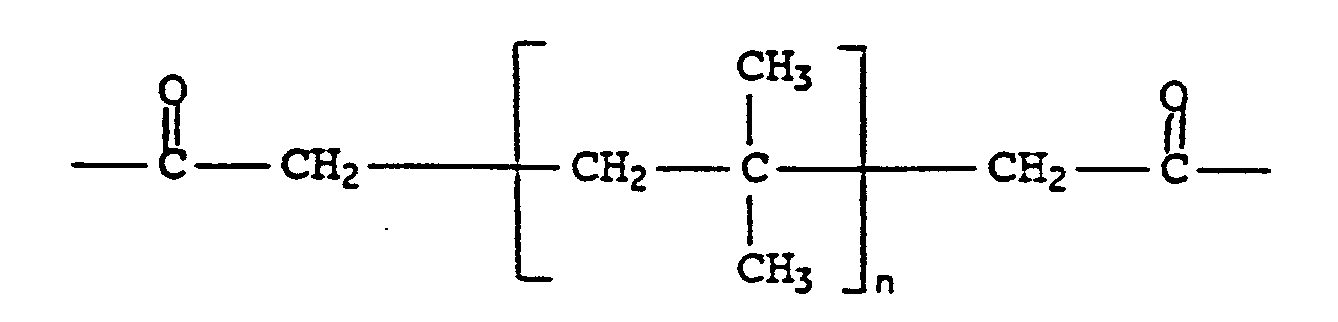
worin n eine solche ganze Zahl ist, daß der Anteil eine Molekulargewichtsverteilung von 5000 bis 30 000 Dalton, bestimmt durch Gelpermeationschromatographie,aufweist.
worin D ein zweiwertiger aromatischer Rest eines zweiwertigen Phenols ist, unterbrochen durch wenigstens einen zweiwertigen Anteil der Formel
worin n eine solche ganze Zahl ist, daß der Anteil eine Molekulargewichtsverteilung von 5000 bis 30 000 Dalton, bestimmt durch Gelpermeationschromatographie,aufweist.
2. Blockcopolymer nach Anspruch 1, worin D der Formel
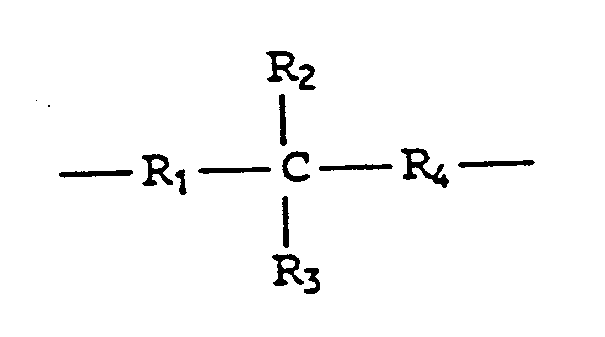
entspricht, worin R₁ und R₄ jeweils ausgewählt sind aus einem zweiwertigen aromatischen Kohlenwasserstoffrest, einem zweiwertigen,halogensubstituierten,aromatischen Kohlenwasserstoffrest und einem zweiwertigen alkyl-substituierten aromatischen Kohlenwasserstoffrest, und R₂ und R₃ jeweils ausgewählt sind aus der Gruppe bestehend aus Wasserstoff und Kohlenwasserstoff.
entspricht, worin R₁ und R₄ jeweils ausgewählt sind aus einem zweiwertigen aromatischen Kohlenwasserstoffrest, einem zweiwertigen,halogensubstituierten,aromatischen Kohlenwasserstoffrest und einem zweiwertigen alkyl-substituierten aromatischen Kohlenwasserstoffrest, und R₂ und R₃ jeweils ausgewählt sind aus der Gruppe bestehend aus Wasserstoff und Kohlenwasserstoff.
1. Copolymère séquencé polycarbonate-polyisobutylène, comportant des motifs structuraux
répétitifs de formule :
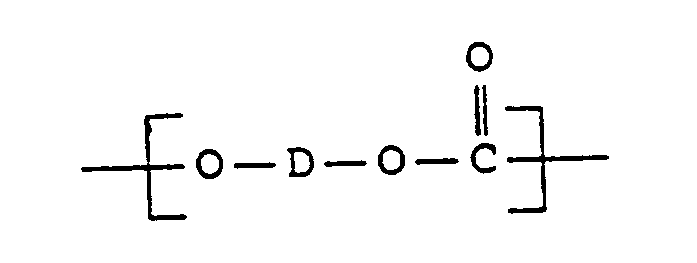
dans laquelle D représente un radical aromatique divalent d'un diphénol, interrompus par au moins un fragment divalent de formule :
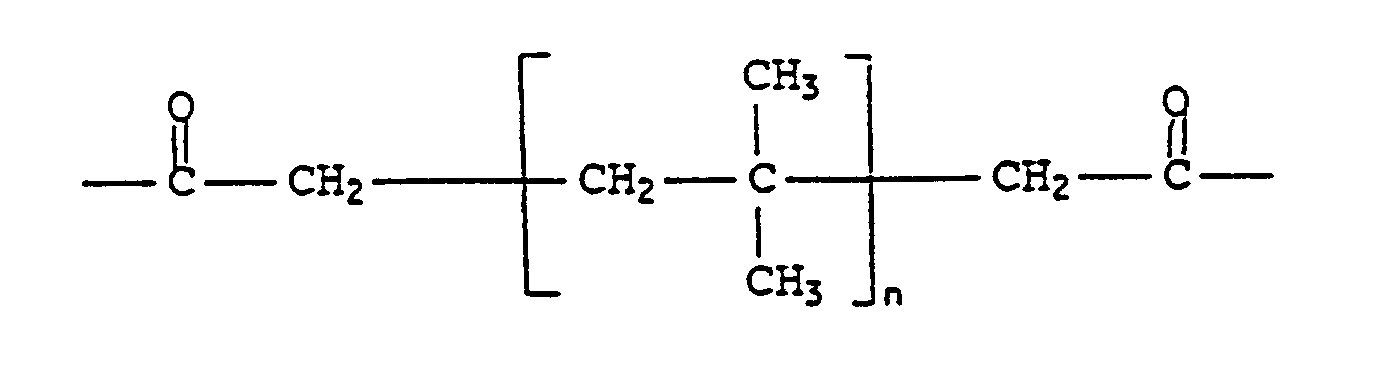
dans laquelle n représente un nombre entier tel que la contribution de ce fragment à la masse moléculaire, déterminée par chromatographie par perméation de gel, vaut de 5000 à 30000 daltons.
dans laquelle D représente un radical aromatique divalent d'un diphénol, interrompus par au moins un fragment divalent de formule :
dans laquelle n représente un nombre entier tel que la contribution de ce fragment à la masse moléculaire, déterminée par chromatographie par perméation de gel, vaut de 5000 à 30000 daltons.
2. Copolymère séquencé conforme à la revendication 1, dans lequel D représente :
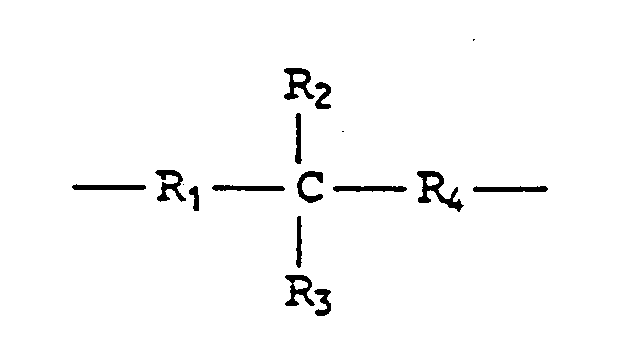
où R₁ et R₄ sont choisis chacun parmi un radical hydrocarboné aromatique divalent, un radical hydrocarboné aromatique divalent halogéno-substitué et un radical hydrocarboné aromatique divalent alkyl-substitué, et R₂ et R₃ sont choisis chacun dans le groupe formé par l'atome d'hydrogène et les radicaux hydrocarbonés.
où R₁ et R₄ sont choisis chacun parmi un radical hydrocarboné aromatique divalent, un radical hydrocarboné aromatique divalent halogéno-substitué et un radical hydrocarboné aromatique divalent alkyl-substitué, et R₂ et R₃ sont choisis chacun dans le groupe formé par l'atome d'hydrogène et les radicaux hydrocarbonés.