|
(11) | EP 0 306 095 B1 |

| (12) | EUROPEAN PATENT SPECIFICATION |
|
|
| (54) |
Diphenyl ether herbicides Diphenylether mit herbizider Wirkung Ethers diphényliques ayant une activité herbicide |
|
|
|||||||||||||||||||||||||||
|
||||||||||||||||||||||||||||
| Note: Within nine months from the publication of the mention of the grant of the European patent, any person may give notice to the European Patent Office of opposition to the European patent granted. Notice of opposition shall be filed in a written reasoned statement. It shall not be deemed to have been filed until the opposition fee has been paid. (Art. 99(1) European Patent Convention). |
[0001] This invention relates to certain diphenyl ether derivatives and their preparation, herbicidal compositions containing the compounds, and their use in combating undesired plant growth.
[0002] The applicants' European Patent Application No. 145078 describes and claims a herbicidal composition which comprises a carrier and, as active ingredient, a diphenyl ether derivative having the general formula I:
wherein R₁ represents a hydrogen or halogen atom or an alkyl or haloalkyl group; R₂ and R₃, which may be the same or different, each independently represents a hydrogen or halogen atom or an alkyl, haloalkyl, nitro or cyano group; and B and A, inter alia, represent, respectively, an oxygen atom and a group of formula =C(R₄)₂ in which each R₄, which may be the same or different, represents a hydrogen or halogen atom or an optionally substituted alkyl, cycloalkyl, alkenyl, alkynyl, aryl, aralkyl, alkaryl, alkoxy, cycloalkoxy, alkenyloxy, alkynyloxy, alkoxycarbonylalkoxy, alkylthio, acyl, acyloxy, carboxyl, alkoxycarbonyl or heterocyclic group, an amino group of formula NR₆R₇, or when one R₄ represents a hydrogen atom, an alkoxy group or a hydrocarbon group, then the other may represent a hydroxyl group, or both groups R₄ together may represent an imino group of formula =NR₆;
R₆ and R₇, which may be the same or different, each represents a hydrogen atom or an optionally substituted alkyl, aryl or acyl group;
and X represents an oxygen or sulphur atom.
[0003] From European Patent Specification No. 219144 A1 it is known that substituted phenoxy phthalides of this class in which each R₄ independently represents an alkyl group have enhanced hydrolytic stability and exhibit an increased level of herbicidal activity under field conditions.
[0004] It has now been unexpectedly found, that a certain group of the compounds broadly described in EPA 145078, but not specifically disclosed therein, possesses significantly higher selectivity in cereal crops than a representative diphenyl ether phthalide specifically disclosed in EP-A-145 078, and than structurally similar compounds specifically disclosed in EP-A-219 144.
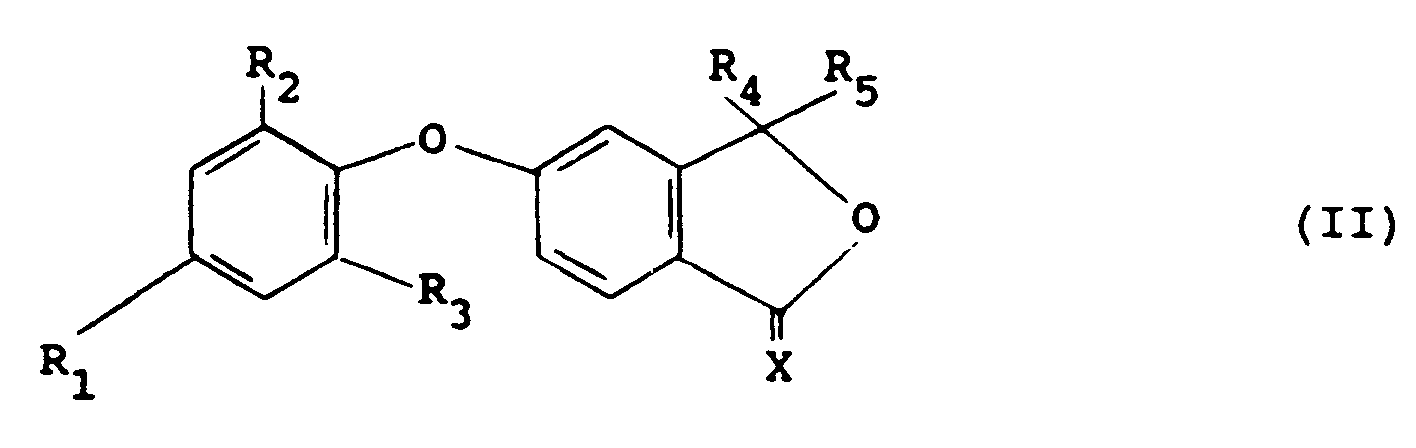
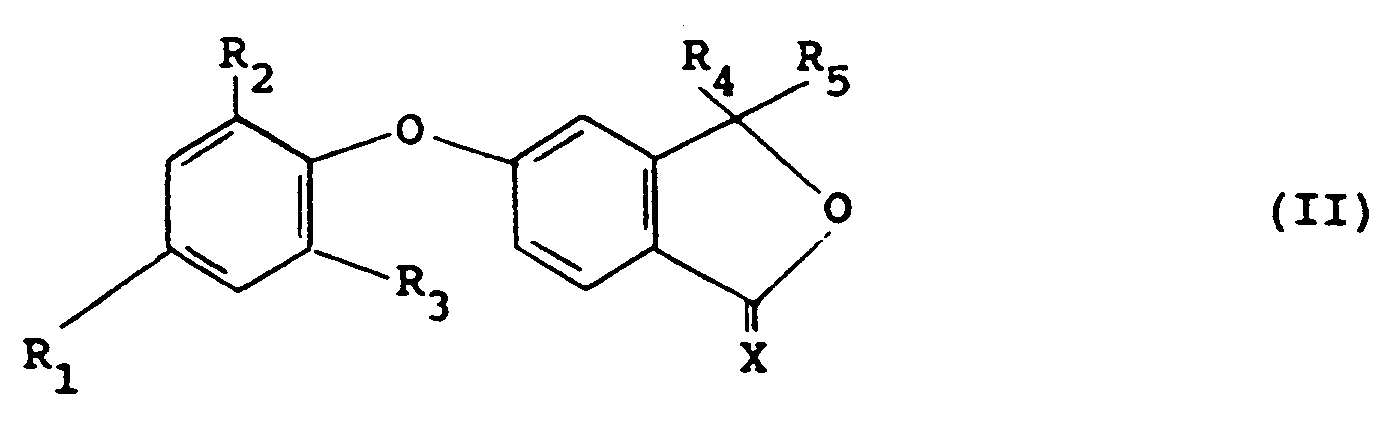
[0005] Accordingly, the present invention provides phenoxy phthalide derivatives having the general formula II:-
wherein R₁ represents a hydrogen or halogen atom, preferably chlorine, or an alkyl or haloalkyl group, suitably of 1-4 carbon atoms, preferably trifluoromethyl; R₂ and R₃, which may be the same or different, each independently represents a hydrogen or halogen atom, preferably chlorine, or an alkyl or haloalkyl group, suitably of 1-4 carbon atoms, for example trifluoromethyl, or a nitro or cyano group; R₄ represents an alkyl group; R₅ represents an alkenyl or alkynyl group; and X represents an oxygen or sulphur atom.
[0006] Preferred compounds are those wherein R₁ represents a halogen atom, more particularly chlorine, or, especially, a trifluoromethyl group; R₂ represents a nitro, cyano, trifluoromethyl or, especially, a halogen atom, more particularly chlorine; and R₃ represents a halogen, more particularly chlorine, or, especially, a hydrogen atom.
[0007] The groups R₄ and R₅ are preferably groups of 1-5 or 2-5 carbon atoms, respectively. Preferably R₄ is a methyl or ethyl group. Preferably R₅ is a vinyl or ethynyl group.
[0008] It will be appreciated that the compounds of the invention can exhibit stereoisomerism and the invention is intended to include stereospecific enantiomers of the compounds of formula II.
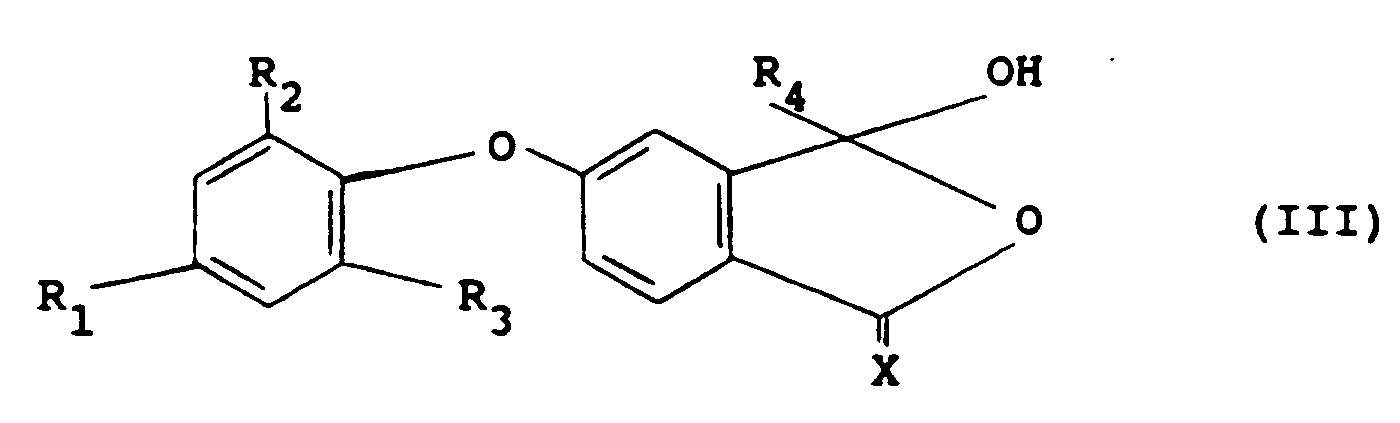
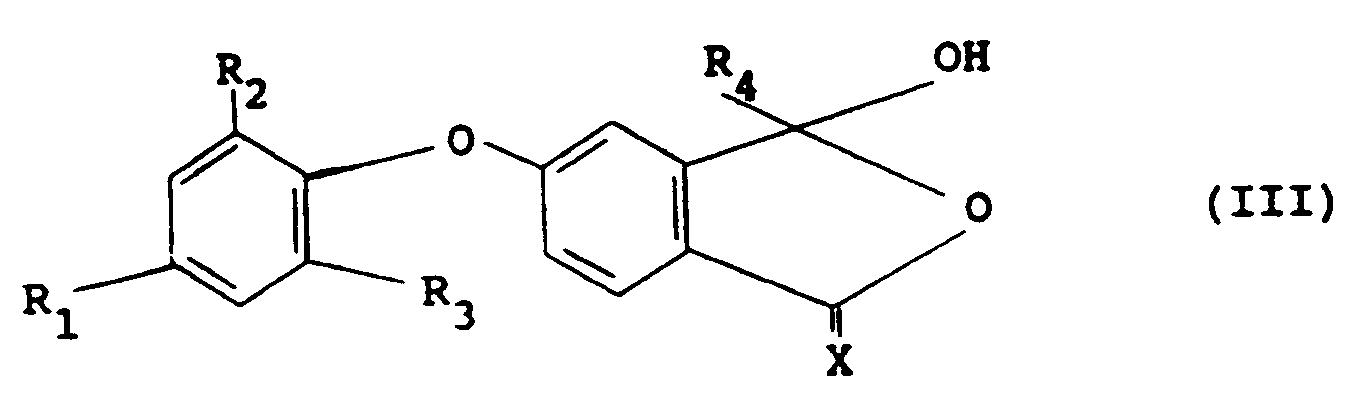
[0009] The invention also provides a process for the preparation of a phenoxy phthalide derivative of formula II as defined above which comprises reacting a compound of formula III
where R₁, R₂, R₃, R₄ and X are as defined above, with an organometallic compound of formula R₅-M-Hal (IV), where R₅ is as defined above, M represents a metal atom and Hal represents a halogen atom.
[0011] The organometallic reagent used is preferably an organomagnesium compound (Grignard reagent), which may be prepared according to established procedures, e.g. by taking up the appropriate alkenyl or alkynyl halide and magnesium metal in an aliphatic ether, such as diethyl ether, in the absence of water, or may be prepared by passing the alkene or alkyne gas through a solution of an alkyl Grignard reagent. The reaction of the compound of formula III with that Grignard reagent is suitably carried out in a solvent, which may also be diethyl ether, or may be a different inert organic solvent such as tetrahydrofuran. The formation of the Grignard reagent and its reaction with the compound of formula III are each suitably carried out in the temperature range 0 to 50°C, preferably at ambient temperature. The Grignard organomagnesium complex may be supplemented by the generation of an organocadmium complex through the addition of cadmium chloride.
[0012] Alternatively, compounds of formula II where R₅ is an alkynyl group may be prepared by reacting a compound of formula III as defined above with a compound of formula R₅M where M is an alkali metal. Examples of compounds of formula R₅M are lithium and sodium acetylides.
[0013] Compounds of formula III may conveniently be prepared by alkaline hydrolysis of a compound of formula V
where R₁, R₂, R₃ and X are as defined above and R₆ represents hydrogen or an alkyl group, preferably having 1 to 4 carbon atoms, preferably methyl, in accordance with the process described in our copending U.K. Application No. 8720511.
[0014] Compounds of formula V may conveniently be prepared from the corresponding phthalic anhydride by reaction with a compound of formula R₆CH₂L in which L is a suitable leaving group, such as a carboxyl group or carbonylalkoxy group, as described in published UK Patent Application No. 2 182 328. The preparation of suitable phthalic anhydride derivatives is also described therein.
[0015] Compounds where X is sulphur may be obtained by reaction of the corresponding carbonyl analogue with phosphorus pentasulphide.
[0016] The compounds of general formula II have been found to show interesting activity as herbicides, in particular in respect of their behaviour in selectively combating weeds in cereal crops such as wheat and rice. Accordingly, the invention further provides a herbicidal composition comprising a compound of formula II as defined above in association with at least one carrier, and a method of making such a composition which comprises bringing a compound of formula II into association with at least one carrier.
[0017] The invention also provides the use of such a compound or composition according to the invention as a herbicide. Further, in accordance with the invention there is provided a method of combating undesired plant growth at a locus by treating the locus with a compound or composition according to the invention. Application to the locus may be pre-emergence or post-emergence. The dosage of active ingredient used may, for example, be from 0.01 to 10 kg/ha, preferably 0.01 to 4kg/ha. A carrier in a composition according to the invention is any material with which the active ingredient is formulated to facilitate application to the locus to be treated, which may for example be a plant, seed or soil, or to facilitate storage, transport or handling. A carrier may be a solid or a liquid, including a material which is normally gaseous but which has been compressed to form a liquid, and any of the carriers normally used in formulating herbicidal compositions may be used. Preferably compositions according to the invention contain 0.5 to 95% by weight of active ingredient.
[0018] Suitable solid carriers include natural and synthetic clays and silicates, for example natural silicas such as diatomaceous earths; magnesium silicates, for example talcs; magnesium aluminium silicates, for example attapulgites and vermiculites; aluminium silicates, for example kaolinites, montmorillonites and micas; calcium carbonate; calcium sulphate; ammonium sulphate; synthetic hydrated silicon oxides and synthetic calcium or aluminium silicates; elements, for example carbon and sulphur; natural and synthetic resins, for example coumarone resins, polyvinyl chloride, and styrene polymers and copolymers; solid polychlorophenols; bitumen; waxes; and solid fertilisers, for example superphosphates.
[0019] Suitable liquid carriers include water; alcohols, for example isopropanol and glycols; ketones, for example acetone, methyl ethyl ketone, methyl isobutyl ketone and cyclohexanone; ethers; aromatic or araliphatic hydrocarbons, for example benzene, toluene and xylene; petroleum fractions, for example kerosine and light mineral oils; chlorinated hydrocarbons, for example carbon tetrachloride, perchloroethylene and trichloroethane. Mixtures of different liquids are often suitable.
[0020] Agricultural compositions are often formulated and transported in a concentrated form which is subsequently diluted by the user before application. The presence of small amounts of a carrier which is a surface-active agent facilitates this process of dilution. Thus preferably at least one carrier in a composition according to the invention is a surface-active agent. For example the composition may contain at least two carriers, at least one of which is a surface-active agent.
[0021] A surface-active agent may be an emulsifying agent, a dispersing agent or a wetting agent; it may be nonionic or ionic. Examples of suitable surface-active agents include the sodium or calcium salts of polyacrylic acids and lignin sulphonic acids; the condensation of fatty acids or aliphatic amines or amides containing at least 12 carbon atoms in the molecule with ethylene oxide and/or propylene oxide; fatty acid esters of glycerol, sorbitol, sucrose or pentaerythritol; condensates of these with ethylene oxide and/or propylene oxide; condensation products of fatty alcohol or alkyl phenols, for example p-octylphenol or p-octylcresol, with ethylene oxide and/or propylene oxide; sulphates or sulphonates of these condensation products; alkali or alkaline earth metal salts, preferably sodium salts, of sulphuric or sulphonic acid esters containing at least 10 carbon atoms in the molecule, for example sodium lauryl sulphate, sodium secondary alkyl sulphates, sodium salts of sulphonated castor oil, and sodium alkylaryl sulphonates such as dodecylbenzene sulphonate; and polymers of ethylene oxide and copolymers of ethylene oxide and propylene oxide.
[0022] The compositions of the invention may for example be formulated as wettable powders, dusts, granules, solutions, emulsifiable concentrates, emulsions, suspension concentrates and aerosols. Wettable powders usually contain 25, 50 or 75% w of active ingredient and usually contain in addition to solid inert carrier, 3-10% w of a dispersing agent and, where necessary, 0-10% w of stabiliser(s) and/or other additives such as penetrants or stickers. Dusts are usually formulated as a dust concentrate having a similar composition to that of a wettable powder but without a dispersant, and are diluted in the field with further solid carrier to give a composition usually containing ½-10% w of active ingredient. Granules are usually prepared to have a size between 10 and 100 BS mesh (1.676 - 0.152 mm), and may be manufactured by agglomeration or impregnation techniques. Generally, granules will contain ½-75% w active ingredient and 0-10% w of additives such as stabilisers, surfactants, slow release modifiers and binding agents. The so-called "dry flowable powders" consist of relatively small granules having a relatively high concentration of active ingredient. Emulsifiable concentrates usually contain, in addition to a solvent and, when necessary, co-solvent, 10-50% w/v active ingredient, 2-20% w/v emulsifiers and 0-20% w/v of other additives such as stabilisers, penetrants and corrosion inhibitors. Suspension concentrates are usually compounded so as to obtain a stable, non-sedimenting flowable product and usually contain 10-75% w active ingredient, 0.5-15% w of dispersing agents, 0.1-10% w of suspending agents such as protective colloids and thixotropic agents, 0-10% w of other additives such as defoamers, corrosion inhibitors, stabilisers, penetrants and stickers, and water or an organic liquid in which the active ingredient is substantially insoluble; certain organic solids or inorganic salts may be present dissolved in the formulation to assist in preventing sedimentation or as anti-freeze agents for water.
[0023] Aqueous dispersions and emulsions, for example compositions obtained by diluting a wettable powder or a concentrate according to the invention with water, also lie within the scope of the invention. The said emulsions may be of the water-in-oil or of the oil-in-water type, and may have a thick 'mayonnaise'-like consistency.
[0024] The composition of the invention may also contain other ingredients, for example other compounds possessing herbicidal, insecticidal or fungicidal properties.
[0025] The invention is illustrated by the following Examples.
N.M.R. spectral data was obtained by QE 300 Spectrometer at 300 mHz using CDCl₃ as solvent.
Example 1
5-(2′-Chloro-4′-trifluoromethylphenoxy)-3-ethyl-3-ethynyl phthalide
[0026] To dry, degreased magnesium metal turnings (3.0g), dry tetrahydrofuran (240 ml) was added and dry nitrogen bubbled in. Bromoethane (13.2g) was added dropwise with stirring and maintenance of the temperature between 15° and 20°C during the formation of the Grignard reagent. After all the magnesium had reacted (about 1 hour), the nitrogen was replaced by dry acetylene, which was bubbled in at 15°C until no further ethane was evolved.
5-(2′-chloro-4′-trifluoromethylphenoxy)-3-ethyl-3-hydroxyphthalide (6.0g) in dry tetrahydrofuran (100ml) was added dropwise at 15°C over 1 hour whilst acetylene was bubbled in. After addition was complete, the reaction mixture was stirred at 15°C for 1 hour and then poured onto 1 kg ice and acidified with concentrated hydrochloric acid. The resulting mixture was extracted with methylene chloride, washed with water, dried using sodium sulphate and chromatographically purified on silica using methylene chloride as eluant. The title compound was collected as the first fraction. Yield 5.6g. m.p. 57-59°C.
| Analysis: | Calculated | 59.9%C; | 3.15%H |
| Found | 59.7%C; | 3.5%H |
- NMR results:
- 7.85 doublet (1H); 7.8 doublet (1H); 7.6 doublet of doublets (1H); 7.2 doublet (1H); 7.1 doublet of doublets (1H); 7.05 doublet (1H) 2.7 singlet (1H); 2.2 sextet (1H); 2.0 sextet (1H); 1.05 triplet (3H)
Example 2
5-(2′Chloro-4′-trifluoromethylphenoxy)-3-ethyl-3-vinyl phthalide
[0027] To a 1M solution of vinyl magnesium bromide in tetrahydrofuran (46ml) was added dropwise at 25°C a solution of 5-(2′-chloro-4′trifluoromethylphenoxy)-3-ethyl-3-hydroxy- phthalide (2.3g) in dry tetrahydrofuran (25ml). After the addition was complete, the solution was stirred for 1 hour and poured into a mixture of ice and concentrated hydrochloric acid. The mixture was stirred for one hour, extracted with methylene chloride, washed with water and dried with sodium sulphate. Chromatography on silica with methylene chloride as eluant yielded a pale orange oil later obtained as colourless crystals (mp. 77-79°C)
| Analysis: | Calculated | 59.6%C; | 3.7%H |
| Found | 58.5%C; | 3.7%H |
- NMR results:
- 7.85 doublet (1H); 7.8 doublet (1H);
7.55 doublet of doublets (1H); 7.2 doublet (1H);
7.05 doublet of doublets (1H); 6.9 doublet (1H);
6.05-5.2 multiplet (3H); 2.1 sextet (1H);
1.95 sextet (1H); 0.8 triplet (3H)
Example 3
5-(2′Chloro-4′-trifluoromethylphenoxy)-3-methyl-3-ethynyl phthalide
[0028] Using as starting material 5-(2′-chloro-4′-trifluoromethylphenoxy)-3-methyl-3-hydroxyphthalide the above compound was prepared using the method of Example 1.
| Analysis: | Calculated: | 58.9% C; | 2.7% H |
| Found: | 58.7% C; | 2.9% H |
- NMR analysis:
- 7.88-7.04 multiplet (6H); 2.68 singlet (1H);
1.9 singlet (3H)
Example 4
5-(2′-Chloro-4′-trifluoromethylphenoxy)-3-methyl-3-vinyl phthalide
[0029] Using as starting material 5-(2′-chloro-4′-trifluoromethylphenoxy)-3-methyl-3-hydroxyphthalide the above compound was prepared as colourless crystals (mp 71-73°) using the method of Example 2.
| Analysis: | Calculated: | 58.6% C; | 3.3% H |
| Found: | 58.5% C; | 3.3% H |
- NMR analysis:
- 7.88-6.86 multiplet (6H); 6.08-5.96 doublet of
doublets (1H); 5.46-5.18 doublet of
doublets (2H); 1.72 singlet (3H)
Example 5
Herbicidal Activity
[0030] To evaluate their herbicidal activity, compounds according to the invention were tested using as a representative range of plants: maize, Zea mays (Mz); rice, Oryza sativa (R); barnyard grass, Echinochloa crusgalli (BG); oat, Avena sativa (O); linseed, Linum usitatissimum (L); mustard, Sinapsis alba (M); sugar beet, Beta vulgaris (SB) and soya bean, Glycine max (S).
[0031] The tests fall into two categories, pre-emergence and post-emergence. The pre-emergence tests involved spraying a liquid formulation of the compound onto the soil in which the seeds of the plant specied mentioned above had recently been sown. The post-emergence tests involved two types of test, viz., soil drench and foliar spray tests. In the soil drench tests the soil in which the seedling plants of the above species were growing was drenched with a liquid formulation containing a compound of the invention, and in the foliar spray tests the seedling plants were sprayed with such a formulation.
[0033] The formulations used in the tests were prepared from solutions of the test compounds in acetone containing 0.4% by weight of an alkylphenol/ethylene oxide condensate available under the trade mark TRITON X-155. These acetone solutions were diluted with water and the resulting formulations applied at dosage levels corresponding to 5 kg or 1 kg of active material per hectare in a volume equivalent to 900 litres per hectare in the soil spray and foliar spray test, and at a dosage of level equivalent to 10 kilograms of active material per hectare in a volume equivalent to approximately 3,000 litres per hectare in the soil drench tests.
[0034] In the pre-emergence tests untreated sown soil and in the post-emergence tests untreated soil bearing seedling plants were used as controls.
[0035] The herbicidal effects of the test compounds were assessed visually twelve days after spraying the foliage and the soil, and thirteen days after drenching the soil and were recorded on a 0-9 scale. A rating 0 indicates growth as untreated control, a rating 9 indicates death. An increase of 1 unit on the linear scale approximates to a 10% increase in the level of effect.
[0036] The results of the tests are set out in Table 1 below, in which the compounds are identified by reference to the preceding examples.
Example 6
Herbicidal Activity
[0037] Further biological evaluations were carried with the compounds of Examples 1 to 4, which compared their properties with those of 5-(2′-chloro-4′-trifluoromethylphenoxy)phthalide, (hereinafter designated as "A") specifically described as Example 1 of EP-A-145078.
[0038] The tests conducted were spray tests, in which seedling plants of a range of species were sprayed with the test compounds. The test plant species were wheat (WH), chickweed (ST), mayweed (MS), speedwell (SW), field pansy (FP), cleavers (GG), dead nettle (DN), poppy (PO), redshank (RS), hedge bindweed (SE) and oil-seed rape (RA). The plants were at the stage of 1-3 true leaves.
[0040] The compounds were tested as technical materials and formulated in a 1:1 acetone:water mix containing up to 0.2% of the alkylphenol/ethylene oxide wetting agent, Triton X155 (trade mark) and applied as single dose foliar sprays in a total volume of 600 litres/hectare. Application was at 4 different dosage levels 0.3, 0.1, 0.03 and 0.01 kg/ha designed to produce a range of responses. At least two replicate pots were used for each treatment. Untreated seedling plants were used as controls.
[0041] Phytotoxicity compared with the untreated control was assessed visually approximately 12 days after treatment using the standard 0-9 scale, 0 indicating no effect and 9 indicating death.
[0042] The results were subjected to a standard probit analysis by computer to calculate the dosage of each compound in g/ha required to kill 50% of the weed species and to produce 50% level of effect on the crop species. These dosages are referred to as the GID₅₀ value.
[0043] The GID₅₀ values comparing the compounds of Examples 1 to 4 with A are set out below in Table 2. These GID₅₀ values were then used to calculate the selectivity factors in wheat by dividing the GID₅₀ value of the compounds in wheat by their GID₅₀ value in each weed species. The results are set out in Table 3. (NB. Numbers greater than 1 indicate selectivity between crop and weed and the larger the number the greater the selectivity).
[0044] Table 4 compares the selectivity factors for Examples 1 to 4 with that of A showing the increased mean selectivity for each Examples 1 to 4 compared with A.
Table 2
| GID 50 values in g/ha for all compounds | |||||
| Species | Compound A | Ex. 4 | Ex. 3 | Ex. 2 | Ex. 1 |
| WH | 111 | 37 | 14 | 108 | 31 |
| FP | 14 | 6 | 3 | 30 | 5 |
| SW | 12 | 8 | 1 | 63 | 7 |
| GG | 42 | 10 | 13 | 44 | 7 |
| MS | 279 | 5 | 3 | 19 | 8 |
| ST | 149 | 29 | 2 | 18 | 5 |
| SE | 591 | 37 | 10 | 175 | 18 |
| DN | 29 | 10 | 3 | 23 | 6 |
| PO | 191 | 10 | 6 | 26 | 9 |
| RS | 9 | 5 | 2 | 23 | 9 |
| RA | 427 | 8 | 2 | 30 | 6 |
Table 3
| Selectivity factors obtained for wheat using GID 50 values | |||||
| Species | Compound A | Ex. 4 | Ex. 3 | Ex. 2 | Ex. 1 |
| FP | 7.9 | 6.2 | 4.7 | 3.6 | 6.2 |
| SW | 9.3 | 4.6 | 14.0 | 1.7 | 4.4 |
| GG | 2.6 | 3.7 | 1.1 | 2.5 | 4.4 |
| MS | 0.4 | 7.4 | 4.7 | 5.7 | 3.9 |
| ST | 0.7 | 1.3 | 7.0 | 6.0 | 6.2 |
| SE | 0.2 | 1.0 | 1.4 | 0.6 | 1.7 |
| DN | 3.8 | 3.7 | 4.7 | 4.7 | 5.2 |
| PO | 0.6 | 3.7 | 2.3 | 4.2 | 3.4 |
| RS | 12.3 | 7.4 | 7.0 | 4.7 | 3.4 |
| RA | 0.3 | 4.6 | 7.0 | 3.6 | 5.2 |
Table 4
| Selectivity factors standardised to Compound A | |||||
| Species | Compound A | Ex. 4 | Ex. 3 | Ex. 2 | Ex. 1 |
| FP | 1.0 | 0.8 | 0.6 | 0.5 | 0.8 |
| SW | 1.0 | 0.5 | 1.5 | 0.2 | 0.5 |
| GG | 1.0 | 1.4 | 0.4 | 1.0 | 1.7 |
| MS | 1.0 | 18.5 | 11.8 | 14.3 | 9.8 |
| ST | 1.0 | 1.9 | 10.0 | 8.6 | 8.9 |
| SE | 1.0 | 5.0 | 7.0 | 3.0 | 8.5 |
| DN | 1.0 | 1.0 | 1.2 | 1.2 | 1.4 |
| PO | 1.0 | 6.2 | 3.8 | 7.0 | 5.7 |
| RS | 1.0 | 0.6 | 0.6 | 0.4 | 0.3 |
| RA | 1.0 | 15.3 | 23.3 | 12.0 | 17.3 |
| MEAN | 1.0 | 5.1 | 6.0 | 4.8 | 5.5 |
Example 7
Herbicidal Activity
[0045] To further evaluate their herbicidal activity , the compounds of Examples 1 and 4 were tested to demonstrate their selectivity in paddy rice (Oryza Sativa) using as a representative range of plants: Echinochloa crus-galli (EC), Cyperus difformis (CD), Monochoria vaginalis (MV), Scirpus hotarui (SM), Cyperus serotinus (CS), Sagittaria pygmaea (SP), and a mixture of broadleaved weeds (BLW).
[0046] The soil used for the tests was collected from Japanese paddy fields and used in small plot containers without drainage holes. Water depth was 10-20 mm.
[0047] Rice plants at the two leaf stage were transplanted as three separate clumps each containing three plants in containers similar to those used for the weed species.
[0048] The compounds were dissolved in a minimum amount of acetone, diluted with water and applied evenly to the paddy water with a pipette. Application was at 5 different dosage levels, i.e. 500, 250, 125, 62.5 and 31.25 g/ha.
[0049] Application was pre-emergence (PE) (after germination, before emergence) or post-emergence (PO) (after growth to 1 to 2 leaves). Application to rice was pre-transplanting (PT) or after transplanting (TR). Phytotoxicity was assessed after 21 days visually using the standard 0-9 scale (0=no effect; 9=dead). The results are given in Table 5.
Claims for the following Contracting State(s): AT, BE, CH, DE, FR, GB, GR, IT, LI,
LU, NL, SE
1. A phenoxy phthalide derivative of the general formula II:
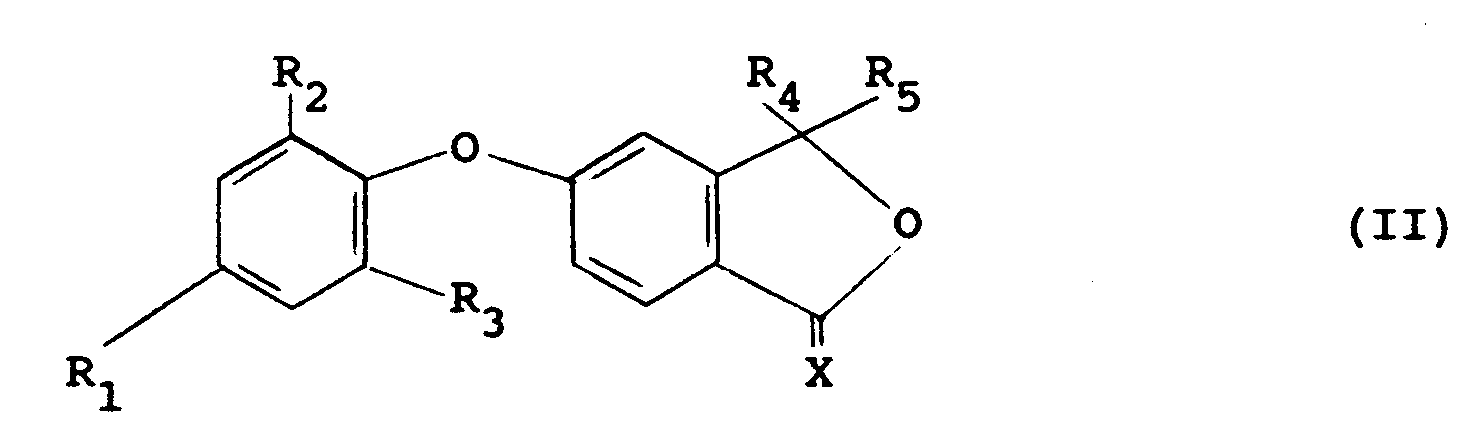
wherein R₁ represents a hydrogen or halogen atom or an alkyl or haloalkyl group; R₂ and R₃, which may be the same or different, each independently represents a hydrogen or halogen atom or an alkyl, haloalkyl, nitro or cyano group; R₄ represents an alkyl group; R₅ represents an alkenyl or alkynyl group; and X represents an oxygen or sulphur atom.
wherein R₁ represents a hydrogen or halogen atom or an alkyl or haloalkyl group; R₂ and R₃, which may be the same or different, each independently represents a hydrogen or halogen atom or an alkyl, haloalkyl, nitro or cyano group; R₄ represents an alkyl group; R₅ represents an alkenyl or alkynyl group; and X represents an oxygen or sulphur atom.
2. A compound as claimed in claim 1 wherein R₁ represents a trifluoromethyl group; R₂
represents a halogen atom; and R₃ represents a hydrogen atom.
3. A compound as claimed in claim 1 or 2, wherein X is 0.
4. A compound as claimed in claim 1, 2, or 3, wherein R₄ represents a methyl or ethyl
group.
5. A compound as claimed in any one of claims 1 to 4, wherein R₅ represents a vinyl group
or an ethynyl group.
6. The compound 5-(2'-chloro-4'-trifluoromethyl-phenoxy)-3-ethyl-3-ethynyl phthalide.
7. The compound 5-(2'-chloro-4'-trifluoromethyl-phenoxy)-3-methyl-3-vinyl phthalide.
8. A process for the preparation of a phenoxy phthalide derivative of formula II as claimed
in any one of claims 1 to 7, which comprises reacting a compound of formula III
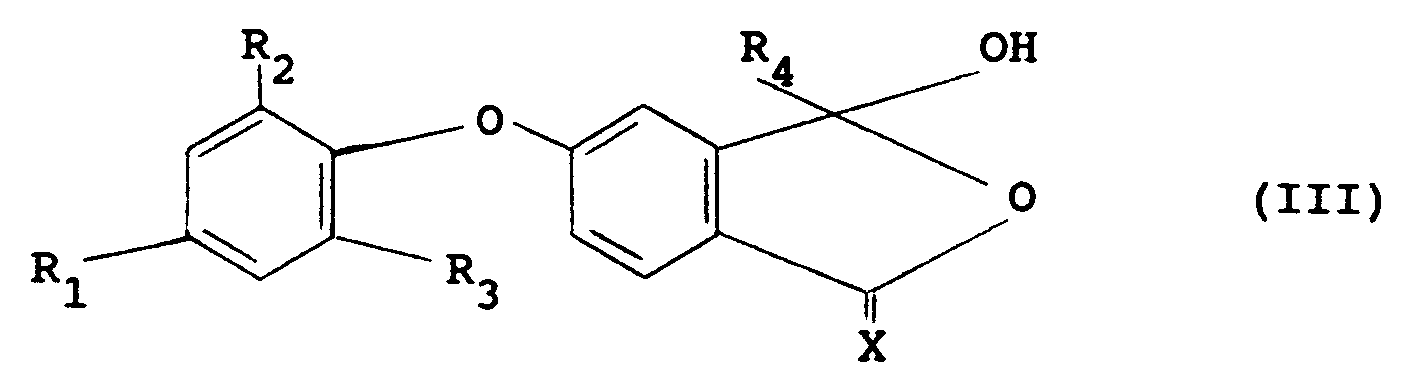
where R₁, R₂, R₃, R₄ and X are as defined in claim 1 with an organometallic compound of formula R₅-M-Hal, where R₅ is as defined in claim 1, M represents a metal atom and Hal represents a halogen atom, or, where R₅ is an alkynyl group, with an organo metallic compound of formula R₅M where R₅ is an alkynyl group and M is an alkali metal atom.
where R₁, R₂, R₃, R₄ and X are as defined in claim 1 with an organometallic compound of formula R₅-M-Hal, where R₅ is as defined in claim 1, M represents a metal atom and Hal represents a halogen atom, or, where R₅ is an alkynyl group, with an organo metallic compound of formula R₅M where R₅ is an alkynyl group and M is an alkali metal atom.
9. A compound as defined in claim 1, whenever prepared by a process as claimed in claim
8.
10. A herbicidal composition, which comprises a compound as claimed in any one of claims
1 to 7, or 9, together with a carrier.
11. A method of combating undesired plant growth at a locus, which comprises treating
the locus with a compound as claimed in any one of claims 1 to 7, or 9, or a composition
as claimed in claim 10.
12. The use of a compound as claimed in any one of claims 1 to 7, or 9, as a herbicide.
Claims for the following Contracting State(s): ES
1. A process for the preparation of a phenoxy phthalide derivative of the general formula
II:
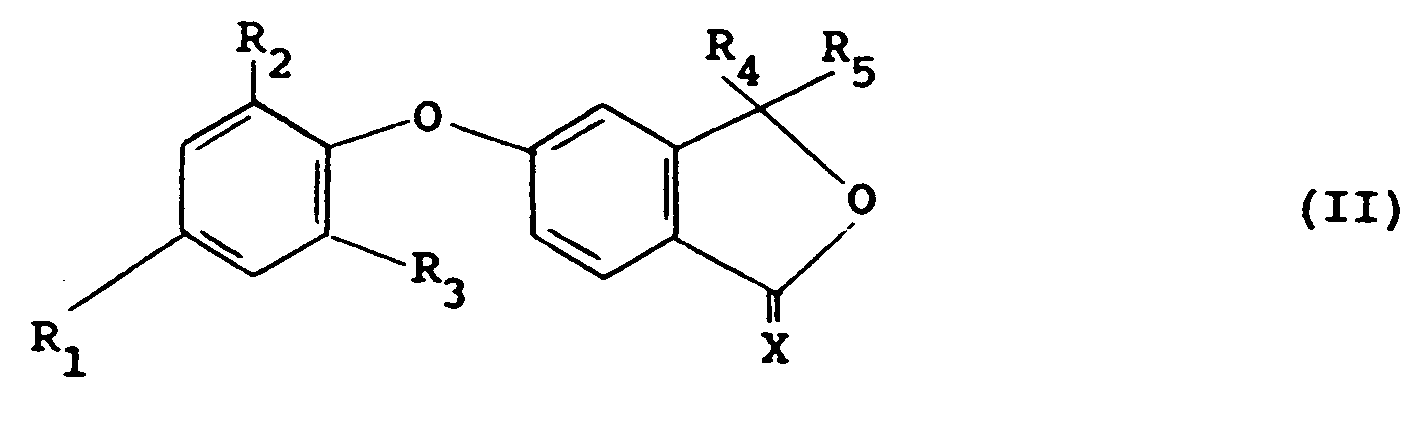
wherein R₁ represents a hydrogen or halogen atom or an alkyl or haloalkyl group; R₂ and R₃, which may be the same or different, each independently represents a hydrogen or halogen atom or an alkyl, haloalkyl, nitro or cyano group; R₄ represents an alkyl group; R₅ represents an alkenyl or alkynyl group; and X represents an oxygen or sulphur atom, which comprises reacting a compound of formula III
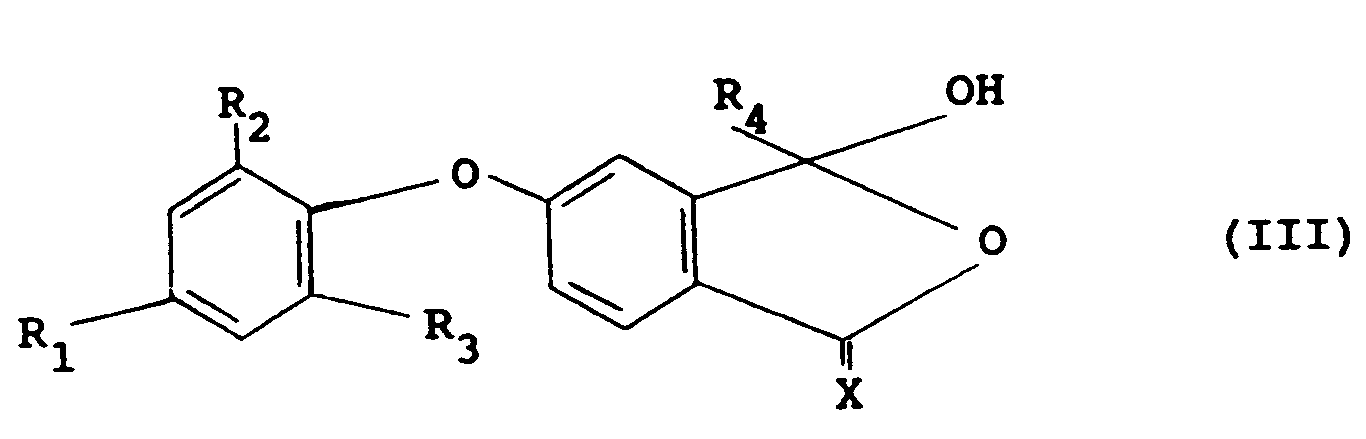
where R₁, R₂, R₃, R₄, and X are as defined hereinabove, with an organometallic compound of formula R₅-M-Hal, where R₅ is as defined hereinabove, M represents a metal atom and Hal represents a halogen atom, or, where R₅ is an alkynyl group, with an organo metallic compound of formula R₅M where R₅ is an alkynyl group and M is an alkali metal atom.
wherein R₁ represents a hydrogen or halogen atom or an alkyl or haloalkyl group; R₂ and R₃, which may be the same or different, each independently represents a hydrogen or halogen atom or an alkyl, haloalkyl, nitro or cyano group; R₄ represents an alkyl group; R₅ represents an alkenyl or alkynyl group; and X represents an oxygen or sulphur atom, which comprises reacting a compound of formula III
where R₁, R₂, R₃, R₄, and X are as defined hereinabove, with an organometallic compound of formula R₅-M-Hal, where R₅ is as defined hereinabove, M represents a metal atom and Hal represents a halogen atom, or, where R₅ is an alkynyl group, with an organo metallic compound of formula R₅M where R₅ is an alkynyl group and M is an alkali metal atom.
2. A process as claimed in claim 1 wherein R₁ represents a trifluoromethyl group; R₂
represents a halogen atom; and R₃ represents a hydrogen atom.
3. A process as claimed in claim 1 or 2, wherein X is 0.
4. A process as claimed in claim 1, 2 or 3, wherein R₄ represents a methyl or ethyl group.
5. A process as claimed in any one of claims 1 to 4, wherein R₅ represents a vinyl group
or an ethynyl group.
6. A process as claimed in any one of claims 1 to 5 wherein the derivative of formula
II is 5-(2'-chloro-4'trifluoromethyl-phenoxy)-3-ethyl-3-ethynyl phthalide.
7. A process as claimed in any one of claims 1 to 5 wherein the derivative of formula
II is 5-(2'-chloro-4'-trifluoromethyl-phenoxy)-3-methyl-3-vinyl phthalide.
Patentansprüche für folgende(n) Vertragsstaat(en): AT, BE, CH, DE, FR, GB, GR, IT,
LI, LU, NL, SE
1. Ein Phenoxyphthalid-Derivat der allgemeinen Formel II:
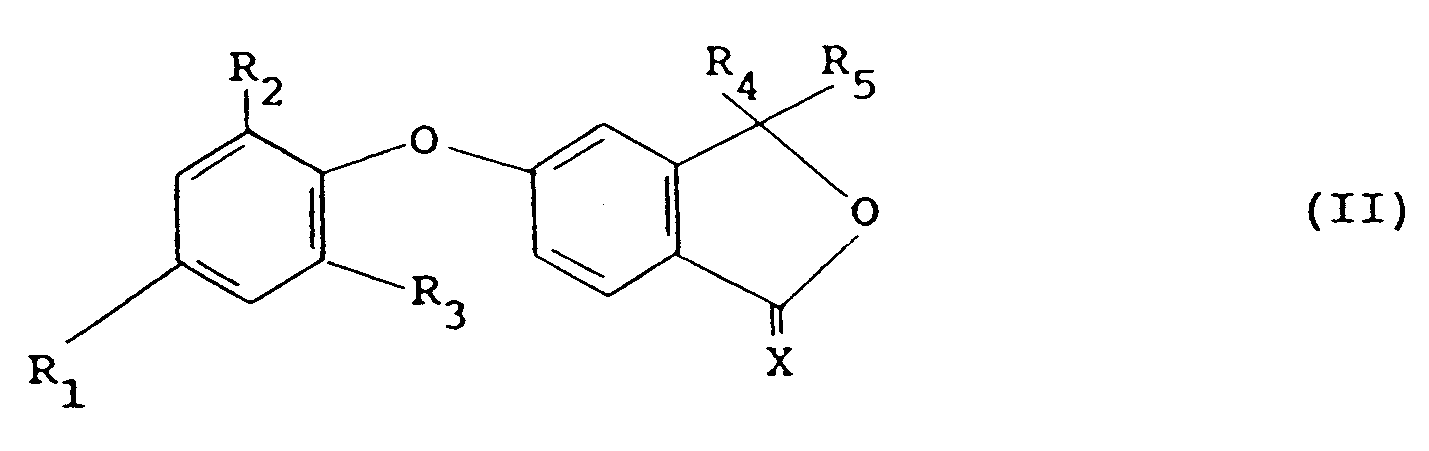
in der R₁ ein Wasserstoff- oder Halogenatom oder eine Alkyl- oder Halogenalkylgruppe darstellt, R₂ und R₃, die gleich oder verschieden sein können, jeweils unabhängig voneinander ein Wasserstoff- oder Halogenatom oder eine Alkyl-, Halogenalkyl-, Nitro- oder Cyanogruppe darstellen, R₄ eine Alkylgruppe darstellt, R₅ eine Alkenyl- oder Alkinylgruppe darstellt und X ein Sauerstoff- oder Schwefelatom darstellt.
in der R₁ ein Wasserstoff- oder Halogenatom oder eine Alkyl- oder Halogenalkylgruppe darstellt, R₂ und R₃, die gleich oder verschieden sein können, jeweils unabhängig voneinander ein Wasserstoff- oder Halogenatom oder eine Alkyl-, Halogenalkyl-, Nitro- oder Cyanogruppe darstellen, R₄ eine Alkylgruppe darstellt, R₅ eine Alkenyl- oder Alkinylgruppe darstellt und X ein Sauerstoff- oder Schwefelatom darstellt.
2. Eine Verbindung wie in Anspruch 1 beansprucht, in der R₁ eine Trifluormethylgruppe
darstellt, R₂ ein Halogenatom darstellt und R₃ ein Wasserstoffatom darstellt.
3. Eine Verbindung wie in Anspruch 1 oder 2 beansprucht, in der X Sauerstoff ist.
4. Eine Verbindung wie in Anspruch 1, 2 oder 3 beansprucht, in der R₄ eine Methyl- oder
Ethylgruppe darstellt.
5. Eine Verbindung wie in irgendeinem der Ansprüche 1 bis 4 beansprucht, in der R₅ eine
Vinyl- oder eine Ethinylgruppe darstellt.
6. Die Verbindung 5-(2'-Chlor-4'-trifluormethylphenoxy)-3-ethyl-3-ethinyl-phthalid.
7. Die Verbindung 5-(2'-Chlor-4'-trifluormethylphenoxy)-3-methyl-3-vinyl-phthalid.
8. Ein Verfahren zur Herstellung eines Phenoxyphthalid-Derivats der Formel II, wie in
irgendeinem der Ansprüche 1 bis 7 beansprucht, das umfaßt Umsetzen einer Verbindung
der Formel III
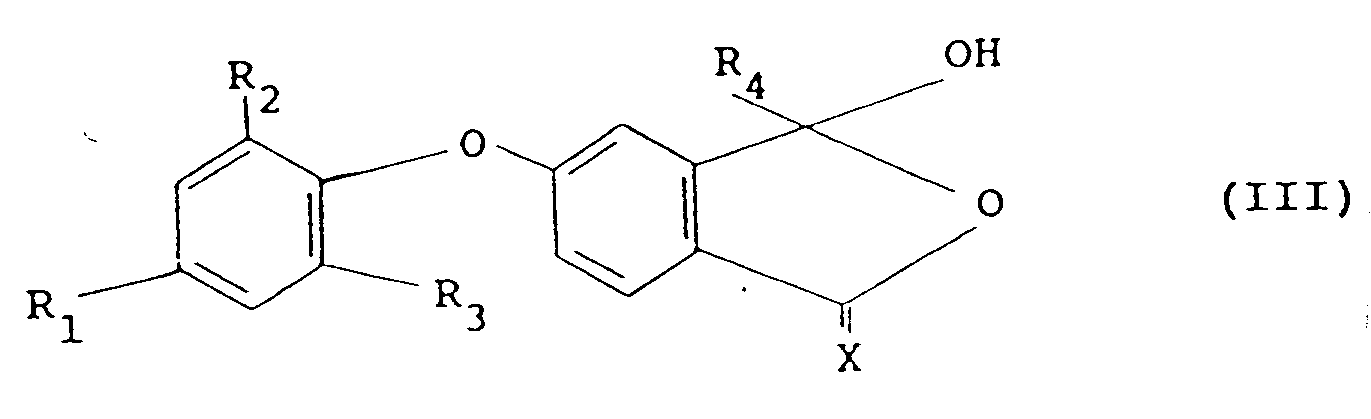
in der R₁, R₂, R₃, R₄ und X wie in Anspruch 1 definiert sind, mit einer metallorganischen Verbindung der Formel R₅-M-Hal, in der R₅ wie in Anspruch 1 definiert ist, M ein Metallatom und Hal ein Kalogenatom darstellen, oder, wenn R₅ eine Alkinylgruppe ist, mit einer metallorganischen Verbindung der Formel R₅M, in der R₅ eine Alkinylgruppe und M ein Alkalimetallatom sind.
in der R₁, R₂, R₃, R₄ und X wie in Anspruch 1 definiert sind, mit einer metallorganischen Verbindung der Formel R₅-M-Hal, in der R₅ wie in Anspruch 1 definiert ist, M ein Metallatom und Hal ein Kalogenatom darstellen, oder, wenn R₅ eine Alkinylgruppe ist, mit einer metallorganischen Verbindung der Formel R₅M, in der R₅ eine Alkinylgruppe und M ein Alkalimetallatom sind.
9. Eine Verbindung wie in Anspruch 1 definiert, wann auch immer mittels eines Verfahrens,
wie in Anspruch 8 beansprucht, hergestellt.
10. Eine herbizide Zusammensetzung, die eine Verbindung wie in irgendeinem der Ansprüche
1 bis 7 oder 9 beansprucht, zusammen mit einem Trägermaterial umfaßt.
11. Ein Verfahren zur Bekämpfung unerwünschten pflanzenwachstums an einem Ort, das umfaßt
ein Behandeln des Ortes mit einer Verbindung, wie in irgendeinem der Ansprüche 1 bis
7 oder 9 beansprucht, oder einer Zusammensetzung, wie in Anspruch 10 beansprucht.
12. Die Verwendung einer Verbindung, wie in irgendeinem der Ansprüche 1 bis 7 und 9 beansprucht,
als ein Herbizid.
Patentansprüche für folgende(n) Vertragsstaat(en): ES
1. Ein Verfahren zur Herstellung eines Phenoxyphthalid-Derivats der allgemeinen Formel
II
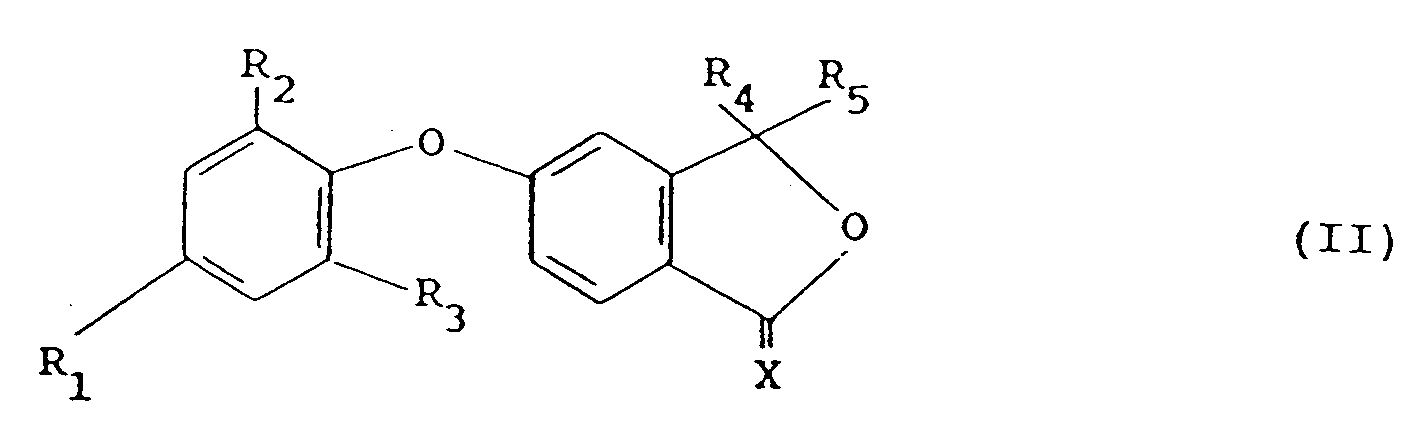
in der R₁ ein Wasserstoff- oder Halogenatom oder eine Alkyl- oder Halogenalkylgruppe darstellt, R₂ und R₃, die gleich oder verschieden sein können, jeweils unabhängig voneinander ein Wasserstoff- oder Halogenatom oder eine Alkyl-, Halogenalkyl-, Nitro- oder Cyanogruppe darstellen, R₄ eine Alkylgruppe darstellt, R₅ eine Alkenyl- oder Alkinylgruppe darstellt und X ein Sauerstoff- oder Schwefelatom darstellt, das umfaßt Umsetzen einer Verbindung der Formel III
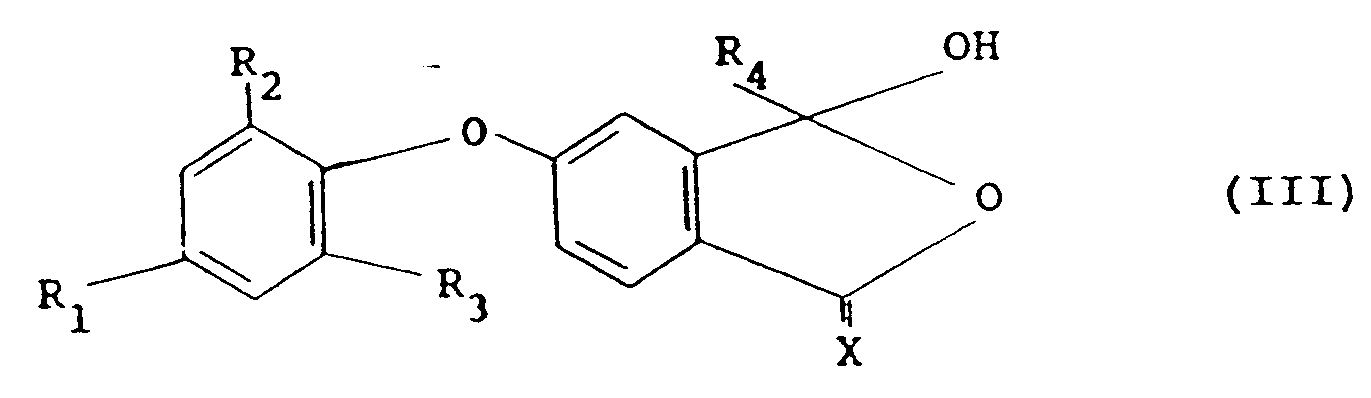
in der R₁, R₂, R₃, R₄ und X wie vorstehend definiert sind, mit einer metallorganischen Verbindung der Formel R₅-M-Hal, in der R₅ wie vorstehend definiert ist, M ein Metallatom und Hal ein Halogenatom darstellen, oder, wenn R₅ eine Alkinylgruppe ist, mit einer metallorganischen Verbindung der Formel R₅M, in der R₅ eine Alkinylgruppe und M ein Alkalimetallatom sind.
in der R₁ ein Wasserstoff- oder Halogenatom oder eine Alkyl- oder Halogenalkylgruppe darstellt, R₂ und R₃, die gleich oder verschieden sein können, jeweils unabhängig voneinander ein Wasserstoff- oder Halogenatom oder eine Alkyl-, Halogenalkyl-, Nitro- oder Cyanogruppe darstellen, R₄ eine Alkylgruppe darstellt, R₅ eine Alkenyl- oder Alkinylgruppe darstellt und X ein Sauerstoff- oder Schwefelatom darstellt, das umfaßt Umsetzen einer Verbindung der Formel III
in der R₁, R₂, R₃, R₄ und X wie vorstehend definiert sind, mit einer metallorganischen Verbindung der Formel R₅-M-Hal, in der R₅ wie vorstehend definiert ist, M ein Metallatom und Hal ein Halogenatom darstellen, oder, wenn R₅ eine Alkinylgruppe ist, mit einer metallorganischen Verbindung der Formel R₅M, in der R₅ eine Alkinylgruppe und M ein Alkalimetallatom sind.
2. Ein Verfahren wie in Anspruch 1 beansprucht, wobei R₁ eine Trifluormethylgruppe darstellt,
R₂ ein Halogenatom und R₃ ein Wasserstoffatom darstellt.
3. Ein Verfahren wie in Anspruch 1 oder 2 beansprucht, wobei X Sauerstoff ist.
4. Ein Verfahren wie in Anspruch 1, 2 oder 3 beansprucht, wobei R₄ eine Methyl- oder
Ethylgruppe darstellt.
5. Ein Verfahren wie in irgendeinem der Ansprüche 1 bis 4 beansprucht, wobei R₅ eine
Vinyl- oder Ethinylgruppe darstellt.
6. Ein Verfahren wie in irgendeinem der Ansprüche 1 bis 5 beansprucht, wobei das Derivat
der Formel II 5-(2'-Chlor-4'-trifluormethyl-phenoxy)-3-ethyl-3-ethinyl-phthalid ist.
7. Ein Verfahren wie in irgendeinem der Ansprüche 1 bis 5 beansprucht, wobei das Derivat
der Formel II 5-(2'-Chlor-4'-trifluormethyl-phenoxy)-3-methyl-3-vinyl-phthalid ist.
Revendications pour l'(les) Etat(s) contractant(s) suivant(s): AT, BE, CH, DE, FR,
GB, GR, IT, LI, LU, NL, SE
1. Un dérivé de phénoxyphtalide de formule générale II
dans laquelle R₁ représente un atome d'hydrogène ou d'halogène ou un groupe alkyle ou halogénoalkyle; R₂ et R₃, qui peuvent avoir des significations identiques ou différentes, représentent chacun, ineépendamment l'un de l'autre, un atome d'hydrogène ou d'halogène ou un groupe alkyle, halogénoalkyle, nitro ou cyano; R₄ représente un groupe alkyle; R₅ représente un groupe alcényle ou alcynyle; et X représente un atome d'oxygène ou de soufre.
dans laquelle R₁ représente un atome d'hydrogène ou d'halogène ou un groupe alkyle ou halogénoalkyle; R₂ et R₃, qui peuvent avoir des significations identiques ou différentes, représentent chacun, ineépendamment l'un de l'autre, un atome d'hydrogène ou d'halogène ou un groupe alkyle, halogénoalkyle, nitro ou cyano; R₄ représente un groupe alkyle; R₅ représente un groupe alcényle ou alcynyle; et X représente un atome d'oxygène ou de soufre.
2. Un composé selon revendication 1, pour lequel R₁ représente un groupe trifluorométhyle;
R₂ représente un atome d'halogène et R₃ un atome d'hydrogène.
3. Un composé selon revendication 1 ou 2, pour lequel X représente 0.
4. Un composé selon revendication 1, 2 ou 3, pour lequel R₄ représente un groupe méthyle
ou éthyle.
5. Un composé selon l'une quelconque des revendications 1 à 4, pour lequel R₅ représente
un groupe vinyle ou éthynyle.
6. Le composé : 5-(2'-chloro-4'-trifluorométhylphénoxy)-3-éthyl-3-éthynylphtalide.
7. Le composé : 5-(2'-chloro-4'-trifluorométhylphénoxy)-3-méthyl-3-vinylphtalide.
8. Un procédé de préparation d'un dérivé de phénoxyphtalide selon l'une quelconque des
revendications 1 à 7, qui consiste à faire réagir un composé de formule III
dans laquelle R₁, R₂, R₃, R₄ et X ont les significations indiquées dans la revendication 1, avec un composé organométallique de formule R₅-M-Hal dans laquelle R₅ a été défini dans la revendication 1, M représente un atome de métal et Hal un atome d'halogène ou bien, lorsque R₅ représente un groupe alcynyle, avec un composé organométallique de formule R₅M dans laquelle R₅ représente un groupe alcynyle et M un atome de métal alcalin.
dans laquelle R₁, R₂, R₃, R₄ et X ont les significations indiquées dans la revendication 1, avec un composé organométallique de formule R₅-M-Hal dans laquelle R₅ a été défini dans la revendication 1, M représente un atome de métal et Hal un atome d'halogène ou bien, lorsque R₅ représente un groupe alcynyle, avec un composé organométallique de formule R₅M dans laquelle R₅ représente un groupe alcynyle et M un atome de métal alcalin.
9. Un composé selon revendication 1, lorsqu'il a été préparé par un procédé selon la
revendication 8.
10. Une composition herbicide contenant un composé selon l'une quelconque des revendications
1 à 7 ou 9 avec un véhicule.
11. Un procédé pour combattre les croissances de végétaux indésirables en un site, procédé
qui consiste à traiter le site par un composé selon l'une quelconque des revendications
1 à 7 ou 9 ou une composition selon revendication 10.
12. L'utilisation d'un composé selon l'une quelconque des revendications 1 à 7 ou 9 en
tant qu'herbicide.
Revendications pour l'(les) Etat(s) contractant(s) suivant(s): ES
1. Un procédé de préparation d'un dérivé de phénoxyphtalide de formule générale II
dans laquelle R₁ représente un atome d'hydrogène ou d'halogène ou un groupe alkyle ou halogénoalkyle; R₂ et R₃, qui peuvent avoir des significations identiques ou différentes, représentent chacun, indépendamment l'un de l'autre, un atome d'hydrogène ou d'halogène ou un groupe alkyle, halogénoalkyle, nitro ou cyano; R₄ représente un groupe alkyle; R₅ représente un groupe alcényle ou alcynyle; et X représente un atome d'oxygène ou de soufre, qui consiste à faire réagir un composé de formule III
dans laquelle R₁, R₂, R₃, R₄ et X ont les significations indiquées ci-dessus, avec un composé organométallique de formule R₅-M-Hal dans laquelle R₅ a été défini ci-dessus, M représente un atome de métal et Hal représente un atome d'halogène, ou bien, lorsque R₅ représente un groupe alcynyle, avec un composé organométallique de formule R₅M dans laquelle R₅ représente un groupe alcynyle et M un atome de métal alcalin.
dans laquelle R₁ représente un atome d'hydrogène ou d'halogène ou un groupe alkyle ou halogénoalkyle; R₂ et R₃, qui peuvent avoir des significations identiques ou différentes, représentent chacun, indépendamment l'un de l'autre, un atome d'hydrogène ou d'halogène ou un groupe alkyle, halogénoalkyle, nitro ou cyano; R₄ représente un groupe alkyle; R₅ représente un groupe alcényle ou alcynyle; et X représente un atome d'oxygène ou de soufre, qui consiste à faire réagir un composé de formule III
dans laquelle R₁, R₂, R₃, R₄ et X ont les significations indiquées ci-dessus, avec un composé organométallique de formule R₅-M-Hal dans laquelle R₅ a été défini ci-dessus, M représente un atome de métal et Hal représente un atome d'halogène, ou bien, lorsque R₅ représente un groupe alcynyle, avec un composé organométallique de formule R₅M dans laquelle R₅ représente un groupe alcynyle et M un atome de métal alcalin.
2. Un procédé selon revendication 1, dans lequel R₁ représente un groupe trifluorométhyle;
R₂ représente un atome d'halogène; et R₃ représente un atome d'hydrogène.
3. Un procédé selon revendication 1 ou 2, dans lequel X représente 0.
4. Un procédé selon revendication 1, 2 ou 3, dans lequel R₄ représente un groupe méthyle
ou éthyle.
5. Un procédé selon l'une quelconque des revendications 1 à 4, dans lequel R₅ représente
un groupe vinyle ou éthynyle.
6. Un procédé selon l'une quelconque des revendications 1 à 5, dans lequel le dérivé
de formule II est le 5-(2'-chloro-4'-trifluorométhylphénoxy)-3-éthyl-3-éthynyl-phtalide.
7. Un procédé selon l'une quelconque des revendications 1 à 5, dans lequel le dérivé
de formule II est le 5-(2'-chloro-4'-trifluorométhylphénoxy)-3-méthyl-3-vinyl-phtalide.