| (19) |
 |
|
(11) |
EP 0 307 367 B1 |
| (12) |
EUROPEAN PATENT SPECIFICATION |
| (45) |
Mention of the grant of the patent: |
|
17.06.1992 Bulletin 1992/25 |
| (22) |
Date of filing: 22.07.1988 |
|
| (51) |
International Patent Classification (IPC)5: A61M 5/315 |
|
| (54) |
Self-blocking hypodermic syringe for once-only use, comprising a needle protection
cap
Selbstblockierende Hypodermische Spritze zum Einmalgebrauch mit Nadel-Schutzkappe
Seringue hypodermique autoblocante à usage unique, avec capuchon de protection de
l'aiguille
|
| (84) |
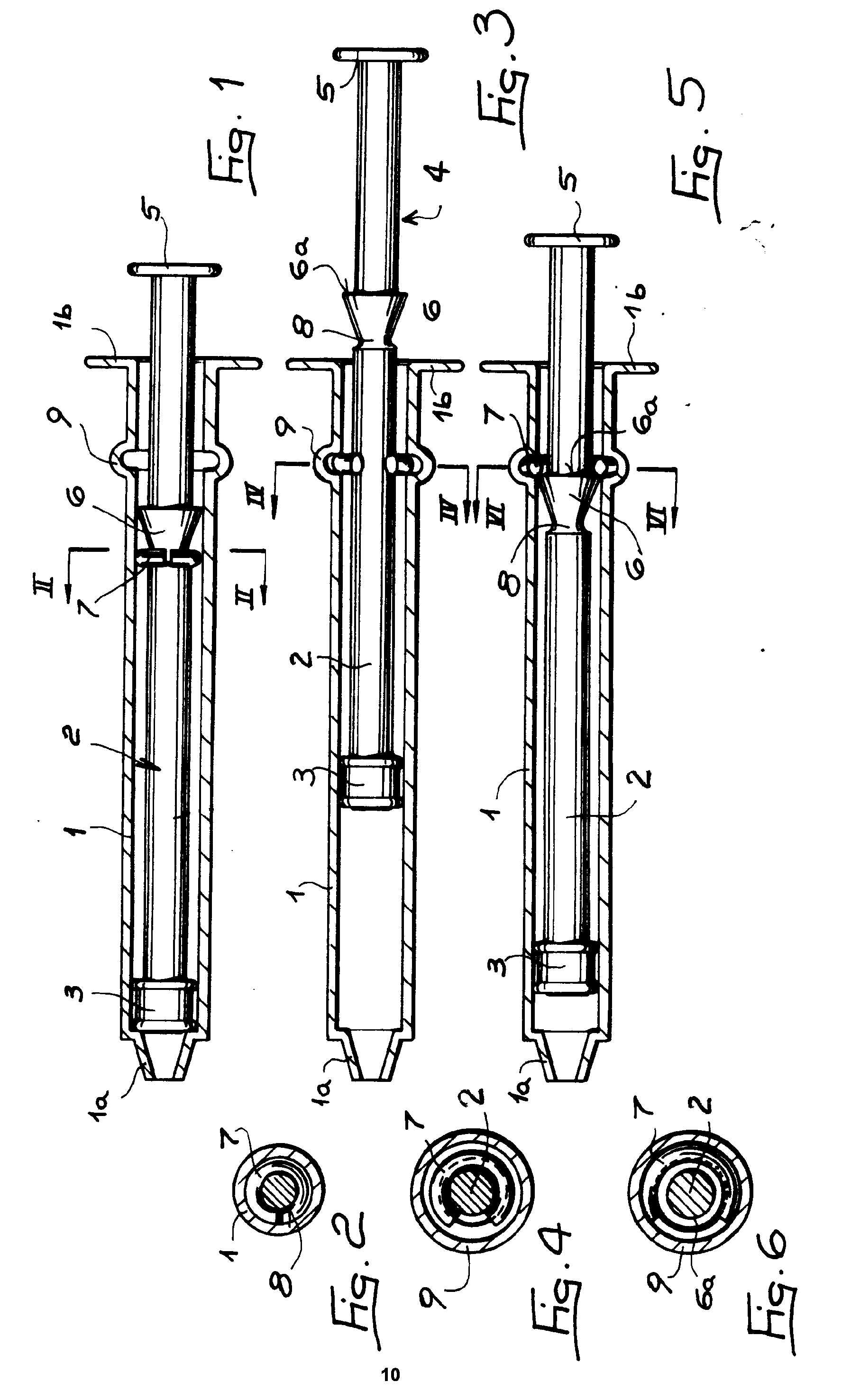
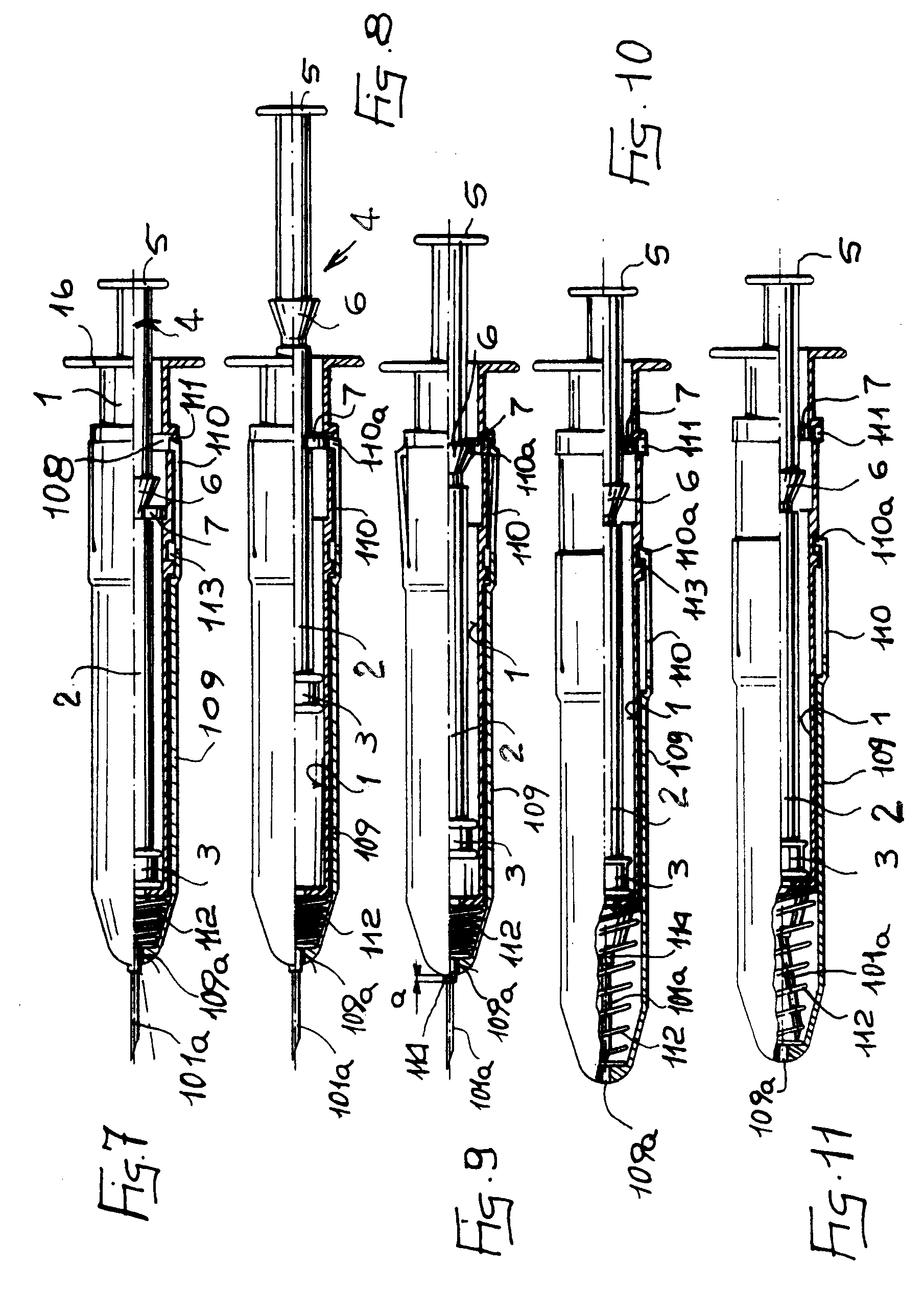
Designated Contracting States: |
|
AT BE CH DE ES FR GB GR LI LU NL SE |
| (30) |
Priority: |
27.07.1987 IT 4822987
19.11.1987 IT 4862487
|
| (43) |
Date of publication of application: |
|
15.03.1989 Bulletin 1989/11 |
| (73) |
Proprietor: AR.MA. S.R.L. |
|
I-00195 Roma (IT) |
|
| (72) |
Inventor: |
|
- Romano, Armando
I-20144 Milan (IT)
|
| (74) |
Representative: Cavattoni, Fabio et al |
|
Cavattoni & Raimondi
Viale dei Parioli, 160
00197 Roma
00197 Roma (IT) |
| (56) |
References cited: :
DE-A- 3 107 414
GB-A- 551 545
|
DE-U- 8 701 501
US-A- 1 434 381
|
|
| |
|
|
|
|
| |
|
| Note: Within nine months from the publication of the mention of the grant of the European
patent, any person may give notice to the European Patent Office of opposition to
the European patent
granted. Notice of opposition shall be filed in a written reasoned statement. It shall
not be deemed to
have been filed until the opposition fee has been paid. (Art. 99(1) European Patent
Convention).
|
[0001] This invention relates to a self-blocking hypodermic syringe for once-only use, which
cannot be reused after it has been once used, and is provided with a needle protection
cap which is automatically transferred into its protection position after use.
[0002] In medical practice, medicaments are frequently administered to the patient hypodermically
by means of a needle and syringe.
[0003] In order to ensure maximum protection from infection and the like, sterile syringes
for once-only use are usually employed, these being packaged in sealed containers
to be opened at the moment of use.
[0004] However, syringes are also used by drug addicts for drug injection, and with this
category of person a considerable increase has been noted in the spread of viral illnesses,
such as type B hepatitis and acquired immunodeficiency syndrome (AIDS), the cause
of which is the contagion transmitted by the use of the same syringe by more than
one person, who ignore the rule which prescribes its once-only use.
[0005] Moreover when syringes are used to inject persons suffering from illnesses of the
aforesaid type, it can sometimes happen that the medical functionary or whoever carries
out the injection is accidentally injured by the used syringe needle either before
fitting a protection cap onto the needle or while fitting it, or before placing the
syringe in a closed container for its disposal, with the danger of contracting the
infection.
[0006] Finally, syringes used by drug addicts for drug taking are very often carelessly
thrown away in public places such as public gardens after use, so exposing park attendants
and other person, especially children, to the danger of accidental pricking and possible
infection.
[0007] Certain syringes comprise means for controlling the plunger stroke within the cylindrical
body for various reasons.
[0008] For example, GB-A-551 545 discloses a syringe comprising means for delaying or braking
the plunger stroke within the cylindrical body and for enabling the user to determine
the quantity of injected liquid by feel.
[0009] DE-A-3 107 414 discloses blocking means for preventing the extraction of a plunger
from the cylindrical body in order to avoid contaminating the space which is to contain
the liquid to be injected, and US-A-1 434 381 discloses a syringe provided with elastic
braking or delay means to prevent accidental introduction of air into the liquid contained
in the syringe or accidental leakage of this liquid, or again accidental escape of
the plunger from the cylindrical body.
[0010] However, none of the known syringes comprises means for preventing the re-use of
a once-only usable syringe or for preventing accidental pricking after the syringe
has been used.
[0011] The problem therefore arises of preventing the spread of contagion by making it impossible
to use the same syringe more than once, independently of the desire or negligence
of the user, and of isolating the needle after the syringe has been used so that the
needle is made safe.
[0012] These results are attained according to the present invention by a self-blocking
hypodermic syringe for once-only use comprising a cylindrical body which at its front
end carries means for connection to a hypodermic needle and is open at its opposite
end and contains a plunger which slides in a fluid-tight manner and is provided with
a gripping rod, characterised by the features as specified in the second part of claim
1.
[0013] According to a currently preferred embodiment, the means for blocking the plunger
intake stroke consist of a split-ring which before the syringe is initially used embraces
the minor diameter region of a frusto-conical portion of the rod, which converges
in the direction in which the plunger is driven for injection. The minor diameter
region of said frusto-conical portion has a diameter less than the rod diameter and
the major diameter region has a diameter substantially equal to or slightly less than
the inner diameter of the cylindrical body. The syringe cylindrical body comprises
an annular bulge which is able to receive the split-ring when this is drawn in front
of it during the initial liquid intake stage, said bulge having an inner diameter
greater than the diameter of the major diameter region of the frusto-conical portion
plus the thickness of the split-ring and being positioned at a distance from that
end of the cylindrical body carrying the needle which exceeds the distance between
the front end of the plunger and the rear surface of its frusto-conical portion. When
in its undeformed state, the split-ring has an inner diameter less than the maximum
diameter of the frusto-conical portion and an outer diameter greater than the inner
diameter of the cylindrical body, and is elastically deformable to widen out into
the bulge under the action of the frusto-conical surface as the plunger is driven
in.
[0014] Before the syringe is initially used, the split-ring is in a position forward of
the bulge in the cylindrical body, and is in its elastically deformed contracted state.
[0015] The distance between the split-ring when in its initial position, i.e. embracing
the minor diameter region of the frusto-conical portion, and the bulge in the cylindrical
body is less than the stroke of the plunger which corresponds to the minimum scheduled
liquid dosage for which the syringe can be used.
[0016] According to a further characteristic, the syringe of the invention also comprises
a slidable cap coaxial to the syringe body and covering the body itself, and being
provided at its front with an exit hole for the needle and further having members
for its fastening to the syringe body, and elastic thrust means, said cap when in
its retracted position leaving the needle exposed and when in its advanced position
covering the needle, the fastening members being moved into their release position
by release means associated with the first forward movement of the plunger.
[0017] Specifically, the cap fastening members consist of elastic tongues provided in the
rear part of the cap and having their ends turned inwards to form a hook so that when
the cap is in its retracted position they become inserted into corresponding slots
in the syringe body to axially lock the cap, the release means consisting of an elastic
element which is provided within the syringe in a position corresponding to the slots
in the syringe body which house the hook-shaped ends of the cap tongues and is arranged
to be radially deformed by the forward stroke of the plunger during the first injection,
so urging the hook-shaped ends out of the relative slots.
[0018] The syringe body also possesses one or more recesses for receiving the cap tongue
fastening elements when the cap is in its advanced position in which it encloses the
needle, to thus blocking any further sliding of the cap and prevent its escape.
[0019] The elastic element inside the syringe, which urges the hook-shaped ends out of the
relative slots, consists of the split-ring which before the syringe is used embraces
the minor diameter region of the forwarding converging frusto-conical portion of the
plunger, and is arranged to be dragged during the intake stroke into an inner annular
cavity in the cylindrical syringe body into which the body slots housing the hook-shaped
ends of the tongues open, the split-ring being radially deformable outwards under
the action of the frusto-conical portion during plunger advancement.
[0020] The elastic means for urging the cap into its advanced position consist of a spiral
spring interposed between the front surface of the syringe body and the front end
of the plunger, said elastic means being pre-loaded by the cap being placed in its
retracted position, before the syringe is used.
[0021] Under the initial conditions, before the syringe is used, the front end of the cap
is rearward of the base of the needle by a distance equal to the distance through
which the cap has to be advanced in order to completely release the hook-shaped ends
of the cap tongues from the respective slots in the syringe body without their re-insertion
into the slots being possible.
[0022] The hook-shaped ends of the cap tongues have their outer surface bevelled towards
the rear of the syringe, and in correspondence with these the recesses in the syringe
body which receive the cap tongue fastening elements when the cap is in its advanced
position have an undercut rear wall to cause the tongues to deflect inwards should
the cap receive a rearward thrust.
[0023] According to a particular embodiment, the needle can have its axis oblique to the
axis along which the cap slides on the syringe body, and is elastically flexible during
the sliding of the cap, after completion of this sliding it returning to its initial
oblique axis position within the cap with its free front end laterally displaced from
the axis of the front hole in the cap.
[0024] The cap is preferably constructed of transparent material, to allow the quantity
of liquid present in the syringe body to be seen.
[0025] The invention will be more apparent from the description of its currently preferred
embodiment which is given hereinafter by way of non-limiting example with reference
to the accompanying drawings, in which:
Figure 1 is an axial section through the syringe according to the invention ready
for drawing in liquid, and with its protection cap removed for reasons of clarity;
Figure 2 is a section on the line II-II of Figure 1;
Figure 3 shows the syringe of Figure 1 during liquid draw-in;
Figure 4 is a section on the line IV-IV of Figure 3;
Figure 5 shows the syringe of Figure 1 during injection;
Figure 6 is a section on the line VI-VI of Figure 5;
Figure 7 is an axial section through the syringe according to the invention in its
initial position ready for drawing in liquid, but with its protection cap fitted;
Figure 8 shows the syringe of Figure 7 in an intermediate stage during draw-in;
Figure 9 shows the syringe of Figure 7 when nearly at the end of the injection stage;
Figure 10 shows the syringe of Figure 7 after use, with the needle protected; and
Figure 11 shows an alternative embodiment of the syringe of Figure 7 after use.
[0026] As shown in Figure 1, the syringe according to the invention comprises an outer cylindrical
body 1 having a front end 1
a shaped to connect to a needle, not shown as it can be of known type, and a rear end
1
b provided with a gripping flange. Within the cylindrical body 1 there slides a plunger
2 provided with a seal element 3 and a rod 4 terminating with a gripping flare 5.
[0027] As best seen in Figure 3, the rod 4 carries a frusto-conical portion 6 which converges
towards the seal element 3 and has its major diameter substantially equal to or slightly
less than the inner diameter of the cylindrical body 1, and its minor diameter less
than the diameter of the plunger 2.
[0028] A toroidal split-ring 7 which when in its rest state has an outer diameter greater
than the inner diameter of the cylindrical body 1 and an inner diameter equal to the
diameter of the rod 4, is located about the minor diameter region 8 of the portion
6 before initial use, and is therefore housed within the cylindrical body 1 in the
position shown in Figure 1, in a deformed contracted state about the minor diameter
region 8 of the portion 6, as can be also seen in Figure 2.
[0029] At a short distance from its rear end 1
b, the cylindrical body 1 comprises an annular bulge 9 with an inner diameter equal
to the maximum diameter of the frusto-conical portion 6 plus the width of the split-ring
7.
[0030] Under the initial conditions, as shown in Figures 1 and 2, the split-ring 7 is contracted
about the minor diameter region 8 of the frusto-conical portion 6, and the plunger
2 is inserted completely into the cylindrical body 1, with the ring 7 in an intermediate
position between the end 1
a of the cylindrical body 1 and the annular bulge 9.
[0031] For its use, the syringe must be filled by drawing the medicinal liquid in by withdrawing
the plunger 2 rearward. During this stage, as shown in Figure 3, the ring 7 is pulled
by the rod 4 towards the annular bulge 9, into which it becomes insterted by opening
out elastically into its rest state, shown in Figure 4.
[0032] The liquid intake stage can then be continued until the syringe is filled with the
required volume of medicinal liquid, without any further movement of the ring 7 which
remains securely housed in its seat, whereas the plunger 2 can be moved to expel residual
air or the like before inserting the needle into the patient's body for injecting
the medicament.
[0033] During the subsequent injection stage, the plunger 2 is driven in to expel the liquid
contained in the syringe, until the frusto-conical portion 6 comes into contact with
the split-ring 7. During advancement of the plunger 2, the action of the surface of
the portion 6 causes the ring 7 to widen out into its dilated state shown in Figure
6, with its inner diameter equal to the maximum diameter of the portion 6, so allowing
the portion 6 to pass through as shown in Figure 5, and enabling the plunger 2 to
terminate its stroke in order to completely expel the contained liquid.
[0034] When the frusto-conical portion of the plunger 2 has passed beyond the ring 7, this
elastically assumes its rest state, held within the bulge 9 and abutting against the
flat rear surface 6
a of the frusto-conical portion 6 and thus opposing any subsequent withdrawal of the
plunger 2.
[0035] As the flat rear surface 6
a of the frusto-conical portion 6 has a diameter substantially equal to or slightly
less than the inner diameter of the cylindrical body 1, even if the ring 7 is forced
and/or fractured it will be absolutely impossible to withdraw the plunger 2 due to
interference.
[0036] This configuration therefore makes it no longer possible to draw further liquid in,
so making any second utilisation of the syringe impossible.
[0037] The distance between the syringe front end 1
a and the bulge 9 and the distance between the front surface of the seal element 3
and the surface 6
a are such that the position to which the plunger 2 has advanced when the ring 7 abuts
against the surface 6
a is such as not to allow sufficient liquid to be injected before this abutment occurs,
and also such as to allow the ring 7 to be drawn into the bulge 9 during the intake
stage with even the minimum usable dosage of medicinal liquid, so as to prevent situations
occurring in which the plunger does not become blocked after the initial injection,
either by accident or by purposeful manipulation.
[0038] With reference to Figure 7, the syringe according to the invention is also provided
with a cap 109 which is of transparent material to enable the quantity of liquid present
in the syringe to be seen, and has at its front a hole 109
a for passage of the needle 101
a, the cap being provided in its rear part with at least two elastic tongues 110 having
their free ends 110
a turned inwards in the manner of a hook and inserted, when under initial conditions,
in respective slots 111 which open into the groove 108.
[0039] Between the body 1 and the front end of the cap 109 there is also provided a spring
112, for example of spiral type, which under initial conditions is compressed. The
body 1 is also provided with an outer annular cavity 113 or several limited cavities,
disposed in correspondence with the free ends 110
a of the tongues 110.
[0040] For its use, the syringe must be filled by drawing the medicinal liquid in by withdrawing
the plunger 2 rearward. During this stage, as shown in Figure 8, the ring 7 is pulled
by the rod 4 towards the annular groove 108, into which it becomes inserted by opening
out elastically into its rest state, in contact with the ends 110
a of the tongues 110.
[0041] The liquid intake stage can then be continued until the syringe is filled with the
required volume of medicinal liquid, without any further movement of the ring 7 which
remains securely housed in its seat, whereas the plunger 2 can be moved to expel residual
air or the like before inserting the needle into the patient for injecting the medicament.
[0042] During the subsequent injection stage, the plunger 2 is driven in to expel the liquid
contained in the syringe, until the frusto-conical portion 6 comes into contact with
the split-ring 7. During advancement of the plunger, the action of the surface of
the portion 6 causes the ring 7 to widen out to an inner diameter equal to the maximum
diameter of the portion 6, so allowing the portion 6 to pass and enabling the plunger
2 to terminate its stroke in order to completely expel the liquid contained in the
syringe.
[0043] During this stage the ring 7 has widened out to the maximum diameter of the groove
108, and its outer surface therefore acts against the ends 110
a of the tongues 110 to urge them outwards, as shown in Figure 9, so that they deflect
until they become released from the engagement with the edge of the groove 108.
[0044] Under the action of the spring 112, the cap 109 then advances through a distance
"a" equal to the needle terminal portion 114 which determines its maximum depth of
insertion, so that it comes into contact with the skin of the patient, against which
it remains until the injection is complete, while the ends 110
a of the tongues 110 rest against the outer wall of the body 1 in a position forward
of the groove 108, so that they are unable to re-enter the relative slots 111.
[0045] When the frusto-conical portion 6 of the plunger 2 has passed beyond the ring 7,
it elastically assumes its rest state, held within the groove 108 and abutting against
the flat rear surface 6
a of the frusto-conical portion 6 and thus opposing any subsequent rearward movement
of the plunger 2.
[0046] This teherefore makes it no longer possible to draw further liquid in, so making
any second utilisation of the syringe impossible. At the same time, with the extraction
of the needle, the cap 109 advances under the thrust of the spring 112 into the configuration
shown in Figure 10, in which it entirely encloses the needle, and the ends 110
a of the tongues 110 become inserted into the cavity 113, to prevent any further advancement.
[0047] That wall of the cavity 113 located towards the rear of the syringe is undercut,
and the rear wall of the end 110
a of the tongues 110 is shaped to correspond to this undercut. In this manner, the
tongues oppose any force which could tend to again move the cap 109 rearward, so keeping
the needle covered and preventing any accidental pricking by the used needle.
[0048] As shown in Figure 11 and by an axis line in Figure 7, the needle 101
a can be formed with its axis inclined to the axis of advancement of the cap 109, or
in any event not coinciding with the syringe axis. In this manner, when the cap slides
forward the needle undergoes deflection until it is completely housed within the cap,
where it then straightens so that its point is displaced sideways from the front hole
109
a of the cap 109, thus making any further retraction of the cap 109 and consequent
exposure of the needle impossible, even under conditions of accidental or voluntary
breakage or bending of the tongues 110.
[0049] The dimensions of the syringe according to the invention can be freely chosen according
to utilisation requirements, and material of various type can be used compatible with
sterisability and absence of toxicity, and compatible with the medicinal substances
injected.
1. A self-blocking hypodermic syringe for once-only use comprising a cylindrical body
(1) which at its front end carries means (1a) for connection to a hypodermic needle
and is open at its opposite end, and contains a plunger (2) which slides in a fluid-tight
manner and is provided with a gripping rod (4), characterised by also comprising elastic
means (7) for blocking the intake stroke of the plunger (2) which are initially located
in an inactive position between the body and the plunger and are transferred, by the
effect of the plunger movement during the first syringe intake and injection operation,
into an active position wherein said elastic means become secured to the cylindrical
body (1) and form a non-removable stop against any further plunger intake stroke,
immediately after the completion of said first injection operation.
2. A syringe according to claim 1, characterised in that the elastic means for blocking
the plunger (2) intake stroke consist of a split-ring (7) which before the syringe
is initially used embraces the minor diameter region of a frusto-conical portion (6)
of the rod (4) of the plunger (2) which converges in the direction in which the plunger
(2) is driven for injection, the minor diameter region of the frusto-conical portion
(6) having a diameter less than the diameter of the rod (4) and the major diameter
region having a diameter substantially equal or slightly less than the inner diameter
of the cylindrical body (1), the syringe cylindrical body (1) comprising an annular
bulge (9) which is able to receive the split-ring (7) when this is drawn in front
of it during the initial liquid intake stage, said bulge (9) having an inner diameter
greater than the diameter of the major diameter region of the frusto-conical portion
(6) plus the thickness of the split-ring (7) and being positioned at a distance from
that end of the cylindrical body (1) carrying the needle which exceeds the distance
between the front end of the plunger (2) and the rear surface of its frusto-conical
portion (6), when in its undeformed state the split-ring (7) having an inner diameter
less than the maximum diameter of the frusto-conical portion (6) and an outer diameter
greater than the inner diameter of the cylindrical body (1), and being elastically
deformable to widen out into the bulge (9) under the action of the frusto-conical
surface as the plunger (2) is driven in.
3. A syringe according to claim 2, characterised in that before the syringe is initially
used, the split-ring (7) is in a position forward of the bulge (9) in the cylindrical
body (1) and is in an elastically deformed contracted state.
4. A syringe according to claim 3, characterised in that the distance between the
split-ring (7) when in its initial position, i.e. embracing the minor diameter region
of the frusto-conical portion (6), and the bulge (9) in the cylindrical body (1) is
less than that stroke of the plunger (2) which corresponds to the minimum scheduled
liquid dosage for which the syringe can be used.
5. A self-blocking hypodermic syringe for once-only use according to claim 1, characterised
by comprising a slidable cap (109) coaxial to the syringe body (1) and covering the
body itself, and being provided at its front with an exit hole (109a) for the needle (101a), and further having members for its fastening to the syringe body (1), and elastic
thrust means, said cap (109) when in its retracted position leaving the needle (101a) exposed and when in its advanced position covering the needle, the fastening members
being moved into their released position by release means associated with the first
forward movement of the plunger.
6. A syringe according to claim 5, characterised in that the cap fastening members
consist of elastic tongues (110) provided in the rear part of the cap (109) and having
their ends (110a) turned inwards to form a hook so that when the cap (109) is in its retracted position
they become inserted into corresponding slots (111) in the syringe body (1) to axially
lock the cap (109), the release means consisting of elastic means for blocking the
intake stroke of the plunger (2), which are provided within the syringe in a position
corresponding with the slots (111) in the syringe body (1) which house the hook-shaped
ends (110a) of the tongues (110) provided on the cap (109), and are arranged to be radially
deformed by the forward stroke of the plunger (2) during the first injection, so urging
the hook-shaped ends (110a) out of the relative slots (111).
7. A syringe according to claim 6, characterised in that the syringe body (1) also
possesses one or more recesses (113) for receiving the fastening elements on the tongues
(110) of the cap (109) when the cap (109) is in its advanced position in which it
encloses the needle (101a), to thus block any further sliding of the cap (109) and prevent its escape.
8. A syringe according to claim 6, characterised in that the elastic element inside
the syringe, which urges the hook-shaped ends (110a) out of the relative slots (111), consists of a split-ring (7) which before the syringe
is used embraces the minor diameter region of a forwardly converging frusto-conical
portion (6) of the rod (4) of the plunger (2), and is arranged to be dragged during
the first intake stroke into an inner annular cavity (108) in the cylindrical syringe
body (1) into which the slots (111) in the body (1) which house the hook-shaped ends
(110a) of the tongues (110) open, the split-ring (7) being radially deformable outwards
under the action of the frusto-conical portion (6) during forward movement of the
plunger (2).
9. A syringe according to claim 5, characterised in that the elastic means for urging
the cap (109) into its advanced position consist of a spiral spring (112) interposed
between the front surface of the syringe body (1) and the front end of the plunger
(2), said elastic means being preloaded by the cap being placed in its retracted position,
before the syringe is used.
10. A syringe according to any claim from 5 to 9, characterised in that under the
initial conditions, before the syringe is used, the front end of the cap (109) is
rearward of the base of the needle (101a) by a distance equal to the distance through which the cap (109) has to be advanced
in order to completely release the hook-shaped ends (110a) of the tongues (110) on the cap (109) from the respective slots (111) in the syringe
body without their re-insertion into the slots (111) being possible.
11. A syringe according to claim 7, characterised in that the hook-shaped ends (110a) of the cap (109) tongues have their outer surface bevelled towards the rear of the
syringe, and in correspondence with these the recesses (113) in the syringe body (1)
which receive the cap (109) tongue (110) fastening elements (110a) when the cap (109) is in its advanced position have an undercut rear wall to cause
the tongues (110) to deflect inwards should the cap (109) receive a rearward thrust.
12. A syringe according to any claim from 5 to 11, characterised in that the needle
(101a) has its axis oblique to the axis along which the cap (109) slides on the syringe
body (1), and is elastically flexible during the sliding of the cap (109), after completion
of this sliding it returning to its initial oblique axis position within the cap (109)
with its free front end laterally displaced from the axis of the front hole (109a) in the cap (109).
13. A syringe according to any claim from 5 to 12, characterised in that the cap (109)
is constructed of transparent material, to allow the quantity of liquid present in
the syringe body (1) to be seen.
1. Selbstblockierende, hypodermale Spritze zum Einmalgebrauch umfassend einen zylinderförmigen
Körper (1), der an seinem vorderen Ende Mittel (1a) trägt zum Befestigen an eine hypodermale
Nadel und an seinem entgegengesetzten Ende offen ist und einen Stempel (2) enthält,
der flüssigkeitsdicht gleitet und ausgestattet ist mit einem Klemmstab (4), dadurch
gekennzeichnet, daß sie auch elastische Mittel (7) umfaßt zum Blockieren des Ansaughubes
des Stempels (2), die sich zuerst in einer inaktiven Position zwischen dem Körper
und dem Stempel befinden und durch die Bewegung des Stempels während des ersten Ansaugens
der Spritze und Einspritzvorganges in eine aktive Position verschoben werden, wobei
diese elastischen Mittel mit dem zylindrischen Körper (1) fest verbunden werden und
eine nicht entfernbare Sperre gegen jeden weiteren Ansaughub des Stempels bilden,
sofort nach Beendigung dieses ersten Einspritzvorganges.
2. Spritze nach Anspruch 1, dadurch gekennzeichnet, daß die elastischen Mittel zum
Blockieren des Ansaughubes des Stempels (2) aus einem geteilten Ring (7) bestehen,
der, bevor die Spritze zum ersten Mal gebraucht wird, die Stelle mit dem kleinern
Durchmesser eines kegelförmig konischen Teiles (6) des Stabes (4) des Stempels (2)
umfaßt, der in die Richtung konvergierend ist, in die der Stempel (2) beim Einspritzen
geschoben wird, wobei die stelle des kleineren Durchmessers des kegelförmig-konischen
Teiles (6) einen Durchmesser hat, der geringer ist als der Durchmesser des Stabes
(4) und die Stelle mit dem größeren Durchmesser einen Durchmesser hat, der im wesentlichen
gleich oder geringfügig kleiner ist als der innere Durchmesser des zylinderförmigen
Körpers (1), wobei der zylinderförmige Spritzenkörper (1) eine ringförmige Ausbuchtung
(9) umfaßt, die den geteilten Ring (7) aufnehmen kann, wenn dieser während des ersten
Flüssigskeitsaufnahmestadiums davor gezogen wird, wobei diese Ausbuchtung (9) einen
inneren Durchmesser hat, der größer ist als der Durchmesser der Stelle mit dem größeren
Durchmesser des kegelförmig-konischen Teiles (6) plus der Stärke des geteilten Ringes
(7) und sich im Abstand von dem Ende des zylinderförmigen Körpers (1) befindet, das
die Nadel trägt, der den Abstand zwischen dem vorderen Ende des Stempels (2) und der
hinteren Oberfläche seines kegelförmig-konischen Teiles (6) überschreitet, wenn der
geteilte Ring (7) in seinem nicht deformierten Zustand einen inneren Durchmesser hat,
der geringer ist als der größte Durchmesser des kegelförmig-konischen Teiles (6) und
einen äußeren Durchmesser hat, der größer ist als der innere Durchmesser des zylinderförmigen
Körpers (1), und der elastisch deformierbar ist, um sich in die Ausbuchtung (9) auszudehnen
während der Bewegung der kegelförmig-konischen Oberfläche, wenn der Stempel (2) eingeschoben
wird.
3. Spritze nach Anspruch 2, dadurch gekennzeichnet, daß bevor die Spritze zum ersten
Mal vewrwendet wird, der geteilte Ring (7) in einer Position vor der Ausbuchtung (9)
in dem zylinderförmigen Körper (1) ist und in einem elastich deformierten kontraktierten
Zustand ist.
4. Spritze nach Anspruch 3, dadurch gekennzeichnet, daß der Abstand zwischen dem geteilten
Ring (7) an seiner ursprünglichen Position, d.h. die Stelle mit dem geringeren Durchmesser
des kegelförmig konischen Teiles (6) umfassend, und der Ausbuchtung (9) in dem zylinderförmigen
Körper (1) kleiner ist als der Hub des Stempels (2), der der kleinsten vorgesehenen
Flüssigkeitsdosierung entspricht, für die die Spritze benutzt werden kann.
5. Selbstblockierende hypodermale Spritze zum Einmalgebrauch nach Anspruch 1, dadurch
gekennzeichnet, daß sie eine gleitende Kappe (109) koaxial zum Spritzenkörper (1)
umfaßt, und die den Körper selbst bedeckt und vorne mit einer Ausgangsöffnung (109a)
für die Nadel (101a) ausgestattet ist, und des weiteren Elemente für die Befestigung
am Spritzenkörper (1) und elastische Schubmittel hat, wobei diese Rappe (109) in ihrer
zurückgeschobenen Position die Nadel (101a) frei läßt und wenn sie in ihrer vorgeschobenen
Position ist, die Nadel bedeckt, wobei die Befestigungselemente in ihre freigegebene
Position bewegt werden durch Freigabemittel, die mit der ersten Vorwärtsbewegung des
Stempels gekoppelt sind.
6. Spritze nach Anspruch 5, dadurch gekennzeichnet, daß die Befestigungselemente der
Kappe aus elastischen Zungen (110) bestehen, die im hinteren Teil der Rappe (109)
angebracht sind und deren Enden (110a) nach innen zeigen um einen Haken zu bilden,
so daß sie, wenn die Rappe (109) in ihrer zurückgeschobenen Position ist, in die entsprechenden
Schlitze (111) im Spritzenkörper (1) eingeführt werden, um die Kappe (109) axial zu
sperren, wobei die Freigabemittel aus elastischen Mitteln zum Blockieren des Ansaughubes
des Stempels (2) bestehen, die sich innerhalb der Spritze in einer Position befinden,
die den Schlitzen (111) in dem Spritzenkörper (1), die die hakenförmigen Enden (110a)
der Zungen (110) aufnehmen, die sich an der Kappe (109) befinden, entspricht, und
so angeordnet sind, daß sie bei der Vorwärtsbewegung des Stempels (2) während des
ersten Einspritzens, radial deformiert werden und so die hakenförmigen Enden (110a)
aus den entsprechenden Schlitzen (111) hinausdrängen.
7. Spritze nach Anspruch 6, dadurch gekennzeichnet, daß der Spritzenkörper (1) auch
eine oder mehrere Einbuchtungen (113) zum Aufnehmen der Befestigungselemente an den
Zungen (110) der Kappe (109) hat, wenn die Kappe (109) in ihrer vorgeschobenen Position
ist, in der sie die Nadel (101a) umschließt, um somit ein weiteres Verschieben der
Kappe (109) zu verhindern und ihrem Entweichen vorzubeugen.
8. Spritze nach Anspruch 6, dadurch gekennzeichnet, daß das elastische Element innerhalb
der Spritze, das die hakenförmigen Enden (110a) aus den entsprechenden Schlitzen (111)
hinausdrängt, aus einem geteilten Ring (7) besteht, der, bevor die Spritze benutzt
wird, die Stelle mit dem kleineren Durchmesser eines nach vorne konvergierenden kegelförmigkonischen
Teiles (6) des Stabes (4) des Stempels (2) umschließt und so angeordnet ist, daß er
während des ersten Ansaughubes in eine innere ringförmige Ausbuchtung (108) im zylinderförmigen
Spritzenkörper (1) gezogen wird, in die sich die Schlitze (111) im Körper (1), die
die hakenförmigen Enden (110a) der Zungen (110) aufnehmen, öffnen, wobei der geteilte
Ring (7) radial nach außen deformierbar ist durch die Bewegung des kegelförmig-konischen
Teiles (6) während der Vorwärtsbewegung des Stempels (2).
9. Spritze nach Anspruch 5, dadurch gekennzeichnet, daß das elastische Mittel, das
die Kappe (109) in ihre vorgeschobene Position preßt, aus einer Spiralfeder (112)
besteht, die zwischen der vorderen Oberfläche des Spritzenkörpers (1) und dem vorderen
Ende des Stempels (2) eingeschoben ist, wobei dieses elastische Mittel dadurch vorgespannt
wird, daß die Rappe in ihre zurückgezogene Position gebracht wird bevor die Spritze
benutzt wird.
10. Spritze nach einem der Ansprüche von 5 bis 9, dadurch gekennzeichnet, daß unter
den ursprünglichen Bedingungen, bevor die Spritze benutzt wird, das vordere Ende der
Kappe (109) in einem Abstand hinter der Basis der Nadel (101a) ist, der gleich ist
dem Abstand durch welchen die Rappe (109) vorgeschoben werden muß um die hakenförmigen
Enden (110a) der Zungen (110) an der Kappe (109) aus den entsprechenden Schlitzen
(111) im Spritzenkörper freizugeben, ohne daß ein Wiedereinhaken in die Schlitze (111)
möglich ist.
11. Spritze nach Anspruch 7, dadurch gekennzeichnet, daß die hakenförmigen Enden (110a)
der Zungen (110) der Kappe (109) ihre äußere Oberfläche zum Ende der Spritze hin abgeschrägt
haben, und dementsprechend die Einbuchtungen (113) im Spritzenkörper (1), die die
Befestigungselemente (110a) der Zungen (110) der Kappe (109) aufnehmen, wenn die Kappe
(109) in ihrer vorgeschobenen Position ist, eine unterschnittene hintere Wand haben,
um die Zungen (110) nach innen abzulenken falls die Kappe (109) nach hinten gestoßen
werden sollte.
12. Spritze nach einem der Ansprüche von 5 bis 11, dadurch gekennzeichnet, daß die
Nadel (101a) ihre Achse schräg zu der Achse hat, an der die Kappe (109) am Spritzenkörper
(1) entlanggleitet und während des Gleitens der Kappe (109) elastisch flexibel ist,
und nach Beendigung des Gleitens in die ursprüngliche schräge Achsenposition innerhalb
der Kappe (109) zurückkehrt, wobei ihr freies vorderes Ende seitlich verschoben ist
von der Achse der vorderen Öffnung (109a) in der Kappe (109).
13. Spritze nach einem der Ansprüche von 5 bis 12, dadurch gekennzeichnet, daß die
Kappe (109) aus durchsichtigem Material gearbeitet ist, damit die Flüssigkeitsmenge
im Spritzenkörper (1) gesehen werden kann.
1. Seringue hypodermique autobloquante à usage unique, comprenant un corps cylindrique
(1) qui porte à son extrémité avant des moyens (1a) permettant le raccordement d'une aiguille hypodermique et est ouvert à son extrémité
opposée, et qui contient un piston plongeur (2) qui y coulisse de façon étanche aux
fluides et est pourvu d'une tige (4) de manipulation, caractérisée en ce qu'elle comporte
aussi des moyens élastiques (7) destinés à bloquer la course d'aspiration du piston
plongeur (2), qui sont placés initialement dans une position inactive entre le corps
et le piston plongeur et sont transférés, du fait du mouvement du piston plongeur
lors de la première opération d'aspiration et d'injection de la seringue, dans une
position active dans laquelle lesdits moyens élastiques (7) se trouvent verrouillés
par rapport au corps cylindrique (1) et forment une butée indémontable, interdisant
toute autre course d'aspiration du piston plongeur, immédiatement après l'achèvement
de ladite première opération d'injection.
2. Seringue selon la revendication 1, caractérisée en ce que les moyens élastiques
de blocage du piston plongeur (2) sont constitués d'une bague fendue (7) qui, avant
la première utilisation de la seringue, entoure la zone de faible diamètre d'une partie
tronconique (6) de la tige (4) du piston plongeur (2), cette partie étant convergente
dans le sens dans lequel le piston plongeur (2) est déplacé pour effectuer l'injection,
la zone de faible diamètre de la partie tronconique (6) présentant un diamètre qui
est inférieur au diamètre de la tige (4), et la zone de grand diamètre présentant
un diamètre qui est essentiellement égal à ou légèrement inférieur au diamètre intérieur
du corps cylindrique (1), ce corps cylindrique (1) de la seringue comportant un renflement
annulaire (9) capable de recevoir la bague fendue (7) lorsque celle-ci est entraînée
jusqu'en face du renflement lors de l'étape initiale d'aspiration de liquide, ledit
renflement (9) ayant un diamètre intérieur qui est supérieur au diamètre de la zone
de diamètre maximal de la partie tronconique (6) plus l'épaisseur de la bague fendue
(7), et est disposé à une distance, par rapport à l'extrémité du corps cylindrique
(1) qui porte l'aiguille, qui dépasse la distance comprise entre l'extrémité avant
du piston plongeur (2) et la face arrière de la partie tronconique (6) de celui-ci,
la bague fendue (7) présentant, lorsqu'elle se trouve dans son état non déformé, un
diamètre intérieur qui est inférieur au diamètre maximal de la partie tronconique
(6), et un diamètre extérieur qui est supérieur au diamètre intérieur du corps cylindrique
(1), et cette bague étant élastiquement déformable de façon à s'écarter et à rentrer
dans le renflement (9) sous l'action de la surface tronconique lorsque le piston plongeur
(2) est repoussé.
3. Seringue selon la revendication 2, caractérisée en ce qu'avant la première utilisation
de la seringue, la bague fendue (7) se situe dans une position avancée par rapport
au renflement (9), dans le corps cylindrique (1), et se trouve dans un état de compression
élastique.
4. Seringue selon la revendication 3, caractérisée en ce que la distance comprise
entre la bague fendue (7), lorsque celle-ci se trouve dans sa position initiale, c'est-à-dire
lorsqu'elle entoure la zone de faible diamètre de la partie tronconique (6), et le
renflement (9) dans le corps cylindrique (1) est plus petite que la course du piston
plongeur (2), qui correspond à la dose minimale prévue de liquide pour laquelle la
seringue peut être utilisée.
5. Seringue hypodermique autobloquante à usage unique selon la revendication 1, caractérisée
en ce qu'elle comporte un capuchon coulissant (109) coaxial par rapport au corps (1)
de la seringue, recouvrant le corps lui-même, étant pourvu à l'avant d'un trou (109a) de passage de l'aiguille (101a), et comprenant ensuite des éléments permettant de le fixer sur le corps (1) de la
seringue et des moyens de poussée élastiques, ledit capuchon (109) laissant l'aiguille
(101a) découverte, lorsqu'il se trouve dans sa position rétractée, et recouvrant l'aiguille,
lorsqu'il se trouve dans sa position avancée, les éléments de fixation étant amenés
dans leur position de relâchement par des moyens de déclenchement en association avec
le premier mouvement d'avance du piston plongeur.
6. Seringue selon la revendication 5, caractérisée en ce que les éléments de fixation
du capuchon sont constitués de languettes élastiques (110) prévues dans la partie
arrière du capuchon (109) et dont les extrémités (110a) sont tournées vers l'intérieur sous forme d'un crochet, de telle sorte que, lorsque
le capuchon (109) se trouve en position rétractée, elles s'insèrent dans des fentes
correspondantes (111) pratiquées dans le corps (1) de la seringue de manière à verrouiller
axialement le capuchon (109), les moyens de déclenchement étant constitués par les
moyens élastiques de blocage de la course d'aspiration du piston plongeur (2), qui
sont disposés à l'intérieur de la seringue, dans une position qui coïncide avec les
fentes (111) dans le corps (1) de la seringue, qui accueillent les extrémités (110a) en forme de crochet des languettes (110) du capuchon (109), les moyens de blocage
étant disposés de manière à être déformés radialement lors de la course d'avance du
piston plongeur (2) au cours de la première injection, forçant ainsi les extrémités
(110a) en forme de crochet hors des fentes correspondantes (111).
7. Seringue selon la revendication 6, caractérisée en ce que le corps (1) de la seringue
comporte également un ou plusieurs retraits (113) destinés à recevoir les éléments
de fixation des languettes (110) du capuchon (109) lorsque le capuchon (109) est placé
dans sa position avancée, dans laquelle il enferme l'aiguille (101a), de manière à interdire ainsi toute poursuite du coulissement du capuchon (109)
et à l'empêcher de s'échapper.
8. Seringue selon la revendication 6, caractérisée en ce que l'élément élastique situé
à l'intérieur de la seringue, qui force les extrémités (110a) en forme de crochet hors des fentes correspondantes (111), est constitué par une
bague fendue (7) qui, avant l'utilisation de la seringue, entoure la zone de faible
diamètre de la partie tronconique (6) de la tige (4) du piston plongeur (2), qui se
resserre vers l'avant, et est agencée de manière à être entraînée, lors de la première
course d'aspiration, jusque dans une cavité annulaire interne (108) pratiquée dans
le corps cylindrique (1) de la seringue, dans laquelle débouchent les fentes (111)
du corps (1) qui accueillent les extrémités (110a) en forme de crochet de languettes (110), la bague fendue (7) pouvant être déformée
radialement vers l'extérieur sous l'action de la partie tronconique (6) lors du mouvement
d'avance du piston plongeur (2).
9. Seringue selon la revendication 5, caractérisée en ce que les moyens élastiques
destinés à forcer le capuchon (109) dans sa position avancée sont constitués par un
ressort hélicoïdal (112) intercalé entre la face avant du corps (1) de la seringue
et l'extrémité avant du plongeur (2), lesdits moyens élastiques étant mis sous précontrainte
par le capuchon lorsqu'il se trouve en position rétractée, avant utilisation de la
seringue.
10. Seringue selon l'une quelconque des revendications 5 à 9, caractérisée en ce que,
dans les conditions initiales, avant utilisation de la seringue, l'extrémité antérieure
du capuchon (109) se situe en arrière par rapport à la base (101a) de l'aiguille, à une distance qui est égale à la distance que le capuchon (109)
doit parcourir pour libérer totalement les extrémités (110a) en forme de crochet des languettes (110) du capuchon (109) par rapport aux fentes
correspondantes (111) du corps de la seringue, sans qu'elles puissent se réenclencher
dans ces fentes (111).
11. Seringue selon la revendication 7, caractérisée en ce que les extrémités (110a) en forme de crochet des languettes (110) du capuchon (109) ont une surface externe
biseautée vers l'arrière de la seringue, et en ce que les retraits (113) pratiqués
dans le corps (1) de la seringue, qui reçoivent les éléments (110a) de fixation des languettes (110) du capuchon (109) lorsque ce capuchon (109) se
trouve dans sa position avancée, ont une paroi arrière taillée en retrait de façon
analogue, de manière à provoquer une flexion des languettes (110) vers l'intérieur
si le capuchon (109) subissait une poussée vers l'arrière.
12. Seringue selon l'une quelconque des revendications 5 à 11, caractérisée en ce
que l'axe de l'aiguille (101a) est incliné par rapport à l'axe le long duquel le capuchon (109) coulisse sur le
corps (1) de la seringue, et que l'aiguille est flexible de façon élastique lors du
déplacement du capuchon (109), l'aiguille retournant dans sa position initiale inclinée
dans le capuchon (109), une fois ce déplacement terminé, son extrémité avant libre
étant alors déportée latéralement par rapport à l'axe du trou (109a) avant pratiqué dans le capuchon (109).
13. Seringue selon l'une quelconque des revendications 5 à 12, caractérisée en ce
que le capuchon (109) est réalisé en une matière transparente pour permettre la visualisation
de la quantité de liquide présent dans le corps (1) de la seringue.