| (19) |
 |
|
(11) |
EP 0 307 745 B1 |
| (12) |
EUROPEAN PATENT SPECIFICATION |
| (45) |
Mention of the grant of the patent: |
|
09.12.1992 Bulletin 1992/50 |
| (22) |
Date of filing: 05.09.1988 |
|
| (51) |
International Patent Classification (IPC)5: A43B 5/04 |
|
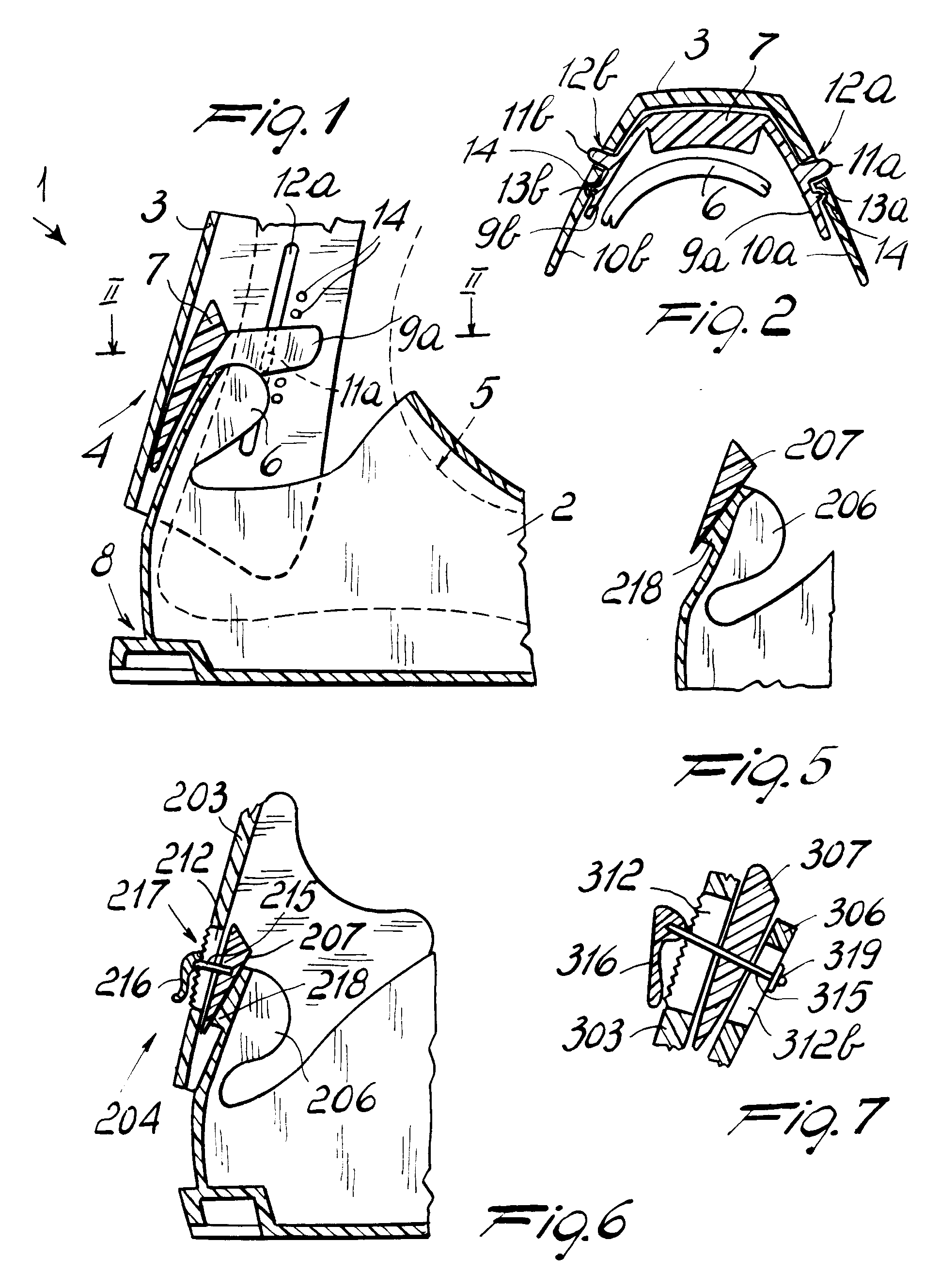
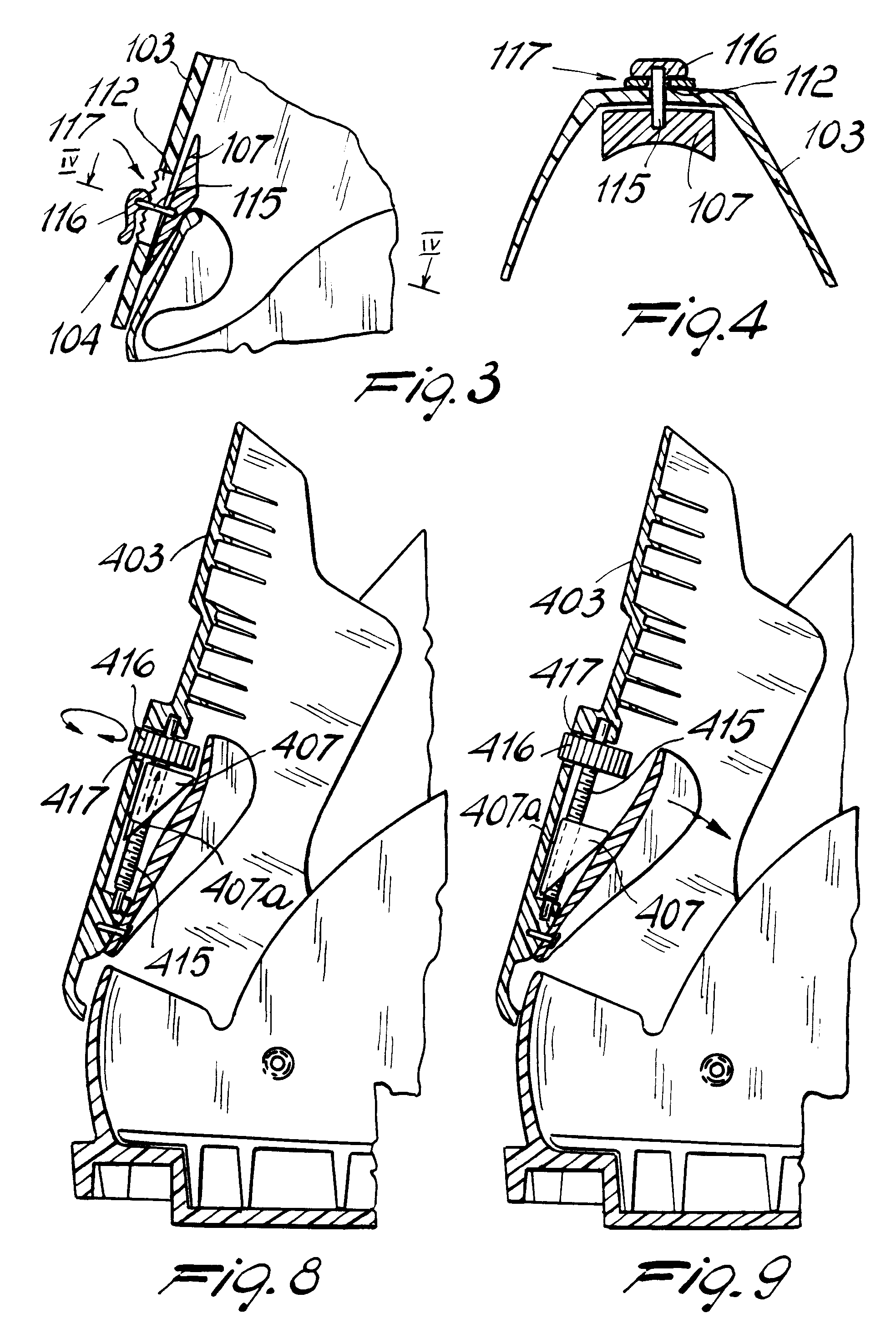
| (54) |
Ski boot with heel securing device
Schischuh mit Fersenhalterung
Chaussure de ski avec un dispositif de maintien du talon
|
| (84) |
Designated Contracting States: |
|
AT CH DE FR IT LI |
| (30) |
Priority: |
15.09.1987 IT 8258687
|
| (43) |
Date of publication of application: |
|
22.03.1989 Bulletin 1989/12 |
| (73) |
Proprietor: NORDICA S.p.A. |
|
31040 Trevignano (Treviso) (IT) |
|
| (72) |
Inventor: |
|
- Sartor, Mariano
I-31044 Montebelluna
Treviso (IT)
|
| (74) |
Representative: Modiano, Guido, Dr.-Ing. et al |
|
Modiano & Associati S.r.l.
Via Meravigli, 16
20123 Milano
20123 Milano (IT) |
| (56) |
References cited: :
EP-A- 0 158 574
DE-A- 3 721 620
|
DE-A- 2 107 659
|
|
| |
|
|
|
|
| |
|
| Note: Within nine months from the publication of the mention of the grant of the European
patent, any person may give notice to the European Patent Office of opposition to
the European patent
granted. Notice of opposition shall be filed in a written reasoned statement. It shall
not be deemed to
have been filed until the opposition fee has been paid. (Art. 99(1) European Patent
Convention).
|
[0001] The present invention relates to a rear-entry ski boot with heel securing device.
[0002] Various devices are currently known which, applied to the boot, allow to secure the
heel inside it.
[0003] For example, in the European patent No. 0158574 and in the German patent No. 2107659,
a device is disclosed constituted by a knob rotatably associated rearwardly to the
rear quarter of the boot which has, at the end of its threaded stem internal to the
boot, a presser interacting with a flap protruding from the shell.
[0004] Said known type of device, however, has disadvantages: the actuation of the knob
in fact leads to the exertion of a pressure on the flap which is concentrated at a
very limited region constituted by the extension of the presser and arranged at a
distance from the sole which remains substantially constant for any adjustment.
[0005] This arrangement makes the securing device difficult to adapt to the different anatomical
configurations of the heel, possibly furthermore causing pain due to the concentration
of pressure on a small area which may not be the optimum one for each individual skier.
[0006] Also known are devices comprising cables which partially embrace said flap protruding
from the shell or from the show internal to the boot, such as for example the device
disclosed in the U.S. Patent Application No. 4620378 in the name of the same Applicant.
[0007] However, these known devices also have the same disadvantages described above for
the preceding devices.
[0008] As a partial solution to these disadvantages, European patent application No. 86109850.7
by this Applicant discloses a ski boot comprising an elongated element which extends
transversely with respect to the longitudinal extension of the rear quarter of the
ski boot, said elongated element being provided inside said rear quarter and substantially
at the heel of the user's foot and being connected to the opposite longitudinal edges
of said rear quarter.
[0009] Though said device is undoubtedly valid, it has the disadvantage that it yields under
stress due to the sliding of the overlapping flaps; this causes a decrease of the
degree of securing, especially during the flexing step in which it is most needed.
[0010] The aim of the present invention is therefore to eliminate the disadvantages described
above in known types by providing a ski boot which allows to achieve the optimum securing
of the heel inside said boot.
[0011] Within the above described aim, another important object is to provide a ski boot
which allows to continuously regulate the pressure exertable at the heel.
[0012] Still another important object is to provide a boot wherein said adjustment can be
executed in a rapid and simple manner by the user.
[0013] Not least object is to provide a boot which associates with the preceding characteristics
that of being structurally very simple and of having extremely modest costs.
[0014] The above described aim and objects, as well as others which will become apparent
hereinafter, are achieved by a rear-entry ski boot with heel securing device, comprising
a shell with which there is articulated at least one rear quarter, characterized in
that it comprises at least one wedge-like element interposed, at the skier's heel
region, between the rear inner surface of said rear quarter and the skier's foot,
with said wedge-like element there being associated means, actuatable by the skier,
for its translatory motion.
[0015] Conveniently, the wedge-like element acts on a flap, protruding from said shell or
from a shoe internal to said boot.
[0016] Advantageously, said adjustment of said wedge-like element occurs according to a
translatory motion thereof along an axis longitudinal to said rear quarter.
[0017] Further characteristics and advantages of the invention will become apparent from
the detailed description of some embodiments, illustrated only by way of non-limitative
example in the accompanying drawings, wherein:
figure 1 is a lateral section view of a boot provided with a device according to the
invention
figure 2 is a view taken along the sectional plane II-II of figure 1;
figure 3 is a view, similar to figure 1, illustrating the means associated with the
wedge-like element for its translatory motion with respect to the rear quarter;
figure 4 is a view taken along the sectional plane IV-IV of figure 3;
figure 5 is a partial view, similar to figure 1, of a device according to another
aspect of the invention;
figure 6 is a view, similar to that of figure 3, of the means associated with the
wedge-like element of figure 5 for its translatory motion with respect to the rear
quarter;
figure 7 is a partial view, similar to figure 1, of a different embodiment of the
invention;
figures 8 and 9 are sectional views, similar to figure 1, of a further embodiment
in two different adjustment conditions.
[0018] With reference to the above described figures, the reference numeral 1 indicates
a rear-entry ski boot composed of a shell 2 to which a rear quarter 3 is articulated.
[0019] At the rear region 4 of the heel of the foot 5 of the skier, the shell 2 has a flap
6 which protrudes upwardly from the shell and is elastically deformable and partially
embraces said region 4.
[0020] The device comprises a wedge-like element 7 arrangeable between the inner surface
of said rear quarter 3 and said flap 6 at the region 4 of the heel.
[0021] Said wedge-like element 7 has its apex directed towards the region of the heel 8
of the boot 1.
[0022] Laterally to the wedge-like element 7 there protrudes a pair of wings, indicated
by the reference numerals 9a and 9b, which affect the inner lateral surfaces, respectively
10a and 10b, of the rear quarter 3.
[0023] From each of said wings there protrudes a pushbutton, indicated by the reference
numerals 11a and 11b, which passes through the rear quarter 3 at adapted slots 12a
and 12b provided longitudinally thereto.
[0024] Adjacent to the pushbuttons 11a and 11b there protrude, in the same direction, from
said wings, raised portions 13a and 13b having a preferably hemispherical shape.
[0025] Said raised portions are selectively arrangeable at adapted shaped seats 14 provided
at the inner lateral surfaces 10a and 10b of the rear quarter 3.
[0026] Said seats 14 are thus aligned substantially parallel to the slot 12a and 12b, and
are in such a number as to allow a wide choice of positions for the wedge-like element
7.
[0027] The use of the device is as follows: by pressing the pushbuttons 11a and 11b the
user imparts an elastic deformation to the wings 9a and 9b, disengaging the raised
portions 13a and 13b from the seats 14, thus allowing the wedge-like element 7 to
move along an axis approximately longitudinal to the rear quarter 3 along the slots
12a and 12b.
[0028] The skier can thus select the desired degree of securing, as the wedge-like element
7 creates a pressure on the flap 6 which is greater as it is lowered towards the region
8 of the heel of the boot.
[0029] Once the optimum position is chosen, the user releases the pushbuttons 11a and 11b,
causing the raised portions 13a and 13b to affect one of the seats 14.
[0030] It has thus been observed that the invention achieves the abovementioned aim and
objects, since the boot allows the skier to achieve the optimum securing of the heel
inside the boot as well as the regulation of the pressure exertable thereat; in fact,
as the securing degree increases, the region of the flap affected by the wedge-like
element also increases, allowing to distribute the pressure exerted thereon on a greater
area.
[0031] The actuation of the device is furthermore very rapid and easy for the skier, a variation
of the securing of the heel being thus obtainable according to specific contingent
situations.
[0032] Furthermore the device is structurally very simple, being therefore also economically
advantageous.
[0033] Naturally the invention is susceptible to numerous modifications and variations,
all within the scope of the same inventive concept.
[0034] Thus, for example, figure 3 illustrates variated means for the translatory motion
of the wedge-like element 107 with respect to the rear quarter 103.
[0035] With the wedge-like element 107 there is in fact rigidly associated, or possibly
articulated, a rod 115 passing at a slot 112 provided longitudinally to the rear quarter
103 at the heel region 104.
[0036] At the other end, said rod 115 is articulated to an eccentric lever 116 interacting
with a set of teeth 117 provided transversely to the quarter 103 laterally to the
slot 112.
[0037] Also in this embodiment it is therefore possible to move the wedge-like element 107
to the required position by acting directly at the eccentric lever 116.
[0038] In a further embodiment, the wedge-like element 207 interacts with the surface directed
towards the flap 206, provided on the shell and/or on the shoe internal to the boot,
with a complementarily shaped tab 218 protruding rearwardly to said flap 206.
[0039] Said tab 218 thus has a surface inclined similarly to the facing surface of the wedge-like
element 207.
[0040] With the element 207 it is possible to associate means for its translatory motion,
such as those illustrated in figure 1 or those illustrated in figure 6, similar to
those associated with the element illustrated in figure 3.
[0041] In said figure 6, in fact, with the wedge-like element 207 there is rigidly associated,
and/or articulated, a rod 215 which protrudes through an adapted slot 212 provided
longitudinally to the rear quarter 203 at the region 204 of the heel.
[0042] With the other end of the rod 215 there is articulated an eccentric lever 216 which
affects an adapted set of teeth 217 provided transversely to the rear quarter 203
in a region adjacent to said slot 212.
[0043] The fact is stressed that by lowering the wedge-like element towards the heel of
the boot an increasingly larger area of the flap provided on the shell and/or on the
inner shoe is affected, thus improving the distribution of the pressure thereon.
[0044] This allows to maximally increase the comfort for the user, obtaining the optimum
adaptation to the various anatomical configurations of each user.
[0045] Figure 7 illustrates a device wherein the rod 315 affects the entire wedge-like element
307, its ends passing at a first slot 312a and at a second slot 312b provided respectively
longitudinally to the rear quarter 303 and to the flap 306 and facing each other.
[0046] Said rod is therefore, at the first slot 312a, articulated to the eccentric lever
316 and, at the second slot 312b, connected to a lug 319 protruding on the opposite
side to the wedge-like element.
[0047] It is thus possible to open the flap when the boot is opened, i.e. when the quarters
are spaced apart to extract the foot.
[0048] This allows a successive easier insertion of the foot without manually moving the
flap as occurred previously.
[0049] According to what is illustrated in figures 8 and 9, the means for the translatory
motion of the wedge-like element, now indicated by the reference numeral 407, are
constituted by a threaded rod 415 which extends longitudinally on the quarter 403
and is rotatably supported by said quarter.
[0050] A knurled wheel 416, which protrudes partially by means of a port 417 defined by
the quarter 403, is rigidly associated with one end of the rod 415.
[0051] The wedge-like element 407 has a through threaded seat which extends substantially
parallel to its side 407a which engages by sliding contact with the inner face of
the quarter 403, so as to prevent the possibility of rotation of the wedge-like element
which is forced to move, consequently to the rotation of the threaded rod 415 executed
by means of the wheel 416, parallel to said rod.
[0052] Naturally the materials and the dimensions and the individual components of the device
may also be the most pertinent according to the specific requirements.
1. Rear-entry ski boot with heel securing device, comprising a shell (2) with which there
is articulated at least one rear quarter (3,103,203,303,403), characterized in that
it comprises at least one wedge-like element (7,107,207,307,407) interposed, at the
skier's heel region, between the rear inner surface of said rear quarter and the skier's
foot, with said wedge-like element there being associated means (11a,11b,116,216,316,416),
actuatable by the skier, for its translatory motion.
2. Boot according to claim 1, characterized in that said wedge-like element interacts
with a flap (6,206,306) acting on the said foot of said skier.
3. Boot according to claim 1, characterized in that said wedge-like element, having its
apex directed towards the heel (8) region of said boot, is controllably movable along
an axis longitudinal to said rear quarter, said wedge-like element being arranged
facing said flap, at least partially embracing said heel region.
4. Boot according to anyone of claims 1 to 3, characterized in that said means for the
translatory motion of said wedge-like element are constituted by a pair of elastically
deformable wings (9a,9b), protruding laterally from said wedge-like element (7), said
wings affecting the inner lateral surfaces (10a,10b) of said rear quarter (3).
5. Boot according to anyone of claims 1 to 4, characterized in that from each of said
wings there protrudes a pushbutton (11a,11b) protruding externally to said rear quarter
at adapted slots (12a,12b) provided longitudinally thereto.
6. Boot according to anyone of claims 1 to 5, characterized in that proximate to said
pushbuttons there protrudes, from each of said wings (9a,9b), at least one raised
portion (13a,13b), said at least one raised portion being removably arrangeable at
adapted and complementarily shaped seats (14) provided on said inner lateral surfaces
(10a,10b) of said rear quarter (3) which are adjacent to said slots (12a,12b).
7. Boot according to claim 1, characterized in that said means for the translatory motion
of said wedge-like element (107) are constituted by a rod (115) associated at one
end with said wedge-like element, said rod passing at a slot (112) provided longitudinally
to said rear quarter (103) on said heel region (104).
8. Boot according to anyone of claims 1 to 7, characterized in that said rod (115) is
articulated, at its other end, to an eccentric lever (116) interacting with a set
of teeth (117) provided transversely to said rear quarter (103) laterally to said
slot (112).
9. Boot according to anyone of claims 1 to 3, characterized in that on the surface of
said flap (206), arranged facing said wedge-like element (207), there is a tab (218)
shaped complementarily to said wedge-like element.
10. Boot according to claims 1 or 7, characterized in that said rod (315) passes through
said wedge-like element (307), its ends passing at a first slot (312a) and at a second
slot (312b) arranged facing each other and provided respectively longitudinally to
said rear quarter (303) and to said flap (306).
11. Boot according to claims 1 or 10, characterized in that said rod (315) is articulated,
at said first slot (312a), to said eccentric lever (316) and is connected, at said
second slot (312b), to a lug (319) protruding on the side opposite to said wedge-like
element.
12. Boot according to anyone of the preceding claims, characterized in that said means
for the translatory motion of said wedge-like element (407) comprise a threaded rod
(415) extending longitudinally on said rear quarter (403) and rotatably supported
thereby, said threaded rod rotatably engaging in a threaded seat defined by said wedge-like
element, with said rod there being rigidly associated an actuation wheel (416) accessible
outside said boot, means (407a) being provided to prevent the rotation of said wedge-like
element with respect to said rod.
1. Skischuh zum rückseitigen Einstieg mit Fersenhalterung, enthaltend eine Schale (2),
mit der wenigstens ein rückwärtiger Schaftteil (3, 103, 203, 303, 403) schwenkbeweglich
verbunden ist, dadurch gekennzeichnet, daß er wenigstens ein keilartiges Element (7,
107, 207, 307, 407) enthält, das im Bereich der Ferse des Skifahrers zwischen die
rückseitige innere Oberfläche des rückwärtigen Schaftteils und den Fuß des Skifahrers
eingefügt ist, wobei mit dem keilartigen Element Einrichtungen (11a, 11b, 116, 216,
316, 416) verbunden sind, die zur Translationsbewegung dieses Elements vom Skifahrer
betätigbar sind.
2. Schuh nach Anspruch 1, dadurch gekennzeichnet, daß das keilartige Element mit einer
Lasche (6, 206, 306) zusammenwirkt, die auf den Fuß des Skifahrers einwirkt.
3. Schuh nach Anspruch 1, dadurch gekennzeichnet, daß das keilartige Element, dessen
Spitze in Richtung auf den Bereich der Ferse (8) des Schuhes weist, steuerbar längs
einer Längsachse zum rückseitigen Schaftteil beweglich und auf die wenigstens teilweise
den Bereich der Ferse umgreifende Lasche weisend angeordnet ist.
4. Schuh nach einem der Ansprüche 1 bis 3, dadurch gekennzeichnet, daß die Einrichtungen
für die Translationsbewegung des keilartigen Elements aus einem Paar von elastisch
verformbaren Flügeln (9a, 9b) bestehen, die seitlich vom keilartigen Element (7) abstehen,
wobei die Flügel auf die inneren seitlichen Oberflächen (10a, 10b) des rückwärtigen
Schaftteils (3) einwirken.
5. Schuh nach einem der Ansprüche 1 bis 4, dadurch gekennzeichnet, daß von jedem der
Flügel ein Druckknopf (11a, 11b) absteht, die vom rückwärtigen Schaftteil an in Längsrichtung
dazu angeordneten, geeigneten Schlitzen (12a, 12b) nach außen ragen.
6. Schuh nach einem der Ansprüche 1 bis 5, dadurch gekennzeichnet, daß nahe den Druckknöpfen
von jedem der Flügel (9a, 9b) wenigstens ein erhöhter Bereich (13a, 13b) absteht,
wobei der wenigstens eine erhöhte Bereich an geeigneten und komplementär geformten
Sitzen (14) entfernbar angeordnet ist, die auf den inneren seitlichen Oberflächen
(10a, 10b) des rückwärtigen Schaftteils (3) angeordnet sind, die an die Schlitze (12a,
12b) angrenzen.
7. Schuh nach Anspruch 1, dadurch gekennzeichnet, daß die Einrichtungen für die Translationsbewegung
des keilartigen Elements (107) aus einer Stange (115) bestehen, die an einem Ende
mit dem keilartigen Element verbunden ist, wobei die Stange durch einen Schlitz (112)
greift, der in Längsrichtung zum rückwärtigen Schaftteil (103) im Bereich der Ferse
(104) angeordnet ist.
8. Schuh nach einem der Ansprüche 1 bis 7, dadurch gekennzeichnet, daß die Stange (115)
an ihrem anderen Ende mit einem Exzenterhebel (116) schwenkbeweglich verbunden ist,
der mit einem Zahnsatz (117) zusammenwirkt, der quer zum Schaftteil (103) und gegenüber
dem Schlitz (112) seitlich angeordnet ist.
9. Schuh nach einem der Ansprüche 1 bis 3, dadurch gekennzeichnet, daß auf der Oberfläche
der Lasche (206), dem keilartigen Element (207) gegenüberliegend, ein Vorsprung (218)
angeordnet ist, der komplementär zum keilartigen Element gestaltet ist.
10. Schuh nach Anspruch 1 oder 7, dadurch gekennzeichnet, daß die Stange (315) durch das
keilartige Element (307) greift, wobei ihre Enden durch einen ersten Schlitz (312a)
und durch einen zweiten Schlitz (312b) greifen, die einander gegenüberliegend und
in Längsrichtung zum rückwärtigen Schaftteil (303) bzw. zur Lasche (306) angeordnet
sind.
11. Schuh nach Anspruch 1 oder 10, dadurch gekennzeichnet, daß die Stange (315) am ersten
Schlitz (312a) schwenkbeweglich mit dem Exzenterhebel (316) verbunden ist und am zweiten
Schlitz (312b) mit einem Öhr (319) verbunden ist, das von der dem keilartigen Element
abgewandten Seite absteht.
12. Schuh nach einem der vorangegangenen Ansprüche, dadurch gekennzeichnet, daß die Einrichtungen
für die Translationsbewegung des keilartigen Elements (407) eine mit einem Gewinde
versehene Stange (415) enthalten, die sich in Längsrichtung auf dem rückwärtigen Schaftteil
(403) erstreckt und von diesem drehbeweglich getragen wird, wobei die mit einem Gewinde
versehene Stange drehbeweglich in einen Gewindesitz eingreift, der im keilartigen
Element ausgebildet ist, wobei die Stange fest auf einem Betätigungsrad (416) befestigt
ist, das von außerhalb des Schuhes zugänglich ist, wobei eine Einrichtung (407a) vorgesehen
ist, die eine Drehbewegung des keilartigen Elements gegenüber der Stange verhindert.
1. Chaussure de ski à entrée par l'arrière munie d'un dispositif de maintien du talon,
comprenant une coque (2) à laquelle est articulé au moins un quartier arrière (3,
103, 203, 303, 403), caractérisée en ce qu'elle comprend au moins un élément en forme
de coin (7, 107, 207, 307, 407) interposé dans la région du talon entre la surface
interne arrière du quartier arrière et le pied du skieur, des moyens (11a, 11b, 116,
216, 316, 416) étant associés audit élément en forme de coin et pouvant être actionnés
par le skieur en vue de lui faire effectuer son mouvement de translation.
2. Chaussure selon la revendication 1, caractérisée en ce que ledit élément en forme
de coin coopère avec un volet (6, 206, 306) agissant sur le pied du skieur.
3. Chaussure selon la revendication 1, caractérisée en ce que ledit élément en forme
de coin dont le sommet est dirigé vers la région du talon (8) de la chaussure peut
être déplacé de façon contrôlée le long d'un axe longitudinal du quartier arrière,
l'élément en forme de coin étant disposé face audit volet entourant au moins partiellement
la région du talon.
4. Chaussure selon l'une quelconque des revendications 1 à 3, caractérisée en ce que
lesdits moyens permettant le mouvement de translation de l'élément en forme de coin
sont constitués par une paire d'ailes (9a, 9b) déformables élastiquement, faisant
saillie latéralement de l'élément en forme de coin (7), lesdites ailes recouvrant
les surfaces latérales internes (10a, 10b) du quartier arrière (3).
5. Chaussure selon l'une quelconque des revendications 1 à 4, caractérisée en ce qu'un
bouton-poussoir (11a, 11b) fait saillie de chacune desdites ailes, en s'étendant à
l'extérieur du quartier arrière par des fentes adaptées (12a, 12b) qui sont constituées
longitudinalement.
6. Chaussure selon l'une quelconque des revendications 1 à 5, caractérisée en ce qu'à
proximité desdits boutons-poussoirs fait saillie au moins une portion en saillie (13a,
13b) sur chacune desdites ailes (9a, 9b), la portion en saillie pouvant être appliquée
de façon amovible sur des sièges adaptés de forme complémentaire (14) prévus sur lesdites
surfaces latérales internes (10a, 10b) du quartier arrière (3), et adjacents desdites
fentes (12a, 12b).
7. Chaussure selon la revendication 1, caractérisée en ce que lesdits moyens pour faire
effectuer un mouvement de translation à l'élément en forme de coin (7) sont constitués
par une tige (115) associée à une extrémité de l'élément en forme de coin, ladite
tige passant par une fente (112) constituée longitudinalement dans le quartier arrière
(103) dans la région (104) du talon.
8. Chaussure selon l'une quelconque des revendications 1 à 7, caractérisée en ce que
ladite tige (5) est articulée à son autre extrémité sur un levier excentrique (116)
coopérant avec un jeu de dents (117) constituées transversalement par rapport audit
quartier arrière (103) et sur les côtés de ladite fente (112).
9. Chaussure selon l'une quelconque des revendications 1 à 3, caractérisée en ce qu'une
patte (218) conformée de façon complémentaire à l'élément en forme de coin est prévue
sur la surface du volet (206) et face à l'élément en forme de coin (207).
10. Chaussure selon la revendication 1 ou 7, caractérisée en ce que ladite tige (315)
traverse l'élément en forme de coin (307), ses extrémités passant par une première
fente (312a) et une seconde fente (312b) disposées face à face et constituées respectivement
longitudinalement par rapport au quartier arrière (303) et au volet (306).
11. Chaussure selon la revendication 1 ou 10, caractérisée en ce que ladite tige (315)
est articulée dans la première fente (312a) sur ledit levier excentrique (316) et
est reliée dans la seconde fente (312b) à une patte (319) qui fait saillie sur le
côté opposé de l'élément en forme de coin.
12. Chaussure selon l'une quelconque des revendications précédentes, caractérisée en ce
que lesdits moyens permettant de faire effectuer un mouvement de translation audit
élément en forme de coin (407) comprennent une tige filetée (415) s'étendant longitudinalement
sur le quartier arrière (403) et supportée de façon rotative par celui-ci, la tige
filetée venant en engagement rotatif avec un siège fileté défini par ledit élément
en forme de coin, une roue d'actionnement (416) accessible de l'extérieur de la chaussure
étant associée rigidement à ladite tige et des moyens (407) étant prévus pour empêcher
la rotation de l'élément en forme de coin par rapport à ladite tige.