|
(11) | EP 0 307 897 B1 |

| (12) | EUROPEAN PATENT SPECIFICATION |
|
|
| (54) |
Trifluorobenzene compounds and process for producing the same Trifluorbenzolverbindungen und Verfahren zu ihrer Herstellung Composés trifluorobenzèniques et un procédé pour leur préparation |
|
|
|||||||||||||||||||||||||||||||
| Note: Within nine months from the publication of the mention of the grant of the European patent, any person may give notice to the European Patent Office of opposition to the European patent granted. Notice of opposition shall be filed in a written reasoned statement. It shall not be deemed to have been filed until the opposition fee has been paid. (Art. 99(1) European Patent Convention). |
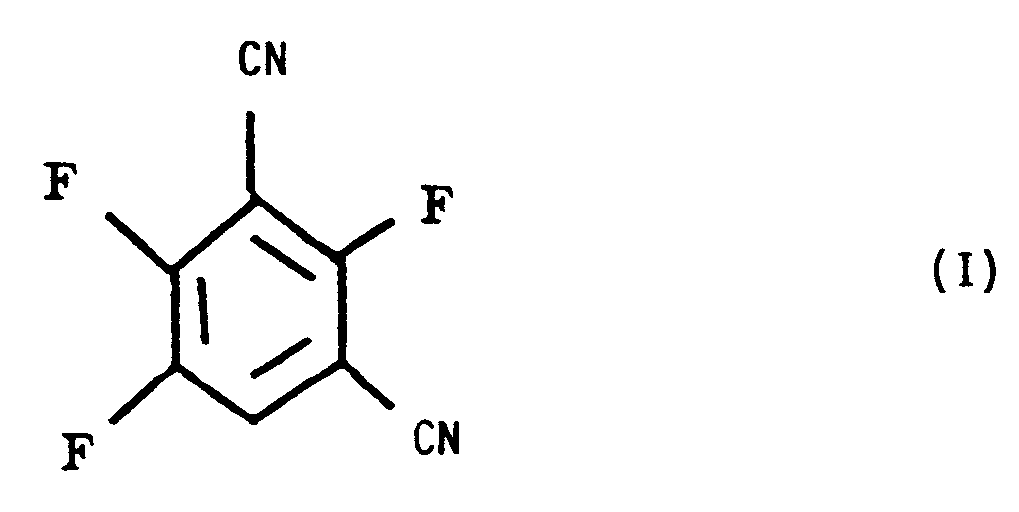
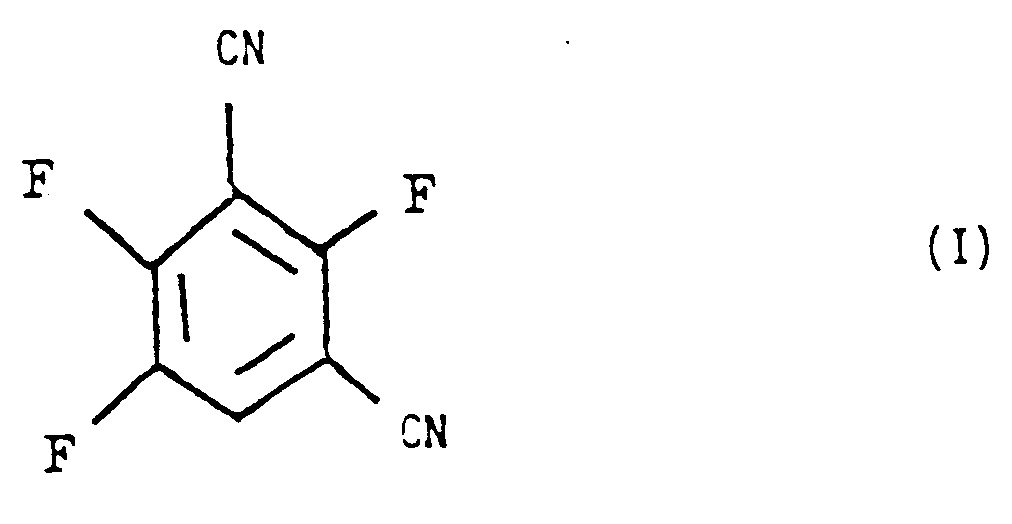
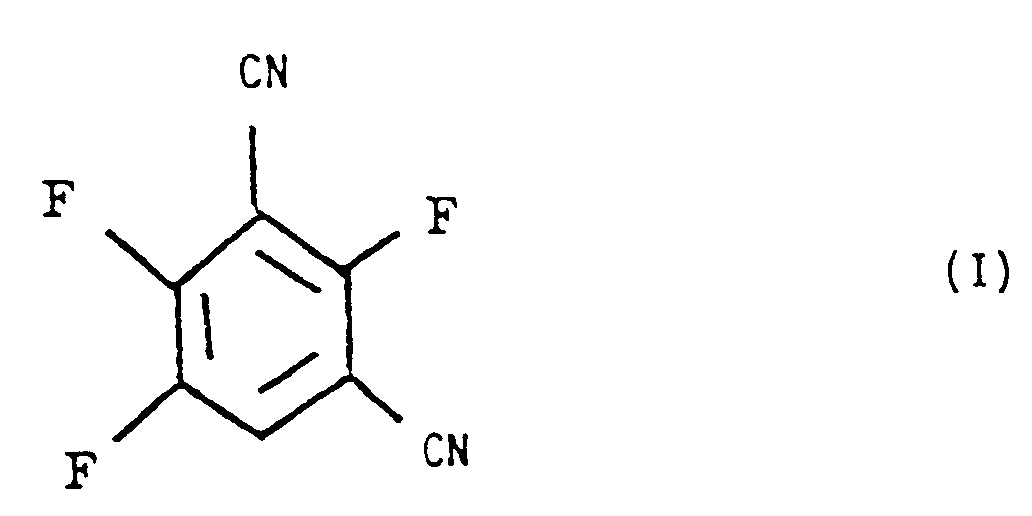
[0001] The present invention relates to 2,4,5-trifluoroisophthalonitrile useful as starting material for the manufacture of medicines, agrichemicals and other industrial chemicals, as well as to a process for producing same and a process for producing 2,4,5-trifluoroisophthalic acid.
[0002] For instance, 2,4,5-trifluorobenzoic acid which is an intermediate for the synthesis of fluorine-containining 4-pyridone-3-carboxylic acid based bacteridices can be produced by a sequence of steps starting with the compound of the present invention.
[0003] Several methods have been known for producing 2,4,5-trifluorobenzoic acid from 2,4,5-trifluorobromobenzene, such as synthesis by Grignard reactions as described, for example, in JP-A-58-188839 (The term "JP-A" as used herein means an "unexamined published Japanese patent application") and synthesis by reaction with cuprous cyanide as described, for example, in JP-A-60-72885, but these methods suffer disadvantages such as difficulty involved in obtaining 2,4,5-trifluorobromobenzene as a starting material.
[0004] Many reactions have also been known for dehalogenating aromatic halogen compounds with reducing agents and they include, for example, reduction with triethylsilane in the presence of palladium on carbon as described in J. Org. Chem., 34, G38 (1969), reduction with a zinc/acetic acid system as described in Organic synthesis, Coll. Vol. 5, p.149 (1973), reduction with a copper/benzoic acid system as described in J. Amer. Chem. Soc., 75, 3602 (1953), and reduction with a triethylsilane/cyclohexane system under ultraviolet irradiation as described in Synthesis, 1971, 537.
[0005] Journal of the Chemical Society, part II, 1965,, pages 2658-2661, The Chemical Society, London, GB, discloses 2,3,5-trifluoroisophthalic acid.
[0006] GB-A-2165239 discloses the use of fluorinated isophthalonitrile compounds as an agricultural fungicide or germicide as well as an anti-bacterial and mildew-proofing agent.
[0007] The major problem with the prior art methods concerns the need to selectively reduce the 4-position only of tetrafluoroisophthalonitrile which contains four possible sites of dehalogenation (defluorination).
[0008] It is the object of the present invention to provide a compound that is useful as a starting material for the synthesis of 2,4,5-trifluorobenzoic acid.
[0009] Said object is achieved by 2,4,5-trifluoroisophthalonitrile of the formula (I)
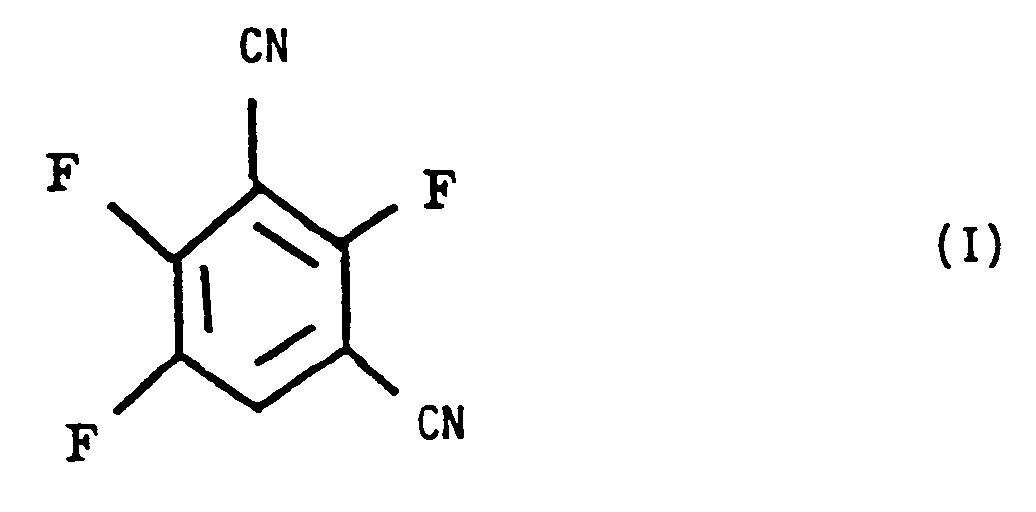
The present invention also provides a process for selectively producing 2,4,5-trifluoroisophthalonitrile by reacting tetrafluoroisophthalonitrile with a metal hydride at a temperature between -80 and 100oC in aprotic solvent. In another aspect, the present invention provides a process for producing 2,4,5-trifluoroisophthalic acid by hydrolyzing 2,4,5-trifluoroisophthalonitrile under acidic conditions.
[0010] Tetrafluoroisophthalonitrile is used as the starting material in the process of the present invention for producing 2,4,5-trifluoroisophthalonitrile. This starting material can be prepared by known methods as described, for example, in British Patent No. 1,026,290 (1966); Bull. Chem. Soc. Japan, 40, 688 (1966); Kagaku Kogyo Zasshi, 73, 447 (1970); and JP-B-41-11368 (The term "JP-B" as used herein means an "examined Japanese patent publication"). For instance, the tetrafluoroisophthalonitrile can be obtained by reaction of potassium fluoride and tetrachloroisophthalonitrile which is the effective ingredient of a commercially available agricultural fungicide, Daconil® (product of SDS Biotech K.K.).
[0011] The term "metal hydride" as used herein means both hydrogenated metal compounds and metal-hydrogen complex compounds. Useful metal hydrides include, for example, hydrides of boron, aluminium, silicon or tin, lithium aluminium hydride, sodium borohydride and hydrogenated organo-aluminum. Typical examples of hydrides of silicon include trimethylsilane, triethylsilane, diphenylsilane, phenylsilane, and polymethyl hydroxysiloxane. Typical examples of hydrides of tin include hydrogenated tri-n-butyltin, hydrogenated diphenyltin, hydrogenated di-n-butyltin, hydrogenated triethyltin and hydrogentated trimethyltin. Typical examples of hydrides of aluminum include hydrogenated diisobutylaluminum. Preferred examples of metal hydrides are sodium borohydride and hydrides of boron. The amount of metal hydrides used in the process of the present invention varies with the type of metal hydrides, the reaction temperature or the reaction time. Normally, metal hydrides are used in amounts of 1.1-3.0 equivalents in terms of hydrogen anions per mole of tetrafluoroisophthalonitrile, with the range of 1.3-2.5 equivalents being preferred. The higher the reaction temperature, the less of the metal hydride needs to be used.
[0012] The reaction temperature generally ranges from -80°C to 100°C, preferably form -70°C to 40°C. A more advantageous reaction temperature is within the range of from -70°C to 20°C. Generally speaking, the selectivity of reaction tends to increase with decreasing temperature and more resinous by-products are prone to occur at elevated temperature.
[0013] Aprotic solvents are used as reaction solvents in the process of the present invention. Typical examples of the aprotic solvents include ethyl ether, benzene, toluene, xylene, cyclohexane, tetrahydrofuran, dioxane, dimethyl sulfoxide, acetonitrile and hexamethylphosphoramide. These aprotic solvents can be used either individually or in combination. When sodium borohydride is to be used as a metal hydride, tetrahydrofuran and acetonitrile are preferred as a solvent. The amount of the aprotic solvent used in the process of the present invention varies with several factors including the type of solvent, the type and amount of metal hydrides. Preferably, the solvent is used in amounts of 0.5 to 5 ℓ per mol of tetrafluoroisophthalonitrile. The larger the amount of solvent used, the more reduced is the reaction rate. Conversely, the smaller the amount of solvent used, the more vigorous is the generation of heat, thereby resulting in difficulty in controlling the reaction temperature.
[0014] The reaction time ranges from 0.1 to 20 h, preferably from 0.3 to 10 h. The higher the reaction temperature, the shorter the reaction time tends to be.
[0015] After the above reaction, a processing in which the excess or unreacted metal hydrides are decomposed may be performed. In the processing, in order to prevent the reaction system from becoming alkaline, a suitable acid such as acetic acid, formic acid, dilute sulfuric acid, dilute hydrochloric acid or aqueous ammonium chloride solution is added in a sufficient amount to maintain acidic or neutral conditions. The amount of the acid used is sufficient if it is more than the equivalents of the metal hydrides added to the reaction. The 2,4,5-trifluoroisophthalonitrile as the reaction product can be purified and isolated by extraction with an organic solvent such as hexane, cyclohexane, toluene or petroleum ether, optionally followed by fractional distillation.
[0016] The resulting 2,4,5-trifluoroisophthalonitrile may be hydrolyzed under acidic conditions to produce 2,4,5-trifluoroisophthalic acid. Mineral acids such as sulfuric acid orphosphoric acid, or organic acids such as acetic acid, are used to render the reaction conditions acidic and sulfuric acid is preferred. These acids can be used either individually or in combination, and are normally used in an amount of 3 parts by weight or more per one part by weight of 2,4,5-trifluoroisophthalonitrile, preferably 3 to 20 parts by weight. The acid concentration is in the range of from 5 to 80 wt%. At low acid concentrations, the reaction rate is slowed down, and at high acid concentrations, 2,4,5-trifluorophthalimide forms as a by-product. Therefore, the preferred range of acid concentration is from 50 to 70 wt%. The reaction temperature generally ranges from 100°C to 200°C, preferably from 130°C to 170°C. Hydrolysis under basic conditions is not suitable for the purpose of obtaining the desired 2,4,5-trifluoroisophthalic acid since the fluorine atom at the 2- or 4-position will be hydrolyzed.
[0017] The present invention provides a process by which 2,4,5-trifluoroisophthalonitrile can be produced from TFIPN with high yield and selectivity. Defluorination of TFIPN potentially involves the formation of various by-products, i.e., 4,5,6-trifluoroisophthalonitrile, 2,4,6-trifluoroisophthalonitrile, 2,4-difluoroisophthalonitrile, 2,5-difluoroisophthalonitrile, 4,5-difluoroisophthalonitrile, 4,6-difluoroisophthalonitrile, 2-fluoroisophthalonitrile, 4-fluoroisophthalonitrile, 5-fluoroisophthalonitrile. A change in the nitrile group is another possibility since the reaction is performed under reducing conditions. However, the process for production of 2,4,5-trifluoroisophthalonitrile in accordance with the present invention is immune to these problems and enables selective production of 2,4,5-trifluoroisopbthalonitrile.
[0018] The so obtained 2,4,5-trifluoroisophthalonitrile may be hydrolyzed under acidic conditions and this enables 2,4,5-trifluoroisophthalic acid to be produced with high yield.
[0019] By reacting the so produced 2,4,5-trifluoroisophthalic acid with a suitable reagent such as copper/quinoline, 2,4,5-trifluorobenzoic acid which is a useful intermediate for the synthesis of chemicals can be easily obtained.
EXAMPLE 1
[0021] 40 g (0.2 moles) of tetrafluoroisophthalonitrile (hereinafter, referred to as TFIPN) was dissolved in 200 mℓ of tetrahydrofuran. To the solution being cooled at -10°C, a suspension of 3.20 g (0.084 moles) of sodium borohydride in 200 mℓ of tetrahydrofuran was added in small portions under agitation at -10°C. After the addition of the suspension, the resulting reaction solution was stirred at -5 to 0°C for 3 h and left to stand overnight at room temperature. After adding an aqueous solution of 14.3 g (0.24 moles) of acetic acid in 20 mℓ of water, tetrahydrofuran was distilled off under reduced pressure. The residual brown oil was continuously extracted with hot hexane, which was distilled off under reduced pressure. The residue was subjected to fractional distillation under reduced pressure, thereby obtaining 21,65 g of a fraction having a boiling point of 104°C/667Pa (5 torr)The purity of the product was at least 99%.
¹H NMR (ppm, internal standard: tetramethylsilane, solvent: d-CHCℓ₃):
7.81 (ddd; J=8.54Hz, 7.8Hz, 5.86Hz)
¹⁹F NMR (ppm, internal standard: C₆F₆, solvent: C₆F₆)
60.439 (ddd; 1F; J=14.65Hz, 5.85Hz, 0.49Hz) 46.975 (ddd; 1F; J=20.50Hz, 7.81Hz, 0.48Hz) 27.663 (ddd; 1F;J=20.50Hz, 14.64Hz, 8.54Hz)
IR (cm⁻¹; neat)
3060, 2240, 1625, 1500, 1450, 1360, 1275, 1205, 1120, 970, 905, 735, 715, 700
The above spectroscopic data show that the product obtained was 2,4,5-trifluoroisophthalonitrile.
EXAMPLE 2
[0022] 20.02 g of TFIPN was dissolved in 100 mℓ of acetonitrile. To the solution being cooled at -42°C, a solution of 1.52 g of sodium borohydride in 100 mℓ of acetonitrile was added dropwise for 2 h with vigorously stirring. The resulting reaction solution yellowed. After the addition thereof, the reaction solution was stirred for 2 h with its temperature held at -40°C. Thereafter, a solution of 10.4 g of acetic acid in 20 mℓ of acetonitrile was added dropwise thereto with its temperature held at -40°C. After removing the refrigerant, the stirring of the reaction solution was continued until its temperature became equal to room temperature. After distilling off acetonitrile under reduced pressure, the residue was dissolved in 100 mℓ of toluene and the solution was washed three times with 100 mℓ of a saturated solution of sodium chloride. The washing water used was also extracted three times with 20 mℓ of toluene. After drying these resulting extracts with anhydrous magnesium sulfate, the solvent was distilled off under reduced pressure to obtain an oil in an amount of 21.10 g. The oil obtained was subjected to fractional distillation under reduced pressure, thereby obtaining 14.56 g of 2,4,5-trifluoroisophthalonitrile having a boiling point of 80-90°C/ 73 Pa (0.55 torr) (yield, 80%).
EXAMPLE 3
[0023] 40 g (0.2 moles) of TFIPN was dissolved in 300 mℓ of tetrahydrofuran. To the solution being cooled at -55°C, a suspension of 4.75 g (0.125 moles) of sodium borohydride in 100 mℓ of tetrahydrofuran was added in small portions with stirring at -55°C. After the addition of the suspension, the reaction solution was stirred for 2 hours with its temperature held at -40°C. After a solution of 15.0 g (0.25 moles) of acetic acid in 20 mℓ of water was added, the stirring of the reaction solution was continued until its temperature became equal to room temperature. After distilling off teterahydrofuran under redued pressure, the residual oil was dissolved in 400 mℓ of ethyl ether and the solution was washed three times with a saturated solution of sodium chloride. After drying with anhydrous magnesium sulfate, ethyl ether was distilled off. The residue was continuously extracted with hot cyclohexane, which was subsequently distilled off under reduced pressure to obtain an oil in an amount of 33.82 g. The oil obtained was subjected to fractional distillation under redued pressure, thereby obtaining 25.19 g of a fraction having a boiling point of 96oC/533 Pa (4 torr)The purity of this product was at least 99.3%. The spectroscopic data of the product was the same as that obtained in Example 1.
EXAMPLES 4 to 8
[0024] Reactions were carried out in the same manner as in Example 1 except that the reaction conditions were changed as shown in the following Table 1. The results are also shown in Table 1 below.
Table 1
| Example No. | TFIPN (g) | Sodium Borohydride (g) | Reaction Temperature (°C) | Reactioon Time (h.) | Products | |||
| A | B | C | D | |||||
| 4 | 2.00 | 0.10 | 30 | 4 | 48 | 0 | 27 | 28 |
| 5 | 2.00 | 0.23 | 30 | 6 | 34 | 18 | 0 | 48 |
| 6 | 2.00 | 0.15 | 65 | 1.5 | 45 | 1 | 2 | 52 |
| 7 | 40.0 | 2.95 | -10 | 6 | 77 | 0 | 5 | 18 |
| 8 | 40.0 | 3.42 | 5 | 10 | 66 | 7 | 0 | 27 |
| Notes A: 2,4,5-trifluoroisophthalonitrile, B: various forms of difluoroisophthalonitrile (mostly 2,5-difluoroisophthalonitrile), C: unreacted TFIPN, and D: products other than A, B, and C (mostly resinous materials) |
||||||||
EXAMPLE 9
[0025] 35.4 g of 2,4,5-trifluoroisophthalonitrile was added to 150 mℓ of 60% sulfuric acid and the mixture was heated under reflux for 5 h. As the reaction proceeded, crystallization occurred. After the reaction, the reaction mixture was cooled to room temperature and the crystal was separated by filtration. The filtrate was extracted 5 times with 100 mℓ of ethyl ether each and the crystal was dissolved in the ethyl ether extracts. The resulting ethyl ether solution was washed several times with 10 mℓ of a saturated solution of sodium chloride. Thereafter, sulfuric acid was removed by washing with 10 mℓ of a 5% CaCℓ₂ solution saturated with sodium chloride. Following another washing with 10 mℓ of a saturated solution of sodium chloride, the solution was dried with MgSO₄ and ethyl ether was distilled off. The resulting white solid was dissolved in 240 mℓ of hot water and heated under reflux for 1 h in the presence of activated carbon. Thereafter, the solution was filtered while hot and the filtrate was evaporated under reduced pressure. The residual white solid was further dried with a vacuum pump. The product was obtained in an amount of 41.96 g (yield, 97%). It was easily soluble in water, alcohol or ethyl acetate, but slightly soluble in benzene or hexane.
mp. 214-216°
¹H NMR (ppm, internal standard: tetramethylsilane, solvent: CD₃OD):
7.94 (ddd; J=10.25Hz, 8.91Hz, 5.37Hz)
¹⁹F NMR (ppm, internal standard: C₆F₆, solvent: CD₃OD):
51.440 (ddd; 1F; J=16.60Hz, 6.34Hz, 5.37Hz) 35.442 (ddd; 1F; J=21.24Hz, 8.91Hz, 5.37Hz) 22.454 (ddd; 1F; J=21.24Hz, 16.60Hz, 10.25Hz)
IR (cm⁻¹; Nujol mull):
3600∼2300 (br.), 1700 (br.), 1490, 1460, 1245, 1090, 950, 890, 800, 740
These spectroscopic data show that the product obtained was 2,4,5-trifluoroisophthalic acid.
REFERENCE EXAMPLE
Synthesis of 2,4,5-trifluorobenzoic acid
[0026] A mixture of 2.20 g (0.01 mole) of 2,4,5-trifluoroisophthalic acid (dried under high vacuum). 1.0 mℓ of quinoline and 0.23 g of copper powder was heated on an oil bath at 200°C. After a while, the mixture liquefied and released a gas (ca. 280 mℓ by top purging). After the gas had been completely released, the liquefied mixture was cooled to room temperature, followed by addition of 15 mℓ of a mixture (1:1 by weight) of conc. HCℓ and water.
[0027] The mixture was subjected to repeated extraction with 100 mℓ of ethyl ether and the ethyl ether extracts were washed twice with 10 mℓ of 5% HCℓ solution that had been saturated with sodium chloride. Following drying on MgSO₄, ethyl ether was distilled off to obtain a crude crystal in an amount of 1.66 g. The crude crystal was dissolved in 20 mℓ of hot water and subjected to discoloration with activated carbon for 1 h. The solution was filtered while hot and allowed to stand overnight at room temperature to obtain the desired pure product (m.p.: 100-101.5°C) in an amount of 1.14 g (yield, 65%).
¹H NMR (ppm, internal standard: tetramethylsilane, solvent: CD₃OD):
7.825 (td; 1H; J=10.49Hz, 10.01Hz, 6.34Hz) 7.250 (ddd; 1H; J=10.50Hz, 9.04Hz, 6.59Hz)
¹⁹F NMR (ppm, internal standard: C₆F₆, solvent: CD₃OD):
53.806 (dddd; 1F; J=16.12Hz, 10.01Hz, 8.78Hz, 6.59Hz)
36.406 (ddt; 1F;J=20.99Hz, 10.50Hz, 9.04Hz, 8.79Hz)
20.660 (dddd; 1F; J=20.99Hz, 16.11Hz, 10.49Hz, 6.34Hz)
IR (cm⁻¹; Nujol mull):
3200∼2400 (br.), 1690, 1510, 1460, 1395, 1340, 1295, 1265, 1220, 1200, 1155, 1070, 900, 860, 840, 760, 735cm⁻¹
The above spectroscopic data show that the product obtained was 2,4,5-trifluorobenzoic acid.
Claims for the following Contracting State(s): BE, CH, DE, FR, GB, IT, LI, NL
1. 2,4,5-Trifluoroisophthalonitrile of the general formula (I)
2. A process for producing 2,4,5-trifluoroisophthalonitrile which comprises reacting
tetrafluoroisophthalonitrile with a metal hydride at a temperature between -80 and
100oC in an aprotic solvent.
3. The process of claim 2, wherein the reaction temperature is between -70 and 40oC.
4. The process of claim 2, wherein said metal hydride is selected from the group consisting
of hydrides of boron, aluminum, silicon or tin, lithium aluminium hydride, sodium
borohydride and hydrogenated organoaluminum.
5. The process of claim 2, wherein said metal hydride is sodium borohydride or hydrides
of boron.
6. The process of claim 2, wherein said metal hydride is used in an amount of 1.1-3.0
equivalents in terms of hydrogen anions per mole of tetrafluoroisophthalonitrile.
7. The process of claim 2, wherein said metal hydride is sodium borohydride and said
aprotic solvent is tetrahydrofuran or acetonitrile.
8. A process for producing 2,4,5-trifluoroisophthalic acid which comprises hydrolyzing
2,4,5-trifluoroisophthalonitrile under acidic conditions.
Claims for the following Contracting State(s): ES
1. A process for producing 2,4,5-trifluoroisophthalonitrile of the general formula (I)
which comprises reacting tetrafluoroisophthalonitrile with a metal hydride at a temperature between -80 and 100o C in an aprotic solvent.
which comprises reacting tetrafluoroisophthalonitrile with a metal hydride at a temperature between -80 and 100o C in an aprotic solvent.
2. The process of claim 1, wherein the reaction temperature is between -70 and 40oC.
3. The process of claim 1, wherein said metal hydride is selected from the group consisting
of hydrides of boron, aluminum, silicon or tin, lithium aluminium hydride, sodium
borohydride and hydrogenated organoaluminum.
4. The process of claim 1, wherein said metal hydride is sodium borohydride or hydrides
of boron.
5. The process of claim 1, wherein said metal hydride is used in an amount of 1.1-3.0
equivalents in terms of hydrogen anion per mole of tetrafluoroisophthalonitrile.
6. The process of claim 1, wherein said metal hydride is sodium borohydride and said
aprotic solvent is tetrahydrofuran or acetonitrile.
7. A process for producing 2,4,5-trifluoroisophthalic acid which comprises hydrolyzing
2,4,5-trifluoroisophthalonitrile under acidic conditions.
Patentansprüche für folgende(n) Vertragsstaat(en): BE, CH, DE, FR, GB, IT, LI, NL
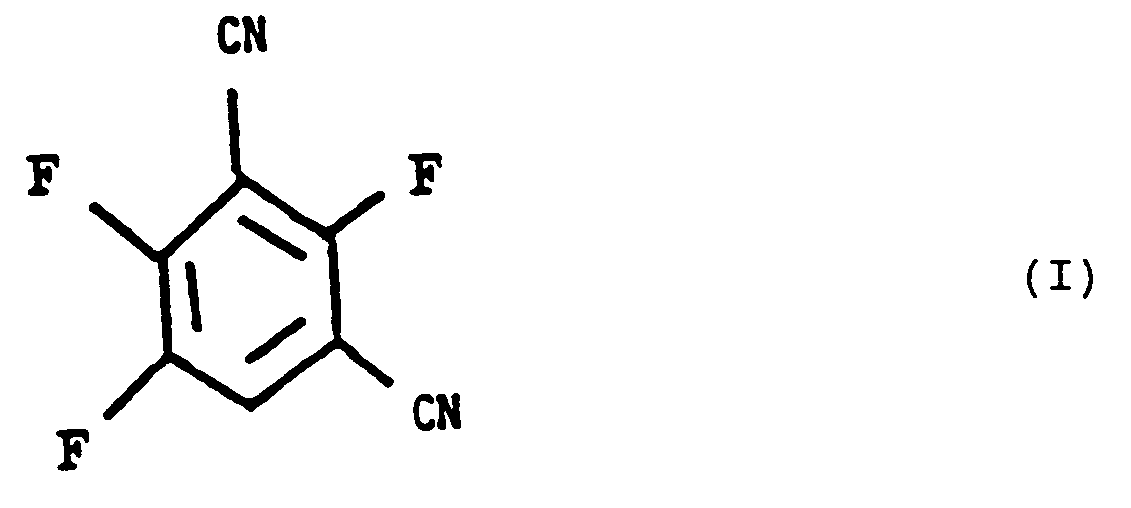
1. 2,4,5-Trifluorisophthalonitril der allgemeinen Formel (I)
2. Verfahren zur Herstellung von 2,4,5-Trifluorisophthalonitril, das die Umsetzung von
Tetrafluorisophthalonitril mit einem Metallhydrid bei einer Temperatur zwischen -80
und 100oC in einem aprotischen Lösungsmittel umfaßt.
3. Verfahren nach Anspruch 2, worin die Reaktionstemperatur zwischen -70 und 40oC liegt.
4. Verfahren nach Anspruch 2, worin das Metallhydrid aus der Gruppe, bestehend aus Hydriden
von Bor, Aluminium, Silicium oder Zinn, Lithiumaluminiumhydrid, Natriumborhydrid und
hydriertem Organoaluminium, gewählt wird.
5. Verfahren nach Anspruch 2, worin das Metallhydrid Natriumborhydrid oder Hydride von
Bor ist.
6. Verfahren nach Anspruch 2, worin das Metallhydrid in einer Menge von 1,1 bis 3,0 Äquivalenten,
bezogen auf Wasserstoffanionen, pro Mol Tetrafluorisophthalonitril verwendet wird.
7. Verfahren nach Anspruch 2, worin das Metallhydrid Natriumborhydrid ist und das aprotische
Lösungsmittel Tetrahydrofuran oder Acetonitril ist.
8. Verfahren zur Herstellung von 2,4,5-Trifluorisophthalsäure, das das Hydrolysieren
von 2,4,5-Trifluorisophthalonitril unter sauren Bedingungen umfaßt.
Patentansprüche für folgende(n) Vertragsstaat(en): ES
1. Verfahren zur Herstellung von 2,4,5-Trifluorisophthalonitril der allgemeinen Formel
(I)
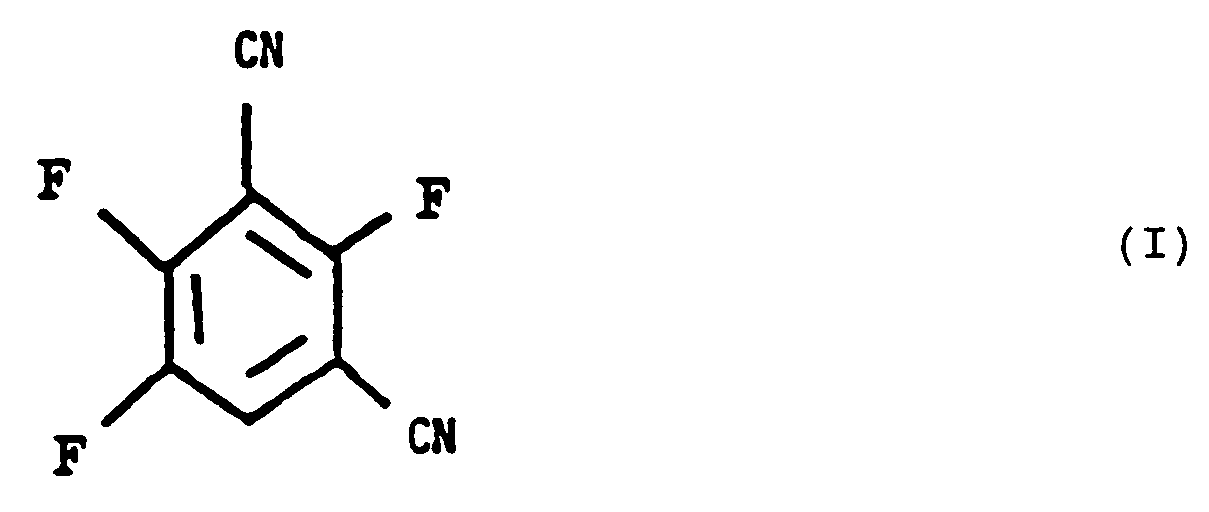
das die Umsetzung von Tetrafluorisophthalonitril mit einem Metallhydrid bei einer Temperatur zwischen -80 und 100oC in einem aprotischen Lösungsmittel umfaßt.
das die Umsetzung von Tetrafluorisophthalonitril mit einem Metallhydrid bei einer Temperatur zwischen -80 und 100oC in einem aprotischen Lösungsmittel umfaßt.
2. Verfahren nach Anspruch 1, worin die Reaktionstemperatur zwischen -70 und 40oC liegt.
3. Verfahren nach Anspruch 1, worin das Metallhydrid aus der Gruppe, bestehend aus Hydriden
von Bor, Aluminium, Silicium oder Zinn, Lithiumaluminiumhydrid, Natriumborhydrid und
hydriertem Organoaluminium, gewählt wird.
4. Verfahren nach Anspruch 1, worin das Metallhydrid Natriumborhydrid oder Hydride von
Bor ist.
5. Verfahren nach Anspruch 1, worin das Metallhydrid in einer Menge von 1,1 bis 3,0 Äquivalenten,
bezogen auf Wasserstoffanionen, pro Mol Tetrafluorisophthalonitril verwendet wird.
6. Verfahren nach Anspruch 1, worin das Metallhydrid Natriumborhydrid ist und das aprotische
Lösungsmittel Tetrahydrofuran oder Acetonitril ist.
7. Verfahren zur Herstellung von 2,4,5-Trifluorisophthalsäure, das das Hydrolysieren
von 2,4,5-Trifluorisophthalonitril unter sauren Bedingungen umfaßt.
Revendications pour l'(les) Etat(s) contractant(s) suivant(s): BE, CH, DE, FR, GB,
IT, LI, NL
1. 2,4,5-trifluoro-isophtalonitrile de formule générale (I)
2. Procédé pour la préparation de 2,4,5-trifluoro-isophtalonitrile, qui comprend la réaction
du tétrafluoro-isophtalonitrile avec un hydrure métallique à une température entre
-80 et 100°C dans un solvant aprotique.
3. Procédé selon la revendication 2, dans lequel la température de réaction est entre
-70 et 40°C.
4. Procédé selon la revendication 2, dans lequel ledit hydrure métallique est choisi
dans le groupe constitué par les hydrures de bore, d'aluminium, de silicium ou d'étain,
l'hydrure de lithium et d'aluminium, le borohydrure de sodium et un organoaluminium
hydrogéné.
5. Procédé selon la revendication 2, dans lequel ledit hydrure métallique est le borohydrure
de sodium ou des hydrures de bore.
6. Procédé selon la revendication 2, dans lequel ledit hydrure métallique est utilisé
en une quantité de 1,1 à 3,0 équivalents en termes d'anions hydrogène par mole de
tétrafluoro-isophtalonitrile.
7. Procédé selon la revendication 2, dans lequel ledit hydrure métallique est le borohydrure
de sodium et ledit solvant aprotique est le tétrahydrofuranne ou l'acétonitrile.
8. Procédé pour la préparation de l'acide 2,4,5-trifluoro-isophtalique, qui comprend
l'hydrolyse du 2,4,5-trifluoro-isophtalonitrile dans des conditions acides.
Revendications pour l'(les) Etat(s) contractant(s) suivant(s): ES
1. Procédé pour la préparation de 2,4,5-trifluoro-isophtalonitrile de formule générale
(I)
qui comprend la réaction du tétrafluoro-isophtalonitrile avec un hydrure métallique à une température entre -80 et 100°C dans un solvant aprotique.
qui comprend la réaction du tétrafluoro-isophtalonitrile avec un hydrure métallique à une température entre -80 et 100°C dans un solvant aprotique.
2. Procédé selon la revendication 1, dans lequel la température de réaction est entre
-70 et 40°C.
3. Procédé selon la revendication 1, dans lequel ledit hydrure métallique est choisi
dans le groupe constitué par les hydrures de bore, d'aluminium, de silicium ou d'étain,
l'hydrure de lithium et d'aluminium, le borohydrure de sodium et un organoaluminium
hydrogéné.
4. Procédé selon la revendication 1, dans lequel ledit hydrure métallique est le borohydrure
de sodium ou des hydrures de bore.
5. Procédé selon la revendication 1, dans lequel ledit hydrure métallique est utilisé
en une quantité de 1,1 à 3,0 équivalents en termes d'anion hydrogène par mole de tétrafluoroisophtalonitrile.
6. Procédé selon la revendication 1, dans lequel ledit hydrure métallique est le borohydrure
de sodium et ledit solvant aprotique est le tétrahydrofuranne ou l'acétonitrile.
7. Procédé pour la préparation de l'acide 2,4,5-trifluoroisophtalique, qui comprend l'hydrolyse
du 2,4,5-trifluoroisophtalonitrile dans des conditions acides.