| (19) |
 |
|
(11) |
EP 0 311 637 B1 |
| (12) |
EUROPEAN PATENT SPECIFICATION |
| (45) |
Mention of the grant of the patent: |
|
12.02.1992 Bulletin 1992/07 |
| (22) |
Date of filing: 24.06.1987 |
|
| (51) |
International Patent Classification (IPC)5: E02F 9/08 |
| (86) |
International application number: |
|
PCT/SE8700/295 |
| (87) |
International publication number: |
|
WO 8800/262 (14.01.1988 Gazette 1988/02) |
|
| (54) |
MOBILE WORK UNIT WITH RAISABLE AND LOWERABLE SUPPORT LEGS
FAHRBARE ARBEITSEINHEIT MIT HEB- UND SENKBAREN STÜTZBEINEN
ENSEMBLE DE TRAVAIL MOBILE A PIEDS SUPPORTS VERTICALEMENT REGLABLES
|
| (84) |
Designated Contracting States: |
|
BE CH DE FR GB LI |
| (30) |
Priority: |
24.06.1986 SE 8602803
|
| (43) |
Date of publication of application: |
|
19.04.1989 Bulletin 1989/16 |
| (73) |
Proprietor: SVENSSON, Ulf |
|
S-191 43 Sollentuna (SE) |
|
| (72) |
Inventor: |
|
- DAHLGREN, Bo
S-191 43 Sollentuna (SE)
|
| (74) |
Representative: Norén, Per Bo Arne |
|
SWEDPATENT AB
P.O. Box 186
746 24 Balsta
746 24 Balsta (SE) |
| (56) |
References cited: :
EP-A- 0 065 118
DE-A- 3 319 160
GB-A- 1 508 605
|
DE-A- 1 481 872
DE-C- 2 614 081
SE-B- 395 674
|
|
| |
|
|
|
|
| |
|
| Note: Within nine months from the publication of the mention of the grant of the European
patent, any person may give notice to the European Patent Office of opposition to
the European patent
granted. Notice of opposition shall be filed in a written reasoned statement. It shall
not be deemed to
have been filed until the opposition fee has been paid. (Art. 99(1) European Patent
Convention).
|
[0001] The present invention relates to a mobile work unit with raisable and lowerable support
legs, for example wheel supported mobile excavators, which, when working, are arranged
with lowered support legs.
[0002] It is desirable to locate the wheel axles of the work unit in such positions in relation
to the vehicle body that maximum stability is achieved during transport movements,
and with regard to the portion where a movable work device is attached, e.g. an excavator
jib with associated bucket, it is of particular importance that adjacently located
pairs of wheels are arranged in such a position that the risk for a forward tilting
movement is eliminated. However, for such units, having pivotally attached support
legs, which by means of a pivoting movement can be moved into a supporting contact
position against a ground plane, it has previously not been considered possible to
locate the wheels in a forward position in relation to the points of attachment for
the support legs against the unit. Such a location is obviously most desirable, since
the stability of the work unit thereby can be considerably improved. However, this
requires that the vertical position of the wheels can be changed when the support
legs are raised/lowered.
[0003] The object of the present invention is to disclose a work unit having the wheels
located in a forward and/or rear position in relation to the vehicle body, and also
how the support legs can be raised/lowered in relation to the ground plane with a
simultaneous movement of adjacent wheels in the opposed direction, said operation
being performed as an automatic operation when the support legs are raised/lowered.
The present invention also facilitates a simple driving and steering arrangement for
the work unit for travel between different work locations, as well as other advantages,
which are disclosed in the following descriptive part of the specification.
[0004] GB-A-1 508 605 discloses a mobile work unit with raisable and lowerable support legs,
which adjacent to one end portion are arranged pivotally attached to the work unit
and which during a pivoting movement take up contact with the opposed end portion
against a below located ground plane under influence from an associated piston cylinder.
At least one of said support legs is arranged supporting a linkshaped member, pivotally
attached to the support leg and extending in a crosswisely extending relationship
to the longitudinal direction of the support leg. Associated piston cylinder for operating
the support leg is pivotally attached with a first end portion against the work unit,
the other end portion being pivotally attached to the linkshaped member.
[0005] The mobile work unit according to the present invention is arranged with raisable
and lowerable support legs, which adjacent to one end portion are arranged pivotally
attached to the work unit, and which during a pivoting movement take up contact with
the opposed end portion against a below located ground plane under influence from
an associated piston cylinder, at least one of said support legs being arranged supporting
a linkshaped member, pivotally attached to the support leg and extending in a crosswisely
extending relationship to the longitudinal direction of the support leg, and the associated
piston cylinder for operating the support leg being pivotally attached with a first
end portion against the work unit, the other end portion being pivotally attached
adjacent to the linkshaped member, and it is mainly characterised in that the second
end portion of the piston cylinder is pivotally attached to a first end portion of
the linkshaped member, and that the opposed end portion of said linkshaped member
is attached to a movement transferring means, which when the linkshaped member is
pivoted between two alternative restricting positions causes a movement in substantially
opposed direction in relation to the support leg for a vehicle wheel located adjacent
to the support leg.
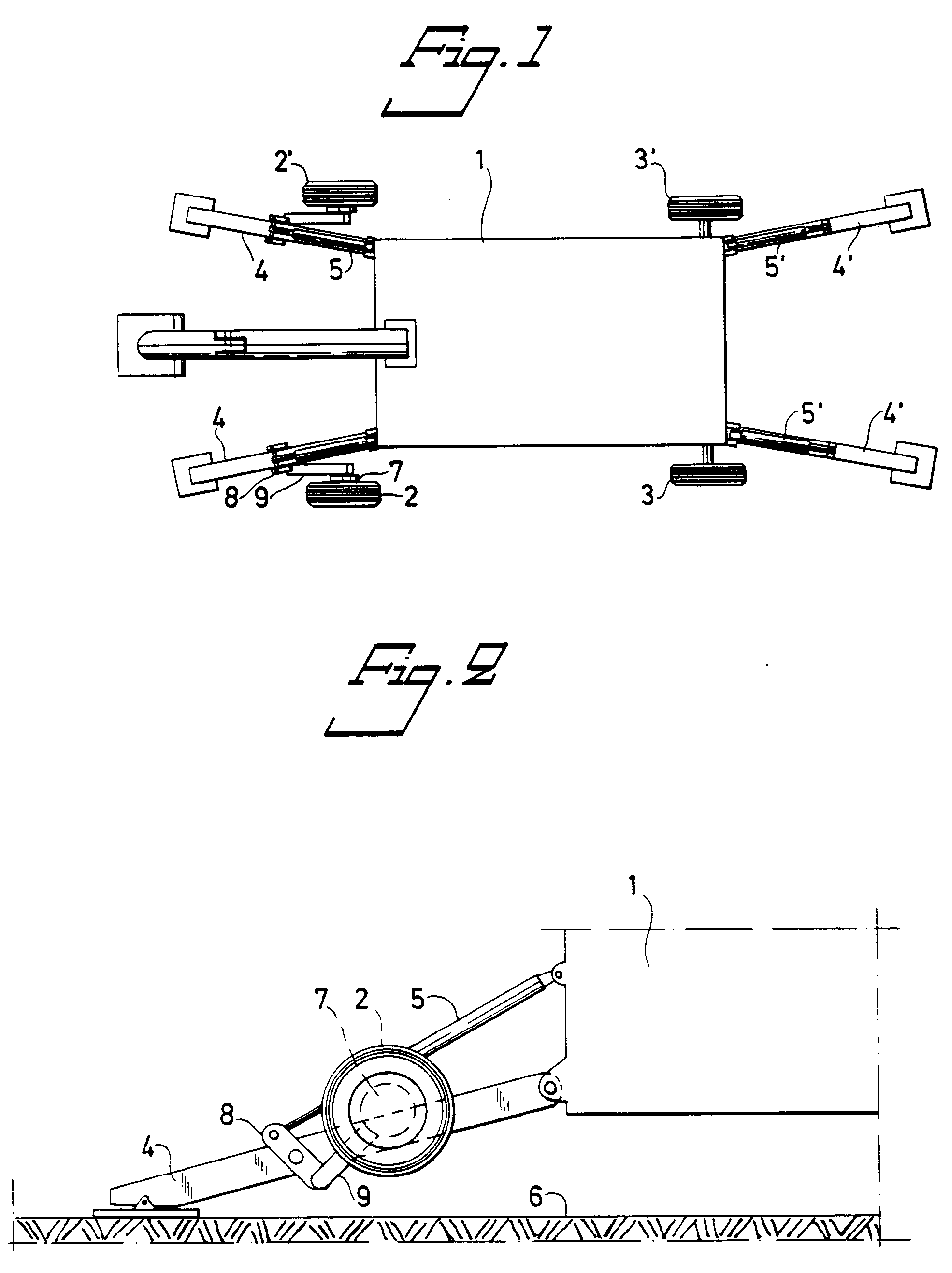
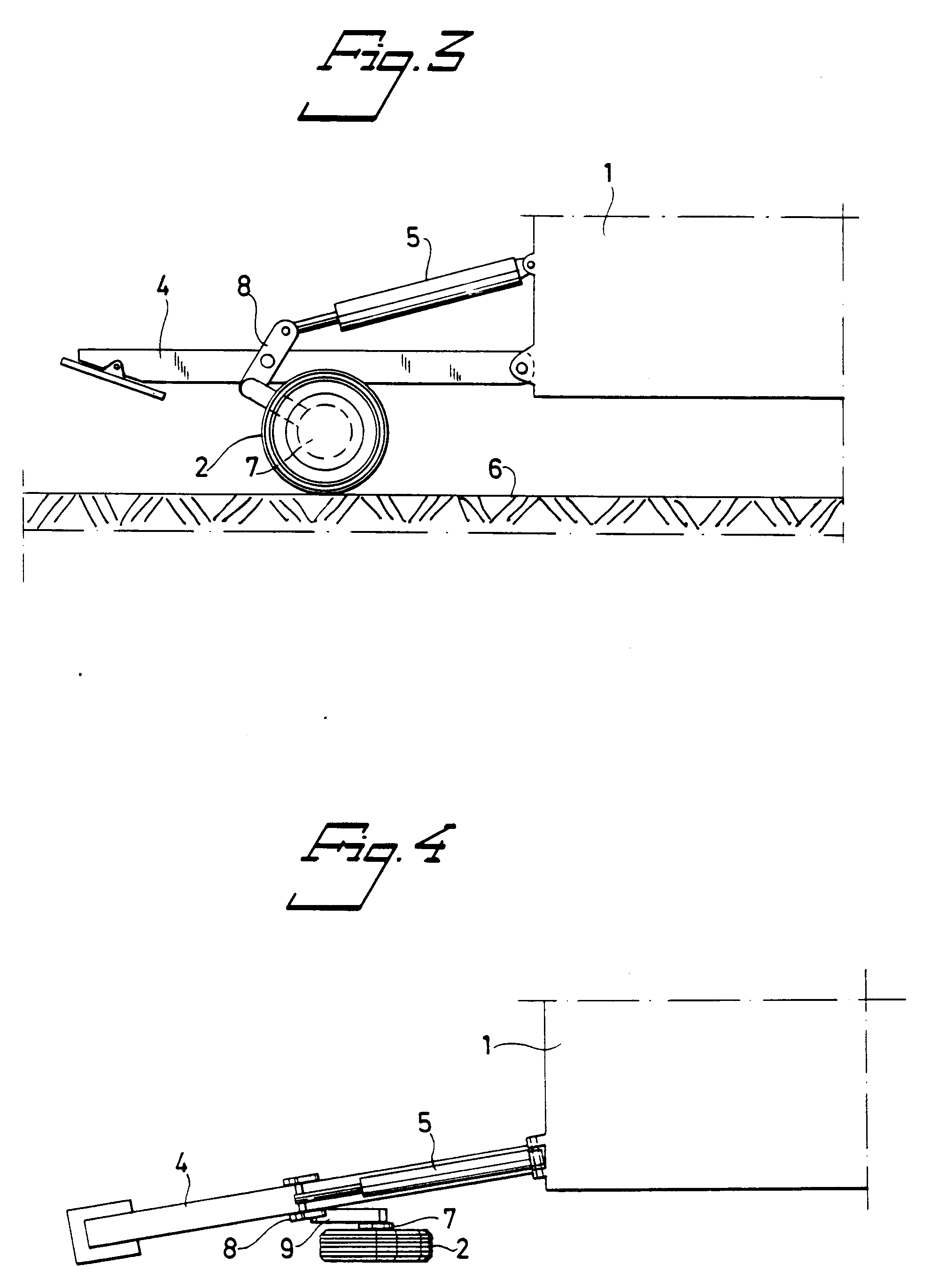
[0006] A number of embodiments of a work unit according to the present invention are more
fully described below with reference to the example of an embodiment of a work unit
shown in the enclosed drawings, in which:
Fig. 1 is a schematical plan view of an excavator having four wheels viewed from above,
and with the wheel pair arranged by the support legs located adjacent to the excavator
jib in a forward position in relation to the excavator body;
Fig. 2 is a side view of a corner portion of the excavator and a front wheel, with
the support leg in a lowered position;
Fig. 3 is a side view corresponding to Fig. 2, but with the wheel lowered into a contact
position against the ground plane, the support leg being located in a raised position;
and
Fig. 4 is a view from above of the corner portion shown in Figs. 2 and 3.
[0007] With reference to Fig. 1, a work unit is schematically indicated as an excavator,
denominated as a complete unit as 1, having two front wheels, 2 and 2′ respectively,
and two rear wheels, 3 and 3′ respectively. Two groups of pairs of support legs 4,
4′ are also shown, pivotally attached adjacent to the corner portions of the excavator
1, arranged to performe a pivoting movement in the vertical plane towards/away from
a ground plane 6 when associated hydraulically operated piston cylinders 5, 5′ are
operated. Such a work unit is of a previously known type, but according to the present
invention, the front wheel pair 2, 2′ is located in front of the excavator 1, and
the piston cylinders 5, 5′ are utilized for a further purpose, namely to raise/lower
the wheels 2, 2′ in relation to adjacently located support legs 4 when same are moved
towards/away from the ground plane 6. In this embodiment, the front wheels 2, 2′ may
also advantageously be arranged connected to an individual hydraulic motor 7 for each
wheel 2, 2′, which independently of each other can be driven in alternative rotary
directions when associated valve means are influenced.
[0008] An example of an embodiment, intended to disclose how the piston cylinders 5 moving
the forward support legs 4 also can be used to raise/lower the front wheels 2, 2′
in relation to the ground plane 6, is shown more in detail in Figs. 2 - 4. Fig. 2
shows a support leg 4 in a lowered position, and adjacently located wheel 2 in a lifted
position in relation to the ground plane 6. Said figure shows, that the piston cylinder
5 is pivotally attached adjacent to one end portion against the work unit 1, and that
the opposed end portion (the piston rod) is pivotally attached against the outer portion
of a linkshaped member 8, which is pivotally attached at its central portion against
the support leg 4. A longitudinally extending member 9 extends from the opposed end
portion of the linkshaped member 8, supporting a hydraulic motor 7 at the free end
portion, which is attached to the wheel 2. In this shown embodiment, the linkshaped
member 8 and the longitudinally extending member 9 are internally rigidly joined together,
whereby a predermined angular relationship therebetween is maintained.
[0009] By influencing a valve means associated with the piston cylinder 5, the piston rod
of the piston cylinder 5 can be moved in direction towards the work unit 1. During
a first movement, the linkshaped member 8 is pivoted in direction towards the position
shown in Fig. 3, while the longitudinally extending member 9 performs a corresponding
pivoting movement in direction towards the ground plane 6, whereby the wheel 2 takes
up contact with the ground plane 6. During the continued movement of the piston rod,
the support leg 4 is pivoted/lifted in direction away from the ground plane, and if
the linkshaped member 8 has not initially been pivoted to the position shown in Fig.
3, this is performed as a final movement.
[0010] The work unit can now be moved to a suitable point of location for continued work,
and this is advantageously performed by influencing a 2-way valve, which interrupts
the oil supply to the piston cylinders 5, 5′, and transfers the supply of oil under
pressure to the drive motors 7 of the front wheels 2, 2′. Hereby can the same operating
device/valve utilized for raising/lowering the forward and the rear support legs 4,
4′ respectively also be used for steering the left and right hydraulic motor 7 respectively.
[0011] When the work unit 1 has been moved to desired location, the piston cylinders 5,
5′ are again influenced in order to lower the support legs 4, 4′. During a preliminary
stage of this movement, the linkshaped member 8 at each support leg 4 maintains a
substantially unchanged position, but when the outer end portions of the support legs
4 take up contact with the ground plane 6, less force will be required to lift adjacently
located wheels 2, 2′ than required to lift the entire work unit 1 by means of the
support legs 4, whereby the linkshaped member 8 performs a pivoting movement, which
due to a corresponding movement of the associated longitudianlly extending member
9 causes associated wheels 2, 2′ to be lifted in direction away from the ground plane
6. The resulting position taken up is shown in Fig. 3.
[0012] When the above described embodiment, the four wheels 2, 2′, 3, 3′ are arranged in
a fixed and non-steerable position in relation to the work unit. As a result, a turning
operation performed during movement results in a "skidding movement" of the rear and
not driven wheels 3, 3′. For certain types of units, locating the working device in
a suitable position makes it possible to move the center of gravity in such a way
that the rear wheel 3, 3′ do not carry an unnecessarily high load, but this obviously
results in reduced stability.
[0013] In order to reduce or eliminate the disadvantages caused when the work unit 1 is
turned, the rear wheel pair 3, 3′ of the above described embodiment may be replaced
by one wheel only, located adjacent to the length axis of the work unit 1, freely
pivotable in the horizontal plane. Such a wheel may advantageously be located in a
position behind the work unit, joined with at least one of the rear support legs 4′
in a fashion comparable to the front wheel pair 2, 2′, whereby the wheel will be raised/lowered
in an opposed relationship to the direction of movement for the rear support legs
4′. Such a wheel is further advantageously arranged freely rotatable in the horizontal
plane, and when the driven wheels 2, 2′ are driven with a different rotary speed in
relation to each other, or different rotary directions, the freely rotable wheel in
the horizontal plane will thus take up a position of location adapted to the present
turning movement. Hereby is the "skidding movement" avoided as previously discussed
with reference to the embodiment including a pair of non-steerable rear wheels 3,
3′.
[0014] It is also possible to accomplish a suspension system for the wheels which as previously
described are arranged movable in relation to adjacent support legs 4, 4′. When the
support legs 4, 4′ are located in a raised position, the piston cylinders 5, 5′ act
as movement absorbing suspension means, but since the piston cylinders 5, 5′ are operated
by means of a hydraulic medium, the degree of compression possible for such a medium
is obviously restricted. The piston cylinders 5, 5′ may therefore advantageously be
connected to at least one hydraulic accumulator when the support legs 4, 4′ have taken
up a position moved away from the ground plane 6. Such a hydraulic accumulator can
be of a previously known type, e.g. a container in which the oil under pressure is
separated from nitrogen or other gas by means of a diaphragm.
[0015] For larger and heavier work units 1, the rigid connection to the linkshaped member
8, formed by means of a fixed longitudinally extending member 9 directed away from
the linkshaped member 8, may for example be replaced by a force transferring link,
pivotally attached against the linkshaped member 8. The movement of such a force transferring
link can be transferred to a crank pin, an excentrically mounted member or similar,
arranged rotatably supported by a support leg 4, 4′, and carrying associated wheel
2, 2′, 3, 3′. As a result, the rather long lever in the shown and described embodiment
is avoided, which causes a relatively large application of force at the point of attachment
between the linkshaped member 8 and the longitudinally extending member 9.
[0016] In the described embodiment, only one wheel pair 2, 2′ is arranged to be influenced
during the movement of associated support legs 4, but it is obviously also possible
to arrange both wheel pairs 2, 2′, 3, 3′ in a corresponding fashion. Furthermore,
there are obviously a number of technical solutions for transferring the movement
of each linkshaped member 8 to associated wheel 2, 2′, 3, 3′, and apart from rigid
joints such as links, it is thus also possible to transfer the movement by means of
chains, wires or similar, and also such modifications fall within the scope of the
invention. It is further also obviously possible to arrange a wheel pair, or a single
wheel supporting one end portion, manually turnable in the horizontal plane, in order
to facilitate a steering operation for the work unit during a transfer movement.
[0017] The present invention is thus in no way restricted to the example of an embodiment
shown and described, but can be further modified within the scope of the inventive
thought and the following claims.
1. Mobile work unit (1) with raisable and lowerable support legs (4, 4′), which adjacent
to one end portion are arranged pivotally attached to the work unit (1), and which
during a pivoting movement take up contact with the opposed end portion against a
below located ground plane (6) under influence from an associated piston cylinder
(5, 5′), at least one of said support legs (4, 4′) being arranged supporting a linkshaped
member (8), pivotally attached to the support leg (4, 4′) and extending in a crosswisely
extending relationship to the longitudinal direction of the support leg (4, 4′), and
the associated piston cylinder (5, 5′) for operating the support leg being pivotally
attached with a first end portion against the work unit (1), the other end portion
being pivotally attached adjacent to the linkshaped member (8), characterised in, that the second end portion of the piston cylinder (5, 5′) is pivotally attached
to a first end portion of the linkshaped member (8), and that the opposed end portion
of said linkshaped member (8) is attached to a movement transferring means (9), which
when the linkshaped member (8) is pivoted between two alternative restricting positions
causes a movement in substantially opposed direction in relation to the support leg
(4, 4′) for a vehicle wheel (2, 2′, 3, 3′) located adjacent to the support leg (4,
4′).
2. Mobile work unit according to claim 1, characterised in, that the movement transferring means (9) comprises of a longitudinally extending
member (9), rigidly connected to the linkshaped member (8), at the opposed end portion
arranged to support a drive motor (7) and/or a vehicle wheel (2, 2′, 3, 3′).
3. Mobile work unit according to claim 1, characterised in, that the movement transferring means (9) comprises of a link, chain, wire or similar,
pivotally attached to the linkshaped member (8), arranged to transfer a pivoting movement
of the linkshaped member (8) into a movement for an adjacently located vehicle wheel
(2, 2′, 3, 3′), thus causing said wheel (2, 2′, 3, 3′) to perform a substantially
opposed movement in relation to the direction of movement for adjacently located support
leg (4, 4′).
4. Mobile work unit according to any one of claims 1 - 3, characterised in, that the control members/valve means utilized to raise/lower the front and rear
support legs (4, 4′) respectively of the work unit by means of a control valve means
can be connected for individual control of two hydraulic motors (7), connected to
a vehicle wheel (2, 2′, 3, 3′) at left respectively right side of the work unit.
5. Mobile work unit according to any one of claims 1 - 4, characterised in, that the piston cylinders (5, 5′) are arranged connected to at least one hydraulic
accumulator when the piston cylinders (5, 5′) take up the position in which the support
legs (4, 4′) are pivoted away from the ground plane (6).
6. Mobile work unit according to any one of claims 1 - 5, characterised in, that the work unit adjacent to one end portion is arranged with only one supporting
vehicle wheel, freely turnable in the horizontal plane, and located in a position
adjacent to the length axis of work unit.
7. Mobile work unit according to any one of claims 1 - 5, characterised in, that the work unit adjacent to one end portion is arranged with only one supporting
vehicle wheel, manually steerable between desired rotary positions in the horizontal
plane, and located in a position adjacent to the length axis of the work unit.
8. Mobile work unit according to any one of claims 6 and 7, characterised in, that the supporting vehicle wheel is arranged to perform an opposed movement in
relation to the movement of adjacent support leg (4, 4′) in direction towards/from
the ground plane (6) by means of at least one connecting means (9) attached to at
least one support leg (4, 4′) via thereby arranged linkshaped member (8).
9. Mobile work unit according to any one of claims 1 - 8, characterised in, that one or a number of the vehicle wheels (2, 2′, 3, 3′) located adjacently to
the support legs (4, 4′) and/or the drive motors (7) supporting the vehicle wheels
(2, 2′, 3, 3′) are arranged joined with adjacent support leg (4, 4′) by means of a
crank pin, an excentrically supported member, or similar, arranged to support and
guide the vehicle wheels (2, 2′, 3, 3′) in a curved movement during the movement of
same in relation to the support legs (4, 4′).
10. Mobile work unit according to any one of claims 1 - 9, characterised in, that a vehicle wheel (2, 2′, 3, 3′) joined to a support leg (4, 4′) by means of a
movement transferring means (9) and a linkshaped member (8) is arranged having a different
angular orientation in the vertical plane than the length direction of extension for
the support leg (4, 4′).
1. Mobile Arbeitseinheit (1) mit heb- und senkbaren Stützbeinen (4, 4′), welche zu
einem Endbereich benachbart schwenkbeweglich an der Arbeitseinheit (1) befestigt sind,
und welche während einer Schwenkbewegung mit dem gegenüberliegenden Endbereich gegenüber
einer darunter angeordneten Grundebene (6) unter dem Einfluß eines zugeordneten Kolbenzylinders
(5, 5′) Kontakt aufnehmen, wobei wenigstens eines der Stützbeine (4, 4′) ein hebelförmiges
Teil (8) aufweist, das schwenkbeweglich an dem Stützbein (4, 4′) befestigt ist und
sich quer zur Längsrichtung des Stützbeines (4, 4′) erstreckt, und wobei der zugeordnete
Kolbenzylinder (5, 5′) zur Betätigung des Stützbeines schwenkbeweglich mit einem ersten
Endabschnitt an der Arbeitseinheit (1) befestigt ist, während der andere Endbereich
schwenkbeweglich benachbart dem hebelförmigen Teil (8) befestigt ist, dadurch gekennzeichnet,
daß der zweite Endbereich des Kolbenzylinders (5, 5′) schwenkbeweglich an einem ersten
Endbereich des hebelförmigen Teils (8) befestigt ist, und daß der gegenüber angeordnete
Endbereich des hebelförmigen Teils (8) an einer Bewegungsübertragungseinrichtung (9)
befestigt ist, welche bei Verschwenkung des hebelförmigen Teils (8) zwischen zwei
alternativen Grenzpositionen eine Bewegung im wesentlichen in entgegengesetzter Richtung
bezüglich des Stützbeines (4, 4′) für ein Fahrzeugrad (2, 2′, 3, 3′) verursacht, das
benachbart zu dem Stützbein (4, 4′) angeordnet ist.
2. Mobile Arbeitseinheit nach Anspruch 1, dadurch gekennzeichnet, daß die Bewegungsübertragungseinrichtung
(9) ein sich längs erstreckendes Teil (9) aufweist, das fest mit dem hebelförmigen
Teil (8) verbunden ist, wobei es am gegenüber angeordneten Endbereich einen Antriebsmotor
(7) und/oder ein Fahrzeugrad (2, 2′, 3, 3′) lagert.
3. Mobile Arbeitseinheit nach Anspruch 1, dadurch gekennzeichnet, daß die Bewegungsübertragungseinrichtung
(9) ein Gelenk, eine Kette, einen Draht oder ähnliches aufweist, welches schwenkbeweglich
an dem hebelförmigen Teil (8) befestigt ist und dazu vorgesehen ist, eine Schwenkbewegung
des hebelförmigen Teils (8) in eine Bewegung für ein benachbart angeordnetes Fahrzeugrad
(2, 2′, 3, 3′) zu übertragen, wodurch das Rad (2, 2′, 3, 3′) eine im wesentlichen
entgegengesetzte Bewegung bezüglich der Bewegungsrichtung für das benachbart angeordnete
Stützbein (4, 4′) ausführt.
4. Mobile Arbeitseinheit nach einem der Ansprüche 1 bis 3, dadurch gekennzeichnet,
daß die Steuerglieder/Ventileinrichtungen die zum Heben/Absenken der vorderen bzw.
hinteren Stützbeine (4, 4′) der Arbeitseinheit mittels einer Steuerventileinrichtung
verwendet werden, für eine individuelle Steuerung der beiden Hydraulikmotoren (7)
angeschlossen werden können, die mit einem Fahrzeugrad (2, 2′, 3, 3′) an der linken
bzw. rechten Seite der Arbeitseinheit verbunden sind.
5. Mobile Arbeitseinheit nach einem der Ansprüche 1 bis 4, dadurch gekennzeichnet,
daß die Kolbenzylinder (5, 5′) mit wenigstens einem hydraulischen Speicher verbunden
sind, wenn die Kolbenzylinder (5, 5′) die Position einnehmen, in welcher die Stützbeine
(4, 4′) von der Grundebene (6) weggeschwenkt sind.
6. Mobile Arbeitseinheit nach einem der Ansprüche 1 bis 5, dadurch gekennzeichnet,
daß die Arbeitseinheit benachbart zu einem Endbereich mit nur einem Stützfahrzeugrad
versehen ist, das frei drehbar in der horizontalen Ebene ist, und an einer Position
benachbart zur Längsachse der Arbeitseinheit angeordnet ist.
7. Mobile Arbeitseinheit nach einem der Ansprüche 1 bis 5, dadurch gekennzeichnet,
daß die Arbeitseinheit benachbart zu einem Endbereich mit nur einem Stützfahrzeugrad
versehen ist, das von Hand steuerbar zwischen gewünschten Drehstellungen in der horizontalen
Ebene ist, und in einer Position benachbart zur Längsachse der Arbeitseinheit angeordnet
ist.
8. Mobile Arbeitseinheit nach Anspruch 6 oder 7, dadurch gekennzeichnet, daß das Stützfahrzeugrad
dazu vorgesehen ist, eine entgegengesetzte Bewegung bezüglich der Bewegung des benachbarten
Stützbeines (4, 4′) in Richtung auf/weg von der Grundebene (6) mittels wenigstens
einer Verbindungseinrichtung (9) auszuführen, die an wenigstens einem Stützbein (4,
4′) mittels eines dazu vorgesehenen hebelförmigen Teils (8) befestigt ist.
9. Mobile Arbeitseinheit nach einem der Ansprüche 1 bis 8, dadurch gekennzeichnet,
daß ein oder eine Anzahl von Fahrzeugrädern (2, 2′, 3, 3′), die benachbart zu den
Stützbeinen (4, 4′) und/oder den Antriebsmotoren (7) angeordnet sind, die die Fahrzeugräder
(2, 2′, 3, 3′) halten, dazu vorgesehen sind, mit dem benachbarten Stützbein (4, 4′)
mittels eines Kurbelbolzens, eines exzentrisch gelagerten Teils oder ähnlichem verbunden
zu werden, das dazu vorgesehen ist, das Fahrzeugrad (2, 2′, 3, 3′) in einer Kurvenbewegung
während der Bewegung desselben bezüglich der Stützbeine (4, 4′) zu lagern und zu führen.
10. Mobile Arbeitseinheit nach einem der Ansprüche 1 bis 9, dadurch gekennzeichnet,
daß ein Fahrzeugrad (2, 2′, 3, 3′) an einem Stützbein (4, 4′) mittels einer Bewegungsübertragungseinrichtung
(9) befestigt ist, und daß ein hebelförmiges Teil (8) eine andere Winkelausrichtung
in der vertikalen Ebene hat, als die Längsrichtung der Erstreckung des Stützbeines
(4, 4′).
1. Ensemble de travail mobile (1) comportant des pieds de support (4, 4′) pouvant
être élevés et abaissés, et qui, au voisinage de l'une de leurs parties extrêmes sont
montés à pivotement sur l'ensemble de travail (1) et qui, durant un mouvement de pivotement,
prennent contact par leur partie extrême opposée, contre un plan de sol inférieur
(6) sous l'influence d'un cylindre à piston associé (5, 5′), au moins un de ces pieds
de support (4, 4′) étant agencé pour supporter un élément (8) formant tringle d'assemblage,
monté à pivotement sur le pied de support (4, 4′) et s'étendant transversalement à
la direction longitudinale du pied de support (4, 4′), le cylindre à piston associé
(5, 5′) prévu pour commander le pied de support étant fixé à pivotement, par une première
partie extrême, sur l'ensemble de travail (1), tandis que son autre partie extrême
est fixée à pivotement au voisinage de l'élément (8) formant tringle d'assemblage,
caractérisé en ce que la seconde partie extrême du cylindre à piston (5, 5′) est fixée
à pivotement sur une première partie extrême de l'élément (8) formant tringle d'assemblage,
et en ce que la partie extrême opposée de cet élément formant tringle d'assemblage
(8) est attachée à un dispositif de transfert de mouvement (9) qui, lorsque l'élément
formant tringle d'assemblage (8) est amené à pivoter entre deux positions limites
alternatives provoque un mouvement, dans un sens essentiellement opposé par rapport
aux pieds de support (4, 4′), d'une roue de véhicule (2, 2′, 3, 3′) localisée au voisinage
du pied de support (4, 4′).
2. Ensemble de travail mobile suivant la revendication 1, caractérisé en ce que le
dispositif de transfert de mouvement (9) comprend un élément s'étendant longitudinalement
(9) relié rigidement à l'élément formant tringle d'assemblage (8), tandis que sa partie
extrême opposée est agencée pour supporter un moteur de commande (7) et/ou une roue
de véhicule (2, 2′, 3, 3′).
3. Ensemble de travail mobile suivant la revendication 1, caractérisé en ce que le
dispositif de transfert de mouvement (9) consiste en une tringle, en une chaîne, en
un fil ou élément similaire, fixée à pivotement à l'élément formant tringle d'assemblage
(8), et agencé pour transformer un mouvement de pivotement de l'élément formant tringle
d'assemblage (8) en un mouvement d'une roue de véhicule (2, 2′, 3, 3′), localisée
de manière adjacente, en amenant ainsi cette roue (2, 2′, 3, 3′) à subir un mouvement
sensiblement opposé par rapport au sens de déplacement du pied de support (4, 4′)
localisé au voisinage.
4. Ensemble de travail mobile suivant l'une quelconque des revendications 1 à 3, caractérisé
en ce que les éléments de commande/dispositifs à soupape, utilisés pour élever/abaisser
respectivement les pieds de support avant et arrière (4, 4′) de l'ensemble de travail
grâce à un dispositif à soupape de commande, peuvent être reliés en vue d'une commande
individuelle de deux moteurs hydrauliques (7) reliés à une roue de véhicule (2, 2′,
3, 3′) se situant du côté gauche et du côté droit de l'ensemble de travail.
5. Ensemble de travail mobile suivant l'une quelconque des revendications 1 à 4, caractérisé
en ce que les cylindres à piston (5, 5′) sont agencés pour être reliés à au moins
un accumulateur hydraulique lorsque ces cylindres à piston (5, 5′) prennent la position
suivant laquelle les pieds de support (4, 4′) sont amenés à pivoter à l'écart du plan
de sol (6).
6. Ensemble de travail mobile suivant l'une quelconque des revendications 1 à 5, caractérisé
en ce qu'il ne comporte au voisinage une partie extrême, qu'une seule roue de véhicule
de support, pouvant s'orienter librement dans le plan horizontal, et localisée dans
une position adjacente à l'axe longitudinal de cet ensemble de travail.
7. Ensemble de travail mobile suivant l'une quelconque des revendications 1 à 5, caractérisé
en ce qu'il ne comporte, au voisinage d'une partie extrême, qu'une seule roue de véhicule
de support, pouvant être orientée manuellement entre des positions de rotation désirées
dans le plan horizontal, et localisée dans une position adjacente à l'axe longitudinal
de cet ensemble de travail.
8. Ensemble de travail mobile suivant l'une ou l'autre des revendications 6 et 7,
caractérisé en ce que la roue de véhicule de support est agencée pour subir un mouvement
opposé par rapport au mouvement du pied de support adjacent (4, 4′) dans un sens s'orientant
vers/à l'écart du plan de sol (6) grâce à au moins un élément de connexion (9) attaché
à au moins un pied de support (4, 4′) par l'intermédiaire de l'élément formant tringle
d'assemblage (8) ainsi agencé.
9. Ensemble de travail mobile suivant l'une quelconque des revendications 1 à 8, caractérisé
en ce qu'une ou plusieurs roues (2, 2′, 3, 3′) localisées au voisinage des pieds de
support (4, 4′) et/ou les moteurs de commande (7) supportant ces roues de véhicule
(2, 2′, 3, 3′) sont agencés pour être reliés à un pied de support adjacent (4, 4′)
grâce à un bouton de manivelle, un élément supporté de manière excentrée, ou un autre
élément similaire, prévu pour supporter et guider les roues de véhicule (2, 2′, 3,
3′) suivant un mouvement courbe durant le déplacement de ces roues par rapport aux
pieds de support (4, 4′).
10. Ensemble de travail mobile suivant l'une quelconque des revendications 1 à 9,
caractérisé en ce qu'une roue de véhicule (2, 2′, 3, 3′) réunie à un pied de support
(4, 4′) grâce à un dispositif de transfert de mouvement (9) et un élément formant
tringle d'assemblage (8) est agencée pour présenter une orientation angulaire différente
dans le plan vertical par rapport à l'orientation dans la direction longitudinale
d'extension du pied de support (4, 4′).