|
(11) | EP 0 312 658 B1 |

| (12) | EUROPEAN PATENT SPECIFICATION |
|
|
| (54) |
Method for the preparation of rigid non-cellular reaction injection molded thermoset polyisocyanurate compositions Verfahren zur Herstellung starrer, nichtzelliger, mittels Reaktionsspritzgiessen geformter, warmgehärteter Polyisocyanuratzusammensetzungen Procédé pour la préparation de compositions de polyisocyanurate rigides non cellulaires thermodurcissables moulées par injection réaction |
|
|
||||||||||||||||||||||||||||
| Note: Within nine months from the publication of the mention of the grant of the European patent, any person may give notice to the European Patent Office of opposition to the European patent granted. Notice of opposition shall be filed in a written reasoned statement. It shall not be deemed to have been filed until the opposition fee has been paid. (Art. 99(1) European Patent Convention). |
[0001] This invention relates to a method for the preparation of rigid non-cellular reaction injection molded polyisocyanurate thermoset polymer compositions by injecting at least two streams into a cavity of a reaction injection molding (RIM) machine.
BACKGROUND OF THE INVENTION
[0002] The preparation of reaction injection molded elastomers such as polyurethane foamed products with release agents is known and has become popular for the preparation of automobile body parts and other applications (See U. S.-A-. 4,420,570). Generally the commercial RIM machines are of the two stream variety to prepare the foamed products, however three, four or more may be employed.
[0003] The preparation of polyisocyanurate foams using a wide variety of trimerization catalysts has been suggested and used (See for example U. S. -A-. 4,033,908 and references cited therein).
[0004] U. S.-A-. 3,878,156, 3,883,466 and 3,886,102 all describe the preparation of rigid non-cellular polyurethane compositions from polyether polyols, isocyanates, organic carbonates and non-amine containing metallic catalysts.
[0005] U. S.-A-. 4,035,331 discloses a rigid non-cellular polyurethane composition using an amine initiated polyol an isocyanate and a liquid modifier of an organic carbonate.
[0006] U. S.-A-. 3,703,520 describes the preparation of a trimerization adduct catalyst of ethylene carbonate and triethylene diamine.
[0007] It is a primary object of this invention, therefore, to provide an improved method for the preparation of a rigid non-cellular polyisocyanate thermoset composition having improved properties via a reaction injection molding (RIM) machine.
[0008] It is another object of this invention to provide a polyisocyanate RIM composition which at 100°C will provide 10 times the release from the mold than the regular prior art RIM urethanes using external mold release agent.
[0009] These and other objects and advantages of this invention will become apparent from the description of the invention and from the claims.
[0010] In accordance with the present invention, rigid non-cellular polyisocyanurate thermoset polymer compositions are prepared by reaction injection molding by injecting at least two streams into the mold cavity of a RIM machine of desired configuration to react at temperatures of from ambient to 140°C a formulation comprising at least one stream of an organic di- or polyisocyanate and in a second stream from 5 to 50 and preferably from 20 to 35 parts by weight of a cyclic alkylene carbonate, per 100 parts by weight of the isocyanate-carbonate composition, and an adduct of a tertiary amine and a cyclic alkylene carbonate at a concentration of from 0.01 to 5.0 and preferably from 0.02 to 0.2 weight percent based on the total composition as catalyst.
[0011] A wide variety of organic isocyanates including aliphatic, alicyclic and aromatic polyisocyanates may be employed in the instant invention and are characterized by containing two or more isocyanate (NCO) groups per molecule. Typical organic di- or polyisocyanates include p-phenylene diisocyanate, polymethylene polyphenyl isocyanate, toluene2,4- and 2,6-diisocyanate and mixtures thereof, dianisidine diisocyanate, hexamethylene diisocyanate, naphthalene-1,4-diisocyanate, naphthalene-1,5-diisocyanate, octylene-1,8-diisocyanate, 4,4'-diphenylpropane diisocyanate, 3,3'-dimethyl diphenylmethane-4,4'-diisocyanate, triphenylmethane triisocyanate,3,3'-ditolylene-4,4'-diisocyanate₁ 4-chloro-1, 3-phenylene diisocyanate,1,4-,1,3-and 1,2-cyclohexylene diisocyanates and in general the isocyanates disclosed in U. S.-A- 3,577,358. Mixtures of polyisocyanates may be used which for example are the crude mixtures of di- and higher functional polyisocyanates produced by phosgenation of aniline-formaldehyde condensates or as prepared by the thermal decomposition of the corresponding carbamates dissolved in a suitable solvent as described in U. S.-A- 3,962,302 and 3,919,279, both known as crude MDI or PMDI. Known processes for the preparation of polyamines and corresponding methylene bridged polyphenyl polyisocyanates there from are disclosed in the literature and in many patents; for example U. S.-A- 2,683,730, 2,950,263, 3,012,008, 3,334,162 and 3,362,979. The isocyanates may contain impurities or additives such as the carbodiimides or uretonimine modified MDI products. The preferred polyisocyanates are the diphenylmethane diisocyanate 2,4' and 4,4' isomers including the 2,2' isomer and the higher functional polyisocyanate polymethylene polyphenyl isocyanate mixtures, which may contain from 20 to 85 weight percent of the diphenylmethane diisocyanate isomers. Typical of the preferred polyisocyanates are those sold commercially as "Isonate 143-L" by the Upjohn Company a carbodiimide modified diphenylmethane diisocyanates, "Rubinate-M" (Rubicon Chemical Inc.) and similar diisocyanates. The amount of isocyanate employed in the RIM process will be from 95 to 50 and preferably from 80 to 65 parts by weight per 100 parts by weight of the isocyanate-alkylene carbonate ingredients in the formulation.
[0012] The cyclic alkylene carbonates employed in the present invention in amounts of from 5 to 50 preferably from 20 to 35 parts by weight per 100 parts by weight of the isocyanate-carbonate composition have the general formula:
wherein R is hydrogen, CH₃, C₂H₅ or C₃ to C₁₀ hydrocarbons. Typical cyclic alkylene carbonates include, for example, ethylene carbonate, propylene carbonate, butylene carbonate,styrene carbonate and octylene carbonate, mixtures thereof and the like. Liquid alkylene carbonates are preferred; however, solid or semi-solid carbonates may be used if liquified with other liquid alkylene carbonates or by the reaction temperature at which they are employed. Propylene carbonate is the preferred cyclic alkylene carbonate. Some of the alkylene carbonate may be added, in the RIM injection process, along with and mixed with the isocyanate in order to reduce viscosity if desirable.
[0013] The catalysts employed in the instant invention for formation of the polyisocyanurate polymer are trimerization catalysts and are complex adducts obtained by the reaction of a tertiary amine and a cyclic alkylene carbonate as set forth hereinabove. The preferred catalyst is an adduct of triethylene diamine (DABCO) and propylene carbonate. In order for the catalysts of the instant invention to provide optimum RIM results i.e., catalyze the RIM reaction in 2 minutes or less, the reaction mixture should be essentially fully aged for periods of from 1 hour to 90 days which time period will be dependent on the given catalyst concentration and aging temperature. Aging at ambient temperatures may be employed and would generally be about 12 hours at, for example, a concentration of about 0.5 weight percent. Lesser periods would be realized at higher temperatures e.g. 40°C to 120°C and/or at increased concentrations.
[0014] The tertiary amines which may be employed to form the complex adduct catalysts include, for example, N-methyl morpholine, N-ethyl morpholine, dimethylaminocyclohexane, triethylenediamine, bis(dimethylaminoethyl) ether, dimethylethanolamine, 1,4-dimethylpiperazine, trimethylaminopropylethanolamine, trimethylhydroxyethyl ethylenediamine and N,N,N', N'-tetramethyl ethylene diamine.
[0015] Although not essential for the practice of this invention, the use of commonly known additives which may enhance color or properties of the polyisocyanurate rigid polymer may be used if desired. For example, reinforcing materials known to those skilled in the art such as chopped or milled glass fibers, chopped or milled carbon fibers and/or other mineral fibers may be useful.
[0016] Although excellent mold release is obtained with the RIM formulation of the instant invention alone, external or internal mold release agents such as for example the dimethyl siloxanes with organic acid groups may be used.
[0017] The present invention is more fully illustrated by the following examples, which include particular features of the invention.
EXAMPLE I
[0018] The following formulation was reaction injection molded on a Martin Sweets "Flexamatic HP-206" RIM machine into an aluminum mold 203mm × 203mm × 3.175mm (8" × 8" × 1/8").
| Component A | Component B |
| Carbodiimide Modified | Propylene Carbonate 99.5% |
| Diphenylmethane Diiso- | Triethylene Diamine |
| cyanate ("Isonate-143L") | (DABCO) 0.5% |
Component B was allowed to stand (age) for a 24 hour period to form an amine-carbonate adduct. A ratio of 56.0:44.0 parts by weight of component A (MDI) to component B was impingement mixed and the sample was demolded in about 1 minute. the formed polyisocyanurate was then postcured for 2 hours at 120°C. Testing of the material with an "Instron" gave a tensile strength and Young's Modulus of 22.8 MPa (3310 Psi) and 784.3 MPa (113750 psi) respectively as well as an Izod impact strength of 13.88 Nm/m (0.26 ft. lbs/in) and a Shore D-hardness of 70.
EXAMPLE 2
[0019] The procedure of Example 1 was repeated using 70.0 parts by weight of component A and 30.0 parts by weight of component B. The materials were impingement mixed into the mold and the sample demolded in about 1 minute and then postcured for 2 hours at 120°C. Testing of the resulting molded polyisocyanurate gave a tensile strength of 34.5 MPa (5010 psi), Young's Modulus of 1137 MPa (165,000 psi), flex strength of 47.4 MPa (6870 psi), flex modulus of 1248.3 MPa (181,050 psi), a notched Izod impact strength of 21.35 Nm/m (0.4 ft-lbs/in), a Shore D-hardness of 75 and a heat distortion temperature of 147°C by DMA.
EXAMPLE 3
[0020] The same 70.0 parts by weight of component A and 30.0 parts by weight of component B as in Example 2 was impingement mixed into the mold which has a woven glass mat placed into it. The final polyisocyanurate molded polymer contained 40% glass by weight. Testing of the material gave the following properties: Tensile Strength = 70.3 MPa (10200 psi), Young's Modulus = 2779.3 MPa (403,100 psi), Flex Strength = 68.9 MPa (10,000 psi), Flex Modulus = 2182.3 MPa = (316,510 psi), Notched Izod = 742 Nm/m (13.9 ft-lbs/in.), Shore D-Hardness = 79, and a Heat Distortion Temperature of 167°C.
EXAMPLE 4
Preparation of the soluble tertiary amine-propylene carbonate adduct trimerization catalyst as used in the instant invention.
[0021] 5.5 gm of triethylene diamine (DABCO) was dissolved in 558.4 gm of propylene carbonate ("ARCONATE" 5000 sold by ARCO Chemical division of Atlantic Richfield Co.) and the solution allowed to stand at room termperature for approximately 500 hours (to form the adduct and age the mixture), at which time a dark brown catalyst solution was obtained. The activity of the catalyst as a function of aging was demonstrated by measuring the set time at ambient temperature of ∼ 25°C of a 70:30 parts by weight mixture of MDI ("Isonate 143L") and 0.1% of the catalyst solution in propylene carbonate.
| Catalyst Age (hrs.) | Set Time (minutes) |
| 0 | No set for 2,000 hrs. |
| 21.5 | 1500 |
| 45.5 | 900 |
| 69.5 | 240 |
| 94.5 | 13.6 |
| 190.5 | 6.0 |
| 220.5 | 4.5 |
| 268.5 | 3.3 |
| 335.5 | 3.2 |
| 507.5 | 2.0 |
| 671.5 | 1.5 |
EXAMPLE 5
[0022] The following example demonstrates the use of high purity MDI modified with difunctional adducts (Sold commercially as "Isonate 181" by the Upjohn Company) in the preparation of a RIM polyisocyanurate composition.
| Component A | Component B |
| MDI ("Isonate 181") 100% | Propylene Carbonate 66.7% 0.5% DABCO in propylene carbonate (aged 79 days) 33.3% |
Component A and component B were maintained at a temperature of 45°C and 30°C respectively. The mold temperature was maintained at 50°C. A ratio of 74.0:26.0 parts by weight of components A to B were impingement mixed into the RIM machine and the material demolded in about 1 minute. After postcuring for 2 hours at 120°C tests of the polyisocyanurate gave the following properties: Tensile strength of 48.1 MPa (6980 psi), flexural moldulus of 1586 MPa (230,000 psi) and a deflection temperature under load (DTUL) of 131°C at 1.82 MPa (264 psi).
EXAMPLE 6
[0023] The procedure of Example 5 was repeated employing the same type of composition with the exception that three pre-cut mats of a continuous strand woven glass mats were preplaced in a 203 × 203 × 3.175mm (8" × 8" × 1/8") aluminum mold. The mold was heated to 50°C and a ratio of 74.0:26.0 parts by weight of components A to B were impingement mixed into the mold. The sample was demolded in about 1 minute. The final polyisocyanurate rigid material contained 30.6% glass. After postcuring at 120°C for 2 hours, testing of the material gave the following properties. Tensile strength of 158.6 MPa (23,000 psi), flex modulus of 6254 MPa (907,000 psi), Izod impact of 1174 Nm/m (22 ft-lbs/in) and a DTUL of 187°C at 1.82 MPa (264 psi).
EXAMPLE 7
[0024] A 5% solution of N,N,N',N'-tetramethyl ethylene diamine in propylene carbonate was prepared and the solution allowed to age at 60°C for 21 hours, at which time a darkening of the solution was observed indicating formation of the active catalyst adduct.
[0025] This catalyst solution was compared to a freshly prepared N,N,N',N'-tetramethyl ethylene diamine with no aging in a RIM formulation, following the procedure of Example 1, with 70% MDI ("Isonate 143L"), 20% propylene carbonate, and 10% of the 5% catalyst adduct solution (concentration 0.5% of total composition). The reactivity results showed no set time for the fresh non-aged solution and a set time of 0.85 minutes for the 21 hour aged catalyst solution.
EXAMPLE 8
[0026] 35 g. MDI ("Isonate 143L"), 14g ethylene carbonate and 1g of a 5% solution of a 24 hour aged N,N,N',N'-tetramethyl ethylene diamine in propylene carbonate (0.1% catalyst concentration of total composition) were impingement mixed in a RIM machine at 60°C. The solution set in about 0.65 minutes to give a solid non-cellular polyisocyanurate polymer.
EXAMPLE 9
[0027] This example demonstrates the use of low catalyst concentrations to prepare the polyisocyanurate polymer by reaction injection molding following the procedure of Example 1.
[0028] A 70:30 parts by weight ratio of MDI ("Isonate 143L") to propylene carbonate and 0.01 weight percent of various aged catalyst solutions (1% DABCO in propylene carbonate) was impingement mixed in a RIM machine. The set time results in minutes at ambient (22°C) and at 80°C were as follows:
| Temp.°C. | Set Time (min.) Aged 936 hrs. | Set Time (min.) Aged 144 hrs. |
| 22 | 77.0 | >100 |
| 80 | 3.1 | 55.9 |
EXAMPLE 10
[0029] This Example demonstrates the mold release characteristics of a 70:30 weight percent ratio of MDI ("Isonate 143L") to propylene carbonate as compared to a standard polyurethane RIM formulation at three different mold temperatures.
[0030] The experiments were conducted using 127mm × 127mm (5" × 5") aluminum molds. The two materials compared were (1) a 70:30 weight percent mixture of MDI (Isonate 143L") to propylene carbonate to which was added 0.1 weight % DABCO-propylene carbonate catalyst complex and (2) a urethane formulation consisting of 40 weight percent MDI ("Isonate 143L"), 52.6 weight percent of an ethylene oxide terminated polyether polyol ("Plurical 380" sold commercially by BASF Wyandotte Corp.), 7.4 weight percent ethylene glycol with .02 phr dibutytin dilaurate and 0.44 phr triethylene diamine (DABCO) catalysts.
[0031] The aluminum molds were initially sprayed with a silicone mold release agent. The two thermoset materials were poured into each of the molds and the moldings repeated until sticking to the mold occurred. The results were as follows:
| Mold Temp. °C | No. of Releases (1) Isocyanate-Carbonate | No. of Releases (2) Urethane |
| 25 | 1 | 1 |
| 80 | 4 | 1 |
| 100 | 10 | 1 |
There is a pronounced improvement of the isocyanatecarbonate formulation over the polyurethane formulation expecially at the higher mold temperatures of 100°C.
1. A method for the preparation of a rigid non-cellular reaction injection molded polyisocyanate
thermoset polymer composition which comprises injecting at least two streams via a
RIM machine into a mold cavity of the desired configuration to react at temperatures
of from ambient to 140°C a formulation comprising at least one stream of an organic
di- or polyisocyanate and in a second stream from 5 to 50 parts by weight, per 100
parts by weight of the isocyanate-carbonate composition, of a cyclic alkylene carbonate
of the general formula
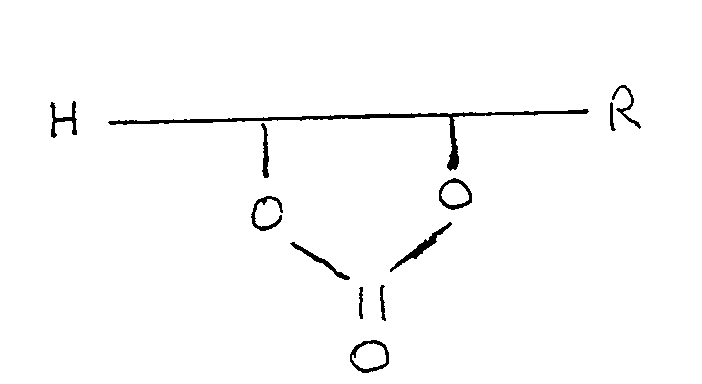
where R is hydrogen, CH₃, C₂H₅ or a hydrocarbon having 3 to 10 carbon atoms, and as catalyst, an adduct of a tertiary amine and a cyclic alkylene carbonate at a concentration to give 0.01 to 5.0 weight percent of tertiary amine based on the weight of the total composition.
where R is hydrogen, CH₃, C₂H₅ or a hydrocarbon having 3 to 10 carbon atoms, and as catalyst, an adduct of a tertiary amine and a cyclic alkylene carbonate at a concentration to give 0.01 to 5.0 weight percent of tertiary amine based on the weight of the total composition.
2. A method according to claim 1 wherein the cyclic alkylene carbonate is employed in
an amount of from 20 to 35 parts by weight.
3. A method according to claim 1 or claim 2 wherein the adduct is employed at a concentration
to give from 0.02 to 0.2 weight percent of tertiary amine, based on the weight of
the total composition.
4. A method according to any one of claims 1 to 3 wherein the organic di- or polyisocyanate
is diphenylmethane diisocyanate.
5. A method according to claim 4 wherein the diphenylmethane diisocyanate is carbodiimide
modified.
6. A method according to any one of claims 1 to 5 wherein the alkylene carbonate is selected
from propylene carbonate and ethylene carbonate.
7. A method according to any one of claims 1 to 6 wherein the adduct is a reaction complex
of triethylene diamine and propylene carbonate.
8. A method according to any one of claims 1 to 7 wherein the streams of the polyisocyanate
formulation are reaction injection molded into woven glass fiber mats.
1. Procédé pour la préparation d'une composition polymère thermodurcie de polyisocyanurate
rigide non cellulaire moulée par injecfion-réaction, qui comprend l'injection d'au
moins deux courants par l'intermédiaire d'une machine RIM dans la cavité d'un moule
ayant la configuration désirée pour réagir à des températures comprises entre la température
ambiante et 140°C, d'une formulation comprenant au moins un courant d'un di- ou d'un
polyisocyanate organique et dans un second courant, de 5 à 50 parties en poids pour
100 parties en poids de la composition d'isocyanate-carbonate, d'un carbonate d'alkylène
cyclique de formule générale :

dans laquelle R est un atome d'hydrogène, un groupe CH₃,C₂H₅ ou hydrocarboné ayant 3 à 10 atomes de carbone, et en tant que catalyseur, un produit d'addition d'une amine tertiaire et d'un carbonate d'alkylène cyclique à une concentration fournissant 0,01 à 5,0% en poids d'amine tertaire par rapport au poids de la composition totale.
dans laquelle R est un atome d'hydrogène, un groupe CH₃,C₂H₅ ou hydrocarboné ayant 3 à 10 atomes de carbone, et en tant que catalyseur, un produit d'addition d'une amine tertiaire et d'un carbonate d'alkylène cyclique à une concentration fournissant 0,01 à 5,0% en poids d'amine tertaire par rapport au poids de la composition totale.
2. Procédé suivant la revendication 1 dans lequel le carbonate d'alkylène cyclique est
employé en une quantité de 20 à 35 parties en poids.
3. Procédé suivant la revendication 1 ou la revendication 2, dans lequel le produit d'addition
est employé à une concentration fournissant de 0,02 à 0,2% en poids d'amine tertiaire
par rapport au poids de la composition totale.
4. Procédé suivant l'une quelconque des revendications 1 à 3, dans lequel le di- ou polyisocyanate
organique est le diphénylméthane diisocyanate.
5. Procédé suivant la revendication 4, dans lequel le diphénylméthane diisocyanate est
modifié par un carbodiimide.
6. Procédé suivant l'une quelconque des revendications 1 à 5, dans lequel le carbonate
d'alkylène est choisi parmi le carbonate de propylène et le carbonate d'éthylène.
7. Procédé suivant l'une quelconque des revendications 1 à 6, dans lequel le produit
d'addition est un complexe réactionnel de triéthylène diamine et de carbonate de propylène.
8. Procédé suivant l'une quelconque des revendications 1 à 7, dans lequel les courants
de la formulation de polyisocyanate sont moulés par réaction-injection dans des nappes
de fibres de verre tissées.
1. Verfahren zur Herstellung starrer, nicht-zelliger, mittels Reaktionsspritzgießen geformter,
wärmegehärteter Polyisocyanatpolymerzusammensetzung, bei dem man mindestens zwei Ströme
über eine RIM-Maschine in einen Formenhohlraum der gewünschten Konfiguration einspritzt,
um bei Temperaturen von Umgebungstemperatur bis 140 °C einen Ansatz umzusetzen, der
mindestens einen Strom von einem organischen Di- oder Polyisocyanat enthält und in
einem zweiten Strom 5 bis 50 Gewichtsteile pro 100 Gewichtsteile der lsocyanat-Carbonat-Zusammensetzung,
ein cyclisches Alkylencarbonat der allgemeinen Formel
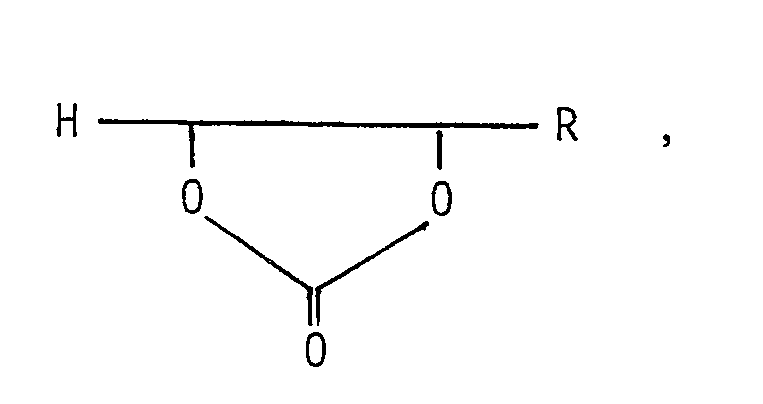
in der R Wasserstoff, CH₃, C₂H₅ oder ein Kohlenwasserstoff mit 3 bis 10 Kohlenstoffatomen ist, und als Katalysator ein Addukt von einem tertiären Amin und einem cyclischen Alkylencarbonat in einer Konzentration enthält, um 0,01 bis 5,0 Gewichtsprozent des tertiären Amins, bezogen auf das Gewicht der Gesamtzusammensetzung, zu ergeben.
in der R Wasserstoff, CH₃, C₂H₅ oder ein Kohlenwasserstoff mit 3 bis 10 Kohlenstoffatomen ist, und als Katalysator ein Addukt von einem tertiären Amin und einem cyclischen Alkylencarbonat in einer Konzentration enthält, um 0,01 bis 5,0 Gewichtsprozent des tertiären Amins, bezogen auf das Gewicht der Gesamtzusammensetzung, zu ergeben.
2. Verfahren nach Anspruch 1, bei dem das cyclische Alkylencarbonat in einer Menge von
20 bis 35 Gewichtsteile eingesetzt wird.
3. Verfahren nach Anspruch 1 oder 2, bei dem das Addukt in einer Konzentration verwendet
wird, um 0,02 bis 0,2 Gewichtsprozent tertiäres Amin, bezogen auf das Gewicht der
Gesamtzusammensetzung, zu ergeben.
4. Verfahren nach einem der Ansprüche 1 bis 3, bei dem das organische Di-oder Polyisocyanat
Diphenylmethandiisocyanat ist.
5. Verfahren nach Anspruch 4, bei dem das Diphenylmethandiisocyanat Carbodiimid-modifiziert
ist.
6. Verfahren nach einem der Ansprüche 1 bis 5, bei dem das Alkylencarbonat aus Propylencarbonat
und Ethylencarbonat ausgewählt ist.
7. Verfahren nach einem der Ansprüche 1 bis 6, bei dem das Addukt ein Reaktionskomplex
von Triethylendiamin und Propylencarbonat ist.
8. Verfahren nach einem der Ansprüche 1 bis 7, bei dem die Ströme des Polyisocyanatansatzes
in Glasfasermatten reaktionsspritzgegossen werden.