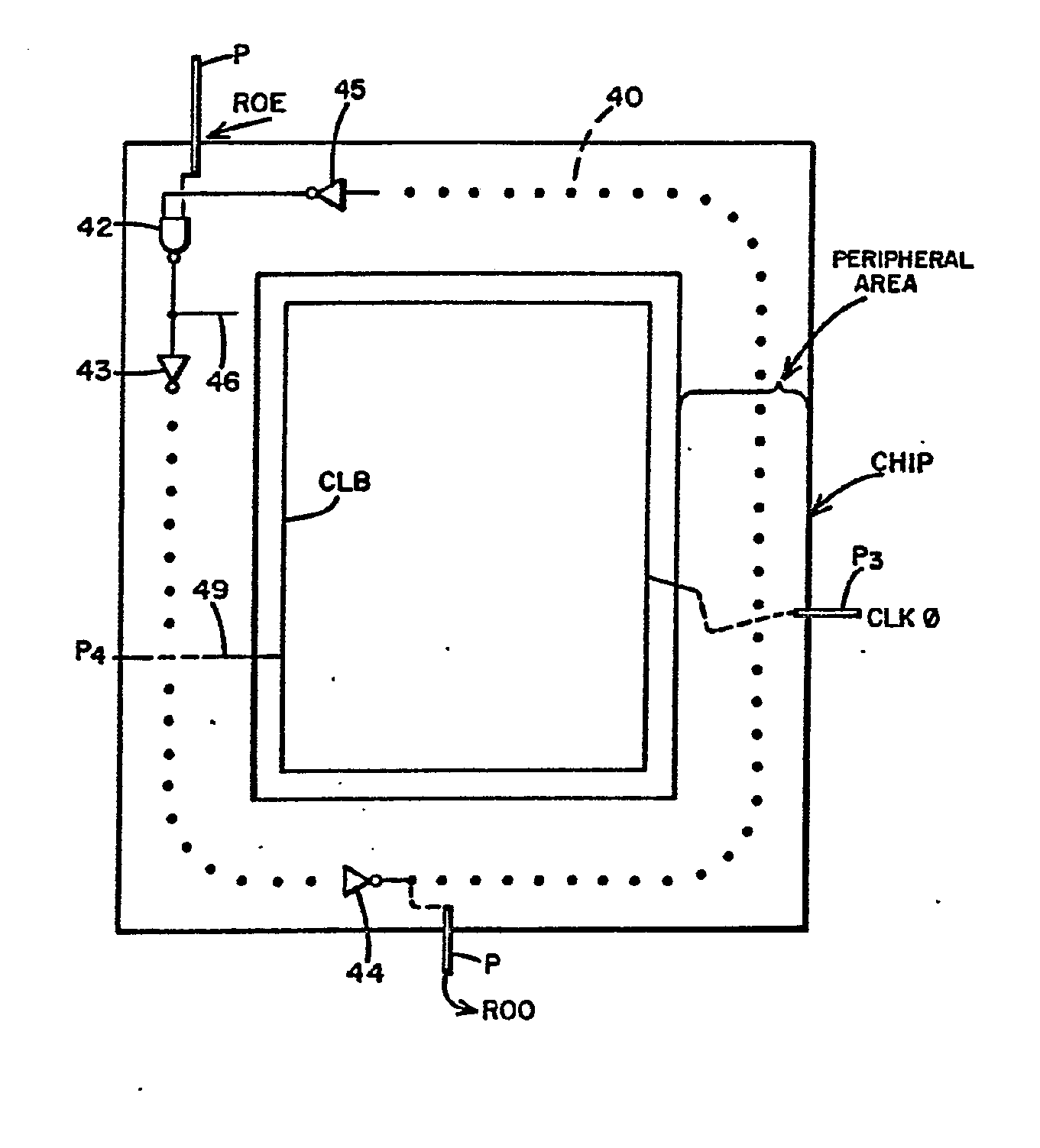
(57) A VLSI chip has a core logic area surrounded by a peripheral zone including a plurality
of 1/0 cells (10) through which nearly all signals between the pins and the core logic
(CLI, CLO) pass. Each cell has an input buffer (IB) and an output buffer (OB) through
which signals pass respectively from pin to core logic and vice versa, and a control
register controlling the operation of the I/O cells. Two shift registers, an input
register and an output register, are formed by flip-flops also included in the I/O
cells and connected to the buffers, core logic, and pins, and to test data in and
out registers and pins. Some of the I/O cells may be dummy cells forming part of the
input and/or output registers but not having pins. Timing circuitry (MS1, MS2; 52,
53) provides early signals (TST EARLY, TCE EARLY) to set up predetermined flip-flops
prior to their receiving clocked signals (TST COPY, TCE COPY), and for separating
a system clock input (CLKO) as a first clock signal (CLK1) to the control circuitry
and a second clock signal (CLK2) to the input and output registers to allow the control
register to operate without clocking the input or output registers.
|
|
