| (19) |
 |
|
(11) |
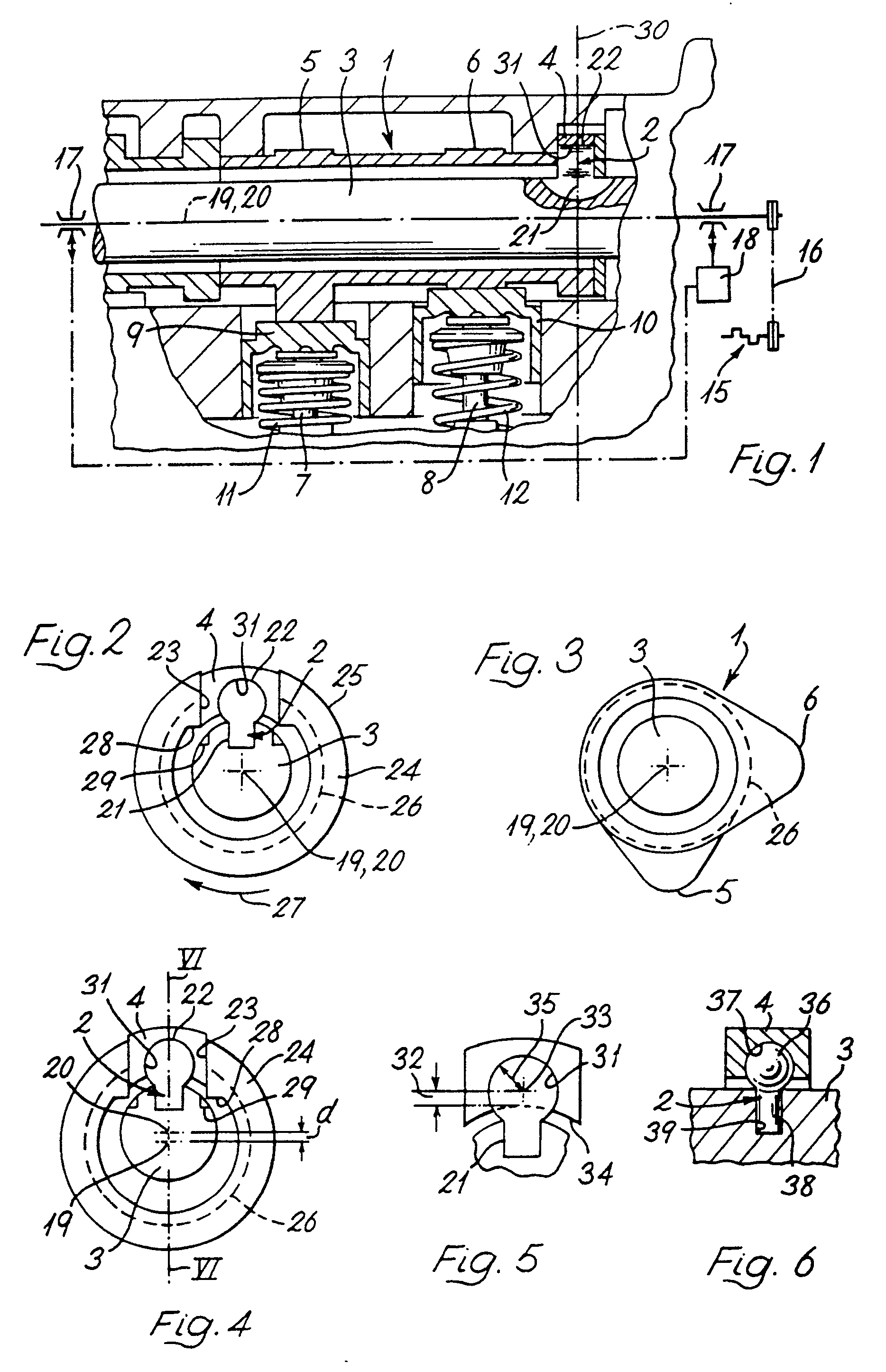
EP 0 313 624 B1 |
| (12) |
EUROPEAN PATENT SPECIFICATION |
| (45) |
Mention of the grant of the patent: |
|
19.06.1991 Bulletin 1991/25 |
| (22) |
Date of filing: 13.05.1988 |
|
| (86) |
International application number: |
|
PCT/GB8800/376 |
| (87) |
International publication number: |
|
WO 8808/919 (17.11.1988 Gazette 1988/25) |
|
| (54) |
IMPROVEMENTS IN OR RELATING TO DRIVING CONNECTIONS BETWEEN TWO ROTATABLE BODIES
ANTRIEBSVERBINDUNGEN ZWISCHEN ZWEI SICH DREHENDEN KÖRPERN
AMELIORATIONS APPORTEES A DES CONNEXIONS D'ENTRAîNEMENT ENTRE DEUX CORPS ROTATIFS
|
| (84) |
Designated Contracting States: |
|
DE FR GB IT |
| (30) |
Priority: |
14.05.1987 GB 8711366
|
| (43) |
Date of publication of application: |
|
03.05.1989 Bulletin 1989/18 |
| (73) |
Proprietor: NATIONAL RESEARCH DEVELOPMENT CORPORATION |
|
London SE1 6BU (GB) |
|
| (72) |
Inventor: |
|
- MITCHELL, Stephen, William
Bury
Lancashire BL8 2ER (GB)
|
| (74) |
Representative: Stables, Patrick Antony |
|
British Technology Group Ltd
101 Newington Causeway
GB-London SE1 6BU
GB-London SE1 6BU (GB) |
| (56) |
References cited: :
EP-A- 0 179 581
GB-A- 2 066 361
|
FR-A- 2 261 413
|
|
| |
|
|
- Automotive Engineering, vol.88,no.10,October 1980 (Dallas,Texas, US),D.Scott et al.:
"Eccentric cam drive varies valve timing", Pages 120-124, see page 122, lines 40-45;
figures
|
|
| |
|
| Note: Within nine months from the publication of the mention of the grant of the European
patent, any person may give notice to the European Patent Office of opposition to
the European patent
granted. Notice of opposition shall be filed in a written reasoned statement. It shall
not be deemed to
have been filed until the opposition fee has been paid. (Art. 99(1) European Patent
Convention).
|
[0001] This invention relates to driving connections between two rotatable bodies having
parallel but laterally-displacable axes of rotation, the first body being hollow and
the second body being located within it. The invention applies particularly to connections
in which the two bodies are both shafts, the first body being a hollow shaft and the
second body - which is probably solid and the driving member of the combination - being
located within it. The invention thus relates especially to mechanisms of the kind
described in UK Patent number GB 2066361 B and European specification EP-A-0179581
which operate the valves of internal combustion engines, which are capable of varying
the valve timing during operation to suit changes in operating conditions, and which
make use of concentric rotatable shafts. UK Patent number GB 2066361 B shows a four
cylinder in-line engine with the four inlet valves of the four cylinders offset relative
to the four exhaust valves. This valve arrangement leaves space between the camshaft
bearings of one cylinder and the corresponding bearings of the adjacent cylinder,
and this space is used for the variable angular velocity mechanism which drives the
short camshafts of both the cylinders. European specification EP-A-0179581 also describes
a valve operating mechanism in which a hollow camshaft is driven by a solid shaft
mounted within it, the axes of the two shafts remaining parallel at all times but
being displaceable radially relative to each other. Each shaft carries a radial arm,
the two arms being separated from each other in the axial direction, and one end of
an axially-aligned pin is fixed to one arm. The other end of the pin engages centrally
with a rectangular block which can slide up and down a radial slot formed in the second
arm to accomodate relative radial movement of the axes of the two shafts.
[0002] However, present compact engine designs are now increasingly using inlet and exhaust
valves which are in-line with the cylinder centres, both in engines with one inlet
and one exhaust valve per cylinder and in engines with two inlet and two exhaust valves
per cylinder. There is also a strong preference for the valve-operating cams to operate
directly onto bucket tappets instead of onto rockers or levers as in GB 2066361 B.
Such designs leave very little space to accommodate the variable angular velocity
mechanism. Similarly, the necessary axial gap (spanned by the pin) between the two
radial arms in EP-A-0179581 requires space that can ill be afforded in a compact engine.
[0003] The present invention arises from appreciating the possibility of components of different
geometry, making possible in turn a driving connection of greater axial compactness
but with no less capacity for timing variation. The invention is defined by the claims,
the disclosure of which is to be understood as included within the disclosure of this
specification, and the invention will now be described, by way of example, with reference
to the accompanying drawings in which:
Figure 1 is a section through part of an internal combustion engine, taken in a plane
including the axis of a camshaft;
Figure 2 is a section through that camshaft and its associated driving member, taken
in a plane at right angles to the camshaft axis, with the axes of the camshaft and
its driving shaft coincident;
Figure 3 is a similar view and shows the two cams carried by the camshaft;
Figure 4 is similar to Figure 2 but shows the maximum separation between the axes
of the camshaft and driving shaft;
Figure 5 is similar to part of Figure 2 but is on a larger scale and includes further
detail, and
Figure 6 shows a modified design, viewed as if it were a section on the line VI-VI
in Figure 4.
[0004] In the sectional views of Figures 2-5 the customary cross-hatching of certain of
the parts has been omitted, so as to avoid hiding lead lines and other detail. Figure
1 shows an internal combustion engine including a first body in the form of a short,
hollow camshaft 1, similar to those shown in UK Patent GB 2066361 B. Camshaft 1 carries
two cams 5 and 6 which actuate two valves 7 and 8 by means of bucket tappets 9 and
10, and which are returned by means of valve springs 11 and 12 respectively.
[0005] Within the hollow camshaft 1 runs a second body in the form of a solid driving shaft
3. As is schematically shown, this shaft is driven from the engine crankshaft 15 by
a chain or like connection 16. It is also supported by bearings 17 which are movable
in synchronism whereby to displace the movable axis 20 of shaft 3 relative to the
fixed axis 19 of camshaft 1, without ever causing these two axes to fall out-of-parallel
with each other. As will be explained, mechanism 18 to effect the displacement is
responsive to engine speed, and operates in a manner which is known per se (as described,
for instance, in UK Patent number GB 2066361 B) so as to vary the timing of valves
7 and 8 by causing camshaft 1 to rotate with a variable pattern of fluctuating velocity
within each revolution, in response to the drive transmitted to it from shaft 3 which
rotates at a substantially uniform angular velocity within each revolution.
[0006] A driving member 2 is in the form of a substantially radial arm, the inner end of
which is connected to shaft 3 by a Woodruff-type connection 21. The outer end 22 of
member 2 has a part-cylindrical shape and thus a part-circular outline which engages
rotatably in a corresponding recess in the form of a cavity 31 formed in a block 4
which is mounted to slide in a radial slot 23 formed in a flange 24 mounted on camshaft
1. The inner radius of most of flange 24 is equal to that of the rest of camshaft
1, while the radius of the outer rim 25 of the flange is considerably greater than
the radius of the outer surface 26 of the rest of camshaft 1.
[0007] If driving shaft 3 is rotating at uniform angular velocity, and the axes 19 and 20
of camshaft 1 and shaft 3 are coincident as shown in Figure 2, then camshaft 1 will
also rotate at the same uniform angular velocity. However if mechanism 18 has operated
to displace axis 20 so that it now lies a distance d from axis 19, as shown in Figure
4, the engagement between the outer end 22 of member 2 and the corresponding cavity
31 in block 4 causes that block, at the illustrated moment in a revolution of the
camshaft 1, to lie at a radially more-outward position than it did in Figure 2. It
will be apparent to the man in the art that if shaft 3 and camshaft 1 now together
execute one revolution while their respective axes 20 and 19 maintain the positions
shown in Figure 4, in the course of that revolution block 4 will move radially inwards
relative to camshaft 1 until it lies 180 degrees from where it is shown in the Figure,
and will then move radially outwards again for the remaining 180 degrees of the revolution.
The position shown in Figure 2, in which axes 19 and 20 coincide, represents one extreme
of the relative displacement of which those axes are capable, and represents the extreme
position that mechanism 18 will typically cause them to adopt when engine speed is
high and efficient operation calls for camshaft 1 to rotate in synchronism with its
driving shaft 3. Figure 4 shows the opposite condition in which there is maximum displacement
between axes 19 and 20. In this condition, which typically will give optimum valve
timing when engine speed is very low, the rotary motions of camshaft 1 and driving
shaft 3 are as different as possible. If shaft 3 is rotating at uniform speed in the
direction of arrow 27 then camshaft 1 will be driven at a fluctuating angular velocity
having a minimum value when the camshaft is in the position shown, this minimum rising
steadily to a maximum value 180 degrees later and then falling back to the minimum
at 360 degrees.
[0008] Two features illustrated by the drawings should be specially noted. Firstly, as shown
best by the combination of Figures 1 and 2, that the arm 2, the block 4 and the slideway
23 all coincide with a common plane 30 lying at right angles to axes 19, 20. This
obviously promotes axial compactness and contrasts particularly with designs like
that shown in European specification EP-A-0179581 where there must be axial separation
between the equivalents of our arm 2 and slideway 23. Secondly, as shown in Figure
5, the outline of the cylindrical cavity 31 in block 4 is only part-circular. The
radial distance 32 separating the centre of curvature 33 of the arm end 22 from the
radially-inner edge 34 of the block is substantially less than the radius 35 of the
curvature. The angle subtended at 33 by the curved wall of cavity 31 exceeds 180°
so as to hold end 22 captive, but is well short of 360°. The advantage of such a geometry,
compared for instance with that of EP-A-0179581 where one end of the pin fits rotatably
within a complete hole formed in the comparable block, is to shorten the effective
radius of block 4 about axis 19 and thus make the mechanism more compact radially
as well as axially.
[0009] Another part-circular shape such as a part-spherical shape could be substituted for
the end 22 of member 2 and the corresponding recess in block 4, instead of the part-cylindrical
shape shown in Figures 1, 2, 4 and 5. Figure 6 shows such a substitution, with a part-spherical
end 36 of arm 2 making a rotary joint within a similar cavity 37 in block 4, in place
of the part-cylindrical equivalents of previous Figures. The advantages of this form
of connection between shaft 3 and camshaft 1 include axial compactness, allowing the
end 36 and its corresponding cavity 37 to engage over a relatively large area within
a short axial length, and also the avoidance of circumferential twist upon the connection
between the two shafts, and so of any resultant axial component in the reaction set
up between them in use.
[0010] As Figure 2 shows, the inner radius of flange 24 is deepened by shoulders 28 adjacent
to the walls of slideway 23, to improve the guidance and support of block 4 when it
is in its radially-innermost position, that is to say 180° from the position shown
in Figure 4. Conversely shaft 3 is machined as at 29 to ensure clearance between the
shaft and the shoulders 28 when the shaft is in its fully eccentric position, that
is to say when shaft and camshaft are displaced by distance d as in Figure 4.
[0011] Alternatives to the Woodruff-type connection between member 2 and shaft 3 are of
course possible. For instance, a cylindrical spigot 38 formed on the innermost end
of the member could fit tightly within a corresponding cylindrical cavity 39 formed
in the shaft 3, as shown in Figure 6.
[0012] In Figure 1 the illustrated valves 7 and 8, both operated by camshaft 1, are an inlet
and an exhaust valve, but the invention could of course be used on a thin camshaft
engine where a single camshaft hill operate one or more valves all of the same kind.
1. A driving connection between rotatable first and second bodies (1, 3) having parallel
but laterally-displacable axes of rotation (19, 20), the first body being hollow and
the second body being located within it, in which one of the bodies (3) is joined
to the inner end (21) of a radial arm (2), in which a radial slideway (23) is formed
on one of the bodies (1), in which a block (4) is mounted to slide within that slideway,
and in which there is a rotary joint between the block and the outer end (22, 36)
of the radial arm, characterised in that a common plane (30, Fig. 1) lying at right angles to the two axes of rotation (19,
20) coincides with the block (4), the radial slideway (23), and both the inner (21)
and the outer (22, 36) ends of the radial arm.
2. A driving connection according to Claim 1, characterised in that the radial arm (2) is carried by the second body (3) and the radial slideway (23)
is formed on the first body (1).
3. A driving connection according to Claim 2 characterised in that each body is a shaft, the second shaft (3) being the driving member of the connection
and the first shaft (1) the driven member.
4. A driving connection according to Claim 3 characterised in that the outer end (22, 36) of the arm (2) is of part-circular outline when viewed parallel
to the shaft axes, in that a cavity (31, 37) of part-circular outline when similarly viewed is formed in the
block, and in that the rotary joint is between the cavity and the outer end of the radial arm.
5. A driving connection according to Claim 4, characterised in that the radial distance (32) separating the centre of curvature (33) of the cavity (31)
from the radially-innermost edge (34) of the block is less than the radius of curvature
(35) of the cavity.
6. A driving connection according to Claim 4 characterised in that the corresponding shapes of the outer end (36) of the arm and of the cavity (37)
are part-spherical.
7. A driving connection according to Claim 4 characterised in that the corresponding shapes of the outer end (22) of the arm and of the cavity (31)
are part-cylindrical.
8. A driving connection according to Claim 3 characterised in that the first shaft (1) includes a flanged part (24) and the slideway (23) is formed
within this part.
9. A driving connection according to Claim 8 characterised in that the minimum and maximum radii of the flanged part (24) are respectively substantially
the same as, and substantially greater than, the corresponding radii of the rest of
the first shaft (1).
10. A driving connection according to Claim 3 characterised in that the means of connection between the arm (2) and the second shaft (3) comprises the
engagement between a cylindrical spigot (38, Figure 6), carried by the arm, and a
corresponding cylindrical recess (39) formed in the shaft.
11. A driving connection according to Claim 3 characterised in that the means of connection between the arm (2) and the second shaft (3) comprises the
engagement between a Woodruff-type key (21), carried by the arm, and a corresponding
recess formed in the shaft.
12. An internal combustion engine including first and second rotatable bodies (1,
3) and a driving connection according to Claim 1 between them, characterised in that the first body (1) is a hollow camshaft and the second body (3) drives that camshaft.
13. An internal combustion engine according to Claim 12 including valves (7, 8) associated
with tappets (9) of bucket or like type that are directly operated by cams (5, 6)
carried by the camshaft (1).
1. Liaison d'entraînement entre un premier corps (1) et un deuxième corps (3) tournant
autour d'axes de rotation (19, 20) parallèles mais pouvant être déplacés latéralement,
le premier corps étant creux et le deuxième corps étant disposé à l'intérieur du premier
corps, l'un des corps (3) étant relié à l'extrémité intérieure (21) d'un bras radial
(2), une glissière radiale (23) étant formée sur l'un des corps (1), un bloc (4) étant
monté pour coulisser à l'intérieur de cette glissière, et un joint tournant étant
prévu entre le bloc et l'extrémité extérieure (22; 36) du bras radial, caractérisée
en ce qu'un plan commun (30, figure 1), perpendiculaire aux deux axes de rotation
(19, 20), coïncide avec le bloc (4), la glissière radiale (23) et les deux extrémités,
intérieure (21) et extérieure (22; 36) du bras radial.
2. Liaison d'entraînement selon la revendication 1, caractérisée en ce que le bras
radial (2) est porté par le deuxième corps (3) et que la glissière radiale (23) est
formée sur le premier corps (1).
3. Liaison d'entraînement selon la revendication 2, caractérisée en ce que chaque
corps est un arbre, le deuxième arbre (3) étant l'élément d'entraînement de la liaison
et le premier arbre (1) étant l'élément entraîné.
4. Liaison d'entraînement selon la revendication 3, caractérisée en ce que l'extrémité
extérieure (22; 36) du bras (2) a un contour partiellement circulaire lorsqu'on le
regarde parallèlement aux axes des arbres, en ce qu'une cavité (31; 37) de contour
partiellement circulaire lorsqu'on la regarde dans la même direction est formée dans
le bloc et en ce que le joint tournant est prévu entre la cavité et l'extrémité extérieure
du bras radial.
5. Liaison d'entraînement selon la revendication 4, caractérisée en ce que la distance
radiale (32) séparant le centre de courbure (33) de la cavité (31) du bord radialement
intérieur (34) du bloc est inférieure au rayon de courbure (35) de la cavité.
6. Liaison d'entraînement selon la revendication 4, caractérisée en ce que les formes
correspondantes de l'extrémité extérieure (36) du bras et de la cavité (37) sont partiellement
sphériques.
7. Liaison d'entraînement selon la revendication 4, caractérisée en ce que les formes
correspondantes de l'extrémité extérieure (22) du bras et de la cavité (31) sont partiellement
cylindriques.
8. Liaison d'entraînement selon la revendication 3, caractérisée en ce que le premier
arbre (1) comporte une collerette (24) et que la glissière (23) est formée à l'intérieur
de cette collerette.
9. Liaison d'entraînement selon la revendication 8, caractérisée en ce que les rayons
minimal et maximal de la collerette (24) sont respectivement pratiquement le même
et pratiquement plus grand que les rayons correspondants du reste du premier arbre
(1).
10. Liaison d'entraînement selon la revendication 3, caractérisée en ce que les moyens
de liaison entre le bras (2) et le deuxième arbre (3) sont constitués par la coopération
entre une queue cylindrique (38, figure 6), portée par le bras, et une cavité cylindrique
correspondante (39) formée dans l'arbre.
11. Liaison d'entraînement selon la revendication 3, caractérisée en ce que les moyens
de liaison entre le bras (2) et le deuxième arbre (3) comportent la coopération entre
une clavette de type Woodruff (21), portée par le bras, et un évidement correspondant
formé dans l'arbre.
12. Moteur à combustion interne comportant un premier corps rotatif (1) et un deuxième
corps rotatif (3) et une liaison d'entraînement selon la revendication 1 entre eux,
caractérisé en ce que le premier corps (1) est un arbre à cames creux et que le deuxième
corps (3) entraîne cet arbre à cames.
13. Moteur à combustion interne selon la revendication 12, comportant des soupapes
(7, 8) associées à des poussoirs de soupape (9) du type cuvette ou analogue qui sont
directement actionnés par des cames (5, 6) portées par l'arbre à cames (1).
1. Antriebsverbindung zwischen einem ersten und einem zweiten drehbaren Körper (1,
3) mit parallelen, aber seitlich versetzbaren Rotationsachsen (19, 20), wobei der
erste Körper hohl und der zweite Körper innerhalb des ersten angeordnet ist, wobei
weiter einer der Körper (3) mit dem inneren Ende (21) eines Radialarms (2) verbunden,
ferner an einem der Körper (1) eine radiale Gleitführung (23) gebildet, darin ein
Gleitstein (4) verschiebbar getührt ist, und eine Drehverbindung zwischen dem Gleitstein
und dem äußeren Ende (22, 36) des Radialarms vorgesehen ist, dadurch gekennzeichnet,
daß eine gemeinsame, senkrecht zu den beiden Rotationsachsen (19, 20) verlaufende
Ebene (30, Fig. 1) mit den Gleitstein (4), die radiale Gleitführung (23) und sowohl
das innere (21) als auch daß äußere (22, 36) Ende des Radialarms enthält.
2. Antriebsverbindung nach Anspruch 1, dadurch gekennzeichnet, daß der Radialarm (2)
vom zweiten Körper getragen und die radiale Gleitführung (23) am ersten Körper (1)
gebildet ist.
3. Antriebsverbindung nach Anspruch 2, dadurch gekennzeichnet, daß jeder Körper eine
Welle ist, wobei die zweite Welle (3) das treibende Teil der Verbindung und die erste
Welle (1) das getriebene Teil ist.
4. Antriebsverbindung nach Anspruch 3, dadurch gekennzeichnet, daß das äußere Ende
(22, 36) des Arms (2) bei Betrachtung parallel zu den Wellenachsen eine teils kreistörmige
Außenform aufweist, daß im Gleitstein ein Hohlraum (31, 37) mit bei gleicher Betrachtungsweise
teils kreisförmiger Außenform gebildet ist und daß die Drehverbindung zwischen dem
Hohlraum und dem äußeren Ende des Radialarms ist.
5. Antriebsverbindung nach Anspruch 4, dadurch gekennzeichnet, daß der radiale Abstand
(32) zwischen dem Krümmungsmittelpunkt (33) des Hohlraums (31) und der radial am innersten
liegenden Kante (34) des Gleitstein kleiner als der Krümmungsradius (35) des Hohlraums
ist.
6. Antriebsverbindung nach Anspruch 4, dadurch gekennzeichnet, daß entsprechende Formen
des äußeren Endes (36) des Arms und des Hohlraums (37) teils kugelförmig sind.
7. Antriebsverbindung nach Anspruch 4, dadurch gekennzeichnet, daß entsprechende Formen
des äußeren Endes (22) des Arms und des Hohlraums (31) teils zylindrisch sind.
8. Antriebsverbindung nach Anspruch 3, dadurch gekennzeichnet, daß die erste Welle
(1) einen mit einem Flansch versehenen Bereich (24) aufweist, und daß die Gleitführung
(23) in diesem Bereich gebildet ist.
9. Antriebsverbindung nach Anspruch 8, dadurch gekennzeichnet, daß der minimale bzw.
maximale Radius des mit einem Flansch versehenen Bereichs (24) etwa gleichgroß bzw.
etwas größer ist als die entsprechenden Radien der übrigen ersten Welle (1).
10. Antriebsverbindung nach Anspruch 3, dadurch gekennzeichnet, daß die Verbindungs
zwischen dem Arm (2) und der zweiten Welle (3) den Eingriff zwischen einem vom Arm
getragenen zylindrischen Zapfen (38, Figur 6) und einer an der Welle gebildeten entsprechenden
zylindrischen Vertiefung (39) aufweist.
11. Antriebsverbindung nach Anspruch 3, dadurch gekennzeichnet, daß die Verbindungs
zwischen dem Arm (2) und der zweiten Welle (3) durch Fingriff eines am Arm angeordneten
Woodruff-Keils mit einer in der Welle gebildeten entsprechenden Vertiefung gebildet
ist.
12. Verbrennungsmotor mit erstem und zweitem drehbaren Körper (1, 3) und einer dazwischenliegenden
Antriebsverbindung nach Anspruch 1, dadurch gekennzeichnet, daß der erste Körper (1)
eine hohle Nockenwelle ist und der zweite Körper (3) die Nockenwelle antreibt.
13. Verbrennungsmotor nach Anspruch 12 mit Ventilen (7, 8), welchen Ventilstößel in
Tassenform oder anderen Typs zugeordnet sind, welche direkt von den von der Nockenwelle
(1) getragenen Nocken (5, 6) betätigt werden.